

Over the years, DC Comics (mostly while still operating under the name National) would occasionally buy out the rights to characters and titles from other publishers who had either gone out of business or were about to. This is how the original Captain Marvel and his family, Plastic Man, G.I. COMBAT, YOUNG ROMANCE, the Blackhawks and the Blue Beetle came to live among the other denizens of the DC multiverse. But they weren’t the only outfit to do this–the only major difference is that they went through the effort and the legality of doing so up front. Marvel, on the other hand, has a history of “adopting” characters the rights to whom had fallen in some way into the public domain. Daredevil, in fact, had been created when publisher Martin Goodman discovered that the name was legally up for grabs–and he gave Stan Lee and his collaborators the option of creating something new or just picking up the 1940s version. Here, then, are five characters Marvel adopted from elsewhere.
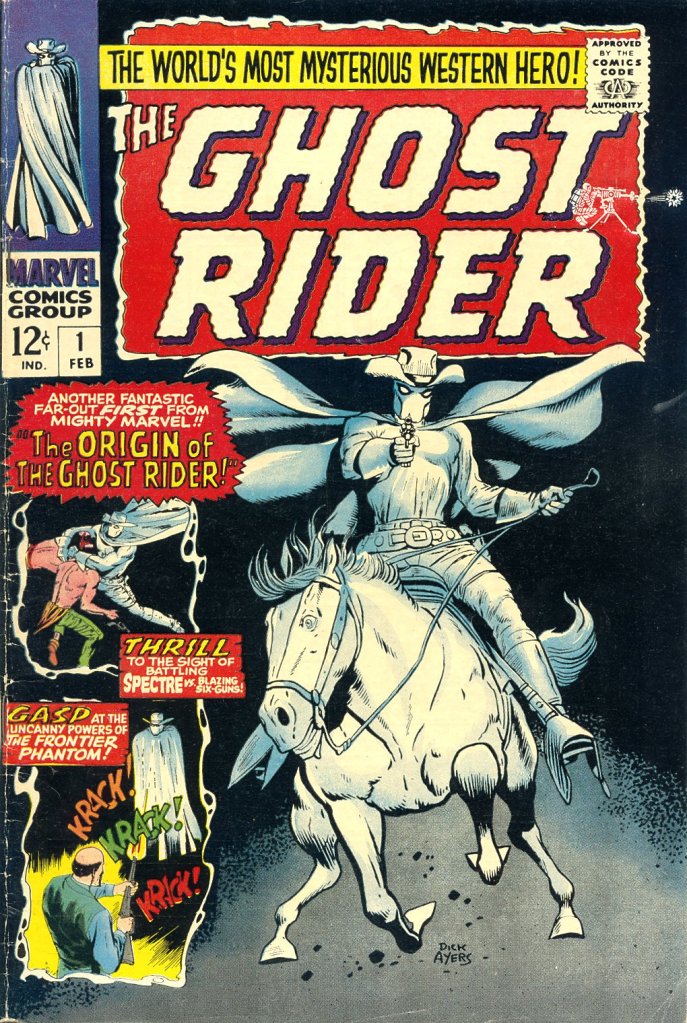

GHOST RIDER, THE GHOST RIDER #1 – The first straight up case of what we’re talking about here, Marvel’s Ghost Rider debuted in 1967 in the pages of his own self-titled comic book series. The artist, Dick Ayers, had worked on the original Ghost Rider feature back in the 1940s and 1950s–when the concept had been originated to save a flagging series called Rex Fury. Ayers had always loved the character and, looking for work, he suggested that perhaps Marvel could revive it–Ayers was imagining that the western Ghost Rider could be revealed to have been an ancestor of SHIELD topkick Nick Fury. Ayers also imagined that Marvel would pay for the rights, but a copyright search indicated that the character was clear and available, so Marvel just went ahead with their own version. In order to better protect their incarnation, Rex Fury was tossed aside and the Ghost Rider instead became Carter Slade. But his shtick of using an all-white costume and some tricks of misdirection and stage magic to make lawbreakers believe that he was an actual spirit remained the same. Eventually, the original publisher apparently showed up claiming that they still held rights to the character, and some money changed hands. The western Ghost Rider was never a huge hit for Marvel, but his acquisition cleared the way for the introduction of the skull-headed motorcycle-riding modern day version who would be way more successful. Like that incarnation, it was Roy Thomas and Gary Friedrich who wrote the first Marvel western Ghost Rider story.


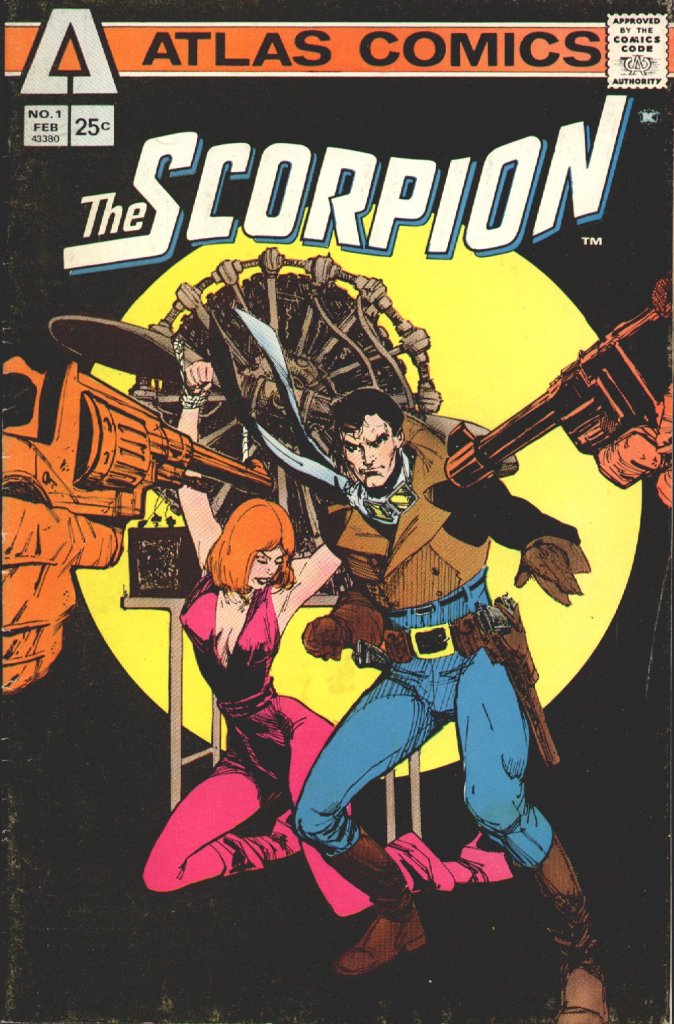
DOMINIC FORTUNE, MARVEL PREVIEW #2 – The short-lived Atlas Comics line of 1974 represents a real missed opportunity. It was set up by former Marvel publisher Martin Goodman in an attempt to get back at Marvel and Stan Lee after his son Chip Goodman was ousted from the company in Lee’s favor. In the industry, it was often called “Vengeance, Inc.”, and for a brief moment, it represented a third major publisher of mainstream action-adventure comic books. In order to get established talent to cross party lines and work for Atlas, Goodman offered higher page rates, the return of original artwork, and some degree of ownership of the characters created. That last point is slightly shady, as not much about that aspect was ever well papered. One of the true standouts of Atlas’ short-lived line was Howard Chaykin’s series The Scorpion, concerning a pulpish adventurer in the 1930s. It wasn’t what Goodman was looking for, and so by its third issue Chaykin was gone and other hands killed off the Scorpion, shifting the action to the present day and replacing him with a similarly-named super hero concept. But Chaykin still had an interest in doing pulp adventure tales with a roguish lead, and so he pretty much brought the entire Scorpion concept over to Marvel, where it debuted in the back pages of MARVEL PREVIEW Black and White Magazine #2 as Dominic Fortune. The character, the milieu and even the costume was virtually identical, only the name had been changed. Dominic Fortune has been a recurring player throughout the Marvel Universe ever since. Len Wein scripted the first Dominic Fortune story.


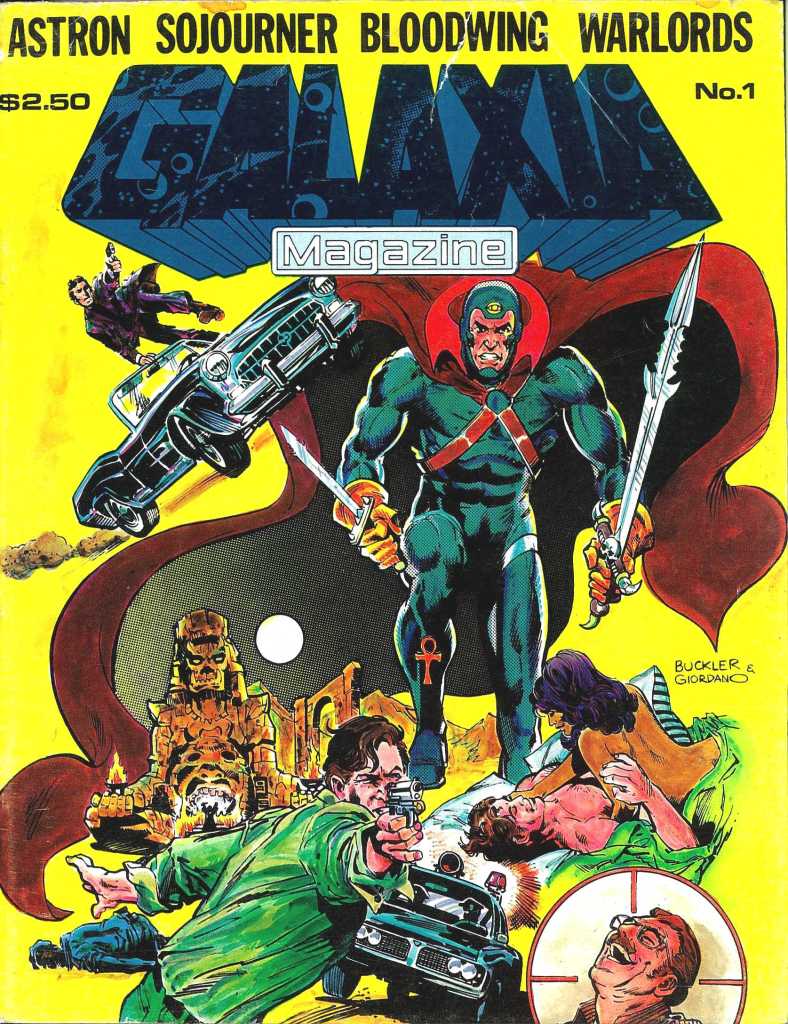
DEVIL-SLAYER, MARVEL SPOTLIGHT #33 – Chaykin wasn’t the only one to repossess his intellectual property after Atlas Comics folded–especially given that it apparently did so owing several of its creators back wages. As one of the outfit’s last releases, Atlas had put out the first and only issue of DEMON HUNTER, a new super heroish adventure series in which the lead character battled sinister demonic forces attempting to bring about Xenogenesis, the rebirth of demons on Earth. Creator and artist Rich Buckler was also doing regular work at Marvel during this period–and in the final installment of his character Deathlok, he decided to introduce a thinly repainted incarnation of his creation as Devil-Slayer. This final Deathlok story wound up seeing print not in the character’s regular title of ASTONISHING TALES, but rather in the final issue of MARVEL SPOTLIGHT, which would seem to indicate that it was an orphaned story that was being burned off since it had been paid for. As with the Scorpion and Dominic Fortune, Devil-Slayer looked almost exactly like Demon Hunter with only a slight change of colors. And like Dominic Fortune, Devil-Slayer would turn up throughout the Marvel line for many years, principally in DEFENDERS, where the Xenogenesis storyline was eventually wrapped up. David A. Kraft scripted both DEMON HUNTER and the first appearance of Devil-Slayer in the Deathlok series. Perhaps unhappy with how his character had been tossed aside twice, Buckler didn’t let Marvel’s claim to Devil-Slayer stop him from introducing yet another version of the same character in his later 1982 black and white magazine GALAXIA. There, the character was called Bloodwing, but the storyline picked up almost exactly where DEMON HUNTER had left off six or seven years before. Unfortunately, GALAXIA didn’t make it to a second issue, so Bloodwing couldn’t take off.
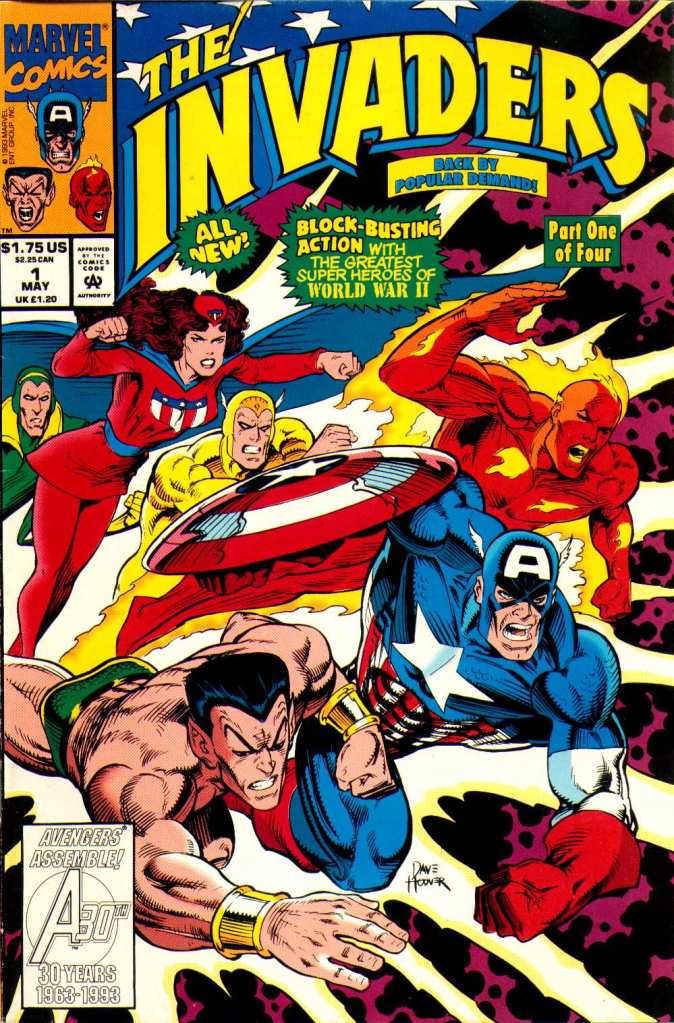

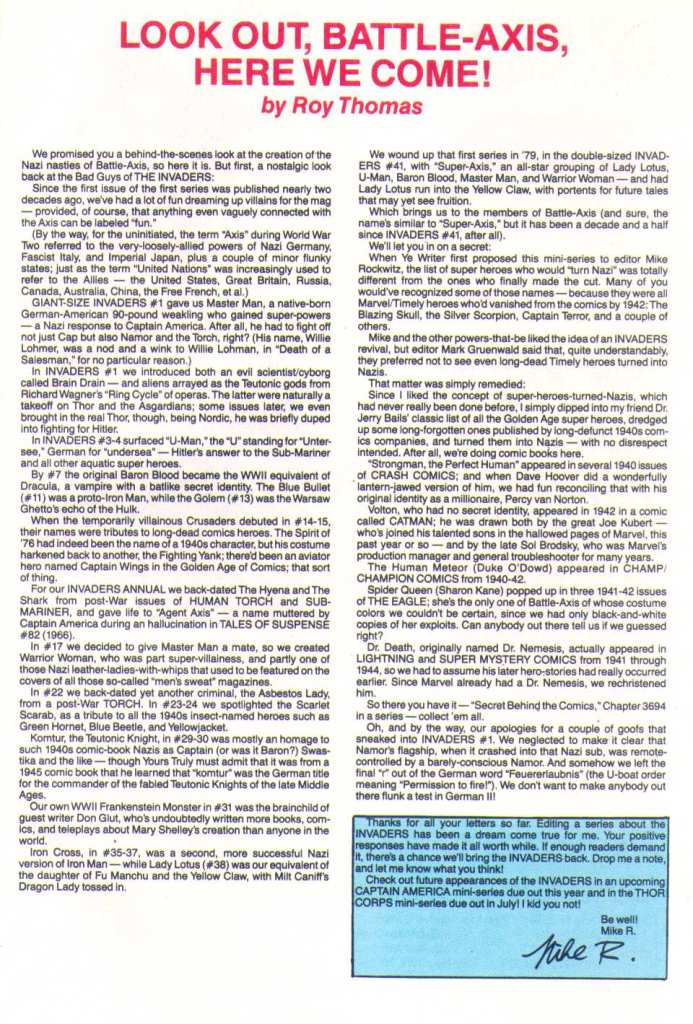
BATTLE-AXIS, THE INVADERS #1 – This is one that’s always rankled me a little bit, to be honest. INVADERS had been a pet project for writer/creator Roy Thomas in the 1970s, a chance to tell new stories of the beloved super heroes of his own childhood in new stories set against the backdrop of World War II. It ran its course before the 70s did–but by the early 1990s, just about everything Marvel was releasing was exploding in the Direct Market, and so the time was right to stage a revival. And Roy had what he thought was a killer idea for his first story: he intended to put together a counter-group of costumed characters to oppose the Invaders, also comprised of genuine 1940s characters, but ones whose allegiance, it would turn out, was to the Nazi regime. Mark Gruenwald apparently stepped in at this point to suggest that maybe making characters such as the Silver Scorpion and the Blazing Skull into card-carrying Nazis wasn’t such a hot idea. This didn’t dissuade Roy, though–and so, rather than using heroes that had originated at Timely Comics in the 1940s, he instead grabbed up a quartet of heroes published by other defunct firms for his Battle-Axis group. The team included Strong Man, The Human Meteor, Spider Queen, Dr. Death (formerly Dr. Nemesis) and Volton, all legitimate golden age creations. Roy wrote a text piece in the final issue of the INVADERS limited series detailing how it had come about–and hand-waving any concerns about making these long-ago creations into Nazis as not being disrespectful. But I can’t help but wonder how the originators of those throwaway characters in the 1940s would have felt to see their ideas and concepts used in such a matter. Doesn’t sit well with me, though your mileage may vary. And one of those characters, Dr. Nemesis (with his name restored to the original) went on to be a regular player in the various X-MEN titles by the early 2000s, his connection to the original Human Torch, established in this storyline, a plot point that was emphasized. Dave Hoover supplied the artwork for the limited series.


THE PRINCE OF ORPHANS, IMMORTAL IRON FIST #8 – Now this one is actually quite fun. When they originally conceived the martial arts hero Iron Fist, Roy Thomas and Gil Kane based his origin story heavily on (what else?) a golden age character called Amazing Man. Amazing Man had been the creation of writer/artist Bill Everett and his early stories were quite formative to Kane. Shift events ahead three decades to where Ed Brubaker Matt Fraction and David Aja have launched THE IMMORTAL IRON FIST, a new and well-received incarnation of the character. One of the things they do in the course of the series is to reveal that K’un-Lun, the mystical Brigadoon where Iron Fist was trained in the martial arts, was only one of seven similar mystical cities, each of which had its own champion. In this second arc, Brubaker, Fraction and Aja brought the champions of the Seven Cities of Heaven together for a tournament–one of whom is the secretive Prince of Orphans. It turns out that the Prince is really John Aman, Amazing Man (though the latter name is never stated out loud) and he becomes a recurring figure in the title. His history is even maintained, though only referenced obliquely–it’s said he went out into the world in the 1930s and 1940s and fought evil. Closer to home, he was an ally of Danny Rand’s predecessor Orson Randall, the Iron Fist of the 1930s pulp era. Brubaker, Fraction and Aja. He was also somewhat combined with his golden age nemesis the Great Question–so as the Prince of Orphans, John Aman possessed the ability to turn himself into green mist and often wore an all-concealing hooded robe like his old foe had done. In effect, the creative team revealed that Amazing Man had been the defacto Golden Age Iron Fist, and wove him and his history into the character’s continuity with aplomb. Roy Allan Martinez drew the majority of his first appearance in issue #8, though Aja was no doubt responsible for the overall look of the character in his modern incarnation.
 The Tom Brevoort Experience
Interesting that you brought this up. While I liked both Marvel and DC as a kid, I liked Marvel better. But one thing DC did that I hoped that Marvel would do was buy the rights to characters from defunct publishers. I really loved seeing those characters join the DC Universe. It was kind of the first intercompany crossovers only the characters came to the DC Universe to stay. I was hoping we’d eventually see the THUNDER Agents, the Atlas-Seaboard characters turn up at Marvel. The ironic part is, the one time Marvel did buy the rights to a line of characters — the Malibu superheroes — they won’t use them anymore for legal reasons and they’ll probably never be seen again.
LikeLiked by 1 person
Re: the Battle-Axis
I agree that taking original World War II heroes and turning them into Nazis is extremely distasteful. Just as bad was the in-story rationale Roy gave for some of the characters: Human Meteor’s excuse was basically, “I’m Irish, and I hate the British, so I became a Nazi.” Spider Queen is the worst: “I hate the Soviets BECAUSE THEY MURDERED MY HUSBAND, so obviously I’m a Nazi. Because really, isn’t ANYONE who hates the Soviet Union a Nazi?” (According to Roy Thomas’ entire comics career, the answer is “yes.” See also: the “Cold Warrior” in Roy’s 3-D Man stories, the Legion of the Unliving characters late in Roy’s West Coast Avengers run, et cetera.)
Oh well. At least Roy wasn’t as bad as Alan Moore, who complains about others appropriating his characters, while he uses Alice in Wonderland, Dorothy of Oz, and Peter Pan’s Wendy in a porno novel…
LikeLiked by 2 people
Moore’s body of work is largely thinly veiled takes on existing characters or public domain characters. Yes, he mostly does well written and innovative stories with them but the starting point is someone else’s work.
LikeLike
Sounds similar to most superhero comics. I’d say his “Watchmen” characters were more independent from their Charlton inspirations than, say, the Squadron Supreme cast were from the Justice League. I also think Watchmen were deeper characters than the Squadron were shown to be.
LikeLike
Re: Ghost Rider
I’d never heard that someone from M.E. approached Marvel over their initial use of the Ghost Rider.Tom, if you know the details I’d love to hear about what transpired. In addition to the Ghost Rider, Marvel had also used Iron Mask as a villain for Kid Colt. There may have been a couple other M.E. creations that showed up as well.
Finally, one of my favorite “ lost” work stories involves at least two Ghost Rider stories that were prepared by Dick Ayers for M.E., but never saw the light of day. While they’re probably gone forever, I keep hoping they some day they will turn up.
LikeLike
Looking at a Chaykin gallery in an Overstreet guide I noticed how much he loves those tunics. American Flagg has another notable example.
LikeLike
can anyone tell me who owns the copyright to “Bloodwing” ?
LikeLike
can anyone tell me who owns the copyright to Bloodwing ??
LikeLike
BATTLE AXIS ( Strong Man, Spider Queen, Human Meteor, Volton & Doctor Nemesis ): I too hated Roy turning them into Nazis and felt it was disrespectful to their creators. To me they seemed to be under the effects of a Hate-Ray ( Did their previous golden age stories by rival companies suggest they could be this bloodthirsty? ) [ Mystic Comics#4 ( August 1940 ) Blue Blaze story – The Trustees of Hate ( Doctor Vortex, Weasel, Lara & many unnamed ) — used a Hate Ray to goad two neighbouring countries to war ( Perhaps the Nazis either bought or stole this Hate Ray or independently created their own Hate Ray ) ] — especially since Spider Queen’s costume is seen along other golden age heroes in Captain America#442 ( august 1995 ). Sub-Mariner foe The Spider ( Tom Hendricks – inventor created spider suits that fired webs ) [ Sub-Mariner Comics#20 ( May 1946 ) – Lolita Dale ( estranged wife ( villain ) model who lost her beauty due to some unknow illness — so much for my suggestion that she was the Avengers 1959 Spider Queen ) & Hogy ( henchman ) ]– me telling you in case you didn’t know that a Timely Comics character created artificial webs before Peter Parker. PRINCE OF ORPHANS ( John Aman/AMAZING MAN/GREEN MIST ): MARVEL COMICS#1 ( October 1939 ) already showed a CENTAUR COMICS-TIMELY COMICS connection — “Jungle Terror: A Complete Adventure Story ( Ken Masters, Professor John Roberts & Tim Roberts appear in Centaur Comics too ( But I think Prof. John Roberts had a different first name ) & Marvel Mystery Comics#2 ( December 1939 ) American Ace ( Perry Webb — called LT. Lank at Centaur Comics ), countries Castle D’or & Attainia ( at Centaur Comics too ), Queen Ursula & Josef ( both at Centaur comics too ) & Both Timely Comics & Centaur Comics share this baseball team — The BLUE SOX ( Captain America vs. the Black Toad story ( MMC’s Human Torch story too ) & Knuckle Down at Centaur Comics ).
LikeLiked by 1 person
I like Dominic Fortune the moment I saw him in Marvel Premiere#56 ( October 1980 ). I have The Defenders issues that Devil-Slayer storyline appeared in.
LikeLiked by 1 person
I like Chaykin’s Scorpion design more than his Dominic Fortune suit. The “one-sie” over the pants just seems wrong.
LikeLike
I was disappointed in what happened to Dominic Fortune & Sabbath Raven during WW2 and that they weren’t doing missions like the golden age characters The Black Wings/Night Devils ( British special agents 5 & 9 /Lt. Dan Cook and Lt. Tom Harrow )[ War Comics#4 ( 1941 ) ( Dell ) War Comics#5-8 (1942-1943 ) ( Jess Nevins & Comics.org ) ] who parachute into Berlin ( covered from head to toe in black outfit ) and destroy a German camouflage factory or help to extract an English spy ( Agent 4-73 – War Comics#5 ( 1942 ) ) from inside occupied territory.
LikeLiked by 1 person
Tom, you can add the YELLOW KID to the adopted list [ ( Historical ) Truth ( 2nd June 1894 ), ( Marvel ) Captain America#401 ( June 1992 ) see profile at marvunapp.com ].
LikeLike
I forgot all about DAVE DEAN [ Funny Pages Vol2#1 ( September 1937 ) Dave Dean story “Devil of the Deep” – Shorty ( Ultem Publications Inc. ) reprinted in Amazing Mystery Funnies Vol1#3(B) (December 1938 ) ( Centaur Publications Inc ) & Mystic Comics#1 ( March 1940 ) “The Deep Sea Demon” – Janet( Jane (, Shorty, Wing Po ( Rival of Dean ) vs. Philip ( Timely Comics/Marvel ) ] & in Funny Pages Vol2#2, Vol2#3, Vol2#4 & Vol2#5 ( Text stories only for the last 2 ) . KEN MASTERS, TIM ROBERTS & PETER ROBERTS ( uncle ) [ Amazing Mystery Funnies Vol2#6 ( June 1939 ) Tim Roberts story ” The Quest of the Golden Idol” — searching for a golden Aztec Idol ( Centaur Publications Inc. ) – also reprinted in Masked Marvel#1 ( September 1940 ) ]. Looks like maybe the PHANTOM OF THE UNDERWORLD [ Daring Mystery Comics#1 ( January 1940 ) Phantom of the Underworld ( Doc Denton — called DOC DOYLE on the cover ) by Maurice Gutwirth who did “DOC” DOYLE, The Scientific Detective [ Masked Marvel#1 ( September 1940 ) /Keen Detective Funnies Vol1#10 ( November 1938 ) Doc Doyle, John Claney, Dan Peters, Joe Peters & Sam ( Centaur Publications Inc ) ] too.
LikeLike
Add Sea Rover ( Barney Mullen ) to shared Timely Comics-Centaur Comics characters [ Daring Mystery Comics#1 ( January 1940 ) Barney Mullen, Sea Rover – vs. Nazis – ( travel to Rotterdam ) – Charles Pearson ( pencils/inks )] & [ Funny Pages#40 ( August 1940 ) Barney Mullen, Sea Rover –Steve West – ( Rio de Janeiro to Mogodoro, Morocco ) – Charles Pearson ( pencils/inks )].
LikeLike
MARVEL’S FIRST GHOST RIDER ( Was a Timely Comics character ): Marvel Mystery Comics#31 ( May 1942 ) Terry Vance, the School Boy Sleuth ( he has an x-ray vision visoscope ( small hand held device put over his eye ) – “The Mystery of the Murdered Ghost” – Deadline Dawson, Tex ( their friend ) The Ghost Rider ( Gil Yard a rodeo star, the most famous horseman in the world -death ) vs. Roney ( hit by a subway train – dead ) ]– in this issue the Sub-Mariner and his people are using cool looking Aerial Submarines with giant drill bits on the nose ( plus at the beginning Namor is wearing a military style shirt, with gloves ( as long as Captain America’s ) and cape ).
LikeLike
GHOST RIDER ( Centaur Publications Inc. ): When I was looking up the first appearance of the shared Timely Comics/Centaur Comics characters I discovered The Ghost Rider ( only appearance ) [ Amazing Mystery Funnies Vol.2#4 ( April 1939 ) ].
LikeLike
I think this Old American West hero was later called Phantom Rider, maybe to distance himself from Johnny Blaze’s blazing skull alter ego.
I remember Everett’s Amazing Man. It’s why Roy used the name for his retroactive Golden Age era hero, w/ the guy’s real name being Will Everett. as an homage Rascally Roy! But when I look at Everett’s original Amazing Man, I see that somebody who helped design He-Man may have been familiar with Everett’s hero.
LikeLike
If Buckler was cool with swiping designs and copying other artists’ work, why wouldn’t he do the same with his own work?
LikeLike
PRINCE OF ORPHANS/AMAZING MAN: actually Tom, Marvel’s Prince of Orphans is not dressed like Amazing Man’s foe the Great Question ( His & The other Council of Seven members resemble the 1966 outfits of the Secret Empire except the Council of Seven hoods look like someone cut around safety googles to create their eye holes so you can see their skin colour — I was motivated to copy his Bill Everett drawn stories. I like Lady Zina ( she threw the 2 knives at him ) & in issue 10 on the last page of his story it said he had the strength of 100 elephants ( Isn’t Strong Man’s golden strength too. I Google the strength of an elephant ( what they can lift with their trunk and a different number I assume is what they can carry on their back which was their own weight ) ). The Prince of Orphans is dressed in European style monk’s robes.
LikeLike