

I’ve been thinking about this for a while now, pointed in this direction by having watched TOKUSATSU GAGAGA, where they make this sentiment overt: what is the purpose of super hero stories?
On the surface, it would seem to be obvious. Like any other story, the primary purpose is to entertain. But with super hero stories, like it or not, over the past 80 years another purpose emerged. For decades now, super hero stories were a way in which certain values were imparted to their almost-exclusively young readership. Super heroes traditionally embody and even define those attributes which we as a society deem to be the most admirable.
Part of this was defensive on the part of the publishers. When the super hero boom first hit in the late 1930s in the wake of Superman’s phenomenal success, the template that most of those coming into the field used in creating their super hero stories was the Pulps, in particular the Hero Pulps of the 1930s. But very quickly, the money-men behind the comics realized their error. Because the Pulps were written for an ostensibly older audience, and so many of their heroic characters–the Shadow comes to mind, but there are dozens more–thought nothing about gunning down a criminal in the most violent and visceral manner possible. In fact, that sense of divine justice was part of the appeal (and still is, in many ways.)
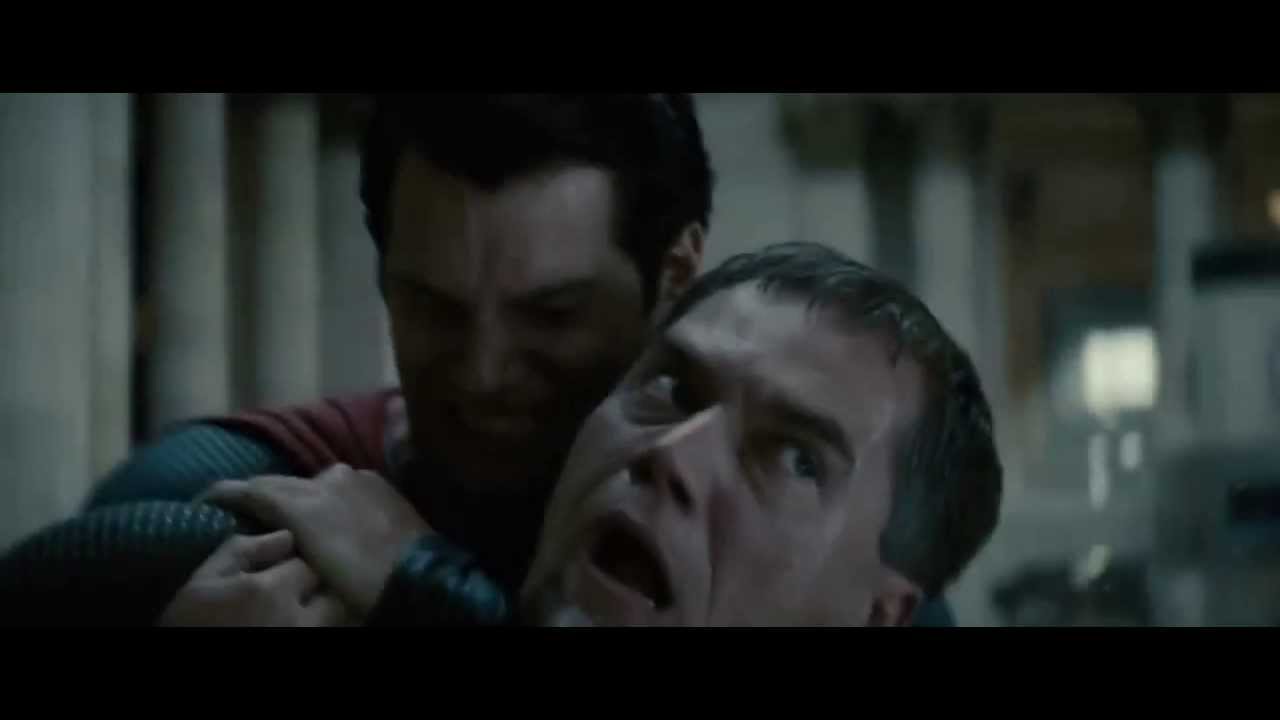
This all kind of came to a head this past week when director Zack Snyder made some derogatory comments about moviegoers who couldn’t handle the fact that his versions of Superman and Batman kill people. Putting aside that the manner in which Snyder made his remarks was insulting and belittling, I do wonder if on some level he has a point. Because as these characters move forward and pass from medium to medium, the rules seem to change. I’m not here to get into the question of whether Snyder’s super hero movies are any good at all–I haven’t liked a one of them, but plenty of other people have, and feel strongly about it. Rather, I want to spend a little bit of time dissecting the underlying question here.
Back when he was Marvel’s President and Publisher, Bill Jemas once described the “Thou Shalt Not Kill” attitude of most comic book super heroes as “kindergarten morality” without any tangible relationship to the world that adults (and presumably adult readers) find themselves grappling with each and every day. He thought that super hero stories were a perfect vehicle to communicate ideas and ideals to other people, which is why projects such as the 9-11 HEROES book and the 411 project were done. He just didn’t have any truck with the previous century’s definition of what made for an appropriate message.
So, should super heroes kill? And beyond that, should they as a rule embody any particular heroic attribute at all? And as we move into new vistas, what responsibility, if any, do we owe to those whose perception of these characters was shaped by the past?
I think this is all especially relevant in a world in which so many super heroes are making the transition to film. And this has always been a difficulty with that translation. Because the ground rules for what defines a hero in cinema have always been different, as a byproduct of the fact that most films are made with an adult audience in mind. So James Bond kills, Indiana Jones Kills, Luke Skywalker kills. Han Solo even shoots first sometimes, no worries about it needing to be self-defense. And yet, all of them are clearly seen and accepted as the heroes of their own universes. So the qualities that make them heroes don’t stop at the point where there is a need to take human life. Or, if we’re being honest about it, a desire.
Because one aspect of the action movie genre is the revenge fantasy, and it’s been a very potent and popular sub-genre for a very long time. In essence, it’s not enough for the good guy to take down the bad guy, we want to see the bad guy get his, we want karmic justice for all of the awful things that he’s done all throughout the movie. We want to live in a just universe, and in a just universe the bad guy is going to pay with his life, preferably painfully, preferably at the hands of the good guy, our avatar. The catharsis of that moment is a key feature of action-adventure films. It’s practically baked into them.
And this has presented problems for the adaptation of super hero properties to the medium of film for decades. BATMAN BEGINS, for example, stops the action of the climax dead so that Batman can turn to the audience and “lawyer” his was out of saving Ra’s Al Ghul from certain death–and it’s a weirdly deft attempt, trying to make it simultaneously apparent that, for the heroes-don’t-kill faction, Batman isn’t killing his enemy, but for the revenge-fantasy-catharsis crowd, this is clearly his doing.
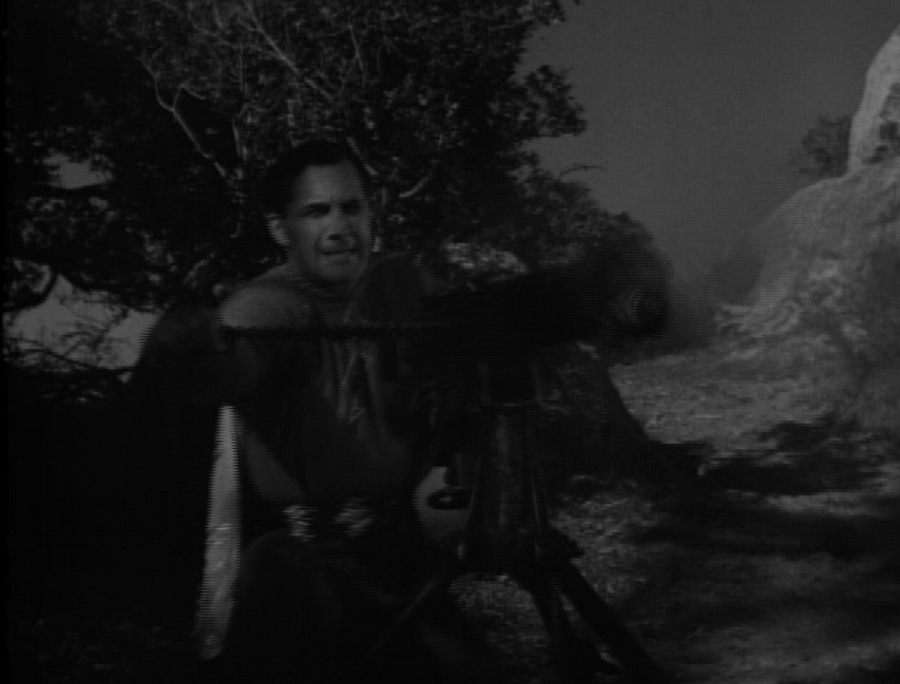
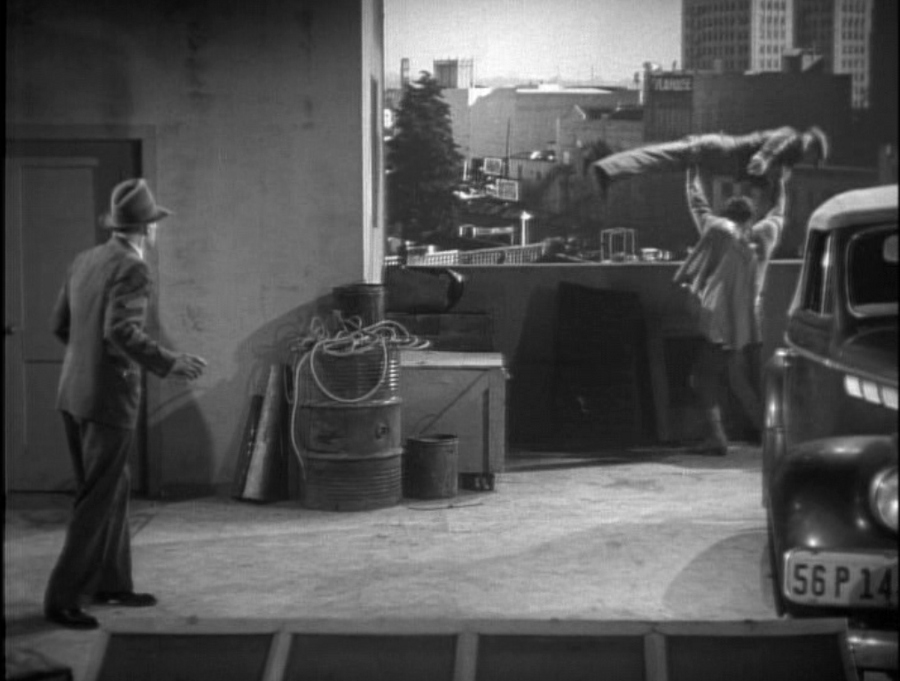
Going back to the earliest comic book adaptations, this dichotomy is immediately apparent. In THE ADVENTURES OF CAPTAIN MARVEL, the Republic serial that first brought the character to the screen, Captain Marvel is an absolute lunatic, a far cry from the jovial “Big Red Cheese” we’re used to. In the very first episode, he machine guns a horde of fleeing enemies, mowing them down without any remorse. And for the next 12 blood-soaked chapters, he dispatches the bad guys with alacrity, often throwing them off the top of building and or dams and watching them fall, screaming, to their deaths. But by the rules of engagement in this arena, this behavior is okay. He’s still the hero because they’re the bad guys and they deserve what they get.
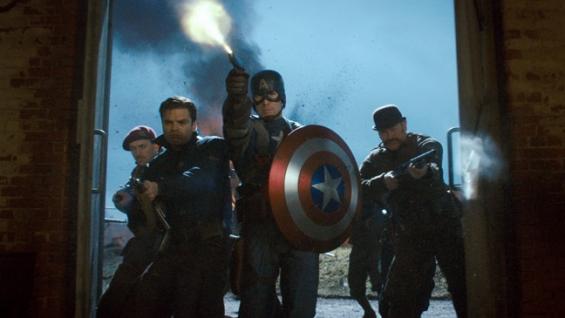
I know that, for myself, there’s a discordant moment in CAPTAIN AMERICA: THE FIRST AVENGER that registers as wrong every time I watch it. And that’s the moment, depicted above, where Cap, alongside the Howling Commandos, bursts into a Hydra outpost, guns blazing. Now, in the surface of things, there really isn’t anything wrong with this intellectually. It’s World War II and Cap is a soldier–he’s not only going to be trained in the use of firearms, he’s going to be expected to use them. But that depiction is not in keeping with what I want from the character (and, in fact, isn’t even in keeping with the rest of the movie. It’s the one time Cap is seen firing a gun in that film, and it feels to me–with no particular insider knowledge–like a sequence that was shot with the Trailer in mind, because there had to be some concern that a character as nakedly patriotic and virtuous as Captain America would be a hard sell to movie audiences. This scene shows you that he’s a total badass in the language of cinema.) And for me, it’s a question of context as much as anything else. I don’t have the same reaction, for example, in the first AVENGERS film where Cap at one point picks up a discarded energy rifle and starts to go to town with it. It may be that the difference here is the fact that the second instance has a layer of fantasy over it, where the first one carries the verisimilitude of reality. It’s a real gun that Cap is firing at people in that case.
And I think this is all becoming a slippery slope, particularly in a world in which the two major American super hero publishers, Marvel and DC, simultaneously want their characters to be wholesome enough to appeal to a kid audience (and safe enough that the parents of those kids feel comfortable in indulging their children) while at the same time wanting to deal with themes and situations and conflicts that are not so cut-and-dried, creating differing shades of gray for the heroes.
And I do feel like there’s a bit of an uphill battle going on even among the people creating these stories. More often than I’d like, we see stories in which the folks behind them have forgotten to make their lead characters heroic, to show them saving or helping the less-fortunate or less-able, to have them exhibiting self-sacrifice. This was one of the recurring mantras of Spider-Man editor Steve Wacker: Can we have the good guys saving somebody, rescuing people, and not just fighting with one another?
I don’t think it’s a question of killing or not killing per se. I think it’s a matter of context. A few years ago, there was a Wolverine story published, and after it came out, I went over and gave the editor an earful because it violated this tenant. In the story, Wolverine finds himself in the Savage Land, where he happens across several SHIELD agents carrying an unconscious Shanna the She-Devil away. leaping from cover, Wolverine proceeds to slice and dice the SHIELD guys. Now, it turns out ultimately that these guys aren’t actually SHIELD Agents at all, they’re impostors–but at this point in the story, Wolverine doesn’t know that. And so, from my point of view, he jumps out and kills a half-dozen law officers who are simply doing their job. No context, no conflict. But visceral. And satisfying. That moment lost me in that Wolverine story because I could no longer relate to him as the hero. He was as bad if not worse than the guys he was fighting, killing people for the hell of it because he just knew better. The fact that the story let him of the hook ultimately doesn’t change the fact that the writer messed up–he was relying too much on the fact that readers are already invested in Wolverine as the hero so they’re likely to go along with his actions and be sympathetic to his point of view.
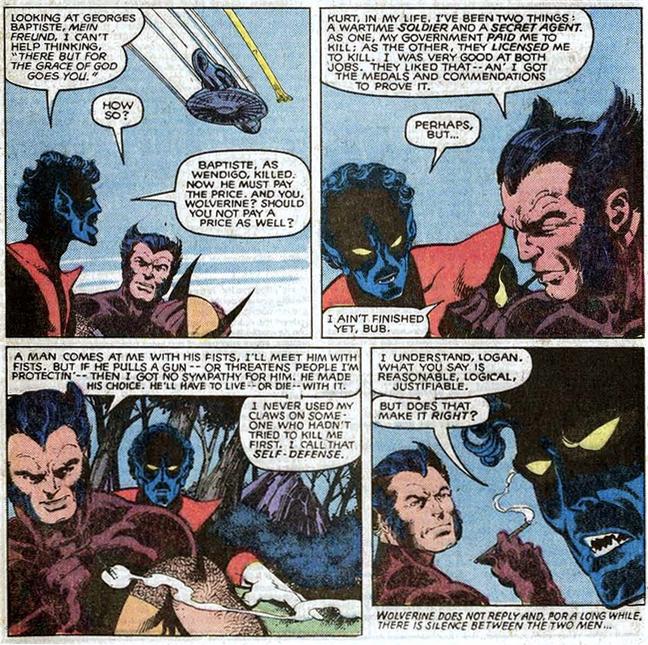
To me, Wolverine always comes back to an exchange that Chris Claremont and John Byrne presented in UNCANNY X-MEN #140. Here, Nightcrawler questions Wolverine’s methodology, how free he is about using his claws, how much he seems to enjoy it. And he asks what gives Wolverine the right? And Wolverine says that, in the past, he’s been both a soldier and a secret agent, highly decorated in both professions for his ability to kill. But if a man comes at him with his fists, he’ll meet him with fists. It’s only if he pulls a weapon or threatens somebody Wolverine is protecting–if the aggressor initiates deadly force–where Wolverine will do whatever it takes to put them down. Future writers–including Claremont and Byrne themselves–sometimes seem to struggle with this idea, but it’s that simple code that allows us to accept Wolverine as a hero and not just another murderous killer. (And even then, in that original story, Nightcrawler isn’t convinced by Wolverine’s rationalizations for his behavior–he believes in a higher morality.)
I do think that super hero creators in all mediums have a responsibility to their audience, regardless of its age, to give thought to their presentation. It’s not as simple as merely kill-or-don’t-kill, and what works for one character won’t necessarily work for them all. But it is about presenting the moral code that a particular character possesses and then operating legitimately within the confines of that code. And if a character violates his own set of ethics, we should see and feel the result of that as well. It’s also worth understanding that, especially when talking about the most iconic super heroic characters, these figures have been around long enough to have become enshrined in the hearts and minds of audiences. They stand for something, even if their particular morality is the byproduct of another time and another era. And so we need to be thoughtful about how and what we update to reflect the times that we are in, and what aspects make the characters who they are. Because the purpose of super heroes is to tell us who we are, and what we value, in an idealized world.
 The Tom Brevoort Experience
Very well said.
LikeLike
One of my favorite golden age Captain Marvel issues!
LikeLike
That comment of Nightcrawler’s has bugged me for a long time. To this atheist, it’s like saying, “That’s a series of drawings of people, with word balloons for their dialogue. They’re in a sequence that implies a passing of time and tells a story. But does that make it a comic?” Yes. Yes it does. Pretty much by definition.
A related pet peeve is the person who says, “If you kill the villain, how are you different from him?” And everyone stands around with no answer. But we all know that there is a difference. Just once I’d like someone to articulate something along these lines: “If I kill it’s in defense of myself or of innocents. Anyone who lives in peace with others is safe from me. She kills for pleasure or for profit, and nobody is safe from her.”
LikeLike
There was an Avengers marathon on TV today which I just finished watching ( I have the DVDs and I probably would have finished sooner watching those, but I like watching it on TV when it comes — like the modern Godzilla marathon ). The Avengers against the aliens ( & Captain America to the mercenaries attacking the SHIELD Helicarrier used lethal force — hell to one of those mercenaries fell to his death with a little help from Cap ) in the First movie, Infinity War & Endgame ( Peter told his mechanical spider-legs to use lethal force ).Years ago I wrote a letter to Marvel telling them that if Aliens attack Earth that Super-Heroes should be using the same lethal force as members of the Military defending the planet. I’m not one of those asking why doesn’t Batman kill the Joker or Daredevil kill Bullseye, no my question is why don’t the Police? Cause in the real world they have zero problems killing an unarmed African-American ( immigrant ? ) for the crime of sitting on a stoop and looking down the street ( They fired multiple bullets at him for that “crime” ). I already mentioned elsewhere that I’m not a fan of killing off a cool villain or heroes I like. Super-Heroes should not commit War Crimes or kill the unarmed ( Even if they just emptied their guns on your invulnerable skin like German Soldiers did in a WW 2 Supreme story and were murdered by Supreme ( Didn’t buy the rest of the mini-series (?) I think it was ) instead of tying them up and leaving them for Allied Troops ).
LikeLike
2 scenes & dialogues ( The Avengers 2012 film — Cap’s character attack on Tony ) & ( Captain America: Civil War 2016 film — Thunberbolt Ross blaming the Avengers for Alien Attack on New York, Captain America: The Winter Soldier 2014 film & Avengers: Age of Ultron – 2015 film — Sokovia ) to this day bothers me. Either in the film Captain America never read SHIELD’s file on Iron Man or in the real world the Writer & Robert Downey Jr. never watched the first Iron Man ( 2008 ) — cause Tony Did lay down on the wire & make the sacrifice play ( Heather push the button and blow the arch-reactor ( He was on the roof of that building with Iron Monger still trying to kill him ) and the writer and none of the actors in the first Avengers film watched it either otherwise surely one of them would have pointed out the Aliens & Loki created the Avengers by their actions ( or Either the Red Skull during WW2 or SHIELD using the Tesseract during modern times to create weapons alerted Aliens ( us watching it – Thanos ) to Earth ) or the Second Captain America film that had nothing to do with the Avengers but was SHIELD-HYDRA and that Thunderbolt Ross should be kissing the asses of Captain America, Black Widow & the Falcon ( who was created by HYDRA’s actions ) for saving his life ( assuming HYDRA say Ross as a threat needing killing ). Granted no one ( but us watching the movie ) at the time knew that Thanos was responsible for Ultron, but Tony knew that he and Bruce never created the Ultron A.I. nor did they set it free un the world. Sure had Tony let Thor take Loki’s scepter directly back to Asgard like Thor plan to do there would be no Ultron threat on Earth.
LikeLike
I read comics because I love heroic fiction. I tend to gravitate away from heroes like Wolverine, the second Ghost Rider, and all because of that, not disapproving as much as it just not being my thing. It’s also why I can’t stand the Punisher being treated as a hero. He’s not. He’s as much a criminal as those he slaughters, more in line as a serial killer whose target group is criminals. My only favorite Punisher story is the Mantlo story where he took Castle’s credo to its logical conclusion and he wanted to kill jaywalkers.
LikeLike
Hi, Steve. Happy Holidays.
I read comics for good art & stories. Increasingly harder to find the second one. I still get some superheroes out of nostalgia. “Batman”, “Detective”, and the ongoing “Batman & Robin” (by PKJ & J Fernandez) are all on a high level of quality. I’m not a Green Arrow fan, but bought the last 2 issues for the masterful art by Montos.
But Garth Ennis’s MAX Punisher was far better written than any superhero back then. It was second in quality for me to “Scalped”.
Frank Castle’s wife & kids weren’t killed by jay walkers. Him killing them doesn’t seem a “logical conclusion” to me.
LikeLike
I know there was quality work on some Punisher stories. It was quality work done in service to a genre I don’t like so I can just go by how good someone’s writing was that I read. Ennis is good but he rarely writes anything I’d read. It’s like I can see Joe Kubert was one of the best comic artists ever but I read only a small portion of it since he mostly did war stories from before I started reading comics and I never enjoyed war stories.
And if you’re gonna put a target on criminals’ backs, why pick and choose crimes? Castle’s family wasn’t killed by drug smugglers or serial killers either and they’re mowed down by the man too. Kidding aside, I loved that Mantlo apparently agreed with me that the Punisher is not a hero and took it to a silly extreme.
LikeLike
Steve, the Mob was involved with drug smuggling. They killed people both directly & indirectly. Serial killers are a no brainer for the Punisher. All three types are killers. Jay walkers, no. Unless one caused a death. I don’t think Frank would prioritize them. I still don’t see the logic.
“Why pick & choose crimes?”. Frank went with those who caused the most damage, took the most lives. Unless a jay walker was responsible for the deaths of others, I don’t see how they could compete with criminals with body counts for Frank’s limited time & attention. I’m surprised this wouldn’t be more obvious.
Also, Ennis made it clear his Punisher stories fell outside the superhero genre. Even Nick Fury’s appearances were stripped of superhero attachments. Action, Crime, these might be more appropriate genres for Ennis’s Punisher work.
LikeLike
Add action and crime to the categories I’ve never enjoyed reading. And I’m glad to hear someone talk about these books who gets real enjoyment out of them. That’s good for the industry in general and thus everyone who loves any type of comic.
LikeLiked by 1 person
What is the purpose of super-heroes? Bucky Barnes as Captain America says it on the first page of Fear Itself#3 –“SAVE THE PEOPLE FIRST. SAVE EVERYBODY. UNDERSTAND?” — during the 2020 Covid-19 lockdown I sent an image of that page to the News Media. SCI-FI & FICTION TV SERIES/MADE FOR TV MOVIE & FILMS have all shown people what to do and what not to do during REAL WORLD PANDEMICS/ALIEN PANDEMICS/ZOMBIE VIRUSES & the first JAWS film ( The Mayor declaring safe to go back into the water when it wasn’t safe to do so because he chose Tourist dollars over Human Life ). Don’t assume you don’t have it, don’t hide the fact you have it ( L.J. from Resident Evil: Extinction — what a selfish evil bastard, I hate his character ), don’t hoard food ( or toilet paper — take what you normally do and there will be plenty for everyone including you when you need it. Or thanks to my mom telling me buy when toilet paper is on sale I never had to worry about it. Food I never stopped taking what I normally did even if others didn’t ), don’t screw your fellow human being over ( Like in Stargate: SG-1’s Red Sky episode or in the real world in Africa a moron got other morons to attack a clinic sent to help deal with Ebola. Or a British Columbia, Canada couple flew to the Yukon to jump the line to get a COVID Vaccine. We are all in this together. If we stab each other in the back then Aliens will have an empty planet to colonize when the do show up ).
LikeLike
WOLVERINE’S LIE TO NIGHTCRAWLER: “If a man comes at me with fists, I’ll meet him with fists. But if he pulls a gun….or threatens people I’m protectin — then I got no sympathy for him” — TELL THAT TO IRON FIST [ Iron Fist#15 ( September 1977 ) Wolverine says words that should be coming from Sabretooth when he called Jean Grey his woman when he knows she is Scott Summers’ girlfriend and that their relationship is teammates or friends only ] who had no gun or glowing fist ( Nor did he attack first ) or CAPTAIN AMERICA [ Captain America Annual#8 ( 1986 )] who only pulled words at Wolverine and yet he tried to gut them both like fish.
LikeLike
A glowing fist of energy would hardly be called unarmed. That time Wolverine was justified. But seriously, this was still proto-Logan that did this with hardly any of what we now consider core characteristics in place.
LikeLiked by 1 person
Except Iron Fist never had his fist glowing for Wolverine, plus like with Captain America Wolverine attacked first with claws out trying to kill them. I haven’t looked up earlier X-Men but I do vaguely remember him trying to gut one of his fellow X-Men too. Plus I remember that early Wolverine was suppose to be struggling to control his “animal instincts”.
LikeLiked by 1 person