


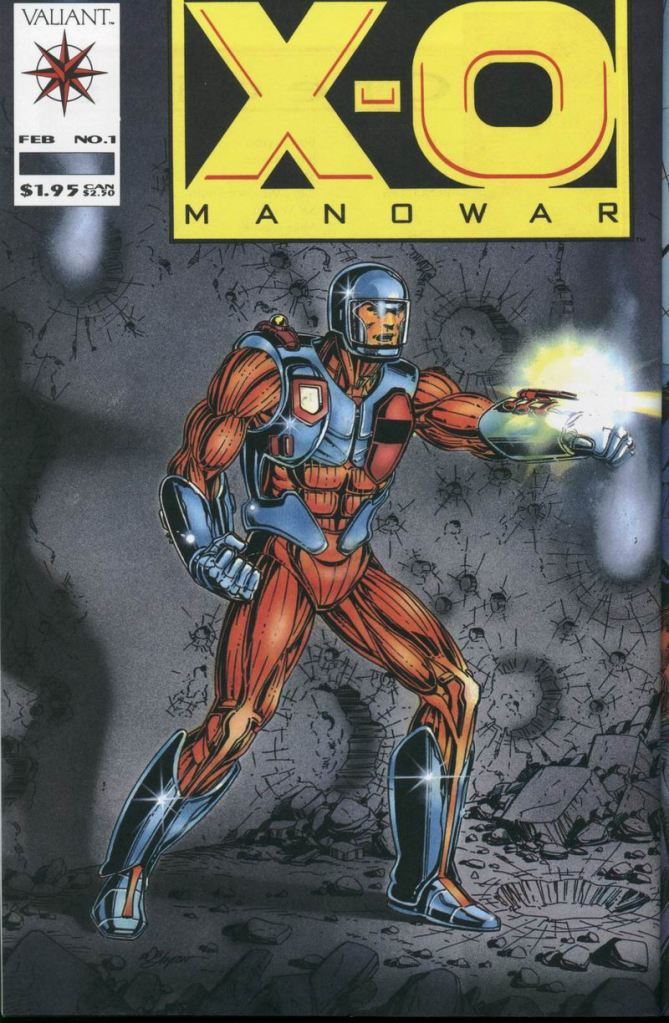
X-O MANOWAR #1 introduced another entirely new character to the burgeoning Valiant super hero universe, that being Aric of Dacia, a Visigoth from the 5th Century who was captured by aliens, and who escapes from them by stealing their greatest weapon, the X-O Manowar living armor. Due to the time dilation involved in faster-than-light travel, however, Aric returns to Earth in the present day, a strange and unfamiliar world to him that he’d need to find his way through. In its original run, X-O MANOWAR ran for 68 issues, and has been revived a number of times since then. It’s underlying premise of a Conan-style barbarian hero in the present day armed with an Iron Man-style suit of liquid metal armor seemed to strike a nerve with comic book readers. It was a simple concept to understand, as well as a simple idea to get on board with. This first cover was apparently penciled by Valiant EIC Jim Shooter himself, with Bob Layton providing the inking. I’m guessing that the piece originated as a concept drawing, as on the interior of the book, certain details of the X-O armor have been refined away from this early design.
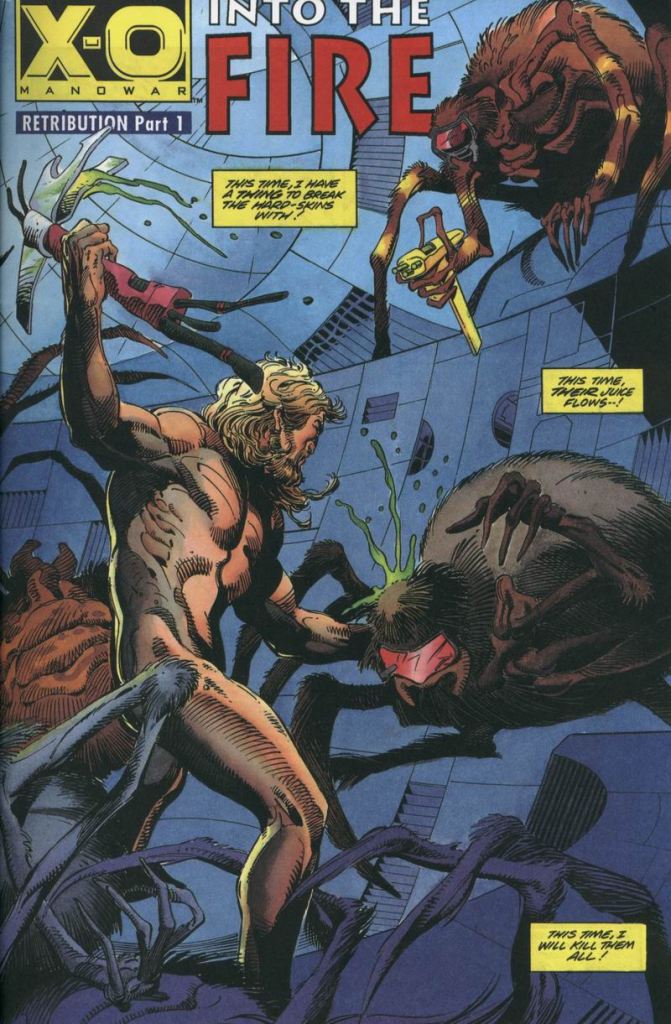
The first issue of X-O MANOWAR was co-written by Steve Englehart and Valiant EIC Jim Shooter. But no doubt there were other hands in the mix as well, including artist Barry Windsor-Smith and inker (and former IRON MAN co-plotter and inker) Bob Layton. According to records, Shooter dialogued the first 6 pages of this initial issue, with Englehart contributing the rest of the dialogue for the issue. The story picks up en media res with the lead character, Aric, battling his way through his captors, the Spider Aliens, in an attempt to reach their armory. The Spider Aliens has previously been introduced in issues of MAGNUS, ROBOT FIGHTER and SOLAR, and were one of the recurring antagonists in the Valiant line. One of the things that Valiant did extremely well in its earliest years was use the events in one series to set up and springboard its new titles. So the thing that has permitted Aric the opportunity to break captivity and make a run for the armory was the Spider Aliens’ battle with Solar in recent issues of his own comic.
The book doesn’t waste any time getting to the nitty-gritty of the story. Within the first six pages, Aric has succeeded in entering the Spider Aliens’ armory. There, he locates the X-O Manowar armor in its development cradle, and he dons the ring that connects the wearer to the suit. At which point, the armor flows around him, protecting him from the Spider Aliens’ attack–as well as the vacuum of space in which Aric suddenly finds himself after inadvertently using the X-O’s weapons systems to break through the outer hull of the craft. He falls back towards Earth, with the armor protecting him from the heat of re-entry, and plummets to Peru. There, not thinking anything more of it, Aric doffs the armor and heads out across the open territory in search of home, not realizing yet that he is centuries away from it.
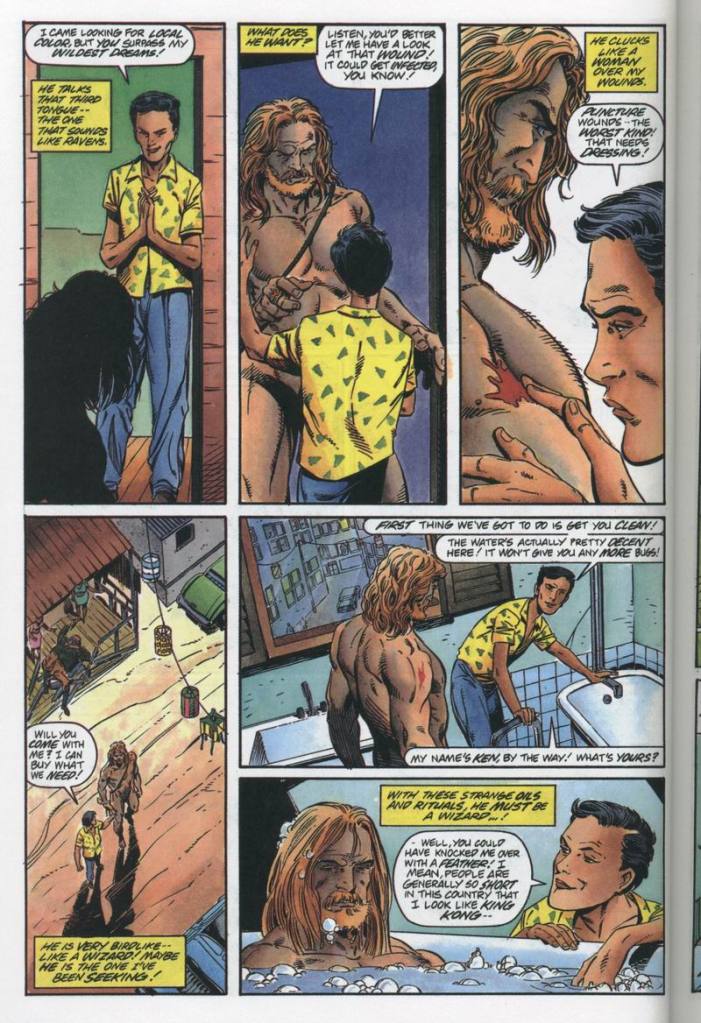
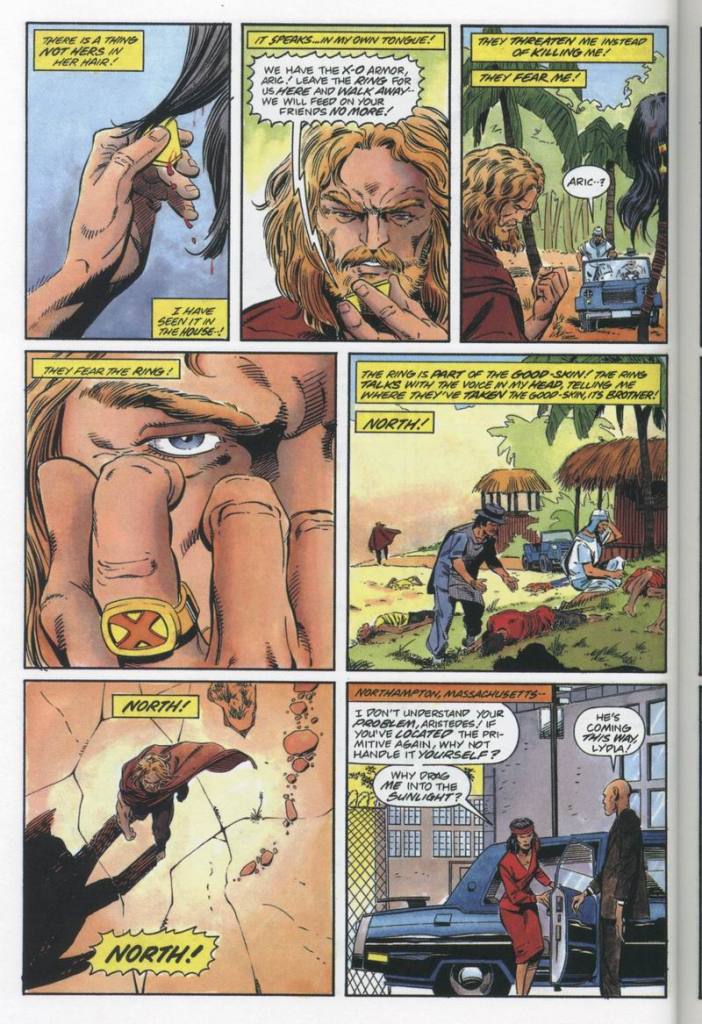
The Spider Aliens, meanwhile, have agents on Earth, members of their number who are posing as regular human beings while they stalk and kill. They move to reclaim the X-O armor, but Aric still has the ring in his possession, meaning that the suit is still linked with him and they cannot use it. A voice from the ring compels Aric to journey north to retrieve the stolen armor. Lydia of the Spider Aliens sets a trap for Aric, counting on him being a stupid primitive. Which he is, but like Conan, he is also sly and smarter than he appears. When he’s attacked, he is able through his own strength and fighting mettle to kill his Spider Alien attackers. In the aftermath, Aric meets Ken Clarkson, a gay man who will become his guide in this strange modern world. While I believe that the intent behind Ken was intended to be inclusive, he’s a bit of a walking stereotype, especially at the outset, which means that these sequences don’t date terribly well. Aric believes Ken to be a wizard, and Ken is attracted enough to the big shirtless barbarian that he not only fixes him up but helps to fly him north to the United States, towards his goal of reuniting with the “Good Skin”.
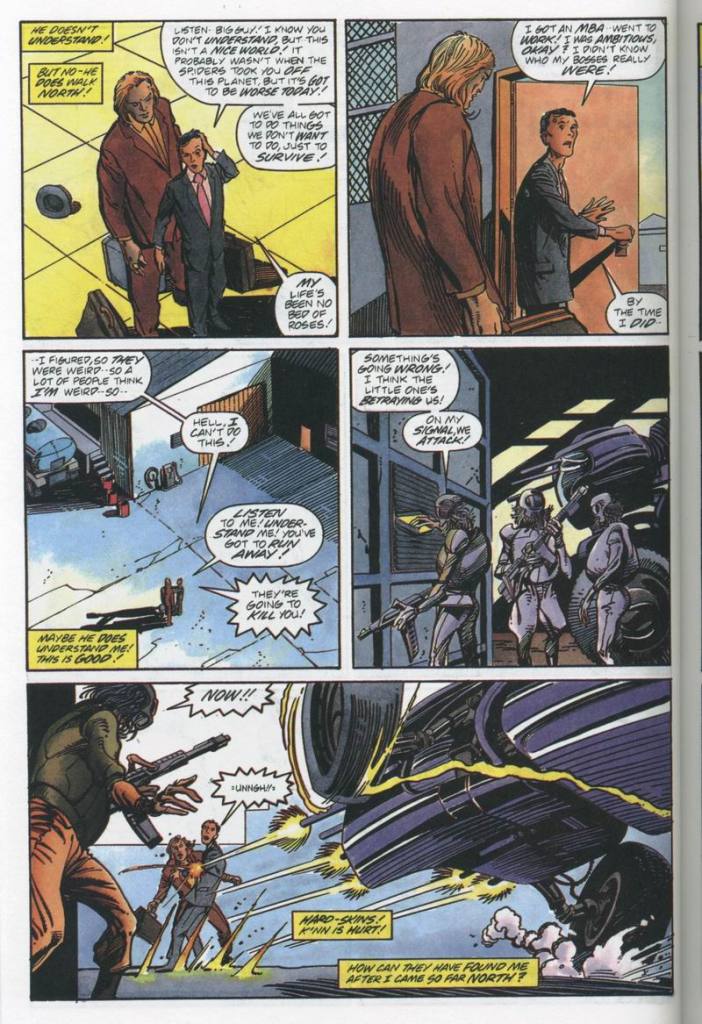
Ken, though, is on the payroll of the Spider Aliens, and he’s been walking Aric into their hands. But he’s come to like this grunting barbarian, and so he tries to warn Aric away before the trap closes–losing his arm in a case of friendly fire in the process. Aric is a skilled and experienced fighter, but he’s overwhelmed by the futuristic weaponry of the Spider Aliens. And all the while, the ring insists that he continue north. Unable to comply, Aric instead demands that the armor come to him–and it does, breaking free of the containment that the Spider Aliens have had it under and zipping across miles to where Aric is calling for it.
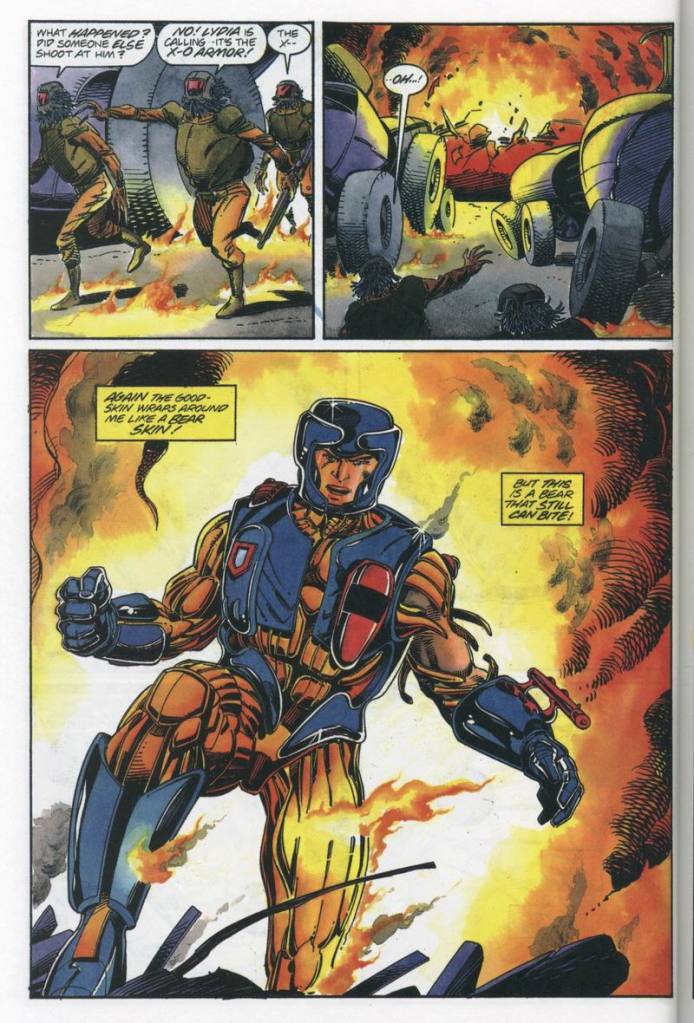
The armor reunited with Aric once more, and from here, it’s action time as we get to see the full range of what the X-O Manowar can do. He battles his way through the Spider Aliens’ troops, smashing his way through their war machines with scant effort. The armor, it is said, adapts to its user, and so in Aric’s battle-tested hands and driven by his unshakable will, it’s more destructive and impervious than anything that can be thrown against it, at least in this initial encounter. By the end of the issue, having prevented Ken’s death and learned the value of his new Good Skin, Aric resolves to master this new land that he finds himself stranded in.
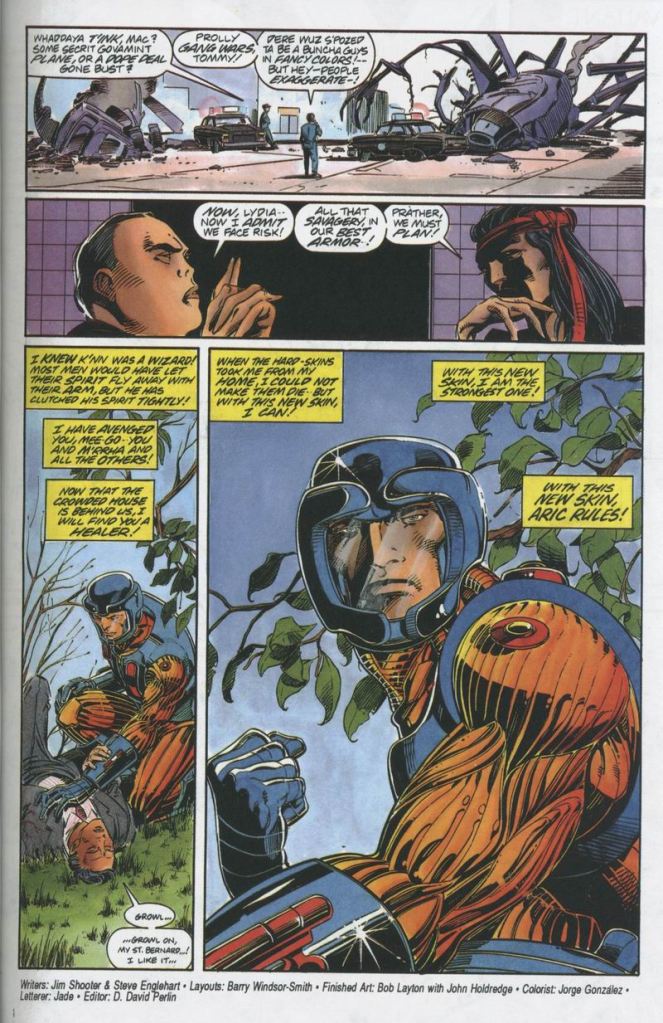
One of the things that made X-O MANOWAR interesting was the amorality of its lead character. Aric possessed a simple warrior’s code, akin to that of Conan, which allowed readers to root for him. But he was unfamiliar with modern life, and his stance on life and death and killing and plundering was a lot different than the other super-powered characters being introduced into this cosmology. Accordingly, he would often act as much as foe to the various other Valiant heroes whose path he would cross. It gave him a bit of the flavor of the early Namor, the Sub-Mariner, in the formative Marvel years–a player that readers liked but whose own needs and desires might put him into conflict with the company’s other super-stars. After first Englehart and then Shooter moved on, Bob Layton adopted the character as his own and took over as regular writer of the feature for an extended run. Barry Windsor Smith only worked on this first issue, with the subsequent ones produced by a bevy of pencilers including Sal Velluto, Mike Manley and Steve Ditko. Eventually, Mike Leeke would settle in as the title’s regular artist.
 The Tom Brevoort Experience
This one I picked up eagerly. Englehart? Windsor-Smith? Powered armor? And BWS on a barbarian? What’s not to like, if you’re me?
I stuck with it for at least a few issues, but the shifting creative teams, which felt like a hallmark of early Valiant — or maybe it was just the books I was looking at — which made me feel like there wasn’t a creative vision even if there might be an editorial one, and so I drifted away.
But I liked how it started.
LikeLiked by 1 person
The shifting creative teams did make it tough to stick with some of the Valiant titles, but I find that to be true for any publisher.
LikeLike
It’s been said that the best concepts are the ones that can be described in just a few words and that’s definitely the case for X-O Manowar. “Conan the Barbarian meets Iron Man” is definitely a good way of summing up the essence of Aric character simply & perfectly.
Agreed that Ken Clarkson is something of a gay stereotype, but he’s still miles away better than what occurred in Jim Shooter’s infamous “Bruce Banner at the YMCA” story from the late 1970s. So, uh, I guess in that respect this is a definite improvement on the part of Shooter. And Ken would go on to become a pretty three-dimensional character as the series progressed.
I didn’t actually start following X-O Manowar until 1993, but I picked up the trade paperback collection that came out in that year which reprinted the first four issues, so fortunately I was able to get caught up on the early storylines pretty quickly. I still have that book, and several years ago at New York Comic Con I got it autographed by Bob Layon. Unfortunately, I never had the chance to get Shooter’s signature on it before he passed away.
Anyway, I ended up dropping X-O after a while, and from what I gather the quality took a dive after the whole “Birthquake” thing in 1995, something that unfortunately happened with several of the Valient titles.
LikeLike
It seemed like everyone and his brother was coming out with a “superhero universe” around this time — Image, Milestone, Malibu’s “Ultraverse”, Dark Horse’s “Comics’ Greatest World”, et. al. I was getting more into alt-comix at the time, and I made a conscious decision to bypass all of them. So I was only vaguely aware of what Valiant was up to; if I’d known Englehart and Smith were working on this, I probably would have picked it up anyway. Would I have been enticed enough to get caught up in Valiant’s whole line? Possibly, although I doubt I would have stuck with it once the creative teams started shuffling around…
LikeLiked by 1 person
I really wanted to like X-O, but Ken Clarkson ruined it for me. Bad enough he was such a stereotype but making him a villain was just grotesque, so I was out after Unity.
LikeLike
One primitive ( Aric ) in stolen alien tech uses it to play hero and another primitive ( Gaius Tiberius Augustus Aggrippa ) in stolen alien tech uses it to enslave people [ Fantastic Four#241 ( April 1982 ) ] and recreate ancient Rome in Africa.
LikeLike
In 81 Shooter introduced the Berserker in Avengers 207. A primitive who became immortal and was armed with stolen alien tech. DC also had the Superman villain Terra man who was a 19th century cowboy armed also with stolen alien tech.
LikeLike
“The Good Skin”
LikeLike