


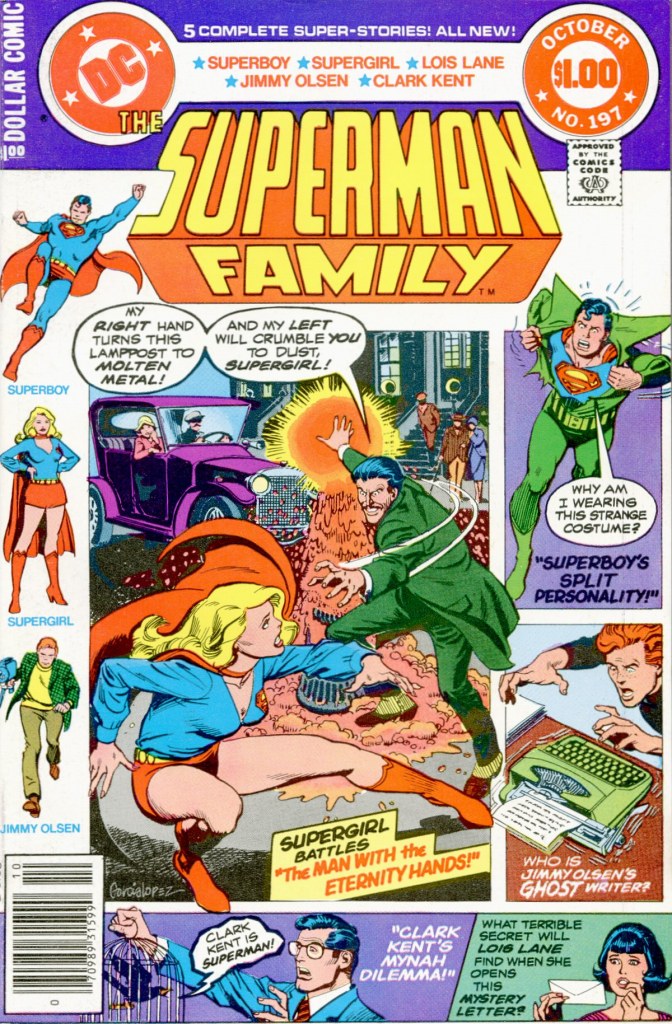
One of the other benefits of my new Stationery Store comic book purchasing location was the fact that I could reliably get comics that I’d only been able to follow ad hoc up to that point. I’d been a mostly regular reader of SUPERMAN FAMILY for some time, but I’m not quite sure how, as the 7-11 that served as my main source of comics had stopped carrying oversized books. It’s entirely possible that, as a Superman title, especially in the umbra of the film, the place made an exception for this series, or else it was widely enough distributed in the other places where I might find comics in my family’s travels that I was still able to get it each month. Either way, any difficulty with sourcing had now been eliminated, and I was able to pick up this issue, #197, at the same time as the other books I grabbed that first week.
By 1979, fiscal reality was beginning to take its toll on the Dollar Comics format. When it started out, it came with an assortment of bells and whistles, including a relatively massive page count. But given that the cover price couldn’t increase–it wouldn’t be a Dollar Comic if it was priced at $1.05, of course–the only way to economize was to begin scaling back on the page count. The frontispiece contents page was the first to go, and a regular ad spread began to appear in its pages. But the most obvious adjustment was that each issue now featured only five stories rather than the six that it had been running. Nightwing and Flamebird, the Kandor-based crimefighters, headed back to literary limbo, leaving Superboy, Lois Lane, Jimmy Olsen, Clark Kent and Supergirl to round out the contents of this issue. Sadly, Mr and Mrs Superman seemed to be a casualty of this economization as well, but it would return in another issue or two, much to my relief.
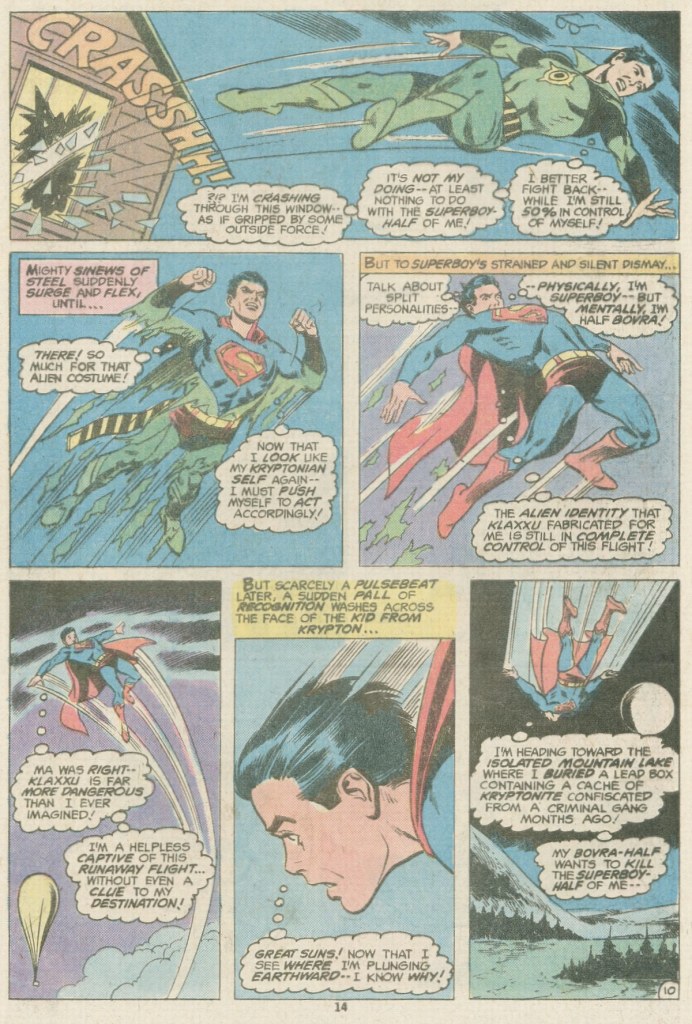
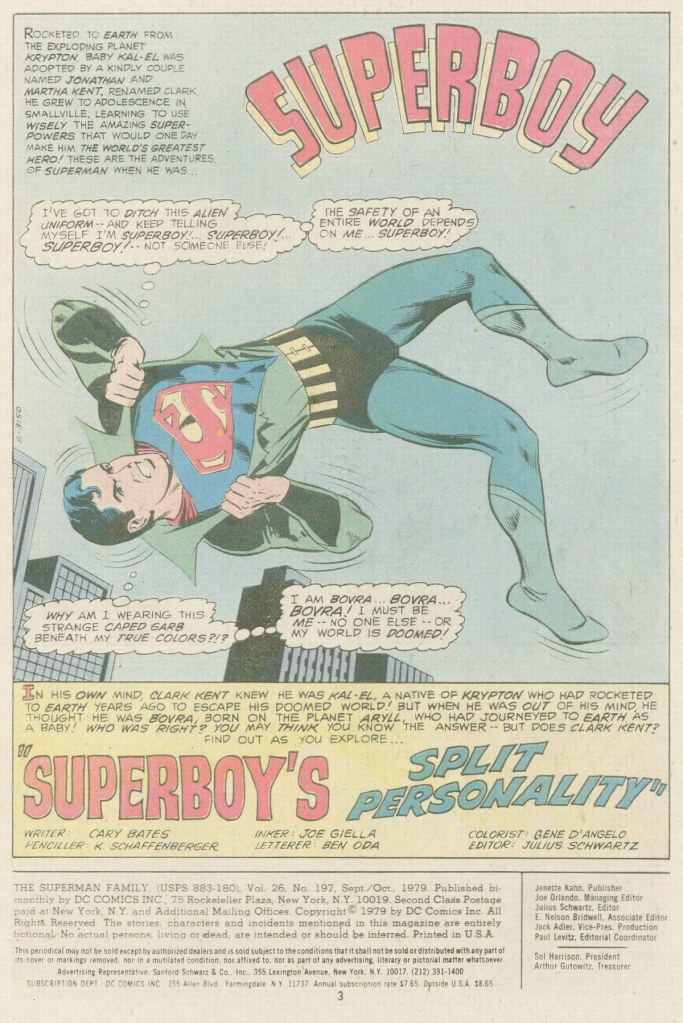
The Superboy story that kicks off this issue is a crazy bit of nonsense. In it, Clark Kent’s science teacher reveals that he’s actually an alien being from the planet Aryll–and so, he claims, is Clark! This is all part of a ploy to imbue earthling Clark Kent with vast telepathic powers that will let the teacher, alien name Klaxxu, take over his home world. Unfortunately, he picked the one student in Smallville who’s actually an alien from another world–and while Superboy momentarily has some trouble overcoming the Aryllian mentality that Klaxxu has implanted in him, he’s able to incapacitate the would-be conqueror with his one vulnerability, Helium, and then deliver him to the Aryllian authorities. The whole thing is delivered by the ever-reliable Cary Bates and the charming Kurt Schaffenberger, here buried a bit under the inking of Joe Giella, a favorite of editor Julie Schwartz.
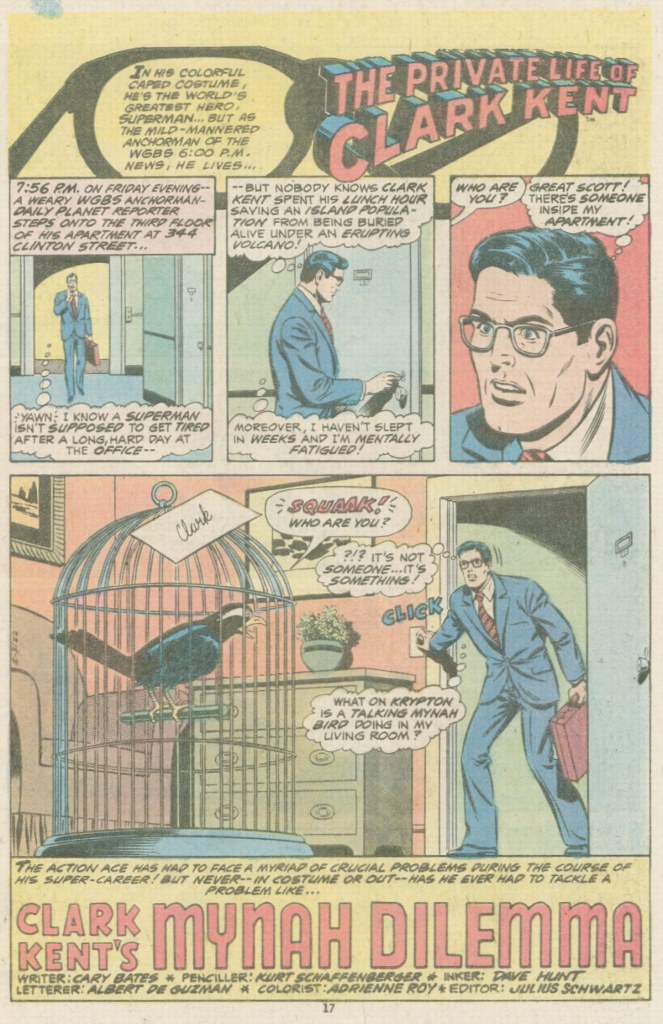
The same creative team, minus Giella but with Dave Hunt doing the inking, delivered the follow-up Clark Kent story, which is similarly silly. Clark’s vacationing neighbors April and May Marigold send Clark a gift–a talking Mynah bird, which begins to drive the reporter nuts with its constant squawking. But Clark has a bigger problem as the bird begins saying Clark Kent is Superman, jeopardizing his secret identity. There’s also an attempt by come criminals to rub out Kent in the midst of the reporter’s efforts to train the bird to not blow his most closely-guarded secret (which he figures it must have picked up by heading him talk in his sleep). But the punch line, of course, is that April and May trained the bird to say Clark Kent is Superman as a gag before sending it to Clark–and in the final panel, he’s desperately trying to undo his efforts to keep the bird from saying the phrase in question. This one is cute, but pretty dopey.
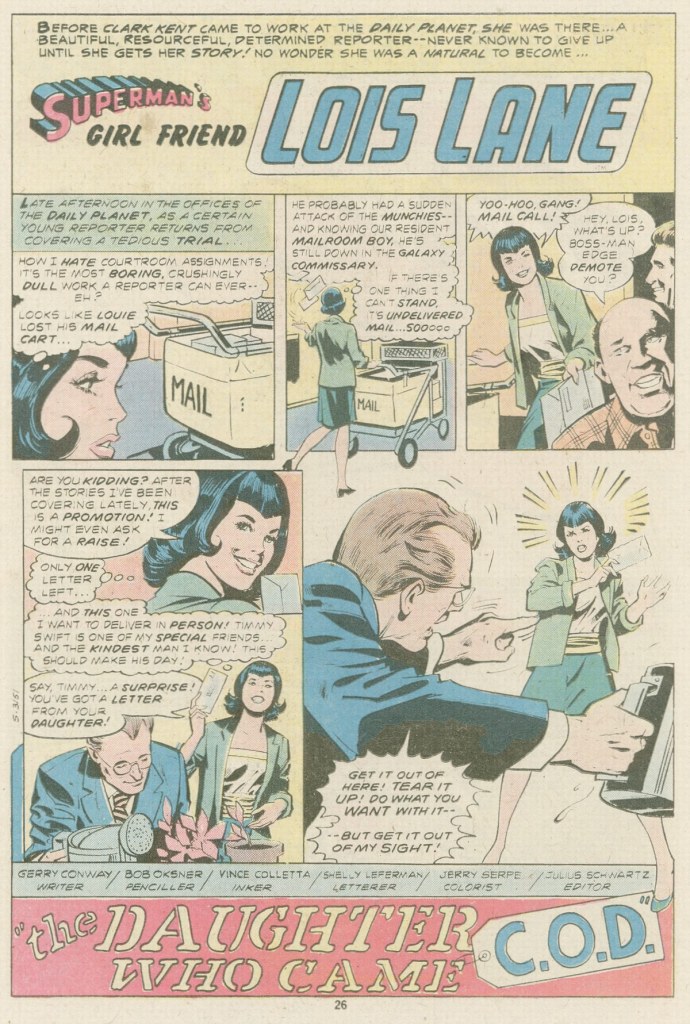
The late Gerry Conway wrote the next story, a Lois Lane caper illustrated by Bob Oksner, whose usual charm is done a disservice by the imprecise inking of Vince Colletta. It’s a movie-of-the-week affair in which Lois intervenes to reunite a Daily Planet staffer with his runaway daughter, stumbling across a human trafficking and extortion scheme along the way and breaking it up without Superman’s assistance. It’s basic but unmemorable, but it runs the bases just fine.
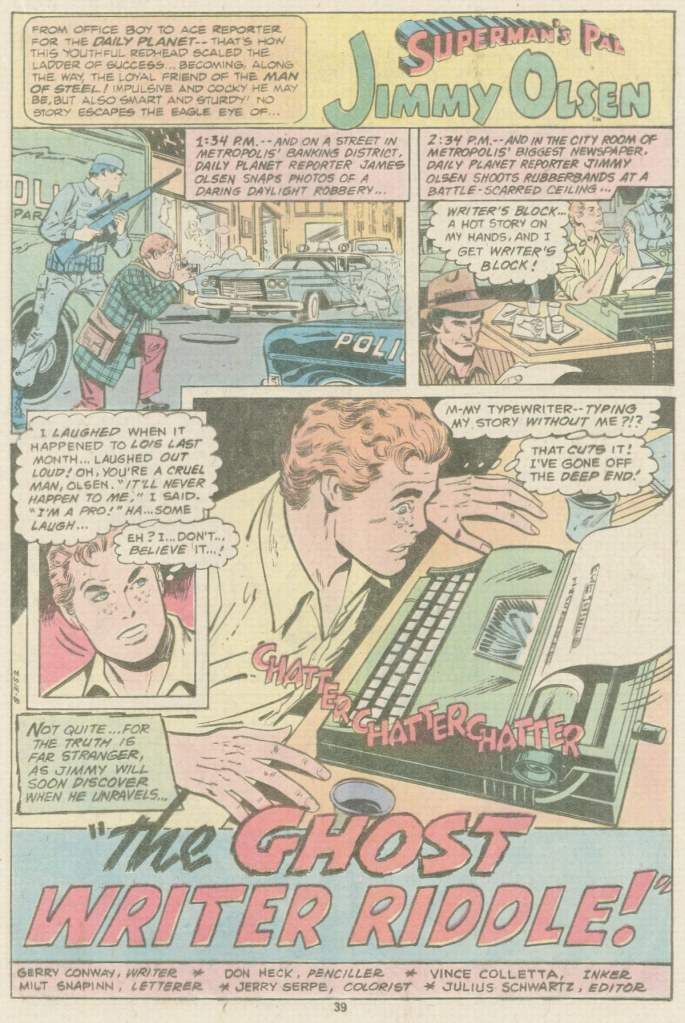
The same could be said about the Jimmy Olsen story that follows it. It too was written by Gerry Conway, with artwork by Don Heck again getting short shrift under the pen of Vince Colletta. It’s a mystery story in which Jimmy gets a prophetic warning that types itself on his newsroom typewriter warning of an impending disaster that’s going to strike the WGBS building. As with the Lois adventure, Jimmy gets to the bottom of this revenge scheme to destroy Morgan Edge’s company entirely on his own with no help from Superman–but in doing so, he misses his copy deadline from Perry White and still ends up in hot water. That Jimmy!
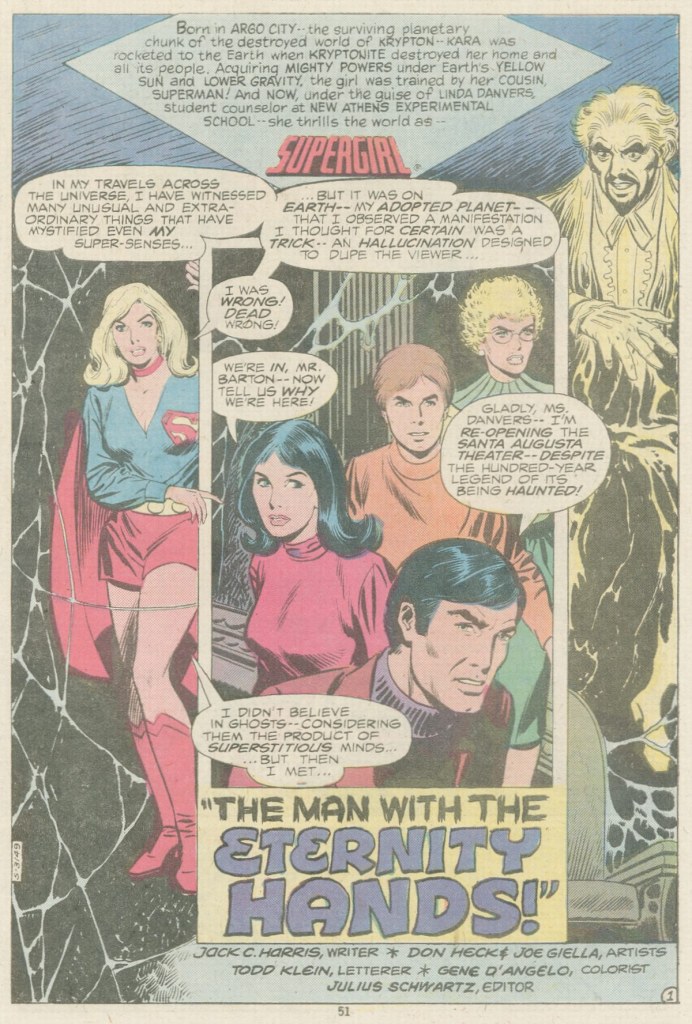
The final story stars Supergirl and was also illustrated by Don Heck. Here, he’s inked by Joe Giella, which honestly isn’t much of an improvement on Colletta. I wonder if a lot of the crap Heck took from fans in this period doesn’t come down to him being handed a lot of ill-fitting inkers. The story was the work of Jack C. Harris, and in it, Supergirl travels back in time a hundred years to unravel the story of a ghost of a murdered actor who is haunting a theater in the present. The cause turns out to be another time traveler, Theodore Marshall, whose ancestor was displaced by the murdered actor and who has come back in time to prevent the misfortune for his family that followed. Supergirl winds up pursuing him through the ages, eventually short-circuiting his temporal equipment in such a way that he’s reverted to an infant. The ghost, it turns out, was an actual ghost, which is dealt with matter-of-factly and off-handedly, which seems pretty strange. it isn’t a great story, it’s pretty scatter-brained and convenient. Like all of the efforts in this issue, it’s a few minutes’ worth of entertainment, nothing more.
 The Tom Brevoort Experience
Can I consider DC stories like the ones in this issue the equivalent of eating iceberg lettuce? Absolutely nothing wrong with it and dressed up, it can be quite tasty. But at the end of the day, it’s not something of enough substance to stick with you for too long. Which is to say, each of those stories looks fun, but not much else.
What stood out to me the most in this review – as well as the subsequent FF Annual – is the impact an inker has on the pencils. I say this because I never cared for Don Heck’s art. While I don’t disagree with Tom that Heck never had the best of inkers during this period, there was more to it than that – at least to me. With all due respect to Don Heck’s fans, I found his figures too stiff and awkward with action scenes unappealing. But if his stint at DC was an improvement with greater acclaim, hey, I’m good with that.
At this point I’ll exchange my cup of tea for a nice glass of wine as I will seek forgiveness from anyone I’ve unintentionally offended.
LikeLike
It was indeed a few minutes of enjoyment, something that you’re never guaranteed will happen. I liked the Jimmy and Lois adventures here while I couldn’t be bothered to read their solo titles after reading one or two of each.
LikeLike
Thanks for pointing out the inherent flaw in Dollar Comics during the inflationary days of the 1970’s. Clever marketing by undone by economics. Maybe Double Comics at 64 pages would have worked for a longer period.
LikeLike
Is it me or is the costume Superboy wears is that of Chemical King, minus the insignia? Looks awfully close to it.
LikeLike
It looked closer to Duplicate Boy to me, but yeah, definitely LSH-ish. I was surprised to realize the suit belonged to some alien dude we’d never heard of.
LikeLiked by 1 person
Yeah, their costumes were a bit similar.
LikeLike
“Clark Kent’s Mynah Dilemma” is lightweight, but it’s lightweight like a perfect meringue. I consider it one of the most perfect short Superman stories of the Schwartz era — it’s demented, but perfectly paced and beautifully drawn. I don’t even mind the Dave Hunt inking….much.
I do think part of the problem Heck had with his reputation in this era and a number of years before it was indeed the inking — editors apparently thought they could throw whatever inker needed work at the moment at Heck pencils and it would come out fine. And it did, for a low bar of fine. But it wasn’t just that indifferent inking by inappropriate inkers made Heck’s work look bad, it was also that Heck was discouraged by his work so steadily looking bad, so why should he do his best on doomed jobs?
Len Wein told me that when he was editing FLASH, he asked Don, “How do I get the Don Heck of TALES OF SUSPENSE and AVENGERS back?” and Don said, “Let me ink my own work.” Len did, and Don’s work perked up — even when he switched over the JLA and was inked by Brett Breeding, Romeo Tanghal and others. Having an editor who cared about the work and tried to make it look its best, with inkers who were actually suitable to the job, did a lot for Heck’s morale.
In earlier years, editors at Marvel treated Heck like a utility infielder, giving him whatever jobs were late on the schedule, knowing that he could bust his ass and make the deadline. Which is a nice show of confidence, but it meant that Heck’s work was usually rushed, and inked by people who could also make a tight deadline (often Vinnie) and Heck’s morale suffered then, too. And when Stan would have him pencil SPIDER-MAN over Romita layouts and do breakdowns on X-MEN for Werner Roth to pencil, that wasn’t fun either — Heck lamented that he was good enough to do layouts and good enough to do pencils, but somehow not good enough to do both on the same book.
Another problem was that writers, in hopes of jazzing up Heck’s storytelling, would plot Big Kirby Reveals and Big Kirby Settings and Big Kirby Godlike Characters, and that just wasn’t Heck’s wheelhouse. Give him intrigue and suspense and romance and danger and menace, and he’d eat that stuff up and do really nice pages. Big Caniff Stuff. Big Kubert Stuff. Ask him to draw Big Kirby Stuff and it was almost always going to fall flat.
I only got to work with Heck once, but I’d have loved to do something ongoing with him. I can plot Big Caniff Stuff. Even Big Caniff Superhero Stuff, like the Conway/Heck STEEL, which had very nice storytelling and character drama.
But sadly, now we’re back to Joe Giella again…!
LikeLiked by 2 people
Regarding Don Heck, all of that makes more sense. I recall an interview with Roy Thomas where he commented that superheroes were the bane of Heck’s existence as he’d been meant to draw westerns, but that the comics world has changed after 1961. That background information also tells me that Iron Man was not the best vehicle for his style.
LikeLiked by 1 person
I think Don Heck was just fine on Iron Man — and on most of his AVENGERS run — because he was doing most of the plotting, and he plotted to his strengths, which were intrigue, incident and character drama. When the book switched over to Gene Colan, he plotted to a very different set of strengths, and the book became hugely different visually: Less story, but wow moments.
When Roy started writing AVENGERS, he did more of the plotting than Stan had, and occasionally — but not always, plotted Big Kirby Stuff for Don to draw, and it didn’t work as well and the previous stuff.
I would say that the best vehicle for Don’s style wouldn’t be superheroes, but he can do superheroes fine, if it’s his kind of story. STEEL was ideal for him because Conway kept the stories pulpish, not superhuman on a huge scale, but full of shadows and menace and incident, rather than Big Reveals and gargantuan sets and menaces. FLASH worked well too, because Cary Bates wrote character stuff and incident-focused action. And so on.
But if they’d given him JONAH HEX, SCALPHUNTER or UNKNOWN SOLDIER, I bet he’d have been happier.
LikeLiked by 1 person
One of Don Heck’s last jobs was penciling two issues of H.P. Lovecraft’s Cthulhu for Millenium. It looked really good. His style definitely suited horror set in 1920s New England. Definitely gave my teenage self a new appreciation for Heck’s work.
LikeLiked by 1 person