

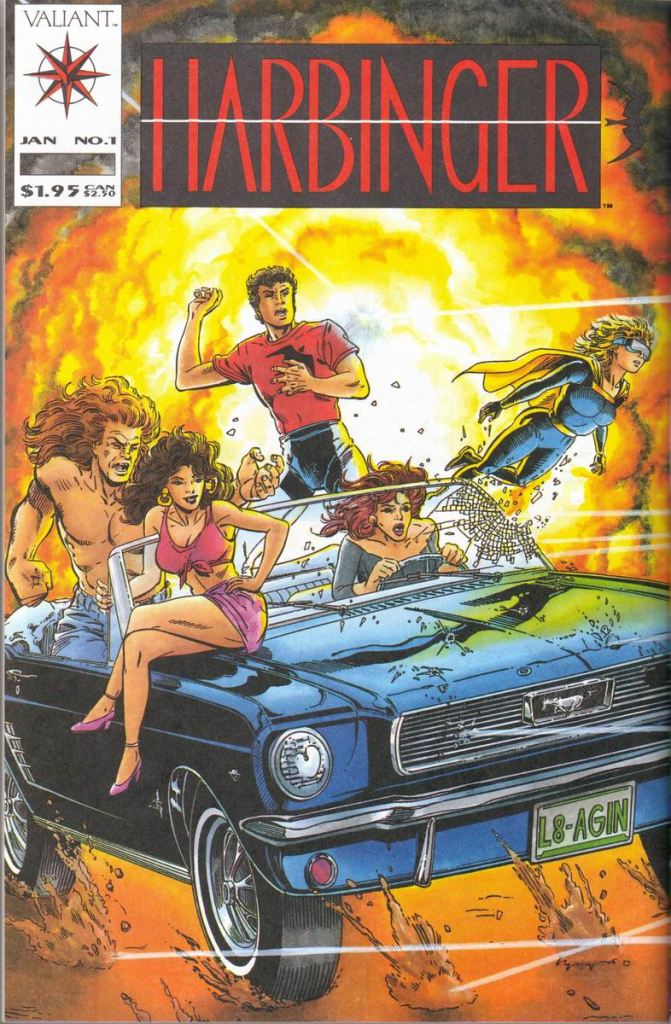
While Valiant had had some middling success up to this point, it was really HARBINGER #1 that put the company on the map in terms of being a presence in the field. HARBINGER was the first fully-original super hero concept that was put forward by Valiant, and it shared enough of its DNA with X-MEN and NEW TEEN TITANS to evoke a positive reaction of interest from among fans of those series. It didn’t hurt either that WIZARD magazine, which was then growing into a real force in the industry, called out HARBINGER #1 as being a notable release likely to go up in value. With all of this promotion behind it, HARBINGER #1 popped, and fans who liked it and its subsequent issues began seeking out the other earlier Valiant releases–books that had had much smaller print runs and which were consequently difficult to lay hands on. This set off a small speculator boom around the company that helped to propel it to the next level.
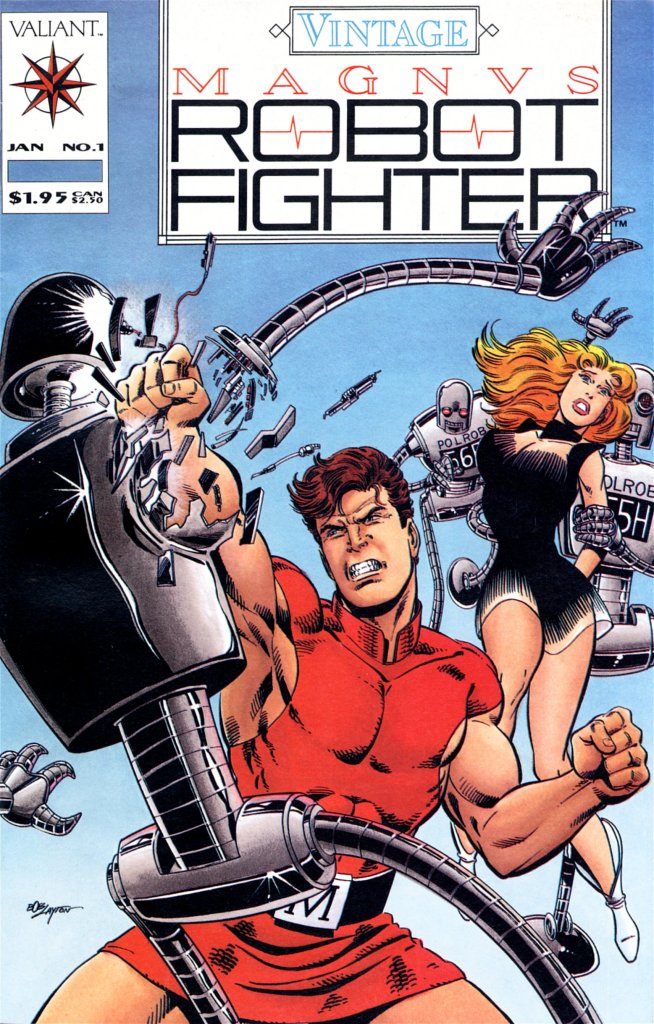
Immediately prior to the release of HARBINGER #1, Valiant did drop one other super hero title, though it was a reprint book. VINTAGE MAGNUS, ROBOT FIGHTER #1 reprinted the main story from Gold Key’s 1964 MAGNUS, ROBOT FIGHTER #1, making the material available to readers who may have come to the character from the Valiant revival and who didn’t have easy access to those earlier stories that were still relevant. It ran for four issues and reprinted a succession of Russ Manning Magnus stories from years past.
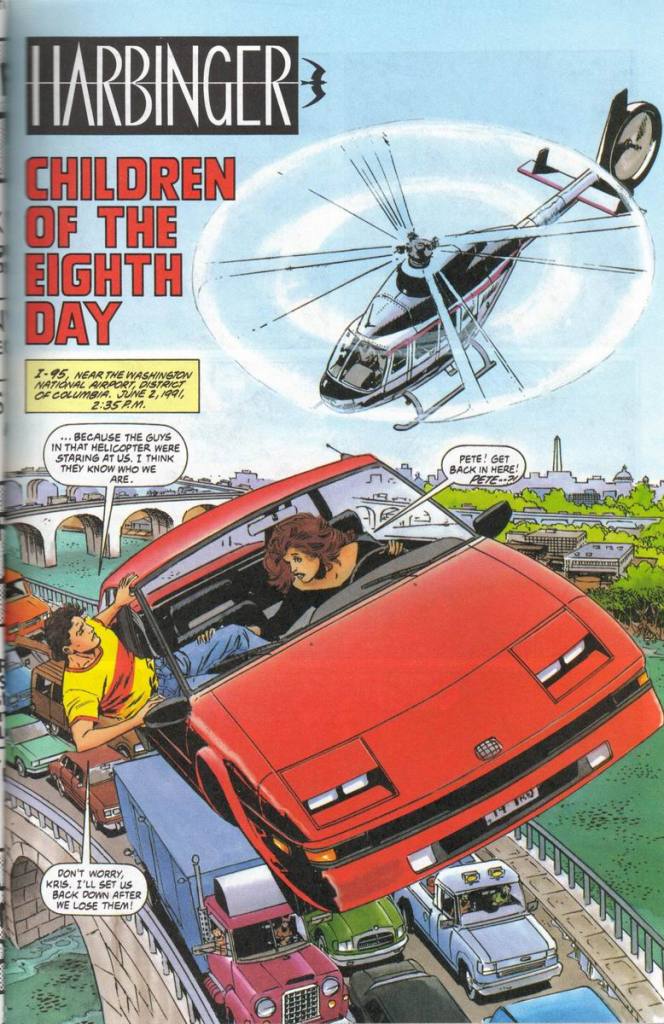
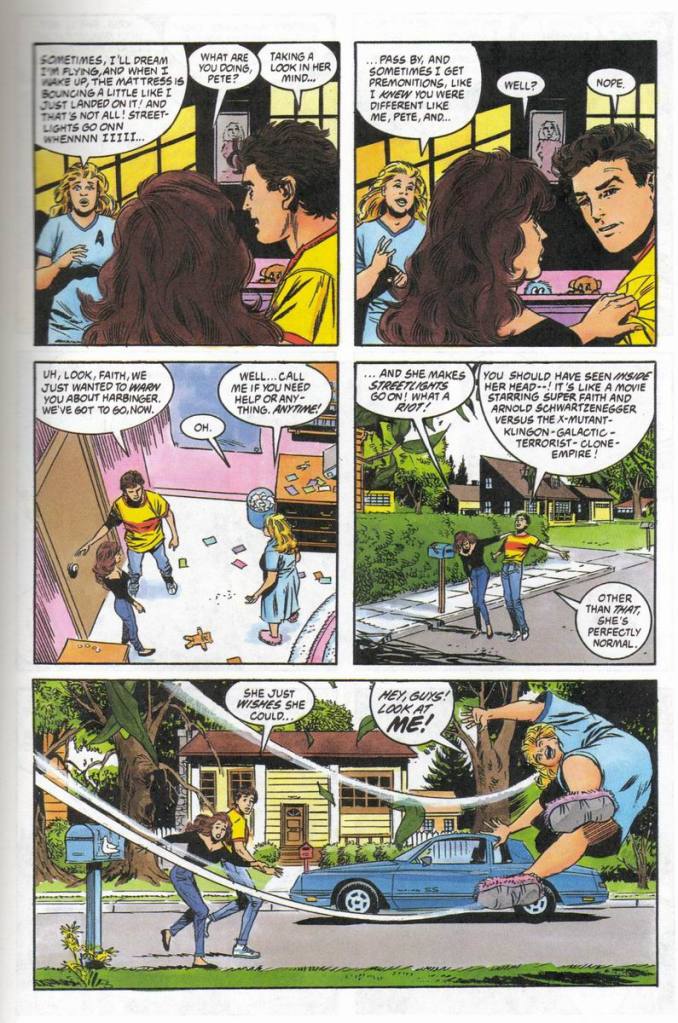
HARBINGER #1 also introduced the artwork of David Lapham, a newcomer whom editor in chief Jim Shooter had discovered. Shooter touted his new find as the most exciting new artist that he’d come across since Frank Miller–strong words, but accurate ones, as Lapham would in years to come follow in Miller’s footsteps into the realm of gritty crime comics with his long-running independently published series STRAY BULLETS. But here early on, he was just learning the ropes, being schooled in Shooter’s theories about what made for effective comic book artwork. Lapham’s work was attractive, even when he was held to a strict grid panel formulation and was asked to primarily work in full figure medium shots. He quickly became adept at being able to create drama despite these limitations, and his pages were attractive, his characters personable.
The story in HARBINGER #1 opens en media res. The first six issues of the series each came with a coupon packed in–redeem all six coupons and valiant would sent you the rare HARBINGER #0 that revealed the backstory of the Harbinger Foundation. The story begins with Pete Stanchek, also known as Sting, and his girlfriend Kris Hathaway fleeing pursuit from a helicopter in a flying car. It turns out that Sting is telekinetic and he’s causing their vehicle to fly in order to elude pursuit. When they reach a more rural area, Sting forces the helicopter to land and questions the pilots–but not before they’ve radioed their location in to the folks that hired them as spotters. Pete and Kris are thereafter attacked by Eel, Weasel and Lump, a trio of young people who all possess super-powers. But none of them are a match for Sting’s telekinesis, and after wrecking up their three pursuers, Pete flies off with Kris in tow.
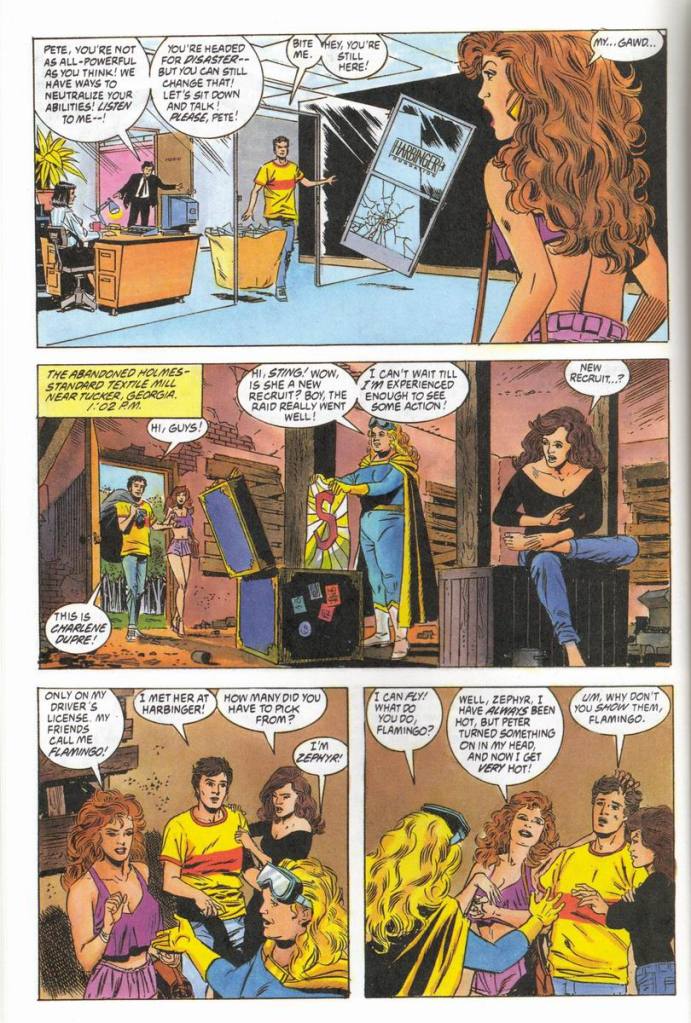
We learn that the people chasing Sting and Kris are operatives of the Harbinger Foundation, a concern that recruits young people who have experienced strange things or gained superhuman powers–Children of the Eighth Day as the title nicknames them X-Men-style–programming them in the manner of a cult and turning them into super-powered assets for their leader, Toyo Harada. Sting had once been such a recruit, but after his best friend was killed by Harbinger, he broke away from them and went on the run with Kris. But now, the pair are looking for a way to fight back. Finding one of Harbinger’s ads, they break into a post office and steal the letters that have been sent to Harbinger from prospective recruits, intending to intercept them and warn them about the organization. They seek out Faith Herbert, who dreams of flying, and who is an overweight fangirl. Sting looks into her mind and discovers that she doesn’t possess any thing more than an overactive imagination, and he and Kris depart. However, faith pursues them–having her mind probed by Pete has unlocked powers in her as well, and she can now fly. A comic book fan, she wants to be known as Zephyr, but most of the cast derogatorily calls her Zepplin instead. As representation, while this would get better over time, Faith is something of a mixed bag in these initial stories.
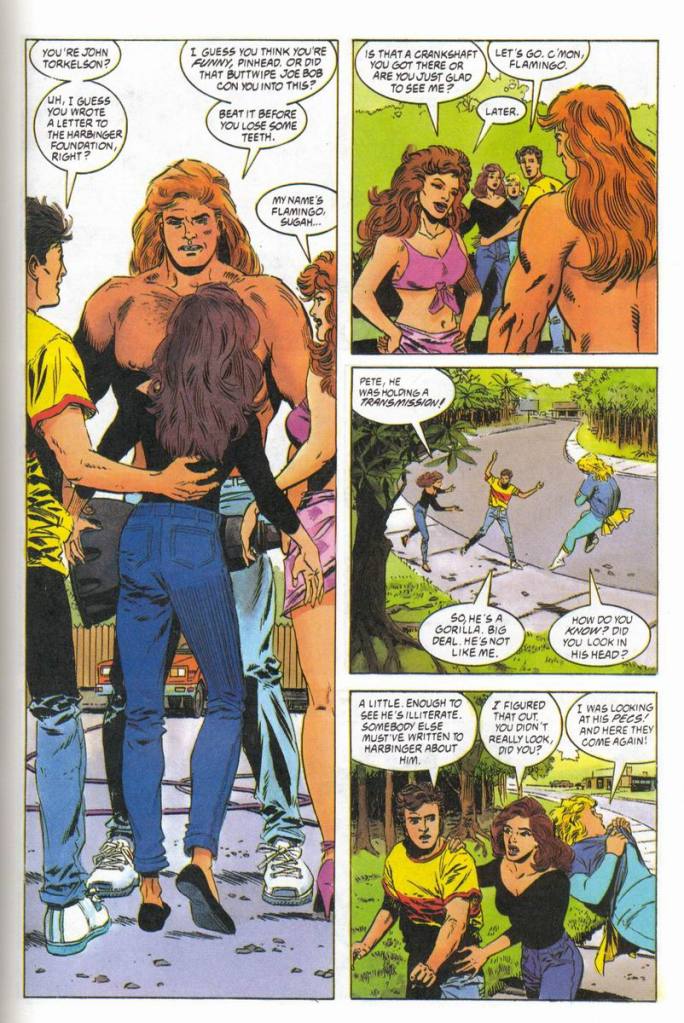
There’s a bit of an intentionally icky scene in here where, forced to sleep out in an abandoned van, Pete uses his power to enter people’s minds to stop Kris and Faith from fighting, and in the aftermath, Kris wonders aloud if the reason she’s sleeping with Pete is because he’s coercing her into being with him with his mind powers. No concrete answer is given here, but when cornered, Pete admits that doing so would be wrong. In any event, the next day Sting hits a local Harbinger office, swiping a bunch more applications and running into Charlene Dupre, Flamingo, who can generate flames after Sting probes her and who becomes the group’s latest recruit. she’s a sassy white trash vamp, and her presence immediately creates more tensions with Kris. The information they’ve gathered leads them to John Torkelson, an illiterate mechanic who gains superhuman strength after Sting probes him. But Sting and Torque rub each other the wrong way from the start, and Pete tries but fails to prevent him from going along with the growing gang. Ultimately, Sting’s mind probe reveals to him that Torque was abused in his past, and while this revelation causes Torque to momentarily act out, the revelation creates a sense of empathy in Sting that lets him get past his own dislike of Torkelson.
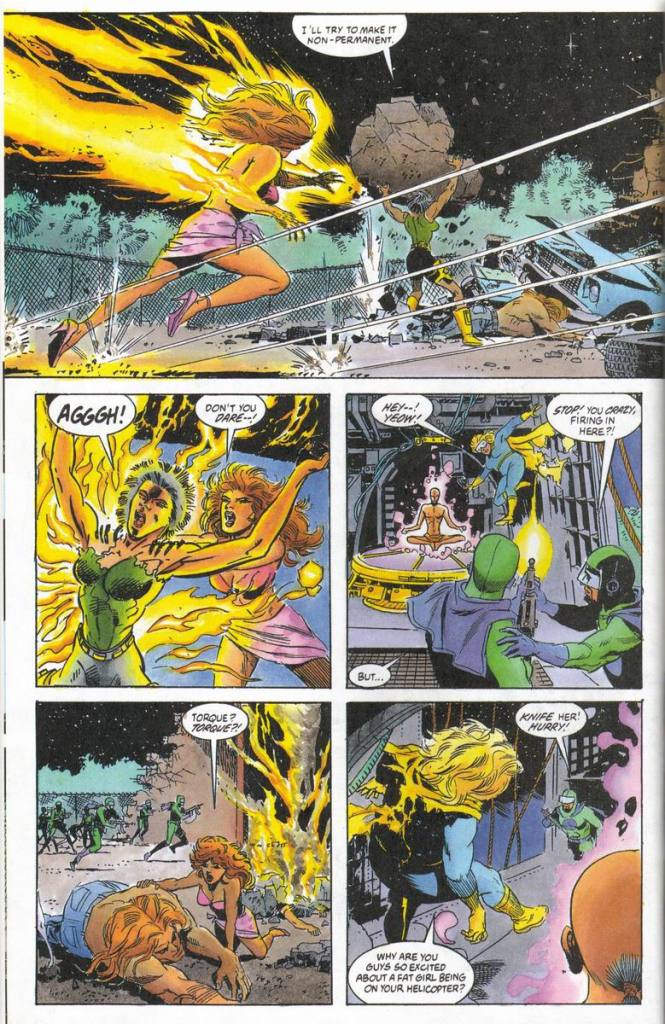
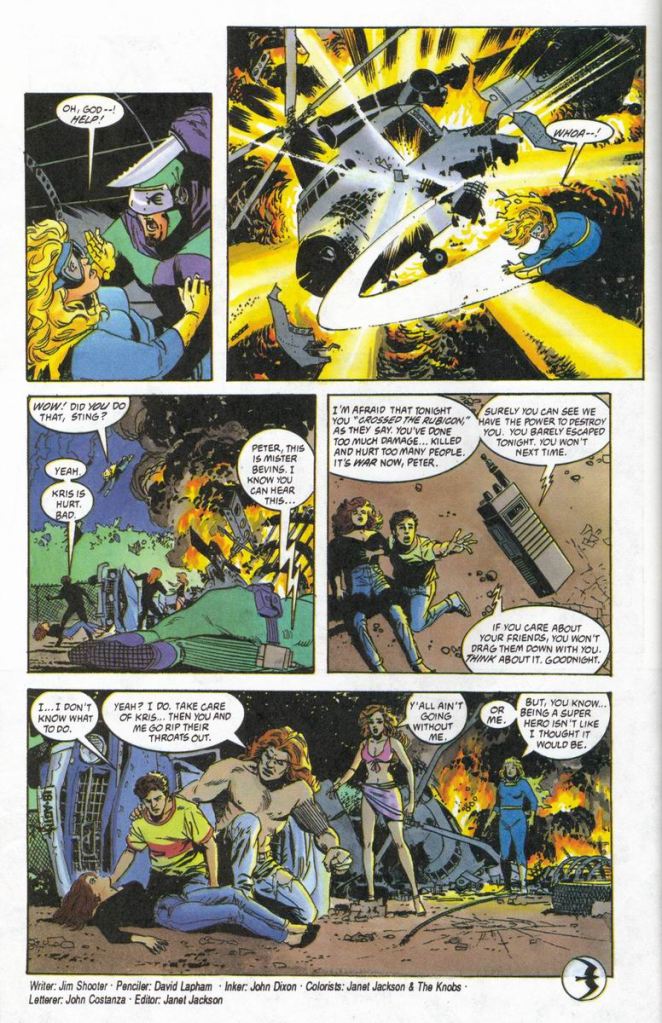
It’s at this point that the crew are set upon by the Harbinger Foundation’s men once again–not just super-powered agents but also soldiers wielding lethal weaponry. They’ve brought along an activated operative who is able to scramble Sting’s mind, preventing him from using his powers, so it’s up to the others to save their asses and turn the tide. Faith is able to crash into the helicopter the bad guys were using as transport and knock out the guy messing Sting up, and from there the fight goes one-sided as Sting’s powers cannot be countered by any of the soldiers or activated agents on site. But Kris has been badly wounded in the conflict, and the issue ends with the group needing to find medical attention for her, while Harbinger’s Mister Bevins tells Sting over the radio that things have gone too far and it’s now all-out war between them.
Conceptually, HARBINGER owed a lot to the New Universe’s D.P.7 which also concerned a secretive think tank recruiting powered individuals for their own nefarious purposes and the group that goes on the run to oppose them. It’s practically a redo, though in this instance in the creative hands of Jim Shooter and David Lapham rather than Mark Gruenwald and Paul Ryan. But it was also a lot more fast-paced and adventure driven than that earlier series, and its youthful cast was a bit more commercial as well. It’s not difficult to work out why HARBINGER succeeded where D.P.7 failed. Shooter wound up writing ten issues of the series before his break with Valiant, and in the immediate aftermath, David Lapham took over as full writer for a number of months, before the book passed into other hands entirely with #14. All in, the series ran for 41 issues in this incarnation, and assorted reboots and revivals have been fielded by the assorted iterations of Valiant that came after this. But none of them were quite able to capture the particular magic of these early issues.
 The Tom Brevoort Experience
I skipped this with the other Valiant books. I did enjoy one of the reboots but I’ll e darned if I can recall which one.
LikeLike
I’m curious- have you or anyone at Marvel ever considered a coupon redemption program similar to what Valiant did? I can’t remember Marvel ever doing such a program, but the idea of getting exclusive access to a comic if you bought X other comics seems somewhat appealing, if the fulfillment costs aren’t excessive.
LikeLike
I feel that the first 25 issues of Harbinger were really good. After that, I think the quality dropped off, and I quickly lost interest in it. But, yeah, early on it was a great series.
LikeLike
Are you planning on covering the licensed Nintendo comics that Valiant put out? I had a handful when I was a young lad, and they always had house ads for the rest of the Valiant line.
The house ads were strange and intriguing to my child brain, having only been exposed to fairly typical Marvel and DC fair. Who were these characters? Why weren’t they wearing the traditional union suit? I wouldn’t find any of the Valiant comics until after the company had been purchased by Acclaim (and found them in a dime-box at a comic shop’s clearance sale! I bought the whole box and wondered why no one I knew had heard of these books).
LikeLike
If I remember correctly, I read this, was annoyed that it opened in the middle of a story, so it felt like I missed the beginning, was extra annoyed that I’d have to jump through hoops to get the beginning, and didn’t buy any more.
Appeals to the collectible-minded were the absolute right hook to offer to the DM fans of the time, but they had the reverse effect on me.
LikeLike
Was a big fan of this series. Felt like Shooter was trying to grapple a bit with having his main characters be more flawed, regular people who might do unpleasant things or make bad choices from time to time with their powers, but ultimately do the right thing, which was interesting. And definitely trying to keep this very grounded. Lapham’s art was really good an interesting, and while Shooter’s predilection for simpler page layouts, medium shot, etc gets beat upon a lot in the industry…his basic rules of storytelling do help make his works easier to grok. (and notably, Shooter was never as dogmatic about this as some people like to pretend; you could go outside the lines and do different things…when you had proven you had the foundation and knew the basics. YMMV on whether some of the people that complain about Shooter’s storytelling dictates really understood the basics at times?)
Print run was still way low for the earliest issues, but the relatively early trade that came with a copy of Issue #0 was a nice touch.
LikeLike