

Only a block or two away from my home in Farmingville, a new strip mall was being constructed. A new road had been put in behind my house a year or so earlier, which turned into a major throughfare, so putting up a commerce area right where it crossed the main road through town up to that point only made sense. The place was anchored by a supermarket and had a CVS and a pizza place and a laundromat if I remember correctly. But it also had what was then known as a Stationary Store, a place that sold greeting cards and assorted ephemera. I can recall they did a brisk business in plastic Smurf figures based on Peyo’s Belgian comic series–this was still well before the eventual American cartoon. But as it turned out, they also stocked comic books. They didn’t have a spinner rack or anything, there was simply a section of shelving on one end of the place where the books would be deposited. But it quickly became apparent that they were carrying a much fuller line of items than my regular 7-11 haunt. For one thing, they stocked oversized issues, as well as titles that had never previously made it to my area. Plus they’d eventually stock digests and Treasury Editions as well. About the only thing you couldn’t get there was Warren magazines–and those were available at the CVS down the row, not that I had much use for them. So from that June on, this Stationary Store (the name of which escapes me after so many years) became my primary go-to spot for picking up comics. It was closer and better than the 7-11.
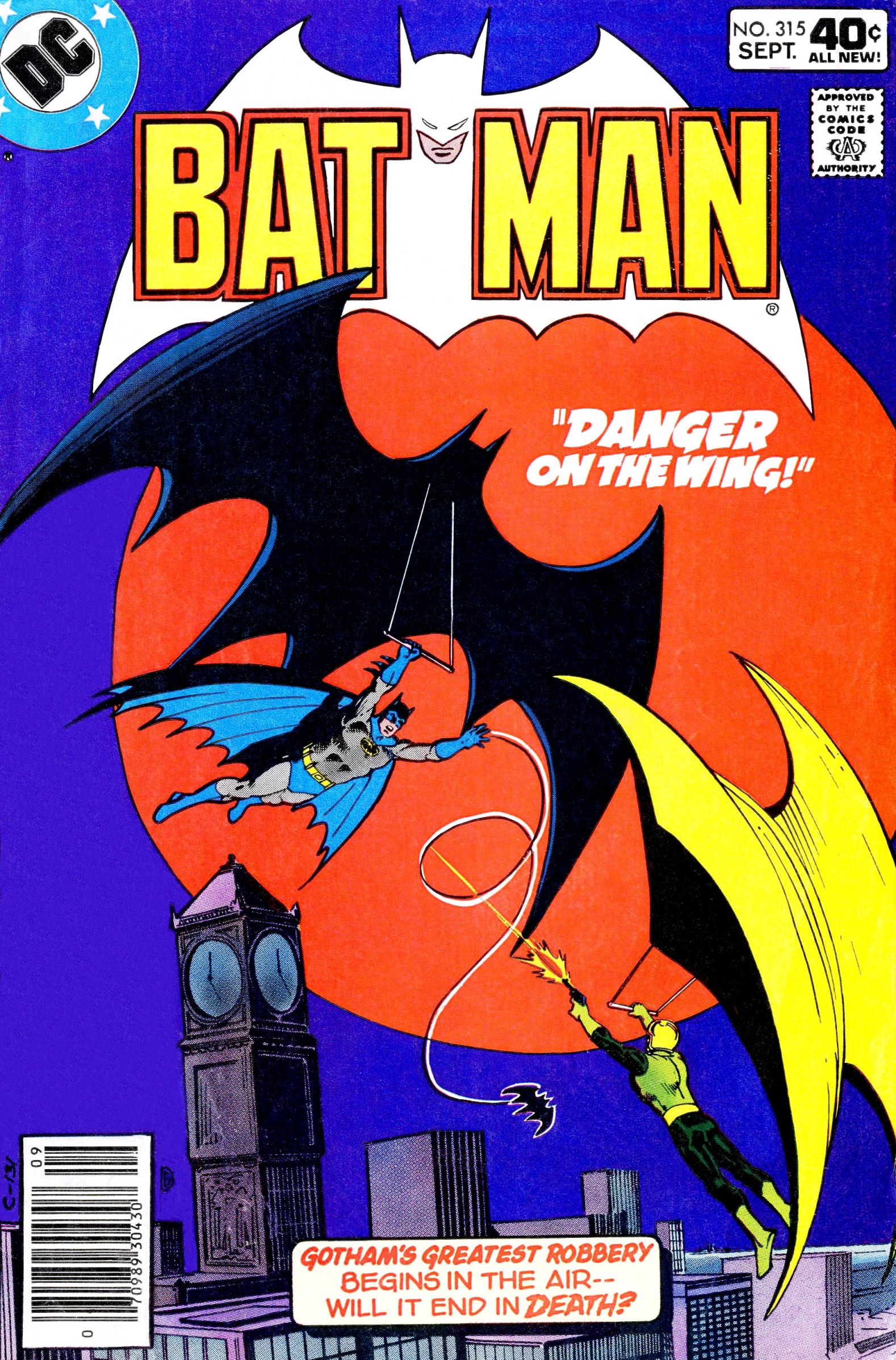
Among the first books that I picked up on my inaugural visit to the Stationary store was this issue of BATMAN, a title that I hadn’t otherwise been following regularly. But this was the beginning of me reading it every month, at least for a while. I don’t know whether I was motivated my having more cash in my pocket that day or was simply drawn in by the bold purple cover spotlighting Batman and, of all villains, Kite-Man against a Gotham skyline. But I bought in with my 40 cents regardless. At this time, editorship of the series had passed into the hands of Paul Levitz, and he had been steering things towards a greater consistency and coordination of the different Batman titles, though the wouldn’t regularly begin crossing over with DETECTIVE COMICS for some time yet. But it was a more Marvel-like approach to the character, one perhaps propagated by the fact that this manner of consistency in approach was something that the steadily-growing Direct Sales market readers were responding positively to. On the other hand, as a fan himself, it’s possible that Paul simply preferred things that way, moreso than his editorial predecessors had.
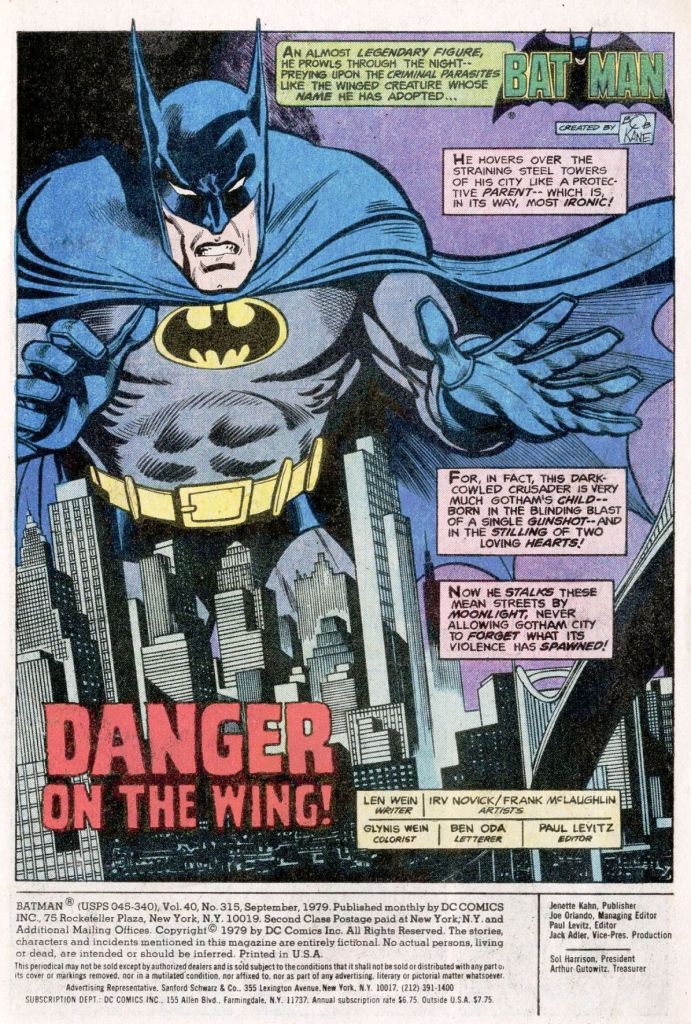
Visually, the series looked the same as it had since I started reading comics, with artist Irv Novick delivering a Neal Adams-inspired rendition of the Masked Manhunter. Batman was treated as a dark character in these days, but not too dark–that was still to come. But the shadow of the 1966 live action television treatment still loomed large–the show was still playing in afternoon reruns and influencing the popular conception of just who and what the character was. So the comics tried to walk a line, making Batman more grim and serious, but not too much. Writer Len Wein was an established professional by this point, and Batman was his favorite super hero, so he no doubt enjoyed his time on the series. But Len wasn’t above bringing back some of the more outlandish elements of the Caped Crusader’s past in contemporary stories, such as this issue’s main villain, the Kite-Man. Kite-Man had been a 1950s-era foe who hadn’t been seen in years outside of the pages of a BATMAN FAMILY reprint. But Wein treats him with the same legitimacy as everybody else.
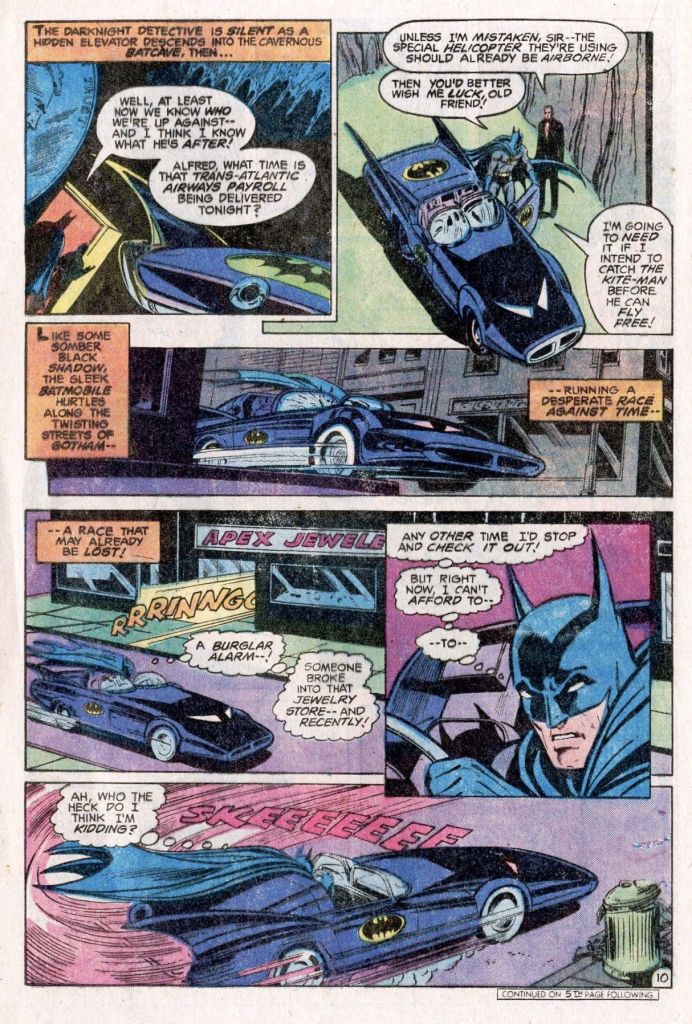
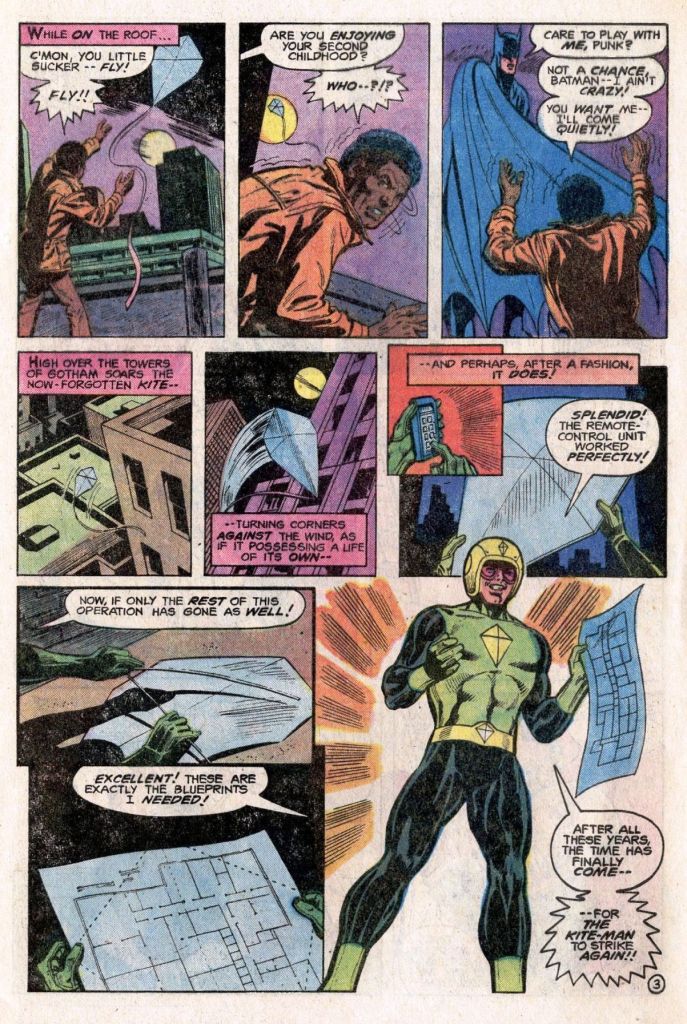
Len also put a lot more emphasis on Batman as Bruce Wayne, and this issue devotes at least a third of its pages to Wayne’s ongoing situations–whether that involves business rival Gregorian Falstaff making overtures to Lucius Fox to come work for him, or Wayne dating the reformed Selina Kyle, formerly the Catwoman. it’s a very human, very Marvel sort of a treatment of the character. The main concern this month is that Falstaff’s company Trans-Atlantic Airways is moving its headquarters out of Gotham City, causing economic turmoil in its wake. The firm’s final payroll is being delivered that evening, and it’s the Kite-man’s target. Early in the issue, goons in his employ succeed in purloining the blueprints to the Trans-Atlantic Building where the payroll is being delivered by helicopter, thus permitting him to plan a heist. Discovering this, Batman heads off to intercept him–but along the way, he happens to pass a jewelry store that’s in the process of being burgled, and he simply can’t allow that to happen on his watch no matter how tight for time he happens to be.
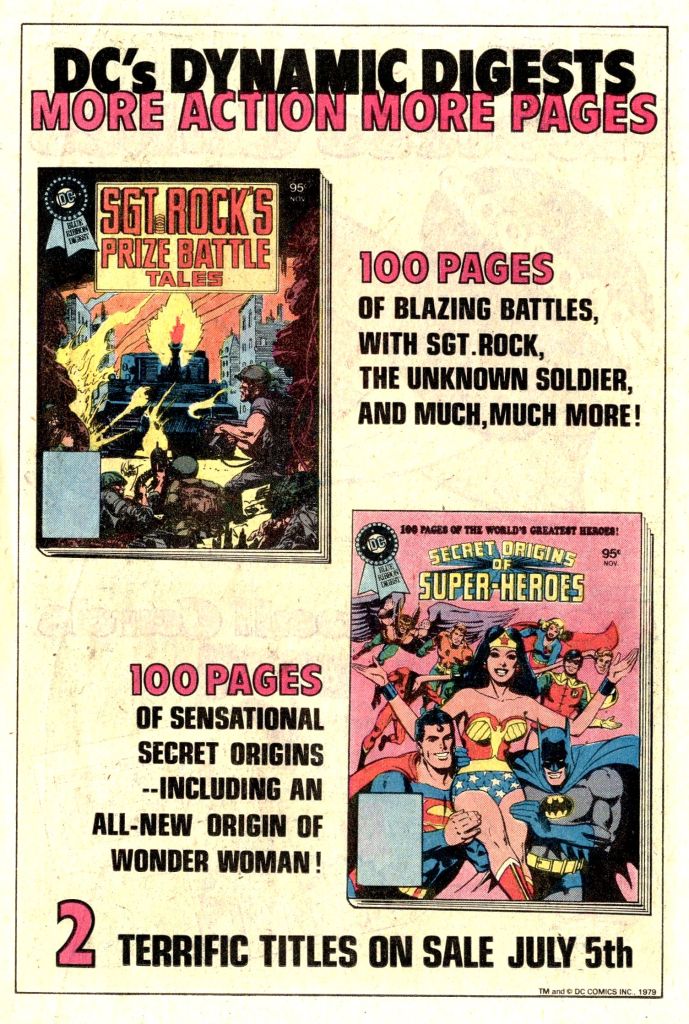
Speaking of digests earlier, this issue contained a house ad for the next releases in that line, which I’d eventually find at the stationary Store in the weeks ahead. This issue was full of cool new house ads, some of which I’ll include in this overview. They certainly made an impact on me as a young reader.
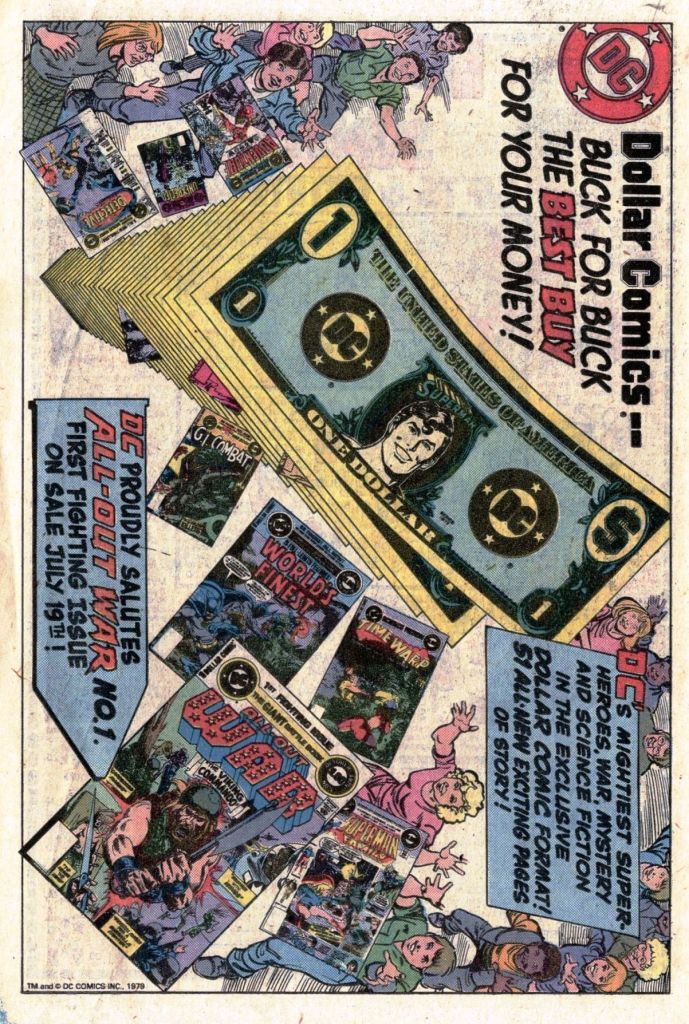
Dollar Comics was still an initiative that relatively new DC publisher Jenette Kahn believed in, so the issue included this house ad for the line as a whole, spotlighting the newest Dollar Comic to be released, the short-lived ALL-OUT WAR #1.
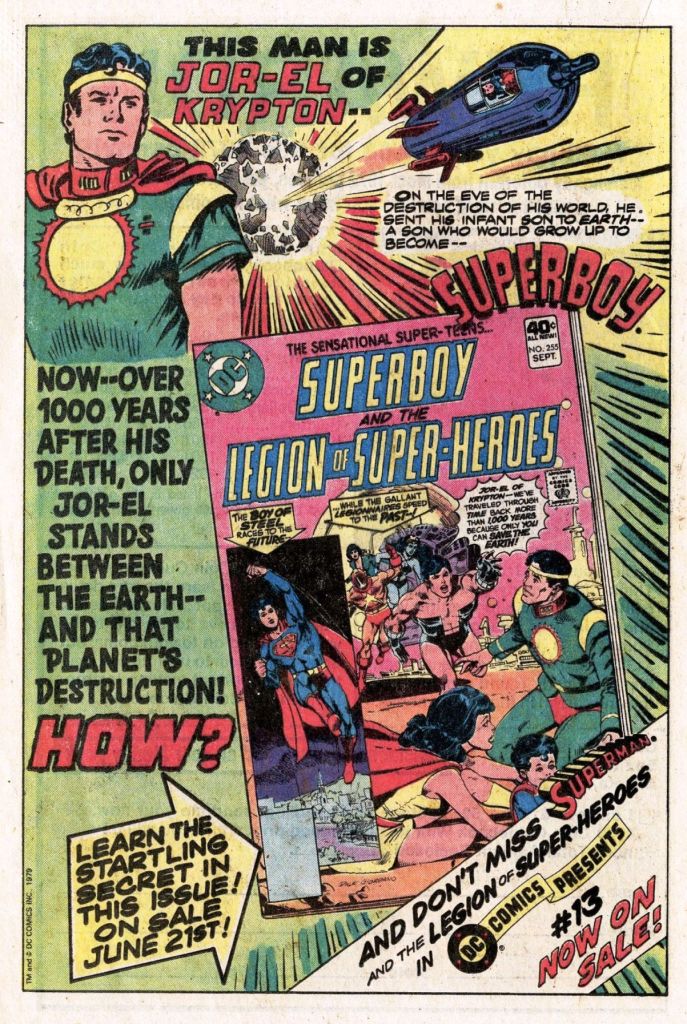
I don’t know if this surfeit of house ads indicated that DC at this moment was having difficulty selling paid advertisements or what, but this book is absolutely full of very nice ads for upcoming releases. This one spotlights the next issue of SUPERBOY AND THE LEGION OF SUPER-HEROES, spotlighting its Jor-El-connected storyline possibly in the hopes of grabbing a few readers who came in off of the excitement surrounding SUPERMAN THE MOVIE. it also mentioned DC COMICS PRESENTS, a title that I had never seen an issue of up to this point but which I’d now be able to find at my new Stationary Store outlet.
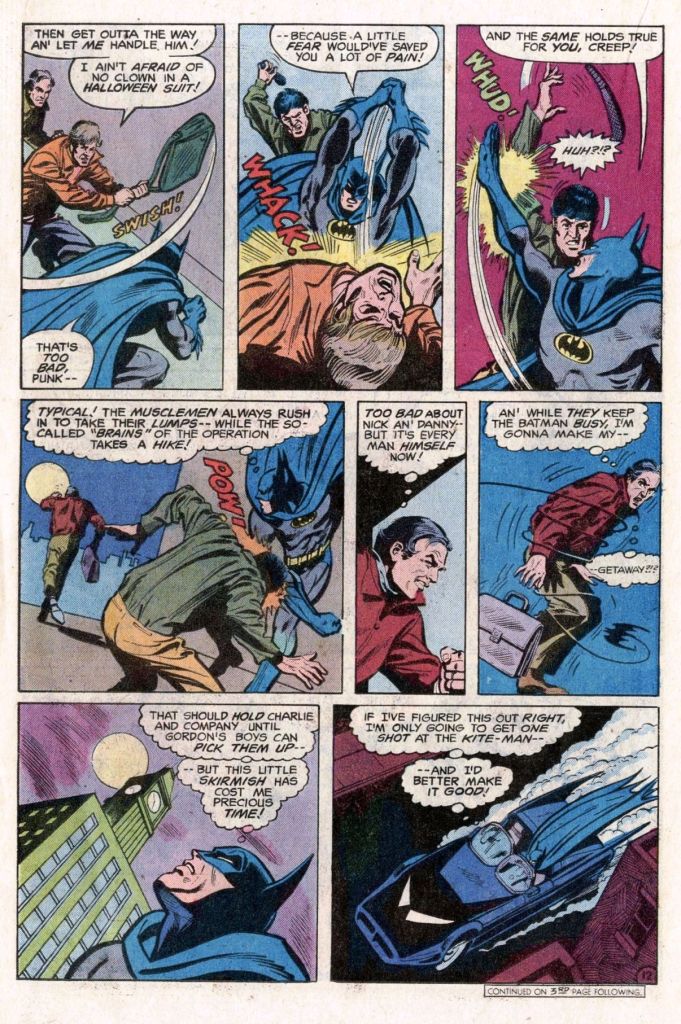
Batman stopping mid-pursuit to foil the jewelry store robbery gives the issue a nice bit of personal action just after a bunch of sequences heavy with personal stakes but no genuine super hero excitement. The whole thing is a bit of a cakewalk for the Darknight Detective, but it is enough to delay him to the point where he realizes that Kite-Manis going to be able to make his escape before he can arrive. Unless…
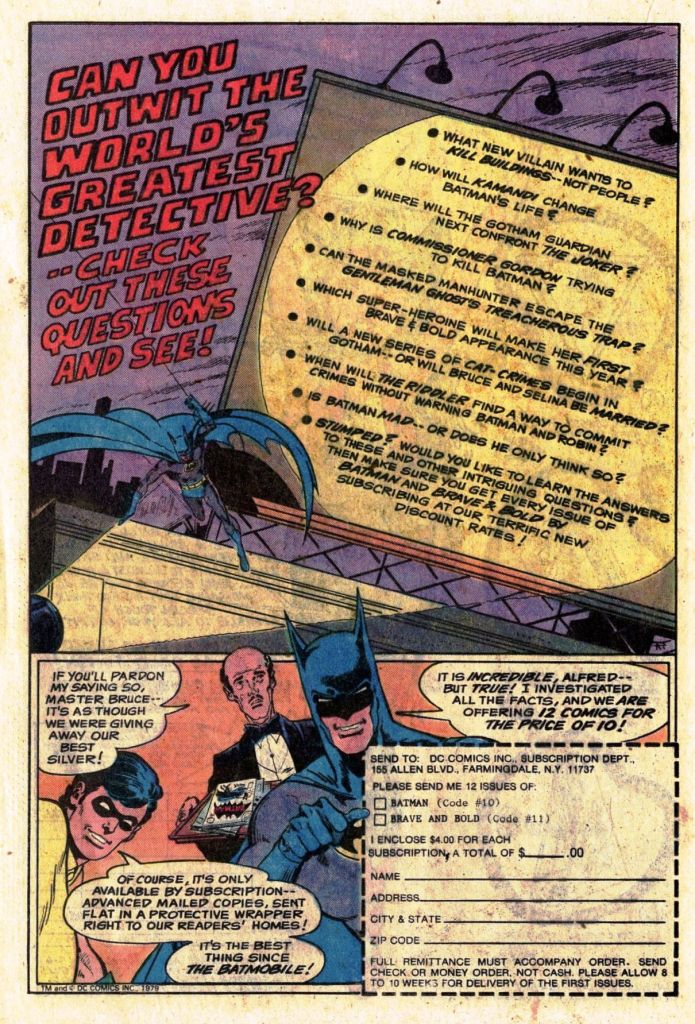
One more house ad at this point, this one a thoroughly terrific subscription ad that teases upcoming events across the two Batman titles helmed by Paul Levitz. This ad was the work of Levitz and was pretty effective in making me want to check out future issues of BATMAN and BRAVE AND THE BOLD–though not convincing enough to get me to subscribe to either.
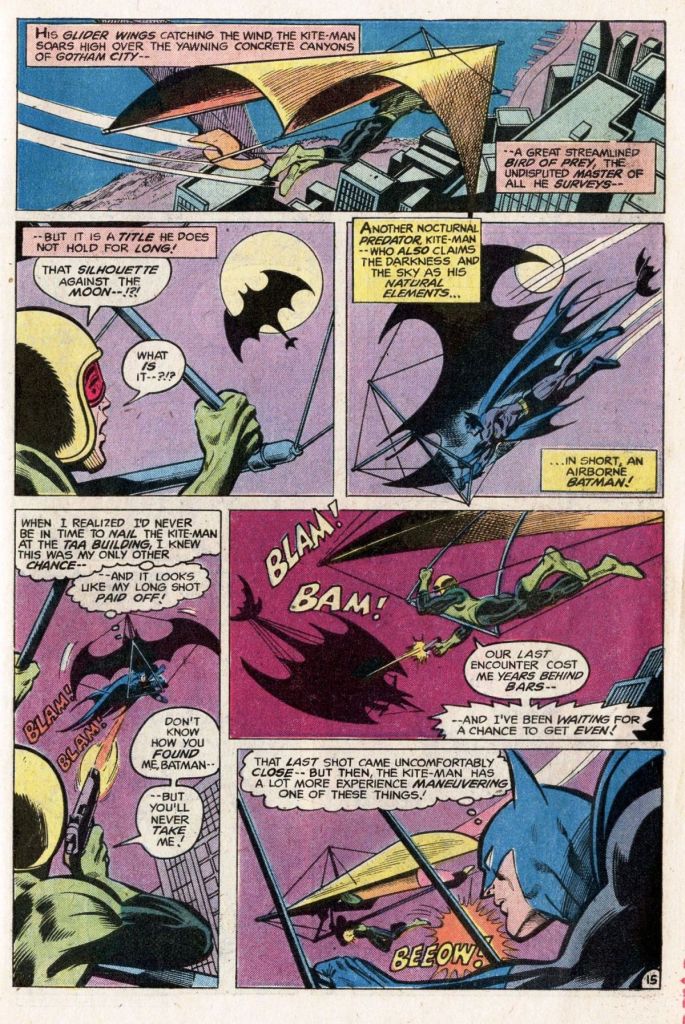
Meanwhile, up on the roof of the Trans-Atlantic Airways building, Kite-Man and his henchmen carry out their heist, using kites filled with nerve gas to incapacitate the guards so that they can make off with the payroll. One of Kite-Man’s men asks his boos if he’s sure the giant glider kite that they’ve brought in order to effect their escape will be strong enough to hold them all, and Kite-Man responds by gassing his own men, double-crossing them, and heading off the building on his own. But just as the cover to this issue indicated, just as soon as Kite-man thinks he’s gotten away with his loot, a dark shape appears in front of the moon. It’s Batman, racing to the scene on his own bat-shaped glider.
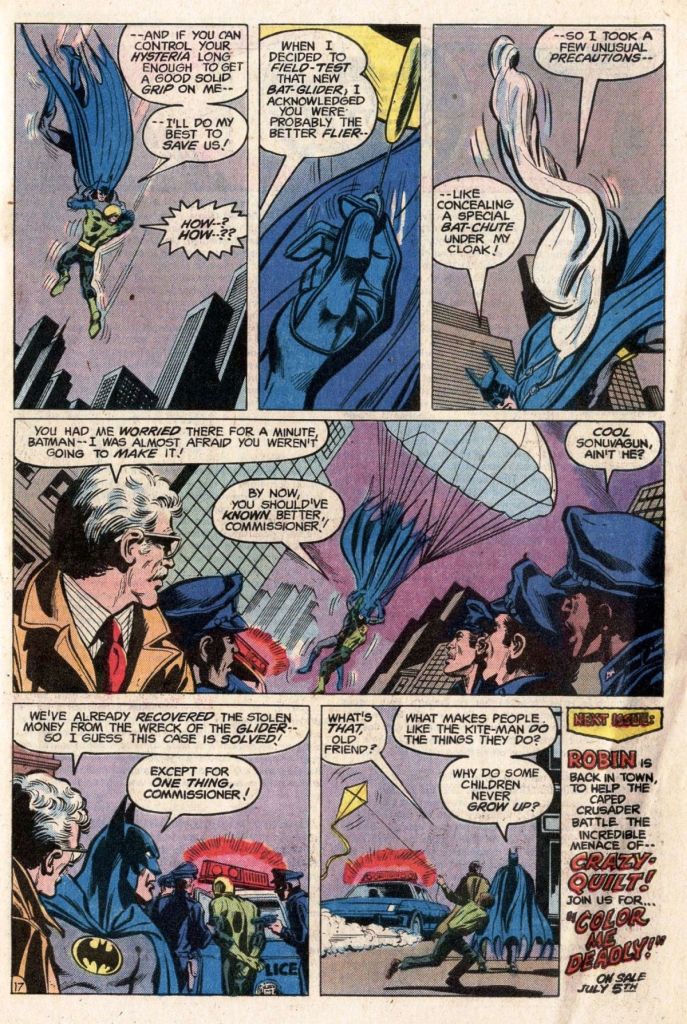
Batman uses a pellet from his utility belt to create a dense cloud of smoke, then deliberately collides his own glider into that of Kite-Man in midair, sending both men plummeting to the ground below. But this is all part of Batman’s plan–he prepared ahead of time, equipping himself with an emergency Bat-Chute under his cloak to arrest their fall. Commissioner Gordon and his officers are waiting below, and they take Kite-Man into custody, thus wrapping up the adventure.
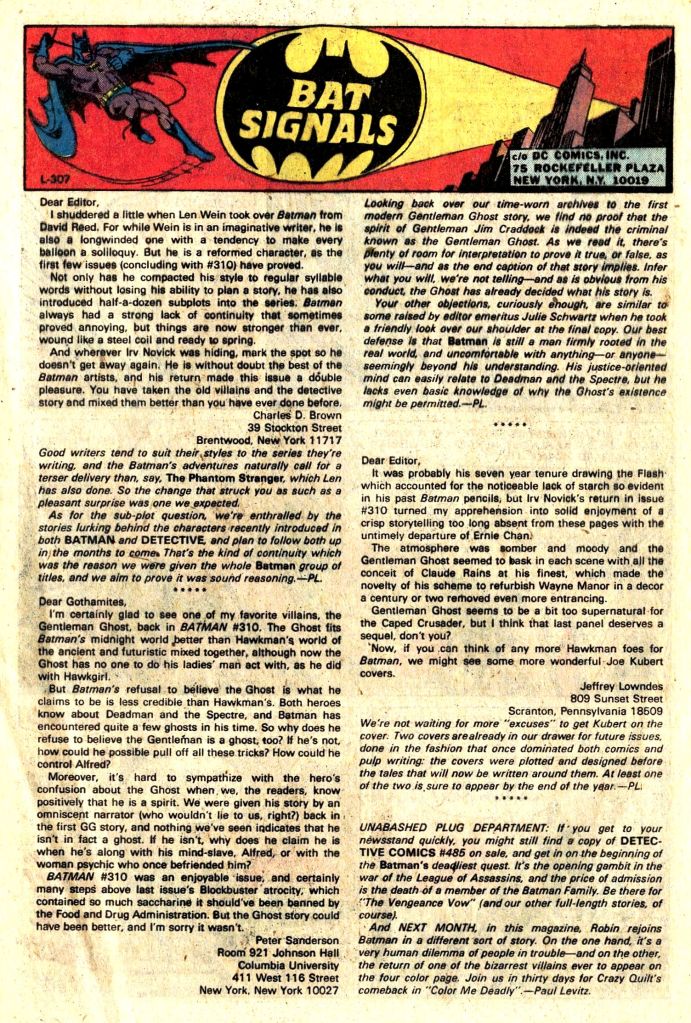
The Bat Signals letters page in this issue included another letter from Peter Sanderson, future comic book historian and researcher. Peter was a semi-regular contributor to such pages, to the point where his name became known among the people at most of the major companies, thus helping to open up a few doors for him in the future.
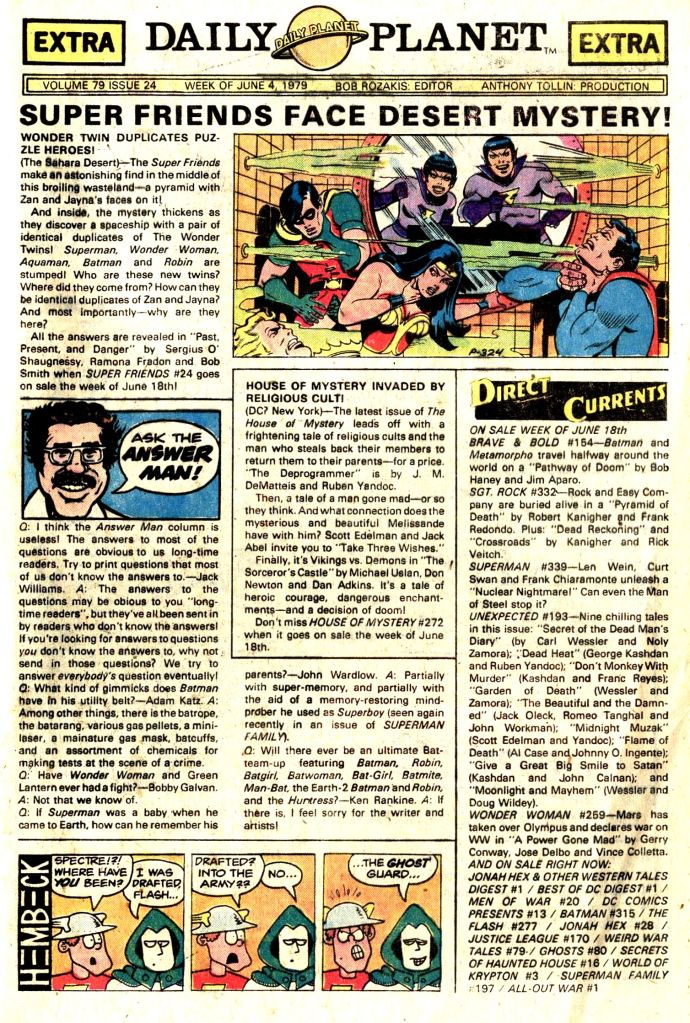
The issue also had the latest installment of the Daily Planet promotional page, which spotlighted the coming week’s releases and also ran such regular features as Bob Rozakis’ Ask the Answer Man column and Fred Hembeck’s cartoon strip. Reading this page was almost as exciting to me as reading the comics it ran in, depending on what new releases were spotlighted.
 The Tom Brevoort Experience
“But it was a more Marvel-like approach to the character, one perhaps propagated by the fact that this manner of consistency in approach was something that the steadily-growing Direct Sales market readers were responding positively to.”
I doubt the direct market would have figured much into DC’s thinking in 1979. At that time, it accounted for a single-digit percentage of their sales.
LikeLike
Always got the idea that Tom Brevoort didnt like Batman that much. Unrelatable, I think he’s previously written in these posts. Wealthy, brilliant, athletic, & an excellent fighter. Unless maybe they came from a super serum, radiation, or mutated DNA at birth.
I’ve seen Tom’s, I don’t know, incredulous reception of the dark knight detective more than a few times over several years now. I wouldn’t say outright disdain. Tom respects Batman’s significance to the history of comic books. And as one of his company’s “Distinguished Competition’s” best assets.
And he wouldn’t have bought and read as many stories featuring Batman if he hated the character. He obviously recognizes and appreciates when good, even great work has been done with it. And the background on those creators and editors has been enlightening.
I think there are probably other longtime readers of this blog that may have noticed Tom’s recently withheld much criticism of Batman as a character, or his lack of enthusiasm for it, compared to other characters Tom’s more openly expressed admiration for. The Thing, Spider-Man, Ma Hunkle (just kidding).
Maybe Tom’s appreciation of Batman has increased a notch or two, over the last 20+ years.
I’m also surprised, unless I totally blanked on it, Tom didn’t mention Jim Aparo when including that house ad for subscriptions to the Bat-books. Tom has been clear in his respect and appreciation of Aparo’s distinct depiction of Bronze Age caped crusader. Maybe he’ll go back and that in.
Nice to see Glynis Wein’s colors grace this issue. I think she was still on “Uncanny X-Men”. Cool, moody pallet.
And stalwart letterer Ben Oda. I think he worked on the Superman titles, too. I remember eventually reading about his upcoming retirement in one of the Direct Currents, or letters pages. He worked on so many books. About as prolific in his day as Saladino,, Constanza, Klein, Novak, Morelli, Rosen, or anybody else, if I remember correctly.
Len’s closing line from Batman about Kite-Man in this story. “Do some children never grow up?”. Maybe not. Some certainly dont grow too far from childhood tragedy, as Bruce suffered. Maybe a kite flew threw a window in hi
LikeLike
house? 🙄😉
LikeLike
In Maryland, we had a chain of stationery stores called New Center, which sounds like the stationery store you described.
LikeLiked by 1 person
Oops, I mentioned “News Center” in previous comment.
LikeLike
Len Wein’s run was fun. And he was IIRC, the first to give Selina and Bruce an ongoing relationship rather than the Bat-Cat flirting.
Kite-Man’s return interested me — I’m the kind of nerd always delighted when obscure foes turn up (okay, almost delighted). Jenny Isabella did better making him a loser in Hawkman (and explaining his kite fixation).
LikeLiked by 1 person
When it comes to Kite-Men I like the Jack Kirby version better: Night Flyer [ Captain America#213-214 ( September-October 1977 ) ]. I liked Night Flyer since I first saw him in The Incredible Hulk#264-265 ( October-November 1981 ). Maybe Kite-Man would be more interesting if he had cool tech too or dress him in black and make him more cat burglar like.
LikeLiked by 1 person
I really liked the idea of thick comics like the 100 Page Super Spectaculars or the Dollar Comics we see advertised here. It’s too bad they tied the name to a unit of currency during a time of high inflation. Great idea, but the naming would mean a leaner and leaner package, and a lot of the times the execution wasn’t great.
I wonder if they’d not tied the name to Dollar if they could have survived on the newsstand, where I understand they were very profitable. I don’t know that they would have done well in the direct market which didn’t like anthologies much.
LikeLiked by 1 person
The last surviving Dollar Comics did go to $1.25, as I recall. G.I. COMBAT dropped the “Dollar Comics” name but kept the trade dress for a while, and ran for close to two years at that price, thought by then it was down to a 48 page package.
I think there were some Dollar format annuals or specials at $1.25 or $1.50 as well. But by then the writing was very much on the wall.
LikeLiked by 1 person
I don’t know that the Dollar Comics were ever that profitable, if at all. The idea with the format was that the higher price point would get them wider distribution in supermarkets and so forth, but it didn’t seem to do anything for sales. Looking through the annual sales statements, the numbers were invariably sub-80k unit sales with 35% or lower sell-throughs, which is terrible. It was consistent with the doldrums almost all of DC’s line was in. The only DC newsstand titles that showed any kind of profit in the first half of the 1980s, at least in terms of North American sales revenue, were New Teen Titans, Legion of Super-Heroes, Justice League, Warlord, Superman, Action Comics, and DC Comics Presents.
LikeLike
Very minor note: You were going to a stationEry store — which got its name because stores of that sort started out selling stationery — not a stationAry store, which would simply be a store that doesn’t move around, not much of a distinction.
We had stationery stores in my area, but none of them sold comics. For that, I had drugstores and convenience stores, and very shortly after I started buying, a specialty comics store.
Paul Levitz’s arrival as BATMAN editor did good things for the Bat-books, but also a couple of bad things, though they were very understandable. When Julie Schwartz was editing BATMAN, he’d chivvy Len along to get his scripts in, and when Len was late he’d have fill-inns prepared. Paul, on the other hand, told Len that he had to get the scripts in on time and if he didn’t, Paul would reluctantly fire him. And Len didn’t, and Paul fired him, ending Len’s run as Bat-writer, which was sad for me because I was enjoying it.
Paul also ended Bob Haney’s run on B&B, which I didn’t mind because I thought Haney’s scripts were nuts, and not in a good way. But Paul didn’t really replace Bob with anyone who gave the book an identity or a sense of direction, so it just felt like a parade of fill-ins — sometimes excellent fill-ins, many times not — something subsequent editors Dick Giordano and Len Wein couldn’t or didn’t fix, either. And B&B went from being reportedly a strong Bat-title to a weak one and eventually got canceled.
We got BATMAN & THE OUTSIDERS as a replacement, but as a guy who likes team-up books when they’re well done, I’d rather have had both instead of just one.
LikeLiked by 1 person
I had fond memories of Alan Brennert and even Mike Barr’s work on the book as it went toward the end.
The book was circling the drain towards the end and they tried some interesting things.
One of Haney’s last B&B stories was a Batman/Green Lantern story that, as I understand, was actually written by Mike Barr under an arrangement with Haney.
If I remember the story correctly, the initial friction between Levitz and Haney was changes Levitz asked for on a Batman/Creeper team-up that Haney did not agree with and Levitz got Cary Burkett to fix the story.
Rather different than when Murray Boltinoff had fired Neal Adams off the feature for changing Haney’s second Batman/Deadman story.
LikeLiked by 1 person
Wait wait wait … we just had a Kite Man story, and no one is going to mention the first missive in the lettercol was from a “Charles D. Brown”?! And that Tony Isabella chose that name for the villain as a nod to the Peanuts character?
LikeLiked by 2 people