

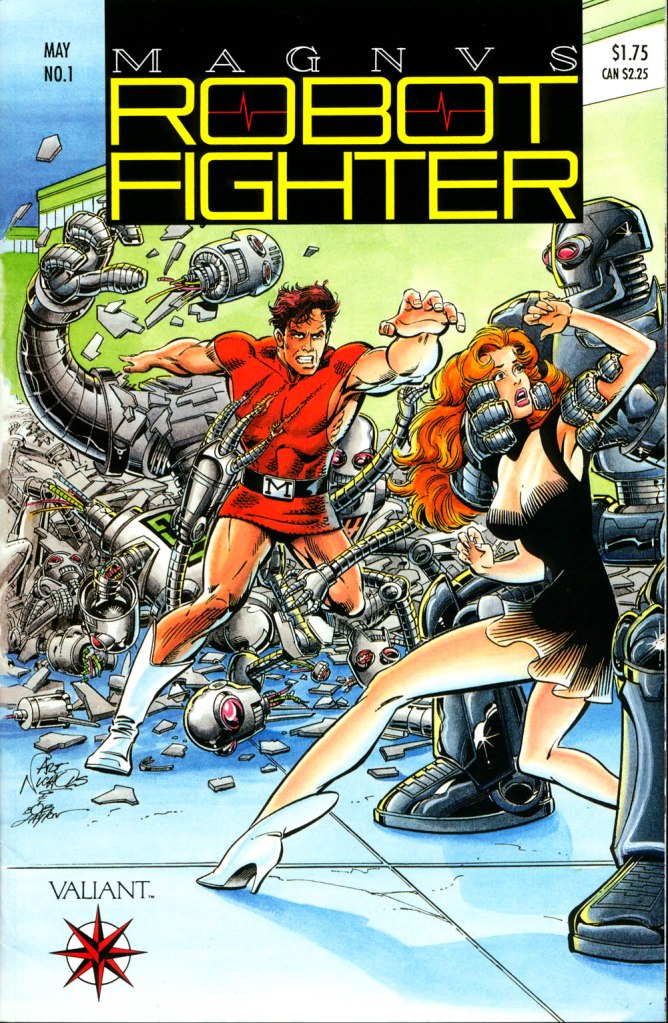
The VALIANT line of interconnected super hero titles were really the successors to Marvel’s New Universe efforts. They evidenced a similarity of ethos, though they were both better conceived and better produced for the most part–and thus were a lot more successful. Whether this was due to Valiant EIC and lead writer Jim Shooter having learned from the New Universe experience, or simply that he was better able to communicate his vision for this new line of titles in a way that he couldn’t for the New Universe (or some combination of the two), the fact remains that the Valiant books represented a strong alternative to the super hero fare being put out by Marvel and DC at the time. For a while, it looked as though Valiant was going to have the staying power to become a lasting third alternative in the Direct Market. Alas, market downturns and turnover in the creative staff ultimately brought the company to ruin, and while the characters have since been revived a couple of times, it’s never been with the impact or the energy of that first series of launches.
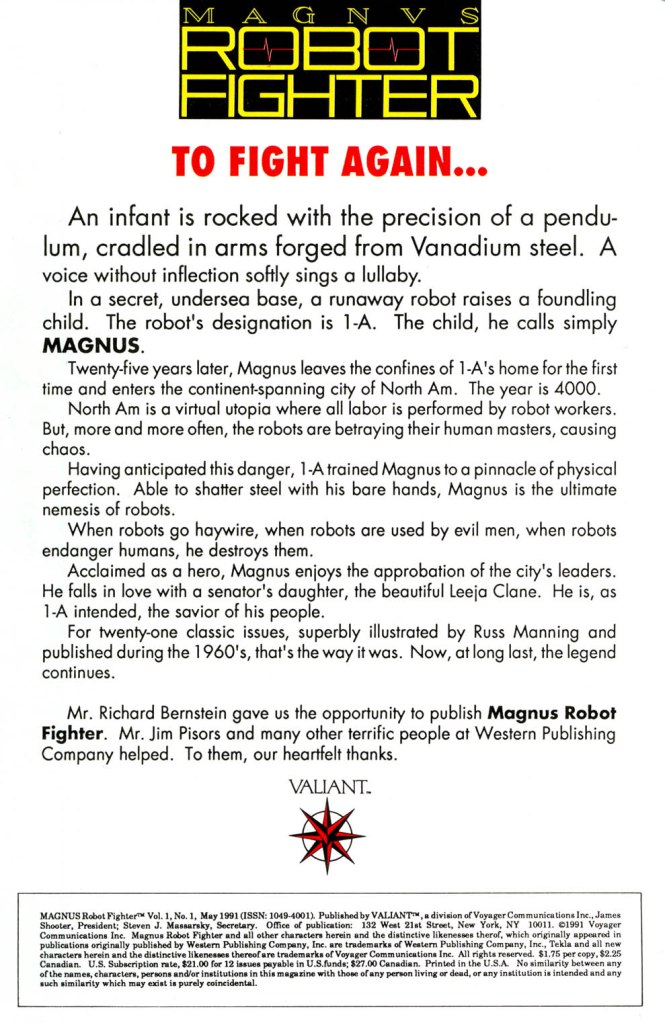
So a bit of backstory before we dive into this issue. MAGNUS, ROBOT FIGHTER was the creation of writer/illustrator Russ Manning, who worked on the series for Gold Key back in the 1960s. We covered the first issue here:
The book ran for 46 issues through 1977, though much of the latter portion of the run was made up of reprints of the earlier stories. so the character was dormant though familiar to most comic book readers of a certain age at that time, and certainly to comic book retailers. Meanwhile, by the start of the 1990s, Jim Shooter had been ousted as Editor in Chief of Marvel. He put together a consortium of investors in an unsuccessful attempt to by his former employer, and when that bid failed, the team decided instead to start up their own rival comic book company. Shooter had previously had dealings with Richard Bernstein at Western Publishing, and Bernstein agreed to license Magnus as well as the firm’s other dormant comic book properties to Shooter’s new venture. This would give Valiant a set of recognizable characters to start to build out from.
As he described it in later years, the Valiant team was a hodge-podge of a creative staff, comprised of people who were loyal to Jim and went where he went, veteran creators who were finding it difficult to get steady work elsewhere, and absolute newbies who were raw and untested but who showed a spark of promise. From these disparate elements, Shooter put together the Valiant Universe. He led with some of his strongest pieces, writing this initial issue of MAGNUS, ROBOT FIGHTER himself. The penciling was done by Art Nichols, who had been in the industry for a while, with polished inking provided by Bob Layton, who was then close to Shooter (though the pair would eventually go through irreconcilable difficulties when Layton chose to remain with Valiant rather than side with Shooter when things got bad.) Don Perlin, longtime artist and former Marvel Assistant Art Director, is listed as the title’s editor, though I have to imagine he was simply giving input along with everybody else on the team. At the end of the day, the initial Valiant books all conformed to Shooter’s vision and he was the ultimate authority on the work being produced.
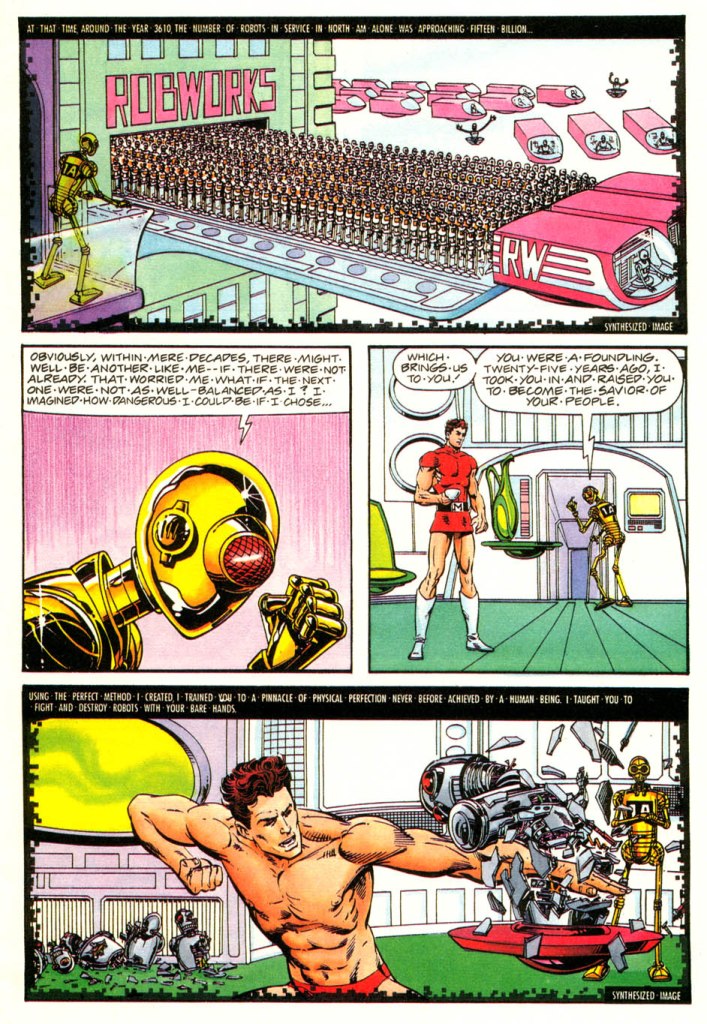
Artistically, MAGNUS, ROBOT FIGHTER as well as the rest of the initial Valiant title hew closely to Shooter’s vision for what made for good comic book artwork. He was a fiend for clarity, and preferred tight grid structures on each page with a clear delineation of borders and gutters. Shooter liked the work to be almost diagrammatical, and so he preferred a preponderance of medium shots so as to better indicate the spatial relationships between the characters and their environments. These were fundamentals that he’d had drilled into his head by the likes of his mentors Mort Weisinger and Stan Lee, and they served to separate Valiant’s offerings visually from everything else on the stands. As other companies’ pages were becoming more graphically complex, Valiant’s books were almost storybook in how classically they were laid out. They depended upon story and what was within the panels to carry the day. Additionally, the Valiant books were printed on nice paper and boasted some fine process coloring, in this issue provided by Janet Jackson. The entirety of the package is very appealing.
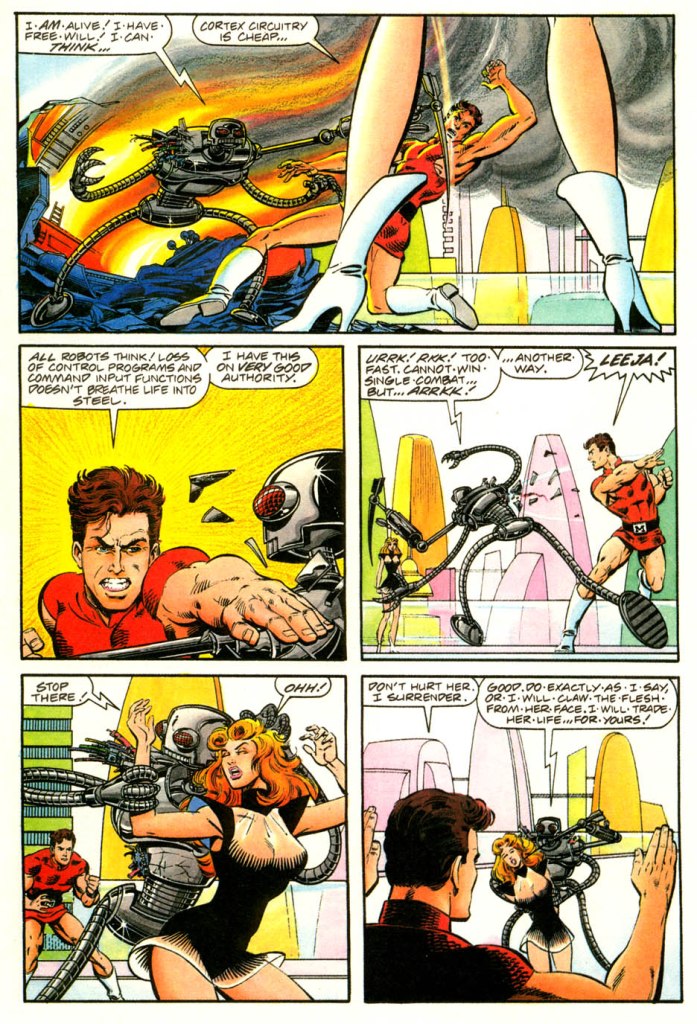
Rather interestingly, Shooter chose to begin his series not with a clean beginning, but rather with the assumption that all of Magnus’ earlier Gold Key adventures had happened. So this was a revival rather than a reboot. At the time, there wasn’t yet a preponderance of Trade Paperbacks and other collected editions, so for new readers now coming to the series, the only way they had to experience those earlier adventures was to seek them out as back issues. But that said, those earlier stories formed only the backstory of what Shooter was about to do here. He used them as the bedrock on which to construct his new approach to the character. In those earlier stories, robots were considered no more than artificial tools of humanity, and robots who might pose a danger to people due to some malfunction were swiftly annihilated by Magnus’ metal-smashing hands. The question that Shooter based his opening story upon was: what if those robots aren’t simply malfunctioning automaton but rather beings who had become self-aware, and discovered that they were being used as a slave class for their human creators? In a way, it’s a very similar approach to that taken by Alan Moore when he took over SWAMP THING; reconsidering the fundamental assumptions of the series and letting that guide a new and more expansive approach.
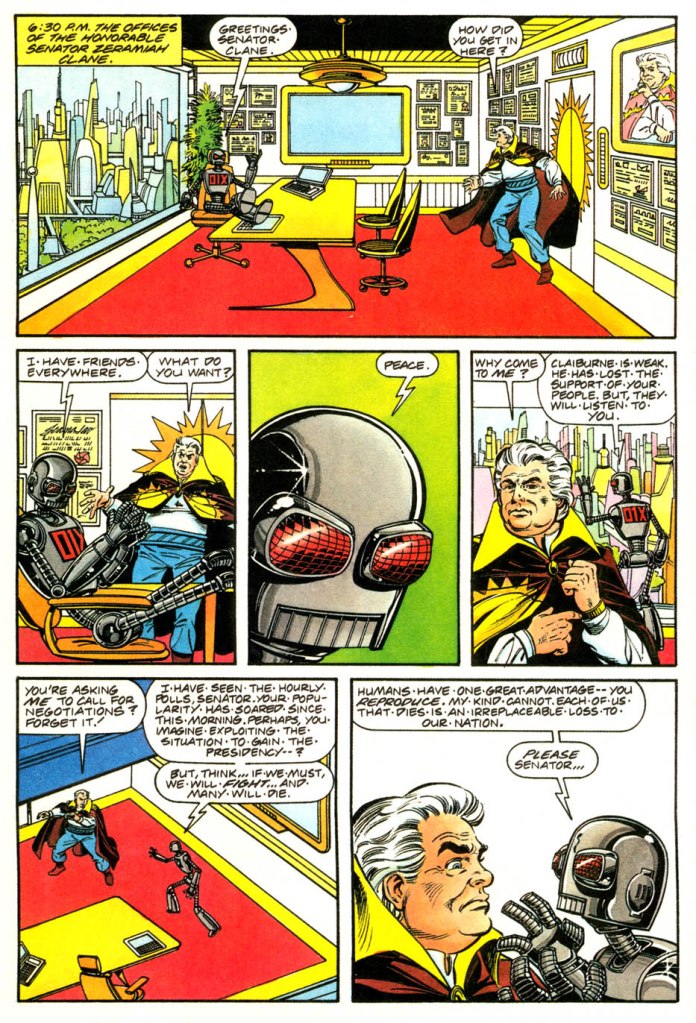
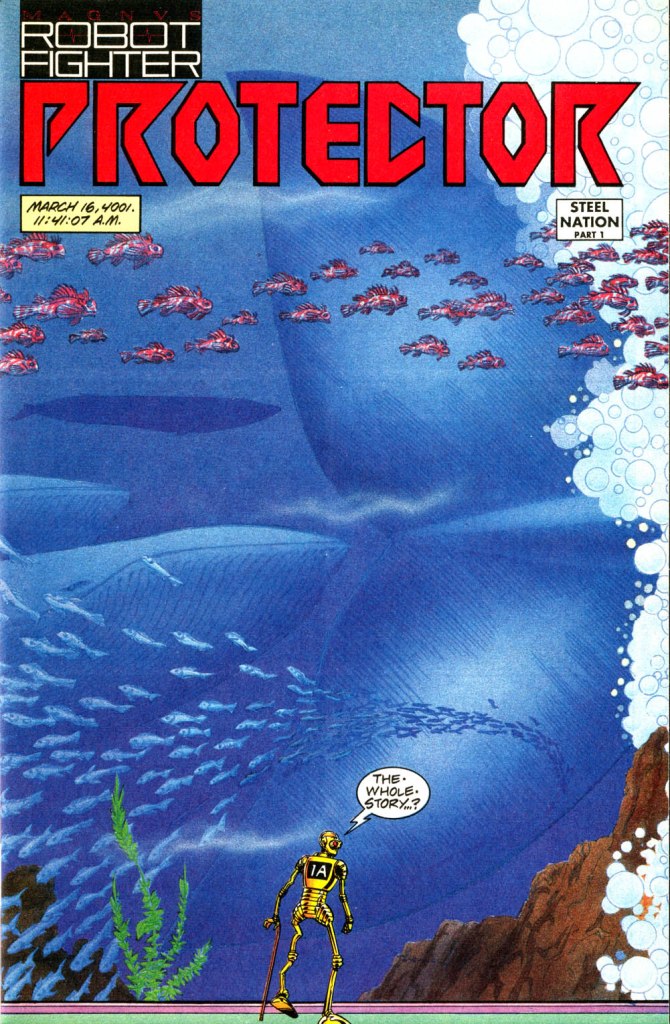
The issue opens with a helpful recounting of Magnus’ previous history by his mentor and father figure 1-A, the freewill robot who had adopted magnus as a foundling and trained him to his steel-smashing self. The news that had caused Magnus and 1-A to review the past is the revelation that recent malfunctions in robot manufacture may have resulted in their being as many as ten million free will robots across NorthAm. 1-A had trained Magnus to fight such free will robots, as he feared what they might do if they were not possessed of the same conscience that he himself possessed. But Magnus is growing increasingly uneasy about his role as NorthAm’s robot-destroying protector. He’s beginning to consider the notion that these free will robots may be as alive as any human being. 1-A himself doesn’t subscribe to this belief, insisting that no robot, himself included, is truly alive–but their discussion is cut short by a covert broadcast being sent out on a wavelength that only robots–and Magnus, with the translation device that 1-A secretly implanted in his brain–can understand. The broadcast is from a leader, 0-1X, hoping to create an uprising for his fellow enslaved self-aware robots, many of whom have been unaware that there are others like them.
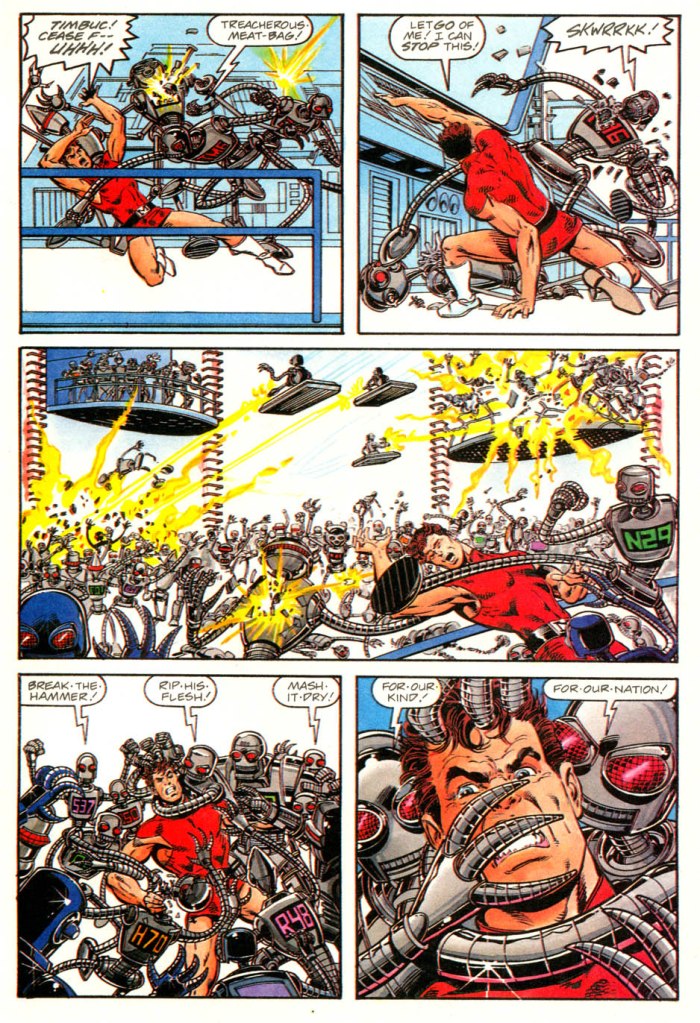
Magnus returns to the city where his girlfriend Leeja Clane and her father Senator Clane live. He’s in time to save Leeja from a free will robot that has turned on humanity, and he then attends a meeting of NorthAm’s leadership, swearing that he’ll defend human lives from this new robot threat. Together, Magnus and Leeja don disguises and venture down into the bowels of NorthAm, terrible slums in which the underdwellers, known as Gophs, congregate. Magnus has a hunch that this is where 0-1X and his followers can be found, and he wants to avoid a war if at all possible. Locating the robot enclave, Magnus calls in City-Security, who unleash a squad of Riot-Robs to annihilate the gathered rogue robots, then he steps out and begins a debate with 0-1X about the group’s aims and objectives. To the assembled hordes of free will robots, Magnus is the great destroyer of their kind–they see him as nothing more than a mass-murderer in the service of their subjugation. As the Riot-Robs arrive, a massive battle breaks out, and Leeja is critically injured in the ensuing melee. As the issue closes, Magnus is left to ponder all that he’s experienced so far, with Leeja’s father Senator Zeramiah Clane inadvertently profiting politically in his bid to become the next NorthAm President thanks to his daughter’s injuries at the hands of the free will robots that he’s been railing against.
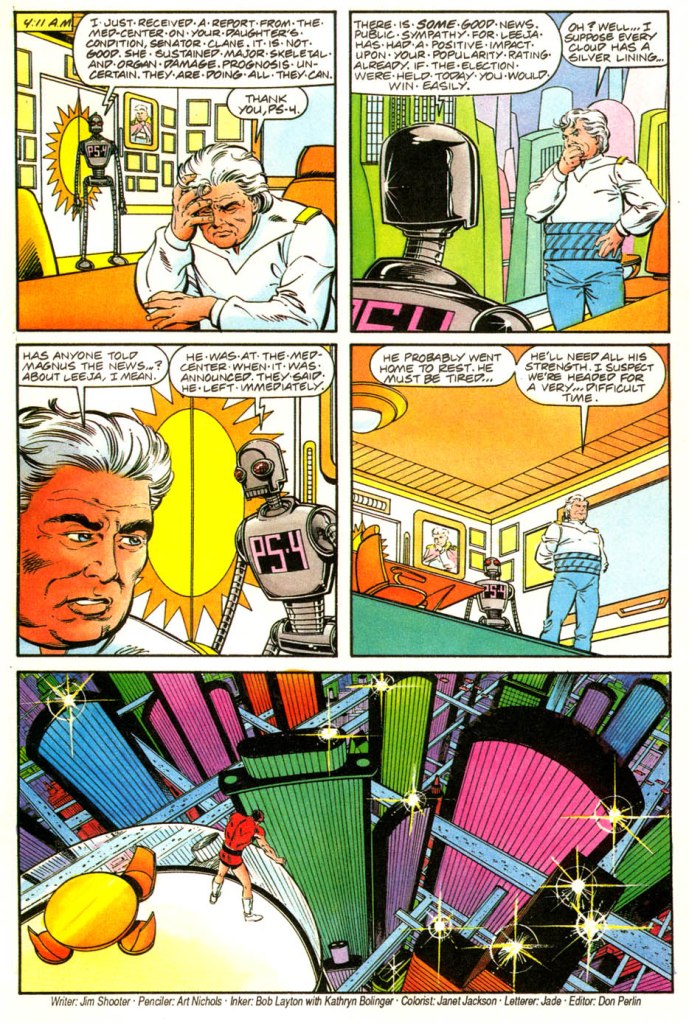
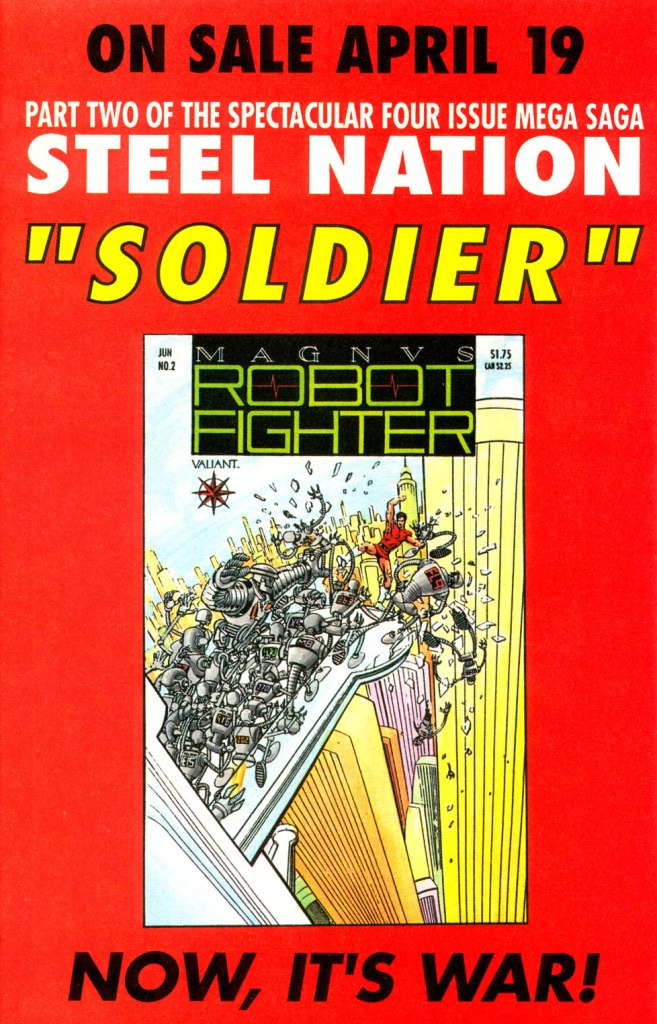
Ultimately, by the end of this first four-part story arc, Magnus will come to accept the truth of the situation: that the free will robots are sentient and alive and have as much right to exist as anyone else. He’ll leave the towers of NorthAm behind, settling in the bowels of the Goph slums, driven out by the bigotry and self-interest of the denizens of the high towers. And a separate colony of free will robots, known as the Steel Nation, will be established, with Magnus acting as a champion of both worlds. This first issue looks good and reads well, and sets up some interesting situations that will play out over the course of the run. It’s a strange but necessary choice to set up the outlines of what is intended to be an interconnected super hero universe in the far future year of 4001 AD, but Shooter and his team of creators did well with it, regularly introducing some of the components of their next project in the pages of the current one. Sales on tis initial issue of MAGNUS, ROBOT FIGHTER weren’t spectacular, but they would grow over time as more and more readers became aware of just what Shooter and his team were building at Valiant.
 The Tom Brevoort Experience
Any reboot of Valiant will fail without the Western/Gold key characters.
LikeLike
As a fan of the original, this sounds like a logical development — though like Eternals, Magnus may be a character I have no interest in following beyond the original run.
LikeLike
I remember Fabian gave such a great presentation at SD for the Acclaim/Valiant. Too bad it didn’t end up working out.
LikeLike
Nothing in the first iteration of Valiant interested me at the time. Thinking on it as I read this, part of it would have been the rigidity of the art. I prefer a happy medium where sometimes the story demands art that might take a moment to parse. Neither extreme, Shooter’s and its counterpart is good to me and too rigid. The licensed line up didn’t appeal either. I’d been aware of most of those properties before and what they had been like compared to my diet of DC and Marvel. To this day I haven’t red any of that run or any subsequent revivals of them. Harbinger got tarred with the same feather and I did follow one run but I couldn’t tell you which one.
LikeLike