

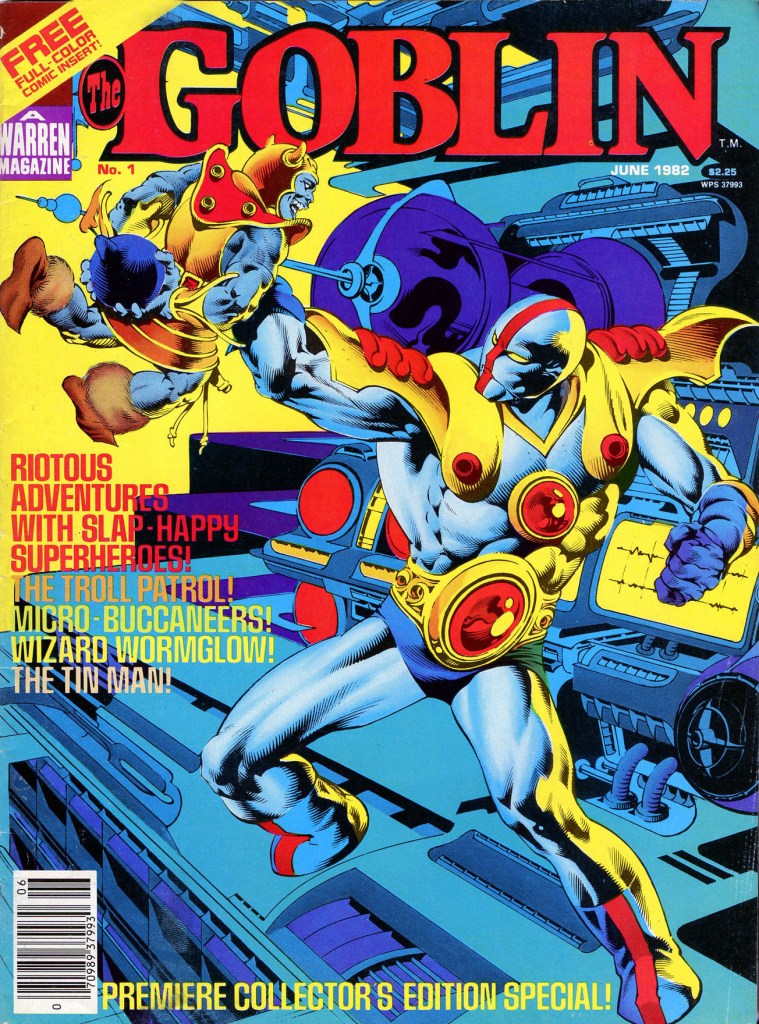
I hadn’t been a fan of Jim Warren’s assorted Warren Magazines. I’d sampled a couple of issues here and there of CREEPY and EERIE, but both the storytelling style and the subject matter left me reasonably cold. I was a super hero guy for the most part, and that was a genre that Warren didn’t have a whole lot of use for. Which is what made it interesting when this first issue of THE GOBLIN hit the stands. This was right at the tail end of Warren’s time as a publisher; the firm would shutter in just a few short months, not that there was any way to tell that from my vantage point. From where I sat, Warren looked to be pretty successful. If nothing else, his magazines were carried in a lot of places that didn’t otherwise have comics, due to the fact that they could be racked with the rest of the magazines. I’m sure the subject matter of many of them was attractive to the impulse purchasing audience also. But THE GOBLIN seemed poised to take advantage of the growing Direct Sales market, as well as my own interest. So coming across it on a newsstand, I picked it up.
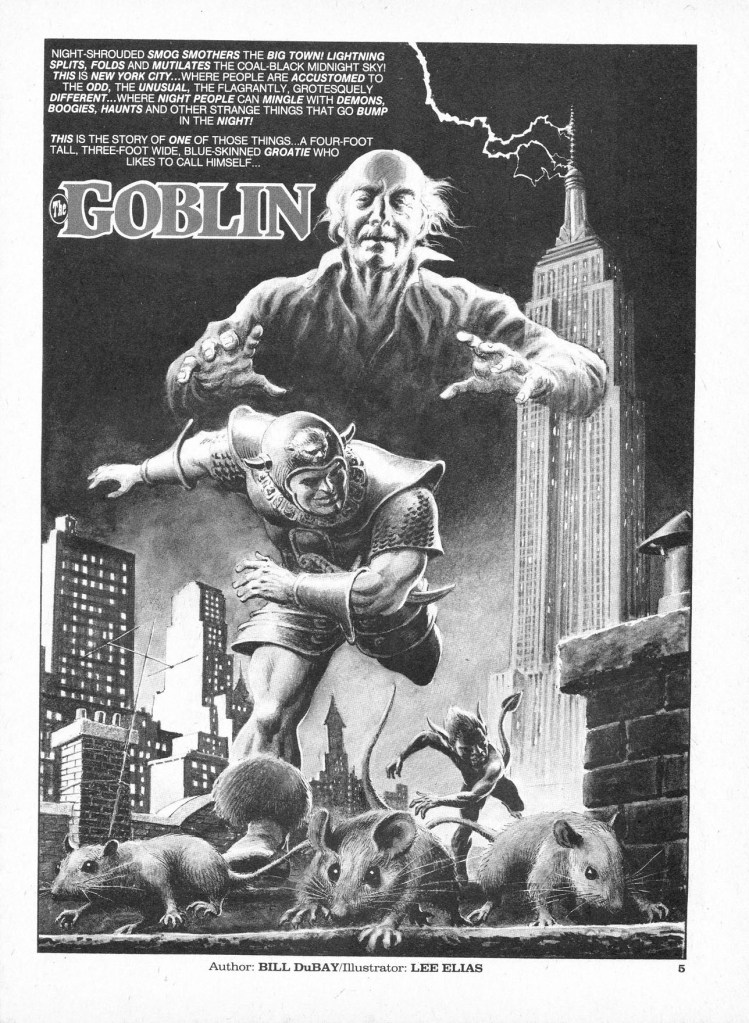
During this period, i was all over any new outfit who entered the field. In each case, I wondered if this new entrant might be the next Marvel Comics, so that I would be on the ground floor of future greatness. Few if any of them worked out that way, but I always had those hopes in mind whenever I came across somebody new doing a super hero book, and THE GOBLIN was no exception. The thing is, while it claimed to be a super hero title, THE GOBLIN really wasn’t any such thing once you got into it. It was more a collection of satirical fantasy strips than anything. Only the lead feature seemed enough like a super hero to clear the bar in my mind, and that wasn’t enough to keep me coming back. The Goblin was created by Warren writer/editor Bill Dubay and illustrated quite lovingly in a full wash style by career comic book artist Lee Elias. it was good looking stuff.
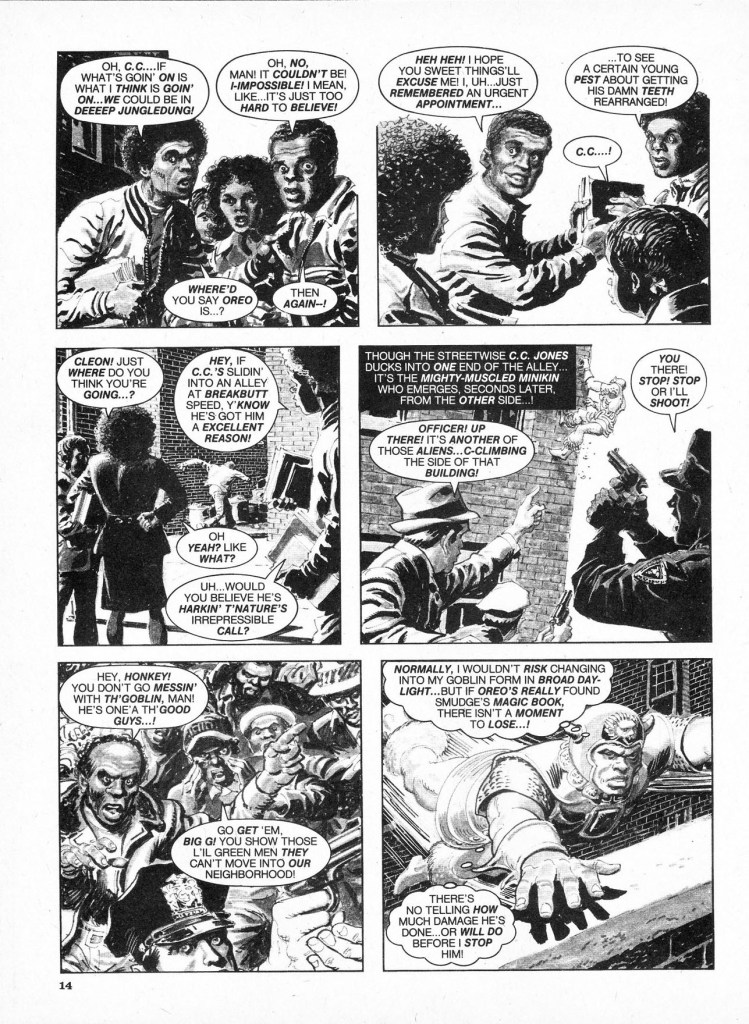
The Goblin was really Cleon Claymore “C.C.” Jones, who came across a magic book belonging to ghostly sorcerer Phinneas Smudge that allowed him to change into a four-foot-tall blue-skinned mass of mayhem known as the Goblin. Smudge’s spirit kept him company and functioned as a quasi-mentor to the kid, whereas his younger brother Penrod (nicknamed Oreo) was a constant irritant. As was the family’s slumlord landlord Mr. Grunge. In this opening story, Penrod winds up using Smudge’s book to accidentally conjure an alien invasion into existence. It’s up to the Goblin to protect the neighborhood, make everybody believe that the invasion was all just a film being shot, and maybe stick it to Grunge along the way. It was entertaining in its way, and it showed potential, but there was also something just a bit off-color and quasi-racist about the manner in which it treated it largely all black cast. So I wanted to like it, but I could also tell that something was a bit off about it.
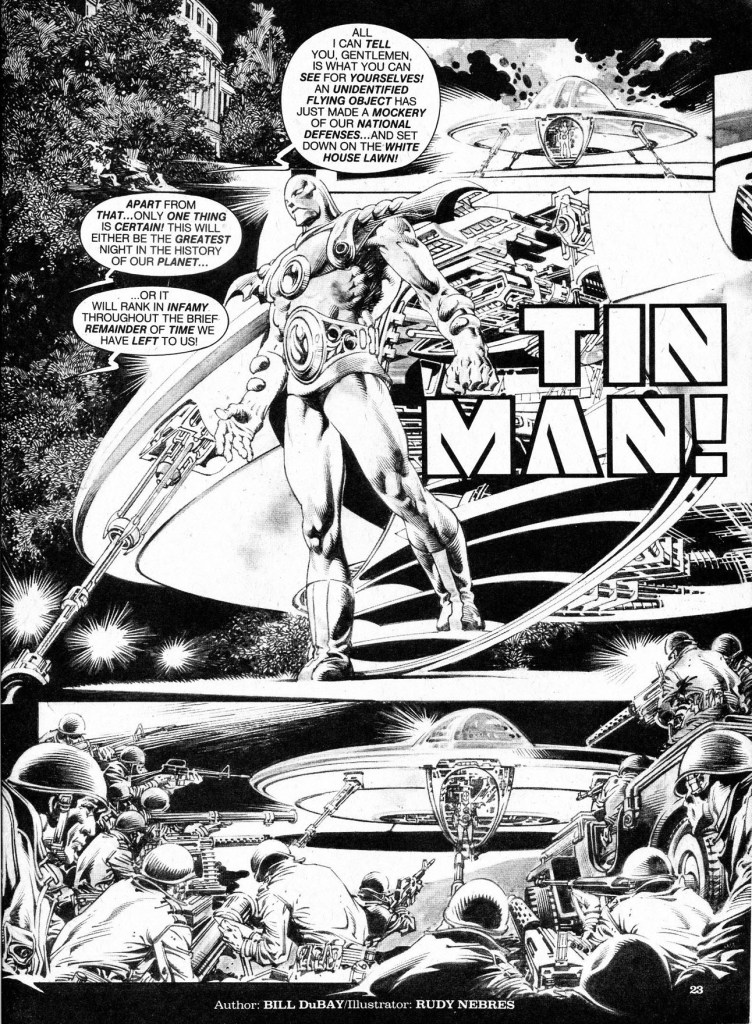
The rest of the features in this issue were of varying quality, and none of them were close to what I’d truly consider a super hero strip. The next story was Tin Man, which was about a secret cabal who, in attempt to bring peace to the world, created a faux alien landing complete with twelve-foot-tall armored robots commanding the Big Two superpowers to put down their weapons and end the Cold War. In a way, it was the same plot that Alan Moore knocked off for WATCHMEN, only executed a lot more clunkily. The artwork was by Rudy Nebres and it was lush, even though the actual storytelling and panel-to-panel continuity was a bit haphazard. Bill Dubay wrote this feature as well. This felt like a one-off, but it was positioned as a series. As I never read the other two issues of THE GOBLIN, I have no idea where it went from here, if anywhere.
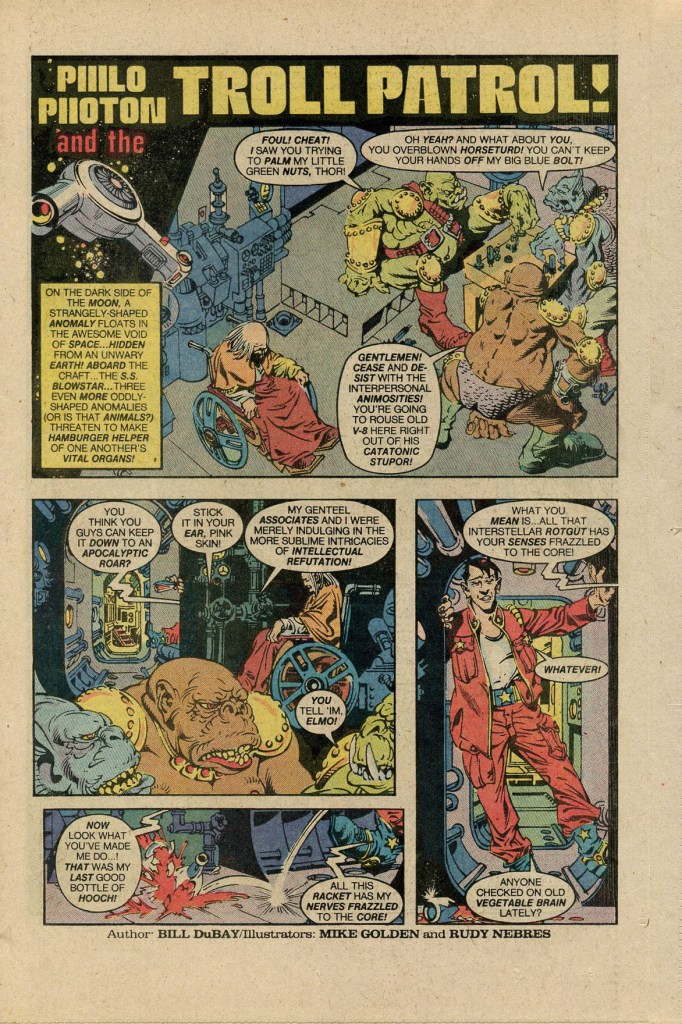
As a bit of a gimmick, the centerpiece of this issue of THE GOBLIN was a bound-in comic book section in full color and at typical comic book dimensions. The feature here was Philo Photon and the Troll Patrol, an ostensibly humorous strip by Bill Dubay, Michael Golden and Rudy Nebres about a crew of strange mutates led by a hard-drinking commanding officer. It’s trying for zany and provocative, but it lands at tedious and turgid, and is literally difficult to get through. Golden’s hand is apparent in the artwork, but he’s so buried under Nebres’ finish that he almost needn’t have bothered showing up for anything other than the storytelling. It’s the sort of premise that might have been fun in the hands of somebody like Wally Wood, whom Dubay was clearly thinking of. But the whole strip simply doesn’t work.
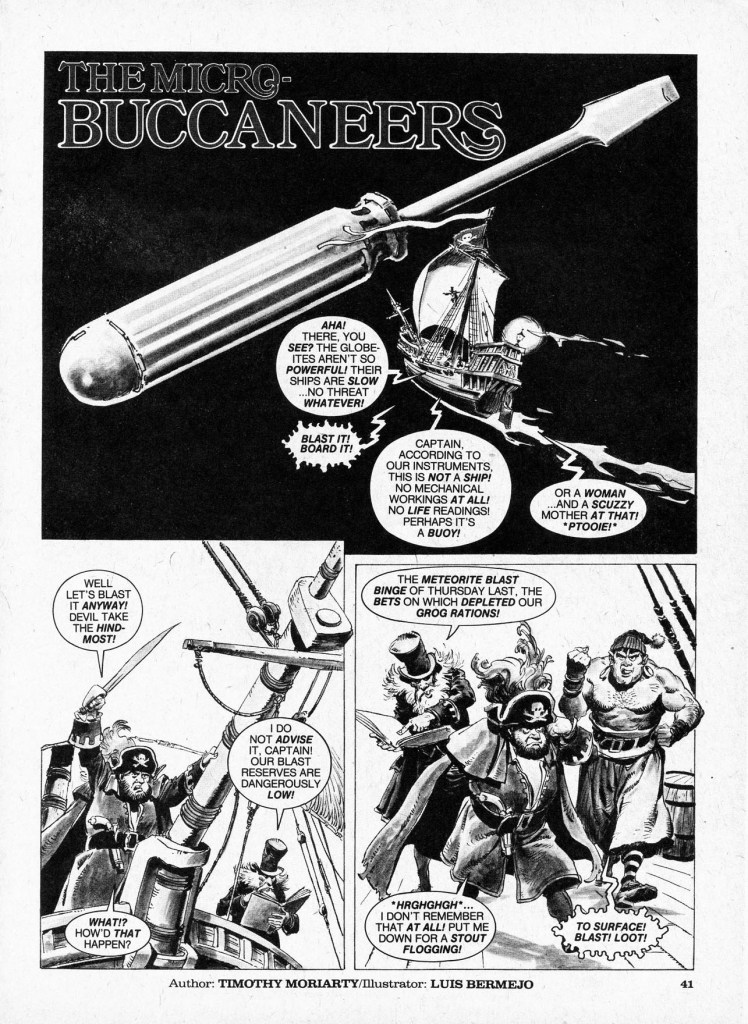
The next strip, the Micro Buccaneers, doesn’t even attempt to make itself look like a super hero outing in the slightest. Instead, it’s a space fantasy about pirates aboard a flying galleon who come to Earth, where they’re tiny in relation to the native life forms. Again, this is meant to be a comedy feature, but the humor is labored and doesn’t really land. This one is written by Timothy Moriarty and illustrated by Luis Bermejo and feels almost like a European strip that was rescripted for English-speaking audiences without any regard for the original translation. It isn’t, but it has that sort of a discordance between the copy and the images.
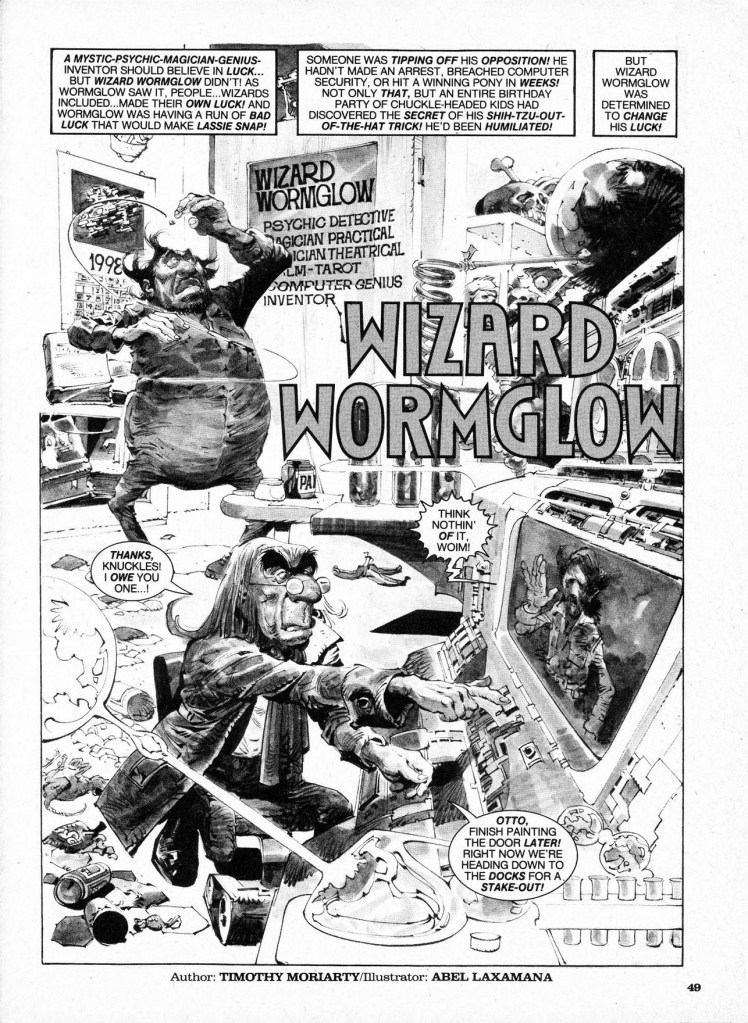
The final strip in the issue was Wizard Wormglow, also written by Moriarty and drawn by Abel Laxamana. Wormglow is a sorcerer cast in the role of a quasi-private investigator who is retained by the President (who is clearly a caricature of Ronald Reagan) to find out who is blackmailing the government by stealing its confidential files. This too is played broadly for laughs, and might have been better if it were tackled just a hair straighter. But it seems like the Warren crew couldn’t really buy into heroic fantasy in general, and so they undercut their own efforts in this magazine time and time again.
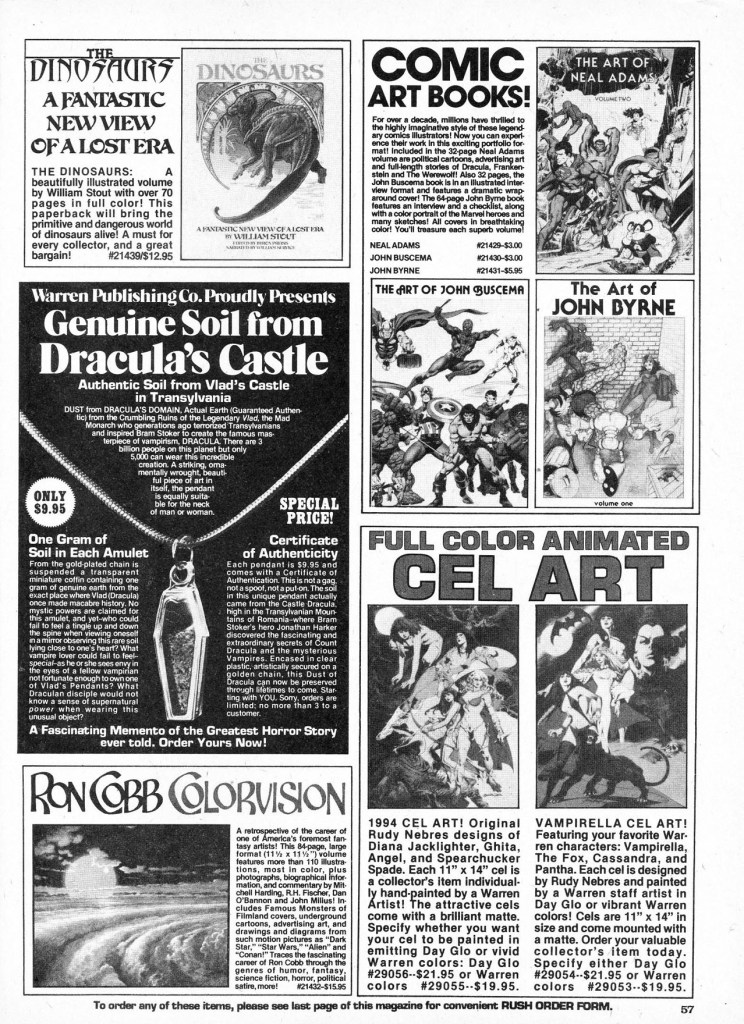
As with all of Warren’s publications, THE GOBLIN was packed with ads for merchandise from his Captain Company subsidiary, which offered a broad collection of genre-related junk for sale, including back issues of his own magazines and a wide variety of toys and books and tchotchkes from all over the place. There was stuff in these ads that always looked cool or at least interesting, but something about their presentation also made the entire venture seem sleezy and not to be trusted. While I might have been interested in ordering some of the items offered if I had the cash (which I almost never did after having bought that week’s comics) I couldn’t quite get behind sending my money to an outfit that presented itself in this fashion. Simpler to just burn it, I figured.
 The Tom Brevoort Experience