

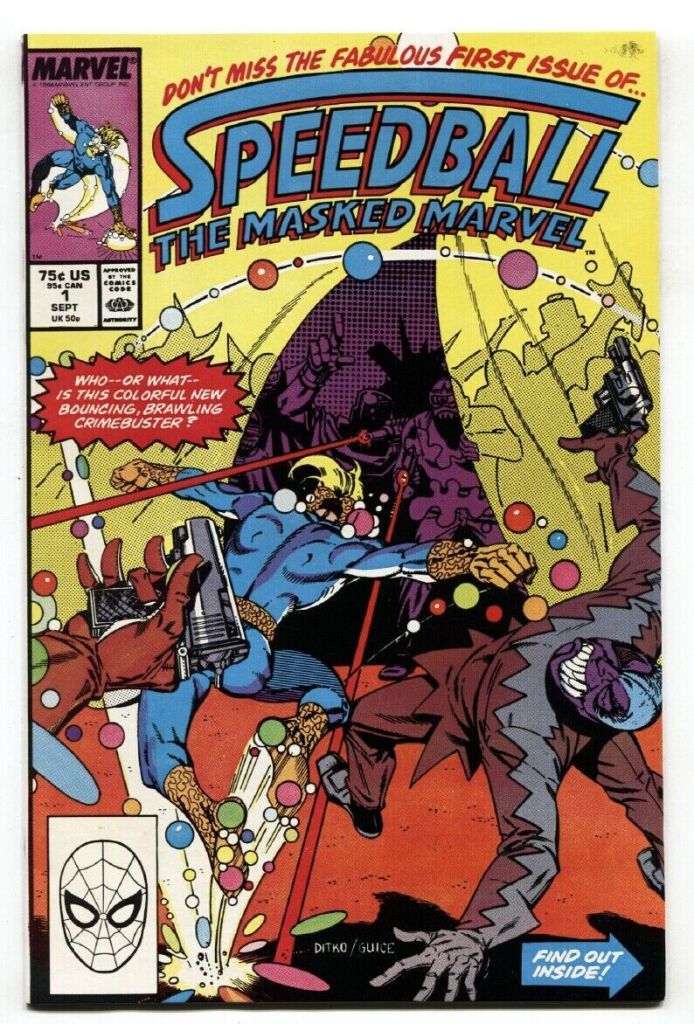
There were other concepts that were originated with the intention that they would be a part of the New Universe initiative but were left by the wayside as the parameters of that concept changed and evolved. One of them went on to become one of the lesser lights of the Marvel Universe. This was Speedball, the Masked Marvel, who debuted after EIC Jim Shooter had left the company and was replaced by the character’s creator, Tom DeFalco. And SPEEDBALL, THE MASKED MARVEL is a relatively good snapshot as to how the two men’s philosophies towards character, storytelling and conception differed.
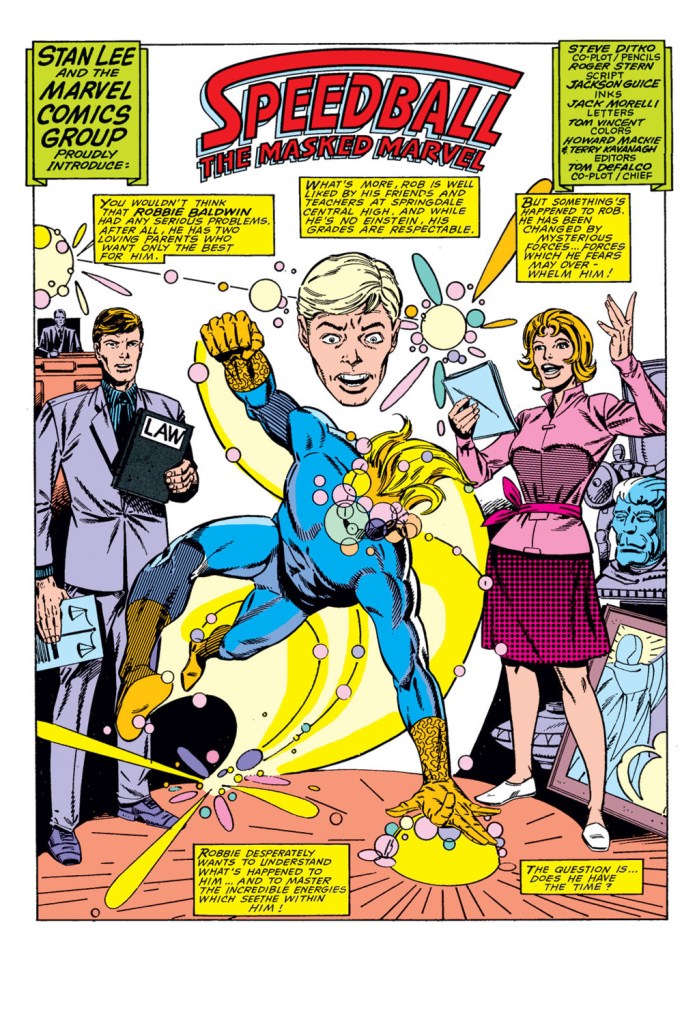
In his role as Marvel’s Executive Editor, Tom DeFalco had been tasked by Jim Shooter with coming up with concepts for the company’s anniversary celebration launch of the New Universe, and DeFalco threw himself into the task. Tom saw the value in creating a new line of comics that would put an emphasis back on the feeder system of the mainstream newsstand marketplace (an environment in which Marvel dominated throughout the 1980s) and which might allow for the sort of self-contained storytelling that had been a hallmark both of the early marvel days, when most stories were complete in a single issue, and over at Archie Comics, where DeFalco had first begun working in the field. He envisioned a super hero book in the mold of the early Spider-Man, one that would feature a likable teenage protagonist who would have super-powers thrust upon him and who would have to navigate the complications that they created in his life. DeFalco nicknamed his prospective new hero the Blue Bouncer, a reflection of the manner in which he saw the character moving, Spider-Man-like, bouncing from surface to surface.
DeFalco immediately got some pushback from his fellow editors, who told him that the name the Blue Bouncer felt quaint and dated. Accordingly, DeFalco gave the matter some thought and rechristened the character Ricochet. He envisioned each issue of the series containing two stories, with an occasional full-lengther as plot required. And he knew exactly the person he wanted to work on the title; Steve Ditko. Ditko had co-created Spider-Man back in the 1960s, so he was the master of depicting the sort of character that DeFalco envisioned. What’s more, Ditko had made his return to Marvel in the late 1970s, and had collaborated with DeFalco on the MACHINE MAN series. Tom hoped that having Ditko as a part of the package would make it appealing to the marketplace and tap into the spirit of those early books that had worked so well.
Unfortunately, Ricochet didn’t get off the ground as a part of the New Universe. DeFalco’s idea and his approach seemed too much of a piece with the Marvel Universe approach–Shooter was trying to do something a bit more grounded and realistic, and had landed on the notion of all of the characters wearing essentially specific real-world clothing. He was hoping to do new things, and the retro flavor at the heart of what DeFalco was proposing didn’t fit his paradigm. So Ricochet was benched–at least until DeFalco replaced Shooter as Marvel’s Editor in Chief. At that point, it was up to DeFalco to come up with new series to launch to keep the Marvel line strong, and so early on he resurrected his Ricochet concept, intending to launch it as an ongoing series. But by this time, he’d grown unhappy with the name Ricochet for the character, so he instead changed it to Speedball. (Possibly, this was the influence of Steve Ditko, but it’s impossible to do any more than conjecture.)
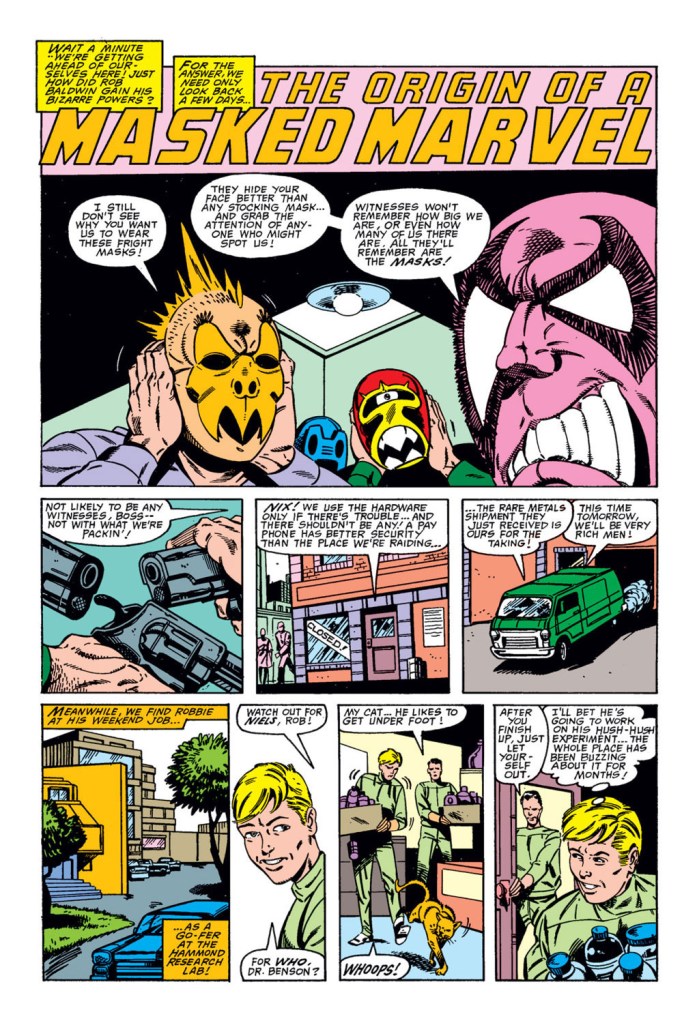
Once again, DeFalco’s fellow editors attempted to dissuade him from using the name–they pointed out that in the parlance of the 1980s, a speedball was a drug cocktail, the very one that had famously caused the fatal overdose of comedian John Belushi. As a hedge, DeFalco decided to give the series the subheading THE MASKED MARVEL. He was a big believer in labeling characters in this fashion, especially if their given names were deliberately strange–so Devos the Devastator, for example. And in fact, in-story, Robbie Baldwin’s alter ego would be exclusively referred to as the Masked Marvel for most of the book’s run. DeFalco got Ditko on board with the project, turning it over to first editor Howard Mackie and then eventually Terry Kavanaugh to edit. Tom wasn’t intending to write the series himself, though he did co-plot the first issue with Ditko. for the scripting, he turned to his former AMAZING SPIDER-MAN writer Roger Stern, whom he reckoned would both value working alongside Ditko and be able to bring the right flavor to Robbie Baldwin’s young life and personal struggles, just as he’d done earlier with Peter Parker. To embellish Ditko’s pencils, Jackson Guice came on board, adding a great deal of texture and detail to Ditko’s pages while maintaining the essential oddness of his characters an compositions.
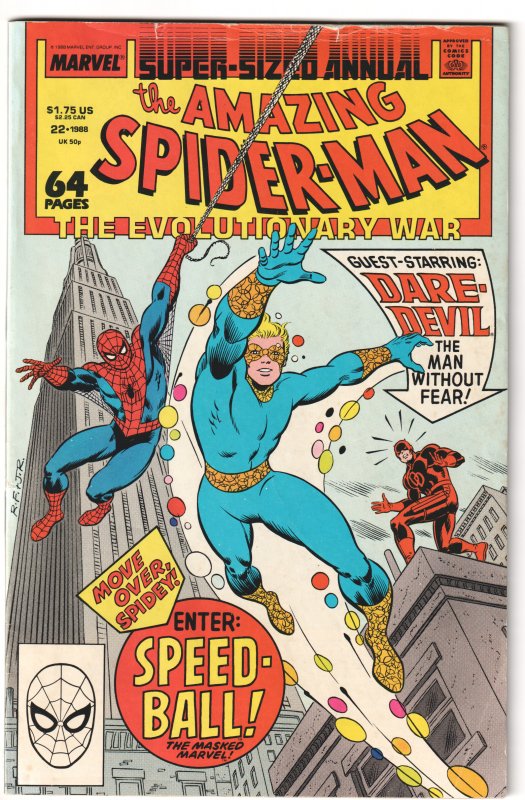
As a way of marketing the new character before the book’s debut, Speedball was introduced in the pages of AMAZING SPIDER-MAN ANNUAL #22, both as a character in the main Spider-Man story and in a short solo tale similar to the fare that would be showcased in his own series. It was a way of shining a spotlight on the new hero and making his upcoming series feel important to the Marvel readership. Thus, it was David Micheline and Mark Bagley who produced the first published story featuring the Masked Marvel. Bagley would go on to have a long association with the character later when he was the artist of NEW WARRIORS.
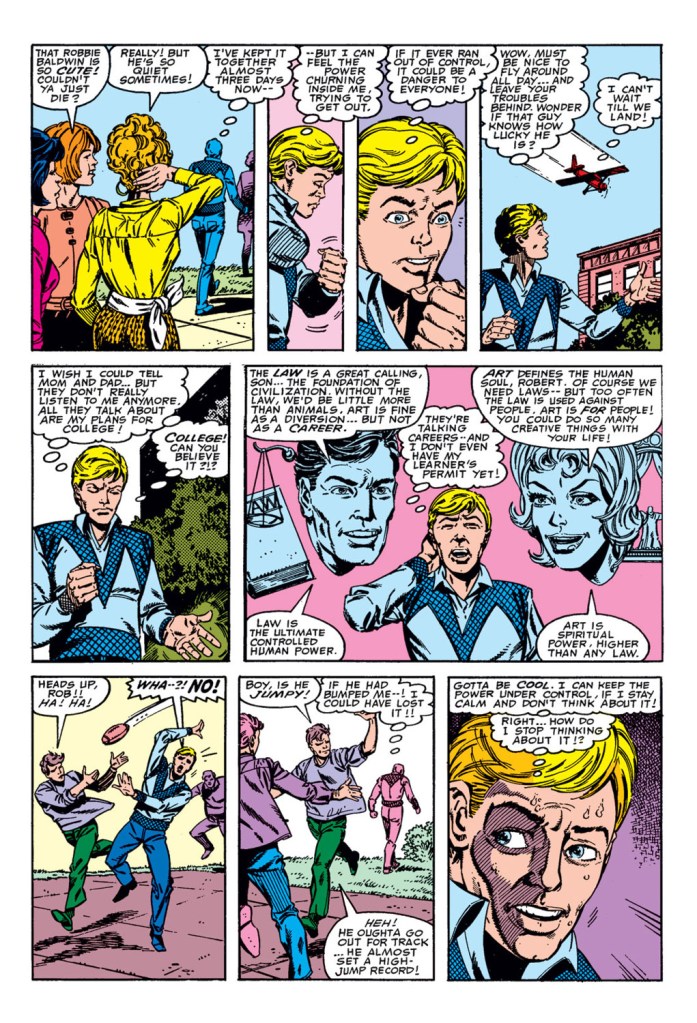
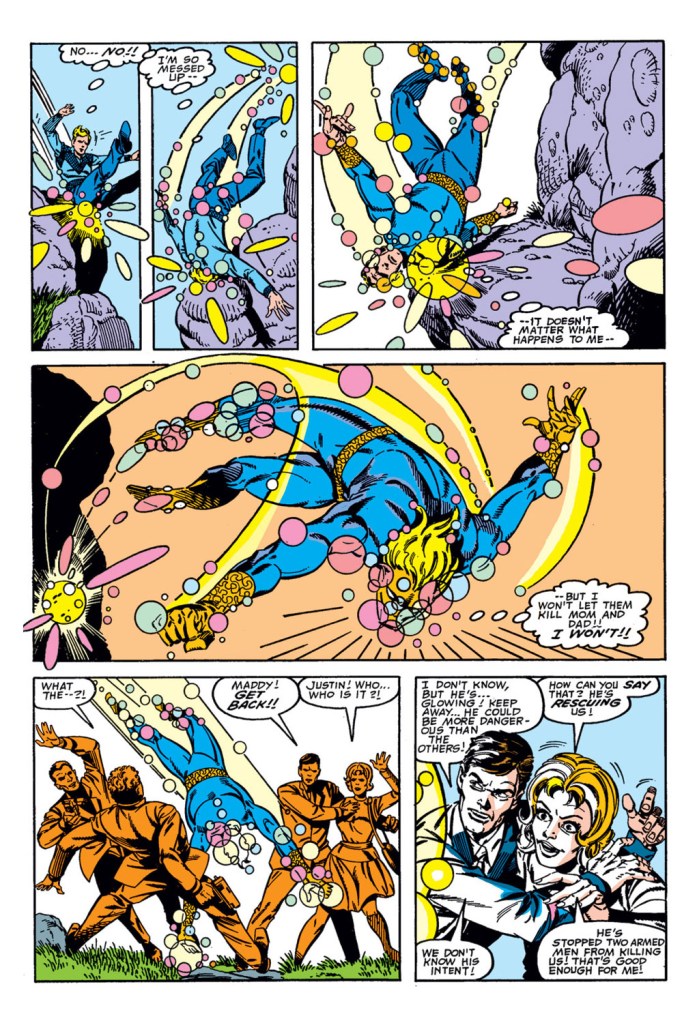
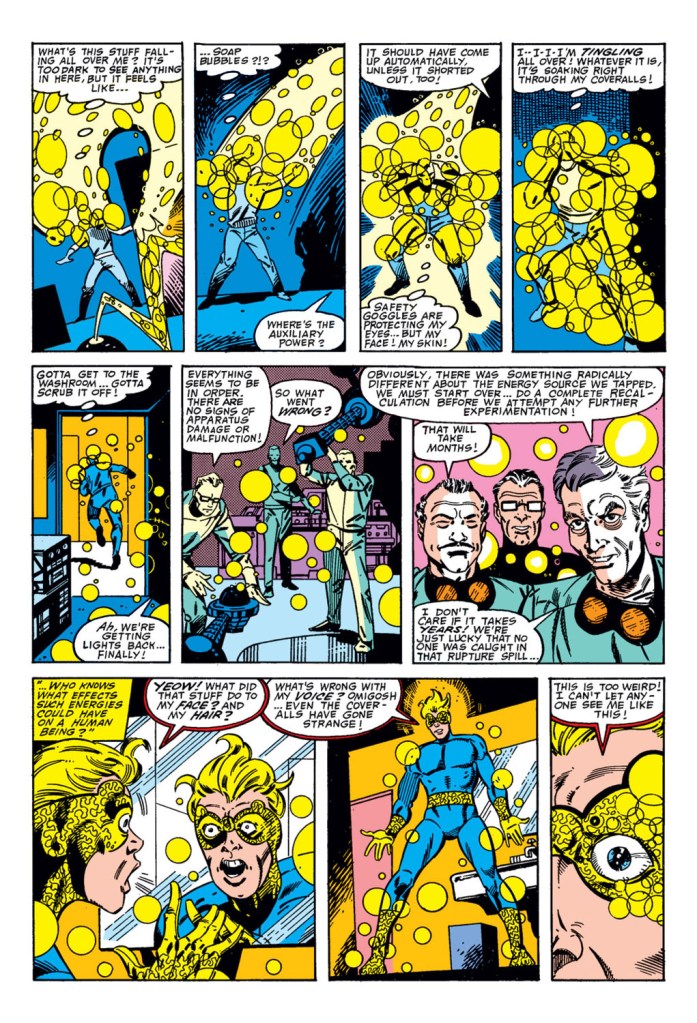
The concept for the character was relatively straightforward; Robbie Baldwin was a typical high school aged kid, not especially brainy or athletic. His father was a District Attorney with a strong love of the law, whereas his mother was a former actress and teacher who espoused the power of art–this tug-of-war between law and art would be one of the running backdrops of the series. Baldwin also had a weekend job at a gofer at Hammond Labs in his hometown of Springdale, Connecticut, and one day while he was working there, he accidentally got caught up in the scientists’ attempts to harness an interdimensional energy source. The energy field that Baldwin was exposed to bonded to him, altering his appearance and voice and giving him the appearance of a masked super hero. It also created a kinetic energy field around him that caused him to repel and react to any force directed against him. In practical terms, if you hit him, he bounced. In his new form, Robbie wound up foiling some criminals who had come to loot the lab at which he worked. And while he found that if he calmed himself, his kinetic field and strange appearance would subside, any sudden impact would start him bouncing again, and transform him into the Masked Marvel. So he was forced to go through life afraid of jostling into anybody accidentally and starting the whole process over again.
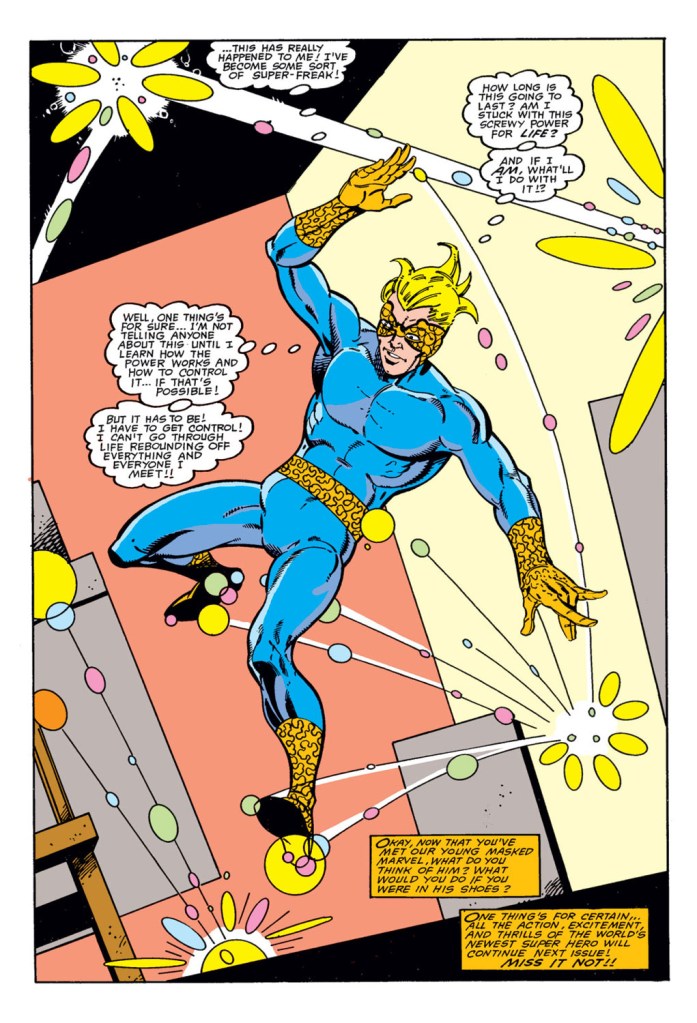
SPEEDBALL, THE MASKED MARVEL was very much a throwback series, and the sorts of situations and villains that the character faced were steeped in a more simple time than the late 1980s in which the book was launched. It was out of step with what the audience of the period wanted out of their super heroes, and the book would up running its course after only ten issues. Thereafter, a bevy of additional Speedball tales plotted and illustrated by Ditko were steadily burned off in the pages of MARVEL COMICS PRESENTS and the quarterly MARVEL SUPER HEROES specials. However, as mentioned earlier, Speedball did have his day after all, beginning with DeFalco and Ron Frenz installing him as a member of the New Warriors in the THOR story that introduced that group. In the actual NEW WARRIORS series by Fabian Nicieza and the aforementioned Mark Bagley, surrounded by other youthful super-characters with whom he could interact and treated with a bit more of a contemporary slant, the character became a favorite of the title’s readership. (By that point, the Masked Marvel sobriquet had been largely dropped, and the hero was directly known as Speedball thereafter.)
 The Tom Brevoort Experience
And as a postscript, DeFalco would use Ricochet a decade later as one of Spider-Man’s temporary costumed personae during the Identity Crisis storyline.
LikeLiked by 1 person
Thanks for the history on this. I bought the ASM annual and then bought the first 2 issues of Speedball. I didn’t buy the rest because I didn’t see them on the stands where I was buying comics. This was before I learned what a comic shop and a pull list was.
I did not know there were additional stories done in MCP and MSH, I will have to go find them.
LikeLike
I think the story of his development here deserves to mention his subsequent rape to be turned into “Penance”. I always thought Ditko had come up with the name and concept, looking at the ink pen name “Speedball”. But I guess I was wrong.
LikeLike