

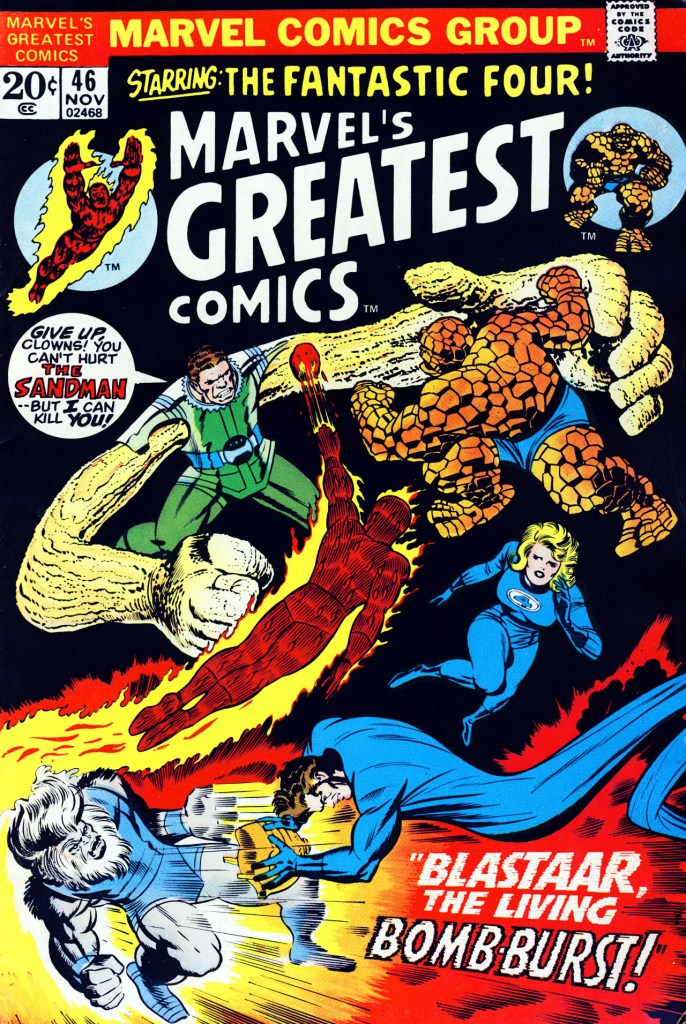
This was the third of the three issues of MARVEL’S GREATEST COMICS that I picked up as a back issue at Bush’s Hobbies in Ronkonkoma after marching with my 6th Grade school band in the Memorial Day parade. That event wasn’t anything particularly special to me, but an opportunity to stick my head into Bush’s Hobbies, which was too distant for me to get to with any regularity, was a rare and welcome change indeed. I was likely working with relatively limited funds on that particular holiday, which is why of all things I walked out with the reprints of this three-part Fantastic Four adventure. But reprints or not, it was a classic adventure of my now-favorite comic book team, and I was hungry for it.
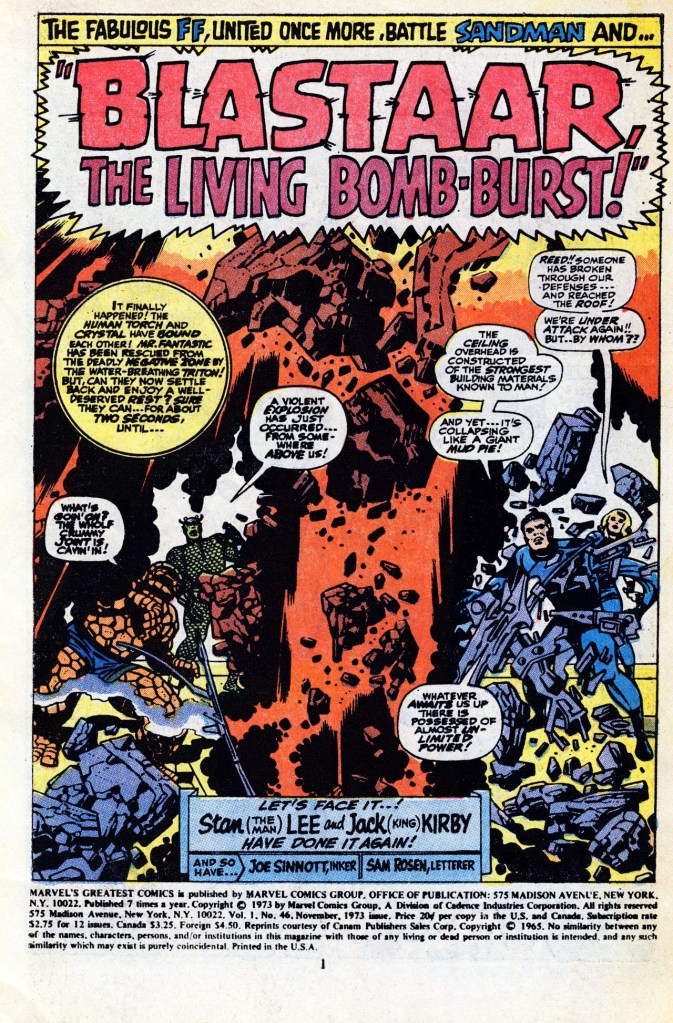
As we spoke about previously, the creative team of plotter and penciler Jack Kirby, scripter and editor Stan Lee and inker Joe Sinnott were functioning as a very smooth unit at this time. A small increase in Kirby’s page rate had allowed him to slow down and devote more time and effort to each page, and on these twice-up pages, the difference showed immediately. What also showed instantly was the skill and proficiency of inker Joe Sinnott, who captured and enhanced the best of what Jack put down. The qualitative difference between the look of issue #43, the last one before Joe came on board, and #44, Joe’s first as inker, is extraordinary. And by this story, a year after that, any initial shakedown adjustments had been made, and the artwork was truly top-flight. And while there was already tension between Lee and Kirby over the credit for what they were doing together, it hadn’t yet reached the point where Jack was looking for the door. So he continued to introduce new characters and concepts in his Marvel work–such as this story’s titular villain, Blastaar.
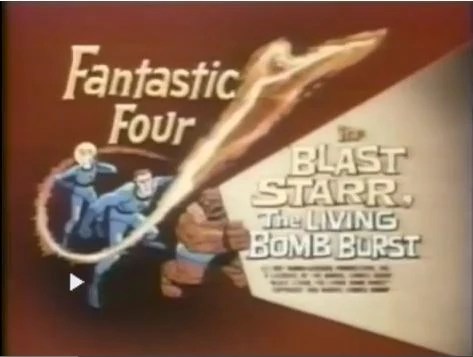
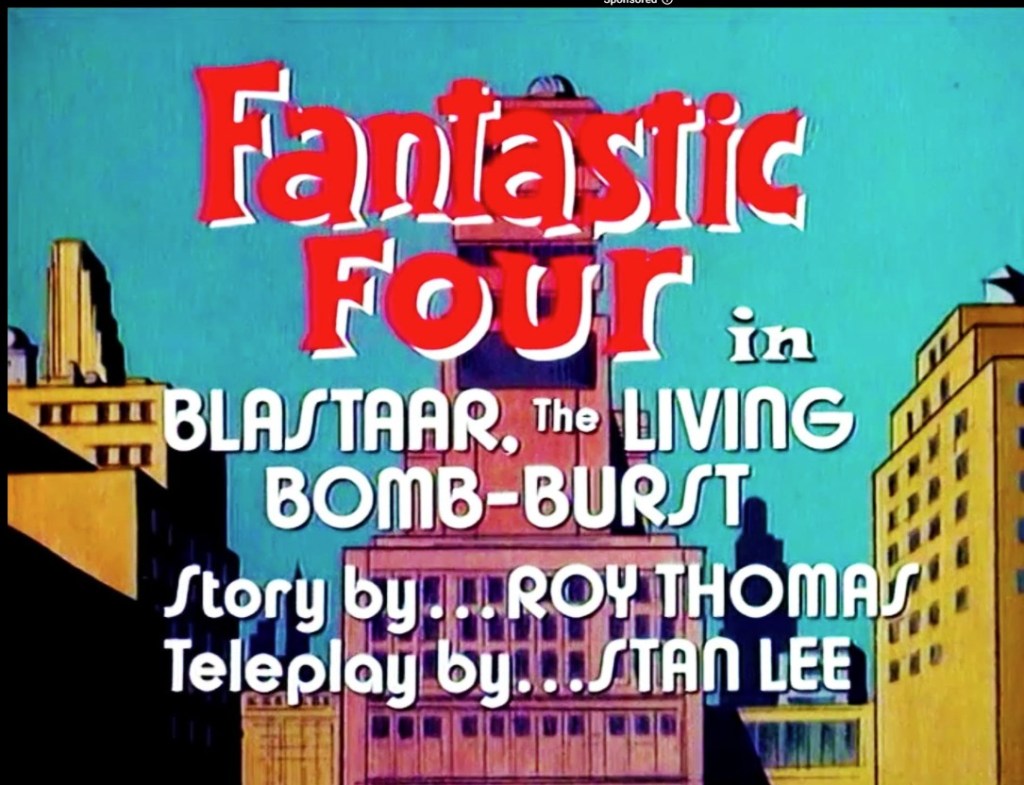
I hadn’t yet seen the 1967 Hanna Barbera FANTASTIC FOUR cartoon at the time when I picked up these issues, though I would in just a few months when that series was rerun over the summer as part of a syndication package of Hanna Barbera super hero cartoons from the 1960s called Hanna Barbera’s World of Super Adventure. But I would have seen the version of this story that was adapted for the later 1978 FANTASTIC FOUR series, the one with HERBIE the Robot that Jack Kirby did storyboard work for. So it was familiar to me. This was the most current story adapted for the 1967 show–they’d have been animating it just about the minute Jack Kirby finished up drawing the thing. In that show, at least on the title card, the character’s name was split into the more easily understood Blast Starr. It was interesting to me to recognize the same material in each of these different forms, and to analyze what had been changed in each one and why. Neither of the animated versions, you’ll learn with no surprise, featured the Sandman
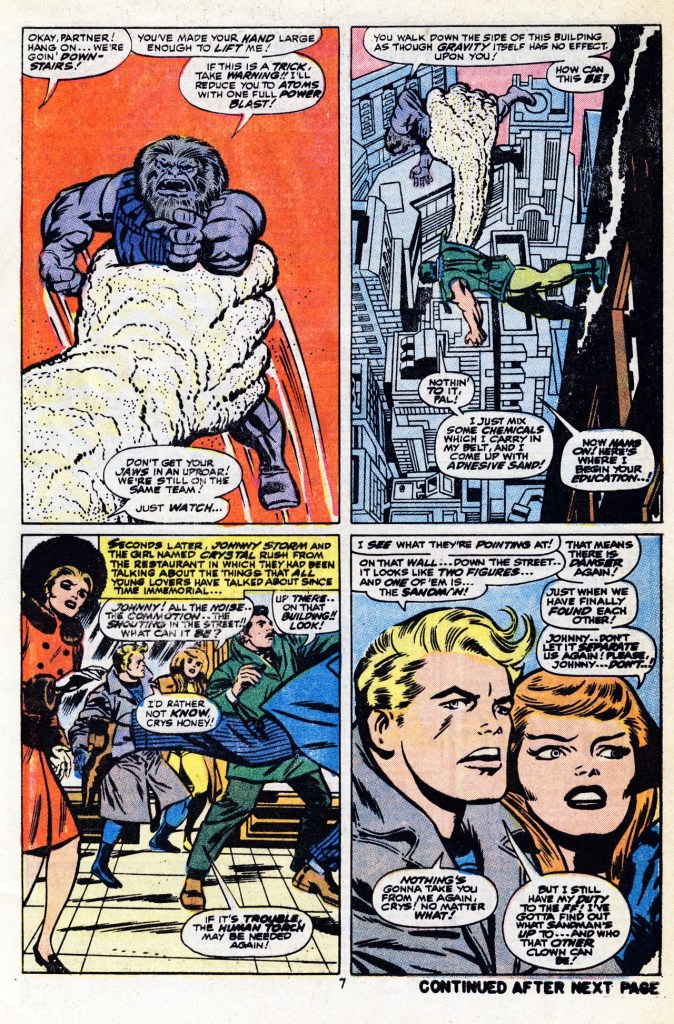
The story opens with a bang, as you’d expect from a character such as Blastaar. As the Fantastic Four and their guest Triton recover from last issue’s venture into the Negative Zone, suddenly an explosive blast from the roof of the Baxter Building blows its way through the ceiling in front of them. Kirby draws this as though it’s taking place only a few minutes after the close of the prior issue, which is why Blastaar and the Sandman are still up there on the roof. But Stan later in the issue lengthens the time by describing a shot that seems to have been intended to be Johnny and crystal leaving the Baxter Building as instead the doorway of a restaurant in which the pair had been having lunch. This is a good example of the sort of minor storytelling snafus that crept into the work all the time as Lee and Kirby weren’t always seeing things eye-to-eye. Anyway, in response to the sudden detonation, Triton uses his air-jet gun to whisk himself up to the rooftop, where he confronts the evil duo.
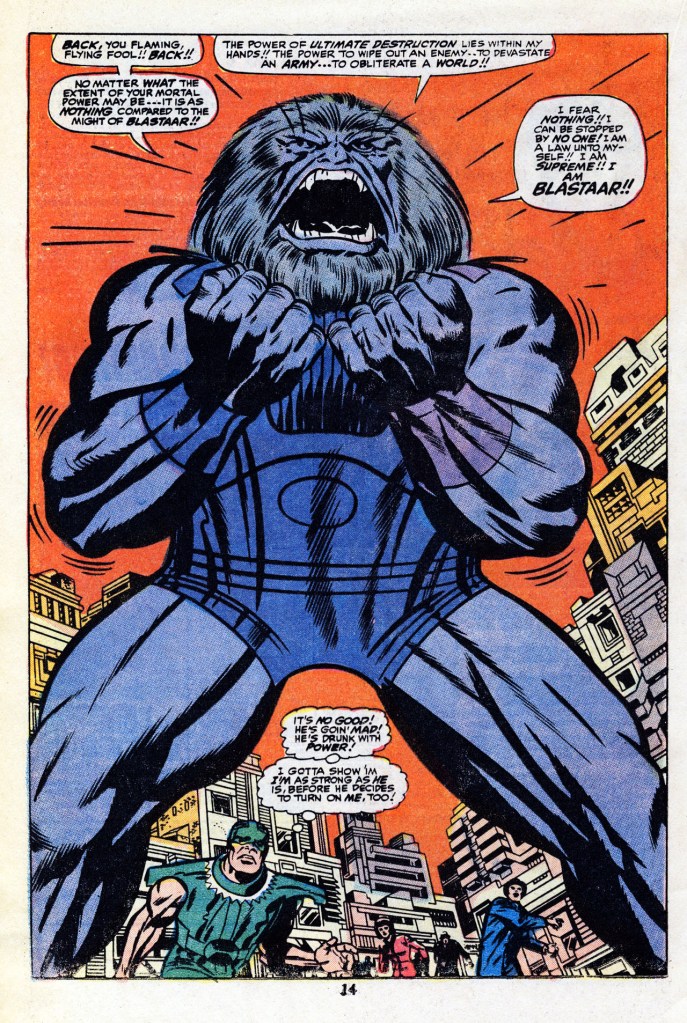
This gives Kirby an opportunity for a quick action sequence showing off his villains’ power, and so the sandman and Blastaar double-team Triton, trouncing the amphibious Inhuman in no time. Then, they descend to the ground below the building, Sandman using the devices in his new Kirby attire to make his sandy particles adhesive enough to stick him to the side of the building. As they venture out into the world, a team of cops show up: the Sandman had broken out of prison a few issues ago, and they’re ready to recapture him. They’re armed with a weapon that encases his sandy molecules in cement, rendering him unable to transform himself. But Blastaar destroys the cement with a demolition generated from his fingertips. The ruckus bring the Human Torch flying in, but as can be seen on this somewhat-unnecessary Kirby splash page, Blastaar is utterly unimpressed by the flaming Fantastic Four member.
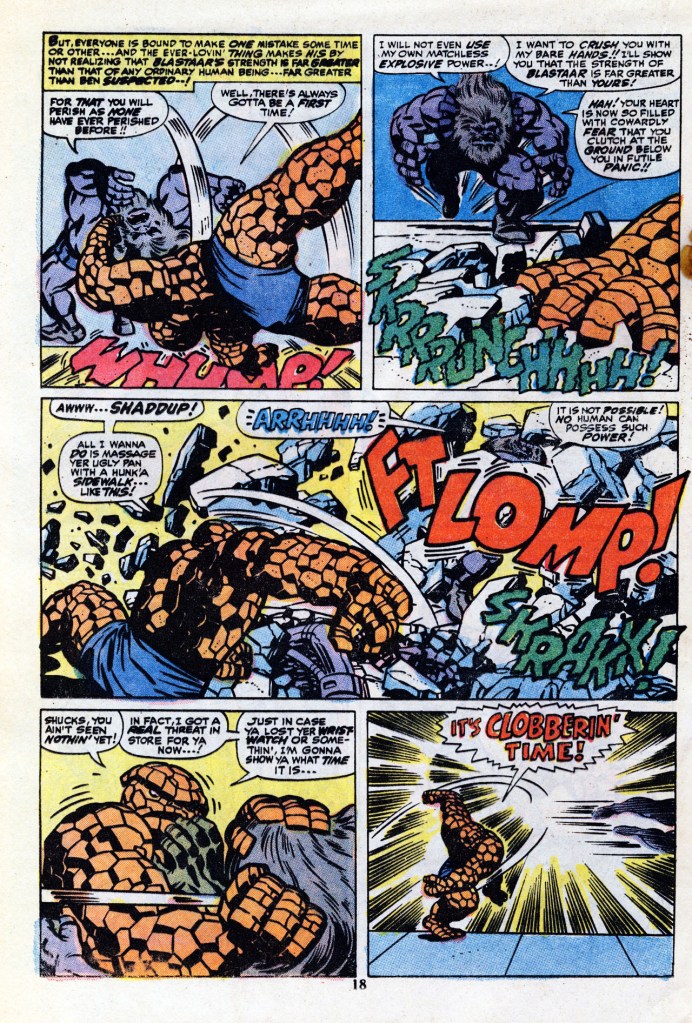
From here on in, we’re pretty much done with plot, it’s all action all the way to the end. At this moment, the Thing races up, and now the conflict is two against two–three if you count Crystal, but she doesn’t get to do anything more than defend herself momentarily from Blastaar’s advances with her elemental abilities, being a woman in a 1960s Marvel book. But Ben and Johnny get to mix it up with Sandy and Blasty pretty good. As the fight goes on, the Sandman rolls Ben up in his sandy body and rolls him away from the fight towards the nearby river, intending to first disorient his foe and then drown him. Blastaar’s pretty pissed that he doesn’t get to finish off the Thing himself, but the Torch raises the intensity of his won flame to dangerous levels, allowing him to at least momentarily absorb the force of Blastaar’s detonations and go one-on-one with him.
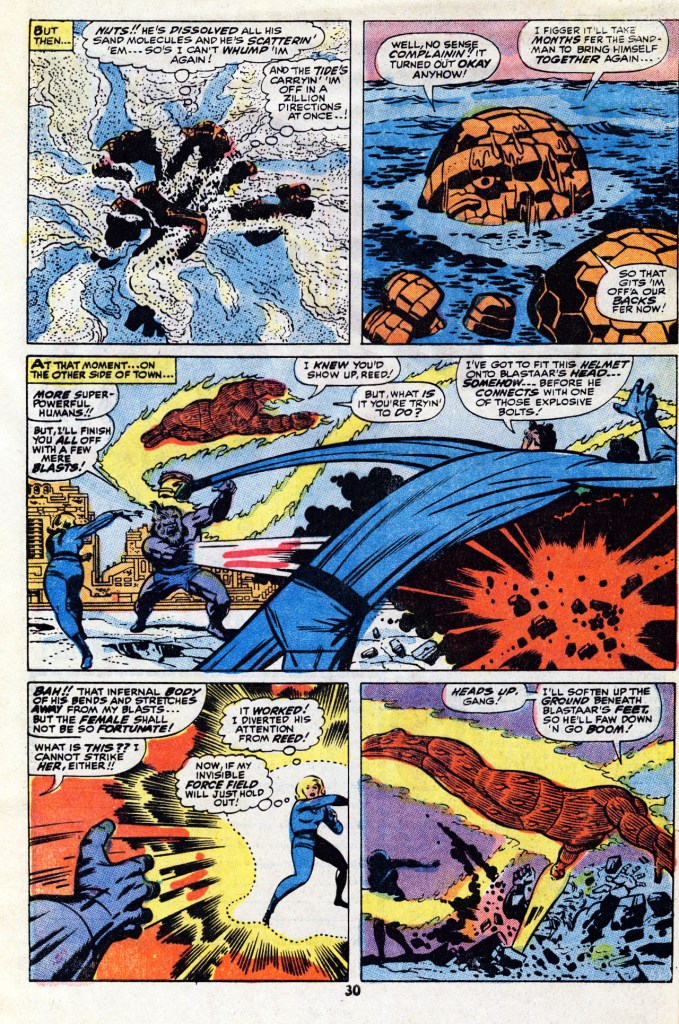
Sandman reaches the docks and succeeds in dumping the Thing into the water. But he fails to reckon with the immense power of the Thing’s lungs, and Ben is able to recover his wits while instinctively holding his breath. The Thing then topples the entire pier, dropping the Sandman into the water with him. the Sandman has always been vulnerable to water impacting on his ability to change form, and so Ben is thereafter able to pulverize him with a single punch, scattering his sand molecules across the water. That’s one down. Back at the battle site, after having cared for triton and diagnosed the source of Blastaar’s powers, Reed and Sue have arrived to pitch in, with the former having crafted a helmet that, when placed upon Blastaar’s head, will prevent his physiognomy from building up the inner explosive charges that power his detonations. But getting the thing onto him is the trick. Even with Reed’s ductility, he can’t quite get the thing on.
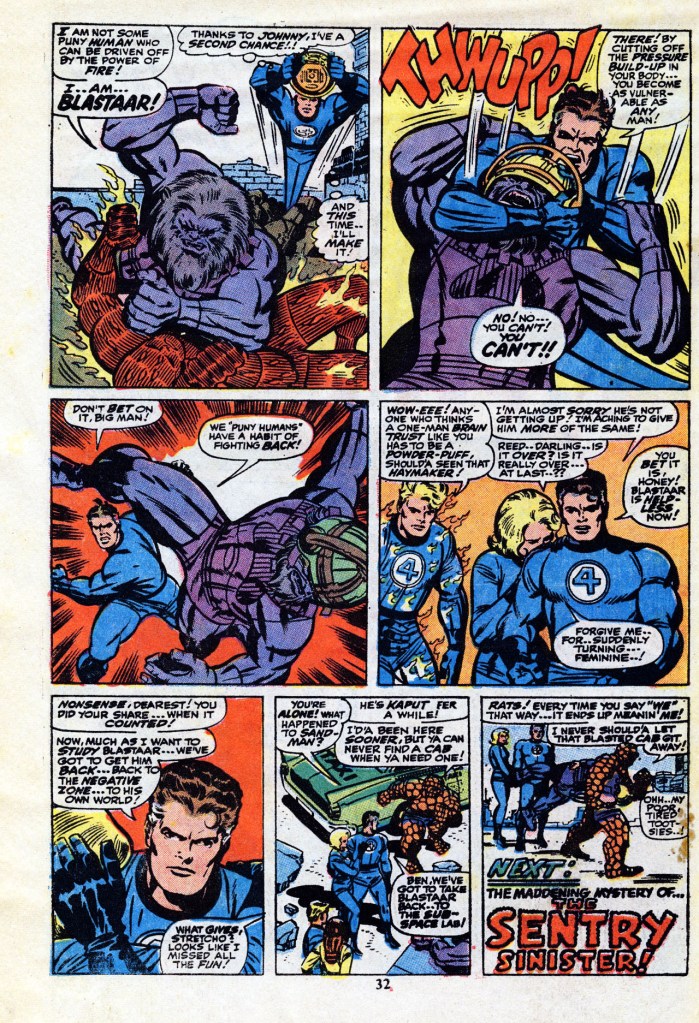
But this is why the Fantastic Four are a team. With Reed rocked back, Johnny dives in to engage Blastaar. And while for an instance it looks as though the super-strong denizen of the Negative Zone is going to snap the Torch in two, flames or not, this distraction gives Reed another change to stretch in and clamp the power-dampening headpiece onto their foe. With his blast-power neutralized, Mister Fantastic finishes the battle by delivering a final haymaker that puts Blastaar down for the count. And that’s a wrap. The final panel in this story feels claustrophobic given how much copy needs to be squeezed into it and how it needs to put a button on the adventure.
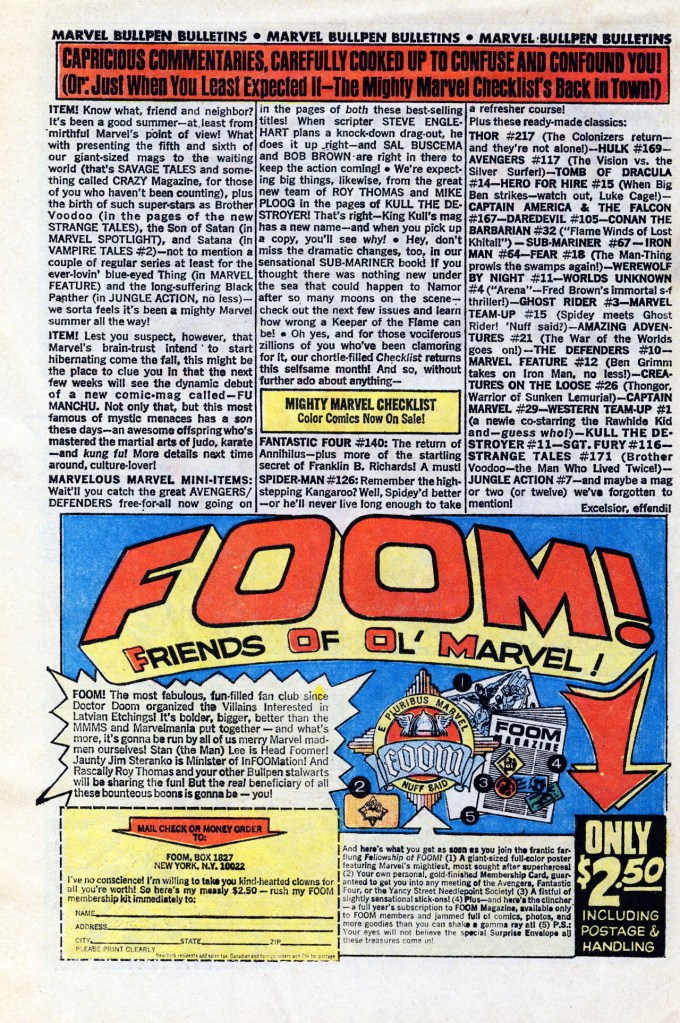
This issue of MARVEL’S GREATEST COMICS didn’t have clever little sell-lines running across the bottom of its pages like the last one did. But it did have another half-page Bullpen Bulletins page that clued me in a little bit as to what had been going on at Marvel at this point in 1973. There was a bunch more about the black and white magazine line (a line I couldn’t have cared less about in 1979) as well as the impending launch of Shang-chi, then being fronted as a Fu Manchu series–just as well that didn’t stick. The checklist crammed into so small a space doesn’t really work here, amounting to little more than a litany of comic book titles without sufficient space to sell the contents of their particular stories. But that’s because for the third month in a row, half of the page was taken up by the same ad pimping FOOM, Marvel’s new fan club and fan magazine. I wouldn’t really get to see an issue of FOOM for a while yet, but it was a good publication for its time, and was filled with more insider information than most would have given it credit for. But by 1979 FOOM had run its course.
 The Tom Brevoort Experience