

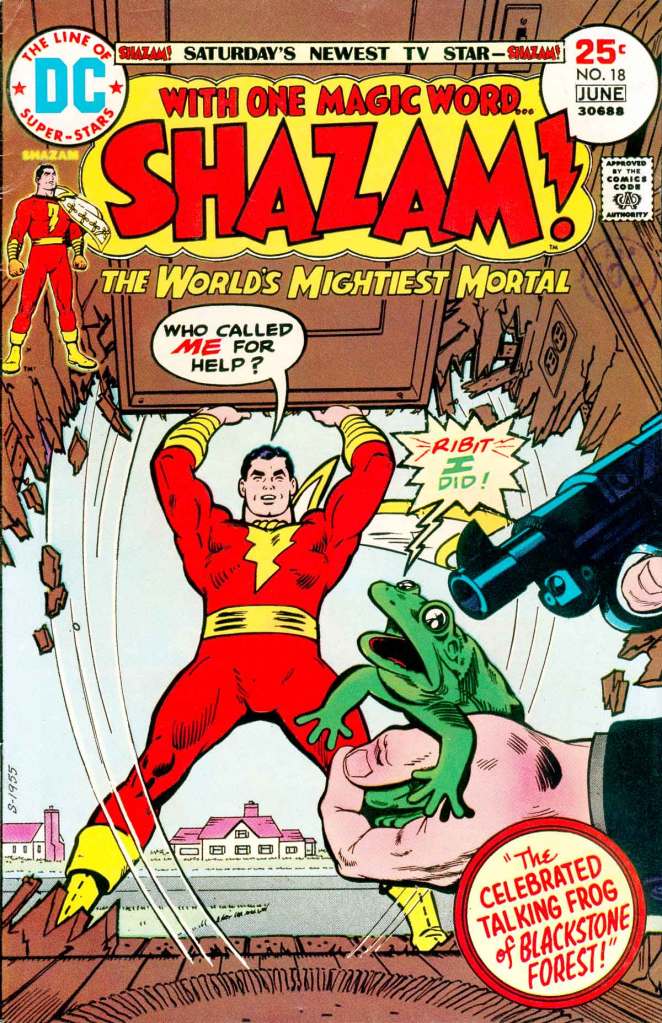
It has to be said that 1975 wasn’t the best year for DC Comics. Editorial Director Carmine Infantino was in his last year running the firm, and the fortunes of the organization were on the wane. This despite having placed a couple of properties onto television and the Superman movie going ahead. A lot of this was down to factors that Carmine simply couldn’t combat, such as the number of retail outlets that were dropping comic books as a product category. But Carmine was also quick to cut titles, and in this era there’s also a sense of some cost-cutting going on. All of which is to say that the covers on the DC books, in particular their super hero titles, during this time really weren’t very good. Case in point: SHAZAM #18. Bob Oksner, who executed this piece, is a better artist than this, but either he was in a rush, hampered by an Infantino cover composition that he didn’t jibe with, or simply having a bad day. This is far from his best work. The concept itself is pretty silly–though I could see the same idea being applied to a SUPERMAN or FLASH cover in this era too, so it’s not intrinsically flawed. But for whatever reason, this cover was a genuine turn-off to me, even though I was reading the book for free as part of the complete run I’d borrowed from my friend Donald Sims. The interiors, sadly, weren’t much better.
By 1975, the 100-Page Super-Spectacular format had proven to be unsustainable, despite my enormous love for it, and so it was phased out. Ongoing series that had transitioned to the format, such as BATMAN and JUSTICE LEAGUE OF AMERICA, went back to being regular-sized comics again. And the same thing happened with SHAZAM as of this issue. The big difference here, at least to me as a reader, was that the most appealing thing about most of the recent issues of SHAZAM had been the classic reprints from the character’s Golden Age releases. Now, those were gone, and the series was going to need to muddle through on just its new material. To cut to the chase, the series was almost cancelled during this period, despite having a popular Saturday morning live action show to help promote it. The book would soon go quarterly and all-reprint, sustained only because the TV program continued to run. But we’ll get there in due time.
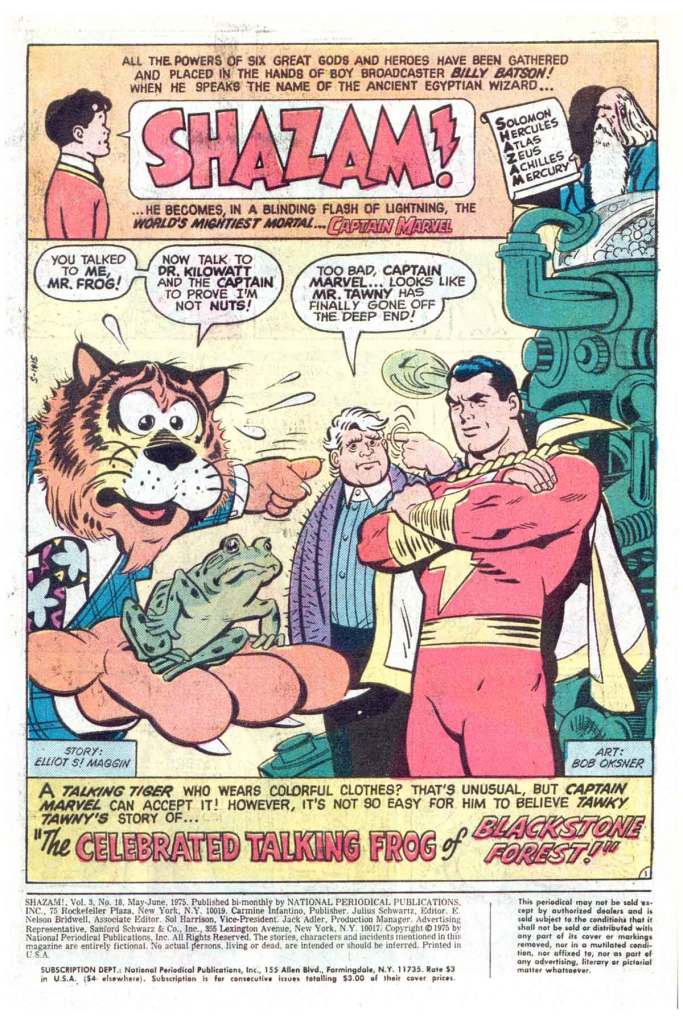
The lead story was written by Elliot S! Maggin and illustrated by Bob Oksner with editorial oversight provided by Julie Schwartz. it’s another good example of the silliness and self-parody that began to infect Captain Marvel’s adventures in DC’s hands. The entire thing is a bit of a riff on the well-remembered Warner brothers cartoon “One Froggy Evening” in which a man finds a singing frog that he thinks will bring him fame and fortune but who refuses to sing in the presence of anybody else. In this story, though, the person on the hook is Mr. Tawky Tawny, himself a talking tiger, so the bit is slightly different. It’s all very low-stakes, and lacks the verisimilitude of the best Marvel adventures. Maggin and Schwartz seem uncertain about what level to pitch their material to, and they wind up skewing too young.
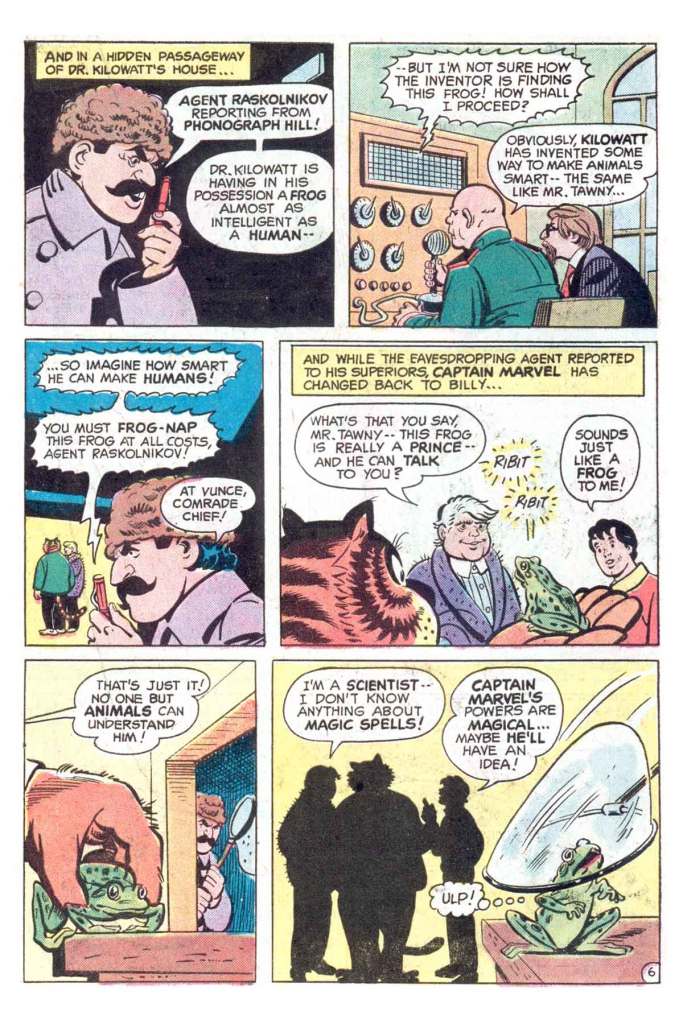
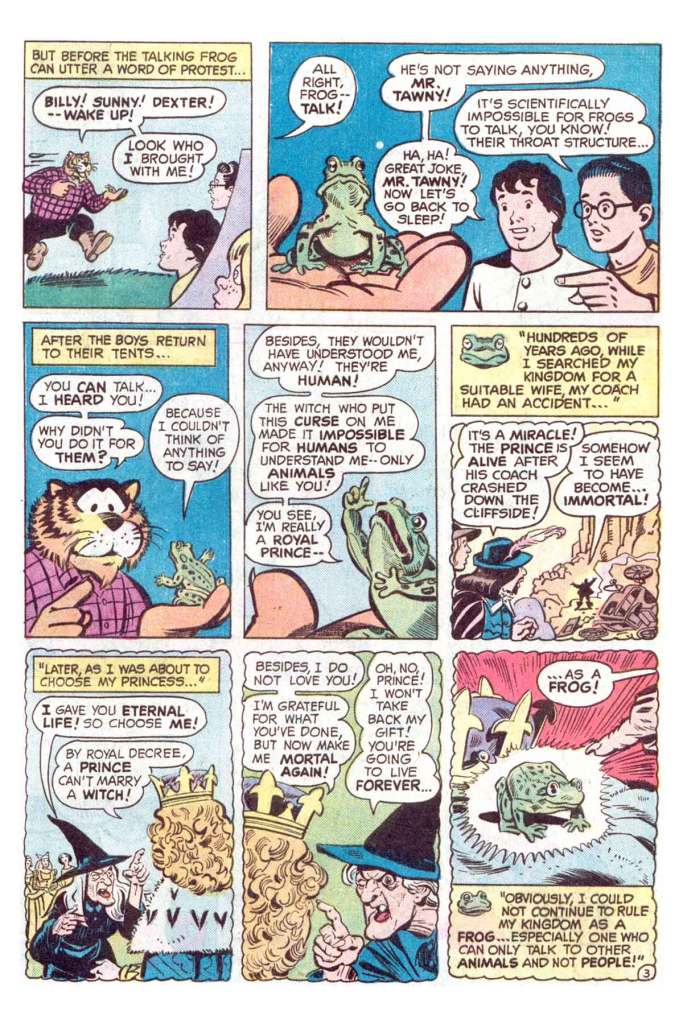
The story begins with Mr. Tawny encountering the talking frog, who claims to be a prince cursed by an evil witch. But while Tawny can head the frog speak, nobody else can–he’s unintelligible to humans. Tawny and Billy take the frog to Dr. Kilowatt in the hopes that he can prove its intelligent. And the frog is so smart that it overloads Kilowatt’s brain-o-meter, causing it to explode. Captain Marvel is able to save the day and provide a little bit of color at this point. Unfortunately, sinister quasi-Russian spy Agent Raskolnikov has Kilowatt’s place under observation, and he thinks that the doctor has found a way to increase the frog’s intelligence. So he swipes it, intending to take it back to the motherland and divine its secrets.
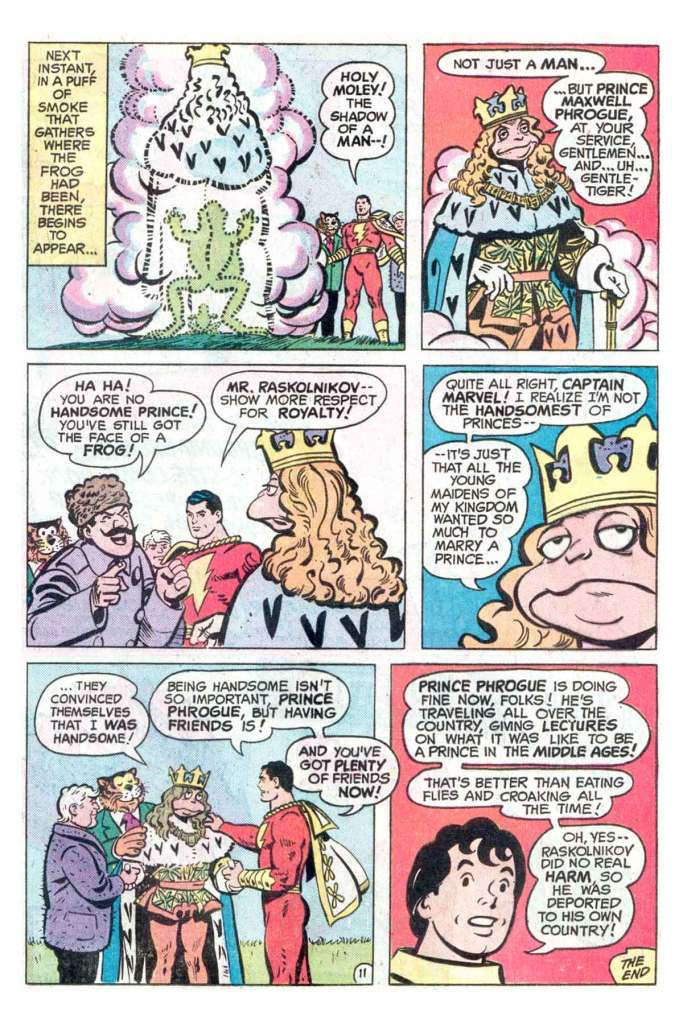
Captain Marvel foils the plot to steal the frog, but not before Mr. Tawny can perform a heroic act on behalf of the frog and break the spell. It transforms back into the human form of Prince Maxwell Phrogue, whose still a bit of an ugly duckling. Captain Marvel ends on a bit of a moral about it being more important to have friends than it is to be good-looking, and the story wraps up. Bob Oksner does his best to emulate the work of creator C.C. Beck, but it feels a bit like he’s operating with one hand tied behind him. I suspect the art on this feature would have looked better if he simply drew it in his own regular style. But, yeah, this story was a snooze without a lot to recommend it.
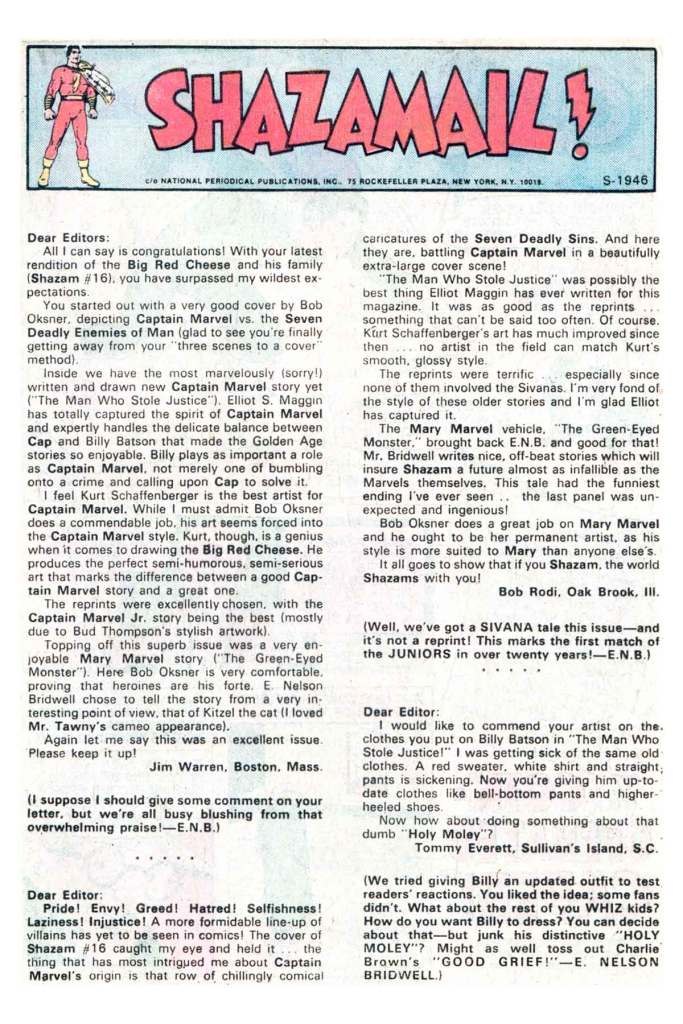
The SHAZAMAIL letters page came next, including a comment from future author Bob Rodi, a regular contributor to editor Schwartz’s letters pages. There’s also a letter from a Jim Warren, but this is certainly not the publisher of the Warren magazine line but rather some other similarly-named reader.
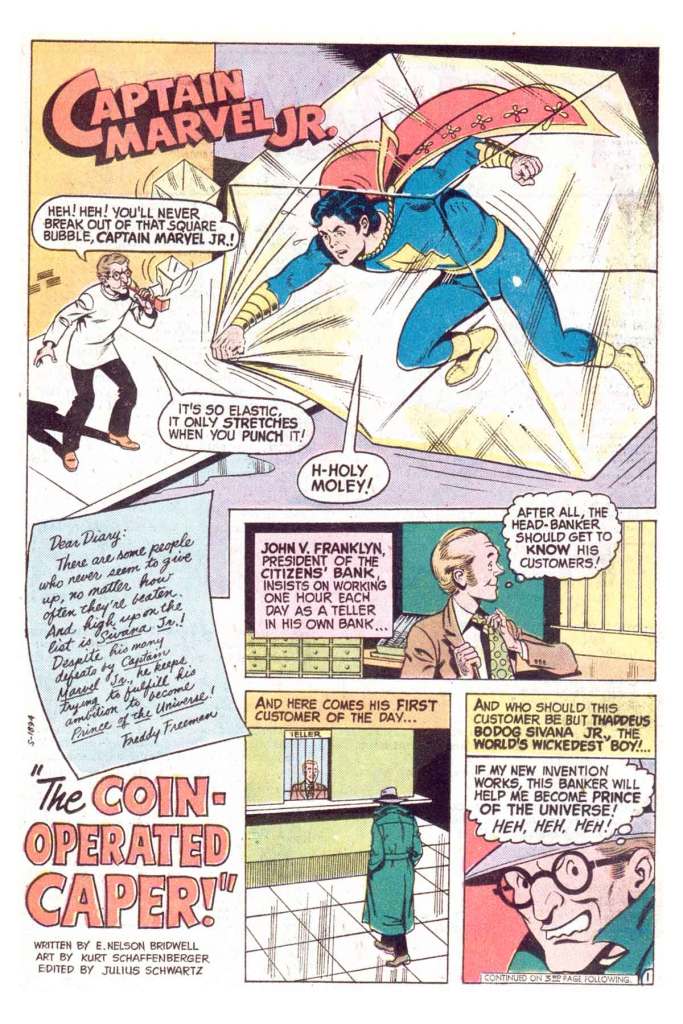
The back-up story was much sharper than the lead feature–it would be hard not to be, but he story is genuinely solid on its own. it was written by E. Nelson Bridwell, Schwartz’s longtime assistant editor. Bridwell had been a fan of Captain Marvel back in the Golden Age and he understood the flavor of the strip and what made it appealing, at least moreso than anybody else then at DC. Artwork was provided by Kurt Scharffenberger who had worked on the Golden Age stories as well, and whose open style was a perfect fit for the material. Captain Marvel Jr. was the star of this story, so the artwork leaned just a bit more DC-mainstream due to the fact that Junior’s adventures had always been depicted in a more quasi-realistic fashion.
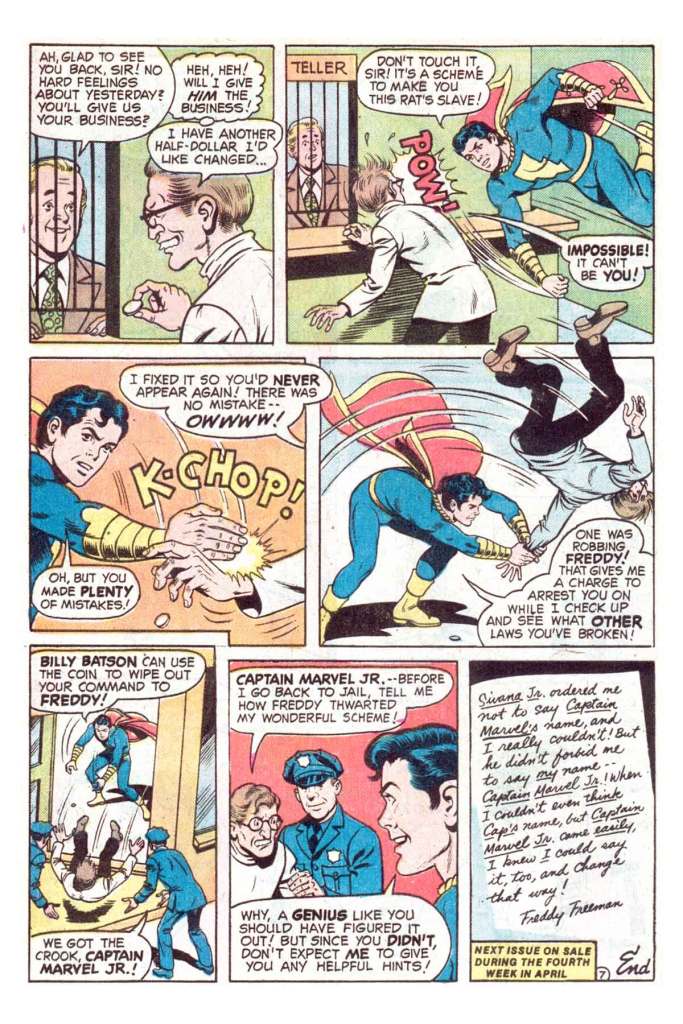
The story is only seven pages long, but it’s got a simple and clever bit at the center of it. After Junior foils the latest scheme of Sivana Jr., the long-suffering son of Captain Marvel’s persistent foe, the second-generation villain devises a way to hypnotize Freddy Freeman into not being able to say his magic words ever again. He can’t even think them. But Junior realizes that he can still say his own name, which contains the enchanted phrase Captain Marvel, and so he’s able to restore himself and clobber Sivana Jr. It’s a simple but effective piece.
 The Tom Brevoort Experience