

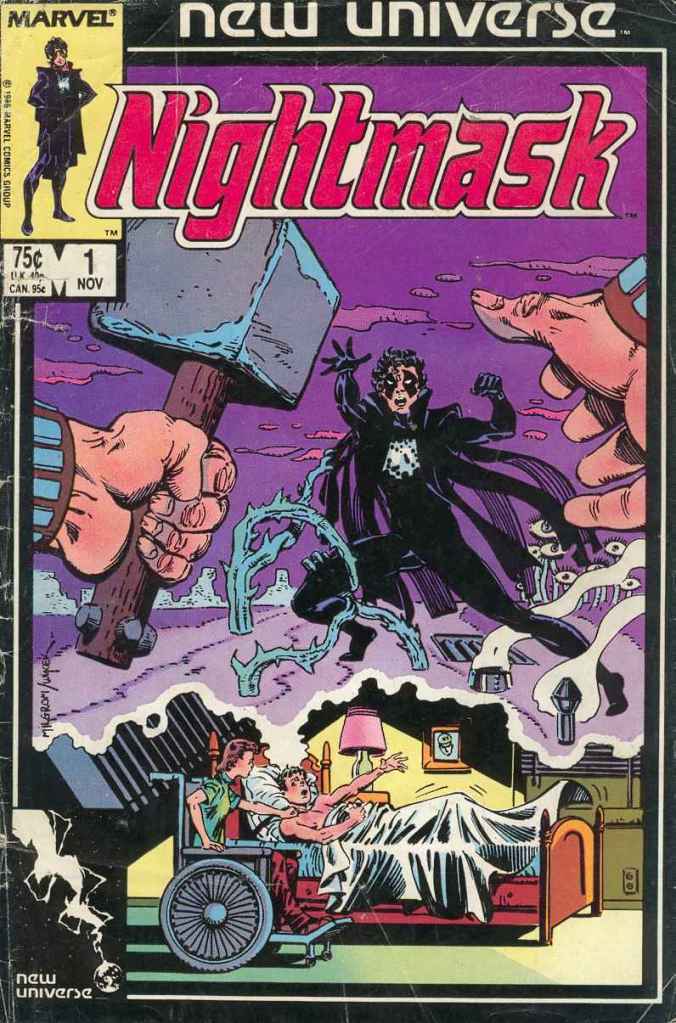
The New Universe was a bit of a confounding launch in that it is clear that all of the titles that were a part of it were terribly rushed and under the gun, to the point where none of them were bale to keep a steady creative team for more than a couple of issues. At the same time, stories abound about how much working and reworking the initial issues all underwent, as Marvel Editor in Chief Jim Shooter had a specific vision for what these books should be, one that he couldn’t seem to get his team of editors and creators to understand and get on board with. There’s a definite ethos to these books, and a bunch of potential buried in what actually saw print. But that potential was mostly unrealized, crushed in the scramble to get succeeding issues to press amidst an increasing unhappiness among all those working on the line.
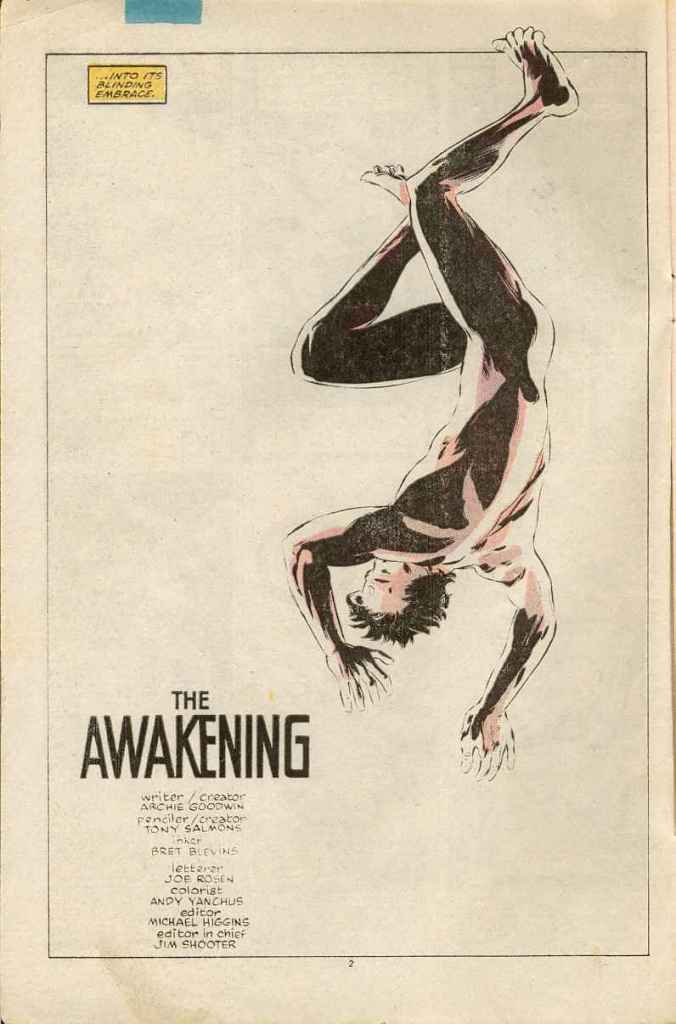
NIGHTMASK was one of the a number of New Universe books that was conceived of by editor Archie Goodwin at Shooter’s request, and it was the only series that he stuck around to write on a regular basis. But that “regular basis” turned out to be only four issues total, with a fill-in writing job as early as #3. NIGHTMASK may have been the series that went through the most creative turmoil in its short run–it was one of the four New Universe series to cease publication at the end of its first year. Amazingly, the book had a different penciler for each one of its first 9 issues, a clear sign that something was going seriously wrong.
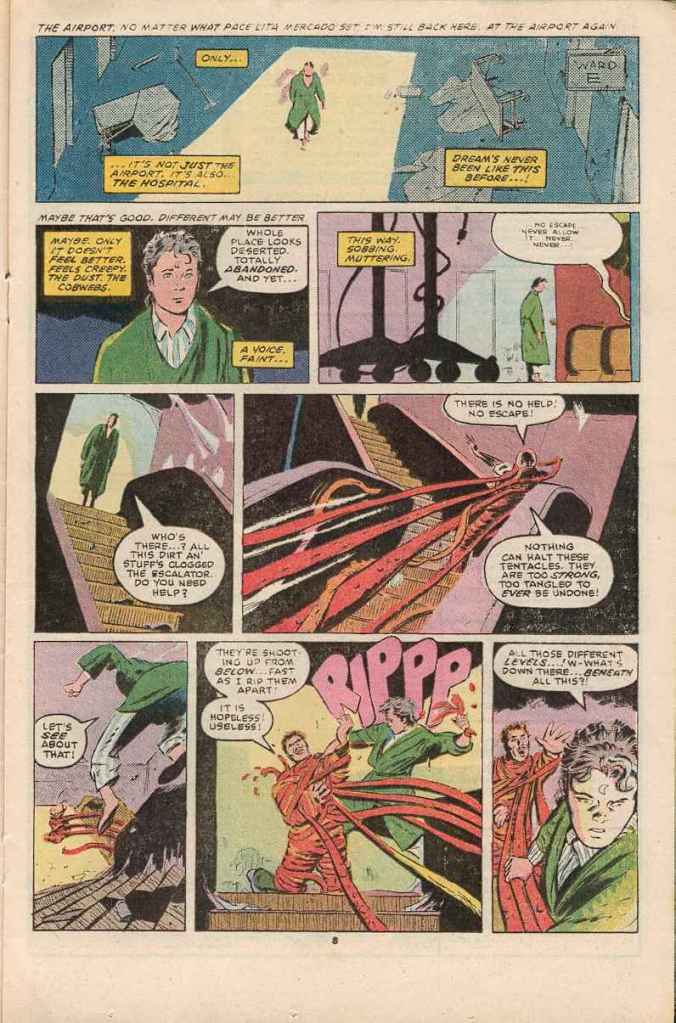
Artistically, the first issue of NIGHTMASK was drawn by Tony Salmons, an artist who worked around the edges of the Marvel Universe during these years but who never managed an extended run on any series. My sense is that he was unable to maintain a monthly schedule, and so he wound up being used on schedule-light fill-ins and Annuals and other such occasions. According to accounts, he was recruited to illustrate NIGHTMASK because his particular style lent itself to the depiction of the sorts of dream landscapes that the title character would be encountering. On this score, however, it looks like salmons’ efforts were hampered somewhat by Shooter’s insistence on straightforward rectilinear storytelling, with six-plus panels to a page and a surfeit of medium shots. Salmons’ work on this first issue is interesting, and there’s a glimmer of something more dramatic waiting to spring forth. But given that he only drew the one issue, that potential was never fully realized.
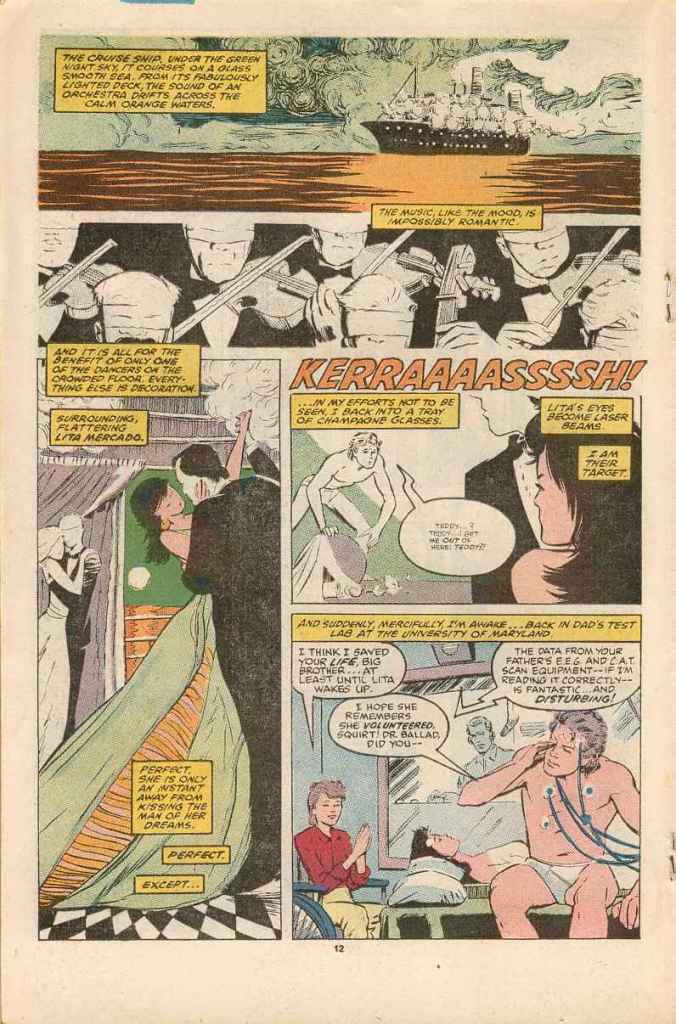
NIGHTMASK is the story of Keith Remsen, who discovers that he has the ability to project himself into the dreams of others after he awakens from the coma that he had been in when the power-unlocking White Event happened. Keith’s wheelchair-bound sister Teddy serves as his psychic anchor, his tether back to reality and his own body when he enters the minds of others. In the opening, we see Remsen first emerge from his coma in the wake of the White Event to learn that his parents have been killed in the same explosion that left him comatose and injured his sister. The explosion has left Keith with a scar on his forehead in the shape of a crescent moon, which becomes the character’s central icon.
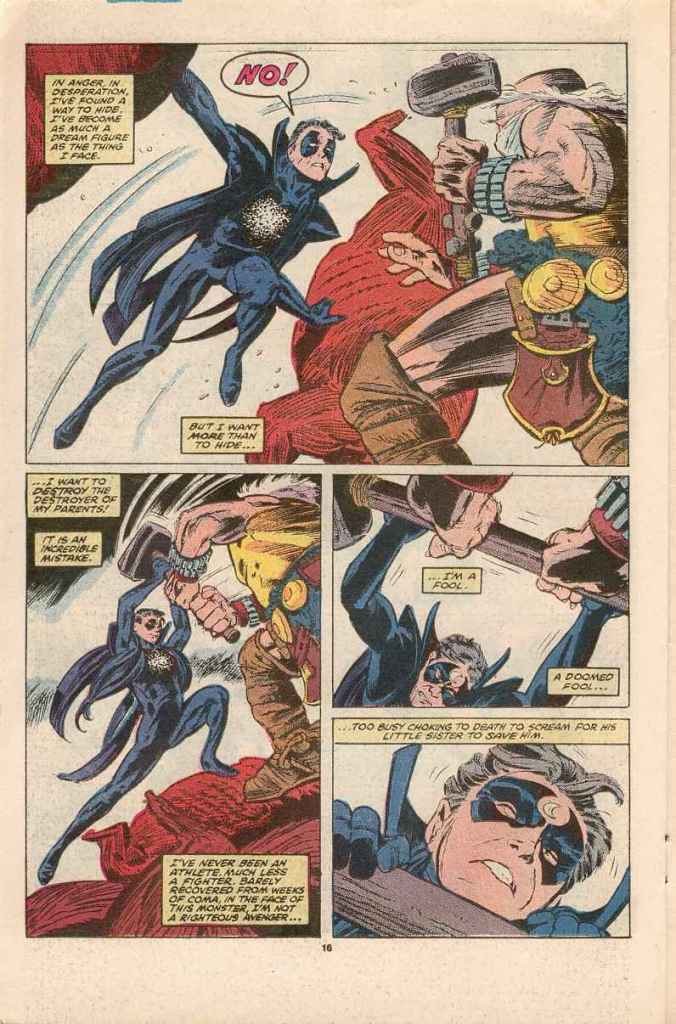
In his dreams, Remsen relives the events of the explosion, which has been chalked up to a terrorist bombing, but which he discovers was actually the work of agents of the Gnome, Doctor Horst Kleinman, whom he and his parents had been studying dreams with and who believed that the Remsens were stealing his work. In the dreamscape, Remsen encounters another figure who isn’t native to the dreamworld, but he snaps back to his physical body before he can learn anything further. However, the man in the next hospital room over has suffered a heart attack and died, and Remsen and Teddy realize that Keith had been in that man’s dreams when the encounter happened–that there’s a connection to what Keith experienced and the man’s sudden demise.
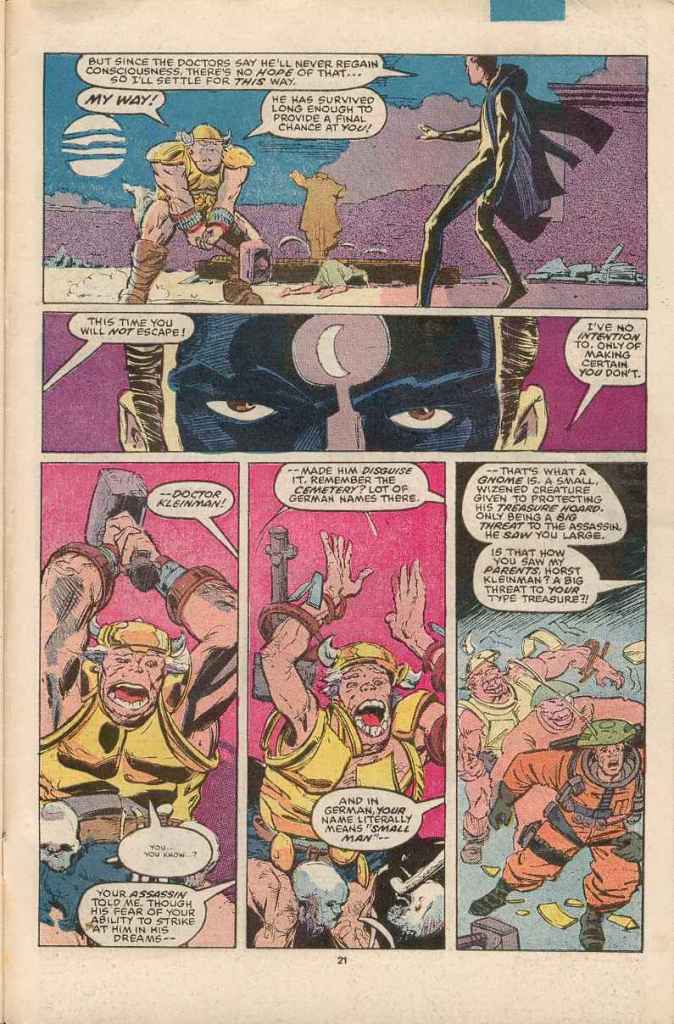
Experimenting further with his power, Remsen encounters the Gnome within the dream world and manifests a costume to conceal his identity from his foe. Having learned that Kleinman was responsible for his parents’ deaths, Remsen battle him in the dream world, despite the fact that he isn’t especially athletic and that the Doctor has manifested a powerful albeit misshapen body for himself. In their final confrontation, the Gnome appears to perish while Remsen escapes to teh real world. But we learn in the final panels that Kleinman is still alive, and he will become a recurring adversary for the character–at least while Archie Goodwin was writing the series. After that, he disappeared without a trace.
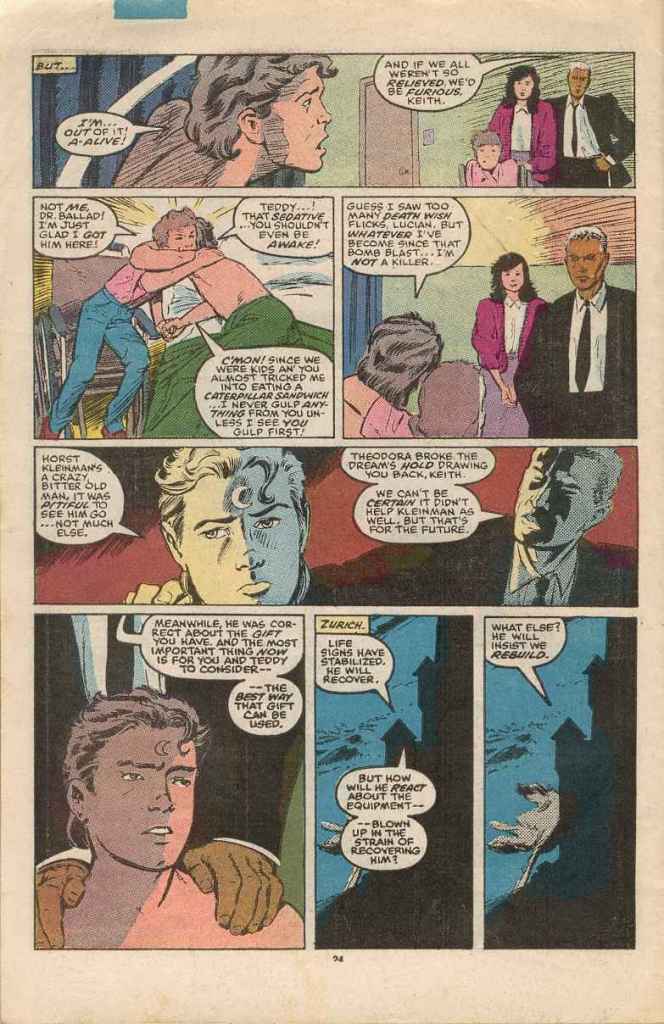
Along with his sister, Remsen sets himself up as a parapsychologist, using his ability to enter the dreams of those in trouble to hep assist with their problems and to battle the nefarious forces that plague them. The series was a sort of cut-rate Doctor Strange, with the flavor of a television series. After Goodwin’s departure, Roy and Dann Thomas wrote most of the subsequent issues, with occasional stories by Cary Bates and Sandy Plunkett. Among the assortment of artists who were drafted into service on one issue or another were Ernie colon, Alex Saviuk, Arvell Jones, Javier Saltares, Michael Bair, Keith Giffen, Kyle Baker and a young Mark Bagley, who became the closest thing to a regular artist the feature ever had, producing three entire issues before the book wrapped up.
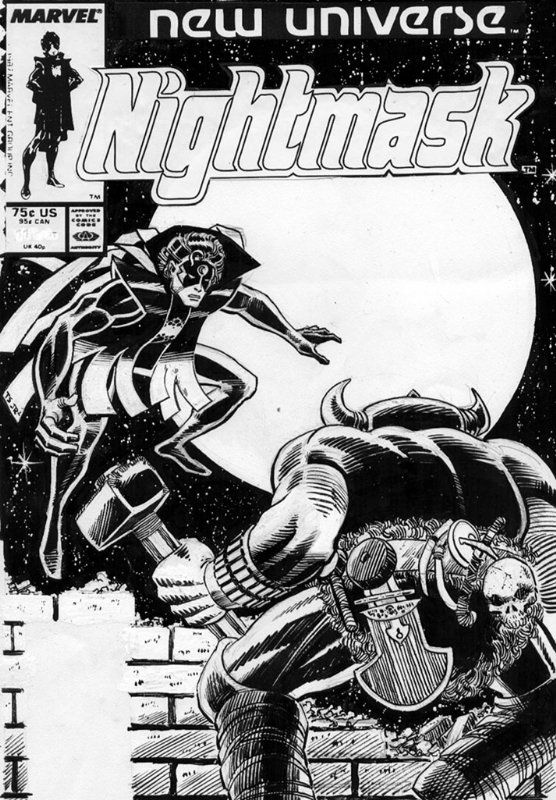
As with a number of the other New Universe launches, it seems that multiple different cover images were drawn for this first issue. This one was penciled by John Romita Jr.
 The Tom Brevoort Experience
Although I recognize the title and costume of the lead character, that’s as far as my memory goes with Nightmask. Clearly it left the barest of ripples in my comic collecting mind. What I am curious about, as we wade through these New Universe titles, is how was it that Marvel plunged forward with a project where every title seemed to bring forth any number of red flags? Or putting it more directly, while I understand the impact Jim Shooter’s management style would have in a profession with free-lance talent, wasn’t there anyone above him seeing what appeared a potential train wreck that would cost Marvel considerably in terms of credibility and finances? I know that Shooter didn’t remain long after the launch of the New Universe. It simply seems odd that one man’s errant vision prevailed so strongly in a clearly misguided direction.
(And I’m not looking to bash anyone. It’s been 40 years and heaven knows I made my share of mistakes back then – and more than few since!)
LikeLiked by 1 person
It was the pet project of the man in charge. Shooter has “saved” Marvel from the shambles it had become in the 70s and had free reign to do as he pleased as long as he produced results and profit. The New Universe was his first failure under those terms and it proved to be his last, at Marvel at least.
LikeLiked by 2 people
A few things.
I’m sorry for boring others here who have read this before, but as long as comments like this keep appearing, this stuff bears repeating.
LikeLiked by 4 people
My thanks for the excellent background information.
LikeLiked by 1 person
Yeah, this came off as a knockoff of the first Dr. Strange story, but longer and with less scope. But a terrific character design.
Another one that seems like Archie slapping something out there fast, because either he’s one of the only people who can grok Jim Shooter’s rules (Gruenwald was clearly one as well), or Jim respected Archie enough and was desperate enough this late in the process that he was willing to take what Archie came up with, even if it would have been better in a louder, less tamped-down setting.
It’s tempting to say Jim should have come up with all the series premises himself, but even if he had the time, it would then have been even harder to recruit good writers. Not because the ideas would have been bad, but because there’d have been no creator participation attached, and you’d still have to deal with Jim demanding rewrites until you managed to read his mind on where the borders were.
LikeLiked by 1 person
I’ve always found Tony Salmons to be an interesting, offbeat artist who did some very distinctive work. Too bad he only was able to pencil one issue of Nightmask. I don’t know if it would have been a better title if he’d been the regular artist, but at the very least it would have been an improvement over the ridiculous round robin of pencilers that the series experienced during its short existence.
LikeLiked by 1 person
Nightmask’s visual deserved a place in the regular MU. I only read the debut issue and maybe two more scattered through the year but all I remember is the awesome costume. At least what you said about the revolving door of artists meant it was mostly a revolving door of pretty damn good artists.
LikeLiked by 2 people
I really like this art. I tried to follow Salmons’ work wherever & whenever I saw his stuff, which was too rare. I only saw one issue of “Dakota North” in a store I didn’t have regular access to. It wasn’t carried in the newsstand/magazine shop I was buying most of my comics regularly. And I remember references that it may have been cancelled in part due to costs, and Jim Shooter was more reluctant to give up any New Universe titles, so “Dakota” got the axe. But I’d read later he liked to take his time, and considered deadlines secondary, which could’ve hurt his getting regular work (especially @ Marvel). I remember seeing his drawings in both the 1980’s Marvel “Handbook” & in DC’s “Who’s Who”. Maybe a “Marvel Fanfare”, too. The later “Vigilante” series written by James Robinson (I think Tony’s lateness was an issue there, too). I think he ended up in TV animation, even on Bruce Timm’s animated Batman series.
LikeLiked by 1 person
I loved Dakota North but I have no memory of the creative team’s names. Thank you!
LikeLiked by 1 person
Written & co-created by freelance magazine writer Martha Thomases. I think the editor was Larry Hama. He may have helped Thomases workshop ideas. Salmons is also credited as a co=creator. The 1980’s was when I got really immersed in comics. That continued for about 20 years. The 1980’s started and covered most of my teenage years. In the 70’s I was too young to appreciate the comics beyond the surface. I couldn’t grasp most of the emotional depth, if there even was much of any of that, in the comics I had access to.
Anyway, the 1980’s introduced me to another level of new art, with pro’s making their entrances into the medium. Salmons, Kyle Baker, John Bolton, Sandy Plunkett, and many more, elevated the visuals. Actually calling back to great predecessors like Wally Wood, Al Williamson (who’d also re-emerge in the 1980s).
Dakota North was ahead of its time. It was nourished, and was pushed to the ide. But comics would soon adopt many of the style/aesthetic choices seen in that series.
LikeLiked by 1 person
Did she show upin Daredevil?
LikeLike
This one has very nice looking art at least.
Applying strict editorial rules to a series set in the dreamworld seems very antithetical to the premise. McKay’s Little Nemo depicted dreams that were off-the-hook inventive, surreal, and trippy… and that was in the early part of 20th century for a mainstream audience. This needed to be way weirder to be engaging to whomever the NU books were aimed at.
As mentioned above it is very much like the first Doc Strange story… and I doubt Doc would have lasted as long if he only helped people sleep better at night.
LikeLiked by 1 person
For the record, Mark Gruenwald and Paul Ryan were the creative team on at least the first 12 issues of DP 7, making it the only New Universe title with a consistent creative team before the soft relaunch of the Black Event. (I think Peter David wrote the entire run of Mark Hazard: Merc and Shooter wrote all of Starbrand before he was fired, but the artists on those changed repeatedly.)
I thought Nightmask was the most promising of the original 8 books, with the widest remit and some interesting character conceptions. Shame that it was such a revolving door of creatives, keeping it from getting any actual narrative progress.
LikeLiked by 1 person
I think Mark and Paul were the creative team for the whole 32-issue run of DP 7.
There were a few different inkers (not many) and a couple of letterers, and I think Paul Becton colored the whole thing. So they were the consistency champs of the whole New Universe.
LikeLike
The corporate mentality of “Ready or not, we must launch NOW!” has always escaped me, especially as it invariably fails. Letting the calendar overrule all else is pure madness.
LikeLiked by 1 person
You’re not wrong… though….
I don’t work in comics, but in all publishing (that isn’t self) there is a pitch, budget and deadline, or it doesn’t happen. The die is cast so to speak.
In the case of the NU… they tied it to the anniversary of the regular Marvel Universe…. which is how publishing works by and large… though no one was clamoring for a new universe…. they could have done another thing… but its not weird that they did a thing that wasn’t complete.
I doubt Marvel set out to make books that weren’t ready or popular, but once they were on the track and people were paid… they either had to eat them or publish them.
My guess is that the budget getting shrunk as the project moved forward were execs minimizing the damage as belief in the project diminished, and things went into the ditch.
Definitely some corporate hubris involved. Since I think in hindsight….it’s sort of dumb to set out intentionally to make a new universe that is more ordinary and restrictive than the one you already have, with more or less the same creatives, and try to sell it to the same audience that you already have.
LikeLiked by 2 people
Remsen setting himself up as a parapsychologist, using his ability to enter the dreams of those in trouble to help assist with their problems and to battle the nefarious forces that plague them reminded me of the short-lived TV series Sleepwalkers ( 1997 — a team of researchers who used technology to enter the dreams of psychiatric patients in order to diagnose their problems — 9 episodes ) and Wonder Woman#300 ( February 1983 — which gave Jack Kirby’s Sandman an origin and real name. Technology was used to help him enter dreams too ). The TV series ( 2 seasons ) Falling Water ( 2016 ) had characters who could enter dreams at will. Before Tom mentioned Doctor Strange I thought about his first appearance in Strange Tales#110 ( July 1963 ). Night Mask’s powers should have been Doctor Droom’s powers since Droom is the Dutch word for Dream. Then there is the Atlas Age anti-commie fighting Nightmare Men ( 3 of them ) [ Strange Tales of the Unusual#10 ( June 1957 ) 6th story — reprinted in Uncanny Tales#9 ( April 1975 ) where their uniforms got colour ) — see marvunapp.com for profile.
LikeLike
Harry Potter has a lightning bolt-shaped scar ( October 31, 1981 — created ) on his forehead and Nightmask [ Nightmask#1 ( November 1986 )] a crescent shaped scar on his forehead, coincidence or was Archie influenced by Harry Potter?
LikeLike
According to Wikipedia….Harry Potter was first published in 1997, and Rowling was born in 1965….. meaning she would have published Harry Potter at age 16 in 1981.
LikeLike
In the Harry Potter books, Harry’s birthday is July 31, 1981. (Not October.) Harry Potter first appeared in the world in 1997, and didn’t become a phenomenon for some years after. The chance of Archie Goodwin being influenced in 1986 by a book that would be published a decade later seems small.
(And for that matter I’d say the chance of J.K. Rowling being influenced by an obscure comic a decade earlier is almost as small.)
LikeLike
Blame Google A.I., it gave me that date ( Maybe it was when the character got the scar in the novel? ).
LikeLike
Distinctive scars aren’t that unusual a trait. Lester Dent’s pulp hero Lee Nace had a snakelike scar on his forehead, hence the nickname “The Blond Adder.”
LikeLike
Thanks Frasersherman cause last night I had a vague memory of either a 1940s hero or pulp hero with a scar shaped like something. I did remember fake WW2 DC Comics soldier Gravedigger [ Men of War#1 ( August 1977 ) ] who has a cross-shaped scar between is eyes.
LikeLike
Never, ever, trust Google AI. Or any other AI.
They give you answers that sound like answers, not answers that are actual answers. When they’re correct, it’s just because the correct answer fit their “this is likely” programming. But it’s coincidence, not fact-checking.
LikeLike
keith remsen and john tensen
LikeLike
This is one I actually bought. The small scale of the premise — battling with people’s inner demons rather than anything larger — still held my interest. That said, I dropped it two issues after Archie Goodwin left.
LikeLike