

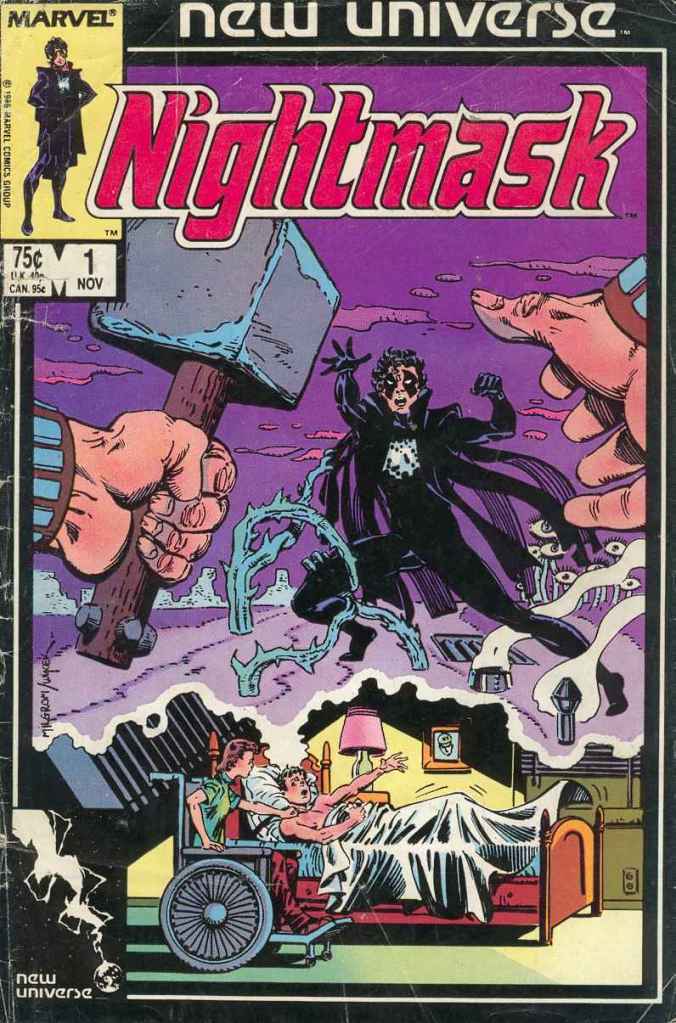
The New Universe was a bit of a confounding launch in that it is clear that all of the titles that were a part of it were terribly rushed and under the gun, to the point where none of them were bale to keep a steady creative team for more than a couple of issues. At the same time, stories abound about how much working and reworking the initial issues all underwent, as Marvel Editor in Chief Jim Shooter had a specific vision for what these books should be, one that he couldn’t seem to get his team of editors and creators to understand and get on board with. There’s a definite ethos to these books, and a bunch of potential buried in what actually saw print. But that potential was mostly unrealized, crushed in the scramble to get succeeding issues to press amidst an increasing unhappiness among all those working on the line.
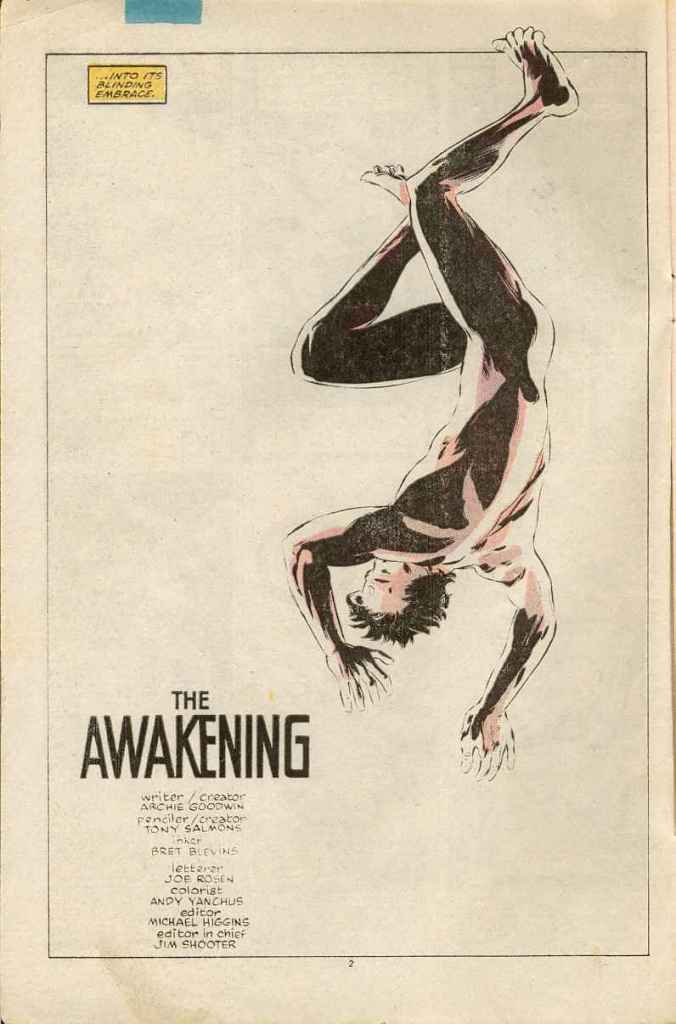
NIGHTMASK was one of the a number of New Universe books that was conceived of by editor Archie Goodwin at Shooter’s request, and it was the only series that he stuck around to write on a regular basis. But that “regular basis” turned out to be only four issues total, with a fill-in writing job as early as #3. NIGHTMASK may have been the series that went through the most creative turmoil in its short run–it was one of the four New Universe series to cease publication at the end of its first year. Amazingly, the book had a different penciler for each one of its first 9 issues, a clear sign that something was going seriously wrong.
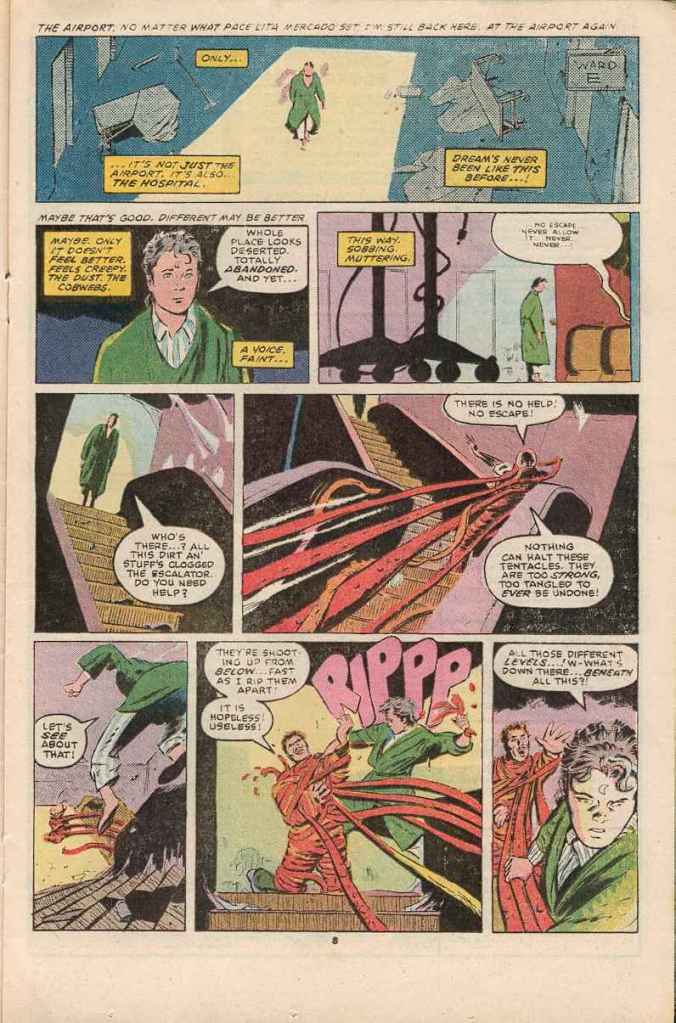
Artistically, the first issue of NIGHTMASK was drawn by Tony Salmons, an artist who worked around the edges of the Marvel Universe during these years but who never managed an extended run on any series. My sense is that he was unable to maintain a monthly schedule, and so he wound up being used on schedule-light fill-ins and Annuals and other such occasions. According to accounts, he was recruited to illustrate NIGHTMASK because his particular style lent itself to the depiction of the sorts of dream landscapes that the title character would be encountering. On this score, however, it looks like salmons’ efforts were hampered somewhat by Shooter’s insistence on straightforward rectilinear storytelling, with six-plus panels to a page and a surfeit of medium shots. Salmons’ work on this first issue is interesting, and there’s a glimmer of something more dramatic waiting to spring forth. But given that he only drew the one issue, that potential was never fully realized.
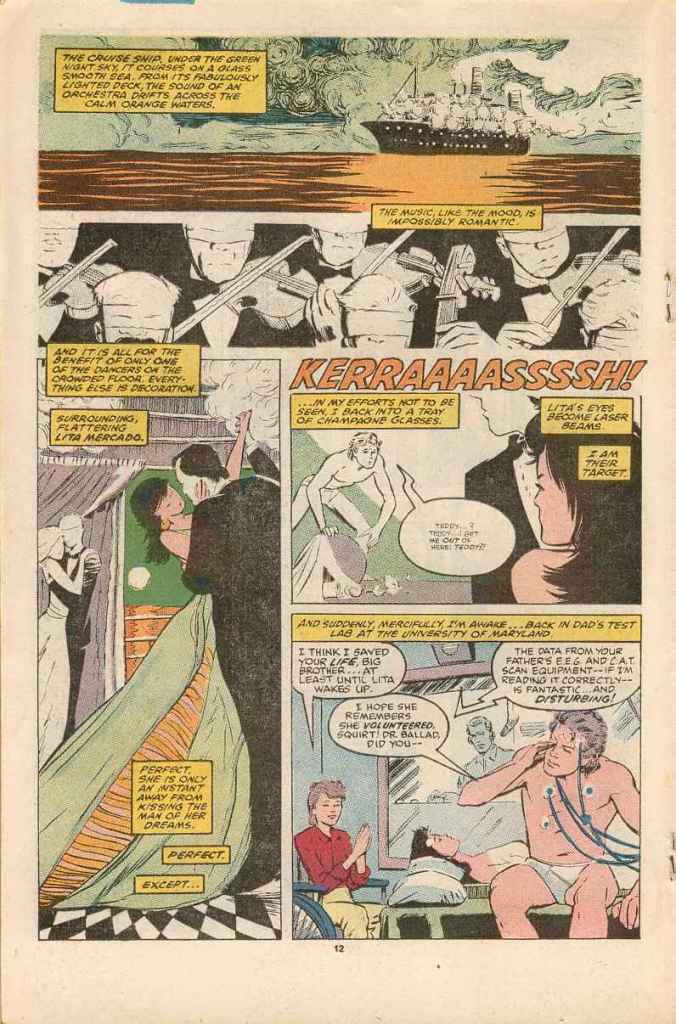
NIGHTMASK is the story of Keith Remsen, who discovers that he has the ability to project himself into the dreams of others after he awakens from the coma that he had been in when the power-unlocking White Event happened. Keith’s wheelchair-bound sister Teddy serves as his psychic anchor, his tether back to reality and his own body when he enters the minds of others. In the opening, we see Remsen first emerge from his coma in the wake of the White Event to learn that his parents have been killed in the same explosion that left him comatose and injured his sister. The explosion has left Keith with a scar on his forehead in the shape of a crescent moon, which becomes the character’s central icon.
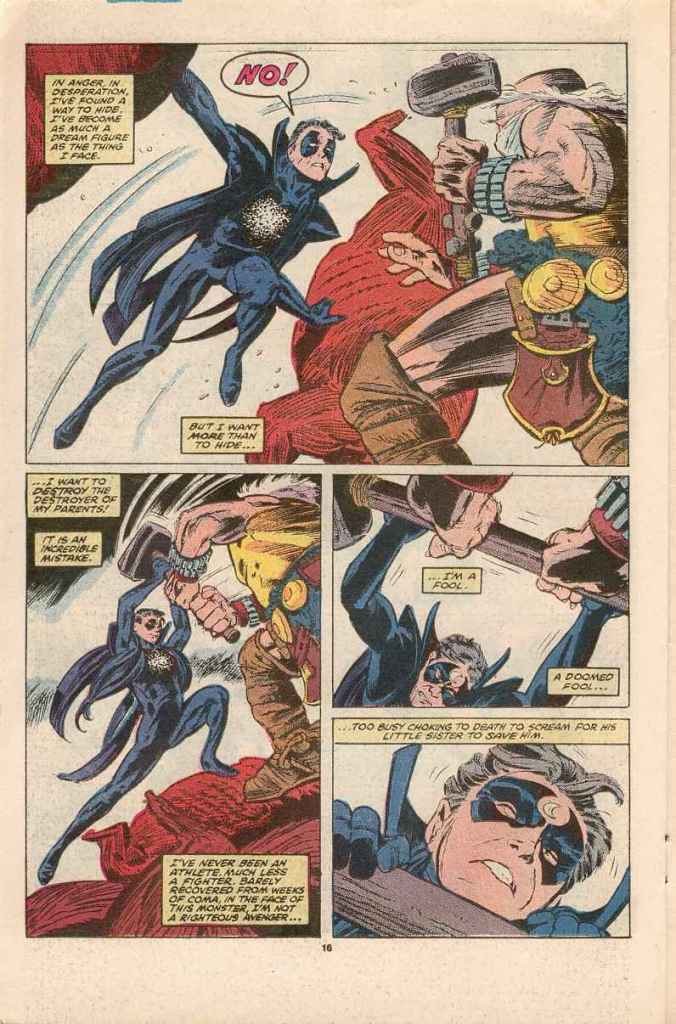
In his dreams, Remsen relives the events of the explosion, which has been chalked up to a terrorist bombing, but which he discovers was actually the work of agents of the Gnome, Doctor Horst Kleinman, whom he and his parents had been studying dreams with and who believed that the Remsens were stealing his work. In the dreamscape, Remsen encounters another figure who isn’t native to the dreamworld, but he snaps back to his physical body before he can learn anything further. However, the man in the next hospital room over has suffered a heart attack and died, and Remsen and Teddy realize that Keith had been in that man’s dreams when the encounter happened–that there’s a connection to what Keith experienced and the man’s sudden demise.
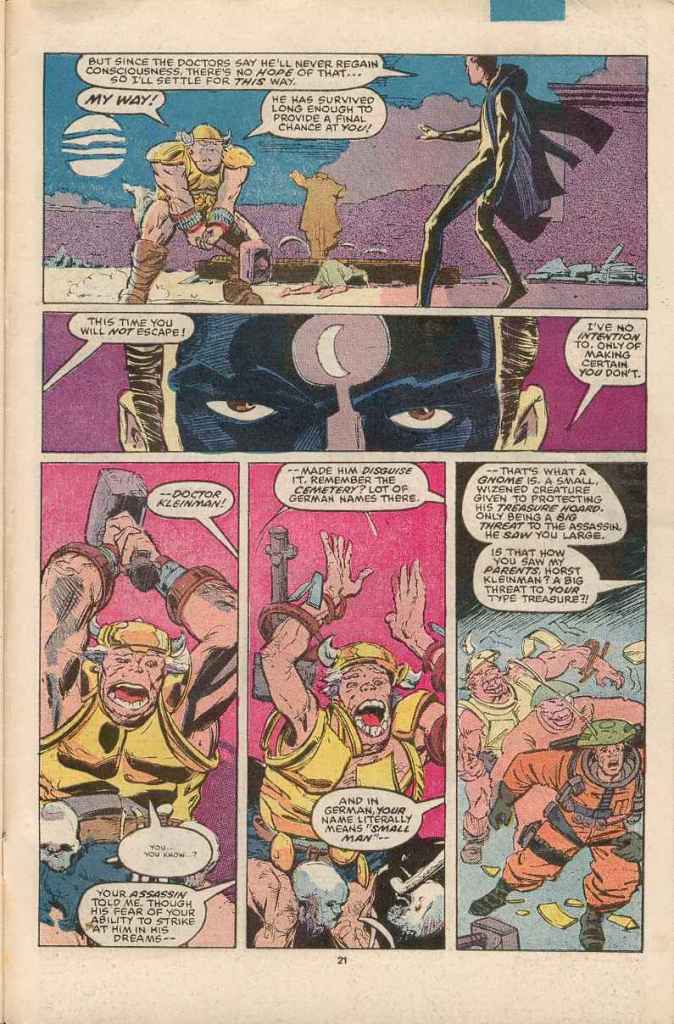
Experimenting further with his power, Remsen encounters the Gnome within the dream world and manifests a costume to conceal his identity from his foe. Having learned that Kleinman was responsible for his parents’ deaths, Remsen battle him in the dream world, despite the fact that he isn’t especially athletic and that the Doctor has manifested a powerful albeit misshapen body for himself. In their final confrontation, the Gnome appears to perish while Remsen escapes to teh real world. But we learn in the final panels that Kleinman is still alive, and he will become a recurring adversary for the character–at least while Archie Goodwin was writing the series. After that, he disappeared without a trace.
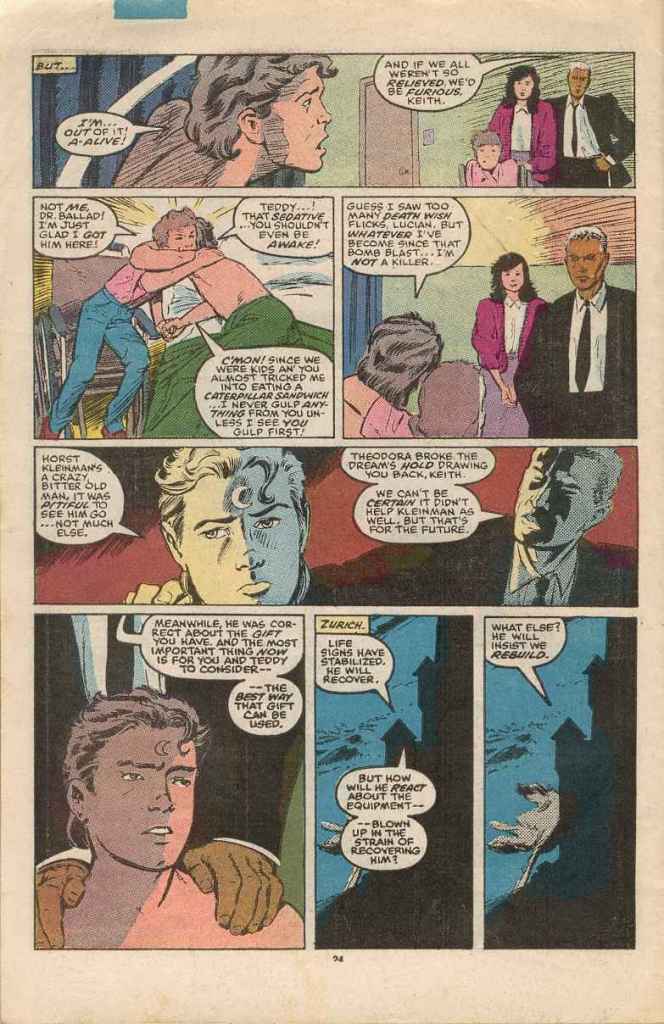
Along with his sister, Remsen sets himself up as a parapsychologist, using his ability to enter the dreams of those in trouble to hep assist with their problems and to battle the nefarious forces that plague them. The series was a sort of cut-rate Doctor Strange, with the flavor of a television series. After Goodwin’s departure, Roy and Dann Thomas wrote most of the subsequent issues, with occasional stories by Cary Bates and Sandy Plunkett. Among the assortment of artists who were drafted into service on one issue or another were Ernie colon, Alex Saviuk, Arvell Jones, Javier Saltares, Michael Bair, Keith Giffen, Kyle Baker and a young Mark Bagley, who became the closest thing to a regular artist the feature ever had, producing three entire issues before the book wrapped up.
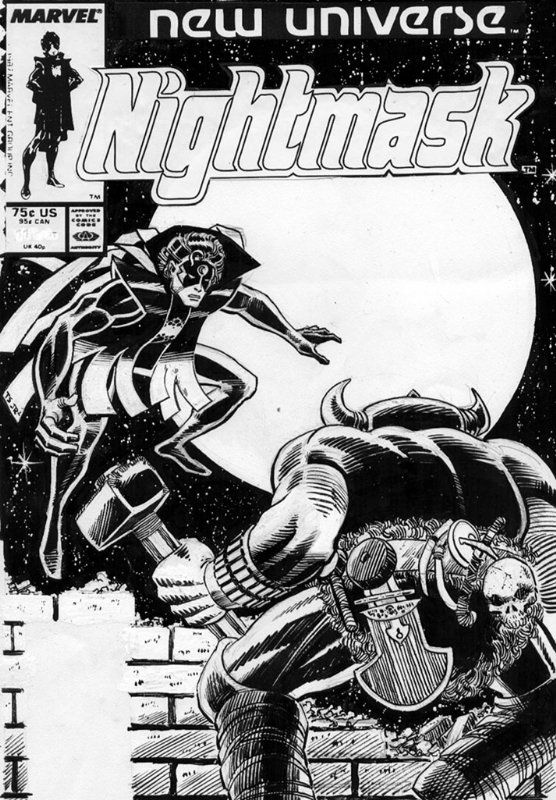
As with a number of the other New Universe launches, it seems that multiple different cover images were drawn for this first issue. This one was penciled by John Romita Jr.
 The Tom Brevoort Experience
Although I recognize the title and costume of the lead character, that’s as far as my memory goes with Nightmask. Clearly it left the barest of ripples in my comic collecting mind. What I am curious about, as we wade through these New Universe titles, is how was it that Marvel plunged forward with a project where every title seemed to bring forth any number of red flags? Or putting it more directly, while I understand the impact Jim Shooter’s management style would have in a profession with free-lance talent, wasn’t there anyone above him seeing what appeared a potential train wreck that would cost Marvel considerably in terms of credibility and finances? I know that Shooter didn’t remain long after the launch of the New Universe. It simply seems odd that one man’s errant vision prevailed so strongly in a clearly misguided direction.
(And I’m not looking to bash anyone. It’s been 40 years and heaven knows I made my share of mistakes back then – and more than few since!)
LikeLike
Yeah, this came off as a knockoff of the first Dr. Strange story, but longer and with less scope. But a terrific character design.
Another one that seems like Archie slapping something out there fast, because either he’s one of the only people who can grok Jim Shooter’s rules (Gruenwald was clearly one as well), or Jim respected Archie enough and was desperate enough this late in the process that he was willing to take what Archie came up with, even if it would have been better in a louder, less tamped-down setting.
It’s tempting to say Jim should have come up with all the series premises himself, but even if he had the time, it would then have been even harder to recruit good writers. Not because the ideas would have been bad, but because there’d have been no creator participation attached, and you’d still have to deal with Jim demanding rewrites until you managed to read his mind on where the borders were.
LikeLike
I’ve always found Tony Salmons to be an interesting, offbeat artist who did some very distinctive work. Too bad he only was able to pencil one issue of Nightmask. I don’t know if it would have been a better title if he’d been the regular artist, but at the very least it would have been an improvement over the ridiculous round robin of pencilers that the series experienced during its short existence.
LikeLike
Nightmask’s visual deserved a place in the regular MU. I only read the debut issue and maybe two more scattered through the year but all I remember is the awesome costume. At least what you said about the revolving door of artists meant it was mostly a revolving door of pretty damn good artists.
LikeLike