


The third Tempo paperback that I wound up buying was dedicated to the adventures of Superboy and the futuristic Legion of Super-Heroes. I seem to think that I got this book at a short-lived convenience store that operated in the local supermarket mall for a short time called Shanes. I had never entirely clicked to the Legion of Super-Heroes as a concept, despite having read a number of their stories over the years. In part, I’m sure that’s because when I began sampling, the series was being edited by Murray Boltinoff, whose sensibilities were different from Julie Schwartz’s and my own. So the SUPERBOY AND THE LEGION OF SUPER-HEROES title, like Murray’s other books WORLD’S FINEST COMICS and BRAVE AND THE BOLD felt wrong to my tastes in some undefinable way that I couldn’t yet put my finger on. The book didn’t typically feature the kinds of stories that I wanted in my super hero comics. So why I took the plunge on this paperback I couldn’t say, apart from possibly opportunity. If I had the buck-twenty-five on me to spare, it wouldn’t have taken much for me to buy a book of comics.

Like the other books in this line, this one is an odd collection of disparate material. I’d love to understand just what was going through the mind of whomever selected the stories for these volumes. The choices seem so haphazard and often in defiance of presenting a unified package of any sort. This particular paperback reprints four stories. The first is a solo Superboy adventure, the second is a Legion story from the 1970s and the third and fourth are later Legion shorts from the revival period of the early 1970s. So it’s all over the map, and it doesn’t really do a great job of introducing the concept of the Legion, let alone the group’s enormous roster of characters. The art style also shifts throughout, so there’s a lack of visual consistency as well.

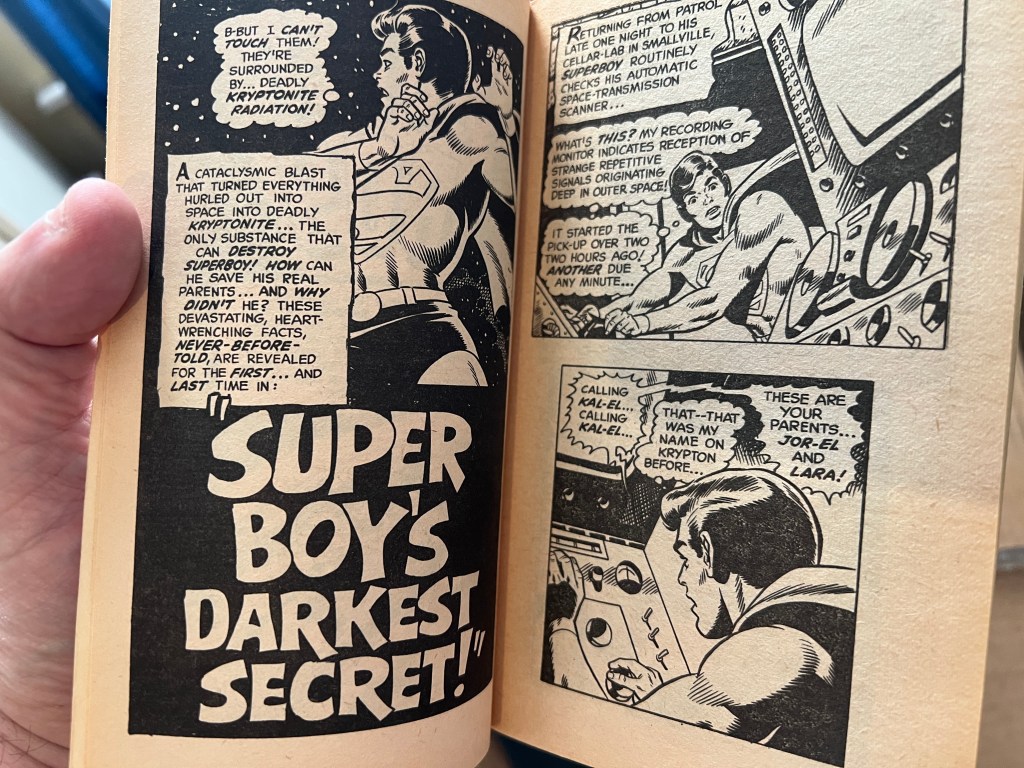
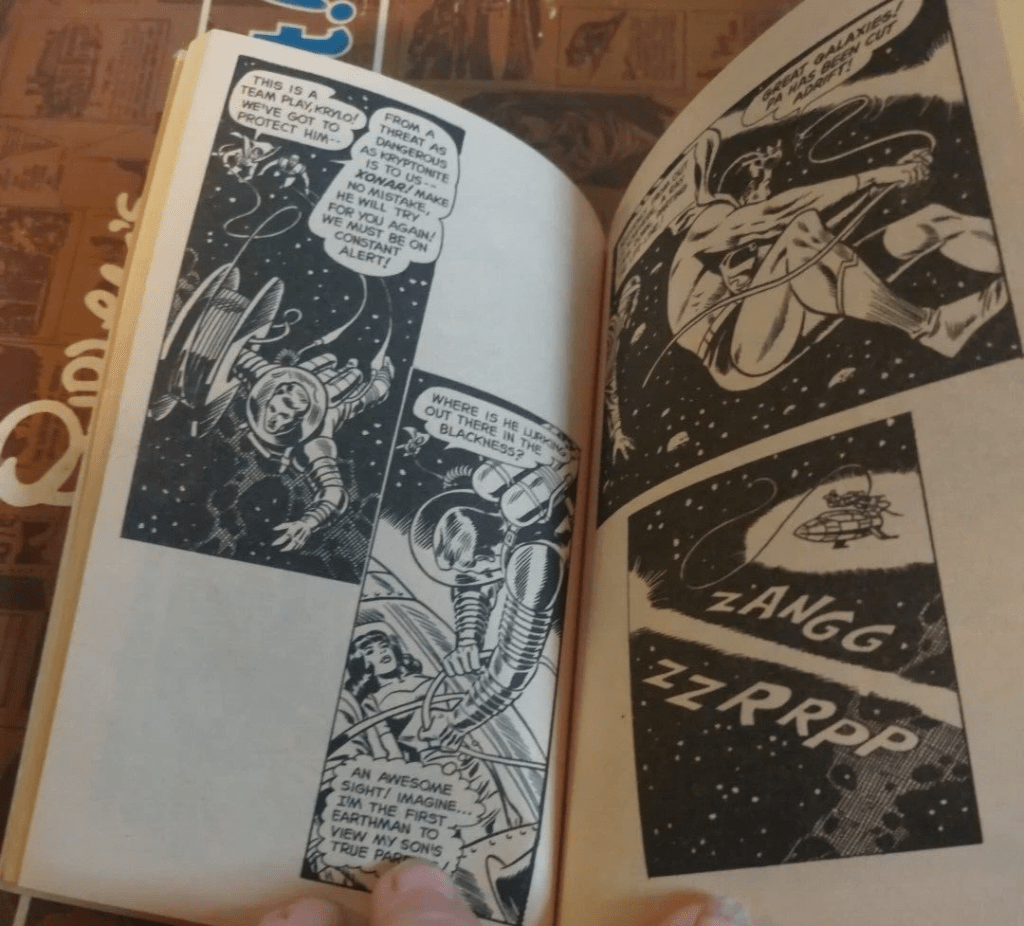
The book opens by reprinting one of the most notorious stories of its era, one that was almost instantly disavowed after it had seen print. As such, it’s somewhat mind-boggling that of all of the Superboy solo stories that might have been selected for inclusion in this volume, this is the one that was chosen. It was the result of the fact that SUPERBOY was the first of the Super-titles to be handed off by soon-to-be-retiring editor Mort Weisinger. The book passed over to Boltinoff, who had just as much disregard for Mort’s continuity as he did for everybody else’s. So in this tale written by Frank Robbins and illustrated nicely by the pairing of Bob Brown and Wally Wood, Superboy comes across his parents Jor-El and Lara floating in space in suspended animation on a big chunk of Kryptonite. it turns out, according to this tale, that they survived Krypton’s destruction, but that they were both already dying of radiation poisoning regardless, so in the end Superboy decides to leave them where they are. It’s a canon-devastating story, but one that puts across some genuine emotionalism on the part of the Boy of Steel. Of course, if Superboy experienced this, then his older self Superman would always have known that his parents didn’t perish on Krypton, which played havoc with all sorts of other stories. So the whole matter was simply forgotten about immediately following the original publication–at least until the story showed up again in this more lasting format.


The next reprinted story jumps back in time several years for a Mort-edited adventure in which Superboy’s girlfriend Lana Lang in her costumed identity as Insect Queen attempts to earn membership in the Legion of Super-Heroes. She’s rejected due to the fact that her powers come from a magical ring rather than being innate to her. But after proving her mettle in battle, she’s given special recognition as a part of the Legion Reserve–the 30th Century equivalent of a participation trophy. This is an enjoyable outing written by Otto Binder and illustrated by the terrific Curt Swan, working with perhaps his best inker of the period, George Klein.

The Legion had lost its regular berth in ADVENTURE COMICS by the end of the 1960s and vanished after a short stint in the back pages of ACTION COMICS. But the strip had developed a strong and vocal fan base that bombarded Boltinoff with demands for its return. Accordingly, Murray began experimenting with short Legion stories in the back pages of SUPERBOY, testing the waters. These were clearly so popular that eventually he relented and changed the entire series to SUPERBOY & THE LEGION OF SUPER-HEROES. This next story was from that testing period. It’s a simple story by Cary Bates and Dave Cockrum in which, after defeating the Legion’s mystic enemy Mordru, Superboy is targeted by his Legion comrade Chameleon Boy, who has fallen under the hate-spell of a crystal created by the evil sorcerer. Cockrum is inked here by his mentor Murphy Anderson, who all but buries Cockrum’s style with his strong finishes. Cockrum’s work would singularly be responsible for the success of the Legion revival–he loved working on the strip, and redesigned many of the characters to make them feel more contemporary. But at the time that this tale was produced, he was still just starting out, only a journeyman artist.
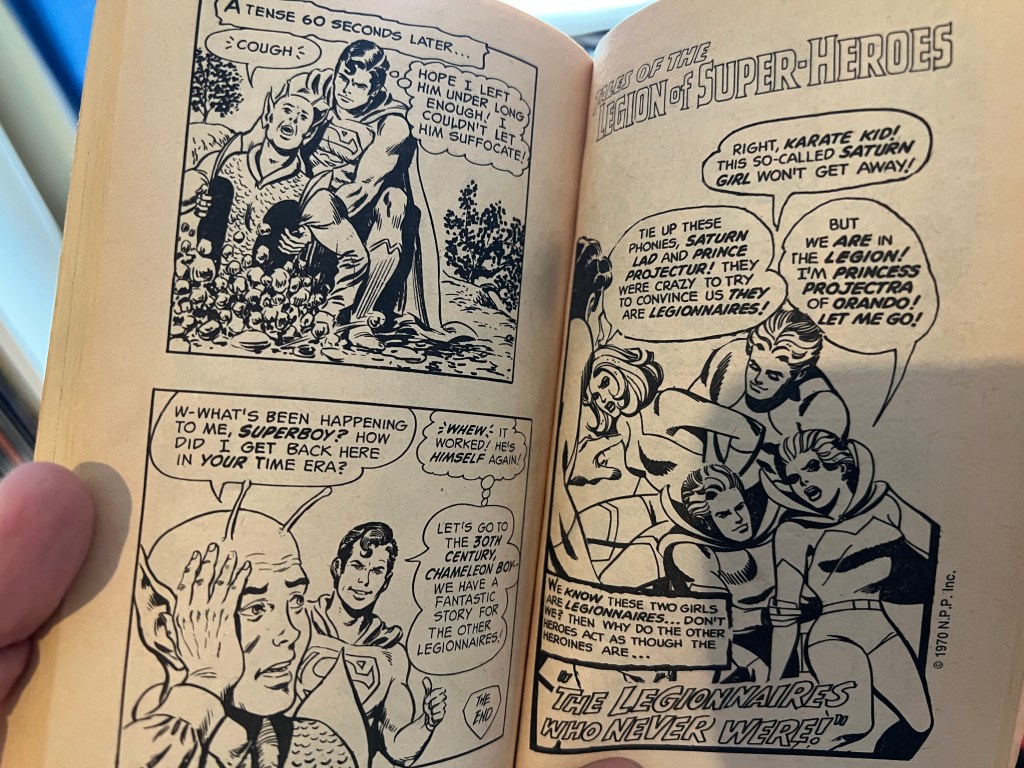
The final story in this volume hops back to that short run of the strip in ACTION COMICS. It was also written by Cary Bates, with artwork delivered by Win Mortimer and Jack Abel. In it, Saturn Girl and Princess Projectra return to Earth from a space mission only to discover that their fellow Legionnaires don’t recognize either of them. What’s more, their places have been taken by male doppelgangers of themselves, Saturn Lad and Prince Projectur. The whole thing is a test of Projectra’s nerve by the rest of the Legion, a prime example of the Weisinger impulse that led to entire websites devoted to “Super-Dickery”. Superboy doesn’t even put in an appearance in this story, it’s entirely a Legion affair.

So as a collection, I found this book enjoyable enough, but it didn’t make me want to delve deeper into the world of the Legion. I probably enjoyed the Insect Queen story the most, a reflection of the fact that I had an innate preference for the material of the 1960s over just about anything else at the time.
 The Tom Brevoort Experience
( I tried to Google it but couldn’t find it ) – Either 1 or 2 years ago while Googling Marvel and DC to see what books were out that week, on a site someone compared how Marvel and DC Comics write the Future ( DC’s mostly takes a Gene Roddenberry view that the Future is a place of Hope ( Legion of Super-Heroes ( April 1958 ) & Star Trek ( September 8, 1966 ), while Marvel sees the Future as a place of despair ( Dystopia ) — MY WORDS ). Other than the containment field around Earth star system Fantastic Four: The End#1-6 ( January-May 2007 ) is the only Future Earth that doesn’t suck ( Most of the people are immortal thanks to Reed Richards, except Doctor Strange who went the Ancient One route and people for the Natural Order ). I thought this FF: The End was where Wakanda conquered the Earth and turned it into a paradise ( No more anti-mutant crap, etc. ) or did I imagine that story? Why does Marvel do so many the Future Sucks stories? No Star Trek fans at Marvel?
LikeLike
Actually, thanks to Reed Richard’s father, Nathaniel, the 30th Century is a wonderful Marvel future. So wonderful that one guy hates it enough that he goes back in time to become the Pharaoh Rama-Tut, before becoming Kang The Conqueror, before becoming Immortus and/or The Scarlet Centurion. And becoming part of a Council of Kangs. (And we won’t even touch on whether or not he’s a future version of Doctor Doom!). All because of this guy, Marvel realized it’s much better to have dystopian futures than glorious ones.
LikeLike
You forgot the future ( 2262 ) Zarrko the Tomorrow Man [ Journey into Mystery#86 ( November 1962 ) ] comes from. FOUND IT — https://screenrant.com/marvel-vs-dc-difference-future-stories ( June 16, 2024 – The Major Difference Between DC & Marvel is Made Clear by DC’s New Time Traveler ) – If readers look back at both company’s catalogs, DC STORYLINES USUALLY SHAPE A POSITIVE OUTLOOK FOR THE FUTURE WHILE MARVEL’S ARE MORE DYSTOPIAN. For DC, The Future Universe is Portrayed in An Optimistic Light ( DC’s main timeline future is one where things get better, not worse ).Marvel Uses A Bleak Future To Add Dramatic Weight To The Present ( Marvel’s future storylines takes a very different approach ( to great results ).
LikeLiked by 1 person
Always had a soft spot for the Legion of Superheroes. Oddly enough, the first Legion story I read had the Insect Queen in it. But it was the art of Dave Cockrum that put their book on my radar as a middle-schooler. His costume revisions and style propelled him to becoming my first “favorite” comic book artist. From there, Cockrum’s move to Marvel and work on other comics such as Giant-Sized Avengers maintained that lofty perch – making it a no-brainer to purchase a certain X-Book that I believe went on to some degree of popularity.
I’ve tried over the years with different variations of the Legion, but nothing ever grabbed as much as those Cockrum issues. (And be gentle with me as I know I’m missing some good stuff.)
LikeLiked by 1 person
Anyone going to mention the Adams cover swipe/homage?
LikeLike
Not a swipe or homage; it’s taken from the 1976 DC Calendar, which was illustrated by Neal and Dick G.
LikeLiked by 4 people
As a longtime LSH fan, I have to say that’s a very bizarre selection of stories for this volume. Nothing here that would really make the casual reader who might pick this up at a bookshop decide to then check on the Legion in the actual comic books.
LikeLiked by 1 person
I also had this paperback, but had forgotten what a mismatched collection it was. I also had a soft spot for the Legion, so I’m sure I had no complaints at the time. Thanks for the memory.
LikeLike
Some of these collections definitely feel like whoever was in charge was just grabbing things off the shelf at random until they had the pages filled.
LikeLike
I love the 1960’S Legion. Kooky stories… offbeat powers… strident rules that make no sense….teens with bouffant hairdos in the 30th century. These are great comics!
I enjoyed the Grell era as well, and I get why the Cockrum costumes are a needed update… but the 60’s era costumes are so cool in their effort to not be cool.
I think I might have come across these b+w paperbacks but they didn’t grab me like the Marvel Pocket books which were small but at least intact.
LikeLiked by 2 people
The Legion is my favorite DC series. Maybe because it has little to do with the rest of the DC titles. I have most everything pre-reboot in one form or another, but don’t remember these stories. The Levitz run through the 70s-80s is excellent. Most of the older stuff is fun. I have had trouble getting into any of the reboots since the Giffen adult version.
Concerning DC and Marvel futures, my favorite Marvel future is MC2, the Spider-Girl future. That was fun!
LikeLiked by 1 person
I like the MC2 universe too. But I would borrow from Earth-98 [ FF/FF 1998 Annual — FF gained powers in 1961, aged ], only the MC2 Universe would have begun whatever Spider-Girl’s age ( 16 year? ) was when that universe was created be the difference between when the MC2 FF began and Earth-616’s FF began. That way instead of a Time-Travel cross-over it is like the old DC Comics JLA-JSA crossovers. Bill Foster is still alive in the MC2 universe. Plus I which Thor’s daughter in the MC2 universe was his mythological daughter Thrud.
LikeLiked by 1 person
Always loved that cover. A bunch of cool flying teens, and Superboy pausing to say, “Hey, c’mon and fly with us!”
This is what I loved about the Legion — they’re not a League or a peacekeeping force or explorers or whatever. They’re a club. A club that does some pretty weird stuff for a teenage club, but hey, that’s the kind of club Superbly would be a member of.
LikeLiked by 2 people
Legion Reserve is more like honorable mention as opposed to a participation trophy. I recall it was typically people who proved themselves heroic and worthy of being Legion members, but couldn’t qualify for some other reason, generally some issue with their powers (e.g as here, being device-based). The flight-belts they gave out to applicants early on would be like a participation trophy.
It was still pretty good in terms of recognition. Basically the Legion was saying you’d earned their respect as a possible comrade-in-arms, and that’s not trivial at all.
LikeLike
Another Legion fan here. Part of it was that with so many characters you could drum Starboy out of the Legion or kill Ferro Lad and not have to undo it immediately (in the case of Ferro Lad, never). Encountering the Cockrum women’s costumes as I hit puberty didn’t hurt.
LikeLike