

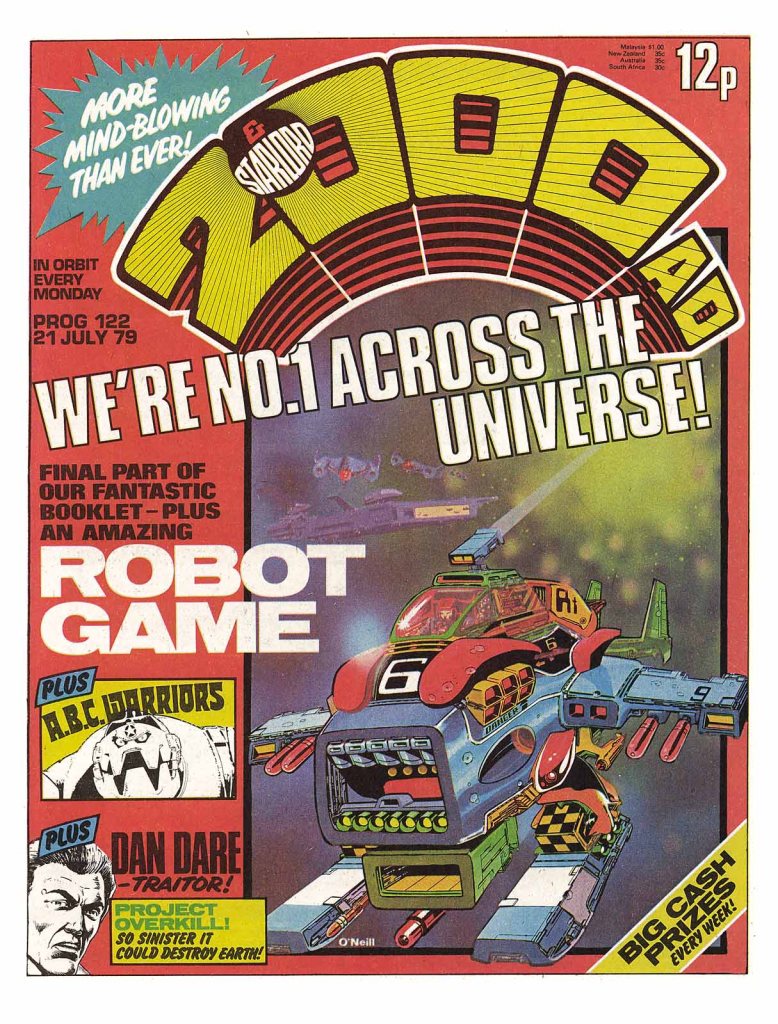
At the time of my family’s move to Delaware in 1981, there was only one comic book shop in the area, and it was in far-off Wilmington. This was Xanadu Comics, best remembered as the store that AMERICAN SPLENDOR cartoonist Harvey Pekar’s future wife Joyce Brabner once worked at. It was too far off to go to with any regularity, but early on I did somehow talk my father into taking me on an outing to the place. (Thereafter, i would prevail upon him repeatedly to stop in on his way home and pick up the issues I most desperately needed–which he did more often than you’d expect.) I remember it as being one of those ramshackle old stores of the period, cluttered and messy-seeming and uninviting to the uninitiated, but a treasure trove to those who already had the calling. There was a wonderful sense of possibility whenever you set foot in such a store; you never knew what treasures you might uncover that you’d never even heard of before. Among the books I picked up on that first outing were a small number of issues of 2000 AD, the British science fiction weekly.
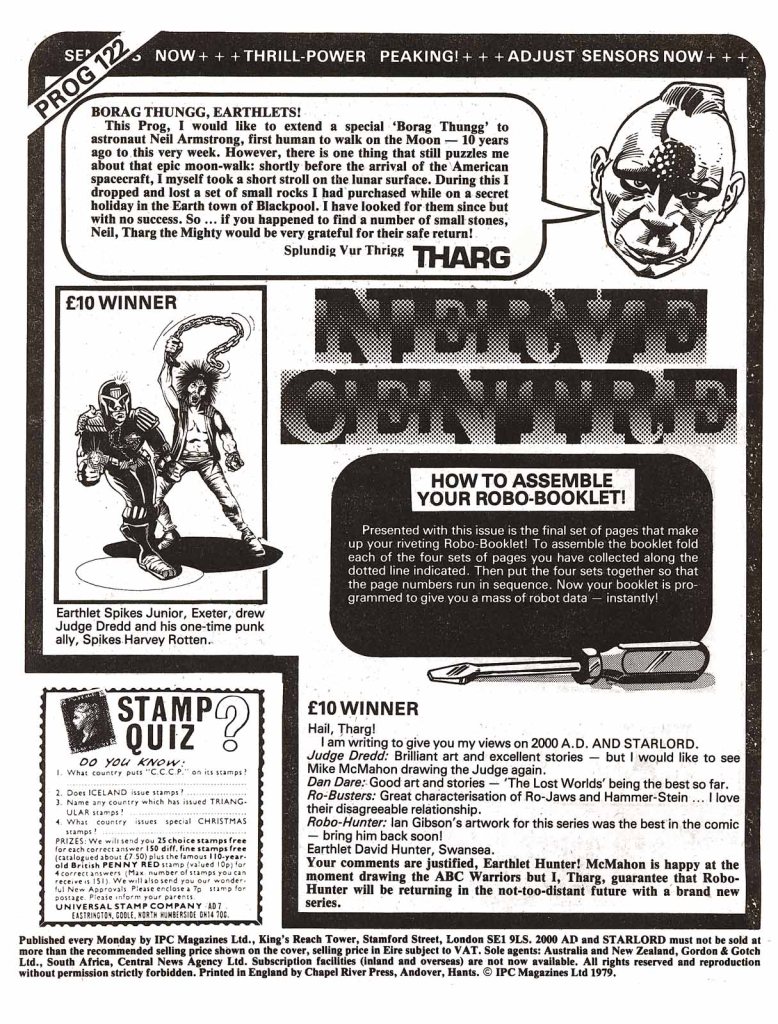
I had read about 200 AD and its lead feature Judge Dredd in an early issue of COMICS SCENE, the mainstream magazine that STARLORD put out for a short couple of years around that time. (It would later return for a more sustained run in the 1990s.) I was reading DOCTOR WHO MONTHLY semi-regularly, so I’d had that much experience with the world of British comics, but this represented my first wholesale dive into the form. It was like excavating an alien world, a realm of weekly anthologies printed on really crappy paper, covers and all, with features that were at once just a bit seedy but also vibrant and compelling. I found these books fascinating, and they led me to hereafter order the first two Judge Dredd albums from Bud Plant’s mail order book catalog. But I believe that this would have been my first encounter with the strip.
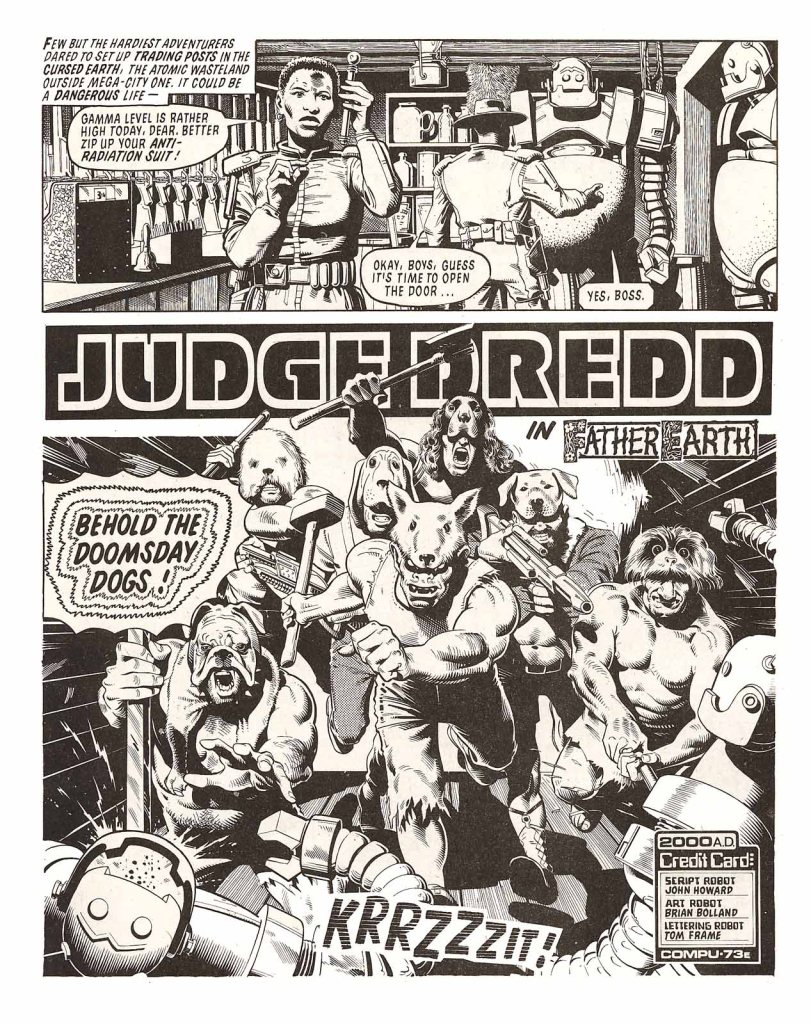
Judge Dredd was being illustrated by Brian Bolland, at least some of the time–2000 AD’s weekly schedule was unrelenting, so it wasn’t uncommon for different artists to need to tag-team on a given strip in order to insure its presence every week. The story in this issue concerned a mutate from the Cursed Earth beyond Mega-City One, Father Earth. He was a technology-hating quasi-hippie who was out to bring down the heathen Mega-City and its corrupted inhabitants. After a violent and somewhat-disturbing introduction, Father Earth and his mob of ten-thousand Mutielanders make for the gates of the Mega-City. The Chief Judge isn’t worries about such rabble, but Judge Dredd has a bad feeling about the situation, even as he rousts pickpockets working the election of a new Mayor. But it turns out that Father Earth has followers within Mega-City One as well, and they take over the Power Tower that provides energy to the City’s outer defenses. And that’s about it for this chapter–the downside of the weekly schedule was that any individual feature only ran for half-a dozen pages at a clip. The art here was sharp, though, and the script by John Wagner had a provocative satirical edge to it.
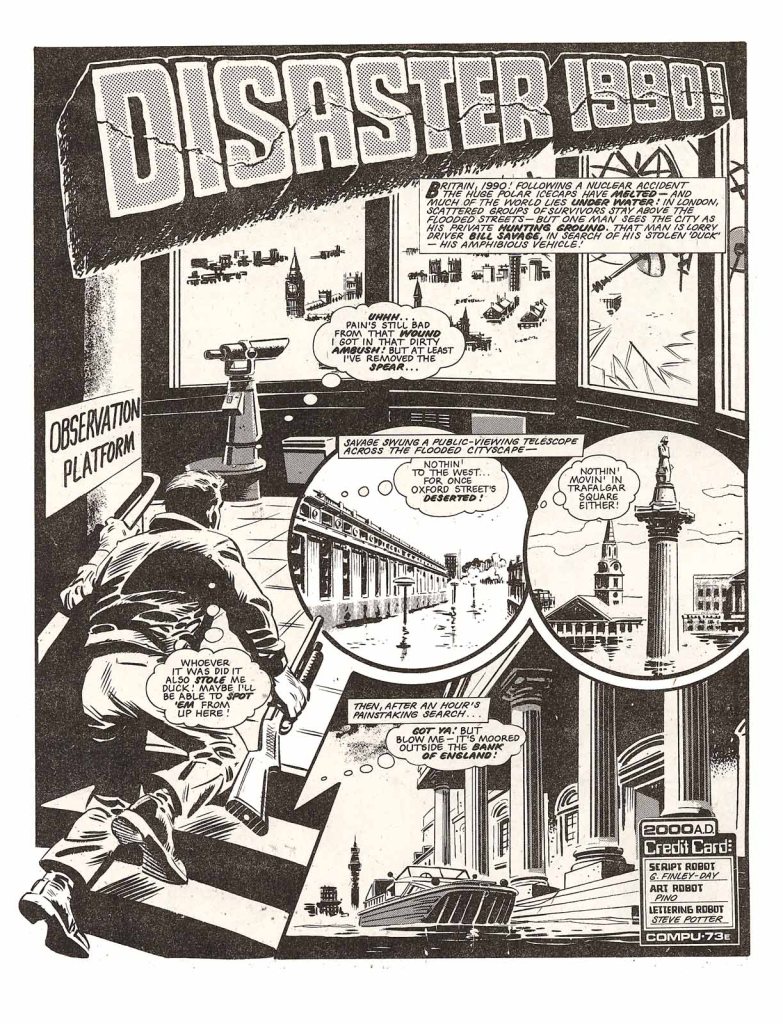
The next story up was an installment of Disaster 1990, a post-apocalypse series that followed the adventures of former lorry driver Bill Savage as he made his way through a half-drowned London following the polar ice caps melting. Savage was attempting to recover his amphibious vehicle and escape from the area. in this effort, he’s somewhat aided by Bamber, the scoundrel who stole his boat in the first place, but whom circumstances put on the same side as Bill as the pair are attacked by other survivalist scavengers. The bad guys are trying to loot the half-submerged Bank of England–this despite the fact that money is worthless in this ruined future. There’s a lot of action and not a whole lot of characterization, but that was all right–it was an action movie on paper, after all. And while it didn’t make a huge impression on me, it also wasn’t a chore to get through or anything. Carlos Pino provided teh artwork over Gerry Finley-Day’s script.
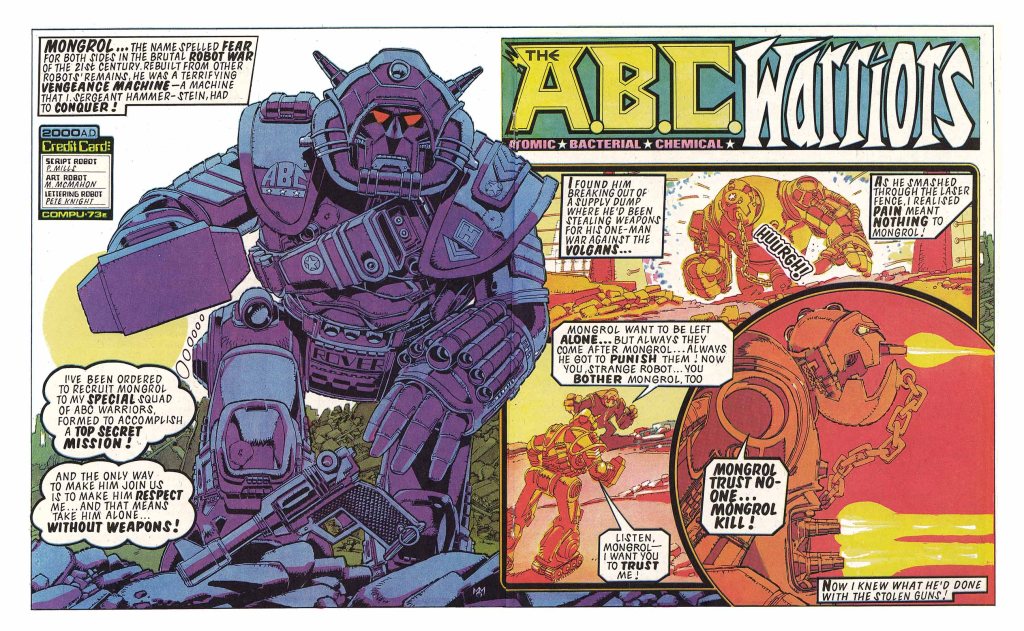
The next strip I really liked, and it was clearly popular enough to warrant the centerfold position, which meant that its opening pages were in color rather than black and white. This was ABC Warriors, about a team of robot soldiers led by Hammer-Stein, who had been introduced earlier as half of the Ro-Busters strip. The real star of the show here was the artwork of Mike McMahon, which was solid and weighty and attractive as hell. I really liked this. This particular chapter is the final part of a multi-prog story in which the warriors recruit the childlike behemoth robot Mongrol to their unit. Author Pat Mills was in fine form here.
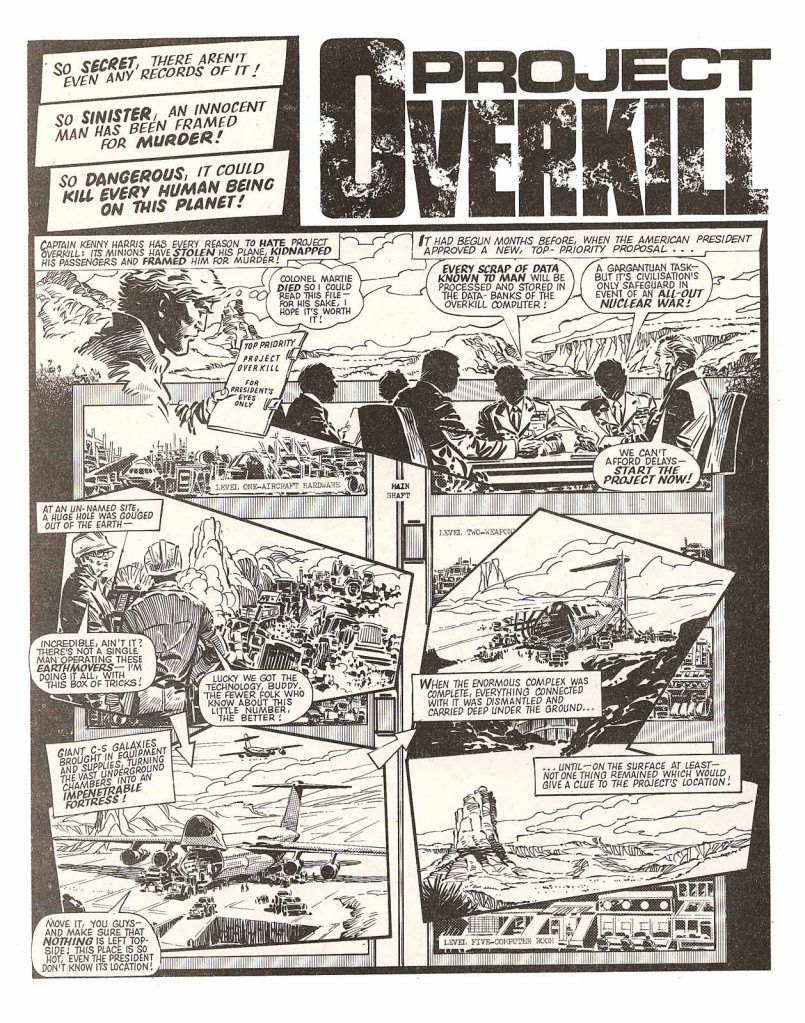
The next strip was pretty forgettable, and I remembered nothing about it before cracking this issue open again for this retrospective. Project Overkill was a techno-thriller about a secret conspiracy to take over the world. The hero, Captain Kenny Harris, is operating on the edges of this conspiracy, trying to get to the heart of it so that he can clear his name of teh false murder charge hung on him to get him out of the way. By the end of this chapter, Kenny has learned that Overkill controls its operatives through an implanted failsafe which they can detonate at will, causing their agents to go up in a flaming fireball. What’s worse, Harris realizes that he’s got such a detonation device implanted in his body as well–which means the bad guys can immolate him at will! Jesus Redondo provides the images, and Kevin Gosnell the words.
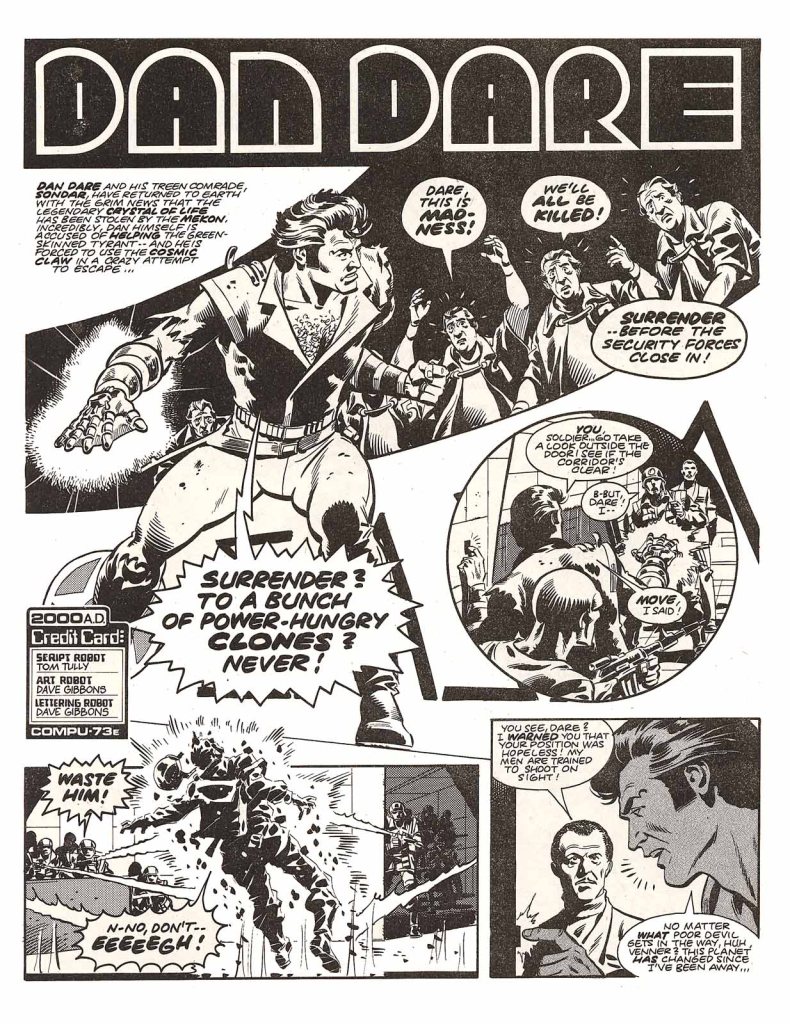
The final story in this issue of 2000 AD featured the perennial British space hero Dan Dare. But this was a very different Dan Dare than the man who had headlined the EAGLE for so many years. He’d been relaunched and reworked into something very different. But not knowing any of the history, my attention was captured by the slick graphics of artist Dave Gibbons, and so I went along with Tom Tully’s script. This version of dan is armed with either a glove or a prosthetic hand–I was unclear on which–called the Cosmic Claw, which let him shoot off energy blasts and stuff. He’s been framed as a traitor to the human race by his old enemy the Mekon, and with his Treen companion Sondar is forced to go on the run. Like most of the other 200 AD strips, the emphasis here was on fast-moving action, and this feature delivered that in spades, not slowing down at all across its four-and-a-half pages.
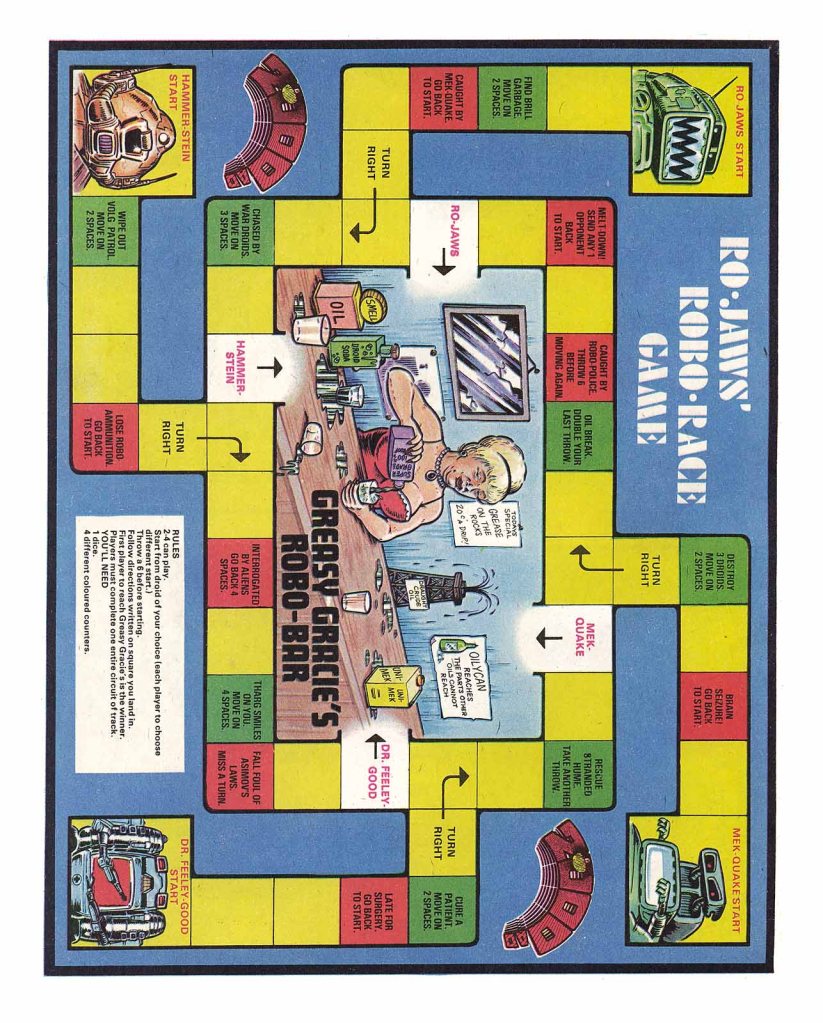
The issue also included a variety of filler features including this Ro-Busters board game that makes up the back cover of this issue. You can see that 2000 AD hadn’t quite figured out what the age of its audience was this early on, and so it produced material across a wide spectrum. There were definitely strips in it that parents might not want their children to be reading–which was really the heart of the publication’s appeal. There was definitely something dangerous and anti-authoritarian about 2000 AD. I never became a regular reader–it was too difficult for me to get copies of regularly for too long–but I always appreciated it when copies would cross my path.
 The Tom Brevoort Experience
Wow, I’d also completely forgotten Project Overkill ever existed. It only lasted eight weeks, apparently…
LikeLike
It was in the few Comics Features I had that I saw ads for Judge Dredd before the 1995 Judge Dredd movie came out. I like Dredd ( 2012 film ) better, except for him and the other Judge not being smart enough to use the guns of the bad guys they killed once the got locked in that building, saving their own ammunition ( They he wouldn’t have gotten shot or so desperate to get his hands on bullets when the corrupt Judges tried to kill him ). Plus there was Batman/Judge Dredd: Judgment on Gotham ( February 1992 ) that I got.
LikeLike
Disaster 1990 was unusual in that it was a prequel to an earlier feature in 2000 AD, “Invasion!” In that one, Britain was invaded in 1999 by the Volgan Republic (basically Communazis) and Bill Savage was the one man who really kickstarted the resistance. This story was an attempt to explain how the world had got to that point.
LikeLike
The typical age of readers at the time, me included, was 10 to 12 year old boys. Everything in it was “age appropriate” in the pre-Weimar pre-Blair-ruined Britain of the time.
LikeLike
This issue came out about a year before I started reading 2000AD, but it looks like it had the same sort of strike rate as it did during my 14 years as a reader – about 60% must-read to 40% meh. It lost some of its anarchic edge over the years, but at its best it was unmissable. Especially when Mike McMahon was involved.
LikeLike
Wow! This looked great! What a terrific variety of strips! I would certainly go for it as an adult, however, other than the name, 2000AD, I knew nothing about it, and have never seen a copy here in the midWest U.S. Thanks for sharing!
LikeLike