

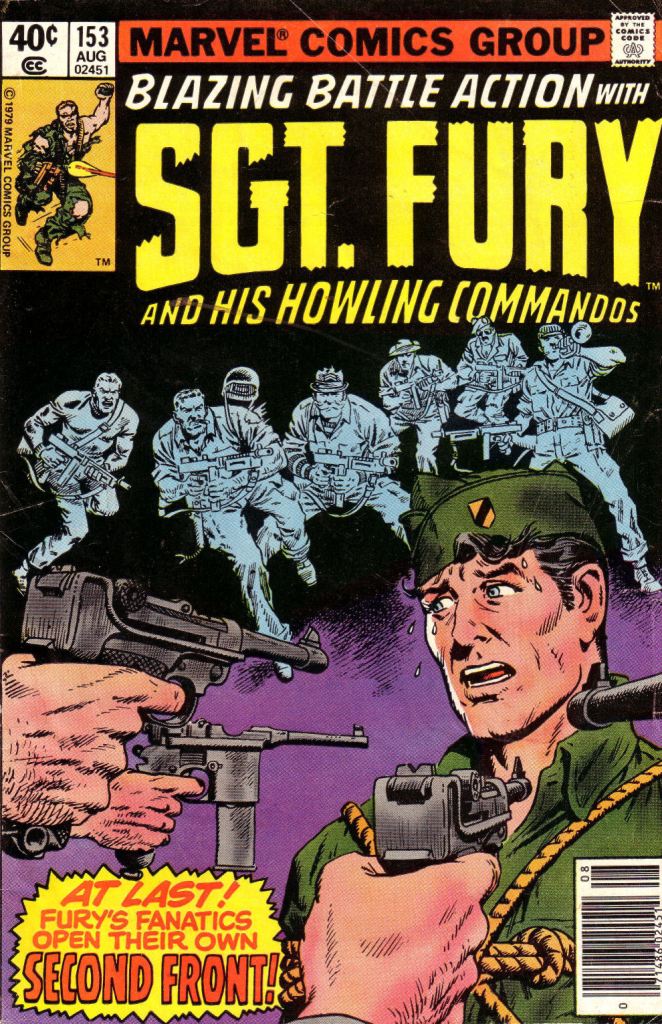
SGT FURY AND HIS HOWLING COMMANOS wasn’t a war comic, not in the way that i understood that term. It wasn’t at all attempting to get across the true horror and cost or warfare. Instead, it was a war movie, a big, grand, fun adventure where the enemy were clowns and caricatures and nobody really got all that hurt despite all of the bullets and bombs flying everywhere. In a sense, it did the opposite of most war comics of this period, making going to war seem like a fun adventure. This cover coloring is interesting to me. It’s clear that, when drawn, the intention was that Fury and the Howlers were in the same space as the captive Dino Manelli and his assailants. But the colorist knocks Fury’s gang back, making them appear to be more like apparitions, thoughts by Dino as he faces what could be his final moments. It certainly pulls the focus far more to Dino’s fearful face, but I’m not 100% certain that this was the best choice here.
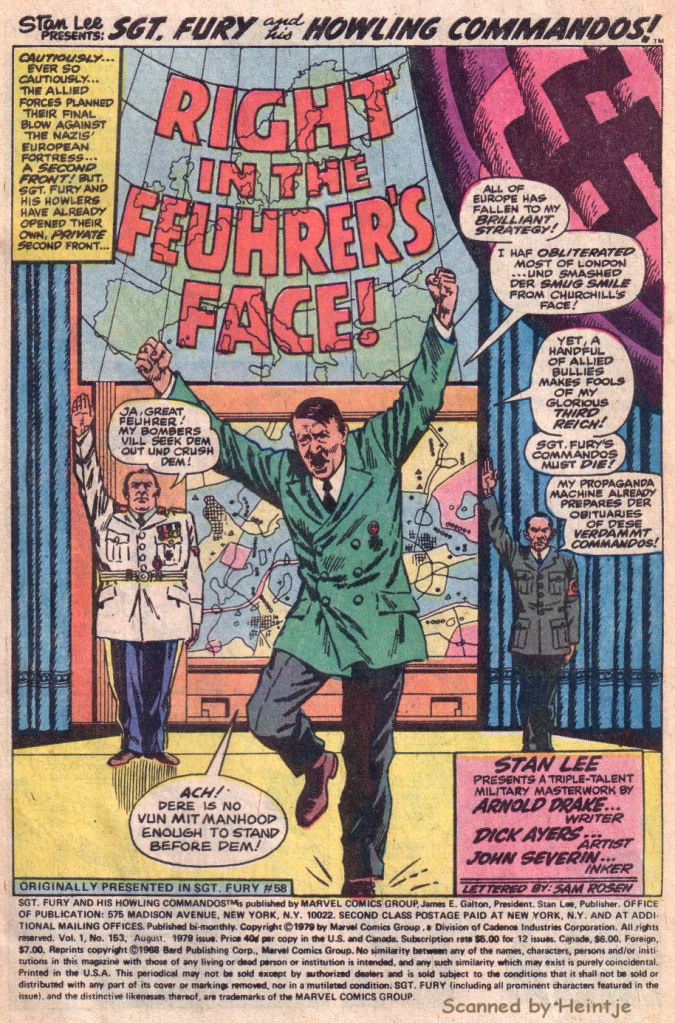
This particular issue of SGT FURY is one of the book’s least realistic–and that’s saying something. It’s clear that writer Arnold Drake wasn’t striving for authenticity so much as entertainment. The whole affair has some of the flavor of Drake’s more lunatic Doom Patrol stories. The artwork was penciled by stalwart Dick Ayers, not that you could really tell apart from the page compositions and storytelling. That’s because the great John Severin was once again on inks, and he dominated the look of the final work. Which was to the good–Severin was a master of the comic book form, and he made Ayers’ work look a bit more sophisticated and modern during their time together. It was a solid combination.
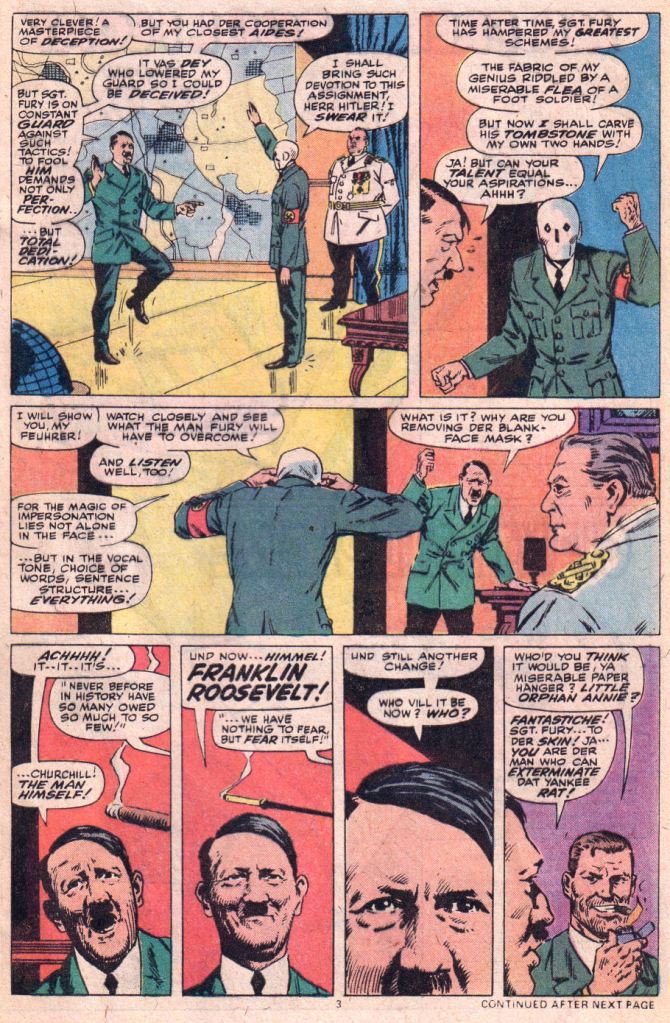
The tone and intentions of this story are made clear through the introduction of its main villain, a nameless Nazi master of impersonation known only as the Man of a Thousand Faces even by the German High Command. He infiltrates a meeting of Hitler’s top lieutenants in the guise of Joseph Goebbles to prove his skill, and then swiftly assumes the likenesses of Churchill, FDR and even Sgt Nick Fury himself to show off his bona fides. Hitler wants the Howling Commandos wiped out, and the Man agrees to take on the assignment. He’s run afoul of the Howlers before and looks forward to being able to take them off the board.
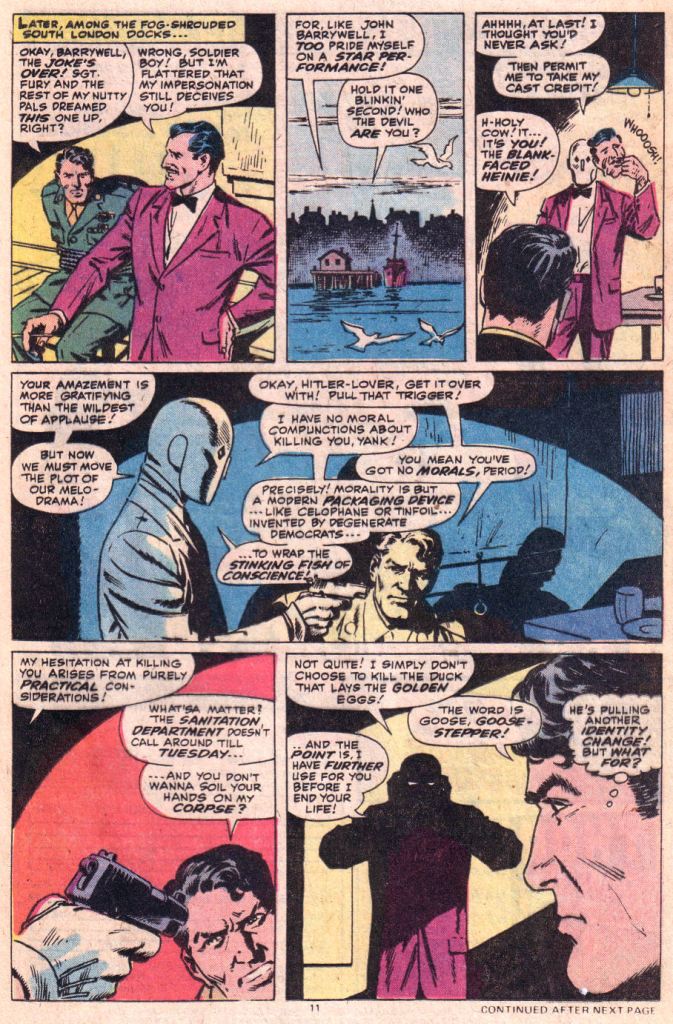
As the first part of his plan, the Man flies to England and assumes the identity of John Barrywell, a noted Shakespearian actor. He claims to be in the area to entertain the troops, and the Howlers’ own Dino Manelli is assigned to him as an attaché. As the two men go out on the town, Barrywell piles Dino with drinks to weaken his defenses, then drugs him outright, carrying him off under the guise of Dino being too inebriated to walk himself. Manelli wakes up as a prisoner of the faceless man, who wastes no time in assuming yet another guise.
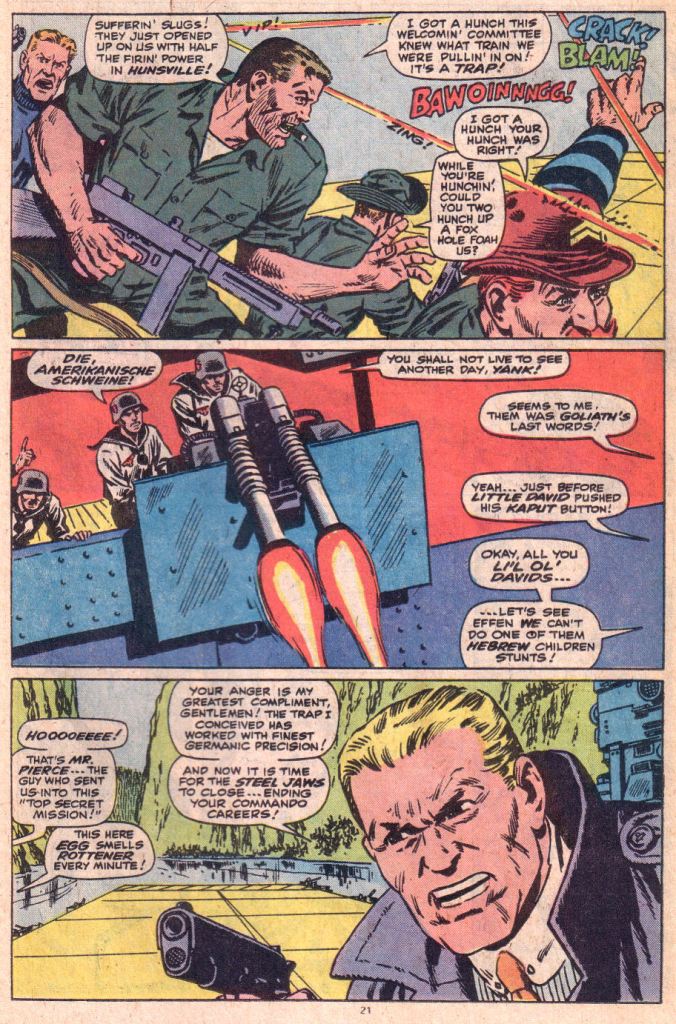
The Man poses as Mr. Pierce, an O.S.F. man who informs Happy Sam Sawyer that Dino Manelli has been captured by the Nazis. Of course, this is a Tuesday for the Howling Commandos, and they’re ready to head out to get Dino back and wipe the floor with whatever Nazi agents may be holding him. But Sawyer puts Pierce in charge of the recovery operation, since he’s the one with the hard data about the situation, and this leads our heroes to a concealed aircraft carrier hidden amongst the fjords of Norway (never mind that Germany didn’t have any aircraft carriers.) The Howlers boldly land on the deck, and are immediately caught in a crossfire.
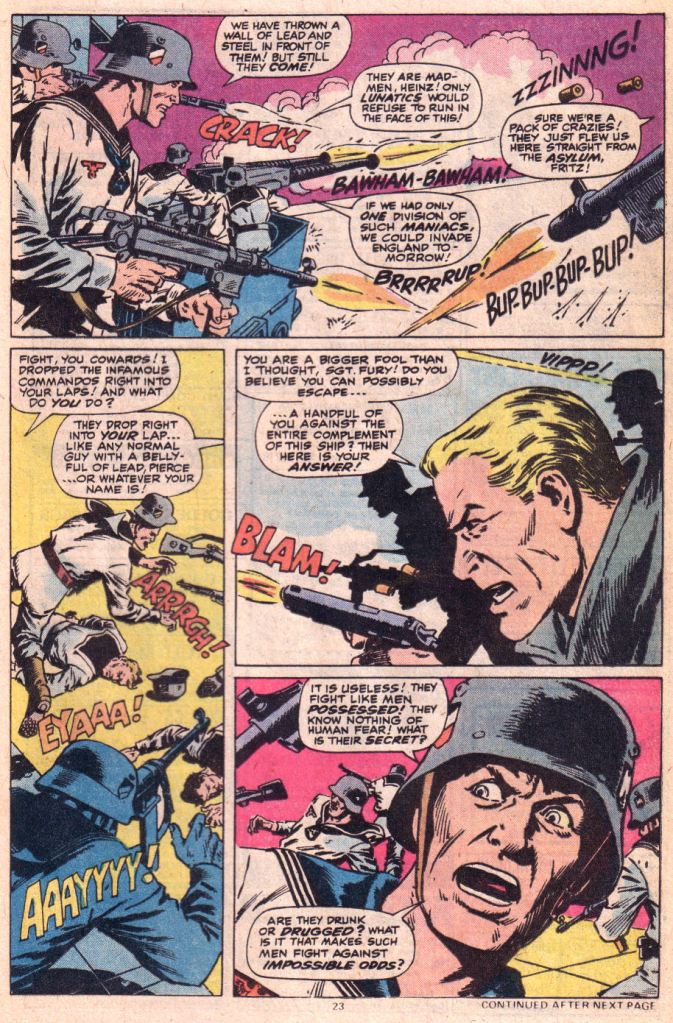
So it’s a single squad of six men–seven once they’ve recovered Dino–against a full carrier of Nazi soldiers. This, too, is just another Tuesday for the Howlers and they literally defeat the entire ship’s worth of bad guys in about four pages of quips and gunblasts. There’s no strategy, no secret plan that allows for their victory–Fury and his guys are just tougher and meaner and more unstoppable than the bad guys. Most crucially, their plot armor is thicker, so they’ve shortly got the upper hand. And now it’s time for Fury to settle the score with Mr. Pierce, who reveals himself as the Man of a Thousand Faces as they pair spar.
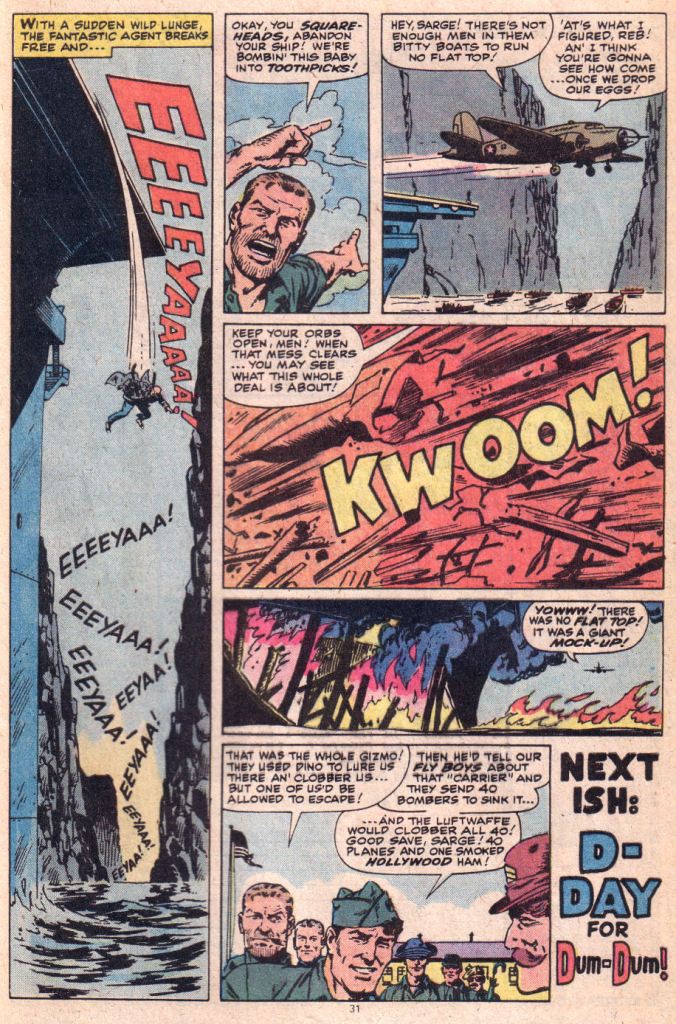
Fury, of course, is a better fighter than any Nazi agent, and so he’s got the Man on the ropes in two seconds flat. Rather than face capture and disgrace, the Man leaps off of the deck of the carrier into the ocean below. Surely he’s dead now, right? Hah! Anyway, the Howlers set up explosive charges to blow up the carrier and take off before they’re also caught in the blast. Drake tries to cover the implausibility of all of this by adding copy that indicates that there were only a small number of enemy combatants aboard the carrier, and that it wasn’t an actual carrier at all but rather a life-size mock-up that the Germans parked here for no really good reason. Best not to think about any of this too closely, though–that isn’t the sort of strip that SGT FURY was, after all.
 The Tom Brevoort Experience
Yet, despite its shortcomings, the book is still more entertaining than Kickers, Inc.!
LikeLiked by 2 people
The Agent of 1,000 Faces, has his mouth covered in that white mask so just how does he pull of a successful impersonation without anyone noticing the white of his mask when he talks? Or how does his and the Chameleon ( no powers version ) pull of their disguises wearing those white masks ( especially when the Chameleon wore those goggles on his forehead )? I have seen Atlas & early 1960s aliens with either tiny horn-like bums on their foreheads or ridges above their eyes that were disguises to make them look human and some how the bums or ridges never show through the disguises ( Technology is to early for the Agent of 1,000 Faces ( Unless it is Deviant tech from Pluto a.k.a. Kro ) but do their masks work like the one the Black Widow used in Captain America: The Winter Soldier movie? ). Plus for people that know the person they are impersonating, shouldn’t the Uncanny Valley thing kick in to tell them that this is an impostor? There is now way unless they are shape-changers that they could walk and move the same as another person without having the same bone structure. Don’t own a Sgt. Fury and his Howling Commandos ( To bad back in the day I never thought to order the Jack Kirby drawn issues ).
LikeLiked by 1 person
This was my first ever Fury Book and War comic. Unusual Cover in that the UPC Code is in the bottom right. As child that fascinated me.
LikeLike
You can tell that Severin ink line anywhere.
LikeLike
I don’t think I ever bought a war comic as a kid though I did have one or two childhood friends who had them. I made an effort to read Kurtzman’s war comics and Warren’s Blazing Combat as an adult….based on a combination of good reviews and an interest in Kurtzman and Goodwin’s war comic philosophies.
That said…I agree that the Ayers/Severin art here is very nice. Severin is a top notch artist, but I also have a soft spot for Ayers’ work whether he was pencilling or inking. He’s a journeyman but his work just says “comics” to me.
LikeLike
I don’t think I ever read this book. I know I read none of DC’s war comics either. All Star squadron and Invaders were the wartime based kind of comic for me.
LikeLike
I enjoyed some Sgt. Fury enough to buy the first Essentials volume. Fun stuff. Historically, it interests me in how the generation that fought WWII told stories about the conflict. It’s still the last global war, which defined a generation and their children. Something we should be glad we have never seen the likes if since!
LikeLike
I don’t think the Howlers are supposed to be in the same space as Dino on the cover, unless they’re meant to be standing on a very steep hill, but there’s no indication of that. The original cover has airplanes and explosions adding to the symbolic feel, but it’s colored realistically.
The ghostly coloring is more powerful, I think.
Incidentally, the cover’s usually credited to Ayers/Severin, and that’s probably right, but looking at it, I could easily believe it was Trimpe/Severin.
LikeLike
I don’t think it is possible, but to me it looks very much like Murphy Anderson inks!
LikeLike
Did Anderson ever use a pseudonym like others to pick up Marvel work? If I only had the depth of knowledge Kurt Busiek does…
LikeLike
Not that I’ve ever heard. I don’t think he was ever in a position to need to.
And that’s definitely Severin on that cover.
LikeLiked by 1 person
Anderson was Swan’s best inker and the rare artist who was as good as an inker as he was superlative as the main artist. Ironically just like the Severins, one of which you just mentioned…
LikeLike
I got a few issues of Sgt. Fury in the very early ’70s, mostly reprints of earlier stories. They were mildly entertaining enough and it wasn’t until I was much older (and had read quite a bit of history on WWII) that I found most of the Sgt. Fury stories ridiculously cheesy. I loved the more realistic EC Kurtzman war stories (of which John Severin drew quite a few), of which i obtained hardbound copies in the 1980s, and of which I initially became familiar with from interviews and articles in The Comics Journal.
LikeLike
If you’re going to turn an umlaut into an E, the E goes after the vowel. So Führer → Fuehrer, not Feuhrer. (I know, I know, nobody cares. Sigh.)
LikeLiked by 1 person
You are right!
LikeLike
…that the E goes after the vowel, or that nobody cares? 🙂
LikeLike
you are right. the E goes after the vowel! Sorry!
LikeLike
No worries. I just couldn’t resist joking on the ambiguity there.
LikeLike
You are a Spelling Nazi! 😉
Hmm, maybe this was avoid infringing on the Disney lyrics? In case anybody doesn’t get the reference:
https://www.youtube.com/watch?v=I7vb89c6pQY
LikeLike