

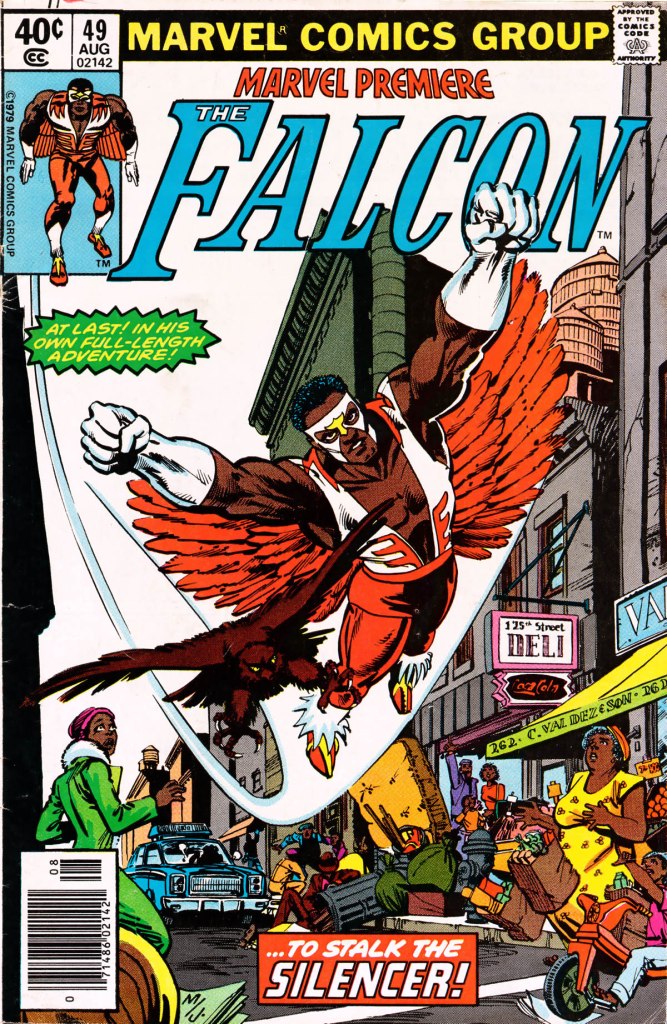
MARVEL PREMIERE was something of a mixed bag as a comic book purchase. While early on it had been dedicated to the adventures of Iron Fist, and before that Doctor Strange, it had turned over time into a SHOWCASE-style try-out series for new concepts (and occasionally a place to wrap up outstanding plotlines from a series that had come to an end, as in the case of the Man-Wolf issues.) I had begun picking the book up for its two-issue try-out of the new Ant-Man, a storyline that really clicked with me. And so, seeing that the newest issue was focused on the Falcon, a character I knew from reading CAPTAIN AMERICA, I figured that I’d continue to buy the book and picked it up. This nice cover by Frank Miller probably helped with that decision.
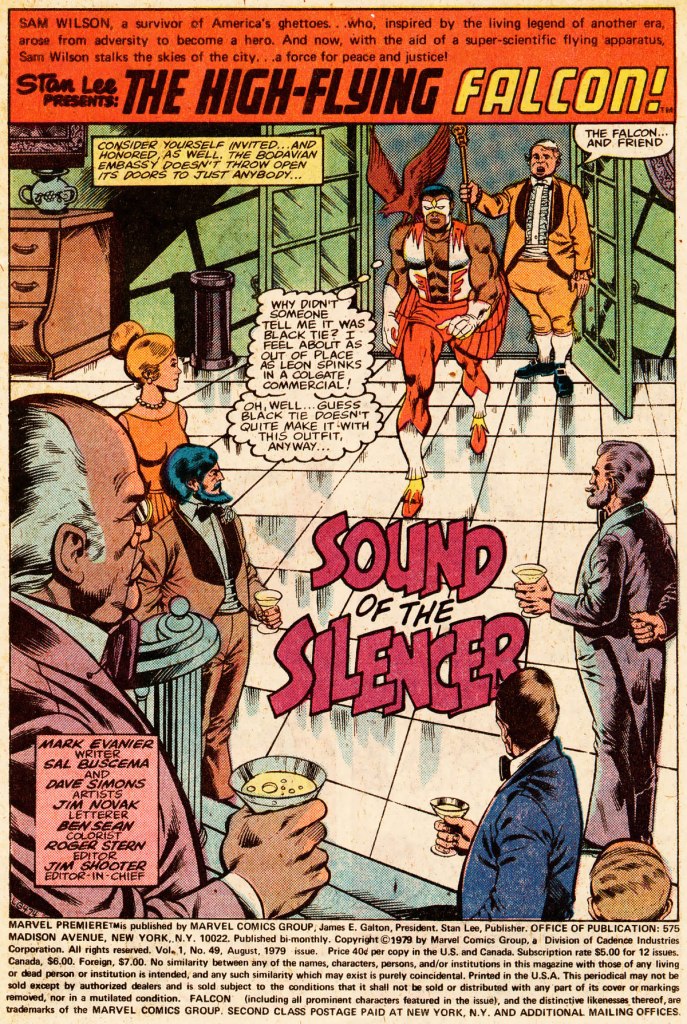
This story has a unique history behind its creation. It was initially conceived of as a stand-alone fill-in issue of CAPTAIN AMERICA AND THE FALCON during the period when Steve Gerber was both writing and editing that series. For a bunch of reasons, it wound up not appearing in that title, but it was still drawn by that series’ regular artist Sal Buscema. Over on his terrific blog, writer Mark Evanier told the entire story of how this issue came to be a couple of years ago. I’ve linked to the appropriate entry below so you can get it right from the horse’s mouth.
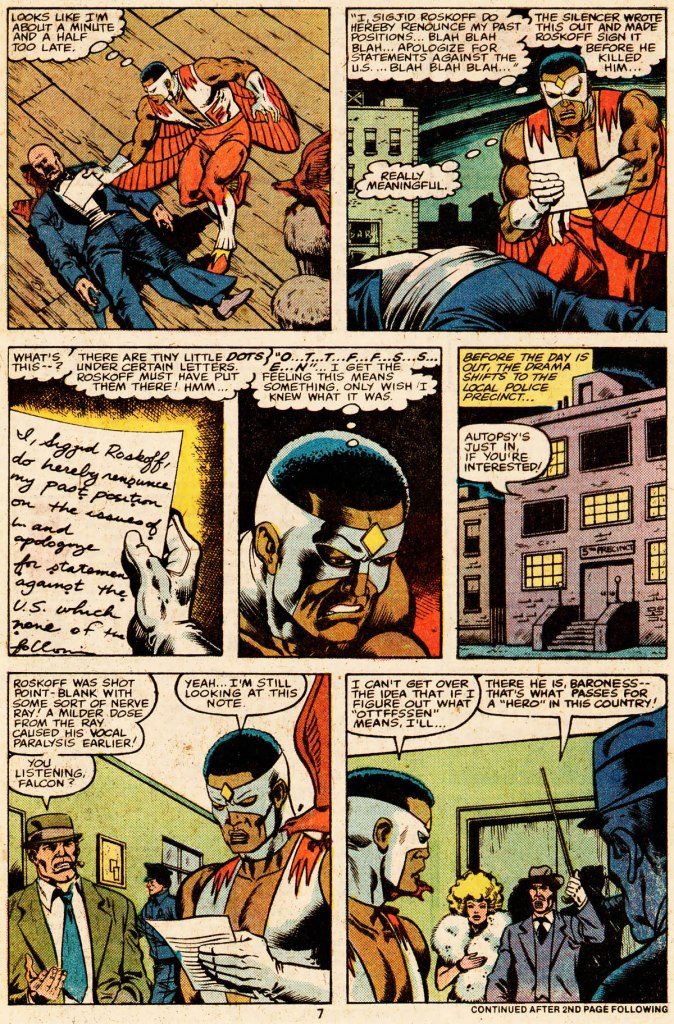
The story, which Evanier says he plotted in about three hours under emergency conditions, involves the Falcon attempting to apprehend the murderer of a slain diplomat, a killing committed by a patriotically-costumed villain called the Silencer. The killing appears politically motivated, for the diplomat, Sigjid Roskoff, was an outspoken critic of the United States, and he’s insulting to both the Falcon and Sam’s absent partner Captain America when Falc shows up to act as his bodyguard. When the Silencer attacks, the Falcon isn’t able to save Roskoff’s life. But he’s fascinated by a code he finds hidden within the note the Silencer made Roskoff write before his death, renouncing his anti-American views.
Evanier builds the central mystery of the story around that hidden clue–certain letters in the note have been underscored with a dot: O-T-T-F-F-S-S-E-N. This wouldn’t be the only time that Evanier would build a story around a mystery trope; in the 1980s, he wrote a short-lived series called WHODUNNIT for Eclipse Comics, the premise of which was that each issue contained a mystery that could be worked out through clues planted in the story, and there was prize money offered for the first reader to solve each issue’s story. I wasn’t sharp enough when I first read this story to figure out this clue, but I clicked to it instantly while typing it out for the first time here.
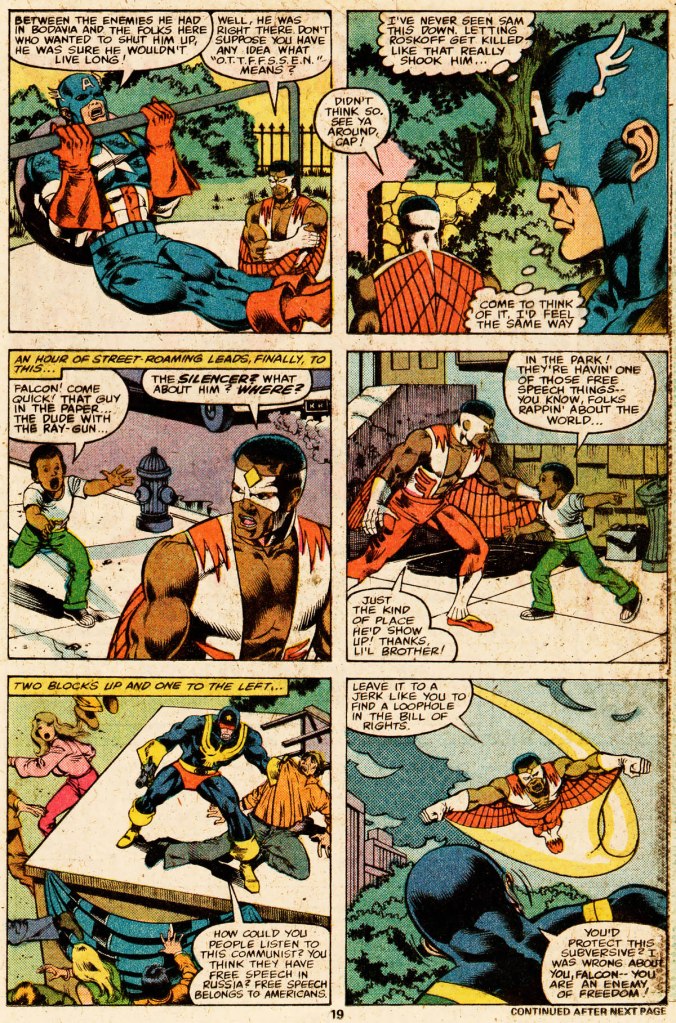
Anyway, Falcon tries to figure out the clue as well, but he’s completely stumped. J. Jonah Jameson plays it up in the pages of the Daily Bugle, making a bit of a contest out of it to spike readership. So we wind up getting a bunch of different possible solutions throughout the story, including On The Top Front Fence Some Soldiers Eat Nuts and Oliver Twist Took Fanny Flag Snow Skiing Each Noontime. Falcon also checks in with Captain America, who makes a brief appearance to provide him with some backstory about Roskoff as well as some moral support. But ultimately, the clue doesn’t lead him anywhere–Falcon locates the Silencer again when the villain attacks a free speech rally in Central Park. This leads to a short action set piece where the Silencer is able to elude his pursuer by throwing a live grenade towards the crowd, causing the Falcon to divert his course in order to catch it and hurl it away.
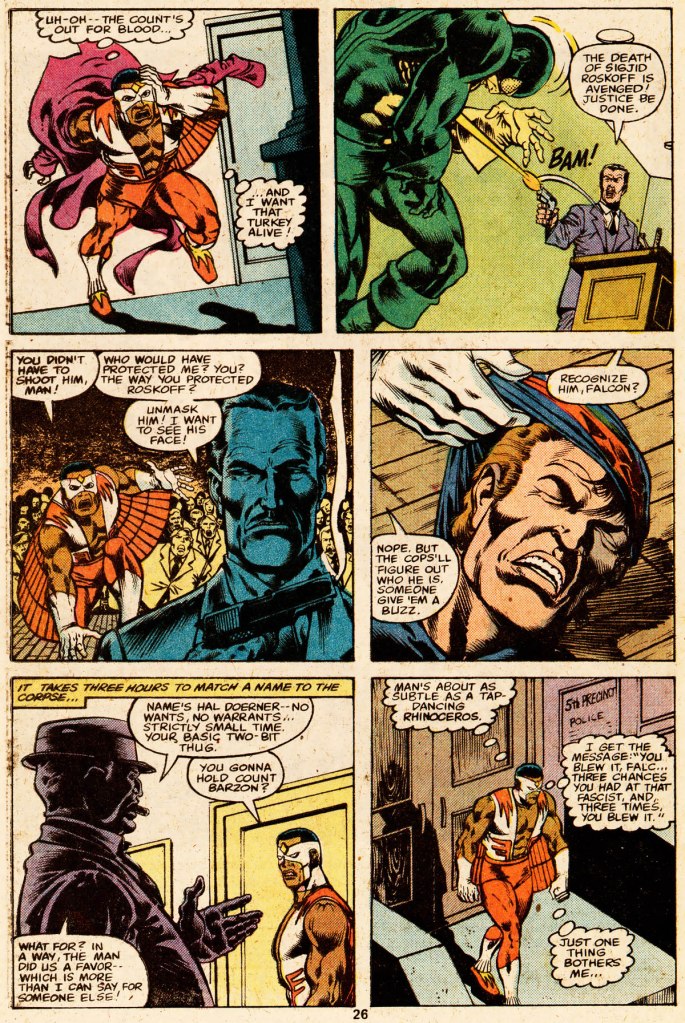
One thing the Falcon learns in his encounter with the Silencer is that the man’s nerve ray paralyzes the vocal cords of its target, rendering them unable to speak for a period of time. Sam figures that the killer won’t be able to resist making an appearance at the rally that Roskoff was supposed to speak at, where his fellow countryman Count Barzon will be subbing in for him. So Sam attends incognito, and he’s ready to jump into action when the Silencer makes his appearance. Unfortunately, in the time it takes for Falc to suit up, Barzon pulls a concealed weapon and guns down the Silencer, claiming this to be justice for what the man did to Roskoff. The authorities seem to agree, and tell Falcon that they consider the matter closed. But Sam is still bothered by that code in Roskoff’s final message.
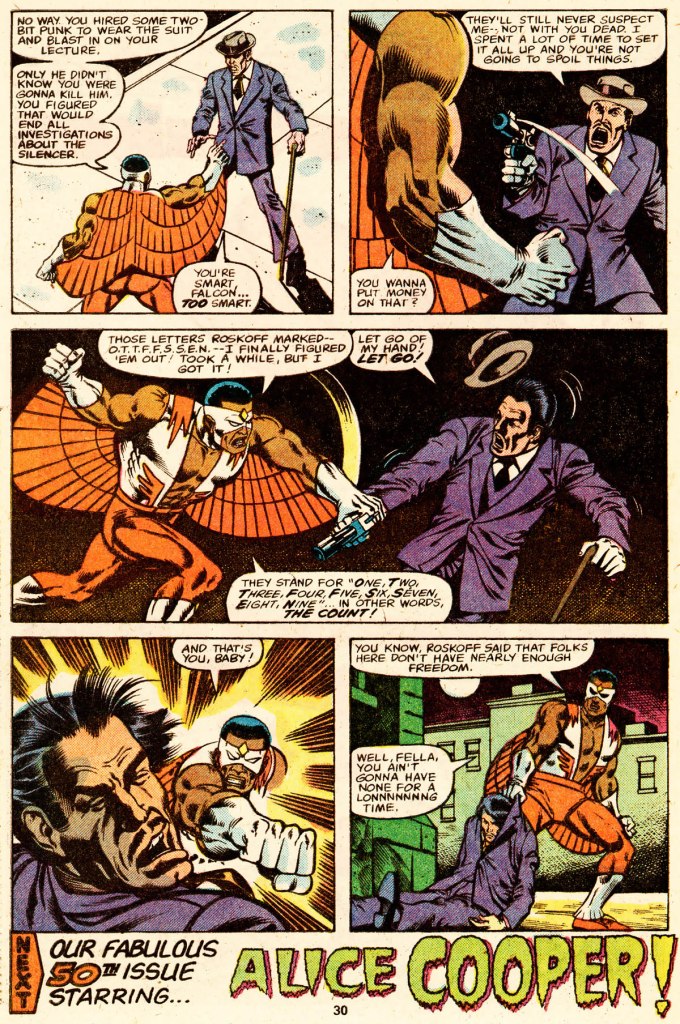
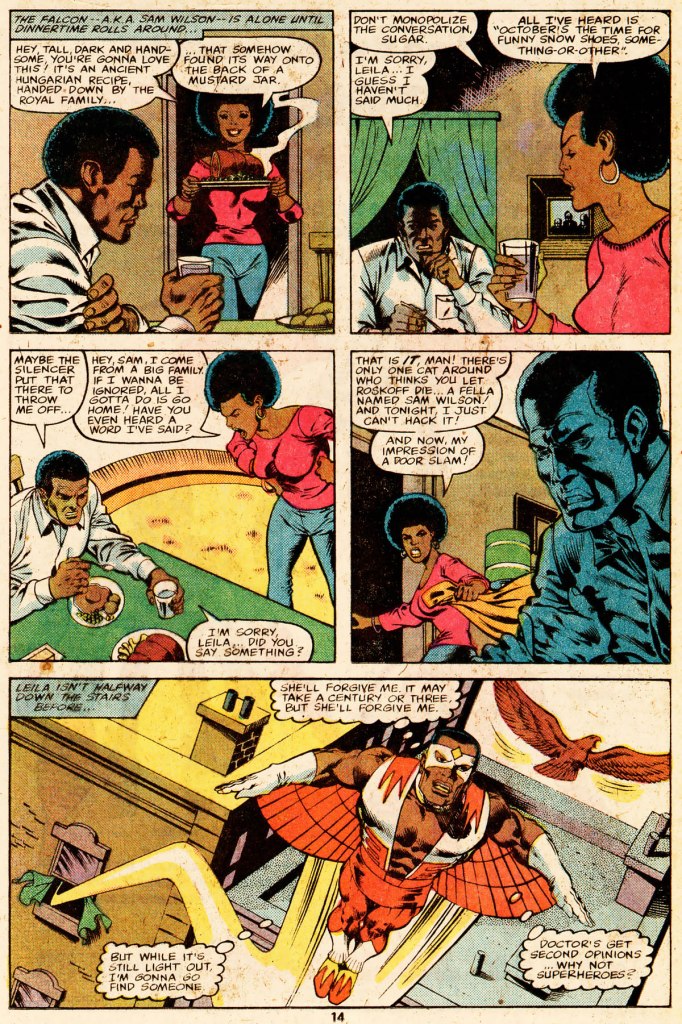
Do you have it worked out yet? Well, let’s get to the finale. The man in the Silencer costume turns out to be a random low-level thug, and a comment from Falcon’s girlfriend Leila unlocks the meaning of Roskoff’s last message for him. It’s actually Count Barzon who is the real Silencer. He’d taken the contract to assassinate Roskoff on behalf of the Bodavian Freedom Party, then hired a stand-in to attack him wearing the Silencer costume so that he could kill him and divert suspicion away from himself. And Roskoff’s clue? Unable to speak at the moment of his demise, Roskoff indicated the letters O-T-T-F-F-S-S-E-N, short for One Two Three Four Five Six Seven Eight Nine. In other words, the count. And that’s the bit that I remember the best about this story.
 The Tom Brevoort Experience
Yes, that solution at the end was certainly memorable, as was the way the Falcon explained it while he was punching the guy out- permanently embossed into my memory a few decades later. It’s a bit like that 1977 Spider-Man/Nova crossover, which included a similar puzzle as a clue to the villain’s identity, and resulted in all of us readers who read the story permanently remembering the real name of the minor one-shot villain of that story.
LikeLiked by 1 person
It was also done in The Brave and the Bold#177 ( August 1981 ) but because the murder victim died before he could write the full clue they misinterpreted what he wrote and created a costume villain ( The Hangman ) who used their screw-up to do A-B-C murders ( The A.B.C. Murders – the title of an Agatha Christie novel — kill other people to cover up who the real target was so it doesn’t lead back to you ). They thought the killer left a message next to the body and mistook the letter Q ( Quigley ) for a hangman’s noose in the game of hangman.
LikeLike
Mark Evanier deserves more accolades than he gets and Sal did his usual awesome job laying out this story. I haven’t read nearly enough of Evanier’s stuff but I still have very fond memories of DNAgents.
LikeLiked by 2 people
I agree. Being a huge fan of old Saturday morning cartoons, Mark Evanier’s name is quite familiar to me. As Tom indicated, his blog is truly fascinating as it encapsulates so much of his amazing array of work. If I had to name several people that I wanted to have dinner with to hear their stories, Mark Evanier would definitely be high on that list.
LikeLiked by 1 person
It’s not a great story, but given the circumstances, it’s a miracle that it’s as good as it is. The puzzle is solid (and the various “alternate” solutions are an entertaining running gag). I like the angle that Falcon is genuinely upset by his failure to close the case, and that the various characters’ criticisms really get to him. But his vindication at the end is very satisfying and cathartic.
LikeLike
About that Mark Evanier blog posting…
I would never describe Evanier as rigorous in his recountings. One example is when he described Sergio Aragones’ objections to signing a supplier agreement with DC in the late 1970s that was completely contradicted by Aragones’ own account–and the two are good friends! There are plenty of others as well, such as the time during the Kirby Heirs litigation when his misrepresentations of Kirby’s correspondence with Marvel humiliated the Kirbys’ lawyer. One should also keep in mind some of what he’s relating are apparently things Gerber told him, and Gerber was a self-serving chronic liar. But let’s address that blog post. In order:
–Gerber was not the editor of the CAPTAIN AMERICA title. He was only the editor of the HOWARD THE DUCK comic-book series.
–It was not Gerber’s responsibility to select or assign artists. Per Gerber’s writer-editor contract, he and Marvel agreed Marvel was solely responsible for selecting artists for his material, even with HOWARD THE DUCK.
–Gerber’s deadline problems were notorious in the Marvel offices at that point. Right around the time Gerber signed his writer-editor contract and received the CAPTAIN AMERICA scriptwriting assignment, Gene Colan quit the HOWARD THE DUCK newspaper trip over frustration with Gerber’s persistent lateness. I cannot believe Archie Goodwin would be so foolish as to put Gerber on a title that would require several issues of work just to get it back on schedule.
–I have a hard time believing Evanier was dealing with the Marvel offices through Gerber. One would think he would insist on dealing with them directly, as they were responsible for vouchering his invoice and getting him paid. Also, per Gerber’s writer-editor contract, Gerber wasn’t even responsible for selecting fill-in scriptwriters for HOWARD THE DUCK if necessary. It certainly wasn’t his responsibility for a title he didn’t edit.
–Gerber never alleged Marvel violated any specific language in his writer-editor contract. Foisting responsibilities onto him that Marvel had contractually reserved for themselves weeks or even days earlier is evidence of bad-faith dealing. I think he would have mentioned it in the declaration he filed after suing the company a couple of years later.
–Beginning with HOWARD THE DUCK #2, Gerber wrote every issue of the series full-script.
–Gerber’s writer-editor contract was terminated with stated cause in writing. It was specifically because he had violated the contract by falling over two months behind in his work quota. He knew why he was fired.
–Gerber’s lawsuit against Marvel was filed over two years after he was fired, and it had nothing to do with his termination. It was due to Marvel’s efforts to license Howard the Duck to outside media. Gerber actually had to argue to the court’s satisfaction that the suit wasn’t about his termination. If it had been about the termination, the lawsuit would have been thrown out of court because the federal courts, where the suit was filed, didn’t have jurisdiction.
Finally, I would advise anyone reading Evanier’s blogpost not to take it the least bit seriously. Mr. ME doesn’t recount facts. He just wants everyone to think he’s in the know.
LikeLike
Not a great issue. But decent for a three-hour plot.
My main problem, I think, is that it’s a story about a gimmick — it’s built around the clue, and the clue is one of those things no one would actually do in any story that isn’t about a clue, like the Nova/Spider-Man story where the clue was a set of calendar pages that coincidentally spelled out the name of the killer (or the other way around, because the calendar worked that way before the character was named). It’s artificial, and it results in a story that doesn’t seem to have much to do with it being a Falcon story, so it very much seems like empty calories.
But, again, a three hour fill-in isn’t really likely to give you time to come up with a great character-centered plot, especially when you’ve had no great reason to be thinking about that character much ahead of time. It’s a well-constructed plot, even if the idea it’s constructed around isn’t a great idea.
When I first read it, of course, I had no idea why it had been done, so it just struck me as a complete misfire at being a Falcon spotlight story. Which it wasn’t intended as.
I don’t think Dave Simons did the Buscema pencils any favors, either.
Anyway, I find it interesting to learn about this kind of thing as a bit of comics history, like the Warriors Three solo (trio?) story that in hindsight you can tell had been done as a THOR fill-in but wasn’t needed there, or the Blade story in TOMB OF DRACULA that didn’t have Drac or the usual supporting cast or any of the ongoing plot lines, so it had to be a similar inventory story that did need to be used as a fill-in.
And then there are the issues that were plotted as stories that could have been fill-ins for two or three different books, depending on which one needed it, or the SPECTACULAR SPIDER-MAN issue that looks like it was a MARVEL TEAM-UP plot that got shifted into SPEC because they needed a story to fill a hole and it was handy.
Looking at it as a piece of editorial maneuvering makes it more interesting.
LikeLike
Mark Evanier came up as a Hollywood TV writer, and the script reflects a major reason why Jim Shooter refused to consider Hollywood writers for anything other than fill-in issues. They think in terms of generic plots that are then tailored to specific feature characters. It was so they had multiple opportunities to sell the piece. Let’s say you write a script for MAGNUM, PI. The MAGNUM, PI producers reject it, so you rework it for the MATT HOUSTON producers. They reject it, too, so you rework it for the SIMON & SIMON people, and the SIMON & SIMON people buy it. The quickest way to manage this process is to come up with a generic plot, with the feature-specific material easy to excise and replace. TV writer thinking defines this piece. If the Falcon is rejected as the hero, he can easily be replaced by Iron Fist, or Captain America, and so on down the line. You (and Steven Grant) can speak to Shooter’s feelings about this better than I can, but I gather he wanted stories that were organic to the feature characters. He didn’t want stories that could be bounced from one feature character to another.
LikeLike
Mark “came up” as a writer of Disney and Gold Key comics, after which he became a sitcom writer, and then a cartoon writer, with other comics experience along the way. I don’t think he ever wrote shows like MAGNUM or SIMON & SIMON.
The idea that this fill-in was cooked up in a rush, therefore that’s because it’s how an entire class of writers who wrote other kinds of materials think seems untenable to me. Certainly, Mark’s work on BLACKHAWK, GARFIELD, KORAK and other series doesn’t seem like it could be easily swapped into being SUPERMAN, JLA or SPIDER-MAN stories.
Sometimes a rushed fill-in is just a rushed fill-in.
LikeLiked by 3 people
I was making an analogy with the MAGNUM, MATT HOUSTON, and S&S scenario. Analogies are figurative thinking, not literal. I was making a point specific to this story. As for Evanier, he had been working in TV animation and sitcoms pretty consistently for a few years by this point. One’s work reflects the craft sensibility of a milieu sooner or later if immersed in it for a while, and these fields certainly paid a good deal better than comics. That means it was pretty damned likely to show up in his thinking, too. In any case, I see it all over this particular story, a point which you are not refuting.
LikeLike
Analogies should probably apply to the subject at hand.
Saying “This is because of a common aspect of the way TV writers think” when it isn’t even a common aspect of that particular writer’s work is just nonsense.
“It’s there in this script, therefore it’s true.” The Falcon is also in this script, and is not a common aspect of the rest of the Evanier oeuvre, but never mind.
I understand. Mark disagreed with Jim Shooter, so, like Gene Colan and Steve Gerber and countless others, he must be tarred and feathered and run out of town. But given how many people disagreed with Jim, I’m not sure where you get the energy for this stuff.
I find it interesting, how a story like this comes to be, even though the story itself wasn’t that interesting. I’m not remotely interested in using it as a club to somehow justify Jim Shooter’s prejudices about what classes of writer shouldn’t be hired.
LikeLiked by 2 people
The analogy does explain the matter at hand. It provides a theory of practice that addresses why the piece is hackwork. And I don’t accept that it was something Evanier dashed off. Marvel Comics is not someone you dash off work with if you have even the slightest interest in having them as a client. There’s also the fact that any work you do for them has a fairly high profile, and can affect other prospective clients’ view of you going forward. Evanier might want people thinking this piece was dashed off, given that it sucks, and you might want to consider that this man has a history of self-aggrandizing bad-faith behavior, so that motive can’t be discounted. My main problem with Evanier is not relevant to discussions of his work as a comics scriptwriter. I try to keep personalities and work separate. Lots of accomplished creative people are jerks, and many modestly talented ones are lovely people. The main thing I detest about Evanier is the fact that this BS pusher has a reputation as a serious historian by the comics community. It is a disgrace on the community, and anyone who buys into that reputation is being deeply foolish. His being a mediocre scriptwriter has nothing to do with that.
FYI, Shooter liked Gerber’s work. What he didn’t like was Gerber treating him like a chump and trying to push through material that would have caused hassles with lawyers and certain members of the creative pool Gerber had a grudge against. Colan went into a late-period decline that repelled most readers of every feature he was assigned to. It’s something to be the artist who nearly got BATMAN cancelled. He was too arrogant to change course, and it made him unemployable. Shooter was the first editor to deal with Colan’s crap, but everyone of note who dealt with Colan afterward ended up with the same view of him. I don’t know what Shooter’s view of Evanier’s work was, but I think I understand enough about his perspective to knowledgeably speculate about where problems arose, at least with this Falcon piece.
Just so you know, I respect your comics work a good deal. You’ve done better with the Alan Moore influence than any comics scriptwriter I’ve encountered. You’re the only one I know of who has moved into anxiety-of-influence territory with it, which is where the influence becomes dynamic. One doesn’t move into anxiety-of-influence territory without being an exceptionally capable craftsman or stylist. MARVELS and ASTRO CITY build off the content-deconstructive aspects of Moore’s work on WATCHMEN, SWAMP THING, and MIRACLEMAN in quite imaginative ways. Count me among those applauding.
LikeLike
“Marvel Comics is not someone you dash off work with if you have even the slightest interest in having them as a client.”
Oh dear God, you have no idea how Marvel Comics has worked over the years.
I thank you for your applause, and still don’t have any interest in your relentless bashing of Gene Colan or others.
LikeLiked by 3 people
Funny the things you can remember… I distinctly recall picking this book up at a specific newsstand and putting it back after a quick flip. The Frank Miller cover would have drawn me in, but Falcon would have to do something more interesting than what he does in this story.
Why didn’t the guy just write out “T-H-E-C-O-U-N-T”? Takes less time than writing “O-T-T-F-F-S-S-E-N” right?
LikeLike
He didn’t write it out. He put marks under the letters on a note that said something completely different. Maybe he couldn’t quickly see a way to do that with THE COUNT?
LikeLike
Thanks for the clairification.
LikeLike
Dying messages often have that quality to them in mysteries, but it’s a trope I’m willing to roll with.
LikeLike
Sure, it’s pretty ridiculous on the face of it — the idea that someone on the brink of death would have the presence of mind to construct some clever code. But it makes for a fun puzzle.
One of my favorite examples came from an episode of the short-lived Ellery Queen tv series: A dying man manages to make it to a phone booth and dials a number just as he expires. But the person called has absolutely no connection to the victim. So why did he call him? Queen eventually figures out that the victim was using the letters on the dial to spell out the name of his killer (Everyone here is old enough to remember when phones had dials and letters, right?).
You do have to wonder if some of these convoluted “death clues” would even hold up in court. Luckily, the bad guys in fiction usually go ahead and confess once they’re confronted with the evidence.
LikeLike
Funny, I was thinking of the same episode when I read this — I loved that show. Though a friend of mine says that for some reason it wouldn’t have worked with phone numbers at the time.
The worst dying clue I can remember is from a Robert E. Howard horror story in which the man gasps out “He had … no nose!” Because if I’d been attacked by a living corpse I don’t think the lack of a nose would be what I’d focus on.
LikeLike
I don’t know. If you’re dying, and likely in shock, from some sort of mind-bendingly bizarre attack, your brain may not be functioning the way it usually does, and the things that are important to you in those last moments may not be the things you’d expect to be important to you.
LikeLike
TRIVIA: This Silencer is the first villain using the name. Silencer ( Dean Helm – assassin ) [ Hawkeye#2 ( October 1983 ) – first time Hawkeye met him he came close to shooting him in the head a point blank range, second time saved by Mockingbird ] wears a suit that silenced all sounds in a small area around him, making it impossible for others to hear his movements or gunshots made by him ( Hawkeye knocked Silencer down an industrial smokestack ( same one Hawkeye went down — suction arrow saved him ), apparently killing him. Silencer ( assassin ) [ Peter Parker: Spider-Man/Elektra ’98 Annual ) August 1998 ) ] and Silencer ( female ) [ She-Hulk#5 ( September 2004 ) ] can generate areas of null-sound — marvel.fandom.com for all.
LikeLike
Before I forget again: TRIVIA — The second Silencer ( Dean Helm )- it was the day after I mentioned him and the others that I remembered fictional character Matt Helm played in the movies by Dean Martin and when I Googled Matt Helm I saw an image for The Silencers ( 1962 spy novel by Donald Hamilton which was grittier than — The Silencers1966 spy comedy –wikipedia for the grittier, author and dates ).
LikeLike
The story would be improved by having some action from Redwing in it. At least in these pages, it looks like he’s just decoration, more like a parrot sitting on a shoulder. Falcons are the fastest birds in the world, and they are predators. An aerial attack-dog which can dive at 200mph, is a really useful “pet” for a street-level hero. Any ordinary-human who starts to draw a gun on Falc should instantly have a shredded hand (or whatever is permissible).
LikeLiked by 1 person
I was thinking the same thing… Redwing is a clear hook that would make it more distinctive as a Falcon solo story. Falcon also doesn’t face very much peril throughout, he just sort of mopes around until the big reveal.
LikeLiked by 1 person
I bought this issue back in the day, and recognized the gimmick from some YA mystery book that I can’t remember anymore. Something along the lines of “Encyclopedia Brown.”
I read somewhere that this was supposed to appear as an issue of Captain America, but its editor didn’t like the idea of Cap not appearing in his own title for a month.
LikeLike