

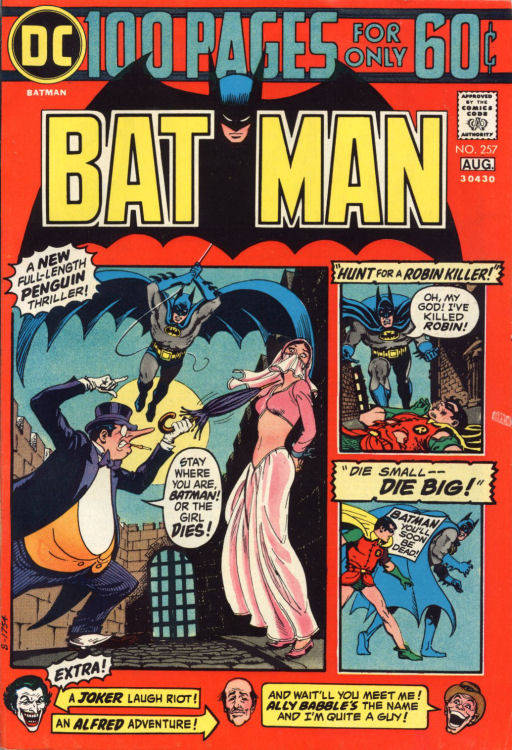
I’m not 100% certain who I borrowed this issue of BATMAN from. it might have been my grade school friend Donald Sims as with most of the books that we’ve been looking at recently. But I suspect that it was actually my next-door-neighbor Johnny Rantinella. Johnny was a year younger than I was and a typical kid of the era, which meant that he read comic books for a short while before graduating on to other things like all the rest of the regular kids. I stuck with comics for far, far longer. But during that time when our interests aligned, I can recall trading comics with him on a few occasions and also sometimes borrowing his books to read. So I think that’s how I got to experience this 100-Page Super-Spectacular issue of BATMAN. I loved this format, those fat books packed with classic reprints and features as well as a new story. I tried to replicate it for a short time at Marvel before the changing economics of the way in which comic books were printed priced the idea out of the market.
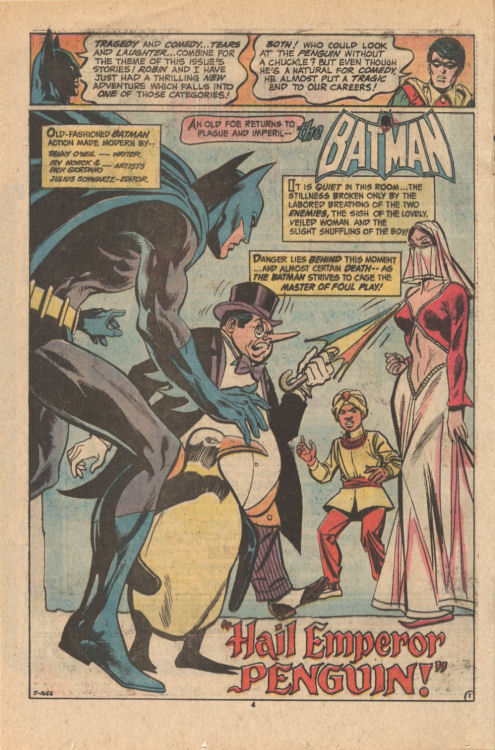
The lead-off new story in this issue I only half-remember for a couple of key moments and scenes. It was the work of Denny O’Neil and Irv Novick, who were semi-regular on the title. Dick Giordano provided his polished inks, making Novick’s work feel just a hair more like that of top-flight Batman creator Neal Adams. It was a bit of a caper, one that reunited Batman and Robin for a rare joint outing–during this period, Dick Grayson was away at college upstate, which meant that most Robin stories were solo affairs. The pair battle the Penguin, who abducts a foreign prince who was visiting Hudson University. The pair are aided by a veiled serving girl who turns out to be Talia , the daughter of Ra’s Al Ghul, in disguise. I didn’t really know who Ra’s was when I first read this story, so the reveal was a bit lost on me. The Penguin still can’t quite pull off feeling like a legitimate threat either, though Denny and Irv try their very best.
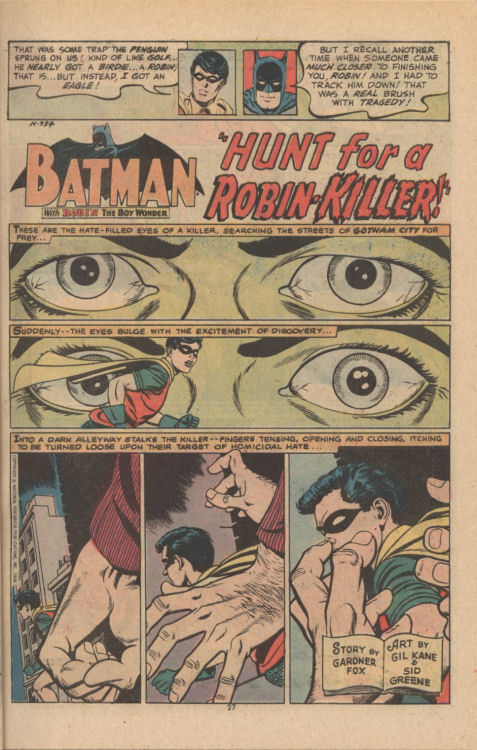
After that, the book presented a two-page feature on the Penguin’s many trick umbrellas put together by assistant editor E. Nelson Bridwell and a Batman-themed crossword puzzle compiled by Bob Rozakis. Then the book moved into reprint territory, starting with a story by Gardner Fox and Gil Kane–a rare instance of Kane working on the character. In it, Robin is beaten half-to-death by an assailant, causing Batman to almost lose control as he hunts down the felon responsible. It’s all somehow a bit cold-blooded, though, with the Comics Code of 1968 keeping any of the violence from getting anywhere close to out of hand. It’s a fine story, but one lacking in intensity and emotionalism.
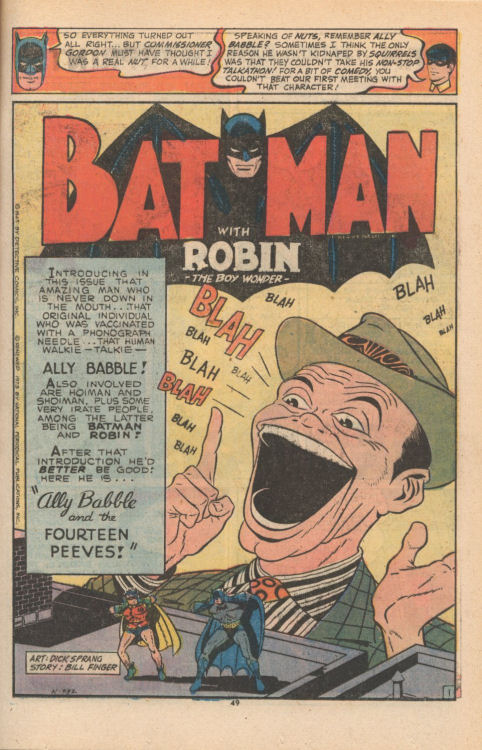
Following a one-page gag strip and a feature page on fingerprinting, the next full-length story was this one by Bill Finger and Dick Sprang. it featured a character that showed up in a couple of golden age Batman adventures, the fast-talking motormouth Ally Babble. Even at an early age, i found this character and his ceaseless chatter incredibly annoying, and even the typically fabulous artwork of Sprang wasn’t enough to get me to really enjoy this tale.
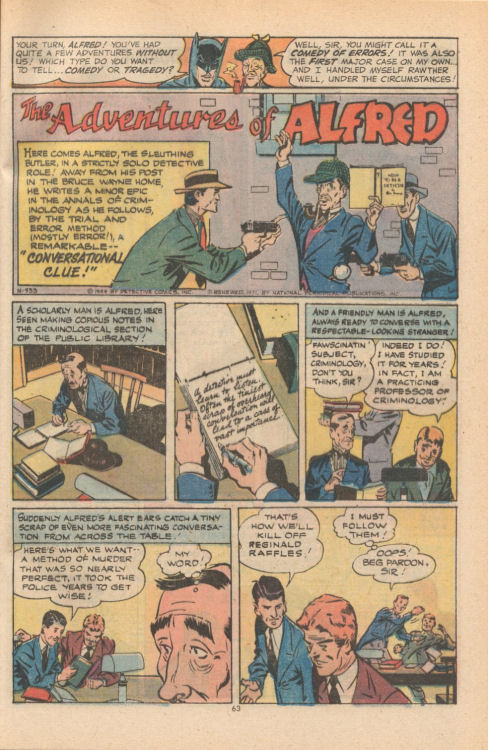
Also a miss for me was the next story, a solo adventure of Alfred, who headlined his own recurring feature for a brief period in the 1940s. This particular episode was a rare one written by longtime DC editor Mort Weisinger and illustrated by Jerry Robinson. The hook of the feature was in focusing on Alfred’s attempts to prove himself as a detective the equal of Batman and Robin, despite the fact that he’s a bit clueless and clumsy. It was a comedy feature, but despite that, Alfred always wound up resolving whatever situation he was in to everyone’s satisfaction. In this one, Alfred inadvertently prevents a murder after he hears a snatch of conversation at the library that gets him involved in the affairs of others. I can’t say that it did much for me.
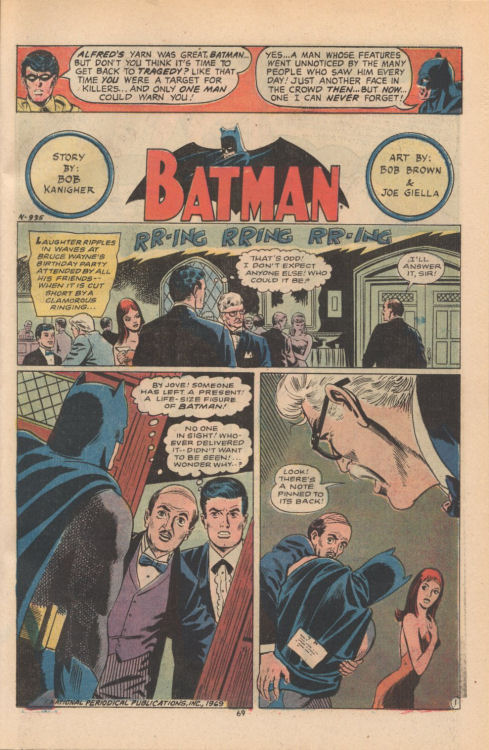
That was something of a theme of this issue, stories that didn’t make much of an impact on me, and it helps to explain why I never attempted to trade for possession of this particular issue once I’d experienced it. The next story was of a later vintage, written by Robert Kanigher and drawn by artist Bob Brown. In it, Batman is called into solo action when a figure dressed in a Batman costume turns up at Wayne Manor during a party. When it is unmasked, the figure’s visage is that of Gotham resident Herbert Small, one of those anonymous people who goes through life being largely unnoticed. The real Small has been diagnosed with a fatal condition, and so in an attempt to do something noteworthy with his remaining days, he’s put himself into harm’s way by posing as the Caped Crusader when he stumbles upon a plot to kill Batman. The true Batman gets involved, but Small still winds up taking a bullet meant for his hero and dying happy that Batman at least sees him.
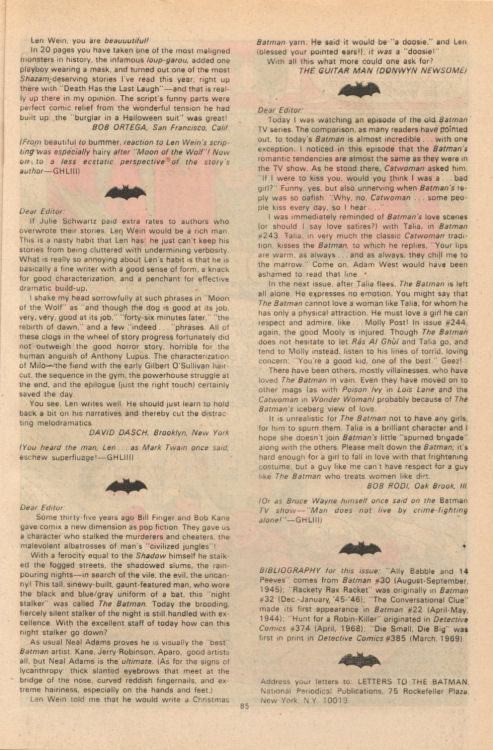
Next came the Letters to the Batman letters page, which in this big book ran for two pages. One of the bits of printed correspondence came from frequent contributor Bob Rodi, who would go on to some success as a literary author as well as writing a number of comic books of his own in days to come.
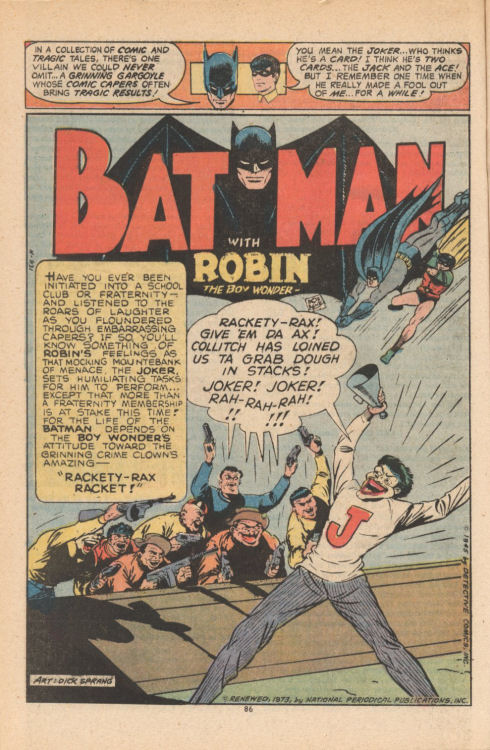
And finally, the last story in this issue was a classic Joker adventure written by Don Cameron and again illustrated by Dick Sprang. In it, the Clown Prince of Crime embarks on a series of crimes built around fraternity pledges, and after he captures Batman, he forces Robin to perform a series of stunts and pranks along those lines that actually enable the Joker to carry out his crimes. Eventually, the Masked Manhunter escapes captivity and the pair turns the tables on their recurring foe. Maybe the most memorable moment in the story is when Robin attempts to solicit aid from a Gotham City police officer, who disregards the Boy Wonder figuring that he’s just another fraternity pledge dressed up as Robin as part of the initiation. Holy Stolen Identity Crisis!
 The Tom Brevoort Experience
I found “Hunt for a Robin Killer” more intense than you did — particularly when Batman finally decks the bad guy (https://atomicjunkshop.com/when-the-new-look-became-the-old-look/). I also like the detail that the doctor sees Dick unmasked but in a city of eight million people he has no idea who the boy is.
Conversely, I didn’t feel they were trying to make the Penguin a threat in the lead story — they’re playing him too much as a buffoon.
LikeLike
Pretty intense for something done when the Batman TV show was airing.
I had the sense that the story left it ambiguous as to whether the doctor recognized him or made it his business not to.
Their was a period after Infantino left ‘Tec when it looked like the new team was Kane/Greene. It makes sense that Fox might go for more action oriented stories . . . .
I have always liked Die Small, Die Big, too. Kanigher had come a long way from his Poison Ivy story in 1966.
LikeLike
Robin shows up in #257, 258, and 259, and in each case I get the impression that O’Neil is only featuring him reluctantly. With both BATMAN and DETECTIVE switching to the 100-page format, there was no longer a venue for Robin solo stories, so I wouldn’t be surprised if editor Schwartz instructed O’Neil to bring the Boy Wonder back into the fold. Once the BATMAN FAMILY series starts in ’75, Robin disappears from the main title again, no doubt much to Denny’s relief.
LikeLike
Maybe not all that much relief.
During the entire lifetime of BATMAN FAMILY, Denny wrote 6 Batman stories — and one of them had Robin in it.
That was kind of a trough for Denny’s Bat-participation, as more and more of the assignments went to David V. Reed. I don’t know what happened there, whether Denny was just too busy elsewhere, or Julie was avoiding using him for some reason. Still, Denny wrote “There Is No Hope in Crime Alley” in that stretch, so there’s that.
LikeLike
I loved the 100 page DC books too for much the same reason. This one I have a vague recollection of and I’m pretty sure I felt the same as you with how meh I found them. Like any long running series, Batman and Detective had their share of stories whose inspiration was solely to get something into print on the deadline. This whole installment seems dedicated to such stories.
LikeLike
This does not seem to be a period in which Denny was much inspired, but I can’t say it felt like Julie was, either.
Kudos to Nelson, though, for picking out “The Rackety-Rax Racket!” to reprint. That cheer by the Joker’s thuggish cheerleaders is just great.
LikeLike
Rackety-Rax! Give ’em da ax! Collitch has loined us ta grab dough in stacks!
One of those bits of comic-book doggerel that remains permanently lodged in my brain, taking up space that should be used for something genuinely useful. See also: the Golden Age Sandman’s “There is no land beyond the law…”, or F-Sharp Bell’s “In loudest din, or hush profound…”
LikeLike