

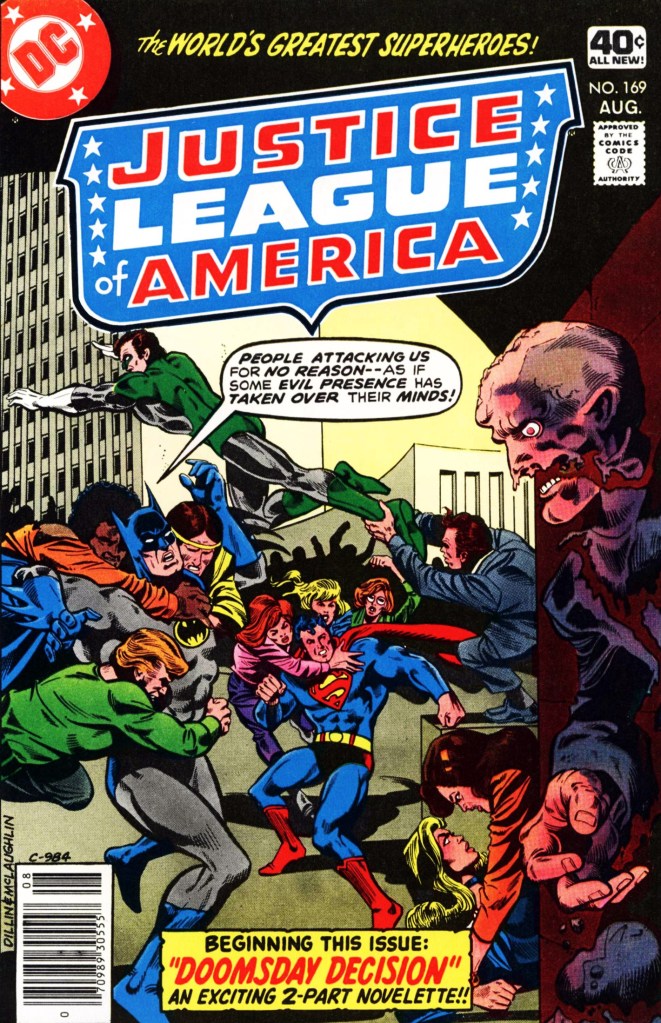
For the next year or two, JUSTICE LEAGUE OF AMERICA turned into a bit of a forgettable series. I still was buying it every month, but some of that was simply out of momentum. I had loved the series when I was younger, but whether it was that nostalgia made those earlier issues look better to me or the fact that as I got older and my tastes changed I wanted more and better material out of my comic books, JUSTICE LEAGUE simply wasn’t hitting the way it used to. The book still looked the same–Dick Dillin, who had been the artist since I began reading the series, was still drawing it. But the change in editorial teams had an impact. This wasn’t a great period for the title.

This issue is another one that I’d completely forgotten until cracking it out to make this piece. It had slipped my mind that writer Gerry Conway had brought his creation Ultraa, who had been introduced as the one and only super hero of Earth-Prime, the world that we readers all lived on, back for another story after his initial two outings. I remembered a bit more after reviewing this issue, but none of the details had remained with me. and maybe that’s just down to it being a 47-year-old comic book, but I don’t think so. I recall exacting details about other books published at this time. No, I think the problem was that this issue just isn’t all that memorable.
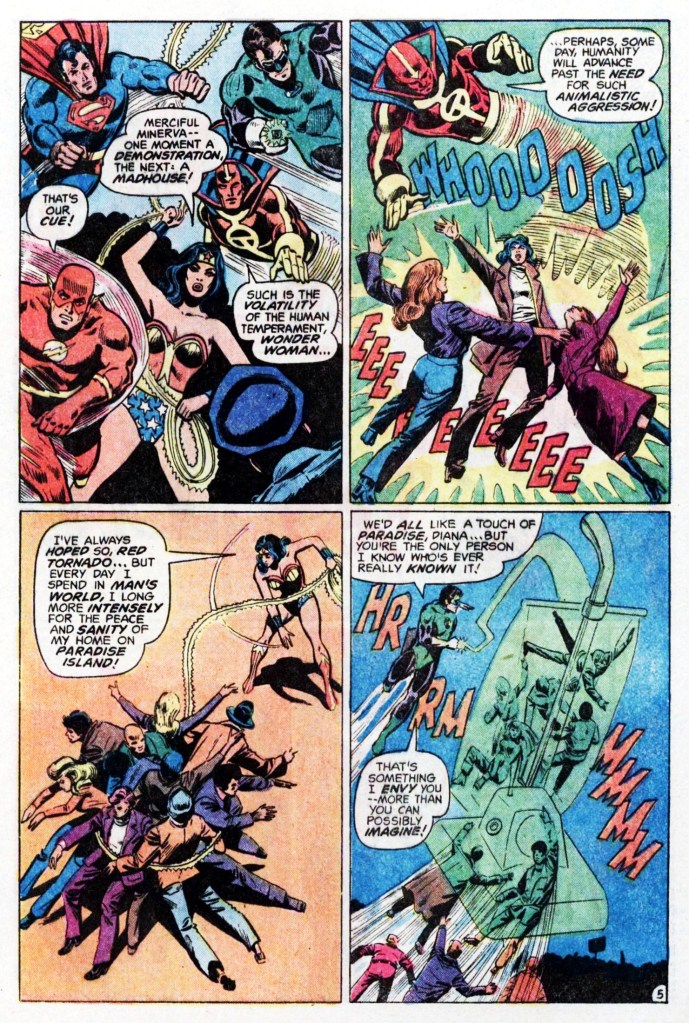
The story opens with the members of the Justice League on trial before the world court. Their crime: unlawfully imprisoning Ultraa after he attempted to take away their super-powers and ability to act in a prior adventure. Ultraa is being represented by Ernest Sloane of the World Citizen’s Defense Society, and he intends to prove that the Justice league acted unlawfully against his client. Out front, there are supporters of the League as well as protestors against the heroes, and as team is led out following a recess, the two groups wind up attacking one another. The League snaps into action to prevent anybody from being injured, then turns itself back into custody. It’s a way to get some action into the opening pages, pretty much.

But the protestors aren’t the only people in the world who are suddenly and inexplicably becoming violent. All across the globe, similar instances are being reported. And it turns out that Ernest Sloane is the cause. He’s actually not a human being at all but rather a colony of organisms that share a hive-mind existence called Over-Complex. They’ve got their own reasons for wanting to stir up trouble in the world, and in the guise of Sloane, they’ve neutralized the Justice League from being able to take any action to interfere with their plans. I think this right here is one of the problems with the JLA stories of this period: the villain lacks any genuine sense of presence or individuality. Over-Complex is kind of dull, actually, so the situation that the League is up against doesn’t have a compelling prime mover behind it.
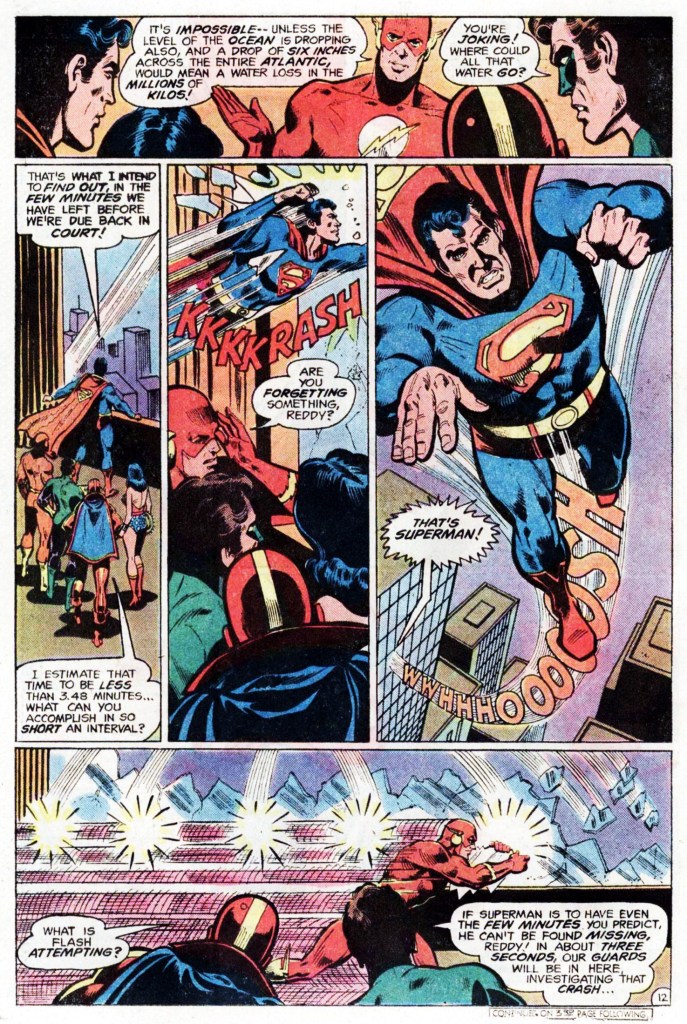
Still in custody, the League becomes aware of events transpiring across the globe. Taking a look with his telescopic vision, Superman notices that the sea level has fallen by almost six inches, which means that a tremendous amount of water is missing. The Man of Steel crashes his way out of the window to go investigate, and his fellow Leaguers conceal his departure–Flash swiftly repairs the glass while Green Lantern uses his power ring to conjure up a stand-in Superman so that the guards don’t realize that the genuine article is missing.
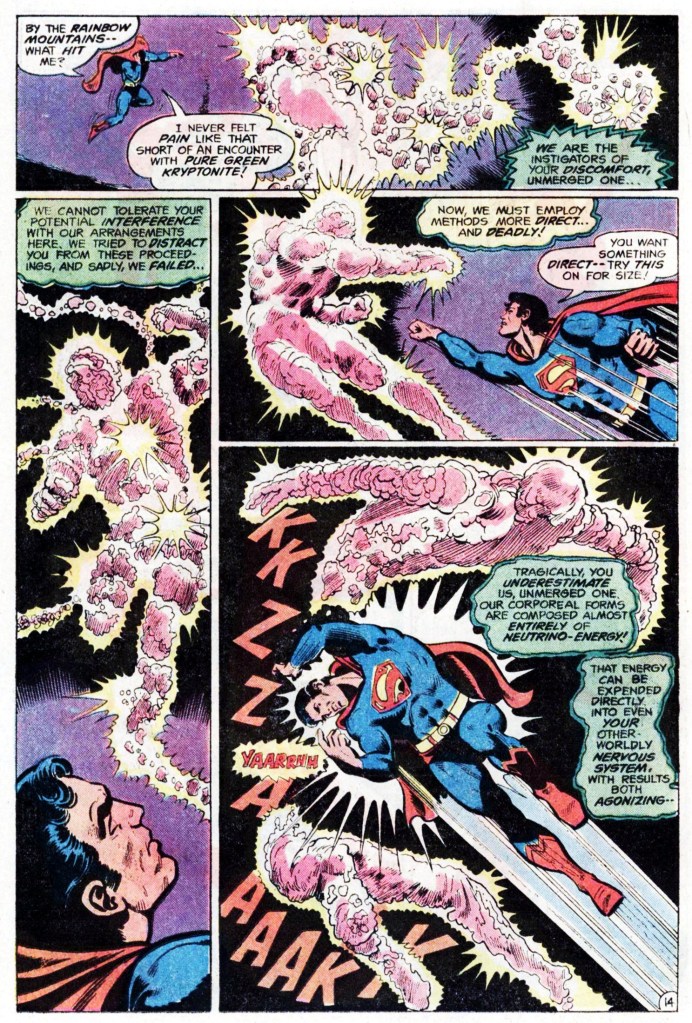
Superman is able to confirm that the seas are all shrinking but he can’t dope out what’s happening to all of the water. Before he can get make any further headway on his investigation, though, he’s attacked by Complex, the Ernest Sloane conglomeration of organisms, who can’t have him looking into their affairs. Complex is bound together by Neutrino Energy which proves powerful enough to stun even the Man of Steel, and at the finish of their encounter, he drops into the ocean unconscious. Meanwhile, Batman, who is on monitor duty on the JLA satellite and not a defendant in the trial (since he wasn’t present for the story in which Ultraa was incarcerated) uses the computers to determine that the reason for all of the discord around the planet is that the levels of oxygen in the atmosphere is growing at an alarming rate. But the Masked manhunter isn’t sure what he can do to nail down the cause.
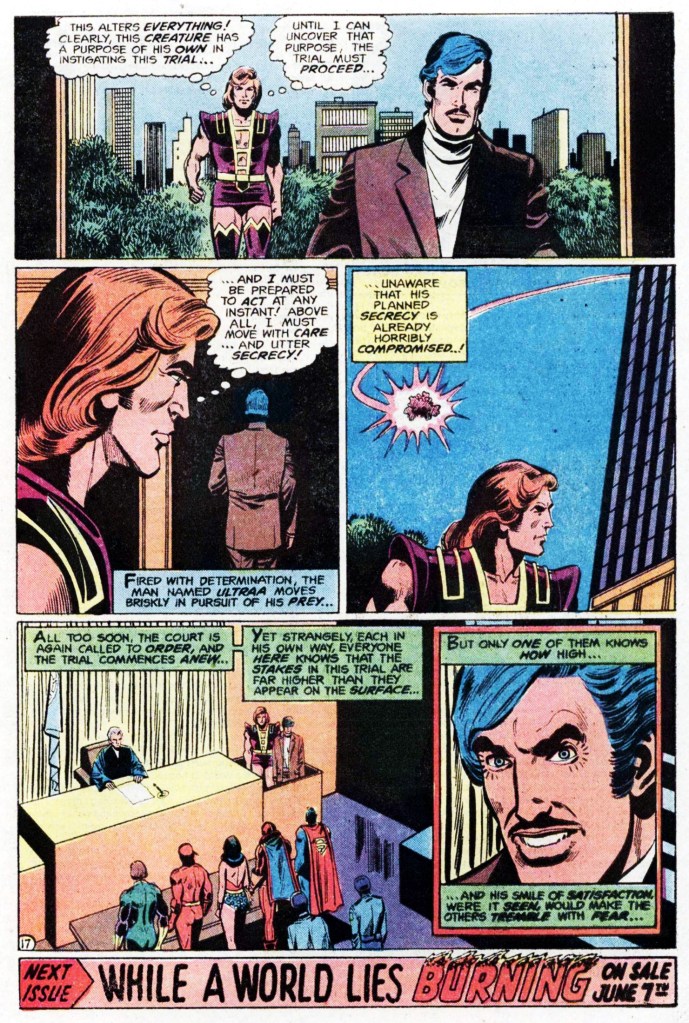
Back at the World Court, Ultraa is beginning to have second thoughts about putting the League on trial, having seen them behave honorably earlier when they broke up the riot and turned themselves back in afterwards. He’s about ready to pull the plug on everything when he happens to spy the Complex creature returning to the area and transforming itself into his lawyer, Ernest Sloane. Figuring that this entity must be behind the troubles on Earth, Ultraa resolves to let the trial continue on until he can determine what is behind everything. But unbeknownst to him, a piece of Complex has seen him seeing them resume their human form, so his attempt to play innocent is already compromised. And that’s where this first part is To Be Continued. Not a whole lot happens, though the idea of putting the Leaguers on trial for having avoided due process and acting unilaterally is a decent one. It’s just that the story deck is stacked against anything but an obvious outcome.
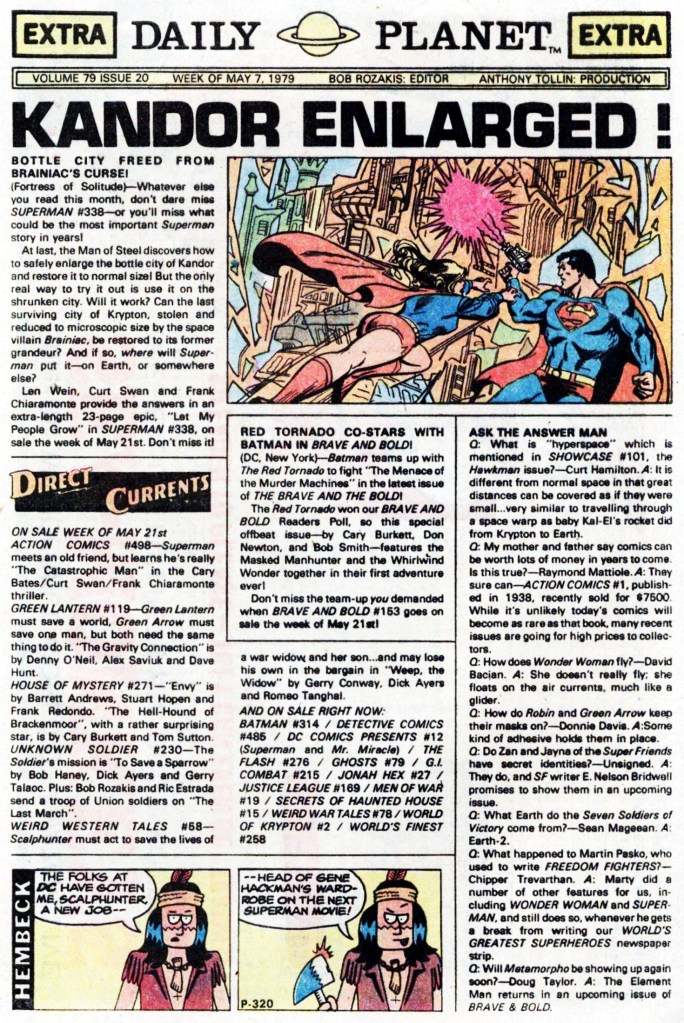
And on the back page, there was yet another edition of the Daily Planet to read, DC’s promotional page, their equivalent to Marvel’s Bullpen Bulletins. The Fred Hembeck cartoon on this one is especially dumb, but Bob Rozakis’ Ask the Answer Man column continued to be entertaining and wasn’t yet completely filled with questions about the value of random back-issues sent in by hopeful fans.
 The Tom Brevoort Experience
So why did Superman break that window when the Flash could have phased him through it as could Green Lantern or Superman who demonstrated in World’s Finest Comics#245 ( June-July 1977 ) that he could imitate the Flash’s ability to vibrate through things ( page 9 panel 2 through a tent wall while holding the Martian Manhunter on Mars II – Super Vibes he called it )?
LikeLiked by 1 person
Tom doesn’t show the page where Green Lantern creates a stand-in for Superman, but I remember when I read about it in The Official Justice League of America Index ( 1986 ) thinking that Superman’s belt, chest & cape shields are yellow so how is Green Lantern’s power ring able to generate the colour it is vulnerable too?
LikeLike
The World Court of the UN does not, of course, look like the lobby of the local police precinct, and there wouldn’t be New York City cops behind the JLA, because it’s in the Netherlands.
There would also be 15 judges there, not one guy with a gavel, attended by no other court officers.
Ah well.
I’ll note that the description of the HOUSE OF MYSTERY issue in the Daily Planet page says that a story has a “rather surprising star,” and I dunno, the star is Sir Morgan Parks, who no reader had ever seen before (or since), so I’m not sure how surprising that was. He was also clearly meant to be Sherlock Holmes, which makes me wonder if it had been originally intended to be a Sherlock story before someone decided they didn’t want a legal fight with the Doyle Estate.
If so, they changed their minds before the story was lettered, because there’s no sign of any lettering corrections in the character names.
And if that wasn’t trivial enough, I’ll also add that this week’s Answer Man column had one of the aspects that bugged me about the column — Bob tended to give flat answers to things that would have been more interesting if he’d done more than the minimum.
In this case, he answers the question about how Wonder Woman can fly by saying that she doesn’t, she just glides on the winds. This would seem to suggest the obvious follow-up, “Okay, Bob, but how does she do that?” — but it doesn’t seem to occur to Bob that David Bacian might be asking how she manages the being-up-there-in-the-air-with-no-clear-explanation thing. Adding, “And she can do that because [name of god] gifted her with that ability at her birth” or whatever would make the answer a whole lot more of an actual answer.
LikeLiked by 1 person
I remember one question asked about how much weight could Superman lift or move with his tongue. That’s right. Ol’Bob replied that it’d the same amount as any other body part, because he has superstrength. Except… That’s not even how human bodies work, so, ah, never mind. Walk away. Not worth it. 😉
I did like some of Bob’s stories, though. Back-ups in “World’s Finest”, “Detective Comics (Starring the Batman Family”). His dialog didn’t come off as weak or as thin, as, say, Gerry’s does in this issue.
LikeLiked by 1 person
That came up a while back, on this post: https://tombrevoort.com/2024/07/07/bhoc-action-comics-493/
The Answer Man clearly wasn’t interested in deep answers. I’ll repost what I wrote previously on that question, since it’s fun:
The framework which seems reasonable is that “Super” is like a multiplier – an extremely large multiplier, but not an infinite multiplier. Thus Supergirl is not as strong as Superman, but that’s analogous to She-Hulk is not as strong as Hulk – both are still highly “super” strong. And that “Super” compares at relative levels. There’s been plenty of stories where it’s been shown that a powered Krypto can injure a powered Kryptonian, comparable to how an ordinary dog can injure an ordinary human. And direct fighting with e.g. Phantom Zone escapees is bruising or worse (I’ve always thought such a battle would logically be a brutal hand-to-hand bare-knuckles fight, since throwing boulders or trees would just be like foam or pillows – and this is why Krypto is very dangerous to Kryptonians, because his teeth are intrinsic cutting/puncture weapons).
But if Superbaby or slightly-enlarged Kandorians are only e.g. 1/100th as strong as Superman, that’s still a mind-boggling large number. It’s like the difference between lifting a 1000 million tons, and 10 million tons. If your wealth is 10 million dollars, that’s far from 1000 million dollars, but it’s still very rich.
Thus I think the answer to “How much weight can Superman move with his tongue” would be roughly how much he weight can move in general, divided by something like 500. Of course, nobody would want to pin down an exact number (I know, I know, it’s really whatever the plot requires). But whatever the value, it’s still an enormous amount.
LikeLike
Superman can inhale a poison-gas cloud into his lungs that’s large enough to blanket Metropolis. Nothing about his body works normally.
I’ve come to think of his powers as working by analogy. I can blow out candles on my birthday cake, he can blow out a forest fire. I can kiss, he can super-kiss, etc. Obviously not the official reason but still.
LikeLike
Seth, it occurred to me a while back that when Clark lost half his powers to the Sand Superman, Supergirl would have been stronger than he was. Though it was never put to the test, unsurprisingly.
LikeLiked by 1 person
Of course, Supergirl was having her own problems around that time, with her powers randomly cutting out (in the Mike Sekowsky ADVENTURE COMICS run). I don’t recall if that ever got officially “fixed” either. But both Kara and Kal were seemingly back to normal as soon as they changed writers.
LikeLike
Thanks, guys. I’ll admit I likely have less mind space for that in-depth analysis. It’s just to ridiculous for me to think any further on it, beyond it being ridiculous. 😉
LikeLike
Can’t think of a comic book story by Gerry Conway that I liked. He wrote some Batman stories in the eponymous title and “Detective Comics” drawn by Gene Colan and Don Newton. And I like their work very much. Just not the scripting. I wasn’t alive or was too young for his Marvel years. I know he’s got one of the best resumes in the business. But except for one issue, one of his last, of Despero’s return to “JLA” (which was wrapped up by JM DeMatteis), his writing and especially his dialog wasn’t for. I’m glad he co-created the Punisher, but it’s the work of Mike Baron, Klaus Janson, and especially Garth Ennis that interested me in that character.
LikeLiked by 2 people
Overall I enjoyed Conway’s JLA run, though he ran out of steam well before the Detroit Era (I sometimes wonder if his thought process was “Is it possible I should change assignments? No, it’s the characters who’ve gotten boring!”). Also his Batman, and his Earth-Two WW run (during the Lynda Carter-triggered shift in the book) is surprisingly good.
Other stuff not so much.
LikeLiked by 1 person
JL Detroit was just flat out Conway imitating the New Teen Titans and the X-Men without understanding what made those books popular. Cringeworthy is a term that gets overused but it certainly applies here as it was a Gogo Checks Era level attempt to be hip and cool that fell flat on its face and ultimately doomed the title.
LikeLiked by 1 person
@Tim Pendergast
Agreed. And it’s one thing to have a team if scrappy underdogs. A team who’s doubted by their opponents, vilified by the “authorities”. Even have the team members show some vulnerability.
But it seemed every one in “Aquaman & the Outsiders” was pessimistic about their belonging on the ream, and doubtful they could be successful. So, as a reader, how am I supposed to believe they can be, if they don’t?
If they keep telling me they’re losers, then I start to believe it. And then I lose interest. And wish for a different roster.
Peter Parker had doubts. But his overcoming them against huge odds made us like him more. The ❌🚹 knowing they were “hated & feared” by a world they still protected helped us to cheer them on
Conway harped too loudly & too long about how this team thought they didn’t deserve to be the JLA. And so we believed them. He sabotaged his own case.
LikeLiked by 1 person
Absolutely. When I reread the original JLA run a few years ago and ended with the Detroit Era, it was striking how they never stepped up the way they needed to. J’Onn beats the Overmaster, Aquaman beats Amazo. When the Maestro defeats the original team members I figure “Ah, now the Detroiters will save the day, proving themselves!” but nope, they lose and get saved because the villain’s brother shoots him.
By contrast, Stan Lee showed the Kookie Quartet were underpowered compared to the original Avengers yet they were scrappy and determined enough to make up for it.
LikeLiked by 1 person
The self doubt was on overload to be sure. That was what turned me off about New Mutants. Also, the team never really gelled as it seemed they were always divided old/new.
LikeLiked by 1 person
@Frasersherman
True. I’m glad I wasn’t around for “Cap’s Kooky Quartet”, though. I mean, I guess they didn’t go up against the 11-member Masters of Evil the way Stern & J.Buscema’s 5 Avenger roster (Namor was on “leave”) had to (Thor and Scott Lang helped out in “round 2”). But CKQ didn’t seem like “Earth’s Mightiest”. 😉 Goliath (Pym) and then Herc joined in soon enough after.
Giffen/DeMaittais/Maguire/Helfer’s JL arguably only had 3 heavy weights in the 1st 3 iisues, then down to 2 from #3 to 7. J’onn. Dr.Fate, until what, #3? And Captain Marvel (until # 7). OK, add in Guy Gardner, who was formidable if he didn’t lose his focus. Reader popularity wise, Batman helped. The core of the team became Batman, J’onn, Beetle, Booster, Guy, Fire, & Ice.
Not the most powerful line-up. But they didn’t consider themselves losers. Booster & Beetle complained about a lack of funds. Maybe a perceived lack of respect from peers. But they had self-worth. Maybe so much that they thought they were being treated unfairly. Anyway, they got the job done, and they knew that they could.
Guy had self-confidence to a fault, to the point of delusion, and arrogance. J’onn was level-headed, and knew his abilities, and those of his teammates. Fire was also confident and ready to prove herself. Ice was quieter, but no coward. Batman was Batman; no lack of confidence there.
JLDetroit could’ve been respectable. But Gerry kept driving the point home that these weren’t the rightful starting line-up, so eventually he convinced us.
LikeLike
The cover art is signed by Dillin & McLaughlin but man, that looks like a Ross Andru layout to me.
LikeLiked by 1 person
I’m sure it was.
LikeLike
Conway wrote some great stories and introduced some great characters. It just didn’t happen on JLA. As many have remarked before, JLA was handicapped by its overpowered lineup, which made it hard to have good villains to match up against them, as well as by the annual JSA crossovers, which prevented the title from building any momentum as the crossovers were always separate from whatever was going in the book. Sadly, Dillin’s stodgy art style didn’t help matters either, as when Conway did come up with a good character or concept, it was given a very ordinary appearance. The Over-Complex would be a perfect example of that. But as we were to discover with JLA Annual #2, we can’t totally absolve Conway.
LikeLiked by 1 person
I thought Gerry’s stories were more fun when Len Wein took over as editor, and then with George Pérez and Don Heck, who were much more suited to the direction Gerry and Len were taking, it’s among my favorite periods of the run.
But I wasn’t fond of the his run while Julie and Ross Andru were editing. How much of that was the editing and how much was the Dillin storytelling and the wretched McLaughlin inking, I couldn’t say.
LikeLiked by 1 person
I bought all of these issues that I can find on the spinner rack as they came out. I don’t know why but somehow I enjoyed most of the characters in this team book rather than pursuing their solo titles.
The ones that I really sort of remember are the Adam Strange and Red Tornado issues where they were featured…and the Neal Adams covers which I definitely remember.
LikeLike
What the everlovinforbush was Tony Stark doing on that last scanned page?!
LikeLiked by 1 person