

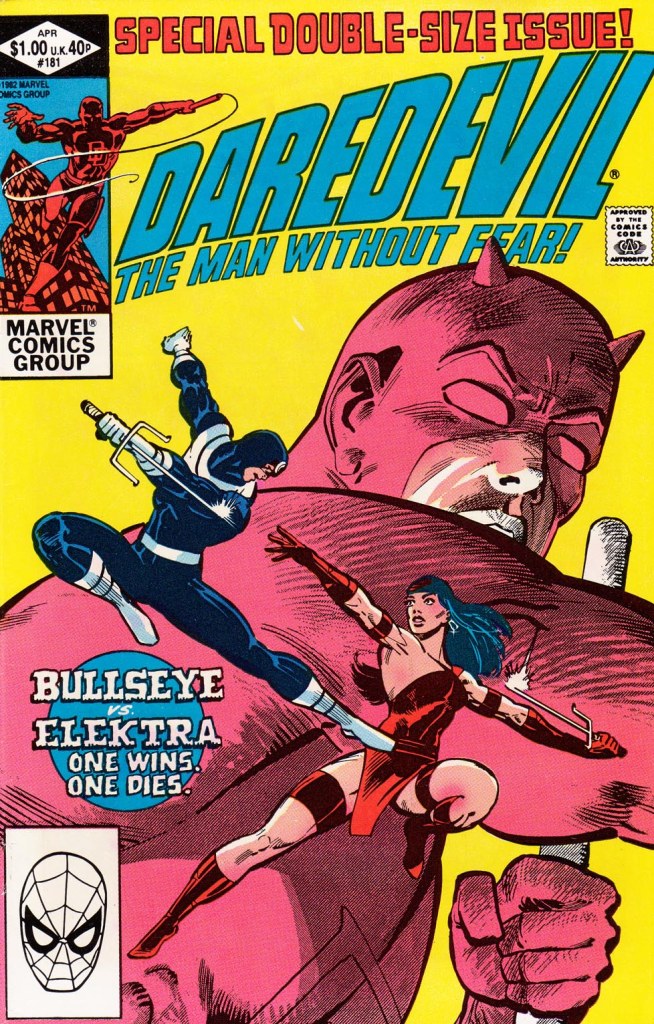
Going into 1982, there was no comic book series that was of greater interest to me and my small collection of comic book reading friends as DAREDEVIL. The title had been gaining momentum ever since newcomer artist Frank Miller had been brought on to pencil it a year or two earlier. Miller’s storytelling chops were self-evident, and became stronger and more graphic over time, elevating some otherwise pedestrian stories into something more meaningful. Editor Denny O’Neil evidently had a lot of faith in Miller’s potential, as he soon let him write the series as well, and it became virtually an entirely different series. Gone were the faux Spider-Man villains and the playful banter. Now, Daredevil had more in common with DC’s Batman, a dark figure of justice whose world was a lot more grounded and realistic (for all that it also included a lot of ninjas and stuff.) Dialogue and copy were stripped down, permitting the artwork to carry a greater percentage of the narrative.
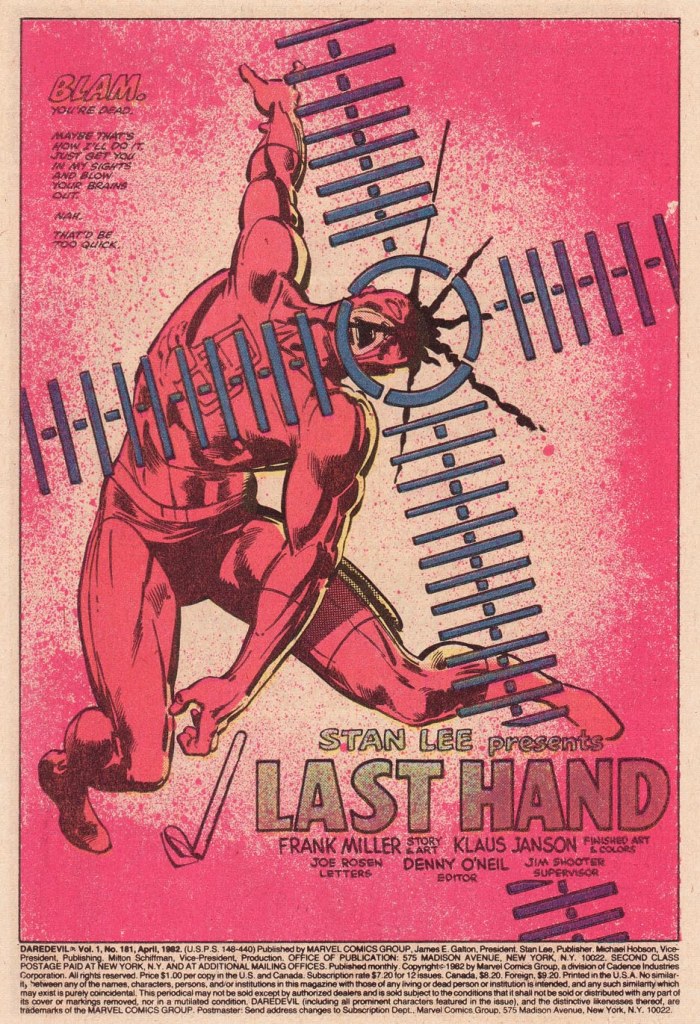
Miller made DAREDEVIL a top series, one that other creators began to emulate to one degree or another. He turned the Kingpin from just another goonish adversary of Spider-Man’s into a dangerous and unbeatable force, and crafted Bullseye into a character to take seriously despite his origins as just another gimmick super-villain. Miller channeled a lot of his love for the work of Will Eisner into his approach, and nowhere was that more apparent than in his creation of Elektra, the woman from Daredevil’s past who had broken bad and who was now an assassin for hire. She started out as a riff on Eisner’s Spirit character Sand Saref before growing in her own direction. Over the course of several months, Miller had kept the stew of these characters and others bubbling, but the main event happened in this special double-sized issue. It was upsized for no particular reason; it wasn’t a centennial issue nor an obvious anniversary. But it signified that something important was about to happen, and just as with X-MEN #137 a year or two previous, it would prove to be climactic.
The other person whose work needs to be acknowledged on this run of DAREDEVIL and who is too often overlooked is Klaus Janson. Klaus had been inking the series before Miller came onto it, providing prior pencilers as diverse as Gene Colan and Carmine Infantino with a sense of grit and texture. He and Miller fit together like a hand in a glove, and so as Miller began to focus more of his time and attention on building the story and the overall page layouts and composition, Klaus wound up doing more and more of the finished artwork. To achieve greater control over the finished pages, Klaus also took up the coloring of the title, which allowed him to get across wonderfully evocative effects operating from a single viewpoint. While Miller is the one who most often gets the plaudits for the artwork, a good deal of the credit by this point should more rightly go to Janson.
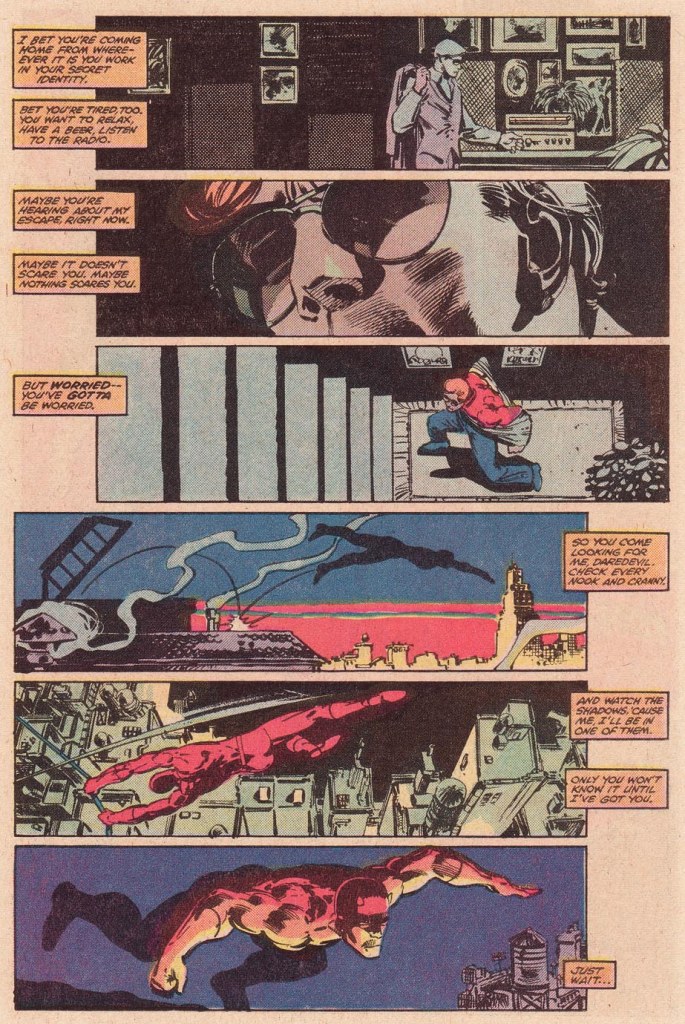
The story in this issue is relatively well known and very well-remembered even after all of these years. And while it’s the culmination to a number of long-running plotlines, like most of the issues surrounding it, it plays as a self-contained single issue story. It focuses on Bullseye, once the Kingpin’s top assassin, now incarcerated after his defeat by Daredevil–who, to add insult to injury, also saved Bullseye’s life before bringing him in. This entire issue is narrated from Bullseye’s point of view, often providing an unreliable narrator’s perspective in the manner in which what Bullseye is thinking and saying clashes with the visuals that we are seeing. It’s an effect that comes across due to the fact that the same person is controlling both the words and the visuals. Having heard that the Kingpin has a new assassin and that he’s been left to rot in prison, Bullseye stages a breakout, determined to take back his number one spot.
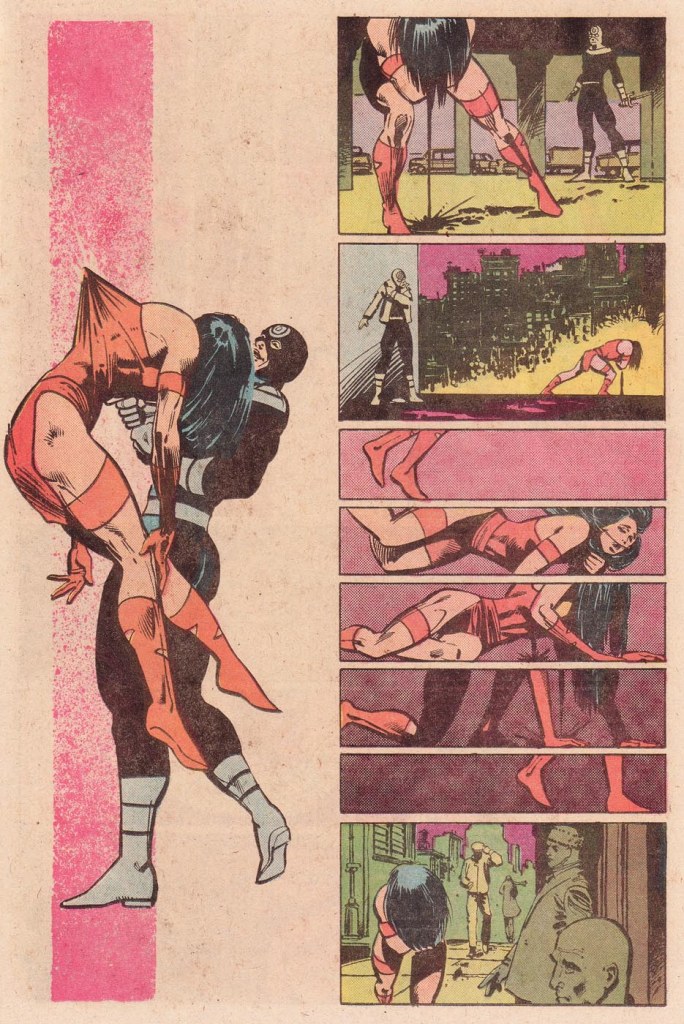
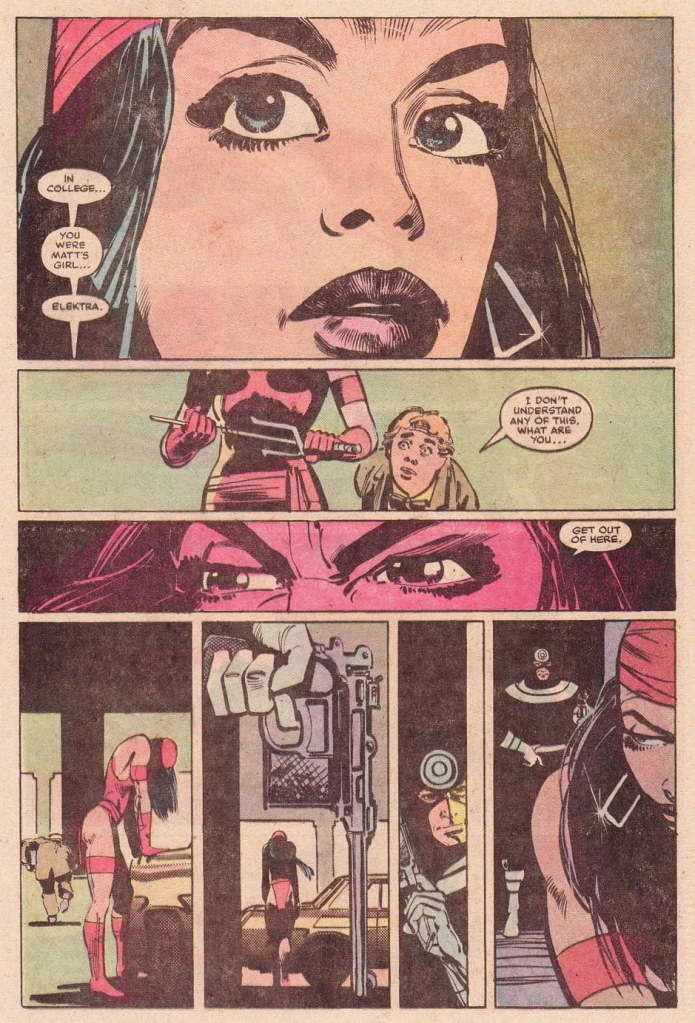
Elektra has been hired to bump off Foggy Nelson, Matt Murdock’s law partner, and so Bullseye figures he’ll beat her to the punch and take her out at the same time. Elektra gets to Foggy first, but when he recognizes her from his and Matt’s time in college, she can’t go through with the hit. Just as well, because then Bullseye is there, and what follows is a virtually silent multi-page action sequence in which the two killers attempt to put one another in the ground. Bullseye, though, gets the upper hand, and in the above shot runs Elektra through with her own Sai, a fatal blow. She’s able to stay alive long enough to stagger to Matt Murdock’s brownstone and die in her arms. Despite the blurb on the front cover, this was an entirely unexpected development–Elektra had only recently been introduced and she was suddenly a phenomenally popular character, so the audacity to kill her off in this manner felt similar to X-MEN #137’s death of Jean Grey in terms of having an immediate impact.
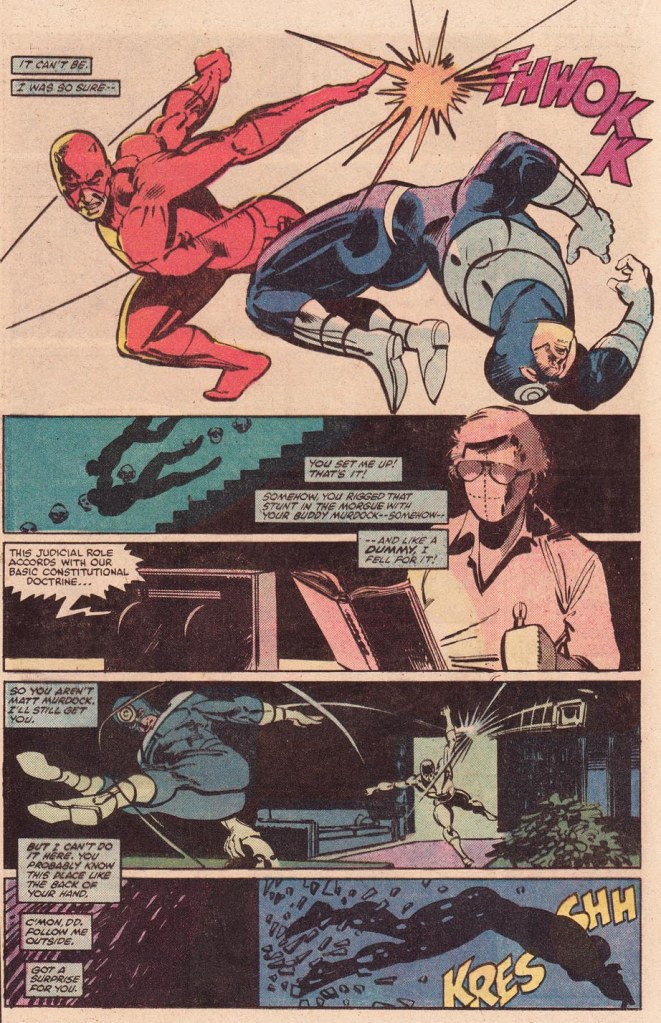
In any event, this convinces Bullseye that Matt Murdock must be Daredevil, a theory he tests with a thrown blade that Murdock effortlessly blocks with his cane. Attempting to get back into the Kingpin’s good graces, he brings this information to the Kingpin, who dismisses it as preposterous (otherwise, we could have had “Born Again” years earlier.) But he tells Bullseye that he’ll consider rehiring him if he eliminates Daredevil. This again leads to a multi-page virtually silent showdown, one that begins with DD tricking Bullseye with a dummy figure and a tape recorder to convince him that he isn’t Matt Murdock at all. Shades of the 1950s Superman! The fight is especially brutal for a 1982 comic book produced under the strictures of the Comics Code, and therefore all the more intense as a result.
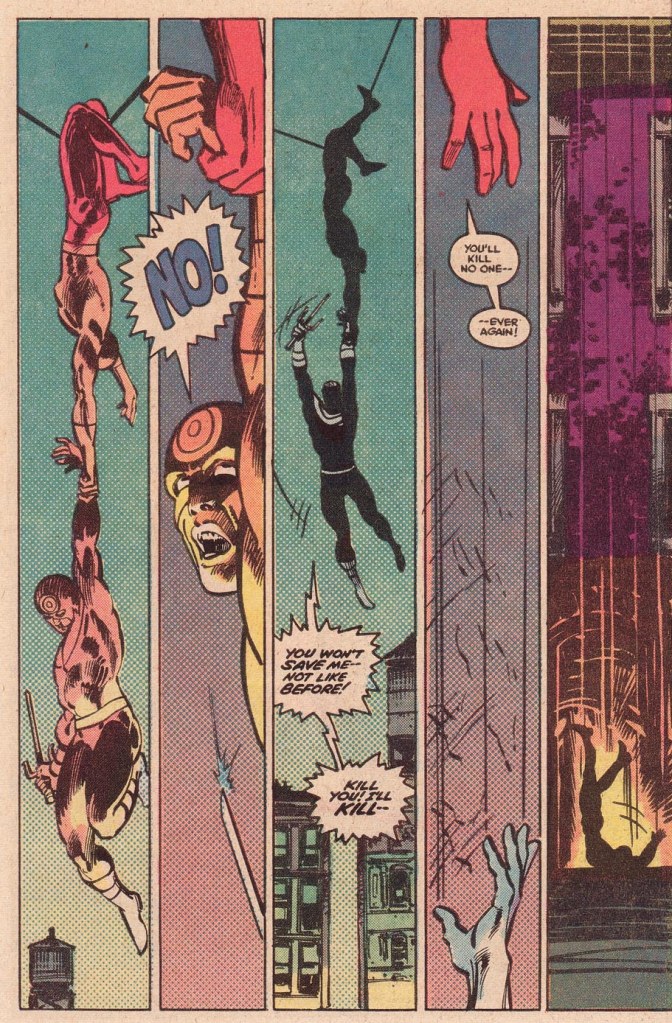
In the end, we end up with a quasi-reprise of the sequence in the earlier story in which Daredevil saved the stricken Bullseye from an oncoming train. This time, he’s keeping the killer from a fatal flaw. But this time, Daredevil chooses to let go and permit his enemy to plummet to his death, the sort of harsh, hard-boiled choice that super heroes simply didn’t make in 1982 as a matter of course. Given Bullseye’s murder of Elektra, though, this felt entirely earned, and I can’t recall any readers of the time complaining about Daredevil’s actions here (though no doubt there were some.)
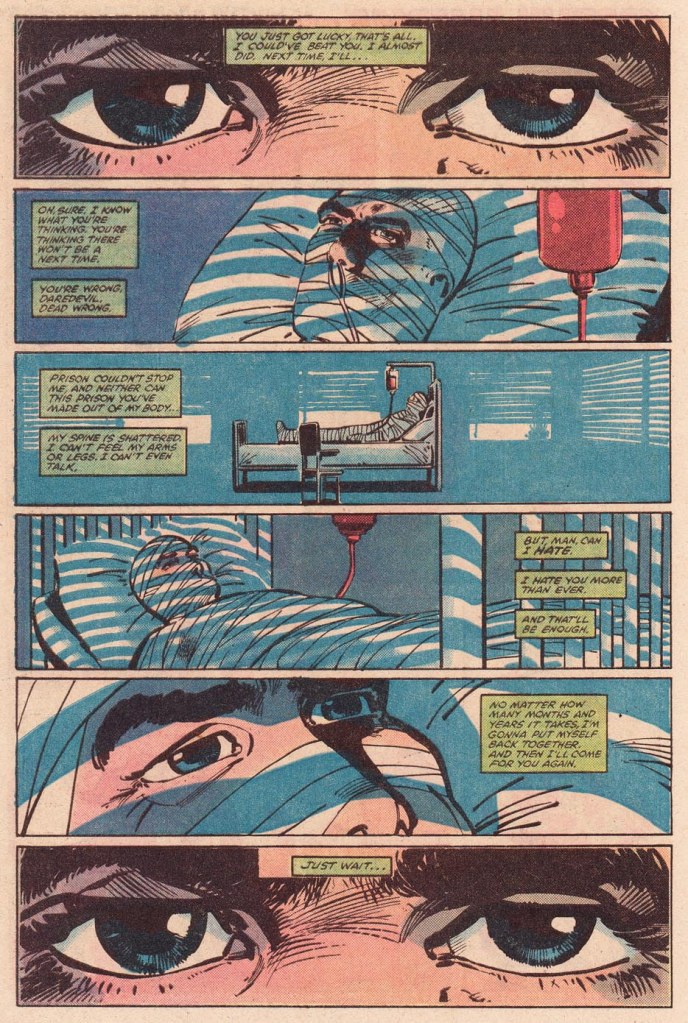
As it turns out (and possibly to shave the harshest edge off of Daredevil’s actions) Bullseye survives the fall, though his spine is shattered and he’s hopelessly paralyzed as a result. And the story ends with him silently stewing in his own hate and vowing that he’ll find a way to rise back up from this misfortune and come after Daredevil again. It’s an impactful moment in an issue that was full of them. Among readers of the time, I don’t know that there was any other comic book that we talked about and dissected more than this one issue–certainly my new friend Steve Cicala and I went over it back and forth like a Rosetta stone of comic book storytelling.
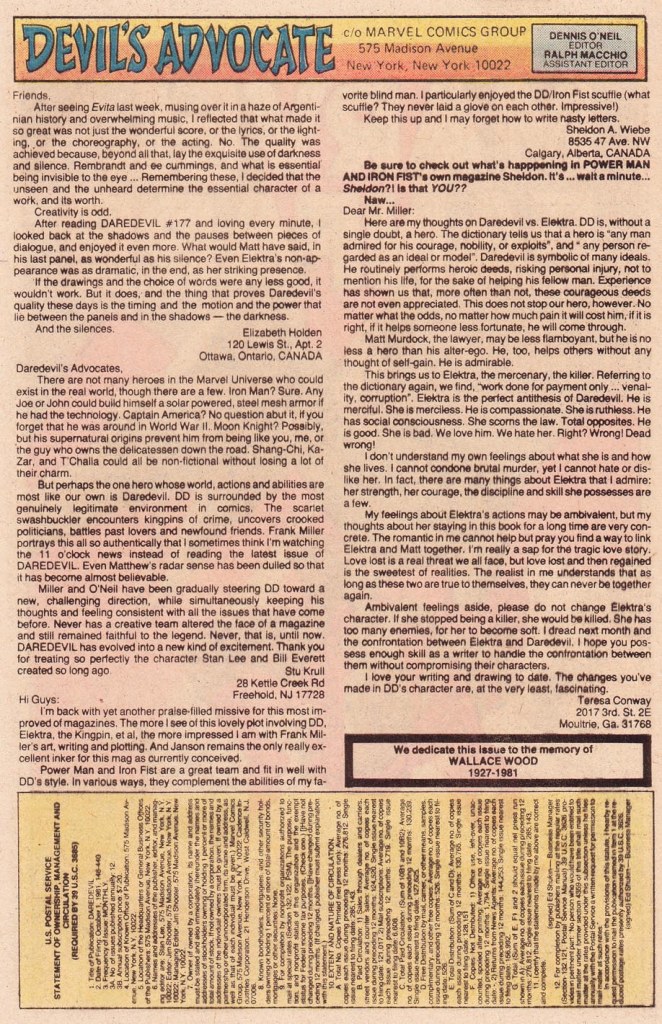
As it happens, this issue includes that year’s Statement of Ownership, which will give us a glimpse into just how well DAREDEVIL had been performing the prior 12-18 months or so. This would have been slightly before Miller took over the writing, though well into his time as the artist on the series. It shows that the book was selling 127,625 copies against a print run of 285,143, giving it an efficiency rating of just under 45%. This would have been an increase from the past, and had caused the book to go monthly after languishing as a bimonthly for a while. And this number would only get better as Miller’s time went on.
 The Tom Brevoort Experience
Thanks for taking the time to credit Klaus Janson’s contributions to these historic Daredevil issues. I don’t think I fully understood just how much work he did on DD during the later part of Frank Miller’s first run until I read Back Issue #321 from TwoMorrows Publishing in 2007. There was an article on DD from the late 1970s thru the 1980s, and among the art for this piece were a page of Miller’s layouts from DD #190 side-by-side with the finished artwork by Klaus Janson. It demonstrated that while Miller was responsible for the storytelling & pacing, Janson was by the end of their run doing both highly detailed finished pencils and inking.
LikeLiked by 1 person
“The title had been gaining momentum ever since newcomer artist Frank Miller had been brought on to pencil it a year or two earlier.”
Just about three, actually — the series had been bi-monthly when Frank took over, and stayed that way for a while.
And yeah, this was easily the most talked-about issue of that month, or the several months around it. It was absolutely must-have reading, and Miller and Janson seemed unstoppable at that point. For someone like me, who’d stumbled into the Lee/Colan DD very early on in my comics-reading days, it was a mixed blessing — I liked the goofy old villains and the comedy elements of the book, and wished I could have them in a modern book as well. But even so, I knew this was cutting-edge comics and I couldn’t wait for each issue.
Though Marvel heroes always seemed to have access to life-size dummies whenever they needed one, huh?
LikeLike
The wigged dummy not having a bit of backstory is sloppy in hindsight. Micheline/Layton had a similar bit with Spymaster and a Stark LMD in the pages of Ironman… very melodramatic but all the parts were in place.
LikeLike
For all I know, the dummy appeared in previous issues (though if so I don’t remember it), but that’s its first appearance in this issue.
LikeLike
They were triplets, Matt, Mike and Mannie(quin) Murdock…
LikeLiked by 1 person
It makes sense I suppose that Matt would have a martial arts practice dummy on hand.
LikeLiked by 1 person
I was one of those that like Elektra ( who in her first appearance was a bounty hunter ) and did not like her getting killed off in this issue. I can’t remember why she chose to betray Matt by becoming the Kingpin’s pet assassin considering Matt saved her twice ( First time back in law school ( flashback ) and later from Eric Slaughter’s henchman — DD#168 ( January 1981 ) ). Spider-Woman became a bounty hunter in Spider-Woman#21 ( December 1979 ) — bounty hunter is the job Kraven the Hunter should have taken up and not villain if he wanted the thrill of the hunt ( But he clearly chose villain because he knows most heroes won’t try to kill him unlike criminals or super-villains ).
LikeLiked by 1 person
I did enjoy Janson’s work with Miller back then. They were a good match. It’s a shame he then did the same chores for Romita. I never liked how those two meshed.
I also agree with Mister Busiek that Daredevil before Miller was a good book and a hero that was very enjoyable. Good thing that the nuts and bolts of DD meshed so well with Miller’s vision. It’s hard to truly regret losing happy DD when grim and dark DD’s adventures were so awesome!
LikeLike
To be fair, “happy DD” had been long over by the time Frank took on the book.
After Stan gave the book over to Roy, it became a straight superhero title somewhere in between quippy Spider-Man and serious Batman, with DD being more often angry than comedic. Then Roger McKenzie pushed it all the way into Batman territory, and Frank made it into a very distinctive atmospheric crime drama from there.
LikeLiked by 2 people
I did like when it was a shared book for Matt and Natasha, I think I got whiplash from how quick they uncoupled them!
LikeLike
I liked some of it.
But that wasn’t “happy DD.” That was mostly “angry DD.”
LikeLiked by 1 person
Steve, did you mean Janson inking JR,Jr or Romita,Sr?
And Janson inking “Romita” on DD specifically, or in general?
Klaus inked some of JR,Jr’s ‘AMAZING 🕷️ SPIDER-MAN” after this DD run. Some of the extended Hobgoblin arc.
Then in the early 1990’s they paired up again on lots of Punisher stuff. I wasn’t into the whole vibe & thought much of it, including story & tone, was ugly. Same for the cross over with Batman.
Klaus would ink more of JR,Jr’s work on “AVENGERS”. I think one issue was during Kurt’s years on the series I liked it.
Klaus inked JR,Jr’s “BLACK PANTHER”, & later in Bendis’s “AVENGERS” run. I really liked both.
JR,Jr’s late 1980’s DD run was fabulously inked (in my opinion) by the great Al Williamson. Beautiful stuff the whole run. The story sometimes lost me
JR,Jr & Klaus didn’t work for me on their “ACTION COMICS”. JR,Jr’s work just looked out of gas.
Overall, Klaus is probably my 2nd fave inker for JR,Jr. Williamson being 1st. Bob Wiacek’s up there, too. And Dan Green. I’d’ve liked to have seen Joe Rubinstein ink JR,Jr. I just cant think of an example. Brett Breeding, too
LikeLike
Junior. So much of the latter day Jansen over Romita always looked like it was inked with a Sharpie.
LikeLike
@Steve. JR,J’s figures & faces often look 2-D. Yes, I know, the pages ARE 2-D, too. (R2D2?) 😉 Part of Klaus’s skill is to use ink to imitate the presence of light & shadow. Giving it the illusion of depth.
But it’s hard to do if there’s little to add to. JR,Jr leaves a lot of empty space, a lack of detail. Klaus will ink some lines to show shading, but on JR,Jr’s drawings, he rarely has the opportunity to “spot blacks’, solid ink shapes.
So I think I see why you said you “never liked how those two meshed’. I’ve enjoyed much of their collaborations, but also, like I said earlier, didn’t like many of them.
LikeLike
“I can’t recall any readers of the time complaining about Daredevil’s actions here (though no doubt there were some.)”
This may be because DD dropping Bullseye was self-defense. Bullseye was yelling he’d kill DD and moving to stab DD with the sai. It also wouldn’t have mattered anyway. If Bullseye had managed to stab DD, he would still would have gone splat on the pavement below. And it was part of a stunningly gripping episode–my choice for the best of Miller’s first DD run–and most were probably too impressed with the overall to mind.
I remain amazed this issue got Comics Code approval, given the splash of DD getting shot in the head, and the panel of Elektra being stabbed. I’m not complaining, though. It’s a great comic. I still remember buying it in December of ’81.
“
LikeLike
If I recall correctly, the Code objected (either in this or earlier issues) to people bleeding red blood, and the sai shown sticking out through people’s bodies, which is why the sai stabs through her torso but doesn’t break the cloth on the other side, and why people bleed black (and why, when we see her blood pooled on the ground, it’s purple).
Years later, Doug Moench would write a MOKF story called “Bleeding Black” that was a reference to the Code’s (inconsistent) insistence on black blood.
LikeLiked by 1 person
That’s really interesting…at the time, I assumed the black blood was just a graphic effect, part of Miller’s noir style. I remember my Mom looking at the cover of #164 and asking me why the boxer had a big spider on his chest. 😀
LikeLike
The black blood and lack of exit wounds were definitely the Code; I could just be misremembering what they were specifically reacting to.
This was before I broke in, but it was still being talked about a lot once I did, and was an ongoing issue for years.
LikeLike
Gerry Conway and Chuck Patton got away with the Justice League’s even more violent ‘Beasts’ issues — hey kids, decapitation! — by making the blood purple.
LikeLike
It’s a great issue in run of great issues. No one was touching Miller when it came to panel design…. even the captions are thoughtfully placed. It’s all around great stuff… and it still looks like comics.
I loved Miller and Janson’s run… and the Miller/Mazzuccelli run. I would have loved it if Miller had penned a story with Colan/Janson or Palmer doing the art.
LikeLiked by 1 person
What a high point for Marvel. I’m so glad that I was around for this run. I may have had to work backwards a few issues to start to pick up#158-160, but I was there for the rest of the run…
LikeLiked by 1 person
I’ve always felt this should see a reprint along with WHAT IF #35 in which Miller riffed on it. In fact what really works as a reading experience is:
DAREDEVIL #181
WHAT IF #35
DAREDEVIL #182-184
SPIDER-MAN ANNUAL #15
LikeLike
I agree that Janson should get more praise.
I recall further issues becoming even more violent with arrow and blade penetration. It wasn’t interesting to me whether it was in comics, tv, movies or whatever.
I think that all of this would have worked better as a way of ending Daredevil as a comic.
It catches attention the first few times but say fifty issues later of lining up all these people and having a kill fest?
And then there’s the tendency to go even more extreme in order to make it not more of the same.
But will the readers go there? Let’s say the story is several issues of something else with an issue or two of action — not several issues leading, building up to the action — but just something else.
LikeLiked by 1 person
I love Klaus Janson’s inks and colors. The 3rd pic, 2nd panel, a slightly upward close up by Frank, on Matt and his glasses. But Kalus’s lighting, and textures, and ambient colors. So cool. I think Klaus had been inking those specific glasses since maybe the Bob Brown days. I remember Klaus saying so in an interview with “AMAZING HEROES” entitled “True Grit”.
Klaus’s career started firmly within the Bronze Age, but he pushed art in comic-books higher, further, and into the next phase. The 6th pic, top panel. Frank chose the poses, the choreography. But then Klaus lighted it. Delineated the figures. Gave them dimension. Highlighted their power and motion. Look at DD’s face in this 1st panel. Naturalistic.
In the early 1980’s, he was inking (& coloring) “DAREDEVIL”, but also maybe 2 handfuls of issues over a couple of years of “BATMAN” & “DETECTICE COMICS”. Mostly inking over Gene Colan’s drawing (my personal favorite for Gene, especially on Batman stories), but I think 2 issues of full art (drawing, inks, & colors). This was before he went exclusive with DC in 1985 (I think- and he was back at Marvel, on “THE PUNISHER” ongoing monthly in 1987, as what writer Mike Baron called a “one-man art army”; drawing, inking, & coloring).
For both DD and Batman, Klaus could make the cityscapes look ghost-like, ethereal, colorizing the inks. It made the figures in the foreground pop even more. But added mood and mystery to the story. Of all the deservedly esteemed inkers that used copious amount of the black stuff; Palmer, Beatty, Breeding, only Al Williamson might edge out Klaus- and that depends on the subject matter. Al’s work has a finer, less frenetic line. On Batman, there’s no inker I like more; though that does depend on the artist drawing it.
I wouldn’t team Klaus up with Gary Frank, or Alan Davis. That clean delicate line work of theirs. But I’ve seen Klaus’s inks elevate stories drawn by Dan Jurgens, Graham Nolan, and many others. His inks add more power and energy to the subjects. And his sense of lighting and atmosphere. Especially when he inks and colors. He did all three on an issue of “DC COMICS PRESENTS”, with Superman and Adam strange, written by Cary Bates. Just great stuff.
LikeLike
“To achieve greater control over the finished pages, Klaus also took up the coloring of the title, which allowed him to get across wonderfully evocative effects operating from a single viewpoint.”
I think that in the pre-digital days, some of the best colorists on standard newsprint comics were actually inkers like Janson, Tom Palmer, and Kevin Nowlan (penciler/inker). They had a sensitivity to tone and an understanding of color theory that a lot of regular colorists just didn’t seem to have. There was a visual sophistication to the color choices that those inkers made.
LikeLiked by 1 person
I agree.
I think Adrienne Roy started taking advantage of the newer printing processes, & really upped her game in the late 1980s early 1990’s, too.
I dont know if Jerry Serpe continued to color after the 1980’s. But his work was among my favorites of his time.
LikeLike
I was one of the minority who couldn’t get into Miller’s DD. I’m not sure why — I wasn’t a DD reader so it’s not as if he was making over a character I loved — but it’s still true today. Can’t deny the skill with which it was executed though.
LikeLiked by 2 people
By the time this story came out, the Comics Code Authority was a dry-rotted, crumbling institution that Marvel had been talking about abandoning for years. The CCA had become progressively more permissive, and by 1982 (with the direct market surging) it was clear that the Code’s days were numbered as a meaningful source of comics censorship. Note that two issues later Marvel put out the ‘Angel Dust’ story (DD #183-184) that was even more gruesome than DD #181. The Code had blocked that story about two years before, but now it was fine with rather minor tweaks to the drug part of the story, despite a nauseating level of virtually pornographic (and unpunished) violence.
I remember reading these comics when they came out, and I saw Miller’s big innovation as the willingness to directly borrow from the exciting and extremely graphic/violent/sexualized films of the late 1960s and early 1970s, especially the genre films that were part of the Grindhouse and Drive-In circuits. Miller’s work was hardly ‘more grounded and realistic’ — it was just as silly and exaggerated and unreal as comics had always been, it was just exaggerated in a new (for comics at the time) direction. The ninjas and samurai nonsense, along with the mangled manga, wasn’t a bug, it was a feature. That is, core elements. Miller brought to comics the energy that cinematic outsiders had brought to film 10-15 years earlier. This was also a pop culture landscape where Heavy Metal magazine and the new independent comics were making Marvel and DC books look childish and dated.
Miller was the right guy at the right time to help kick open the small box that mainstream comics occupied around 1980, and I credit him with proving that the Comics Code was irrelevant. Unfortunately he was instrumental in ushering in a new era of mainstream comics that were still childish in themes, characterizations, and ideas, but which sold themselves on gritty’ violence and hyper-sexualized images.
LikeLiked by 1 person
Agree in a broad sense, but had Miller never existed, the industry would have gone through some comparable mutation, because the core audience had changed, and it didn’t want kiddie comics any more.
LikeLiked by 2 people
No doubt change was coming, was inevitable, and in fact was already in progress. I’d argue, though, that the core audience for comics had so shrunk by that point that the amped-up violence and sexuality of Miller’s work made it appealing to the comics nerds who were now teenagers and up, and who weren’t ready to give up comics collecting. Comics became a medium for young guys who didn’t want to grow up, and who wanted the signifiers of adult themes, without the complexity and ambiguity that could be found in novels and cinema. The core audience was the same, just a little older. And that wasn’t sustainable, so the industry began collapsing again soon enough.
LikeLiked by 1 person
“Comics became a medium for young guys who didn’t want to grow up,”– Kevon
C.S. Lewis once said something along the lines of, “It’s unfair to assume fairy tales are for children, for many adults like them, and many children do not.”
I feel the same way about the general assertion that adventure stories, in the comics or anywhere else, were aimed at kids and/teens. Don’t some adults like the genre all their lives, while some children turn their nose up at superheroes and barbarians when very young?
It’s true that adolescents may pursue a genre or form of storytelling avidly for some years and then lose interest. Getting older MAY be a factor why those persons move on to other things. However, the best seller lists suggest that the greater numbers move on not to Nabokov but to “beach books.”
Other adolescents, like the majority of comics nerds under discussion, can’t be said to simply “not want to grow up.” If they like a genre deeply enough, they’ll pursue it. Maybe they’ll embrace trash as readily as diamonds; maybe they won’t. But since the “adult world” supports quite a lot of trash too, getting older doesn’t seem to have anything to do with one’s tastes.
LikeLiked by 1 person