

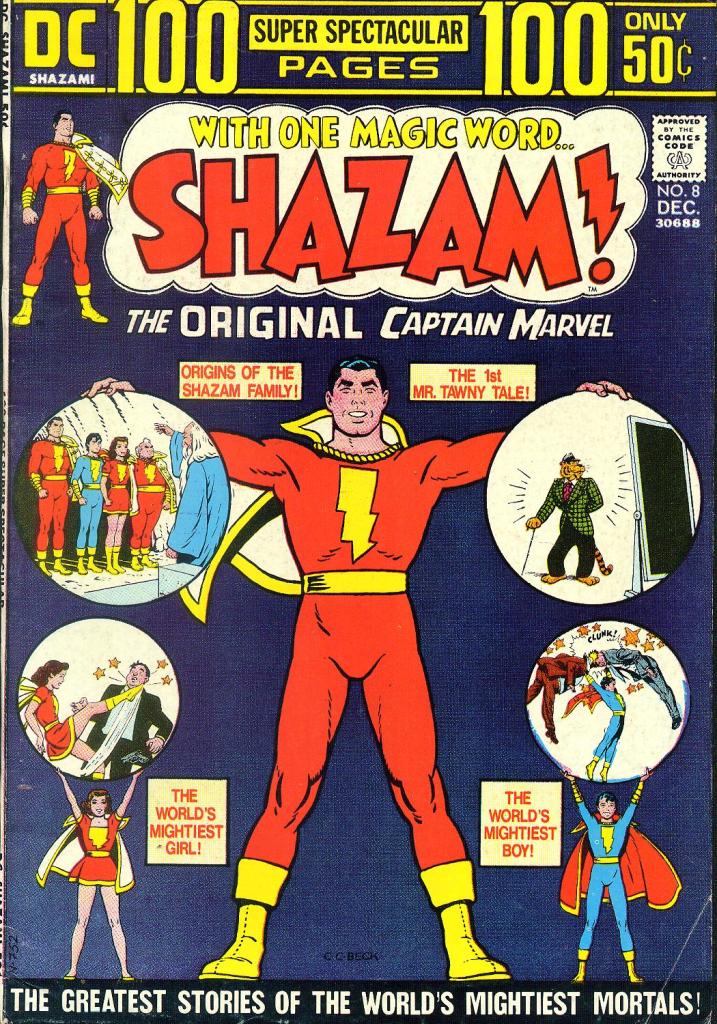
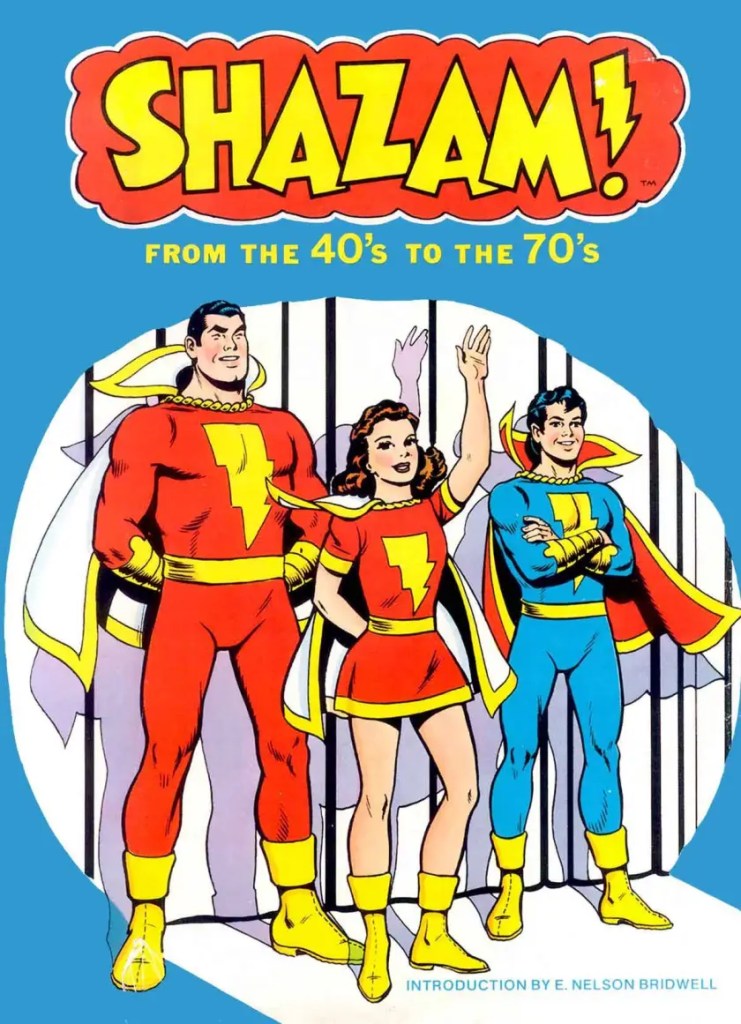
My days-long journey through the entire run of SHAZAM that I had borrowed from my buddy Donald Sims continued with this next issue, a highly-prized 100-Page Super-Spectacular. I adored this format, each one a fat treasure trove of vintage comic book stories. Unfortunately, much of this particular issue was wasted on me. While this is a great package, presenting some of the most formative and memorable classic tales of the Marvel Family, most of the contents of this issue I had already read in the published-later hardcover book SHAZAM From The 40s To The 70s.
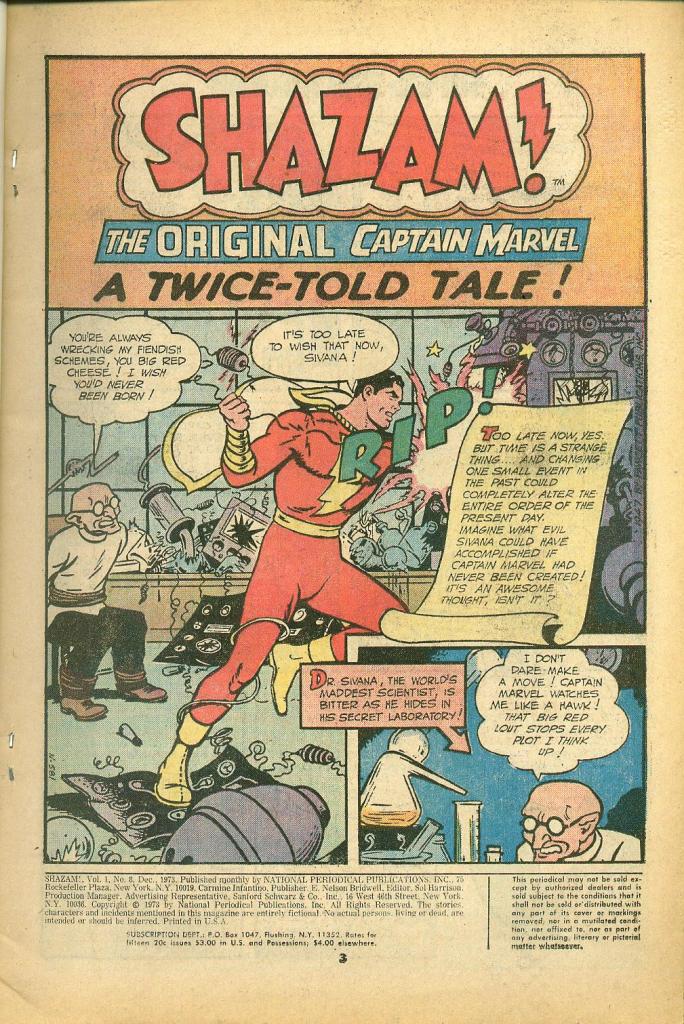
But most wasn’t all, and so this issue still had some new stories to entertain me (and I’d get to experience the ones I had already read in color since that hardcover has been mostly black and white.) This opening tale by Otto Binder and C. C. Beck succinctly recapped the origin of Captain marvel within the context of a new story in which Dr. Sivana attempt to prevent the creation of his hated enemy by traveling to the past and preventing his beginnings. Unfortunately, in doing so, old Sivana loses his memory of future events as well, and so the creation of Captain Marvel and his first adventure still goes off without a hitch.
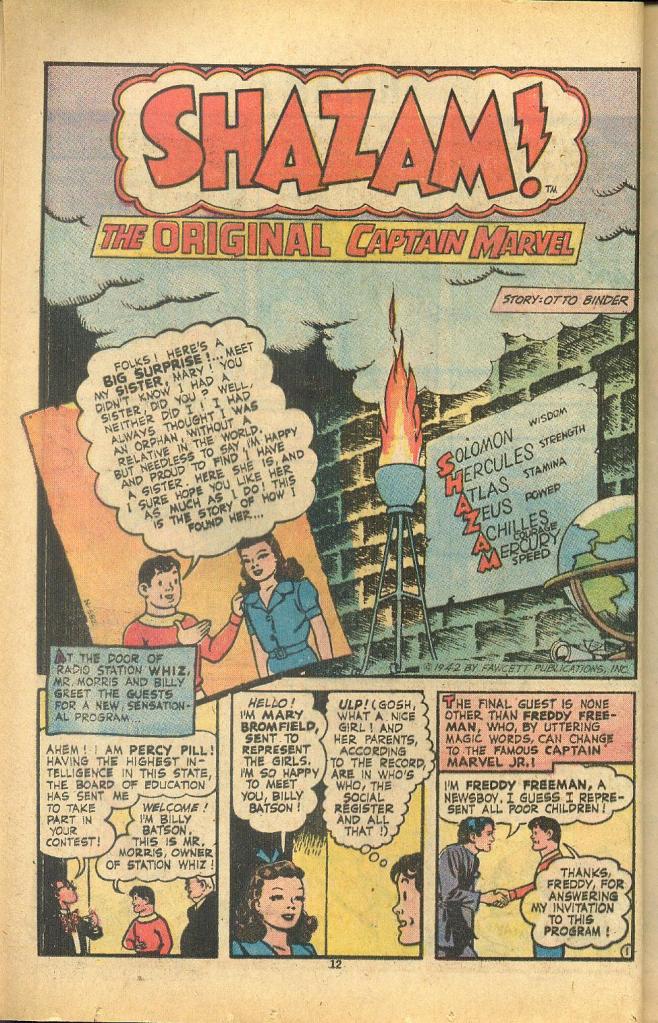
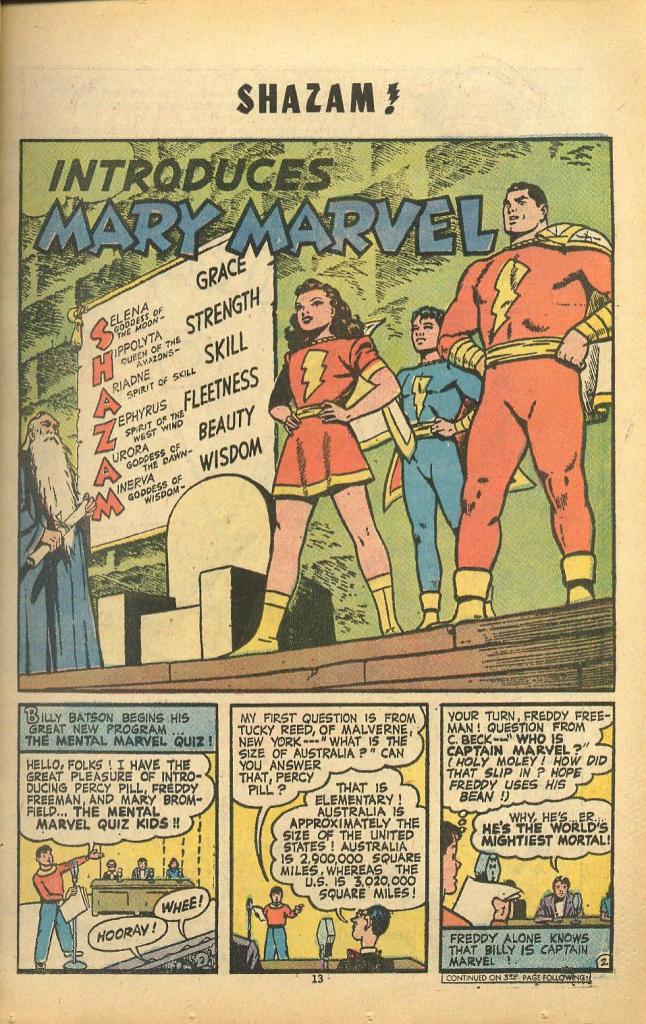
The next story reprinted was the one that first introduced Mary Marvel, the final member of the Marvel Family trio. It was crafted by Otto Binder and artist Mark Swayze, whose style was a hair more comic book realistic than Beck’s more cartoonish stylizations. Consequently, Mary is a bit more typically drawn in this first story, as is Freddy Freeman/Captain Marvel Jr. Only Billy Batson and Captain Marvel maintain their dot eyes and broad Beck looks. In the story, Billy learns that he’s got a younger sister, who turns out to be Mary Bromfield, the adopted daughter of a wealthy family. And it turns out that the magic word works for Mary as well, though in her case the acronym describes the attributes of a series of goddesses rather than male gods.
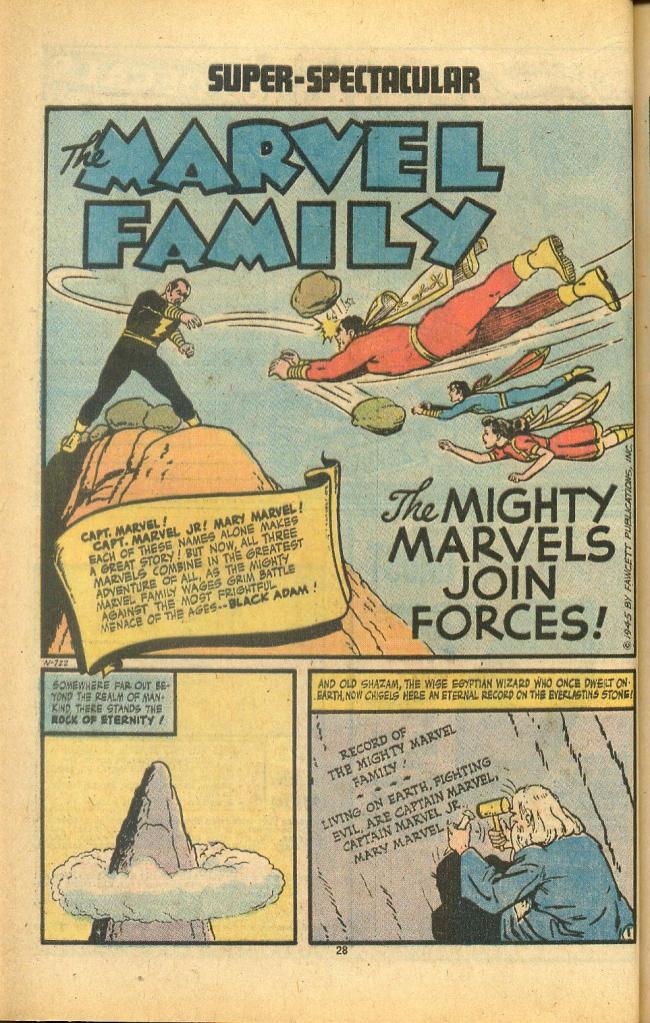
The next reprinted story was from the first issue of MARVEL FAMILY COMICS, and is the one and only Golden Age story to feature the villainous Black Adam. Given how prominent the character has become in recent years, to the point of headlining his own feature film, it’s strange to think that he only made a single appearance for his first thirty years or so of existence. But this story having been reprinted twice, it was inevitable that modern creators would bring the character back. This was another tale written by Otto Binder–no surprise, given that he was responsible for more than half of all of the Marvel Family stories done in the Golden Age–and artist C.C. Beck. This story also recaps everybody’s origins once again, including both Junior and Uncle Marvel, the W.C. Fields-style good-natured fraud of the group who winds up solving the problem through cunning rather than strength.
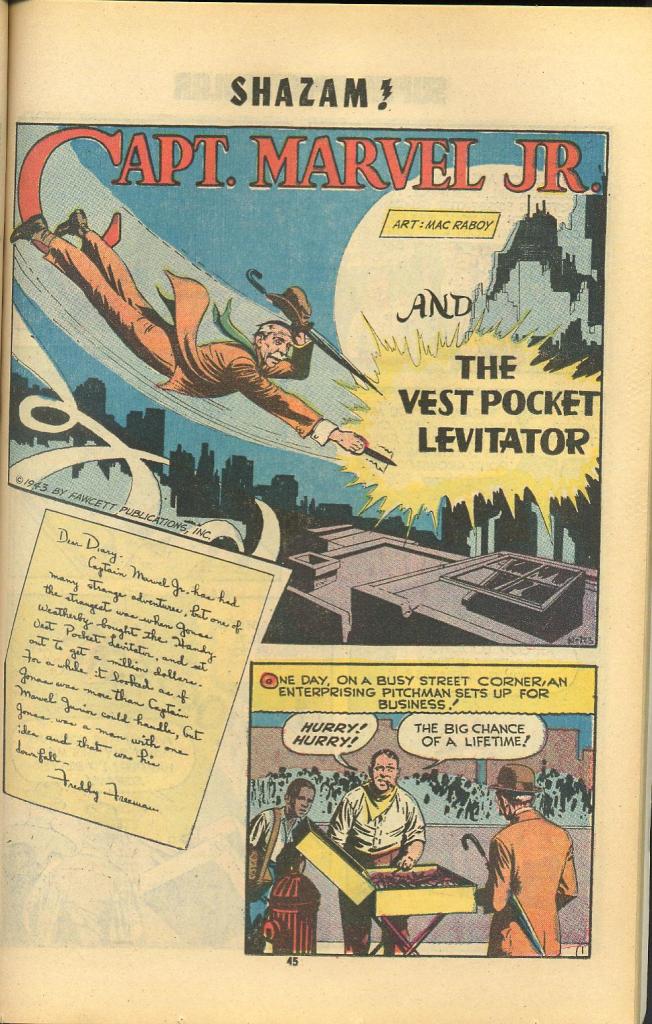
Next was a new-to-me Captain Marvel Jr. story illustrated by the great Mac Raboy and whose writer is unknown. The interesting choice had been made when starting the spin-off strip to have the artwork depicted in a more illustrative fashion than anything else in the Marvel canon. This gave Junior’s adventures a flavor all their own. But to be honest, it was a flavor that I didn’t like as much as the clean, open lines of Beck. The story involves a fellow who winds up with a gimmicked-up eggbeater that allows him to fly, courtesy of a mischievous gremlin. Junior’s around to make sure that the guy doesn’t get into too much trouble until he eventually loses the device.
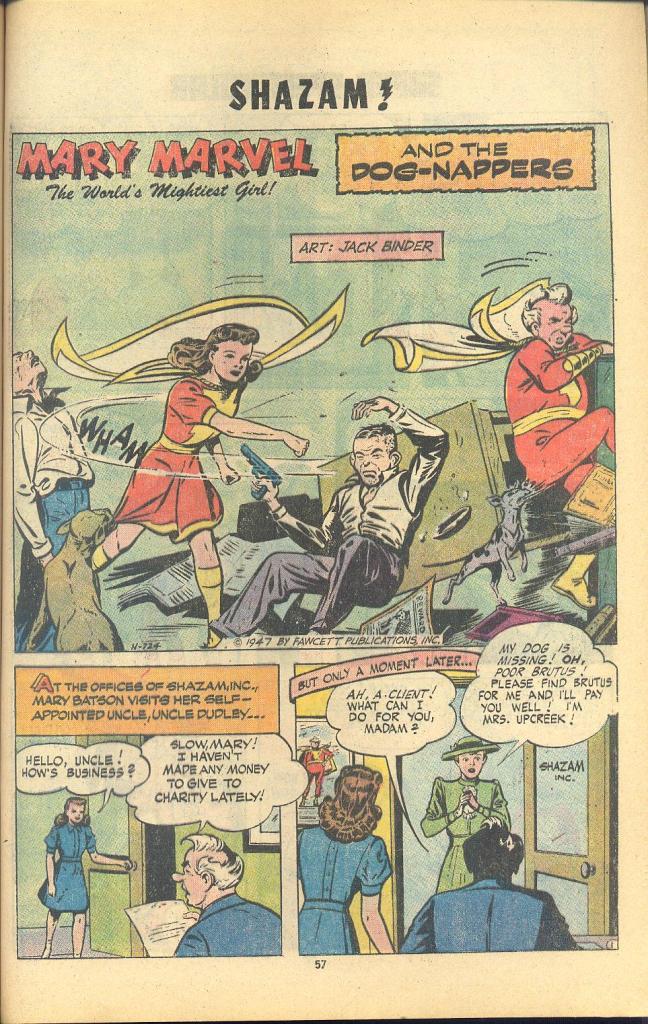
The next tale was also new to me, and featured Mary Marvel and Uncle Dudly, and was produced by Otto Binder again, this time paired with his brother Jack Binder as the artist. Jack ran a shop for comic book production during the wartime years that produced a lot of material for Fawcett, including a bunch of Marvel stories. It’s a pleasant enough little tale concerning Mary and Dudley’s efforts to reunite a missing dog with its owner, running afoul of a dognapping ring along the way. Much of the fun is in seeing Uncle Marvel bluff and stumble his way from one predicament to the next, given that his SHAZAM powers are all a put-on. And Mary, of course, keeps events from growing too dire.

A trio of lesser lights were featured in the next reprinted story. The Three Lieutenant Marvels were a trio of other kids from across the nation who were also named Billy Batson. At a certain point, they learned that if they shouted the magic word together with Billy, they would also gain the attributes of Captain Marvel–though they all humbly declared themselves lower-grade Lieutenant Marvels in comparison to the genuine article. This story is by Binder and Beck again, and revolves around Captain Marvel having scheduling conflicts on the memorial Captain Marvel Day where he’s meant to be in four separate locations at the same time. His Lieutenants sub in for him in three of those spots, and together they foil Sivana’s attempts to ruin the celebration all around the globe. A fun ending bit is that by the time the story wraps up, Sivana has crossed the international date line, so Captain Marvel captures him for crimes that he’s committed a day in the future.
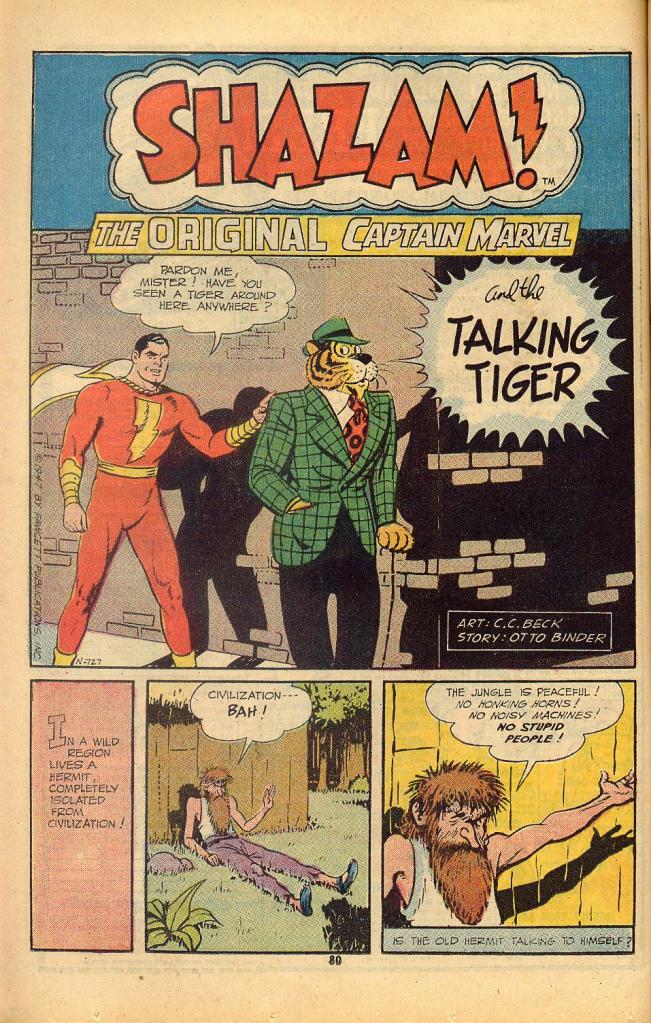
The next story reprinted was the debut of Mr. Tawny, the talking humanoid tiger who became a fixture in the Captain Marvel strip for its final five years or so. Creator Otto Binder clearly loved the idea of Tawny and his ability to comment upon human foibles, and he even planned a possible newspaper comic strip featuring the tiger to be drawn by his collaborator C. C. Beck. The strip didn’t wind up selling, but Binder got a lot of mileage out of the character in his Captain Marvel stories. In this first story, the manner in which Tawny became able to talk and think like a human being was left a mystery–he could simply do it, and so crossed Captain Marvel’s path when he attempted to enter human civilization.
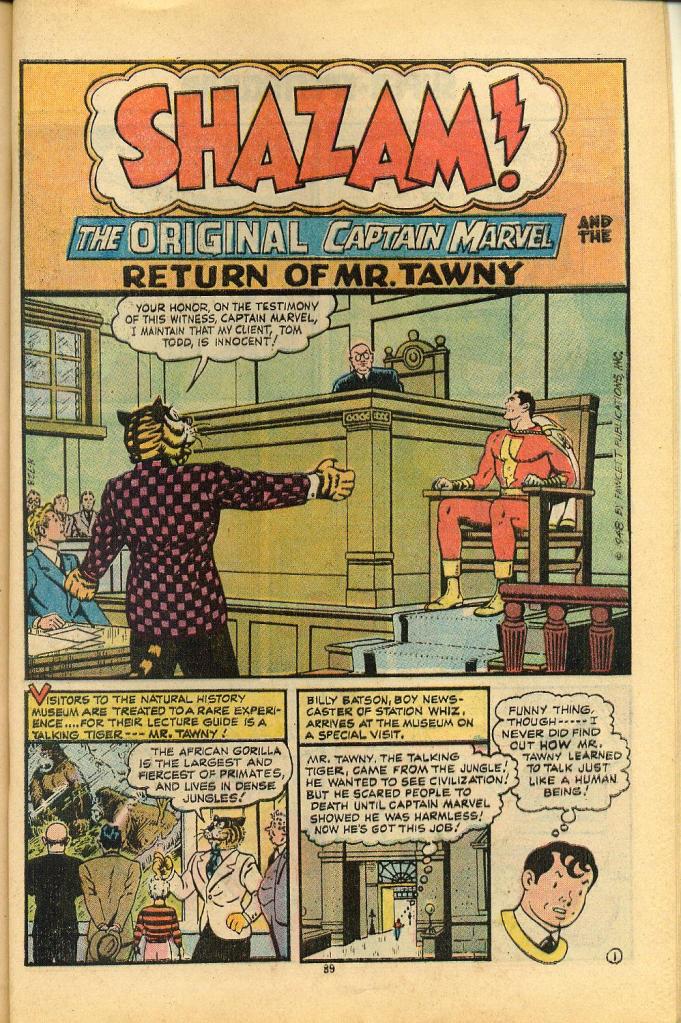
This was followed up by a sequel, the Return of Mr. Tawny, which is the final story reprinted in this issue. It too was by Binder and Beck and it reveals that Tawny’s mind was super-charged by a serum given to him by a helpful passing scientist who only appears in three panels of this story, and remains unnamed. The bulk of the adventure concerns Tawny’s attempts to save his oldest friend Tom Todd from the electric chair after he’s accused of murder. Captain Marvel, of course, finds the real killer and brings him to justice, allowing for a reunion between Tawny and Todd. So overall, this is a terrific sampler of Fawcett material and far stronger as a package than any previous issue of SHAZAM–even if I’d read about half of it prior to this.
 The Tom Brevoort Experience
“it reveals that Tawny’s mind was super-charged by a serum given to him by a helpful passing scientist who only appears in three panels of this story, and remains unnamed.”
Wandering super-scientists are probably all over the DC and Marvel multiverses, even if most of them never get involved with superheroes.
I agree this was a great package (I loved those spectaculars). I do like Raboy’s art.
LikeLike
Or some times the scientist doesn’t wander but an injured person drops into their figurative lap: Fred Parrish ( Blue Bolt ) and Dr. Benton [ Blue Bolt Comics#1 ( June 1940 ) Novelty Press ] or the Terror ( unnamed back then — but modern times Laslo Pevely ) and Dr. John Storm [ Mystic Comics#5 ( March 1941 ) Timely Comics ] or John Corben ( Metallo ) and Professor Vale [ Action Comics#252 ( May 1959 ) DC Comics ]. Don’t know if there are other golden age characters or silver age characters.
LikeLike
This is the kind of issue I’d gripe about, when buying back issues. It was all reprint, and therefore “unimportant” — what I wanted was new stories!
Never mind that the reprints were actually better than the new stories — I wanted new stories anyway. And I wanted the kind of ongoing continuity and subplots I liked from Marvel books, which I definitely wasn’t getting from SHAZAM, new or old…
LikeLike
Most of the classic Marvel stuff was not my cup of tea except for Junior’s stories. Raboy did an amazing job visually making those stories seem more important and less lighthearted.
LikeLike
I loved the 100-pagers as well, and this is a great one. I’m sure most young readers at the time were in the same situation as me, not knowing much about the Captain’s background or his supporting cast, so this was a great introduction. And as a budding art connoisseur, I enjoyed studying the different artists, all more or less working in the same “house style”, but with their individual quirks (much like Bob Kane’s various “ghosts”). Aside from Raboy, of course, who was completely off in left field doing his own thing. His dark & moody approach gives the otherwise-whimsical “Pocket Levitator” story a weirdly creepy undertone.
And yes, it’s wild that the very cool Black Adam was just written off after one appearance. Perhaps they thought it would be too difficult to find plausible ways for him to be defeated over and over again…having him bamboozled by Uncle Dudley was funny and ironic the first time, but would get old after a while (like those stories where Superman has to cook up ever-more-contrived ways to get Mxyzptlk to say his name backwards).
LikeLike
Black Adam [ The Marvel Family#1 ( December 1945 ) ] not the only golden age villain used only once with the same power gained the same way as the hero: The Nazi “Shock Gibson” [ Speed Comics#23 ( October 1942 ) Shock Gibson — a Nazi spy accidentally gains the same powers as Shock Gibson by sitting in Gibson’s Electrical Energizer — https://pdsh.fandom.com/wiki/Fritz ] and Frank Rone [ USA Comics#8 ( May 1943 ) Whizzer story — thief Frank Rone steals a diary from Jack Robinson/Bob Frank’s safe which contains the secret of the Whizzer’s speed ]. Plus you could add Professor Lawson [ Marvel Mystery Comics#49 ( November 1943 ) Miss America’s first appearance — Prof. Lawson told Madeline Joyce his experiment accidentally gave him powers which inspired her to expose herself to his invention. When he found her he attempted a murder suicide that caused an explosion that sent her body flying ].
LikeLike
It’s likely to be (at least) another 30 years before we get another Black Adam movie too, fortunately. Perhaps The Rock will have learnt to be a team player and/or better actor by then?
LikeLiked by 1 person