

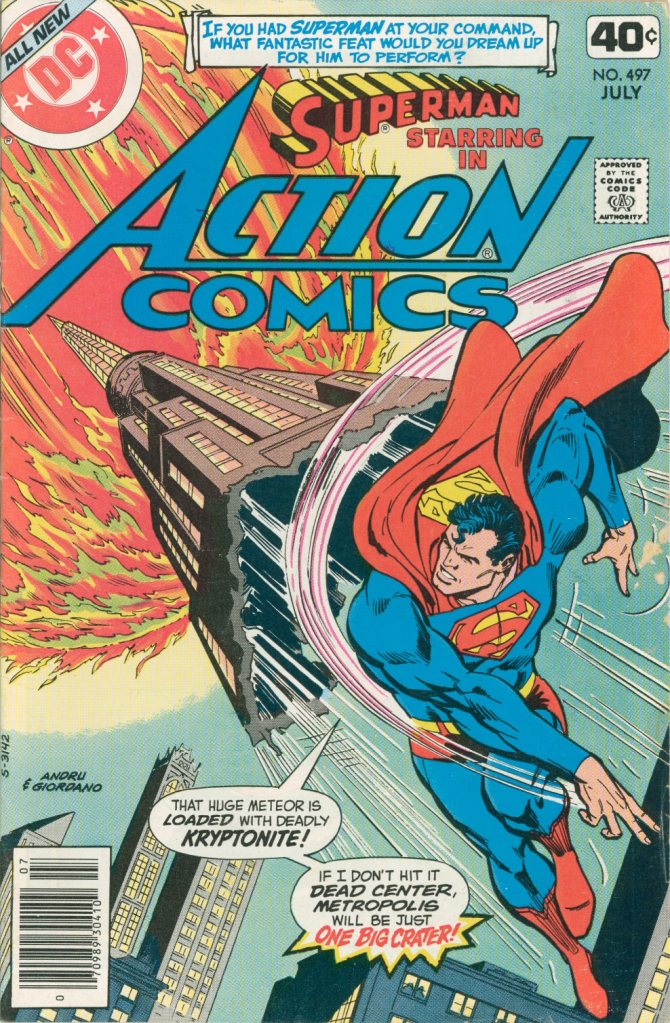
Despite the overwhelming global popularity of SUPERMAN THE MOVIE, DC for years refused to make any but the most cursory moves towards reflecting that iteration of the Man of Steel in the comics. It’s really wasn’t until Post-CRISIS when John Byrne took over the character that the influence of the film version came to the fore. But prior to that, Superman kept on chugging along exactly as he’d been before, increasingly feeling out of step with the world around him and the rest of the comic book landscape of the period. Editor Julie Schwartz has his approach down and his roster of talent set, and he didn’t really deviate from it. This did mean that the titles possessed a remarkable consistency, but it was a consistency mostly of mediocrity.
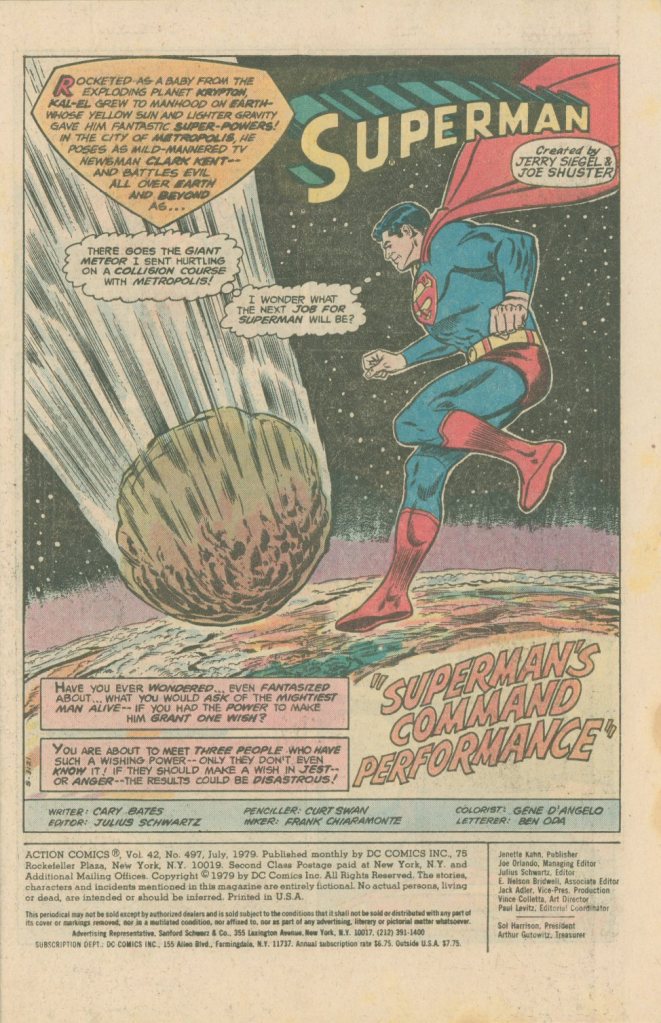
Case in point, this issue of ACTION COMICS is eminently forgettable, and indeed I didn’t recall anything but the most broad details of the story before cracking it open again to write up this piece. It isn’t a bad story per se, but it’s lacking in genuine drama and jeopardy. It’s comfortable, and nice, but not in any way noteworthy. The sort of story designed to hold the attention of a kid for ten minutes but nothing else beyond that. As the hardcore fan audience became a more important part of the business, they wanted more out of their comic books than this.
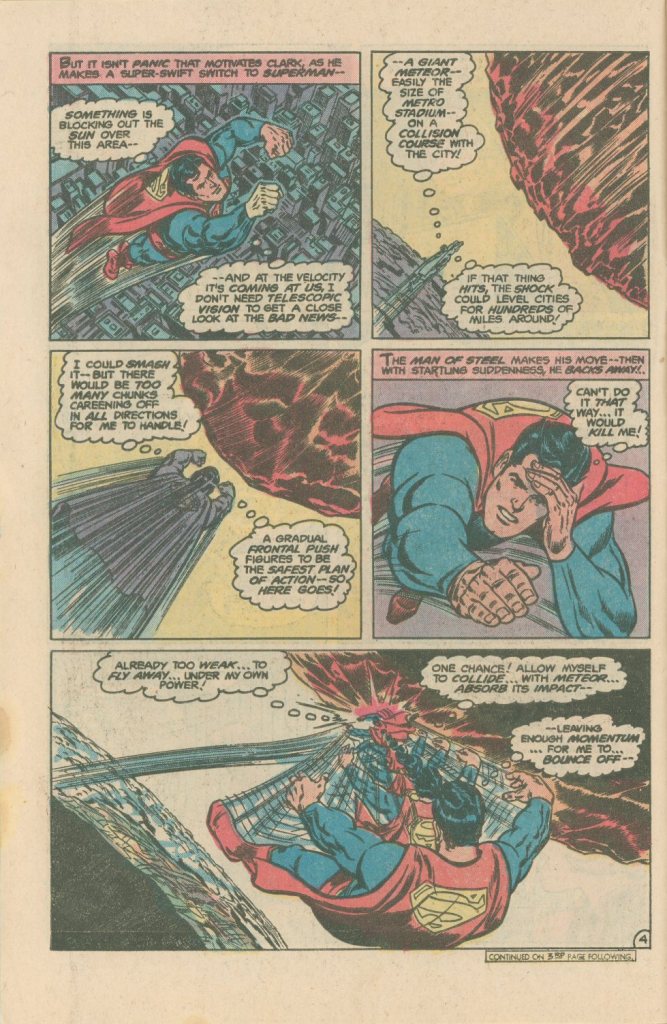
The creative team was made up of reliable craftsmen. Writer Cary Bates was ne of Schwartz’s regulars, and he specialized in gimmick-laden stories of the sort that Julie preferred. And artist Curt Swan had defined the look of the character for two decades, and while his Rockwell-esque portrayal still held a certain understated charm, it was having difficulty competing with the younger and flashier popular artists on the scene. The functional inking by Frank Chiaramonte didn’t help much in the way of adding excitement. But it was a reliable assembly line product, as familiar as a Hershey bar or a Big Mac.
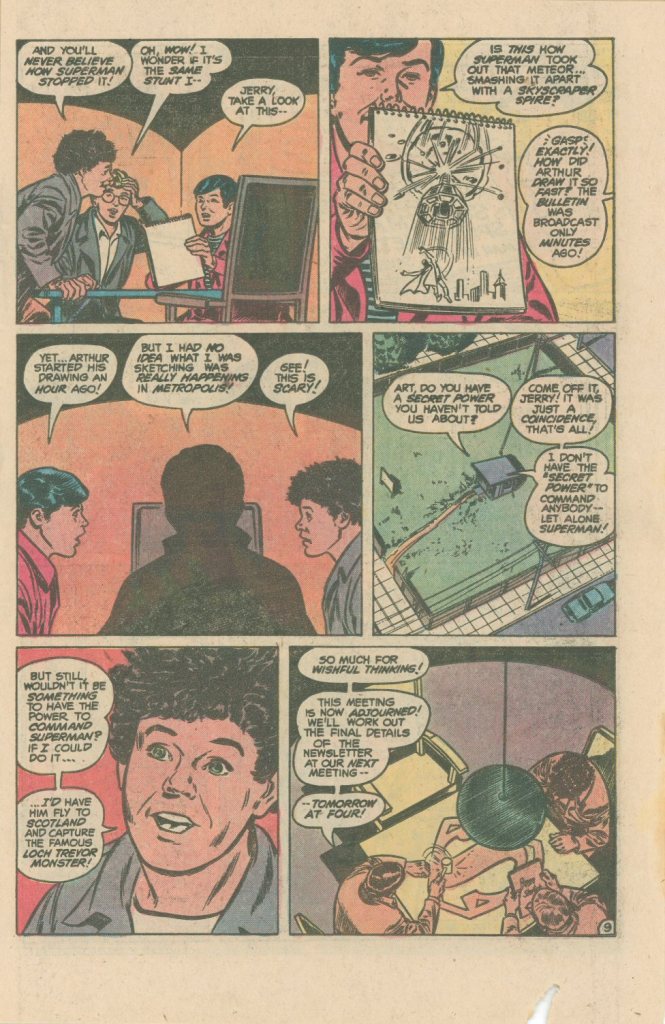
The story concerns a trio of Superman fans living in Plaintown, Kansas, who have set up a Superman fan club and who occupy themselves at every by imagining spectacular super-stunts that their hero could perform. Unbeknownst to them, however, the situations that they dream up for the Man of Steel to contend with are coming true far away in Metropolis, and the trio are never quite able to come up with a solution to the situations they dream up until after Superman has found one. What’s more, Superman comes to realize that he himself is unconsciously setting up these dangerous situations in sleepwalker-like fashion. But he can’t quite dope out what is causing it.
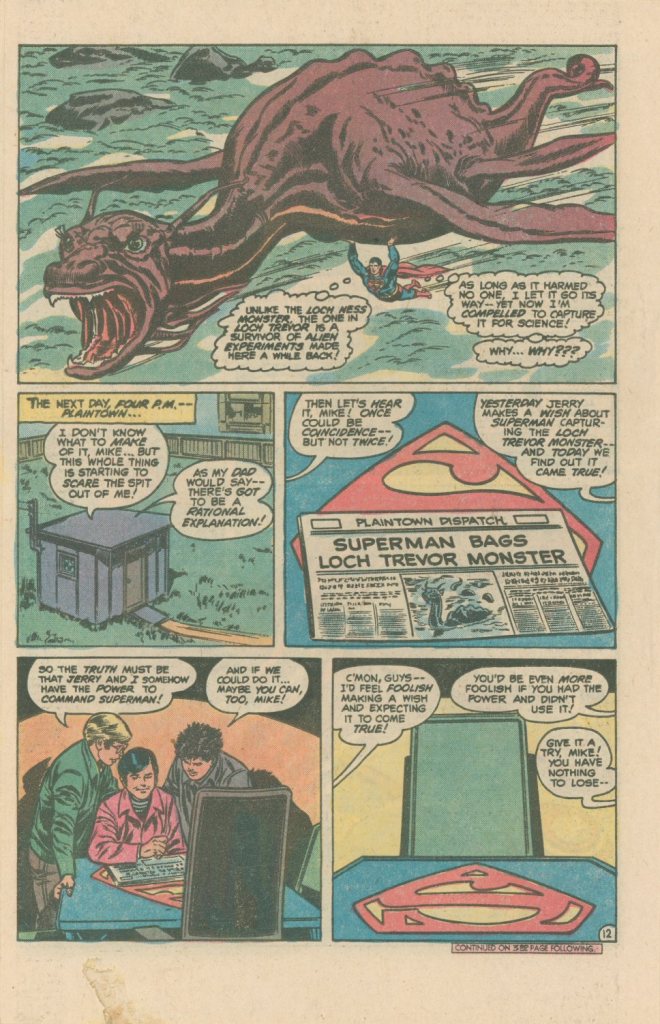
Eventually, though, the three kids–Jerry, Mike and Arthur–start to become aware of the fact that whatever ideas they dream up to challenge their hoer inevitably come true–such as Superman capturing the Lock Ness Monster because Jerry imagined him doing so. In order to test their strange control over the Metropolis Marvel, Mike commands him to fly to Plaintown and attend their club meeting. This command catches Superman just as he’s in the middle of foiling a heist, and so he’s forced to hang the perpetrators from the skis of a nearby helicopter while he’s being compelled to fly out west. How the copter and the crooks got back down to Earth safely is anybody’s guess.
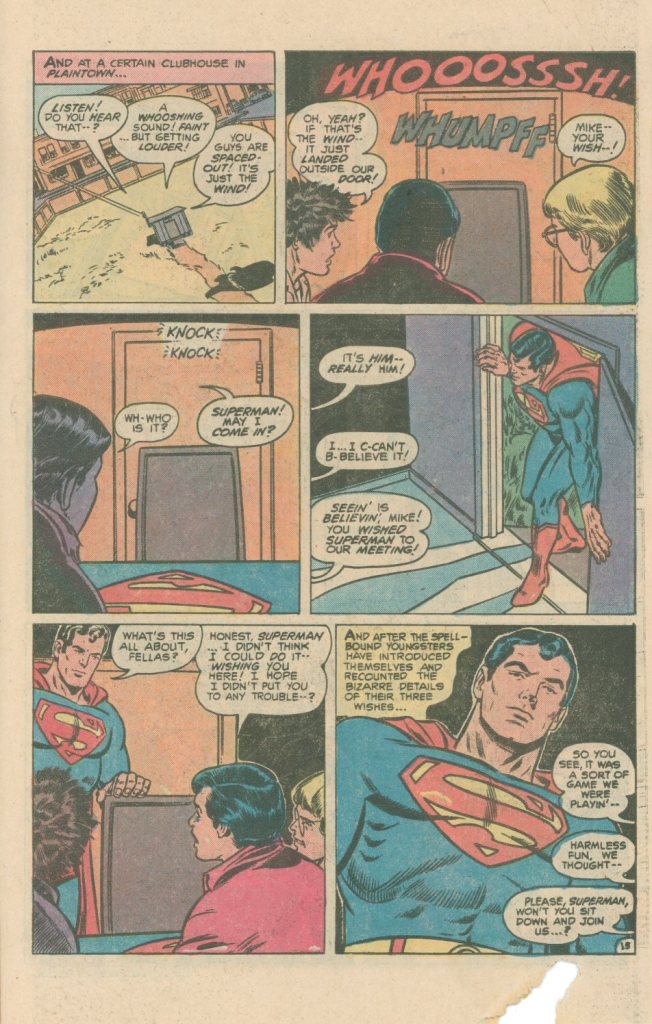
And sure enough, back in Plaintown, there’s a knock on the door to the kids’ clubhouse and in walks the Man of Tomorrow. The trio of fans have always kept an extra empty seat at the head of their table open in case Superman ever did deign to visit with them, and so they invite him to take the seat reserved for him. But Superman tells him that he can’t do that, because the seemingly-empty chair is already occupied. And he uses his infra-red vision to enable the kids to see their other visitor, a child from a dimension close to our own.
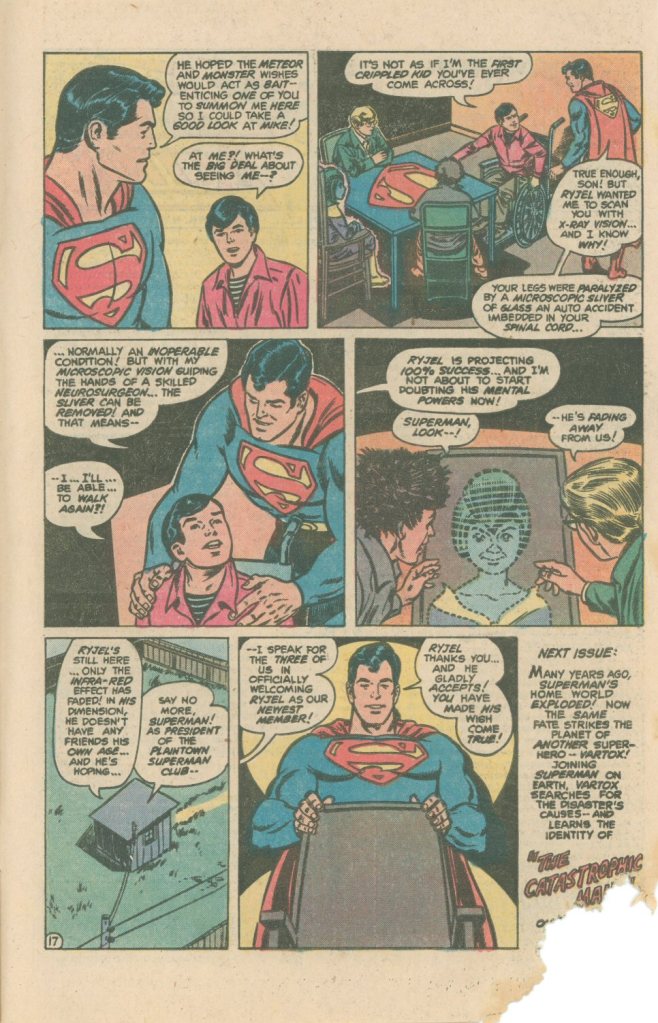
This child, Ryjel, is responsible for what has been going on. Using mental powers, he influenced Superman to carry out the super-stunts as a way of bringing him to the clubhouse. Why he didn’t just use them to summon Superman here directly is best not thought about too much. And he’s got an altruistic reason for doing so. Superman is able to use his X-Ray vision on the wheelchair-bound Mike and determine that a sliver of glass embedded in the boy’s spine can be safely removed, allowing him to walk again. The three kids vote to accept Ryjel as a member of their group going forward, and the story is at an end. No real stakes, no great drama, just a bit of simple entertainment with a pat resolution and just a hair of sentimentality to it. This was the Superman of 1979, but it wasn’t really a competitive approach.
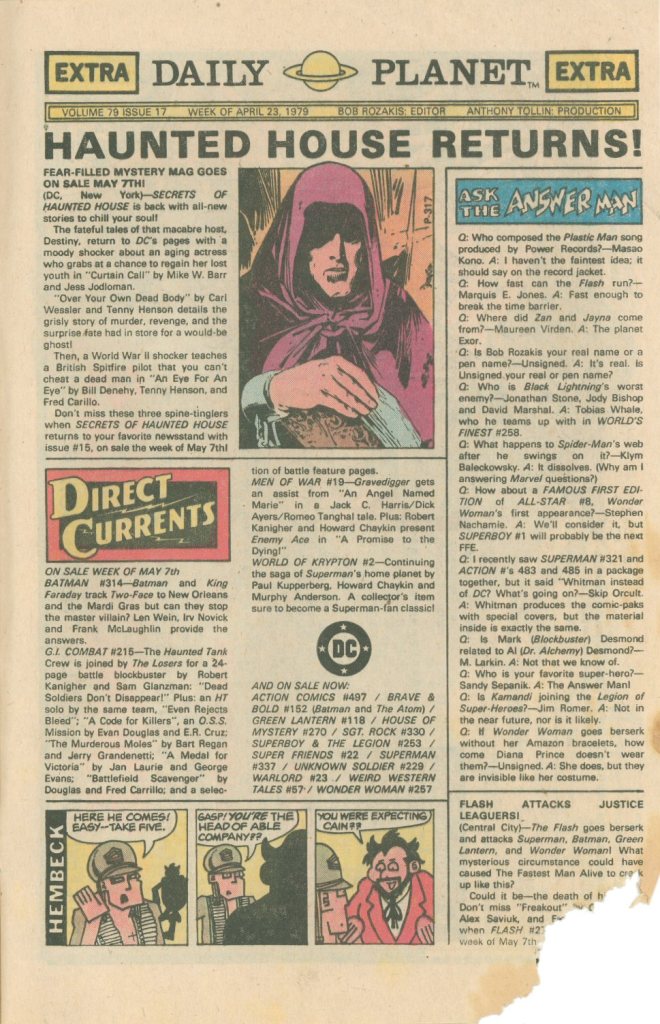
The issue carried another new installment of the Daily Planet promotional page, which contained as always an Ask the Answer Man column in which Bob Rozakis provided answers to reader questions as well as another short comic strip by fan cartoonist Fred Hembeck. This particular Answer Man column mentions that DC was considering doing a Famous 1st Edition of SUPERBOY #1, which never came to pass.
 The Tom Brevoort Experience
Seriously? I would’ve said the exact opposite: That the ’78 movie lovingly embraced all the Silver/Bronze Age tropes that Byrne later tossed out. Other than the more dystopian view of Krypton, I’m hard-pressed to think of anything from the movie that made it into Byrne’s version.
LikeLiked by 1 person
John Byrne’s Clark Kent has a lot in common with George Reeves Clark Kent [ Adventures of Superman ( 1952-1958 ) ] than with the Clark Kent in Pre-Crisis DC Universe or Christopher Reeve Superman movies version. Even Byrne Lex Luthor has nothing in common with Gene Hackman and more in common with Iron Man’s Justin Hammer ( The making sure nothing gets linked back to him that law enforcement can charge him with. Don’t remember old man Justin Hammer pressuring women into sex or offering them money for it — like that waitress in the diner ).
LikeLiked by 1 person
“Other than the more dystopian view of Krypton, I’m hard-pressed to think of anything from the movie that made it into Byrne’s version.”
One of the more obvious ones is that Smallville is in Kansas in the Byrne version.
DC did make a couple of nods to the movie in the late 70s — Clark started splitting his time between WGBS and the Daily Planet, to get newspaper stories back into the comic, and Lois started being drawn more like the Margot Kidder version (particularly in SUPERMAN FAMILY, when Bob Oksner drew her solo strip).
LikeLike
Byrne’s stripped away most of the “barnacles” from the Silver Age. In that respect, it was closer to the Donner movie than the Bronze Age comics. No Superboy, no super pets, no teenage rivalry with Lex Luthor (and no causing Lex’s baldness.) Maybe the most radical change from any Superman in any media before (at least that I’m aware of), was to have Kal-El “born” on Earth, as the rocket’s “matrix” he was “incubating” in was like an artificial “womb”.
I think Byrne said somewhere that it was where the fetus had grown. I don’t remember now when the point of separation from his mother was. If the eggs were removed before or after Jor-El had made his “contribution”. I don’t think there was any physical contact involved, between Kal’s biological patents. The future Kal-El was placed in the “matrix”, and then the matrix was carried by the rocket/ship.
I think Byrne wanted him to be “born” on Earth. That puts a little distance between the “Moses in the basket” parallel, but the 2 stories are still similar.
LikeLike
Liking the new artists and liking Swan didn’t have to be an either or situation. I loved both. Byrnes’ worst legacy was Swan losing his job and not being used for any other title. Not that Byrne was responsible but it’s the first thing when I think of the changeover.
LikeLike
Steve, I remember Swan drawing some Aquaman issues in the late 1980’s, written by Robert Loren Flemming & Keith Giffen. I think there were other projects, too. Personally, I wasn’t enthused by his art style. I appreciate that he can drew better than most, & better than many other comic book artist. But his style was too “quiet” for me as I reached my teens. He was a good storyteller.
Very few artists can claim to have given the definitive look to arguably the best known & most important superhero. Curt’s one of them. But it was a style came to paled in comparison for many readers to other artists’ versions of the same character (though there are a few Golden Age artists whose Superman I preferred over Swan’s).
There’s still a grace Curt gave Superman that’s unique. But other, more kinetic & dynamic versions seemed to have more impact or resonance. No question his was the most recognizable or familiar for almost 2 decades. But for many of us, maybe too many for DC’s bottom line, it was no longer the most preferable version.
LikeLike
You would think the JLA Satellite would have detected that giant meteor long before it got anywhere near Earth so that Superman or Green Lantern or another hero capable of deflecting, deflected it. JLA Satellite must have Amazonian/Kryptonian/Thanagarian/Atlantean/Martian technology in it, plus the Fortress of Solitude should have been able to detect it too.
LikeLike
Superman Unlimited raises the same questions.
LikeLike
I wonder why no movie version of Jimmy Olsen is ever played by an actual red headed actor. I thought James Gunn might actually fix that. At least Gunn is finally allowing different villains in Superman besides just Zod and Lex Luthor.
LikeLike
Another reminder of how much I disliked the pre-Crisis version of Superman. You captured it perfectly: it’s mediocre from top to bottom.
LikeLiked by 1 person
Julius Schwartz is a pivotal and hugely influential, impactful figure on the comics industry. But like many others, eventually there comes a disconnect. Or a “sea change”. I’ve no idea what was in Julie’s mind when he decided to retire. But the titles he was editing were mostly out of step with most of the current comic book audience in the mid-1980’s. At least this seemed reflected in the sales. And to my tastes, too.
I also don’t know if Julie had any restrictions on writer Cary Bates, or if Cary had simply resigned his stories to a certain formula. Many of those stories read well now, and many of them don’t. Julie reportedly said something like, “It’s called ‘behind the scenes’ for a reason”. I do know that there’s a “DC Comics Presents” issue published with Adam Strange in 1985 written by Bates and drawn and colored by Klaus Janson that remains in my top 10 fave Superman stories.
I also know I enjoyed Cary’s “Silverblade” with Gene Colan, Janson (and other inkers) more than most of the Superman issues under Julie. And I consider Cary the biggest reason that I really liked the first year or so of DC’s “Captain Atom” reboot. Cary was doing some terrific writing that, for whatever reason, most of his earlier work didn’t excite me as much as that post-Superman writing did.
Maybe he was less confined or given more range or different themes to explore. Or maybe he was just trying harder, I’ve no idea. I hadn’t been interested by his Flash work either. But that was also due to not liking Carmine’s bizarre looking drawing style. There’s also the fact that I was in my teens, and maybe I had been to young to really appreciate Bates’ writing before then. But his first year on “Captain Atom” was always towards the top of my reading list. And I’ve never been a big fan of Pat Broderick’s art. His late 70’s Mar-Vell is still his peak, for me. His Batman is one of my least favorite (though Klas Janson’s inks on one issue made Pat’s drawings look more to my liking).
LikeLike
Sorry for the typos. I ended with Klaus Janson’s inks over Pat Broderick’s drawings, but called Klaus “Klas”.
LikeLike
True Believers at Marvel and his Superman elseworld around that time showed what Bates was capable of. I don’t know if he held himself back at his height or if he continued to grow while away from comics but both are favorites of mine. I enjoyed his Flash and Superman a lot under Schwartz and would have dumped Flash under other editors had I not still been a completist. Has he ever said in an interview why the Flash’s trial was interminable? The guess is he knew Barry was doomed but I don’t trust common wisdom.
LikeLiked by 1 person
Ross Andru & Dick Giordano did some great covers for Superman’s titles. As did Rich Buckler & Dick Giordano, & Jose Luis Garcia-Lopez (with & without Giordano’s inks).
Klaus a inked Ross Andru’s first three & final two pages in “World’s Finest”, V1, #300. I’d’ve liked to have seen then take over a Super title together w/ Bates still as writer. Ah, well.
LikeLike