

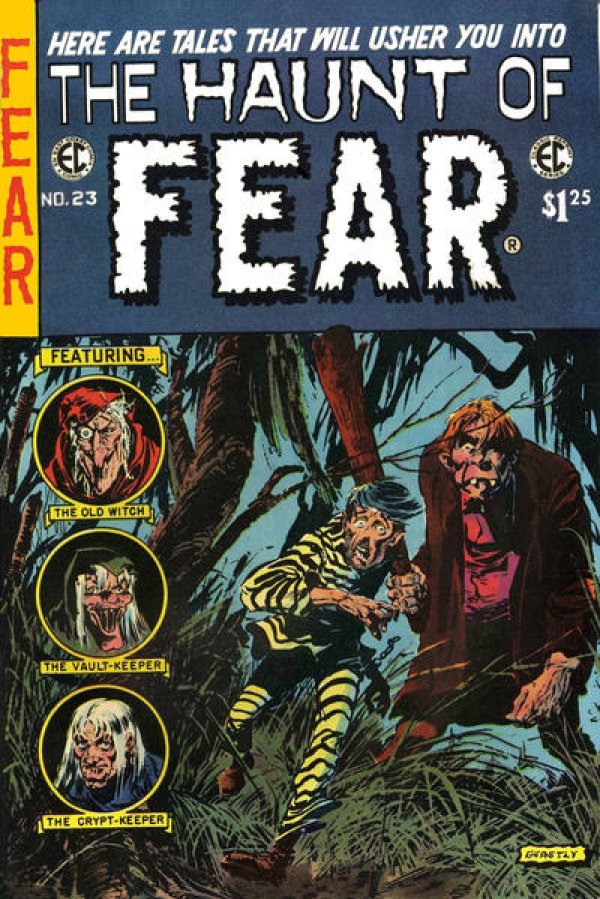
And finally we come to the last of the box of eight classic EC reprints issues by the short-lived East Coast Comix organization that I purchased from the Superhero Merchandise catalog. Reading through this lot was somewhat transformative for me, in that it expanded my tastes just a little bit. I was still primarily interested in super hero comics, but my exposure to these EC stories, while not every one was a memorable gem, made me begin to realize that other genres might have something to offer as well. I had sampled an occasional DC mystery title over the years and found them all wanting in terms of connection–the stories simply didn’t excite my interest, a situation that is still largely the same despite some very lovely artwork. But these EC books had more to them than that, and so I found them very satisfying.
East Coast Comix put out a total of 12 vintage EC reprints before giving up the line, and I’m told that they mainly had distribution on the west coast and the network of head shops that maintained the underground comix scene. In that environment, the $1.00 and later $1.25 price tag wouldn’t have been out of line, but in the mainstream where new comics still cost 40 cents, that would have been a bit of a hurtle to overcome, quality notwithstanding. I eventually did manage to track down the other four East Coast EC reprint over the course of the 1980s–well before the Gladstone reprints of the early 1990s kicked off, which I also wound up buying a bunch of. I never cracked on any of those lovely-looking black and white hardcover slipcase sets of the complete run of titles, though–the price tag was simply prohibitive for me all throughout that decade, though I eyed them from time to time.
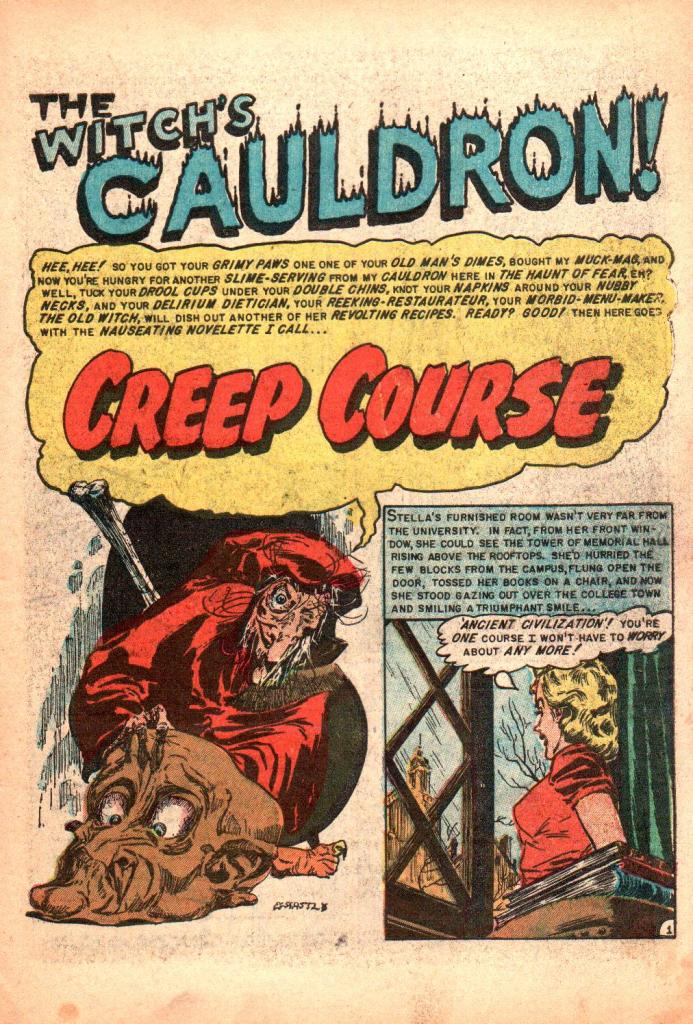
So what did this issue have to offer? I confess that I had largely forgotten about most of these stories until reviewing the book again for this writing. The stories here didn’t stick with me quite so well as some of the other books. The opening story, written by Al Feldstein with kibbitzing from publisher Bill Gaines and illustrated by “Ghastly’ Graham Ingles, tells the story of a shapely young co-ed who’s intent on seducing her Ancient Civilizations professor to get a good grade. There’s also a situation on campus where three girls have gone missing, and our lead character experiences a vivid dream where her professor has abducted her and those girls to be sacrifices in his homemade Roman coliseum. This is crazy, of course, but to reassure herself that it was only a dream, she implores the professor to give her a tour of his place. There isn’t a coliseum in sight, fortunately enough–but there is a series of mummy cases. The professor had been responsible for the disappearance of the other girls, but he didn’t feed them to lions, he mummified them–a fate that now awaits our protagonist. This was a long way to go for a not-terrific punch line.
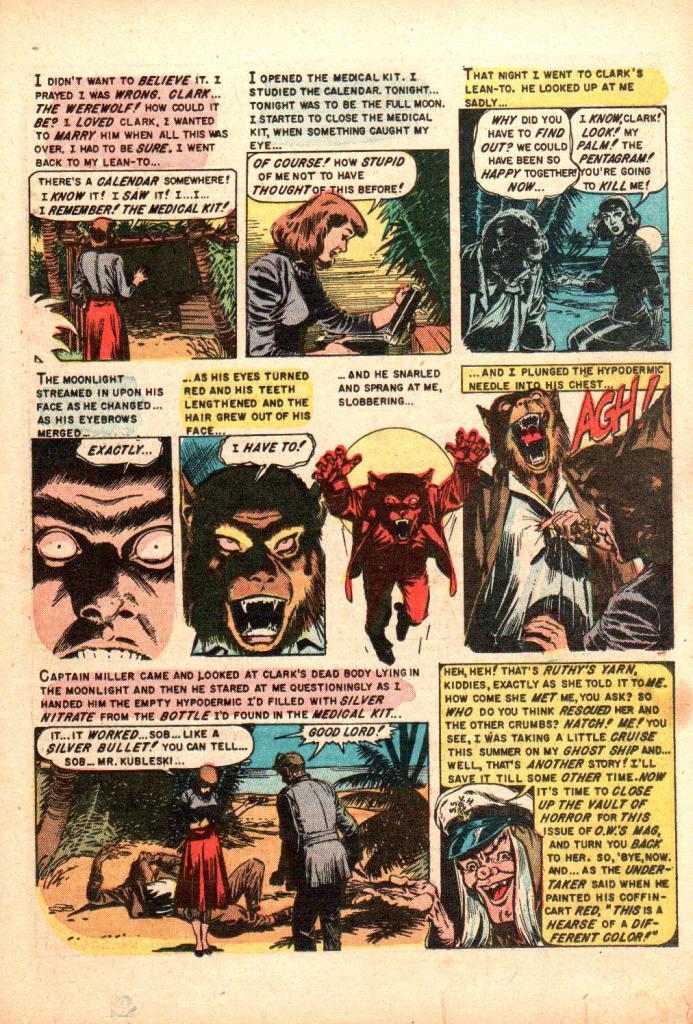
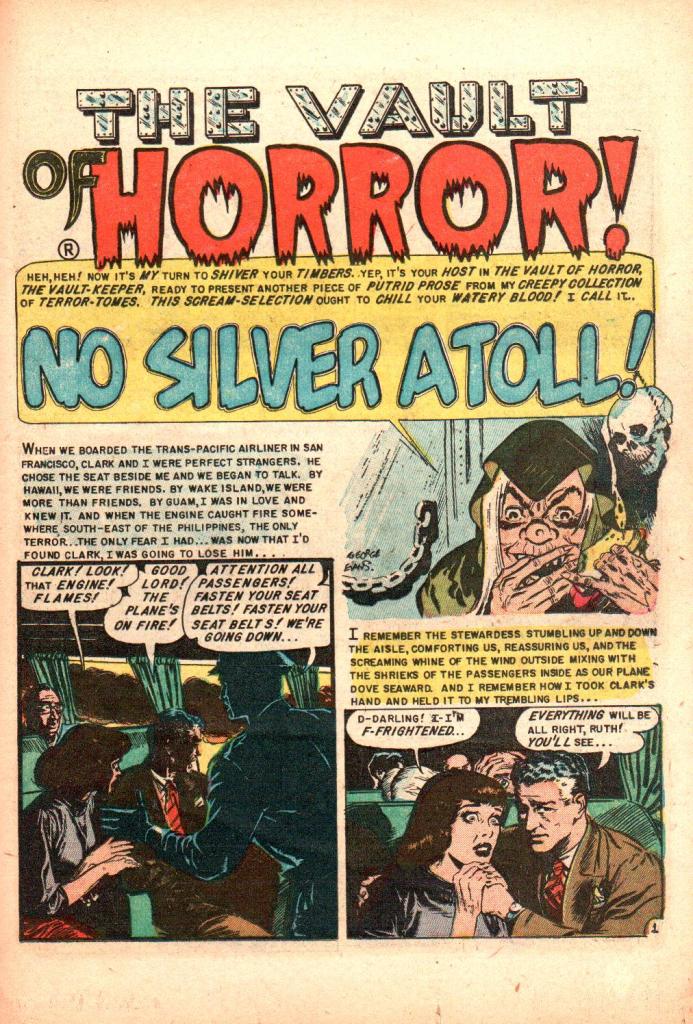
The next story, also by Feldstein and Gaines, has some wonderfully evocative artwork by George Evans, though the story is again only so-so. It’s about the survivors of a plane crash who are marooned on an uncharted island and who are being picked off one by one by what turns out to be a werewolf among their own party. This becomes apparent as all of the passengers’ possessions that contain silver disappear one by one, swiped by the werewolf so as to circumvent his vulnerability to them. In the end, our lead character works out who the werewolf is–it’s the guy she’s been striking up a burgeoning relationship with–and when he attempts to kill her to safeguard his identity, she kills him with a hypodermic filled with silver nitrate, the only silver among the campsite that he had overlooked.
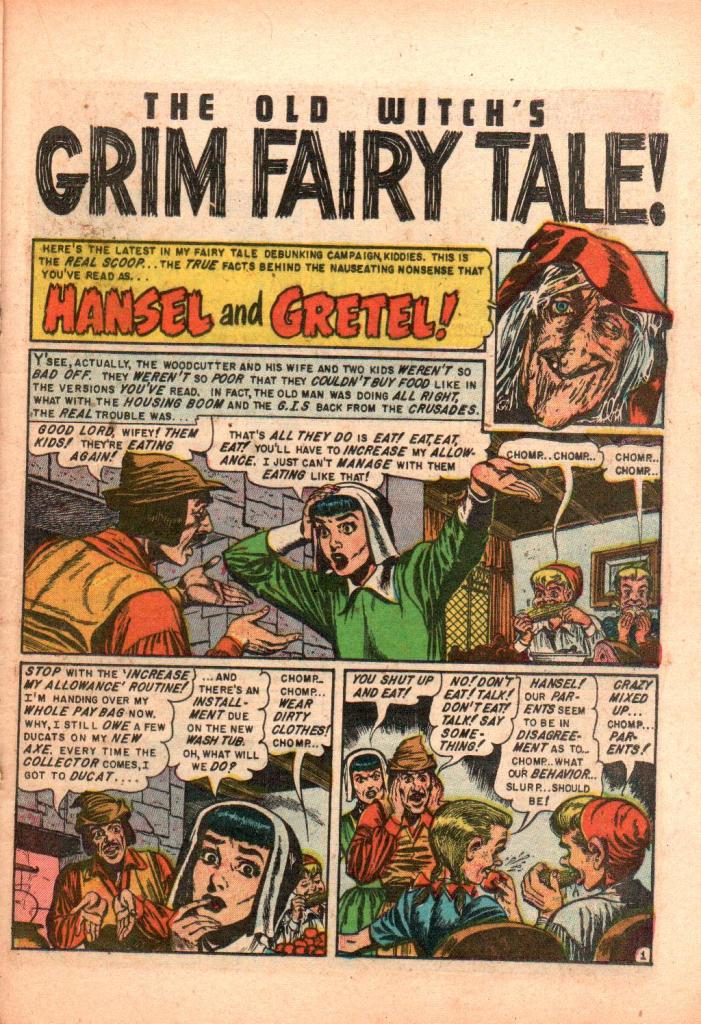
Story number three is another one of those reimaginings of a classic fairy tale that EC liked to do quite often–so often, in fact, that this is the second story based upon Hansel & Gretel within the eight EC comics that I had bought. It’s by Feldstein, Gaines and artist Jack Kamen, who does his usual underrated job on it. The bit here is that the real Hansel & Gretel are both asshole children, little monsters whose parents try to get rid of them before they’re eaten out of house and home, and who murder the little old lady who gives them shelter when they discover she’s got a chest full of coins and jewels that they want. In the end, they reconcile with their parents, the sudden wealth making all of the kids’ past misdeeds water under the bridge. I found this story pretty tedious as a kid and I don’t really think much more of it looking back on it today. Not one of EC’s best.
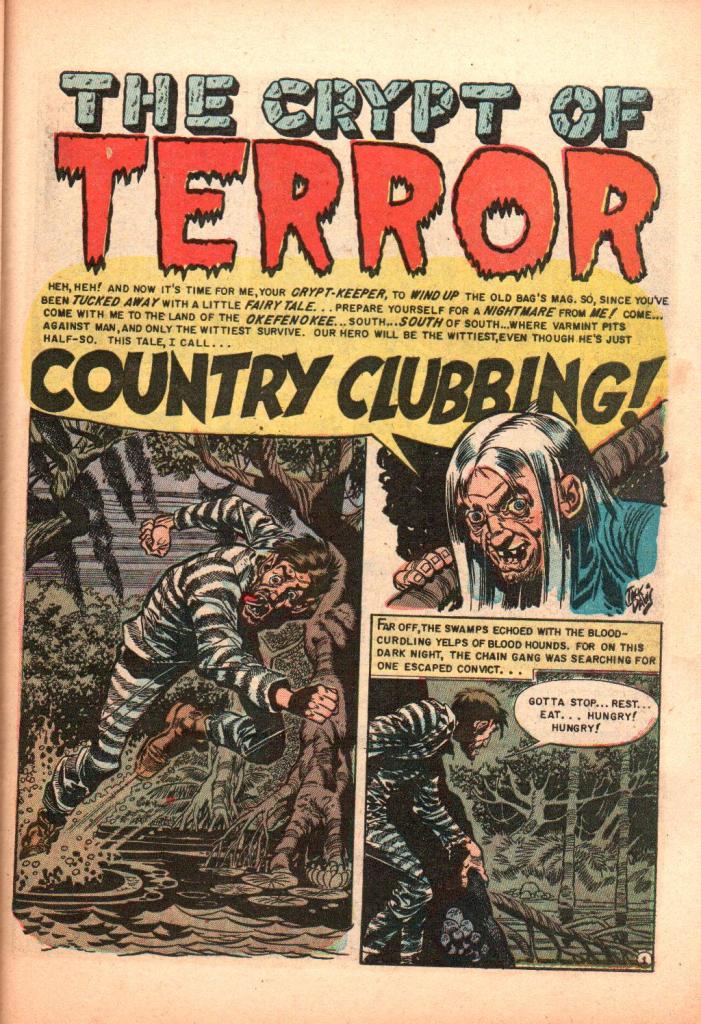
The one memorable story in this issue slotted in way at the back, and it was both written and illustrated by the terrific Jack Davis. It’s all ultimately a long shaggy dog story to get to a punch line, but the punch line is pretty good and unexpected in an EC book, so the whole thing works. It’s about an escaped convict who is looking to elude pursuit and so heads into the swamplands of the area. He comes across a small cottage, and driven by hunger, he murders the old woman he finds there so that he can chow down on the stew she’s making. But the convict didn’t think about who she might be making that stew for, and so he’s surprised when the woman’s in-bred-seeming husband arrives.
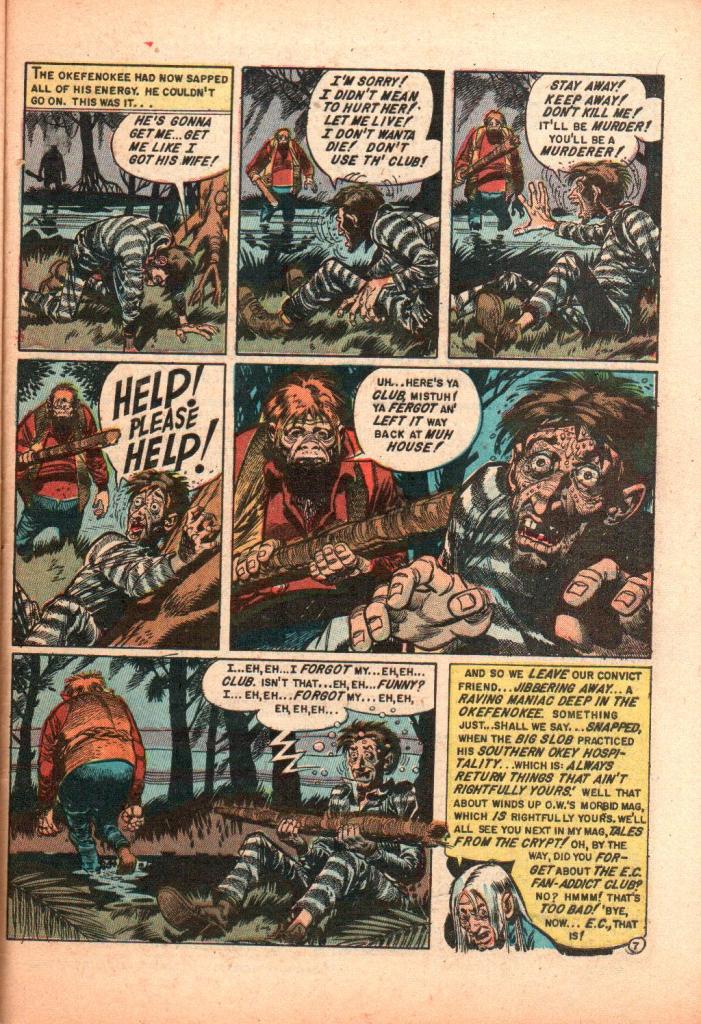
As the silent and unspeaking man draws closer, the convict panics and runs. But no matter how far into the swamp he goes, the giant of a man pursues him, holding in his hand the very club with which he’d murdered the giant’s wife. The convict’s wild flight puts his life in jeopardy several times, but he’s so afraid of his relentless pursuer that he’s heedless of the danger, getting progressively more and more banged up as he goes and unable to escape to safety. Eventually, though, bruised and exhausted, he collapses and awaits his fate as the giant draws nearer. And then, the man says the only thing he verbalizes throughout the story: “Uh…here’s ya club, mistuh! Ya fergot an’ left it way back at muh house!” And then the man wanders off, leaving the convict a broken shell of his former self. The whole thing’s kind of dumb, but Davis’ great cartooning makes a meal of it.
 The Tom Brevoort Experience
I know it doesn’t make any difference to the story, but any time I see someone stab someone else in the breastbone with a hypodermic in a comic, I think, “You just broke the needle, ya dope! That’s bone there! Even going for the ribs is like 50/50 a bad idea!”
Anyway. Nice art, weak stories. And always remember, kids, stab them in the gut.
LikeLike
Formulaic to the extreme…but it’s easy to see why kids gobbled them up. In the 1950s, where else could a youngster easily get their hands on something this lurid and transgressive?
LikeLike
I enjoy the EC Comics line as a whole, even if not every story is a winner. Part of it is due to the art, of course, but I also tend to like genre fiction anthologies as a whole. Maybe its due to growing up on Twilight Zone, Outer Limits and Alfred Hitchcock Presents reruns…
LikeLike
Killing the werewolf with a hypodermic full of silver nitrate is a neat twist ending. It makes sense both within the story rules and traditional lore. That story’s also good for the aspect where the intended victim, an ordinary human woman, defeats the much stronger supernatural monster via a clever solution.
LikeLike