

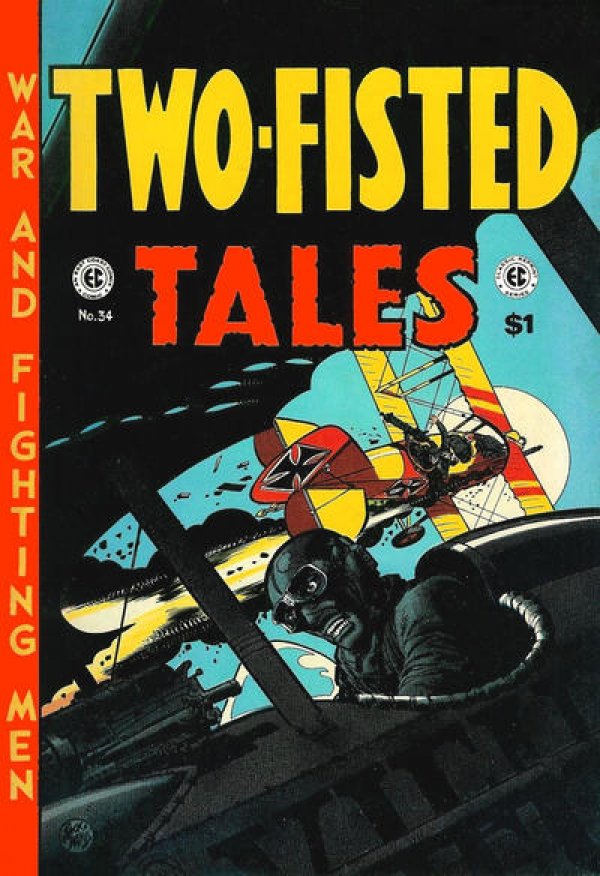
If you were to ask me today about what constituted the best work that EC put out during its short but well-remembered time, I’d say without question the war titles edited and overseen by Harvey Kurtzman. They followed the EC tradition of tightly-plotted stories with punch endings, but they also had a point of view about war and the people who fight it that was refreshingly honest in an era when that wasn’t often the case. Additionally, they didn’t use the same Leroy lettering as the balance of the line, so their pages felt a bit more lively and alive consequently. All that having been said, i wasn’t much of a war comic reader at the time when I read this issue, and so it didn’t especially stand out for me. I can’t say that I have any understanding as to why these particular issues were the ones selected for reprinting, but there are some unfortunate choices among them.
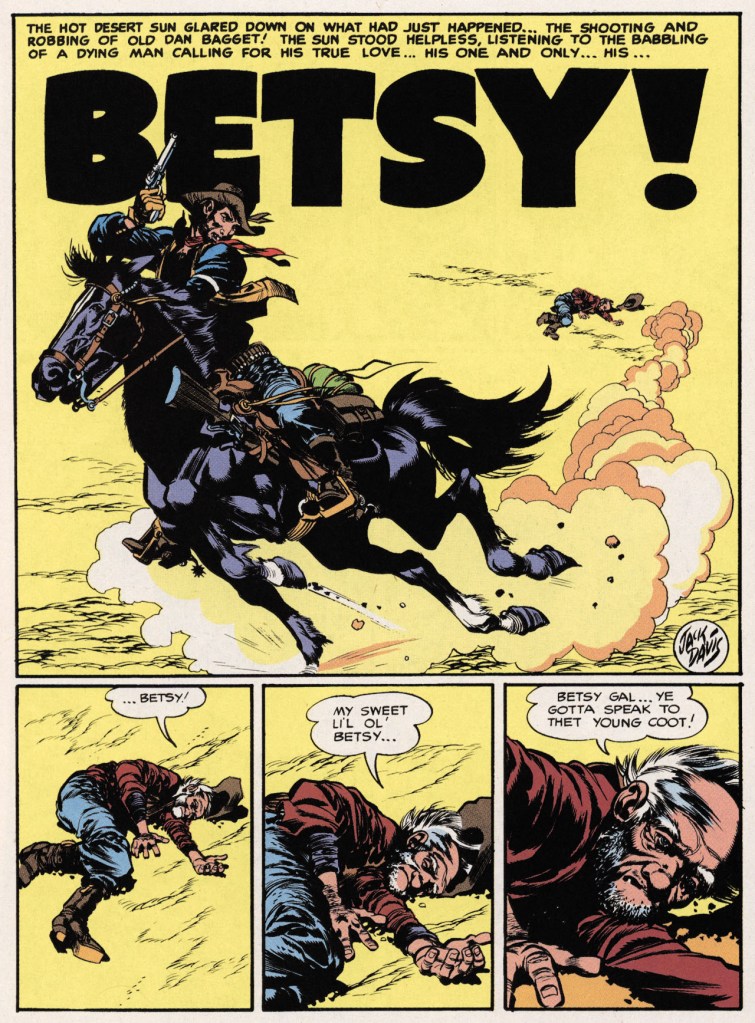
This issue, in fact, was only partly worked on by editor and main writer Harvey Kurtzman. At the time, Kurtzman was hospitalized for a case of yellow jaundice, and assistant editor Jerry De Fuccio wound up completing most of the issue. That meant that in this rare instance, most of the stories were written by the artists rather than Kurtzman. So this opening feature illustrated by Jack Davis in fine form was also his handiwork from a writing point of view.
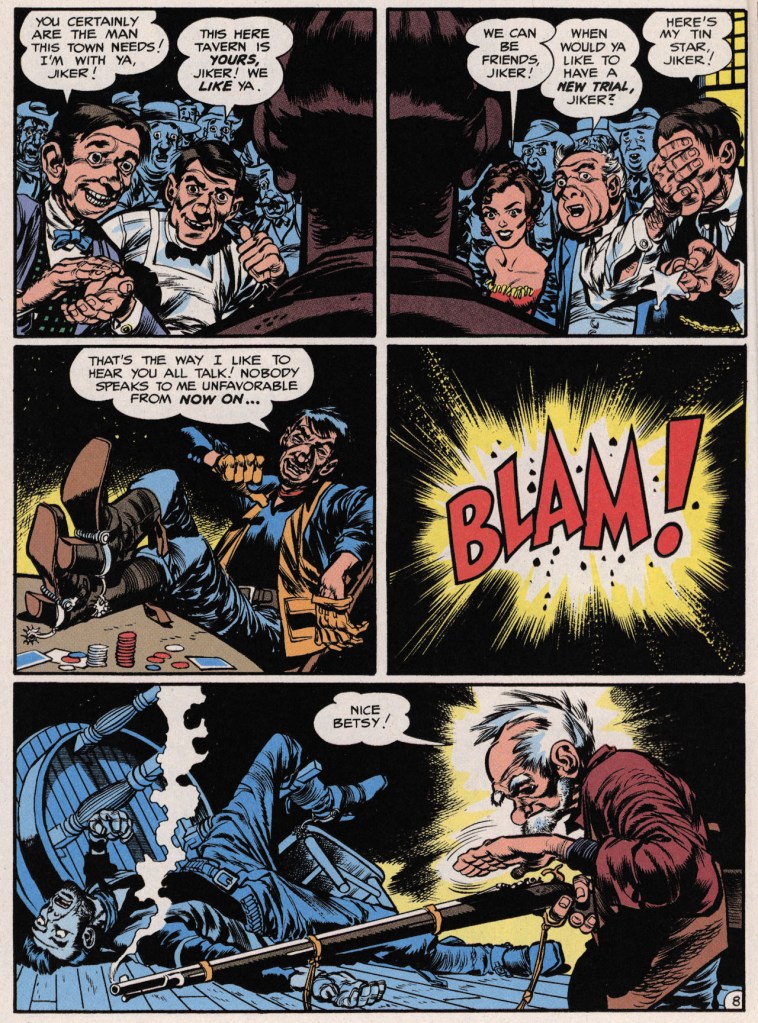
The story’s about Jiker Miller, an outlaw who had years before been sentenced to five years in prison by the people of a little town. But now the violent Jiker has returned to get his revenge, and he steamrollers into the place, first shooting and robbing old Dan Bagget and then terrorizing the denizens of the local saloon, including the judge that sentenced him and members of the jury. Eventually, the town sheriff shows up, and Miller proceeds to beat him to a bloody pulp. All the while, we’re cutting back to Dan Bagget, who is slowly making his way back to his homestead, talking about his girl Betsy and how she needs to straighten Jiker out. On the final page, with the townspeople cowed, it looks as though Miller has won. And then he’s suddenly killed by a shot from out of frame–and the final panel shows Bagget with his rifle, which he’s named Betsy. Davis’ art is excellent in this story, and the rhythm of it works well even if the end beat is a bit obvious.
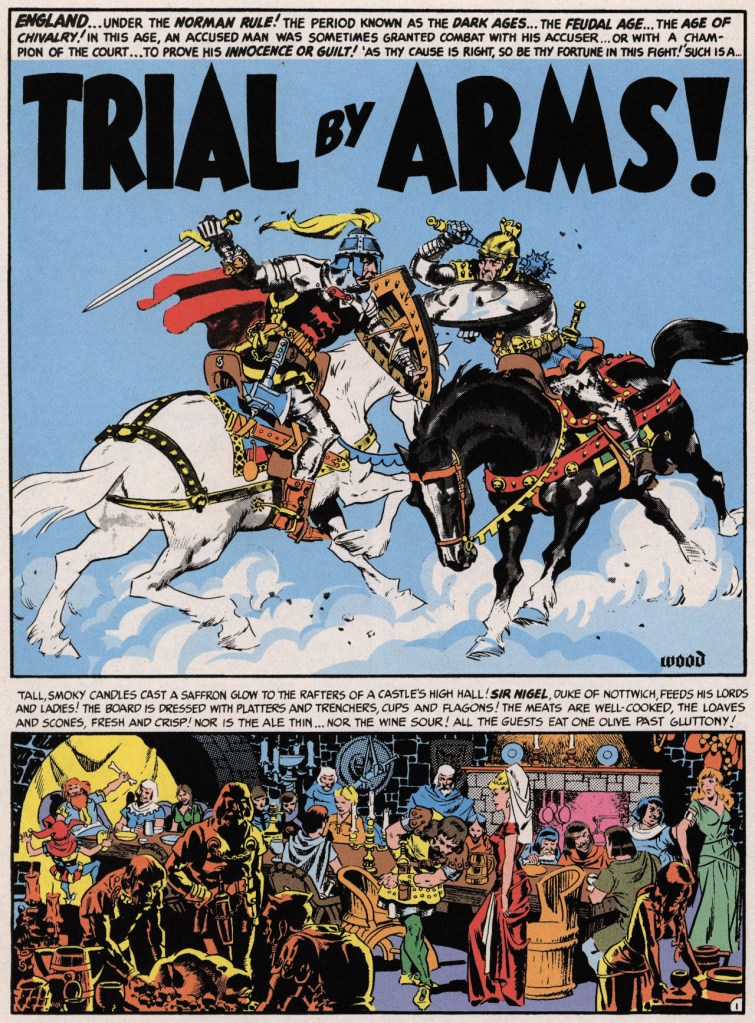
The following story was written and illustrated in lush fashion by the great Wally Wood. Jerry De Fuccio provided most of the script and copy, but the story was Wood’s all the way, a reflection of his interest in medieval knights and the era of chivalry. Wood positively packs his panels full of period detail while still keeping his storytelling utterly clean. The story also features a terrific extended battle sequence between two combatants, a trial by combat that begins as a joust and then works its way down to the two men facing off with sword and flail. This battle is really the main set piece of the story, though it has a fun punch line as well.
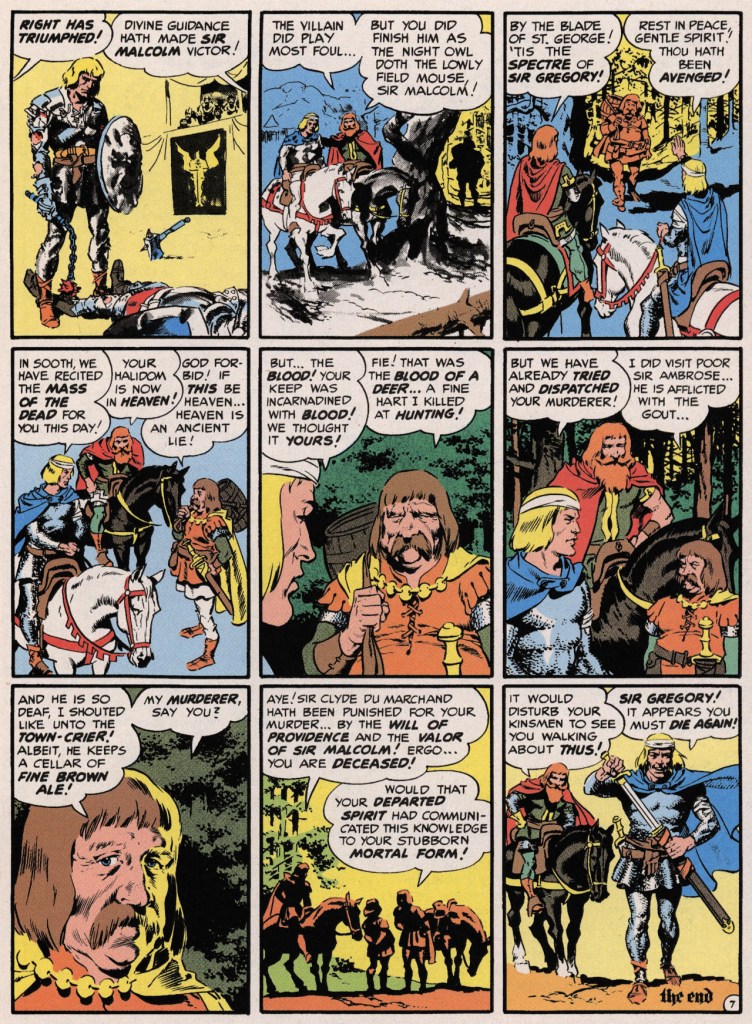
The story is designed to put the lie to the concept of trial by arms as a true measure of determining the guilt or innocence of the accused. In it, a knight is accused of the murder of one of his fellows, with whom he’d argued two days earlier. The knight protests his innocence and demands trial by combat to prove his claim. Another knight takes up the challenge, and the two men battle brutally for literally hours. Finally, though, the accused knight is struck down, proving him without a doubt to be the murderer. Except that afterwards, the victim shows up, hale and hearty. The entire affair had been a mistake, a misunderstanding. But having killed the first knight for murder, there must be a victim, and as the story ends, it is clear that the “noble” knights are about to slay the original victim. Justice indeed.
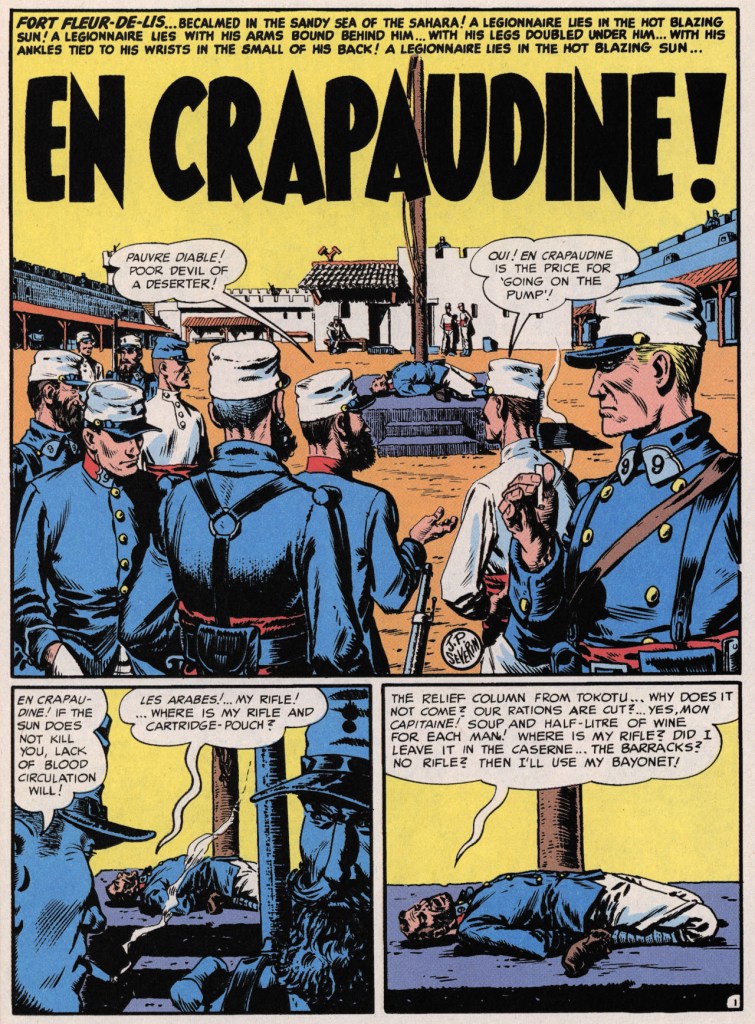
The next story was illustrated by John Severin, whose sister Marie did the coloring for the issue and most of EC’s output. It was scripted and dialogued by Jerry De Fuccio. It’s about a deserter in the French Foreign Legion who is recaptured and punished by being hogtied in the blazing sun, a process known as En Crapaudine. As the deserter slowly dies, he recounts to himself the events of the preceding days, when half in a madness he stalked out from the camp and out into the desert in the middle of the night to face the leader of the Arab forces that were assaulting them. And of course, once the man has died, the other soldiers discover evidence on his person that he did just as he had claimed, and killed the Arab leader. A shame they didn’t think to search him before they staked him out for punishment.
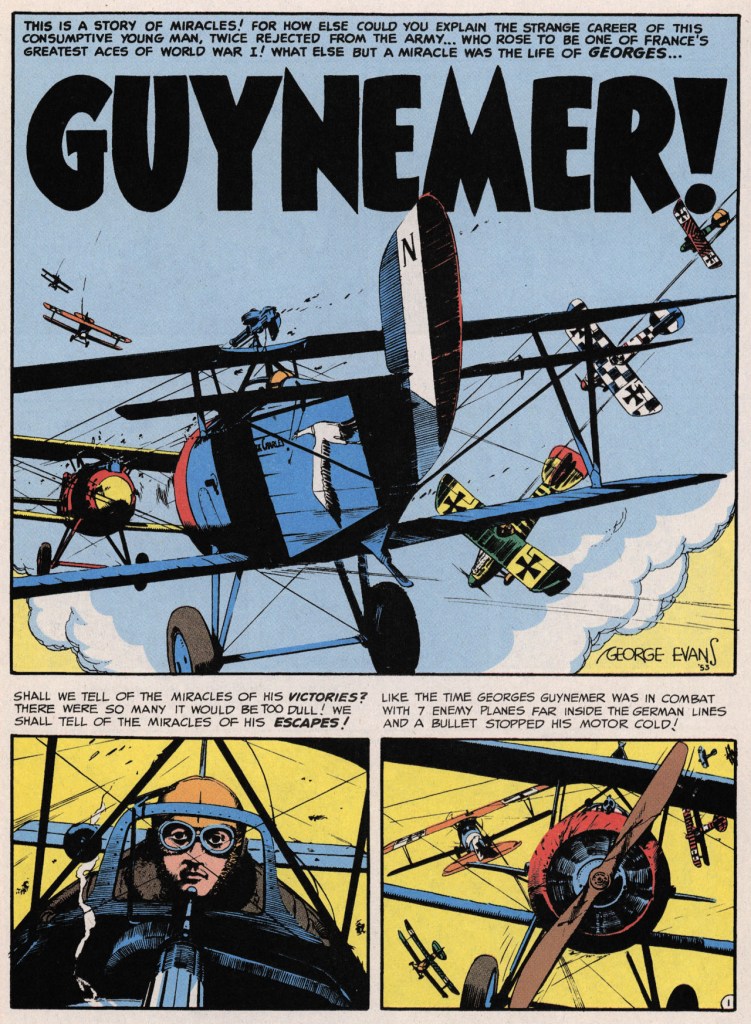
The final story in this issue is the only one written by Harvey Kurtzman, and it’s illustrated by George Evans, who had an abiding love of airplanes. It’s a historical piece that tells the tale of the French aviator Georges Guynemer, including his near-misses with death, the manner in which he regained his nerve after being shot by seeking out an enemy plane and allowing it to empty its machine gun at him without returning fire, and ultimately how he disappeared, his final fate unknown. As was Kurtzman’s way, he researched the subject matter extensively and most of the details in this story jibe with the reality of Guynemer’s life. The real star here, though, is Evan’s polished artwork.
 The Tom Brevoort Experience
Ever since Tom started with these EC books last month the twist endings has been bothering me and I knew it wasn’t the twist ending in some Atlas Age books. I wonder if it was Night Gallery or Outer Limits or Twilight Zones and then it hit me the TV series Tales from the Crypt ( which when I googled it said it was based on EC series ). I don’t know what season of Tales from the Crypt I came in on, but I don’t remember any of the episodes unlike the two Fear Itself episodes that creeped me out: Eater ( with Elizabeth Moss as a rookie cop and Stephen R. Hart as a cannibalistic serial killer nicknamed “Eater” ( who was not a normal serial killer — if memory serves he knew voodoo ) ) & Skin & Bones ( with Doug Jones as a missing rancher who returns to his family, but they realize that he is no longer the man they knew — cause Windigo ).
LikeLike
Yes, the TV series “Tales From The Crypt” adapted an EC story for each episode. As I recall, the intro segment for each one even showed the exact title and issue number for the story. Some of the shows were quite good, others not so good. I tend to think the more psychological or comedic tales worked better on TV, but that might be just my own taste.
LikeLike
While I tend to think the Kurtzman-written stuff is better, the non-Kurtzman stories here still feel more like they’ve got more humanity to them (good and ill) than the Feldstein stuff, which seems so mechanically-plot-focused there’s no room to breathe.
Part of it, I’m sure, is that the de Fuccio dialogue is more relaxed and human than Feldstein’s — and even than Kurtzman’s, really. And the Ben Oda lettering makes a huge difference.
Gorgeous art, too.
LikeLike
I really like George Evans’ art on the final story.
LikeLike
This always reminds me of a book I saw someone reading which was titled, Three Fisted Tales, Seeing that title was one of those, “Wait, what?” experiences . . . .
LikeLike