

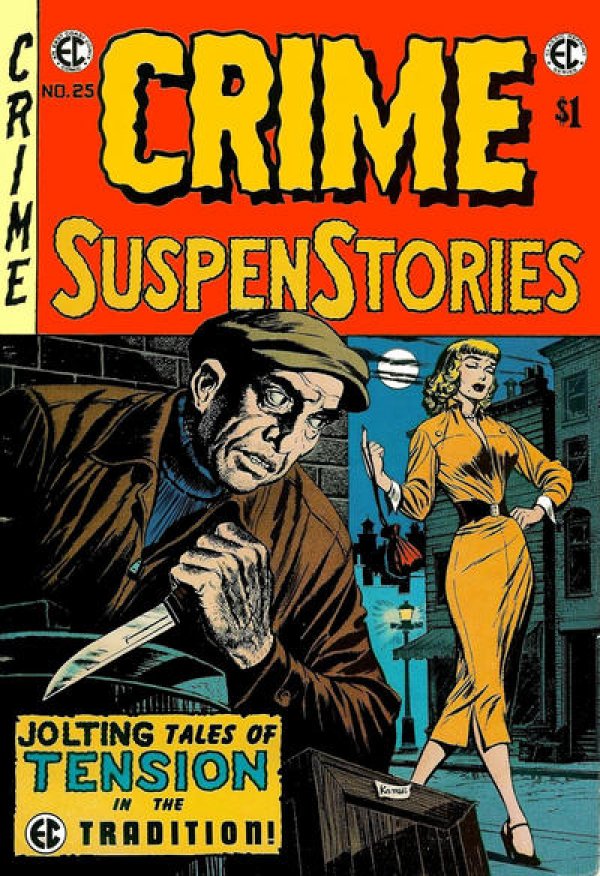
To a very great degree, most of the assorted EC anthology titles resembled one another. The only difference between them was genre. So WEIRD FANTASY ran the same sorts of shock ending stories that SHOCK SUSPENSTORIES did, however theirs were played out against a science fiction background. The same was true of THE HAUNT OF FEAR and horror. So CRIME SUSPENSTORIES was more of the same, but in the crime genre, which meant in effect no monsters or supernatural or fantasy elements. No science fiction. Just down-to-earth tales of criminals getting their just desserts (or not–this was EC after all). Crime was a popular genre at the time, and so the series performed admirably, and was better written and drawn than most. As with most of EC’s other genres, I didn’t have any particular interest in crime stories, but I was willing to give it a chance.
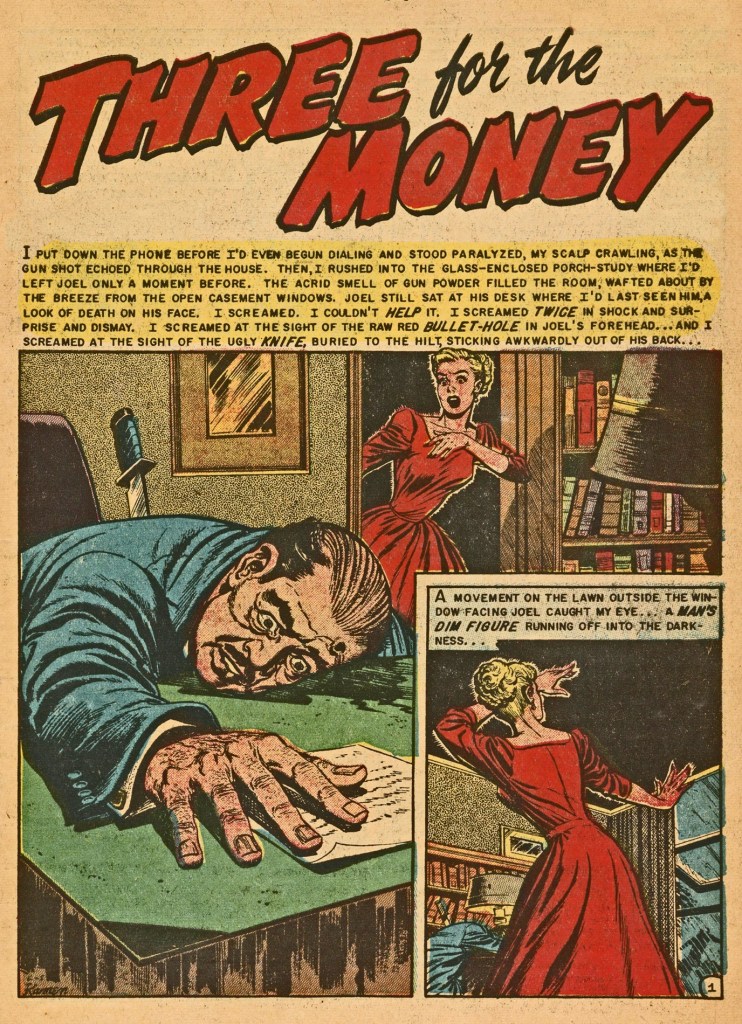
This particular issue had seen print relatively late in the life-cycle of EC, and so as opposed to many of the firm’s releases, the stories in this issue weren’t written by editor Al Feldstein, but rather by freelance contributors. This opener is the work of Otto Binder working in collaboration with artist Jack Kamen (who also contributed the provocative cover to the issue.) It was all about two rival suitors to a wealthy woman who decide to murder her husband so they can be with her. They do so, unknowingly, at the same time, so the question that comes down once the crime is discovered and their guilt is established is who actually did the deed and is looking at the death penalty. Of course, it turns out that the true murderer was the wife, who poisoned her husband just moments before the other two suitors struck. And this being EC, she apparently gets away with it, gloating about it in the final panel.
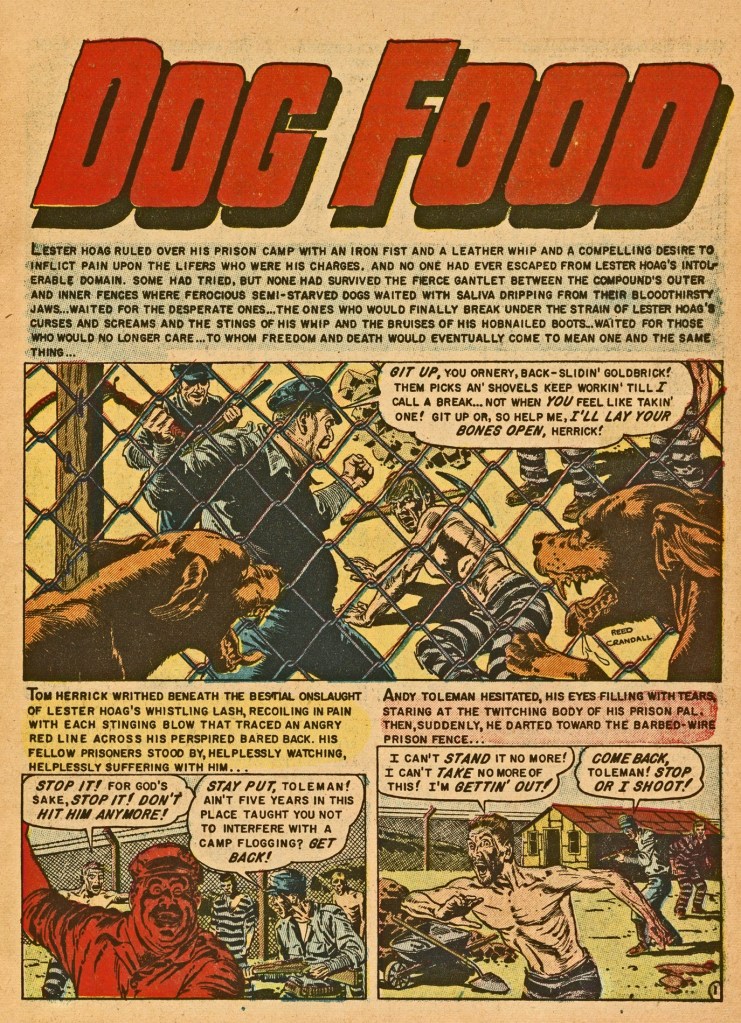
The second story in this issue is perhaps the most memorable–it’s certainly the one that stuck with me the most, and unsettled me when I first read it. It was illustrated by Reed Crandall and may have been written by Jack Oleck, nobody seems to be 100% certain. It’s all about the dictatorial and abusive warden of a prison camp, and how he torments the inmates in his charge. The key thing is that the camp is ringed by a fence beyond which the warden keeps his ravenous attack dogs. Any prisoner is permitted to try his luck in escaping through the gantlet of killer hounds, but none ever succeed–they’re inevitably eaten alive, gruesomely. For all that this wasn’t a horror story, EC wasn’t above featuring a lot of gore in it.
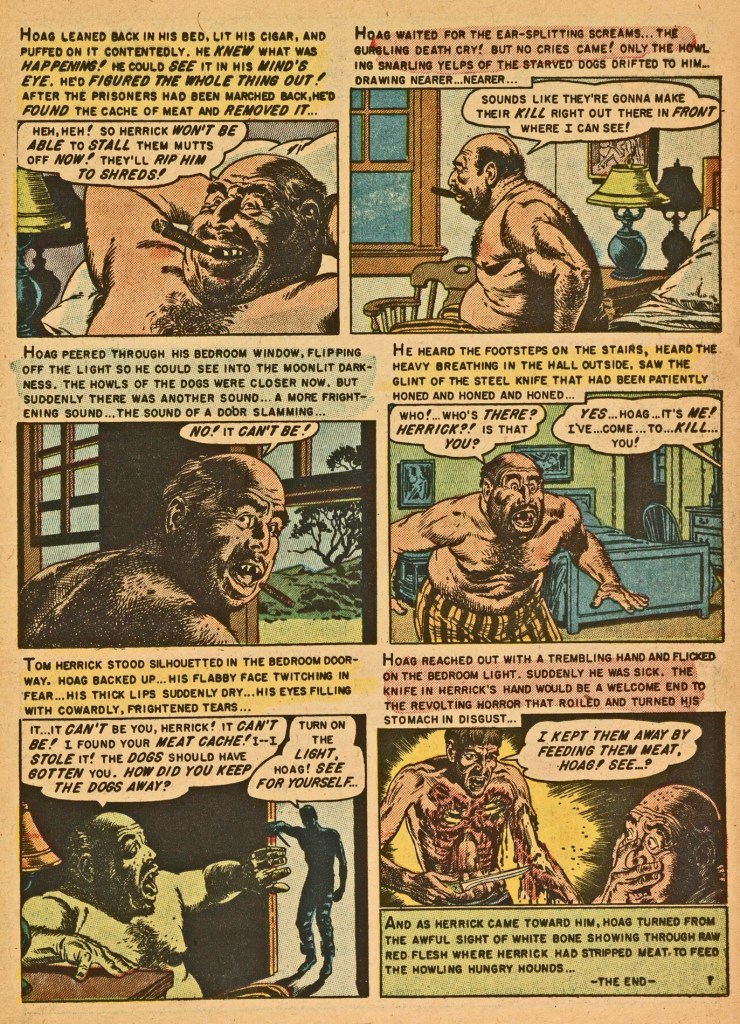
But one inmate, pushed to the breaking point, devises a plan to stockpile food from himself and his fellow prisoners until they have enough where he can make a run through the gantlet and survive, then kill the evil warden. The warden tumbles to this plan, though, and discards the hidden cache of meat that would have staved off his dogs long enough for the prisoner to reach safety. That evening, the warden listens to it all playing out, smug in his own cleverness. But it turns out that the inmate survives long enough to get to him–and in the final panel, we learn how., With no other recourse, the man has stripped chunks of his own flesh off of his body to throw to the attack dogs as they pursued him. It’s a pretty gruesome final beat, and it made an impact on me.
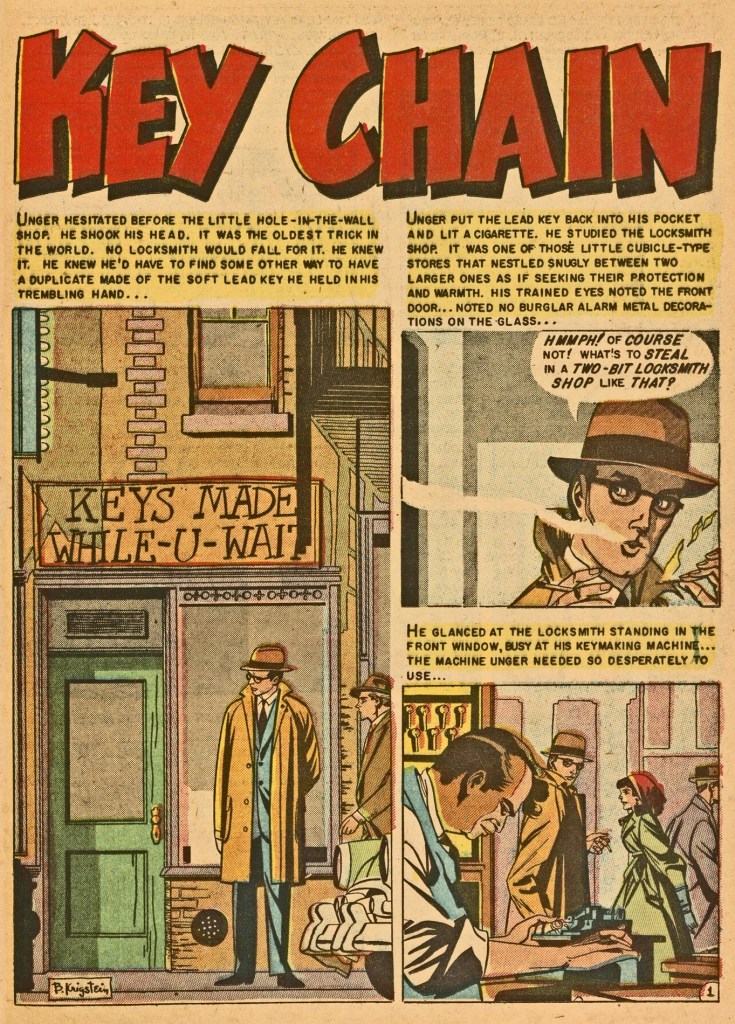
The next story was memorable for an entirely different reason. It was one of the small number of EC tales illustrated by the great Bernard Krigstein. Krigstein was a pioneer in visual storytelling, innovating new ways to get an impression across, and a psychological tale such as this one took good advantage of his abilities. He also worked on crafttint paper, which gave him halftones to work with as well, enhancing his work all the more. On this story, written by Jack Oleck, he mostly stuck to editor Al Feldstein’s page layouts. But in the back half, he began to subdivide the space that was intended for a single panel into thirds to achieve a greater sense of the manic panic of the protagonist. It’s a really effective and simple choice.
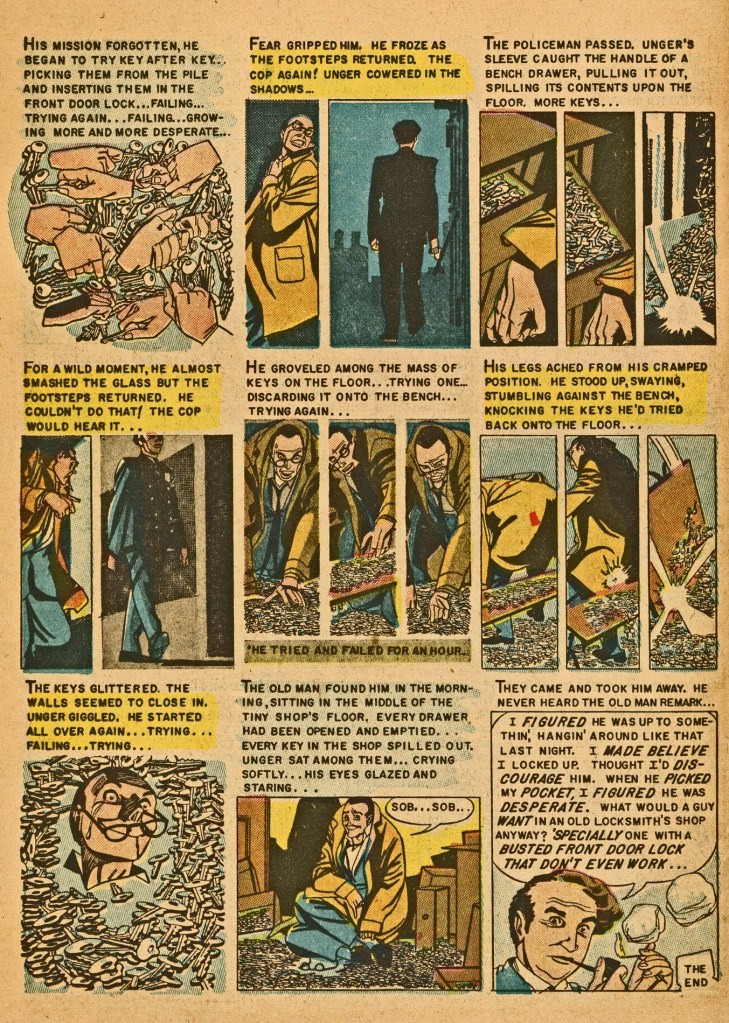
The story’s all about a conman who plans a heist but is undone by circumstance. In order to steal the jewelry owned by a wealthy woman, the conman arranges to make an impression of the landlord’s master key for the building. In order to make himself a duplicate of that key, he breaks into the locksmith shop at the front of the building, locking the door behind him. But as he goes to work, he winds up knocking over a rack of keys, losing the door key among them. As his panic rises, he realizes that he has no way to get out of the shop, and frantically tries to locate the correct key amidst the fallen ones. Of course, the more he struggles, the more keys he dislodges into the pile, until at the end of the story, he’s found sitting amidst every key in the place, half out of his mind as he tries them in the lock one by one. The kicker, of course, is that the front door lock is broken and has been open the entire time. It’s not really much of a story, but Krigstein’s artwork makes more of it than it is.
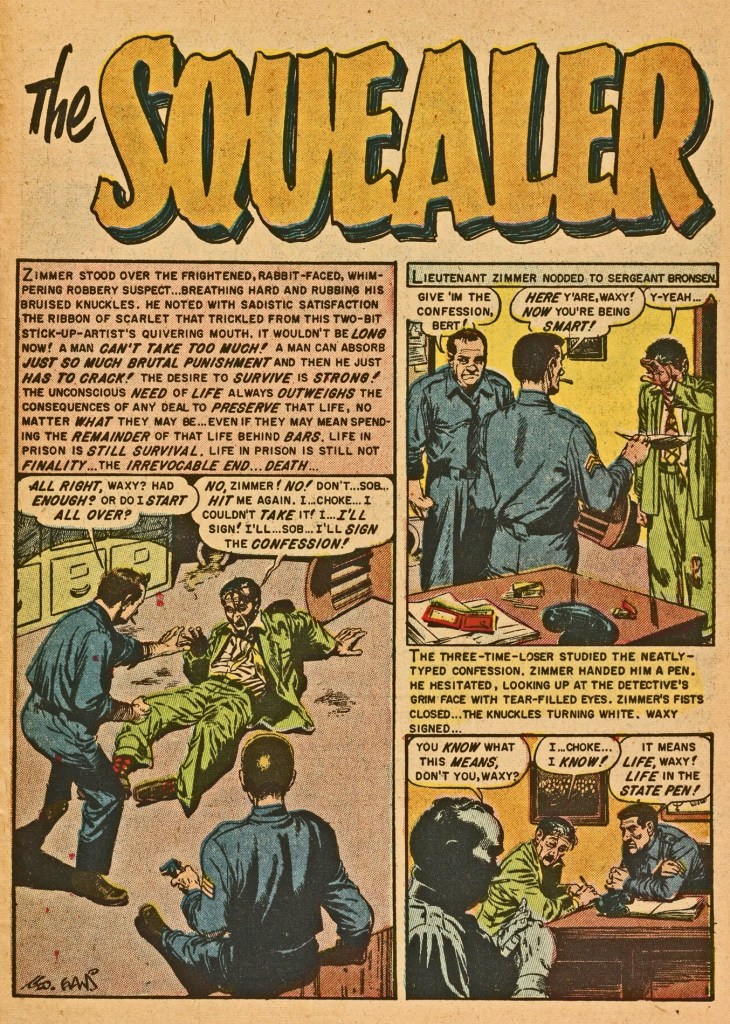
The final story in the issues is illustrated by George Evans and was another Jack Oleck script. Unfortunately, it’s a forgettable by-the-numbers piece. It’s about a pair of corrupt cops who pinch pickpockets and safecrackers and the like, beat confessions out of them, then put them to work for them and pocketing the proceeds. The main cop is ostensibly doing this so that he can afford to send his son to college and provide a better life and future for him away from the slums in which they live and work. But in the end, the son gets picked up by the cop’s partner on a breaking-and-entering rap, and refuses to confess. So the other cop winds up beating the son to death in trying to force a confession from him. Oops.
 The Tom Brevoort Experience
I’d read this mag too. The “Dog Food” story is memorably gross, but I agree that the artistic standout is “Key Chain” – a so so story significantly enhanced by Krigstein’s unique art. And I can easily empathize with the maddening dilemma of searching for something amidst piles of similar items, whether a key or a document or whatever, but the specific one you’re looking for simply isn’t there. However, you can’t be certain it’s not there and so keep on exhaustively searching. Fortunately, I’ve never done so to the point of achieving full-blown dementia, but a few times I felt I was getting dangerously close!
LikeLike
No Johnny Craig story, sad.
Still love the art, hate the lettering and am largely indifferent to the stories, which feel like mechanical constructs more than anything about nuanced humans with lives beyond the needs of the story.
But man, that art.
LikeLike
Every time I see Krigstein’s work, I’m reminded of how much Daniel Clowes’ early work on Lloyd Llewellyn was influenced by him.
LikeLiked by 1 person
If anyone wants to check out some of Bernie Krigstein’s other work — https://fourcolorshadows.blogspot.com .
LikeLike
I owned this EC reprint as well and had forgotten about the Krigstein story, which definitely looks like a cut above what you would have seen in a typical crime comic of its day. But the “Dog Food” story I remember well. Even by EC standards it stands out as extreme …
LikeLike
Maybe 25 years ago I could see DC’s Vertigo doing an homage issue w/ artists like Bob Burden, Michael Lark, JH Williams, Goran Parlov, Kelley Jones, Paul Pope, Mike Allred, John McCrea & others. Maybe adjust the “DC” logo to resemble the “EC” as a one-off. I thought the other 48 or larger issues that used titles from the past were very well done, and were often by some of the best in the biz.
LikeLike
All of the EC artists were excellent.
Wood, Severin, Williamson, and to a lesser degree, Orlando, were the heirs to the Foster/Raymond tradition. So beautiful.
Feldstein, Kamen, Craig, and later, Crandall and Evans–they were utilitarian. Frank Miller can talk your ear off about Craig, but he never impressed me as a stylist.
Ingels had the stylization, but not the anatomy. Wrightson bringing the Frazetta figure drawing to the Ingels imagery made it spectacular.
Jack Davis had an expressionist edge that made everything work. Except the science-fiction. But everything else was wonderfully good.
Krigstein had a modernist/alienation edge that understandably made such an impression on Spiegelman and Clowes. The Krigstein pictures actually complement the Leroy Lettering. They’re the most readable EC stories now.
LikeLike
It is striking how different Bernard Krigstein’s work looked just a few years before this was published when he was drawing Wildcat in Sensation Comics. That was also nice work, the draftsmanship and design work was easily up to the standards of the 1970s for adventure strips
But this work was more memorable. Like Alex Toth, he seemed to have grown into Shelly Mayer’s (apocryphal?) advice to “draw less.” .
Johnny Craig did a memorably good Doorway into Nightmare in 1978. Solid artist, although not a superhero artist, nice work on one issue of Brave & the Bold and several Iron Mans to the contrary
I guess Craig started out as a production man on the elder Gaines All-American comics in the 1940s… . . .
Gardner Fox did some EC work and Alex Toth did some war comics for them, so I wonder why Infantino and Kane never did anything at EC?
LikeLike