

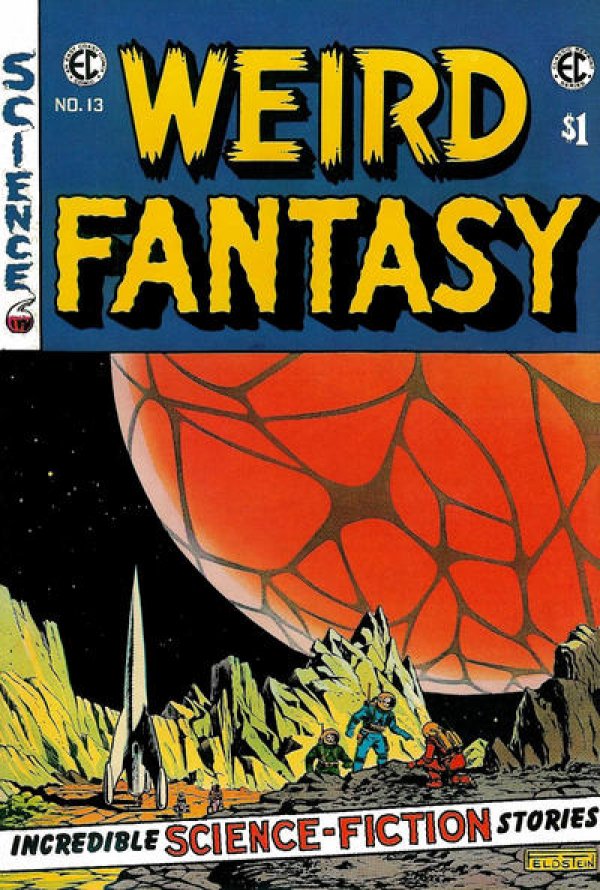
EC’s science fiction titles were the weak link in the publishing line at least from a sales point of view. They never performed at much beyond a break-even level. But publisher Bill Gaines liked them, and so he kept them running regardless, using capital from his more profitable titles to underwrite them. Gaines was rightly proud of these books, as they were of a very high quality in a field that often devolved into junk at least as far as comic books were concerned. These books made a big impact on me when I was first reading through those eight EC Classic Reprints that I had ordered, and I’d have measured the science fiction books as among my favorites in the lot.
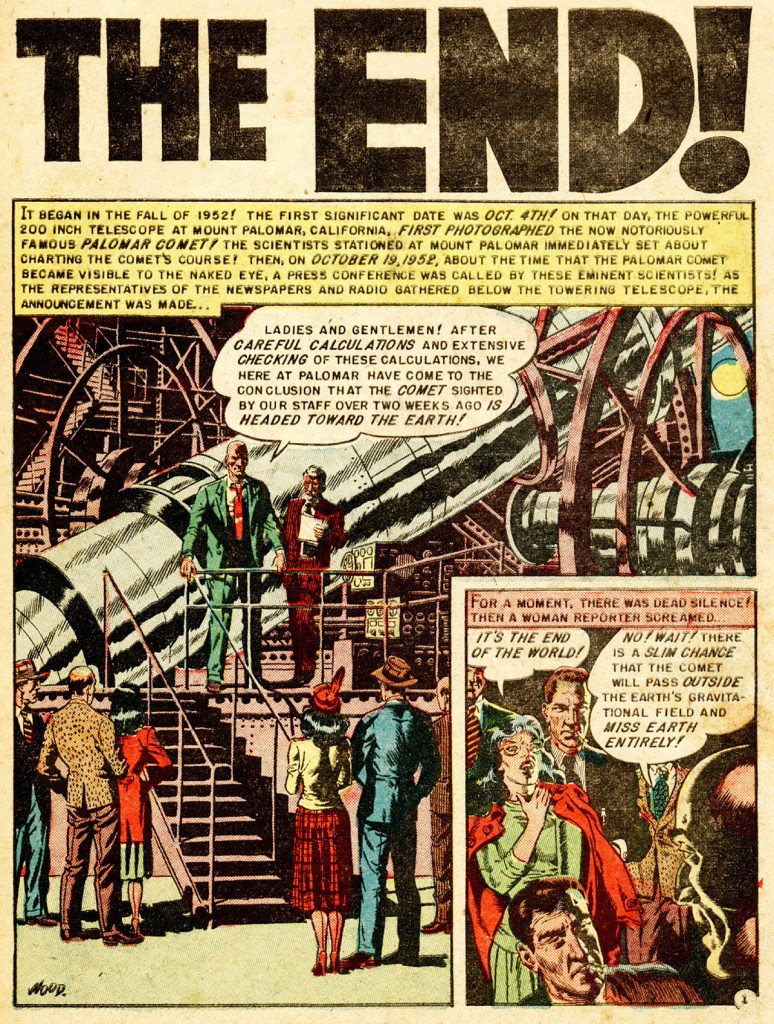
In the pattern of EC’s anthology releases, this issue of WEIRD FANTASY contained four short stories with twist-endings, all written by Al Feldstein with some plotting involvement from Gaines himself. The lead-off feature was illustrated by Wally Wood, one of the acknowledged masters of science fiction comic book artwork. Wood contributed to just about every issue of EC’s science fiction ventures and his artwork really set the standard for the line. It was crisp and modern, with Wood’s beautiful use of double-edge lighting and an incredible amount of detail. The story goes that the EC artists wound up putting more detail into their pages than could be reproduced by the technology of the time. They did so to wow one another, which kept everybody working at the top of their game.
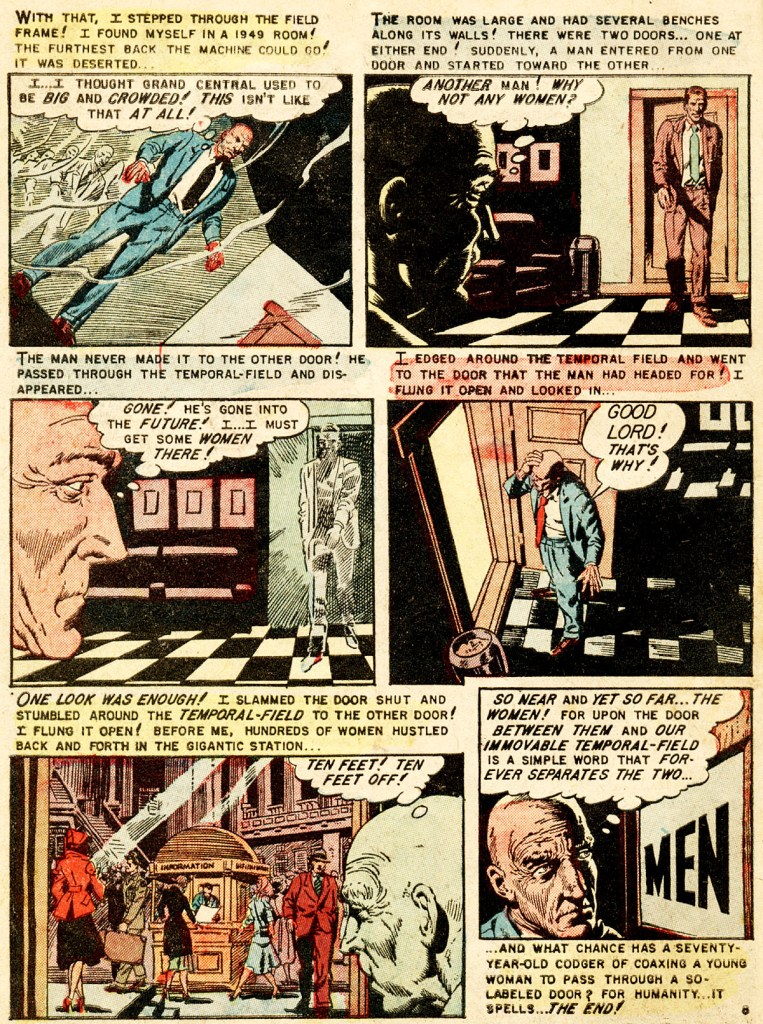
What I remember most about this opening story is the fact that I shamelessly plagiarized it for a seventh grade writing assignment in English class. If my teacher had any idea, he never mentioned it, but I’ve been a bit chagrined about it ever since. That said, I wouldn’t be surprised if Feldstein and Gaines had ripped off the central idea for it from some earlier pulp story. Set mostly in the future, this tale tells of how the Earth was rendered sterile by the radiation from an exploding comet, and how a doomed effort to repopulate the planet with people pulled through time from the past failed when it was revealed that the immovable temporal gateway to the future had been situated in a Men’s Room in the present day–a place where no woman was ever likely to enter. This climax was impactful enough that I remembered it a year or so later when the time came to have to write that English assignment.
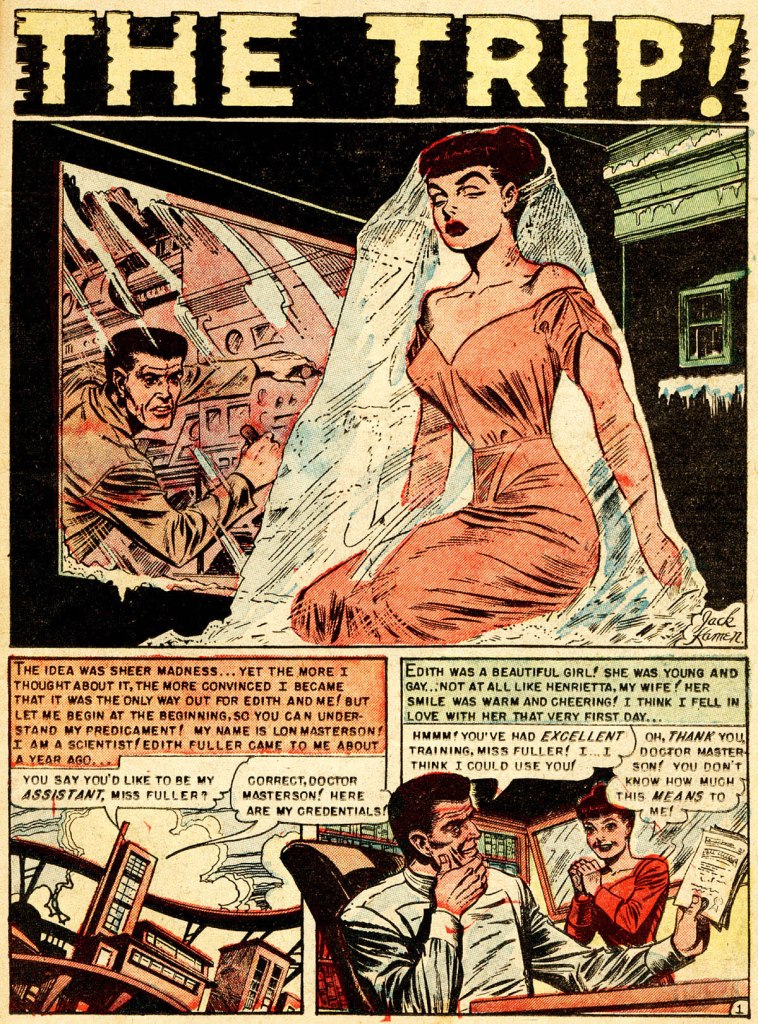
The second story is illustrated by Jack Kamen, who was a real workhorse of the EC line despite never quite achieving the popularity of the superstars such as Wood. But he had a clean style that’s very much become associated with the EC books and he always delivered spot-on storytelling. Kamen’s forte tended to be stories about unfaithful partners who met their just desserts in one way or another, and this one is no different. The whole story is an extended set-up to the punch line of the final panel. It’s about a scientist who is working to transport colonists to a far-off world. He’s also having an affair with his assistant, and the two plan to run away to the new world together, leaving the scientist’s wife behind. In order to do this, the assistant needs to be put into deep freeze for the journey and smuggled in with the animals that are being taken as well. In the end, the couple gets away with their plan–but before the scientist can defrost his paramour, he accidentally drops her frozen body, causing it to shatter into a million pieces. Oops!
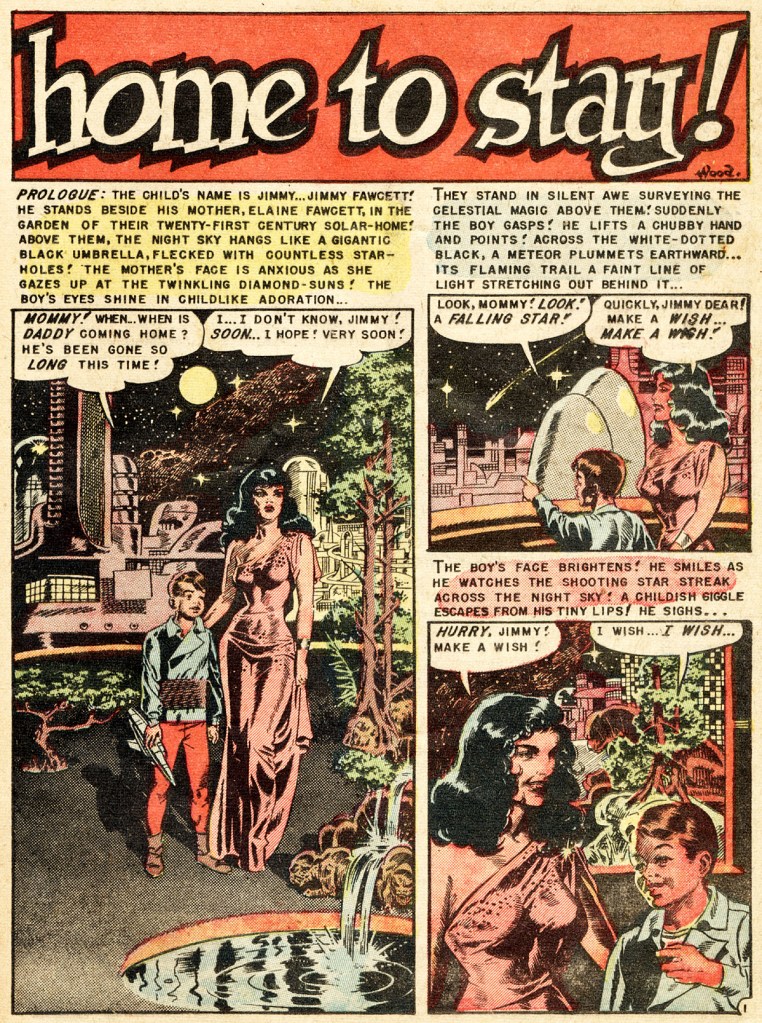
I’ve mentioned plagiarism once or twice in these assorted EC write-ups, and now is the moment to explain. Because the firm needed to generate so many stories for its assorted anthology titles, publisher Gaines would read anything he could get his hands on and then spin off variations of the ideas in those stories as the basis for EC’s tales. Gaines called them “springboards”, but some of them were a little bit closer than that. This third story was the one where EC’s lifting got them caught, even though the result was a positive one. Excellently illustrated by Wally Wood, “Home To Stay” by Al Feldstein is a mash-up of two of the short stories of noted science fiction author Ray Bradbury: “Kaleidoscope” and “The Rocket Man”. (I kind of wonder whether the lead character Dan Fawcett’s name was a cheeky reference to the publisher of the paperback book from which Gaines read those two stories.) What’s more, somebody brought this to Bradbury’s attention.
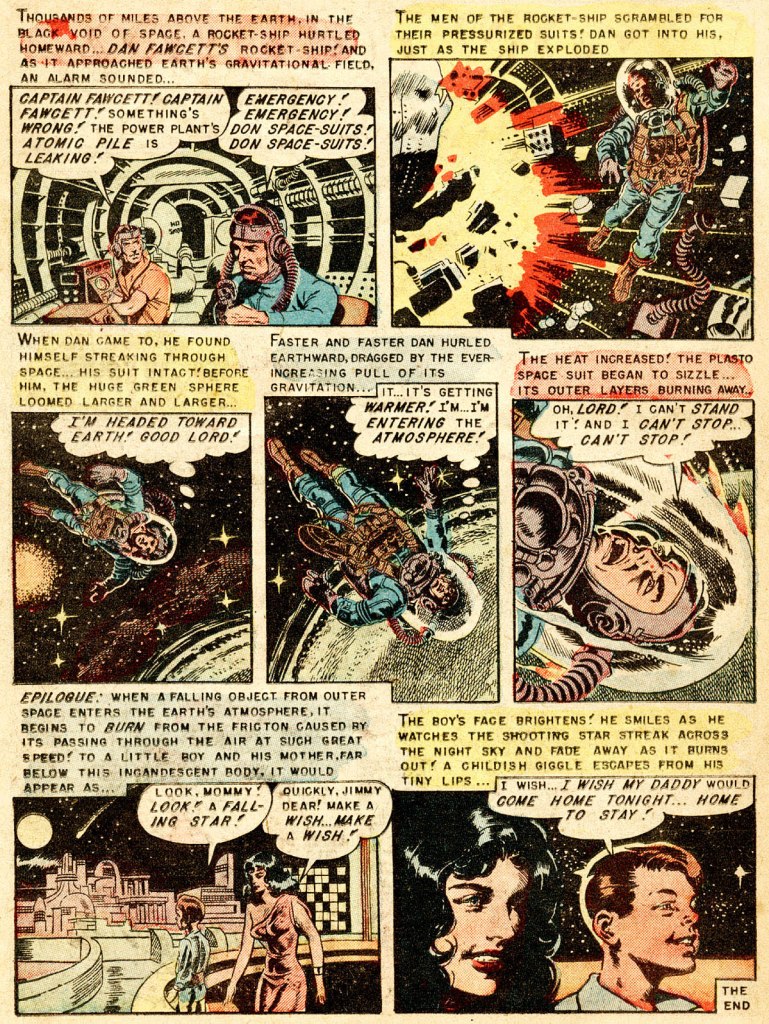
Bradbury, though, was a good sport about it. Recognizing the irreverent tone of EC’s editorial matter, he sent the firm a letter reminding them that they’d “forgotten” to issue him a payment for the use of his stories. Bradbury, it turned out, liked the job that Feldstein and Wood had done on his material, This led to an ongoing relationship between the author and EC who were permitted to adapt Bradbury’s short stories for a token payment and credit. EC plastered Bradbury’s name on subsequent covers whose contents drew from the SF master’s work, hoping to attract some of his readers. It was an equitable outcome, one that benefitted both parties, and it lasted until the comic book witch hunts of the mid-50s, at which point Bradbury decided that it might be wise for him to distance himself from the firm.
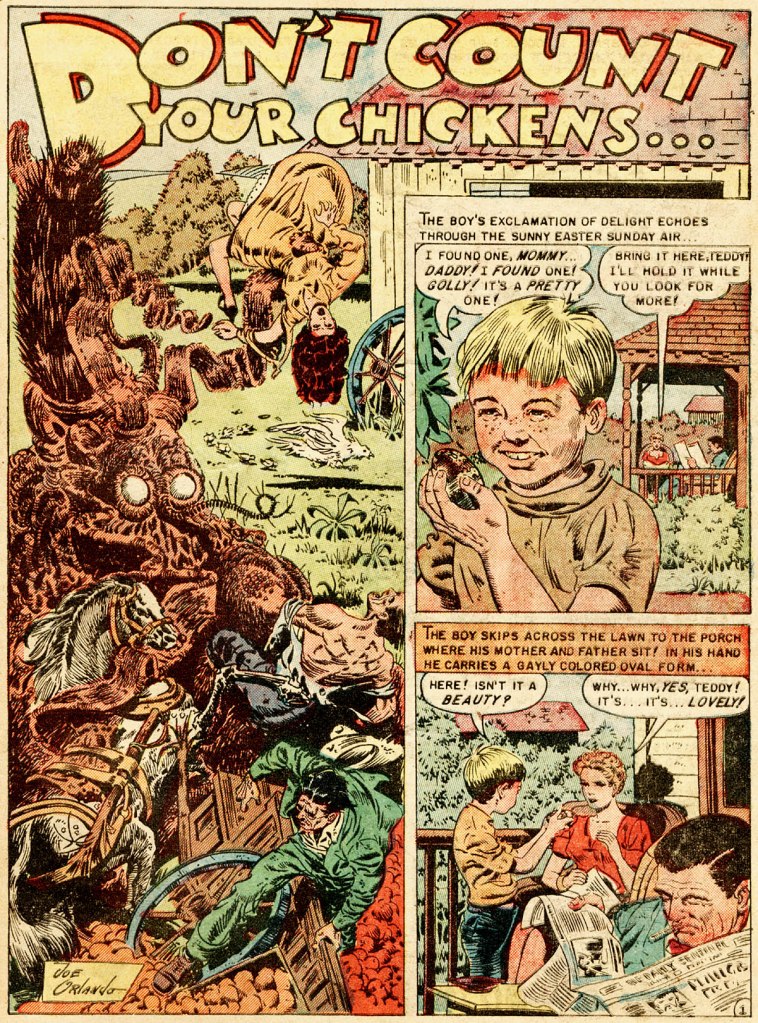
The final story in this issue is expertly illustrated by Joe Orlando, and concerns a kid who winds up coming across an alien egg on his Easter egg hunt. The egg hatches a telepathic monster who forces the child to hide it and to procure food for it as it grows ever larger and ever more malevolent. Eventually, fully grown, the shapeless Lovecraftian beast makes itself known, defying all efforts to vanquish it. Ultimately, the army is able to incinerate it with flamethrowers. But not before it’s left its own eggs scattered throughout its trail, eggs that are similarly picked up by children the following Easter.
 The Tom Brevoort Experience
20 Years ago I was lucky enough to get five of the different EC boxed sets of reprints from Russ Cochran. Marie and John Severin were living in Denver and when my wife waited on Marie where she worked they started talking about comic and eventually she got John (007 Severin) to sign all my reprinted MAD stories that he drew . They were very nice to do that for us and I’ll always treasure them.
LikeLiked by 2 people
It’s possible I’d like these stories more with better lettering. That Leroy lettering sets my teeth on edge, particularly when it comes in huge copy blocks like those opening captions. But the thin characterizations and lack of continuing characters would probably still be an issue for me. Still, fantastic art…!
By the way, the lettering wasn’t done on a typewriter-like setup, it was done with a pantograph/stencil system that seems to me like it wouldn’t save any time at all. See: https://kleinletters.com/Blog/wizards-of-leroy-and-wrico-lettering/
It was the Charlton lettering by “A. Machine” that was typed onto the art boards.
LikeLiked by 2 people
The End! reminds me a little of the Millennium film ( 1989 ) based on Air Raid ( 1977 ) by John Varley: About one thousand years into the future, pollution has rendered humans unable to reproduce. Teams are sent into the past to abduct people who are about to be killed, including the 1989 flight. The abductees are kept in stasis until they can be sent into the far future to repopulate the Earth. They had better luck than The End!
LikeLike
There’s also an obscure SF 1973 movie in which the government’s sending young people into the future to reproduce post-apocalypse. Only we learn the process makes the kids sterile so what’s the point?
LikeLike
Much like Tom, reading EC reprints, I’ve always been much fonder of their science fiction stories than their horror ones. When I was younger, I found the sarcastic, darkly humorous tone of the horror hosts to be somewhat off-putting. Although in the case of stories like “Don’t Count Your Chickens…” the line between sci-fi and horror was rather thin indeed.
LikeLike
i actually got a reprint of this very issue, maybe back in the 1980s. Great art, although the stories themselves aren’t all that exceptional, aside from the one “borrowed” from Ray Bradbury.
LikeLike
The Tau of EC: The War and Science Fiction stuff are really remembered fondly. The Horror stuff sold. Mad did both,
LikeLiked by 1 person
The SF short story “Not With A Bang” by Damon Knight has a similar men’s room twist-ending gimmick. It was published around 1950, so it’s quite likely it was the “springboard” for the EC comics story.
https://scifi.stackexchange.com/questions/84534/identify-sci-fi-short-story-about-last-man-and-woman-on-earth
I believe a defeated monster leaving behind a clutch of eggs for the future is a generic SF/horror idea. Though I think having them be Easter eggs is fairly original.
LikeLike
For me the classic in that genre will be “The Caterpillar” on Night Gallery. “It was a female … it laid eggs.”
LikeLike
Look who also swiped Ray Bradbury ( “The Small Assassin” — comics.org ): Strange Tales#4 ( December 1951 ) It! — Bill and Jenny Carter adopt a baby but it soon runs Jenny ragged. Bill finds his coffee poisoned and they both nearly die in a mysterious fire, yet the baby somehow got out of the house before the blaze erupted. After Jenny tripped on the baby’s teddy and fell to her death, Bill suspected the baby was responsible. Taking Bill’s gun, the baby confronts Bill and reveals its true nature: It’s an alien in disguise, killing from safety thanks to its innocent appearance. The baby kills Bill and is later adopted by another couple.
LikeLike
Another Ray Bradbury swipe ( “Mars is Heaven” ): “The People Who Couldn’t Exist”[ Journey into Unknown Worlds#9 ( February 1952 ) 1st story — comics.org ].
LikeLike
EC used a number of Ray Bradbury stories (with his permission) to boost their sales with the Sci-Fi pulp readers. There were a couple of write ups in various EC issues back in the day.
LikeLike
Orlando and Wood worked closely together just before this and you can kind of see that in that story.
LikeLike
The Trip: A similar Atlas Age story but the cheater get accidentally killed by the lover [ Adventures into Terror#11 ( August 1952 ) Ed’s Young Wife! — A man tries to get his lover’s husband out of the way by sawing through the steering column of his car so it will give way on the mountain road, but is surprised to see him when he goes to his lover’s abode. the husband tells him he wasn’t feeling well that morning so he sent his wife in his place ].
LikeLike