


By far the best-selling titles in the well-regarded EC Comics line of the early 1950s were the company’s horror books. Horror was a big genre during this time, and nobody in the field did it better than EC. As with their other offerings, their horror comics were story-driven and literate, with high-quality artwork throughout. These were the money-makers that underwrote the costs of some of EC’s less profitable ventures, notably the Science Fiction books. And honestly, in my reading of the initial batch of eight vintage reprints of EC Comics that I’d bought from the Superhero Merchandise catalog, it was the horror titles that appealed to me the least. Just as I really had no use for the “mystery” titles then being put out by DC and others, my heart was not aligned with horror as a genre even when done well as it is here.

As with most of the EC books, each issue of THE HAUNT OF FEAR contained four short stories, each one in this case written by editor Al Feldstein with story contributions from the firm’s publisher and owner, Bill Gaines. Gaines read voraciously, and such was the company’s need for new material that he’d typically come up with slightly new twists based on other stories he was writing, which he and Feldstein would then flesh out and make different. On at least a few occasions, what they did wasn’t different enough, as we’ll see in future installments. But this did mean that the story material in the EC titles was dedicated to plot and to delivering a twist shock ending as much as it was to gore or violence. EC would skirt and occasionally step over the line of good taste and common sense, but it had a lot more to offer than most of what was being produced in this genre at the time in comics.
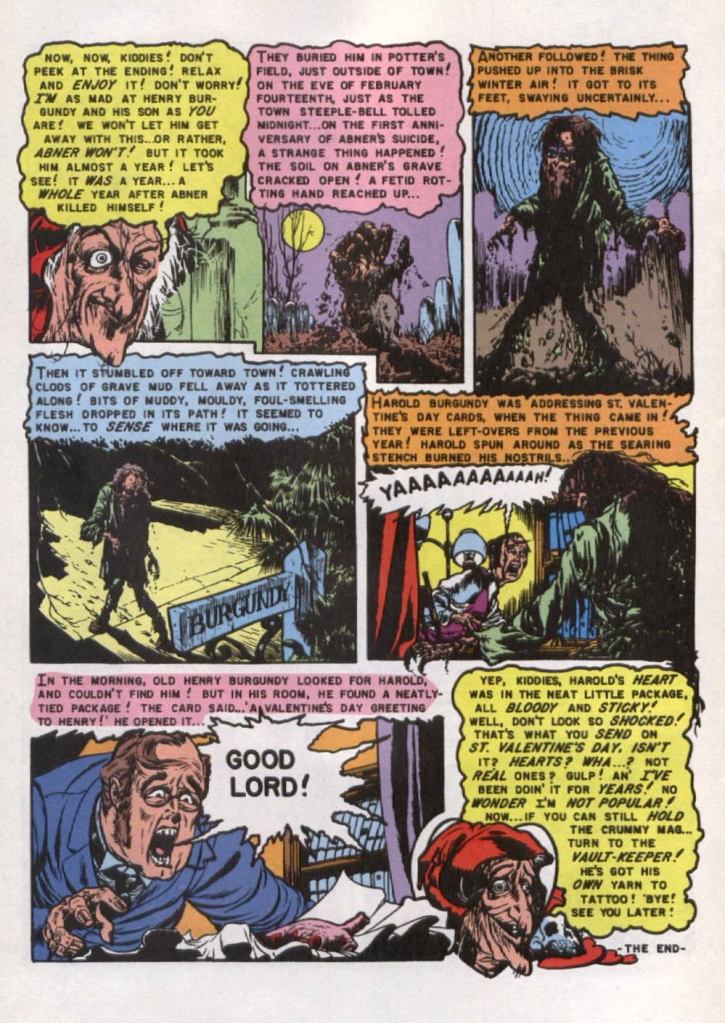
The first story in this particular issue was illustrated by Graham Ingles, who usually signed his work simply Ghastly. he had a forte in depicting walking corpses and rotting flesh, and EC kept him busy almost exclusively on the company’s horror titles. In later years, Ingles is said to have been a bit unhappy with some of the work he’d contributed to, but he was a favorite of readers at the time, and a big influence on up and coming cartoonists such as Bernie Wrightson. The story is about a greedy father and son, land developers who want to take possession of the property owned by the elderly town garbageman. So in a smear campaign, they gaslight the old man into committing suicide by making him feel unloved. In the end, though, his disquieted corpse gets back up, kills the son, and leaves the villain’s heart, torn from his chest, for the father for Valentine’s Day.
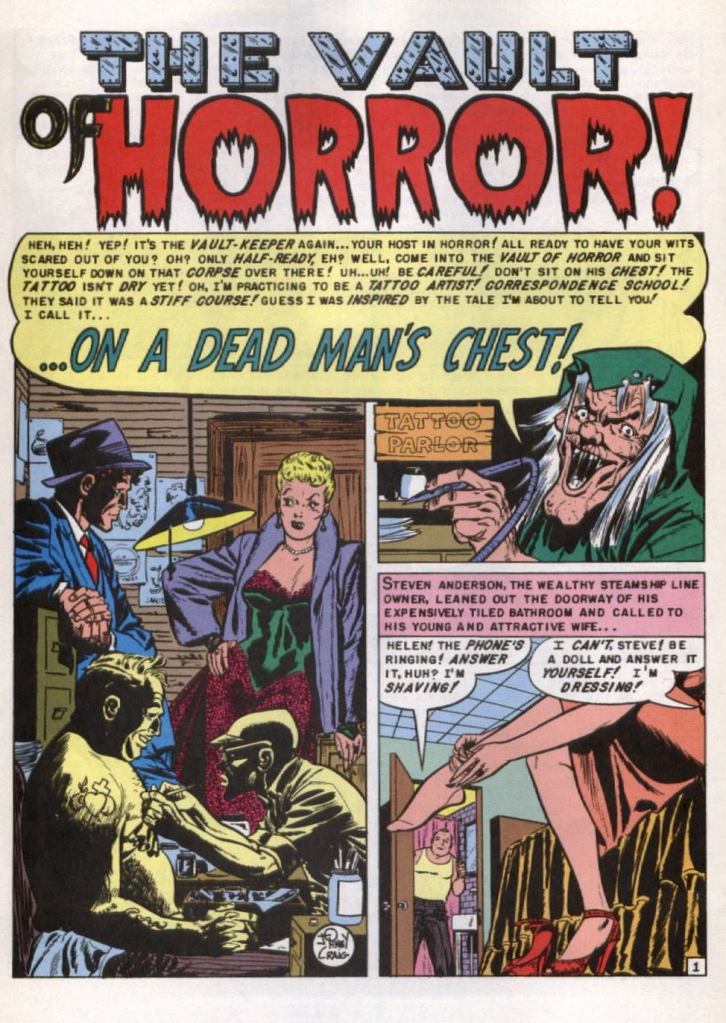
The second story was illustrated by Johnny Craig, who was a backbone player at EC. His artwork was straightforward and unadorned–he wasn’t as adept as Ghastly at depicting rotting flesh, but he could always be turned to for a tale of cold-hearted people getting their comeuppance. The story is about a well-off sailor whose wife is cheating on him with is younger brother. After the pair decides to off the sailor so that they can be together and get full possession of the shipping line that he owns, their plan is undone when somehow the chest tattoo the sailor had gotten of the three of them now mysterously shows how they murdered him. When the truth is revealed, the wife’s mind snaps and she guns down the brother before being arrested herself. it isn’t a great story–it feels very much of a formula that EC used often–but it’s solidly put together.
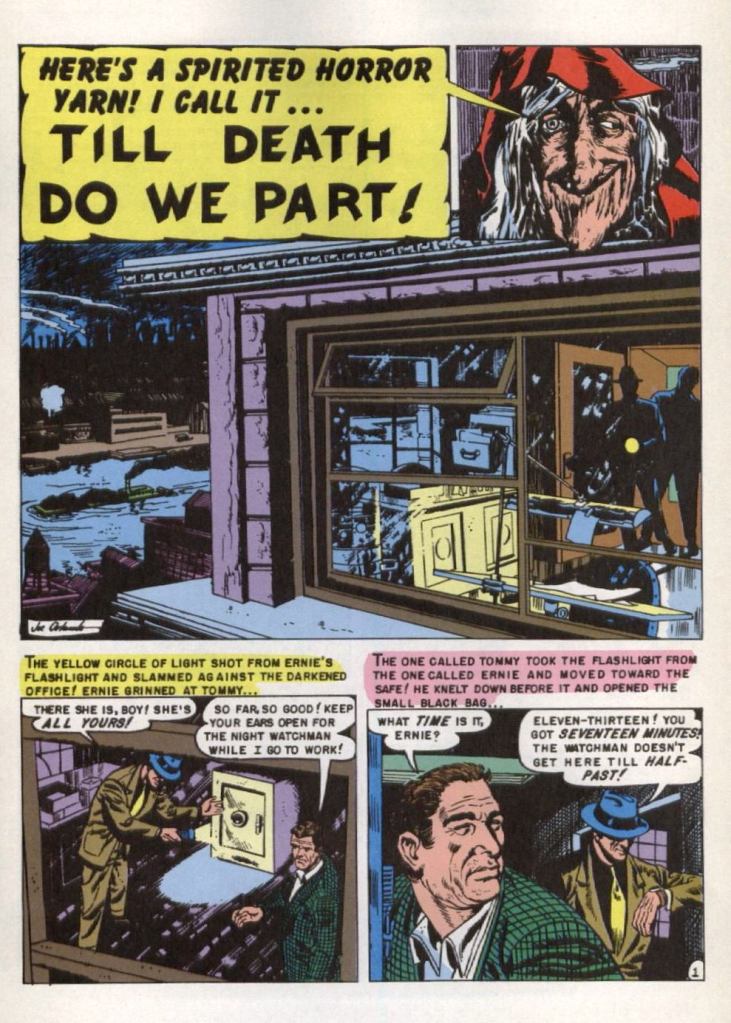
Joe Orlando handled the artwork on the third story. The skill of EC’s bullpen of artists was a strong reason for readers to follow the line. It was a rare EC story that didn’t look good all throughout their run. This one’s about a criminal who is gunned down during a botched heist. The guy seemingly survives, and manages to make his way to where his accomplice is getting ready to leave town with the loot. Try as he might, the criminal can’t convince him to stay or to help him, and in fact it’s as though he can’t see the first criminal at all. And that’s because the guy is dead, as we find out on the last page, killed when he was gunned down. but his restless spirit just hasn’t quite accepted it. There’s an unconvincing final line on this story that indicates that the accomplice doesn’t get away with the crime either, that he’s gunned down fleeing by the police. But it feels like an add-in to me, a way of making the story not seem to glorify criminal behavior. In later years, this sort of thing might have been mandated by the Comics Code. Here, though, either Feldstein or Gaines must have decided to add it.
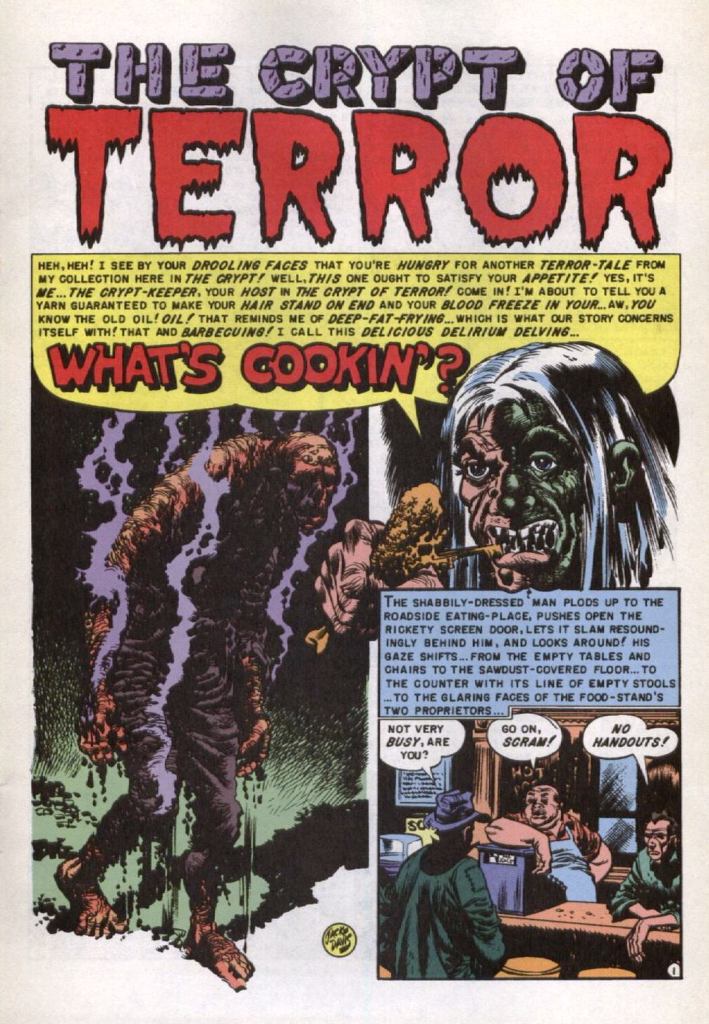
The final story in this issue was illustrated by Jack Davis, who would go on in later years to be a world-renowned illustrator, famous for his many movie posters and TV Guide covers among other things. Here, his talent for caricature is well-matched by his facility at depicting shambling horror and gooey gore. The story here is a potboiler about a slick operator who turns around the prospects of a roadside diner owned by a couple of hapless guys in exchange for 50% of the profits. Under the operator’s management, the place becomes a roaring success–but the two proprietors, who are now getting rich, become obsessed with how much richer the operator is getting, and they resolve to bump him off. So they burn him to death in his home. But of course, his corpse gets back up to seek out vengeance, and in the morning, the cops find the two proprietors having been horribly cooked like the new products they’ve been serving.
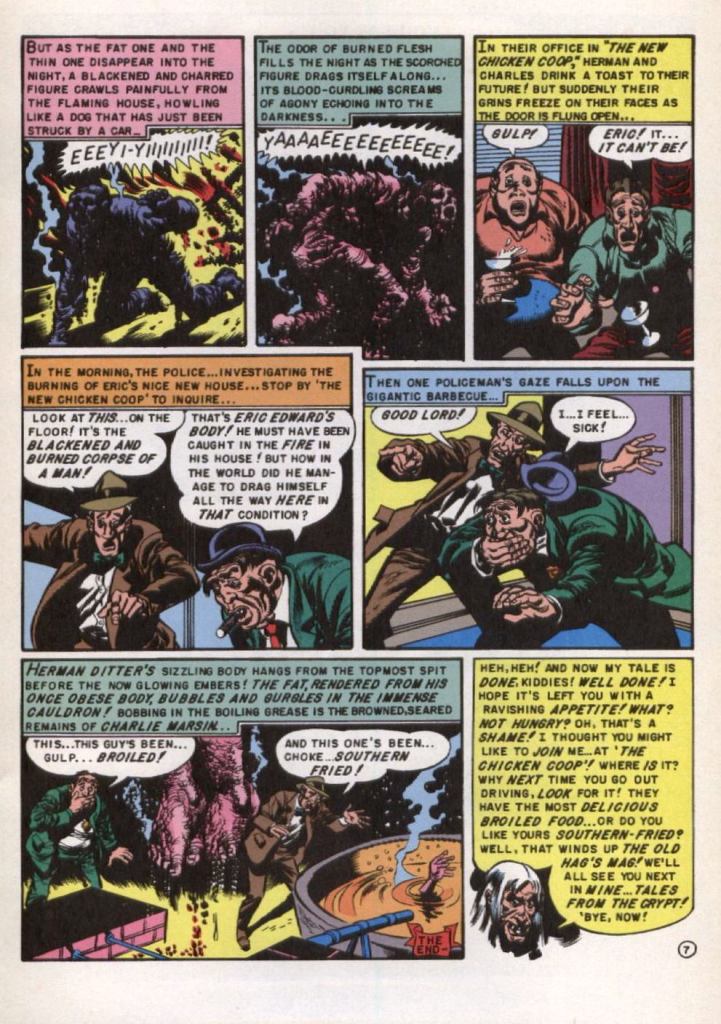
If you read a few of EC’s books, you could typically see exactly how these stories were going to work out in the end, as Feldstein and Gaines did have a couple of pretty recognizable formulas. By that same token, the thrill of the repulsive is what you were laying your dime down for (or your dollar for these classic reprints in the 1970s) and so even if the execution was formulaic, the delivery was often crisp and solid and the artwork was always top-flight. I think this particular issue isn’t especially strong in the story department, and so I kind of wonder why it was selected for reprinting when there were so many other better options to choose from.
 The Tom Brevoort Experience
The first story with the human heart taken out on Valentine’s Day: Adventures into Terror#31 ( May 1954 ) “Dear Valentine! is about a wealthy but elderly man ( millionaire Frank Terris ) whose gold digger wife ( Mimi Terris ) is cheating on him and has her lover ( Ed Kelty ) kill him bout his ghost gets revenge by sending his wife her lovers heart in a heart shaped pink box on St. Valentine’s Day and the goes after her on the last panel.
LikeLike
… kill him but his ghost gets revenge.. Atlas Comics has twist ending ( Like a criminal planning to escape by jumping off a bridge into the water below only to go splat on the solid ice below ).
LikeLike
Willie Brown is out to Get Me! [ Journey into Mystery#8 ( May 1953 )] — Weasel tells Monk that Willie Brown is looking for him and tough guy Monk rabbits but Willie Brown finds and corners him. Monk is so terrified of Willie Brown that he would rather die by his own hand than by Willie’s so he jumps out a window and his last sight is of Willie’s face looking much worse than he did a week ago… when Monk shot him dead. In the same issue is “Indoor Sport! about a 24 year old woman named Mona Rand who died in 1952 after committing suicide because she was spurned, jilted and left with a broken heart. Mona seeks revenge on every man ( “They’ll pay eternally for the agony I suffered!” ) — so she kills every man who dates her. In her ghost form she can appear as her 24 year old self or an old crone. “Johnny’s Last Jump!” [ Mystery Tales#15 ( September 1953 ) is the story with the criminal who jumped off a bridge expecting to hit water only to impact solid ice ( atlastales.com helped find Johnny story once I remember his name might be Johnny ).
LikeLike
That Johnny Craig story was also written by Craig, not by Feldstein.
LikeLiked by 1 person
I agree that there are better options out there re. EC’s horror magazines but it’s still strong, if formulaic, and contains some of the best artwork of its era.
LikeLiked by 1 person
Johhny Craig’s “spotted black” inks! Stark, bold, noir-ish. Totally conjures up iconic movie images from the 30’s & 1940’s.
Visual echoes of Caniff, Sickles, Robbins, Toth.
LikeLike
Good to see Joe Orlando’s art. He replied to a letter I wrote when I was around 12 or 13 years old. I still have it, somewhere. The DC watermark, and on the back was a vertical line of character images, standing on each others’ shoulders. I came up in the mid-to-late Bronze Age, so I only knew his name in credits mostly as an editor, sometime artist, & frequent colorist, maybe even as a writer. It wasn’t until he retired from DC that I started to get an inkling of how much more of a substantial & impactful figure he’d been. The Filipino artist recruitment as one example.
Jack Davis. Oh, man, I read “MAD” regularly from like age 10 to 14. And I remember his ads from even earlier. When I first came across inks by Janson & Palmer, they immediately reminded me of Davis’s. That frenetic, kinetic energy. His basketball ad in which he drew Dr. J. was in so many comics for months.
LikeLiked by 1 person
Poetic Justice was adapted for the screen in one of Amicus Production’s anthology horror films, Tales From the Crypt; the garbage man was played by Peter Cushing.
LikeLiked by 1 person