


So it was around this time that I ordered a set of EC Classic Reprints from the Superhero Merchandise catalog. I wasn’t in any way a fan of the mystery/horror series that were then coming out, mostly from DC. But I had read about the heyday of EC in the pages of THE COMIC-BOOK BOOK wherein Don Thompson enthused about the glory days of the firm. For some reason, this was enough in this particular week to get me interested in sampling those riches, and so I ordered the set. My memory is that i was home sick from school on the day the package arrived, which meant that I had all early morning to devour the eight classic EC reprints that had shown up, #3-10. This third issue, reprinting SHOCK SUSPENSTORIES #12, was the first that I consumed.
These books had been released by East Coast Comix a few years earlier, in 1973, and there were still enough copies floating around of a bunch of them that Heroes World could offer sets of what was in stock. All in all, East Coast reprinted twelve vintage EC books in total, though the batch I got that day only accounted for eight of them. But even by the 1970s, the luster and reputation of EC has been established, and the company’s loss, driven out of the field by the advent of the Comics Code Authority, was seen as a tragic moment for the field, which was thereafter totally pigeonholed as being exclusively a medium for children. EC, though, had maintained high quality standards, both in their artwork and more importantly in their writing. While no EC story was necessarily high art, they were all a lot more sophisticated than anything else on the market during that period by a wide margin. The stories were literate, and they had a point of view.
If anything, they were maybe even a bit too literate, in that writer and editor Al Feldstein packed each page with mountains of text. He was effectively writing a short story, one a day at the height of EC’s production time, and his prose style was appropriately pulpy. EC books weren’t meant to be read quickly, and if you weren’t willing to pore over the exhaustive captions, they weren’t going to make a heck of a lot of sense. EC was also willing to tackle subject matter that nobody else in the field would touch with a ten-foot pole. In particular, the second story in each issue of SHOCK SUSPENSTORIES, the magazine dedicated to twist-ending tales, was known as a “preachie”, in which Feldstein and editor Bill Gaines would sound off on some hot-button topic, including race, religion, and in this particular issue, drug abuse.
The EC books also had a definitive look, based completely upon the decision to use the Leroy Lettering system for their text. This was like a massive typewriter that the original artwork pages were inserted into so the copy could be typed into place. Editor Feldstein would type his script directly onto the boards before passing them off to one of EC’s coterie of excellent artists, who would then illustrate the story based on what was typed in the copy. Certain artists, such as Graham Ingles and Bernie Krigstein, would bristle at Feldstein controlling the flow of the page so and would rework the text, sometimes putting two panels under one block of copy, sometimes having balloons jut awkwardly into a neighboring panel. It was a free-flowing operation, but it got excellent work out of everyone.
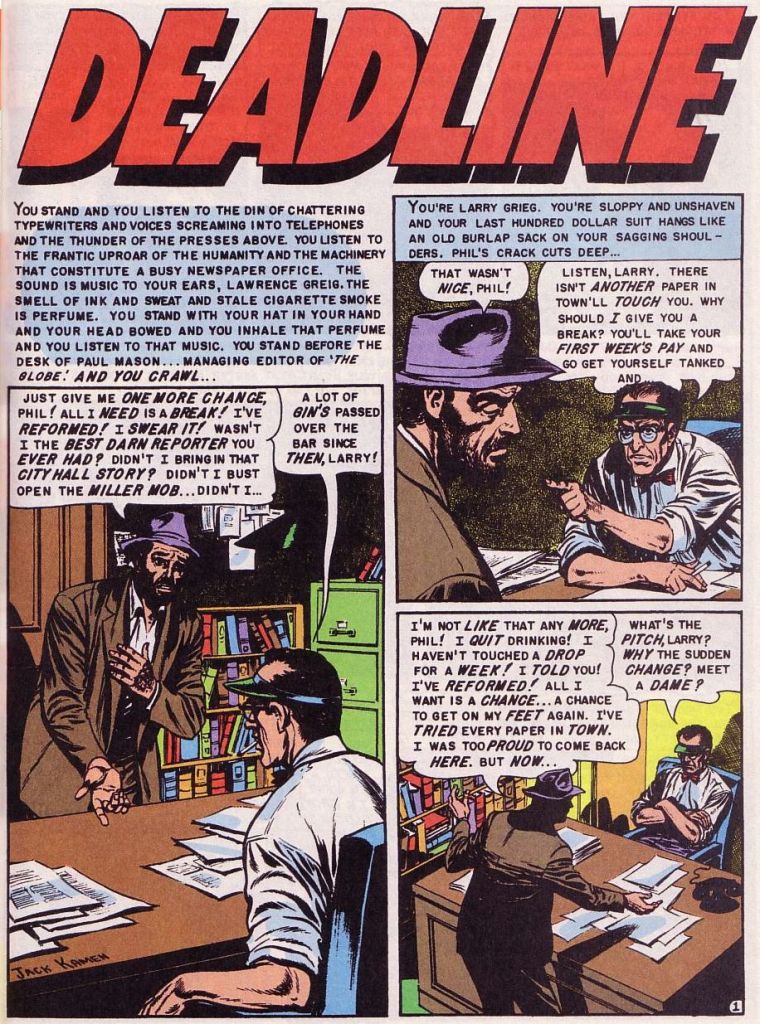
Like pretty much every EC book, this issue of SHOCK SUSPENSTORIES contained four separate stories, each one with some manner of twist or pow ending to it. EC didn’t mess around much with continuing characters apart from the three horror hosts who functioned as narrators for the horror books. All of the stories int his issue were written by Feldstein. In the opener, illustrated by the underrated Jack Kamen, a down on his luck boozing reporter has one last chance to land a big story so he can be with the woman he loves who rescued him from a life of alcoholism. He winds up finding a guy who has killed his wife for being unfaithful to him, but when the reporter goes to file teh story, the supposedly dead woman stirs–and the reporter, of course, murders her so that he can have the story. And of course, she winds up being the woman who had brought him up out of the gutter. This sort of noir morality was constantly at play in the EC books, but I was new to it, and so it made an impact.
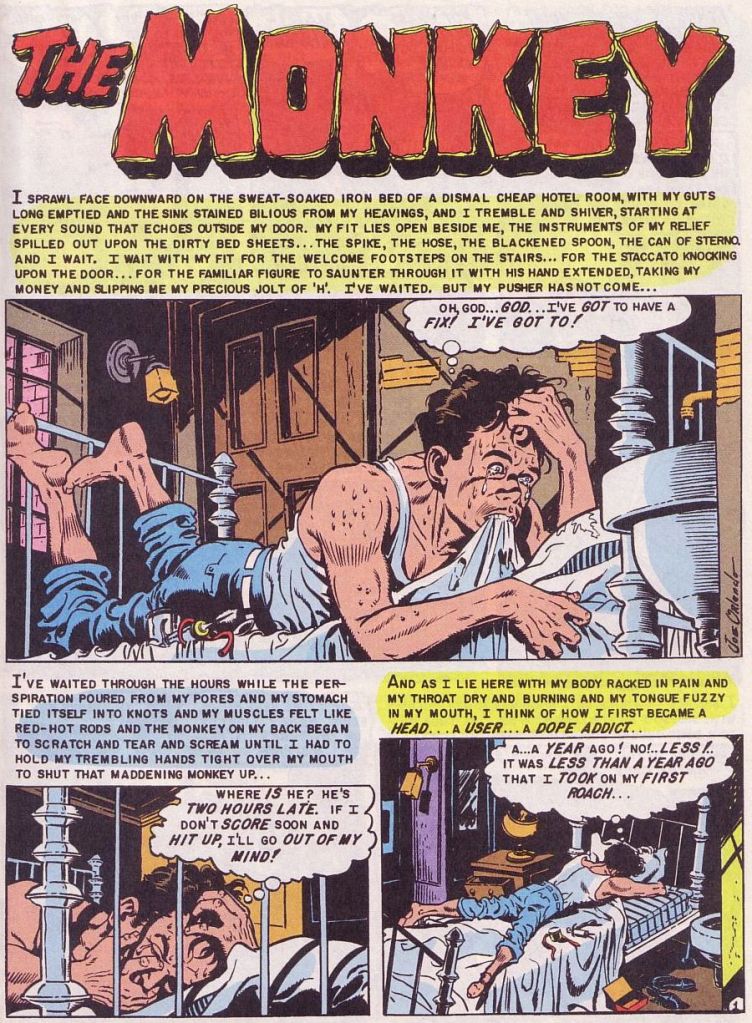
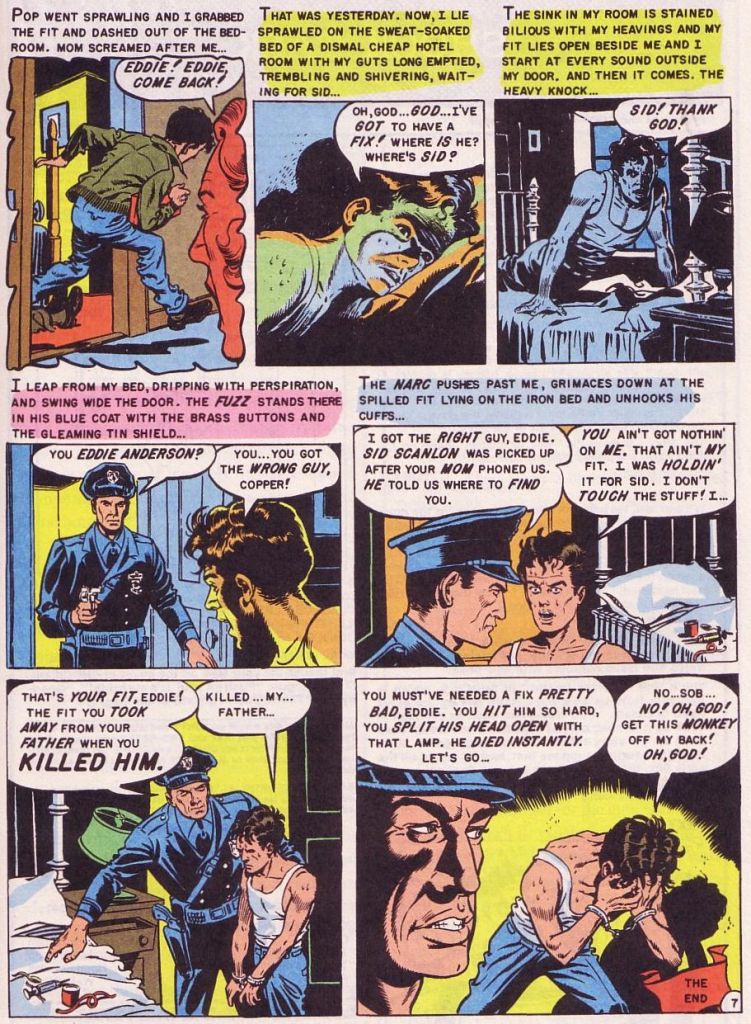
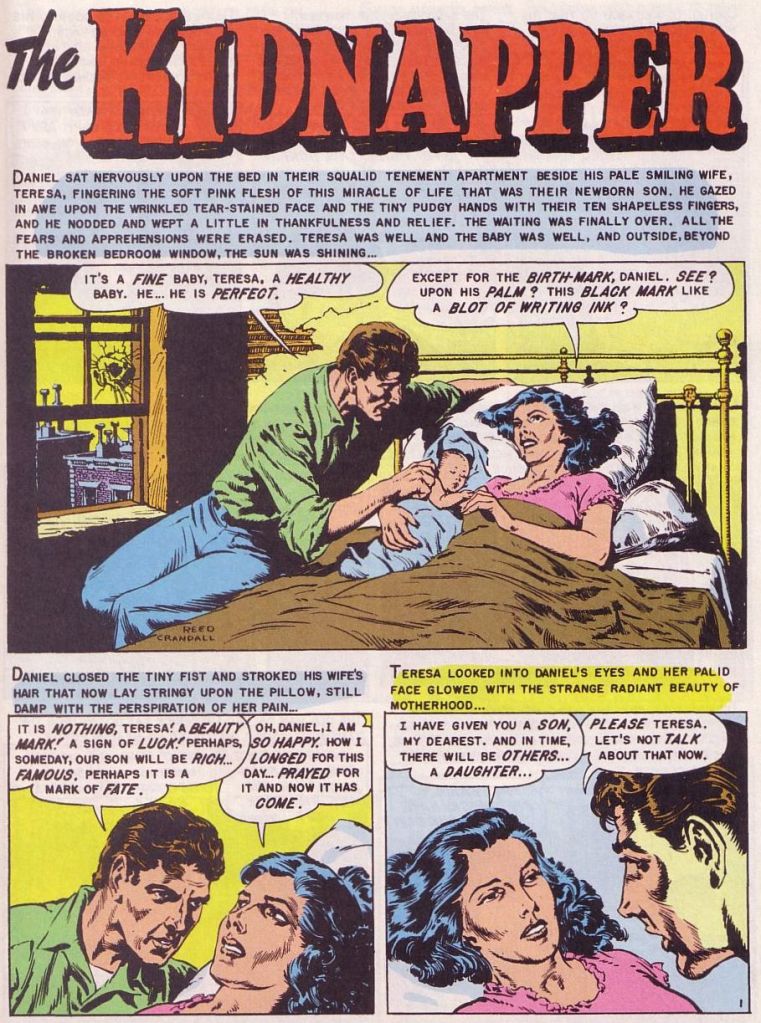
The second story, the preachie, was illustrated by Joe Orlando and it’s all about a kid who gets so hooked on Heroin that he winds up killing his own father for a fix. As a kid, I didn’t really have any working knowledge of drug culture, so this story scared the crap out of me and made me determined not to go down a similar route. So it did its job, even decades after the fact. The third story in the issue was illustrated by Reed Crandall, and concerned a couple whose baby is kidnapped. This sends the wife into a downward spiral of depression and madness. Finally, pushed to his breaking point, the husband decides to steal another baby to replace the boy they’d lost. But he’s caught and beaten to death by an angry mob. And of course, the child that he tried to snatch turns out to have been his own baby in the end. These stories had a familiar rhythm to them, though reading them as a kid, their impact was all new to me.
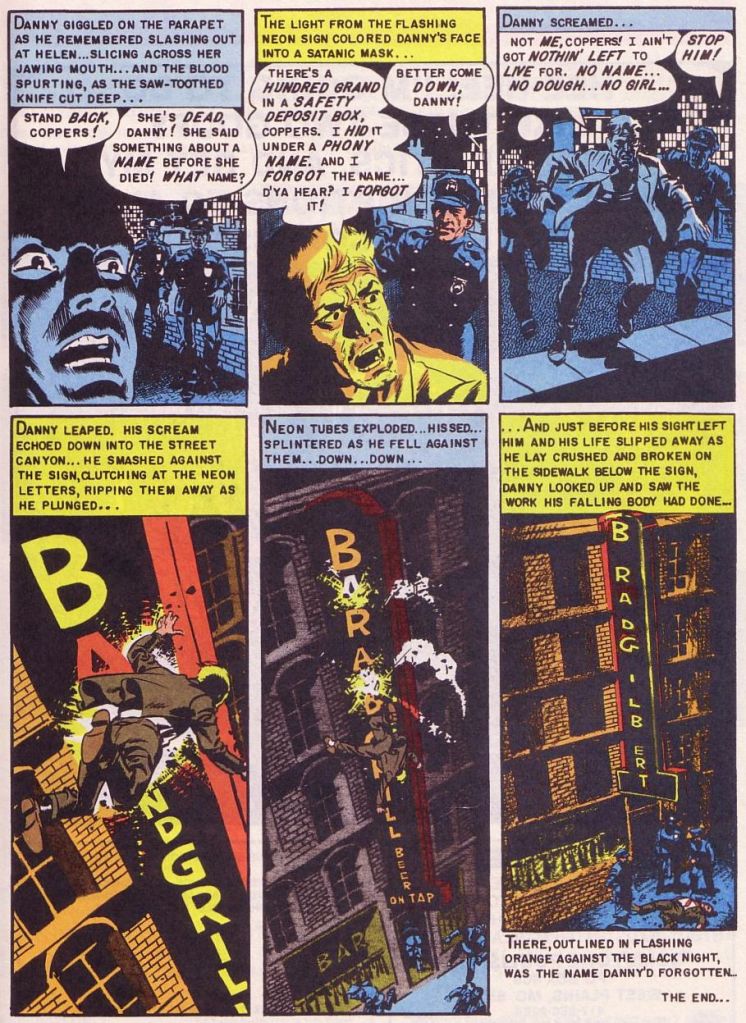
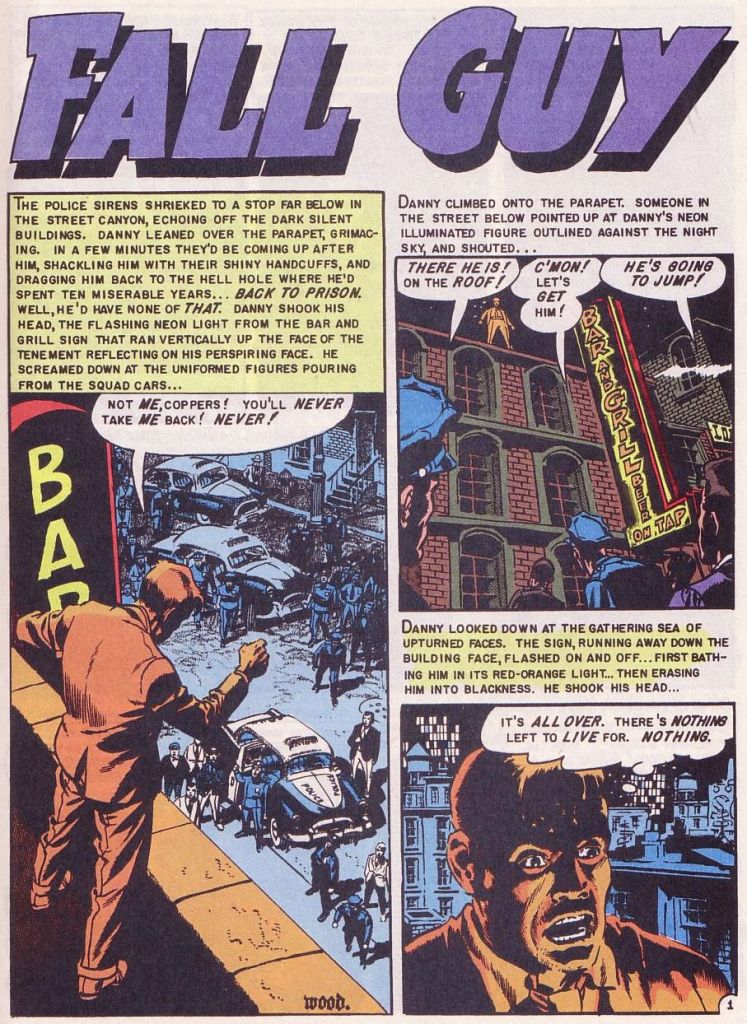
The final story is illustrated by the great Wally Wood, and is the one that perhaps had the longest influence. Alan Moore and Dave Gibbons referenced it visually in WATCHMEN when Rorschach is cornered by the authorities. It’s about a guy who steals a hundred thousand dollars in order to get with a gold-digging woman, but who is foiled when he can’t remember the false name he gave when he deposited the stolen cash into a brand new bank account after a fifteen year stint in prison. Cornered on a rooftop by the police, the man leaps to his death, colliding repeatedly with the neon sign for the Bar & Grill in the lobby of the hotel he was standing on. And as he perishes, the remaining neon lights spell out the name that he had forgotten, the rest of them shattered by his impacts. It’s a pretty memorable ending. While not every story hit with me, enough of them did that I found the experience of reading these EC books to be exciting and a bit lurid. This was definitely worlds apart from teh super hero books that were my mainstay meat.
 The Tom Brevoort Experience
I think the art in the EC books is great, but it’s the Kurtzman stories that appeal to me. The Feldsteins are so pulpy, and so, ironically, formulaic in their twist endings that don’t surprise so much as moralize, that I could never get into them. The characters aren’t people, they’re chess pieces in a structure entirely built on leading inexorably to the “surprise.”
But man, what great art.
LikeLiked by 2 people
I can enjoy Feldstein’s work in small doses, and certainly the art is magnificent. But, like you, I much prefer Kurtzman’s war stories — and, of course, Mad. Kurtzman’s stories also had great art and reading them, I never got a sense that they were formulaic, and the characters in his stories didn’t had more depth. Of course, many of his stories included historical figures.
Bit of a shame that Kurtzman & Elder wound up spending most of their career doing Little Annie Fanny strips for Playboy. But after leaving Mad for what he thought would be more promising offers and dealing with one set back after another, that wound up being the most financially secure opportunity that came their way. Maybe it’s just as well that Trump magazine, published by Hugh Hefner, only lasted two issues, as I’d guess Kurtzman wouldn’t have wanted to be too closely associated with the current president of that name, even if only by the coincidence of the name.
LikeLike
I remember these Russ Cochran EC Reprints quite vividly, partly because they were well done and still command somewhat of a premium, but mostly because of the unending stream of people coming into the store I worked at thinking that they had the originals.
LikeLiked by 1 person
I think it’s about 1/10 EC stories that works for me. Too formulaic and the twist-ending stories often feel like Look At Us Setting Up For The Big Twist (I read short stories like that too and I hate them as much). It’s rare art can make me enjoy a story that I think is “meh.”
LikeLike
Sounds interesting. Any way to get a hold of these stories currently?
LikeLike
Sure. They were reprinted recently in TPB’s by Dark Horse, and those are readily available used for around $10-$20 per volume. Search for: EC Archives Shock Suspenstories
You can get some more expensive hardcover reprint collections too, $50 each or so for the basic version. Or there’s deluxe editions.
Library should have, or be able to get, these reprint books, maybe even the digital versions.
The art on these stories suffers in my view from reading on a screen, though that might just be my preferences. If you haven’t seen them before, I think it’s a better experience to start with one of the physical book reprints.
LikeLike
The 1870s Marvel reprints of the 1859s Atlas Horror, Science Fiction and War Comics made me see what a vast shadow EC cast in the 1950s.
It is interesting to note that Johnny Craig had been a production guy for All-American/DC in the 19409s and Bernie Krigstein had been drawing Wildcat in Sensation Comics.
More changed when Bill Gaines had to drop out of NYU’s Teacher-Prep-Chemistry program to run his dad’s comics company than future generations of kids having more problems learning how to balance REDOX Reactions . . . .
I wonder if Max Gaines had not been killed in that accident if EC would have developed in that same way,
LikeLike
Deadline is almost similar to this Atlas Age story: Newspaperman Will Karp is desperate for a big story so he arranges a deadly train wreck so that he can cover it, but he didn’t know that is son was on the train [ Adventures into Terror#27 ( January 1954 ) The Big Story! — comics.org — a similar plot to “Death Waits Within” – JIM#4 ( December 1952 ) an elderly couple Mr. & Mrs. Kumel run an inn in Europe murder their guests in order to rob them and send the money to their son in America. They do not recognize their final victim as their son and he does not tell them because he wanted to surprise them with his visit ]– twist ending being someone the killer knows.
LikeLike