

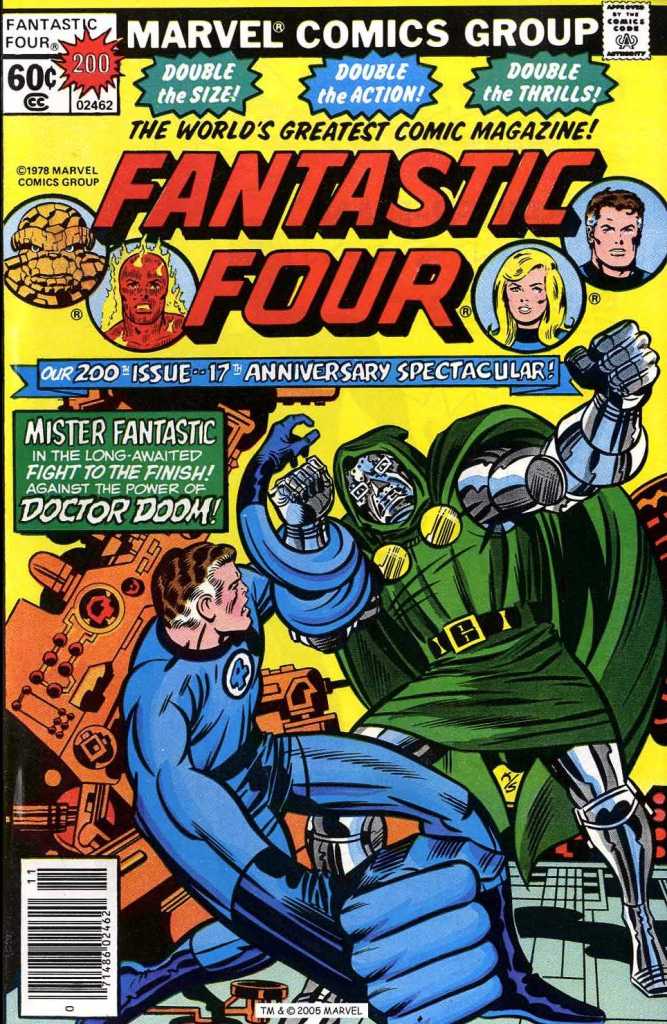
My friend David Steckel got a copy before I did. As I’ve talked about previously, for whatever reason our area didn’t get any copies of FANTASTIC FOUR #200, the long-awaited and heavily-promoted anniversary issue. For some reason, none of the oversized Marvel books, such as Annuals, turned up in this period. It was one of the biggest traumas of my young collecting life, missing this key issue of my favorite series, and I felt its absence like a missing tooth. I don’t recall the circumstances under which David finally got a copy of this book, but I burned with jealousy for weeks. And then, as fate would have it, I wound up finding a copy of my own.

My folks had decided to take a drive out that Saturday to a craft fair happening at the Nassau Coliseum, bringing us kids along. Coming into the place, I was surprised to see a table being run by the proprietor of a local store, Ed’s Coins, Stamps and Comics. I of course made a bee-line for the table, and flipping through what he’d brought along, I came across a copy of this long-sought treasure. My Dad wanted us to move on, telling me that we’d come back later (a promise that he reneged on at the close of the afternoon) but there was no way that I was going anywhere without this copy of FANTASTIC FOUR #200. So he or my mother gave me the dollar to buy it, and then we went on our way.
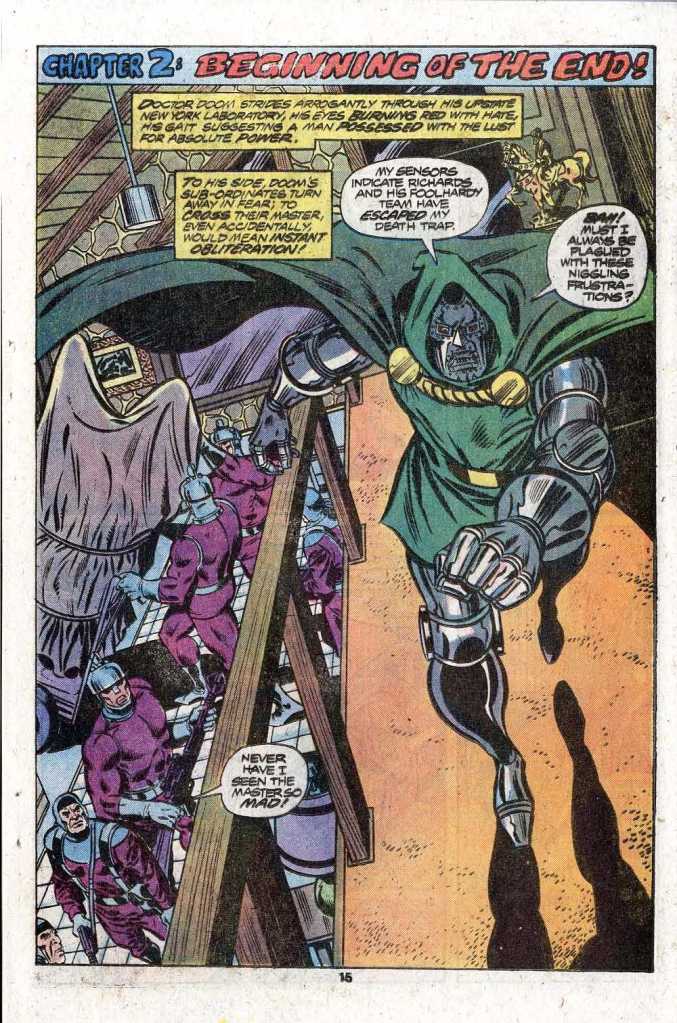
Writer/editor Marv Wolfman has gone on record as not being pleased with his run on FANTASTIC FOUR. It was a series that he loved growing up, and one that he dearly wanted to write. But he felt that his execution was lacking–he was more comfortable on AMAZING SPIDER-MAN, which he was writing at the same time. Speaking only for myself as a reader of this era, I think Marv is being too hard on himself. I loved this issue, as did the friends that I had who were reading comics at this time. Marv’s run did wobble a lot during the period when he had to integrate all of his NOVA plans into the series after that title had been axed, but in his first year or so, I thought he did an excellent job.

As for penciler Keith Pollard, he’s one of the more underappreciated artists of the era. He wasn’t especially flashy in his approach, typically employing a very standard grid structure to his page layouts in the manner of John Buscema. But he channeled a nice Buscema vibe on FANTASTIC FOUR that was appealing. In particular, his Doctor Doom always came across as powerful and menacing, if occasionally a little bit over-the-top. Pollard was aided, of course, by the iron man of FANTASTIC FOUR, embellisher Joe Sinnott. Sinnott had been in residence since 1965 and he very much defined the look of the series, keeping it consistent even through assorted changes of penciler. And the cover to this issue is noteworthy in that it is the final one ever penciled by the team-s co-creator, the great Jack Kirby.
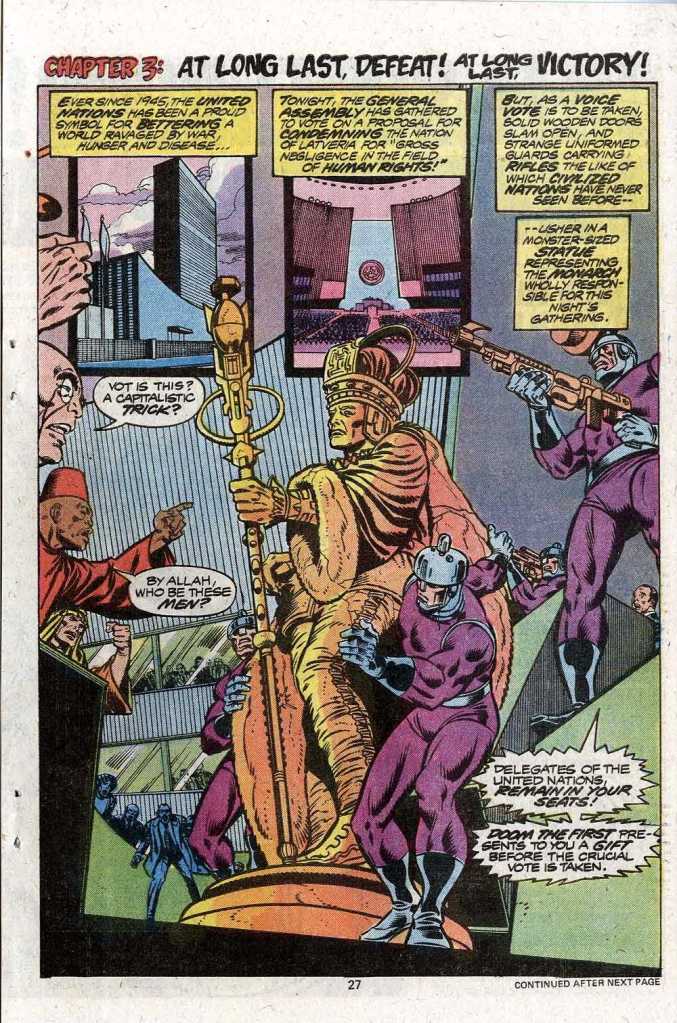
As for the plot, it’s all a lot of nonsense, actually. It involves Doom abdicating the throne of Latveria in favor of his son, who is actually his own clone. He imbues this clone with the powers of the Fantastic Four, but since the clone doesn’t have Doom’s scarred face and madness, he turns against his creator upon realizing the elder Doom’s plans, and Doom is forced to kill him. Doom’s ultimate goal is for Latveria to join the United Nations, to whom he’s gifting a sculpture of himself crafted by the Thing’s girlfriend Alicia Masters. But there’s technology within the statue that will enslave the minds of the U. N. delegates to Doom’s will. Thus will he take over the world. Nobody ever told Doom that the delegates to the United Nations don’t really have authority over the countries that they represent–a bit of a flaw in the whole affair. You can see why Wolfman felt his material was lacking. But to me, this was all a backdrop to the big showdown between Doom and the FF, in particular Mister Fantastic.

Reed Richards had been suffering the lost of his stretching powers for a couple years by this point, an event that led to the team breaking up and going their separate ways. But Doom restores those powers, so that he can then siphon them into his clone (which seems a roundabout way of going about things, but hey, I’m not a megalomaniacal genius.) But really, it’s so that he and Reed can have a massive and savage throwdown in this anniversary issue, while the rest of the FF tries to prevent Doom’s statue from being activated at the U.N. And it’s a killer fight sequence, with Pollard and Wolfman finding novel ways for Reed to use his powers offensively. In the end, Reed winds up tearing off Doom’s mask, including the protective lenses that prevent him from being overwhelmed by the intensified reflections of his own visage within the chamber in which the pair is fighting. So Doom goes mad, with his own horrible features seared into his brain. Steckel and I thought this was pretty cool.
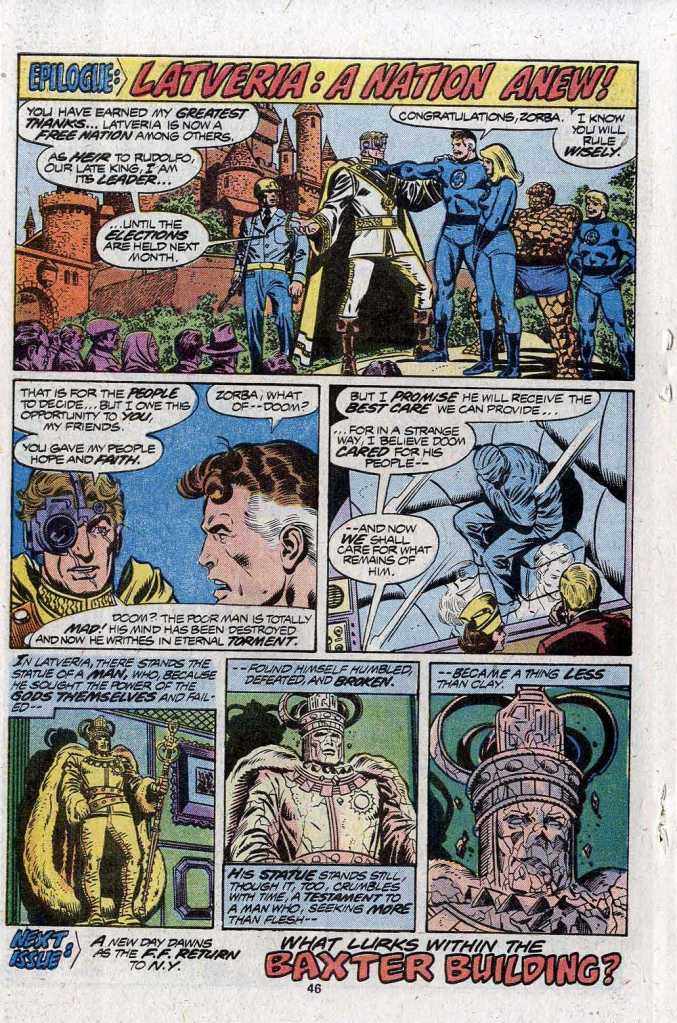
Today, with the benefit of hindsight, it’s obvious that Doctor Doom will return once again. But at the time, I was still new enough at reading comics where this felt like a truly climactic clash, one that wouldn’t be reversed in short order. And indeed, it did take about two years for Doom to pull himself together once more. This was, I believe, the first of the oversized anniversary issues that both Marvel and DC would begin to release in the late 1970s and 1980s, and for a while those books had a terrific track record of being truly epic and meaningful stories for the series they were a part of. It was always exciting when one of those numbers was coming up in the near future and the story build-up began to take place in the stories.
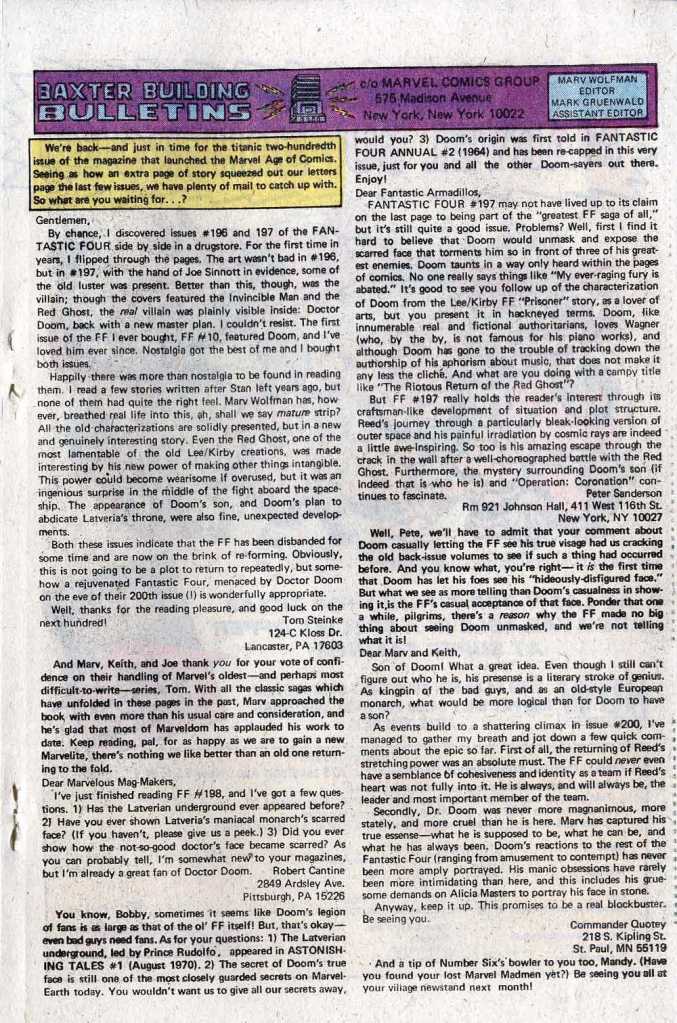
The Baxter Building Bulletins letters page in this issue includes a letter from future comics professional and historian Peter Sanderson, in which he points out that Doom unmasking himself in front of the FF in a prior issue was out of character for him to do. The letters page writer–possibly Marv Wolfman, but more likely Assistant Editor Mark Gruenwald–hints at there being a reason why the FF didn’t react to Doom’s unmasked face but refuses to say what it is. Steckel and I were perplexed by this, but it’s a reference to Jack Kirby’s assertion that Doom’s face wasn’t horribly scarred at all, but rather that it was only slightly scratched. But such a perfectionist is Doom that even that small imperfection compels him to hide his features away from the world.
 The Tom Brevoort Experience
“Nobody ever told Doom that the delegates to the United Nations don’t really have authority over the countries that they represent–a bit of a flaw in the whole affair.”
No-Prize Explanation: Doom was smart enough to launch his plan during “High-Level Week” of the UN General Assembly’s new session – a real thing where most nations’ heads of state are in attendance.
LikeLike
In fairness the idea of the UN as some kind of world government crops up quite a bit in pop culture. The Left Behind books hinge on the idea that the Antichrist can seize power by becoming UN Secretary General (one of the authors was of the far right Never Trust The UN It’s Evil school)
LikeLike
I preferred the slight scarring explanation of Doom, though if he is massively damaged it being by putting his first mask on while white hot is a good explanation too. I never shared your opinion of Pollard. His work never excited or interested me and with his F4 work, it could have been anyone in his place and looked virtually the same with the overpowering effect of Sinnott’s inks. I doubt even Charles Vess or Bernie Wrightson could have avoided that fate though but Pollard’s middle of the road art stood no chance.
LikeLike
This mustache twirling eeeevil version of Doom that existed from my start of reading comics and lasted for years is why I’m not even picking up the current Doom Big Event. I’ve had enough of purely evil Victor and the only time recently I enjoyed the character was under Bendis.
LikeLike
I think the slight scarring version makes zero sense. It’s up there with the idea of Clark Kent’s glasses hypnotically convincing people he looks very different than Superman. Consider, Doom is one of the smartest people on Earth (he’s perhaps the second-smartest, and thinks he’s number one, with some justification). He also has the ability to be treated by the greatest plastic surgeons in the world. Whatever happened to his face must be something he can’t fix himself with his genius. And even if he’s got some sort of inability to understand plastic surgery, none of the specialists can fix it either. Slight scarring just doesn’t fit. Also, people have seen his unmasked face, and generally react with horror. If it was just a little scar, that would be general knowledge in the Marvel Universe – he’d be thought of as the poster boy for body-image issues.
This isn’t original with me, but the best explanation I’ve seen is that his original accident caused a piece of hell to be lodged in him, like spiritual shrapnel, at the level of his soul. And it’s fused so thoroughly now that he can’t ever get it out without killing himself in both body and spirit. He doesn’t even know what his soul would look like without it, since it was years before he gained the necessary skill to even understand the issue. It’s thus more than even he can solve, since it’s a literal God-level problem.
This means he can’t e.g. just clone a new unscarred body, and mind-swap into it. As long as it’s “him” in essence, he carries the effects, because they travel with his soul.
LikeLike
Considering Doom arrogance when it came to his intelligence ( hence the ignoring Reed’s warning back at State U that led to the accident that gave him his scar ), he might have been just as arrogant about his looks. In the WB Batman cartoon episode “Mean Season” Calendar Girl ( Paige Monroe a model-actress ) wore a Kabuki mask to hide her disfigurement from “botched plastic surgery” but when Batgirl unmasked her, she was surprised by her beauty ( Highlighting Calendar Girl’s obsession with perceived flaws and inability to see her own beauty — Google AI ). I know John Byrne showed him putting his still hot mask on burning his face and causing him to run out into the snow.
LikeLike
Yes, I understand the character-logic people are trying to have. However, it runs right into major failures of world-logic. You have to say that a super-genius who can make a clone of himself and imbue it with all the powers of the Fantastic Four, and is extremely arrogant plus personally vain, cannot figure out how to perfectly heal a slight scar. It doesn’t work. Something like Calendar Girl is different, because she’s not anything like that in terms of power-level.
Moreover, slight scar doesn’t fit continuity well either. Doom’s accident happened in a place where there were several people around, some would see how badly he was hurt or not. Someone had to pull him out of the wreckage, give him First Aid, transport him to the hospital, etc. Even you want to say that doctors and nurses who treated him can’t discuss the extent of his injuries due to medical confidentiality, there’s still got to have been others who knew in general. He wasn’t powerful at the time. It would have been a local scandal – even in the Marvel Universe, I doubt dorm rooms explode every day. Once he becomes world-famous, everyone who knew-him-when is going to be interviewed. If there was any basis to think he wasn’t seriously hurt, this would be known, if nothing else by his many detractors. I just checked FF#5, and Reed himself says “his face was badly disfigured”, and Doom is shown with his head all swathed in bandages.
It’s one thing to leave the exact nature of his appearance as a mystery, with the general idea that the horror you imagine is more artistically satisfying than anything one can draw on a page. But that’s completely different from trying to have it be that the accident had a very small effect and he’s really still very handsome but doesn’t think so. That’s pushing my suspension-of-disbelief too far.
LikeLike
As Seth says we see his face heavily bandaged after the original accident. And when Jack and Stan of Earth 616 see him, they’re horrified (as is Don Blake years later).
The Ninja Turtles did a story with a Phantom of the Opera-like character where it turns out the “villain” isn’t really scarred he was just too terrified to ever look in a mirror so he didn’t know his face was fine.
LikeLike
“Why was I forced to slay my own clone?”
No offense whatsoever meant to Marv, but for years after that issue came out, that line stuck with me and some friends as a truly goofy opening line.
And it served as an object lesson: Don’t try to do too much recap too fast in word balloons. Not unless you can make it sound natural.
That line aside, it was a fun and fitting anniversary issue. Though I tend to agree that Marv’s SPIDER-MAN worked in a way that his FF didn’t, quite. I came to think it was because Marv has a real strength in writing character who lose as much as they win — DRACULA was a years-long laboratory of heroes who couldn’t fully triumph because the villain was the lead, and the villain couldn’t triumph because, well, he was a villain. So it was rare that a story ended with an unmuted victory. That fits the hard-luck Spider-Man, too, and later on it worked for the Titans (George brought the visual triumph, Marv brought the muted never-quite-ideal struggles, and the alchemy of that made the book a sensation), but the FF are sunnier, more conventionally heroic characters. Not to the point of the Flash or the JLA, but sunny enough that Marv’s great strengths as a writer don’t sit as comfortably with them as with Spider-Man.
LikeLike
Excellent write up of a classic story. Thanks Tom. For your information, I have also read an interview with Marv from about 20 years ago where he made very similar comments regarding his work on Fantastic Four and Spider-Man. But where he was generally tough on himself because he was comparing his FF work perhaps too much to Lee and Kirby’s run, he did state that the one issue he was completely satisfied with in his FF run was FF 200. Furthermore, he also stated that FF 200 was the first double sized issue of that time (1978) and he actually had to fight with management to get it put out (they were afraid it would lose money). He got Archie Goodwin to support him, and FF 200 wound up doing so well that when Marv wanted to do Spider-Man 200 as a double size issue there was no problem, and of course that led to many double size issues…Avengers 200, Thor 300, X-Men 137, X-Men 150 and on and on in the 80s…
Generally I enjoyed Marv’s FF run and I believe the only problem was that the Skrull storyline beginning in FF 204 just went on too long; not really completely Marv’s fault because of the cancellation of Nova. Personally I liked Keith Pollard’s work and was sorry to see him leave after FF 206. Ironically he left to work on Thor, wanting to work on a single character instead of a team but then Roy brought in all those Eternal and Deviants and lots of other characters.
By the way, I believe that no one ever really explained what was going on with Doom showing his unmasked face to the other members of the FF and their non-reaction. Maybe Marv had something in mind but I don’t think it was ever explained. I don’t know if anyone remembers but in Thor 182 Don Blake saw Doom’s unmasked face and is horrified and yells out that no surgery can repair that face. That was written by Stan, Of course there was also a famous sequence in the storyline of FF 84-87 where Doom is not wearing his mask (we don’t see his face) and he’s being painted and the painter is not running in horror. So who knows what was going on with his face. Everyone seems to have a theory. Probably best that we don’t know…
LikeLike
However messed up Doom’s face is… the FF are intrepid explorers of the unknown….so it makes some sense for them to be pretty chill about it… …especially when they’re held captive by the guy…..they aren’t going to necessarily reference his disfigurement. It makes way more sense than DOCTOR Don Blake (also a captive) recoiling in horror. Probably would have been better all around if the Doom dropping his mask for the first time happened in the FF’s mag.
LikeLike
[Wolfman] also stated that FF 200 was the first double sized issue of that time (1978) and he actually had to fight with management to get it put out (they were afraid it would lose money). He got Archie Goodwin to support him, and FF 200 wound up doing so well that when Marv wanted to do Spider-Man 200 as a double size issue there was no problem, and of course that led to many double size issues…Avengers 200, Thor 300, X-Men 137, X-Men 150 and on and on in the 80s…
I’m more than a little skeptical of this. Wolfman tends to aggrandize himself in behind-the-scenes stories in ways that are fairly debatable, and there are red flags here.
The first is the claim about Archie Goodwin. He had left the editor-in-chief’s position by the time this would have become a subject for discussion. Beyond that, he had no clout with the people in Marvel’s business operations. They didn’t respect his judgment. It was a major factor in his being replaced by Jim Shooter. Goodwin’s support, to the extent this was any of his business, wouldn’t have helped.
The second red flag is that there is no evidence that FF #200 was any unusual sales success. If it had been, I believe there would have been several special double-sized series issues in 1979. There was only Amazing Spider-Man #200 and Conan #100. If FF #200’s sales contributed in any way to the decision to double-size those, it was in making the argument that such a move wouldn’t hurt sales. That’s not the same thing.
The blossoming of the company’s sales under Shooter meant that after 1979, the businesspeople’s rule, within certain limits, was that what Shooter wants, Shooter gets. Shooter was an exceptionally savvy marketer. He certainly understood the benefit of event marketing done right, and given the freedom to make the attempt, he took it. There were six releases of this sort in 1980. X-Men #137 was one of those, and famously fast-tracked the increasingly popular series into becoming the industry’s top-selling color title.
If any comic deserves the credit for making the special double-sized series issue a norm, it’s X-Men #137, not FF #200.
LikeLike
Great summer memory. I got to pick up issues 197-200 each month off the spinner rack, reading it all as it unfolded. And agree with Tom – I think Marv nailed it, and it still holds up.
Wonder how much of an influence DC had on FF #200 going oversize – both Showcase #100 (May ’78) and Batman #300 (June ’78) were oversized milestones released earlier that year.
LikeLike
Loved this issue. When Doom returns to power and his countrymen are jubilant it felt like something had really changed at Marvel. Doom’s subsequent overthrow of the previously well-meaning Zorba was a real shift towards a cynical pov in regards to the “positives” of super villainy and authoritarianism… to the point where the FF wonder if they were right in helping to get rid of him.
LikeLike
You would think that with Doom’s love of science and art that Latveria would be as much a technological wonder as Wakanda. State of the art farming ( technology to keep the wrong insects away from crops ), technology that made tracking criminals easy ( Like that technology Reed created to see the Enclave take Alicia Masters after she was taken — see Him/Adam Warlock’s his “first” appearance ). State of the art colleges/universities for the sciences and arts ( painting, sculpting, acting, writing, music & dance ).
LikeLike
Wakanda has the cool anachronistic aesthetic of an advanced/ lost race wearing tribal robes and masks …. Latveria could go for the same schtick…but are stuck with lederhosen and cuckcoo clocks. Doom has a burgermeister and probably a year round Christmas shop.
LikeLike
When I was younger I really hated John Byrne’s story that democracy in Latveria had failed so catastrophically and his conceit that the country was much better off under Doctor Doom’s autocratic rule. Having said that, in the 21st Century Byrne’s story sadly reads as a much more plausible scenario, as we have seen repeated instances in the real world that attempts to overthrow dictatorships & establish stable democracies in their place more often than not fail, with those countries being plagued by political & economic instability before sooner or later lapsing back into tyranny.
LikeLike
That’s fair.
LikeLike
I recall speaking briefly with Marv Wolfman at a Chicago Comic-Con (either in 1979 or 1981, the only two years I attended) where I was able to tell him how much I enjoyed his run (with Keith Pollard) on Amazing Spider-Man. “Good to hear”, Marv replied, saying his work on ASM hadn’t come as easily to him as his scripts for the Fantastic Four, a book with which he had a more natural affinity. Seems like he’s had a reappraisal of his work on the FF work in the years since. At any rate, I still enjoy his Spidey run, which I recently revisited earlier this year in the Epic Collection trade, “Nine Lives Has the Black Cat”.
LikeLike
One aspect of the Doom origin story, that connects to the FFs origin, rings true to me as a scientist. Though I’m sure it was unintentional on Stan’s and Jack’s part.
Every successful scientist I know has made a mistake, early in their career. In fact, it is the fact that they erred, and yet continued on, that is part of what made them successful. The experience gave them confidence that making a mistake is not the worst thing in the world, and thus they keep swinging for the fences. And sometimes those swings connect. If you are going to get credit for a discovery, you are by definition ahead of the crowd, and thus you have to be able to hold up to challenges (which is part of the process by which discoveries are vetted).
Now both Reed and Victor made big mistakes early in their careers. But they responded to them very differently. Reed accepted responsibility for the failure to adequately shield the crew from cosmic rays, and spends most of his career trying to atone for his error. Victor blames others, notably Richards, for his accident trying to contact the “Netherworld” and never accepts responsibility. I find it interesting that in Byrne’s Terror in Tiny Town story, we learn that Doom builds multiple redundancies into his devices, whereas we assume that Reed trusts his initial calculations and expects his device will work the way he intends, without the need for back-ups.
LikeLike
as a kid, I had issues 198 and 199 but never read 200 until years and years later.
always liked the story.
LikeLike
This was a really spectacular issue .The fight scene, with Doom insisting he’s the smart one, not Reed and accusing Reed of tampering with the scarring accident, was great.
I’m now remembering a parody of Doom’s accident on “The Specialist,” which ran on MTV’s old Liquid Television: The brain of the group mentions how he met their now mortal enemy in college, discovered him working on some insanely arcane calculations and suggested double checking them, but he didn’t listen. “And he suffered a terrible, tragic accident?” “Worse — an IRS audit.”
LikeLike
Pfft.
Can’t write up FF 200 without referencing panel 3 here. It was kind of notorious at the time:
Of course, I expect it’s getting recycled and improved in World Under Doom’s finale — I have faith in North.
😳😬
LikeLike