

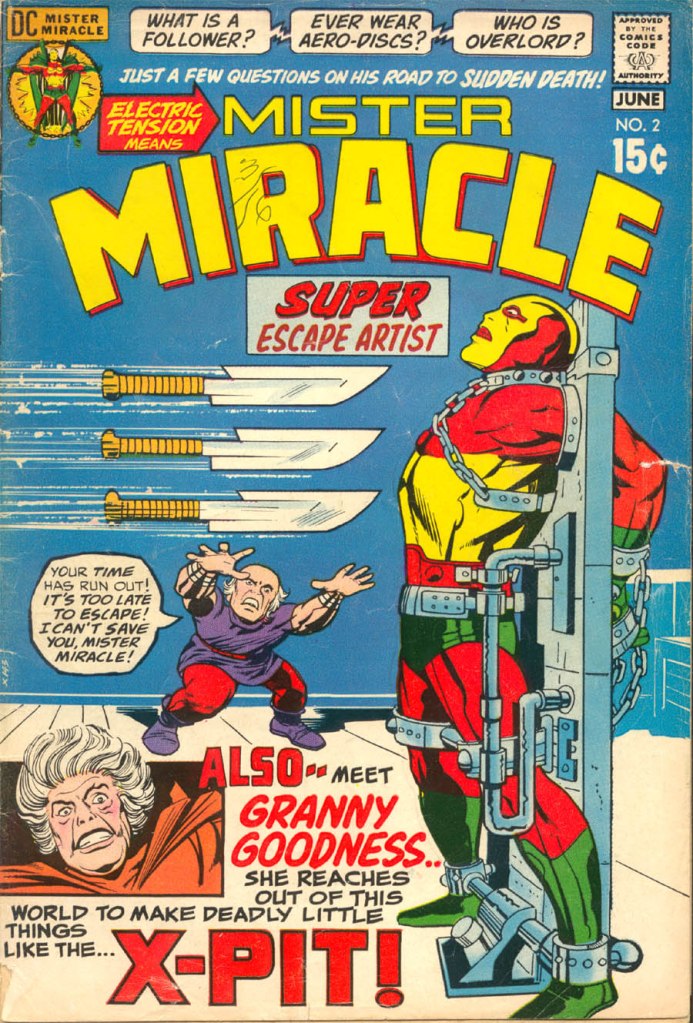
My grade school friend Donald Sims only had two comic books from Jack Kirby’s by-then-gone Fourth World line of titles. This was the other one, MISTER MIRACLE #2. And like FOREVER PEOPLE #1 which I spoke about last time, this comic book seemed strange and alien to my young sensibilities. It was clearly a super hero comic book, the lead character wore a costume. But there was something strange about it. I think that I may have encountered Mister Miracle previously in an issue of BRAVE AND THE BOLD by this time, but there he was handled by writer Bob Haney in a more prosaic manner.
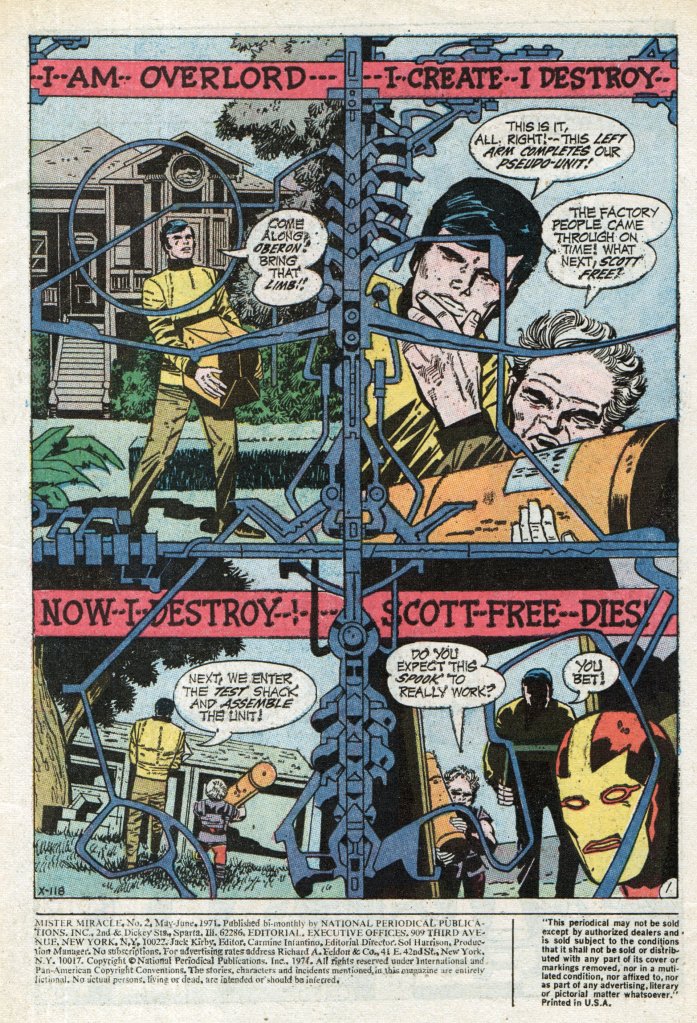
The reading experience was fairly jarring to me as well. it was unlike any DC comic that I had seen up to this point. But the fact that it was an older book made it feel like an archaeological relic of some bygone long-ago time–my young mind couldn’t even truly comprehend 1971 as anything but an eternity ago. This opening page, for example, uses the delicate machinery employed by Overlord, a computerized servant of granny Goodness, as a design element, one that even intrudes directly across the panels that are being monitored. I’d never seen anything like this before.
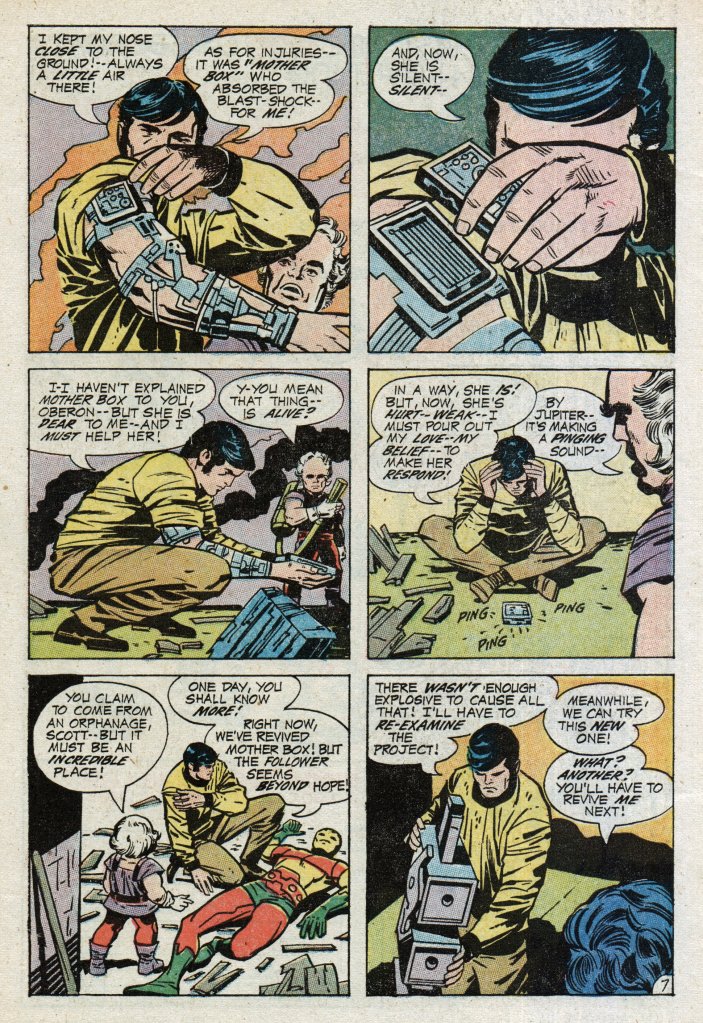
Reading this story without ever having seen issue #1, I assumed that a lot of the elements of it that I had questions about had been answered in the previous issue. But years later, when I eventually got to peruse the first issue, I learned that I was wrong. Most of what I wondered about here, the oblique references that Scott Free made to his past and his upbringing, and his strange array of gadgets and gizmos, were all set up by Kirby as ongoing mysteries that would slowly unravel. I was wrong-footed by this issue as a consequence, but not to the degree that it made me disinterested.
So what’s going on in the story? Well, we open on Scott Free and his assistant Oberon working on a new escape for Mister Miracle’s performing act. This particular escape is so dangerous that Scott is employing a “follower”, a lifelike android dressed in the Mister Miracle costume that is attuned to him and which will mimic his movements. So the follower is at the heart of the danger while Scott himself is somewhat removed and thus somewhat more safe. But the trick goes wrong when an attack launched by Overlord, a computerized operative of granny Goodness, attempts to kill Mister Miracle, setting off the explosives. Scott, though is unhurt, and he and Oberon continue to refine their act, not realizing that the mishap was caused by outside forces.
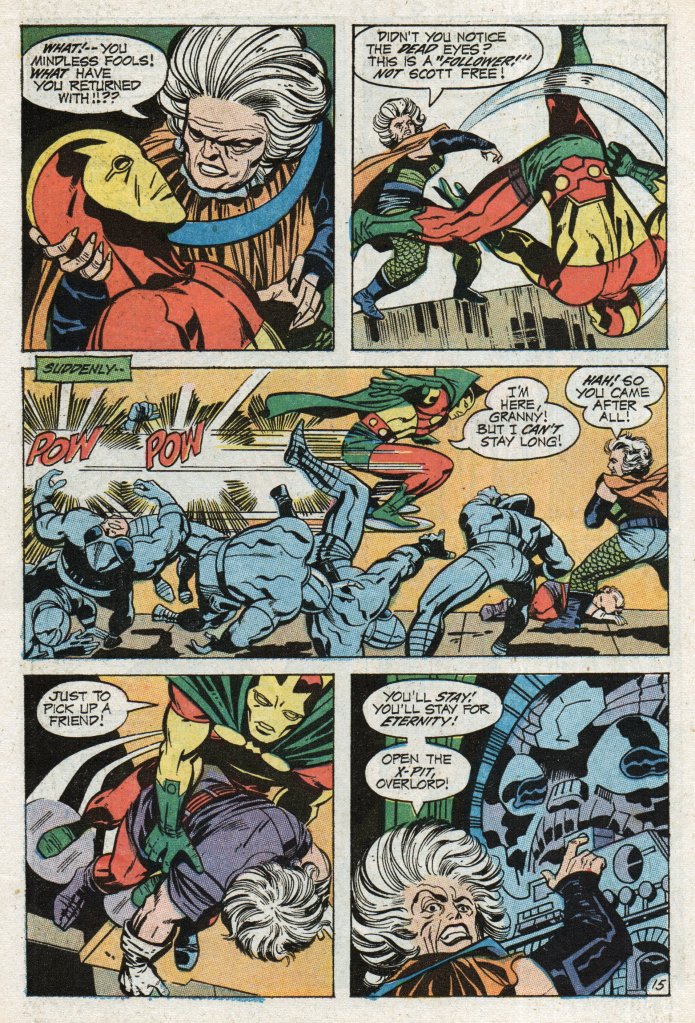
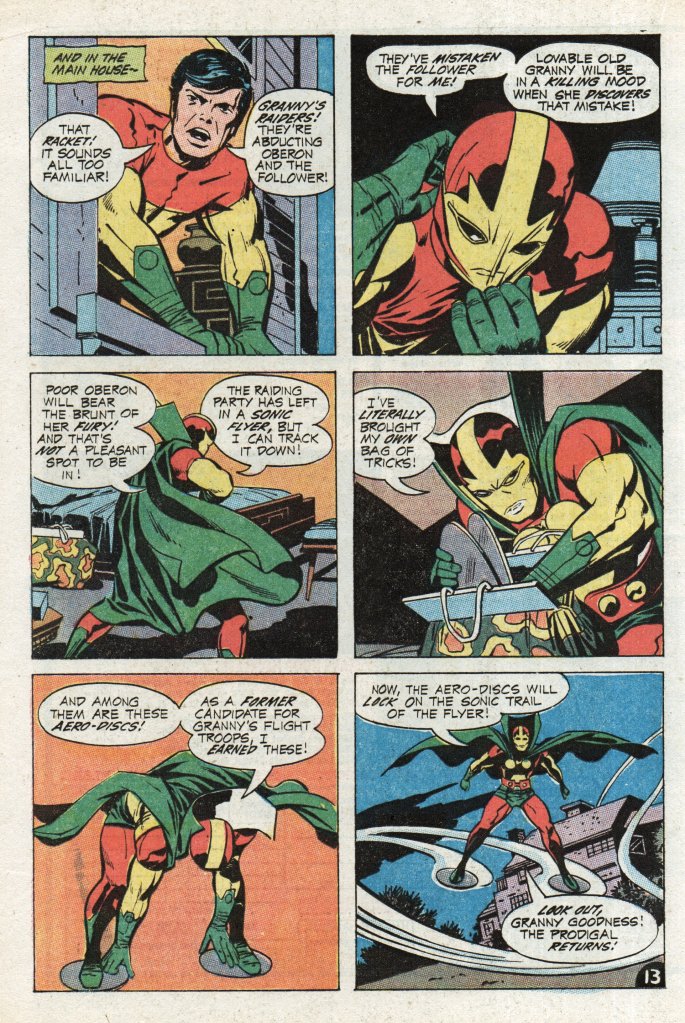
But moments later, Granny’s footsoldiers enter the grounds and capture both Oberon and the Follower, thinking that he’s the true Mister Miracle. Scott suits up and pursues them back to Granny’s citadel, intent on rescuing Oberon. But before the pair can make their escape, Granny has Overlord trap them in the X-Pit, a complex series of cunning death traps designed to test Scott Free to the limit, and ultimately to destroy him for the crime of having escaped from Granny and run to Earth.
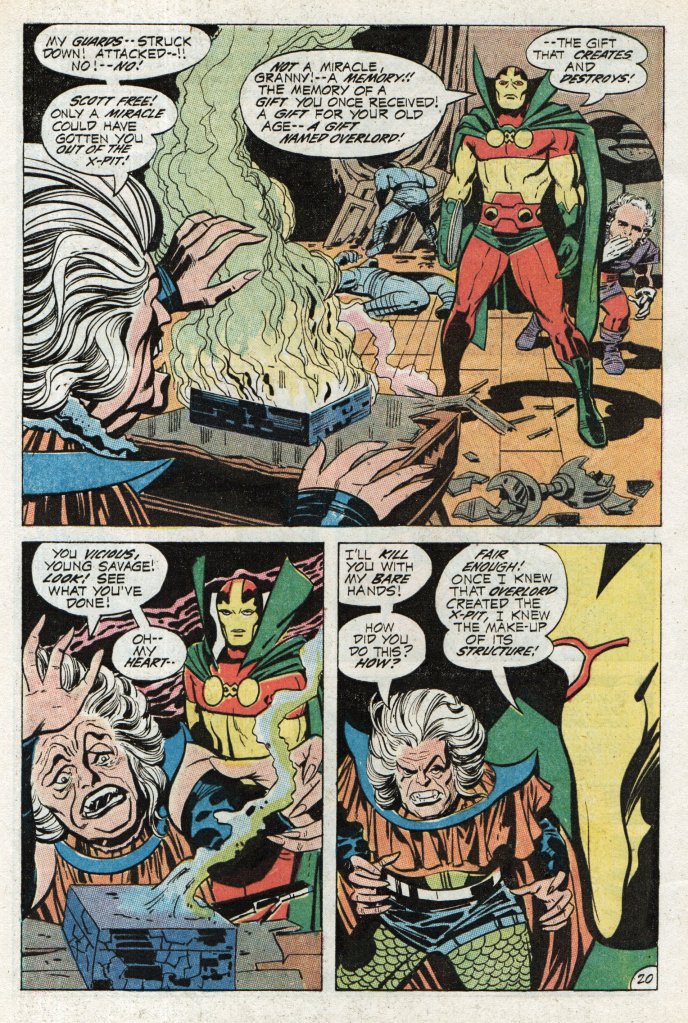
So we get a series of death-defying exploits as Mister Miracle and Oberon hurtle from one do-or-die situation to the next. In most instances, it feels as though Scott survives not because of his own skill or wits, but because he’s got superior technology in the form of his Mother Box, which is able to override granny’s traps and provide the pair with escape routes. As a kid, this seemed like cheating to me (though I wouldn’t have felt the same in a Green Lantern story where GL used his power ring to the same effect. So go figure.)
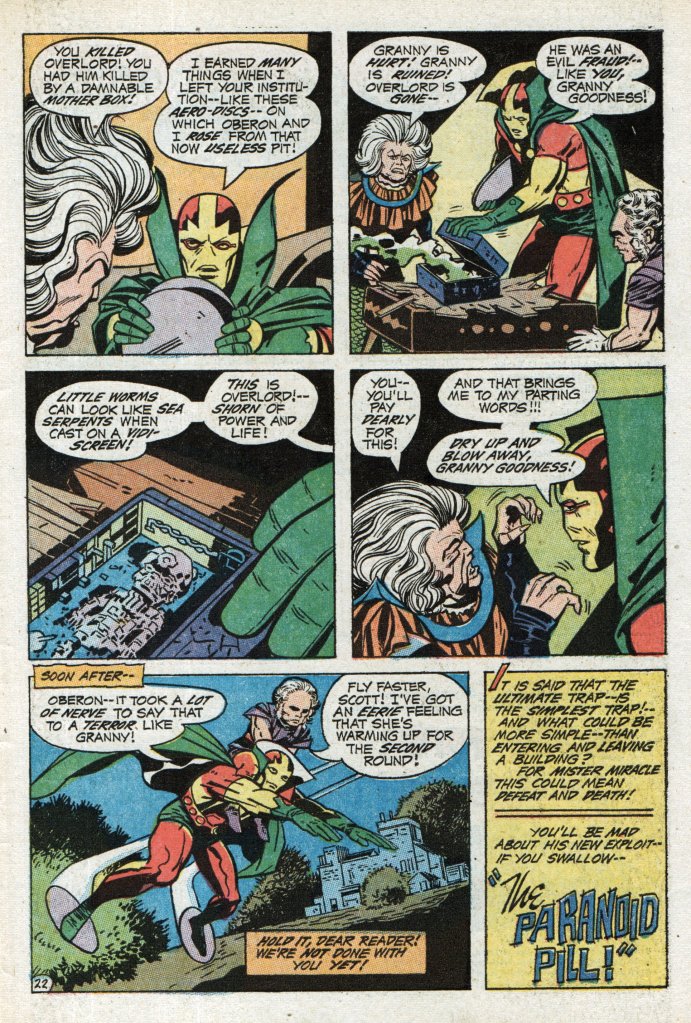
Ultimately, Scott is able to use Mother Box to deliver a fatal blow to Overlord, destroying him much to the sorrow of Granny Goodness. And we learn that Overlord wasn’t the massive computer at all, but rather a tiny, helpless life form with the power to both create and destroy. Mister Miracle tells granny to dry up and blow away, and then he and Oberon hotfoot it away from the citadel. So it was an exciting adventure, but as a kid, I can’t say that I really understood what it was all about, what the stakes were or what the bad guys were after. It was a bit too abstract for me at this point. But it was memorable.
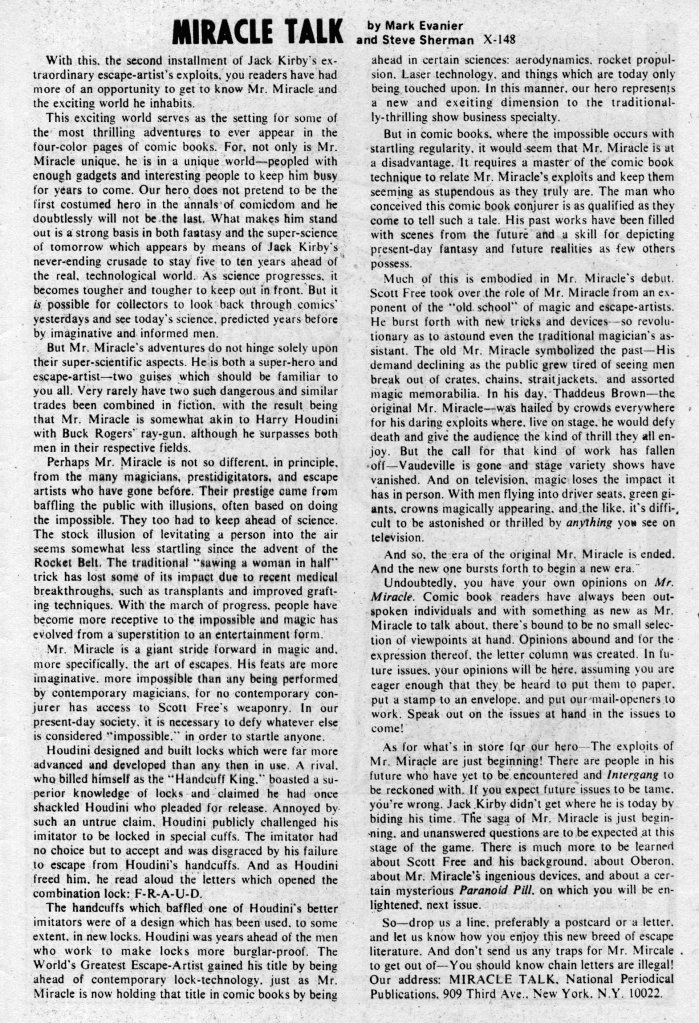
Like FOREVER PEOPLE #1, this issue of MISTER MIRACLE included a text page revealing background behind the making of the series, this one written by Kirby’s assistants of the time, Mark Evanier and Steve Sherman. This one was less colorful than the one Marv Wolfman had done in FOREVER PEOPLE #1, and so it didn’t stick we me in quite the same fashion.
 The Tom Brevoort Experience
Again, you’re almost synching up with Comics Archeology here. For us in the audience it never hurts to get differing takes.
LikeLike
I didn’t collect these until years later, nor read them (I started with #7) but the early MMs are my favorite of the Fourth World books. I agree that using gadgets for the escapes was a mistake. Kirby was trying to wow us with the cool tech, as the text page implies, but it didn’t work. The series is still cool.
Arguments such as “sawing a woman in half is old hat now that we can transplant organs” are just silly. And from my (admittedly limited) knowledge of magic history, I don’t believe Houdini did, in fact, have lockpicking skills that far in advance of lock technology.
LikeLike
Wikipedia: Harry Houdini explained some of his tricks in books written for the magic brotherhood. In Handcuff Secrets ( 1909 ), he revealed how many locks and handcuffs could be opened with properly applied force, others with shoestrings. Other times, he carried concealed lockpicks or keys. When tied down in ropes or straitjackets, he gained wiggle room by enlarging his shoulders and chest, moving his arms slightly away from his body. ME, I look at the Mother Box and other advanced technology as no different than the lockpicks or keys, especially considering how much more dangerous his stunts are or the traps of his Apokolips New God adversaries. Some how I just do see Harry Houdini surviving the X-Pit.
LikeLike
According to one history I read, Houdini also relied on handcuffs of a given model all unlocking with the same type of key, so he didn’t need handcuff-specific keys to open them.
I’m fine with Scott upgrading his tech but presenting it as the explanation at the end sometimes felt about one step above having a Bat-Rope Disintegrating Gas. Steve Englehart showing us what equipment Scott had made more sense.
That said, I love the JLU episode where Scott goes into Granny’s deathtrap and shows up at the end surviving it without any explanation.
LikeLike
There are Jack Kirby Mister Miracle stories like that JLU where he escapes without an explanation of how he did it. Like the stunt he was practicing in Mister Miracle#11 ( November-December 1972 ), 13 ( March-April 1973 — with the train ). My theory was he teleported Vanisher style and not Boom Tube or he can move at super-speed after doing his escape Houdini style.
LikeLike
Does Oberon have the power of super-speed talking? That word balloon on the cover, sheesh.
LikeLike
One of my all-time favorite comics.
LikeLike
“In most instances, it feels as though Scott survives not because of his own skill or wits, but because he’s got superior technology in the form of his Mother Box, which is able to override granny’s traps and provide the pair with escape routes. As a kid, this seemed like cheating to me (though I wouldn’t have felt the same in a Green Lantern story where GL used his power ring to the same effect. So go figure.)”
I think it’s because Mother Box felt like a “man in the chair” or some other separate character who’s giving Scott the cheat codes. GL’s ring occasionally spoke, but it seemed to be a servant of Hal’s, while Mother Box seems like a guardian of Scott’s.
I never had a real problem with Scott using tech — escape artists did use tools, after all — but having a hi-tech guardian angel did seem like cheating.
Another aspect of it may be that if you’re a Green Lantern, you’re a space sheriff, a Texas Ranger of the Galaxy, and your job is to keep the peace and stop the space crooks, while an escape artist is putting on a show. So our expectation of the “rules” is different — with an escape artist we want it to feel mysterious and magical, not be shown how he does the stunts, and with a space sheriff, we just want him to bring down the perps. So if he out-gadgets them, no sweat.
LikeLiked by 1 person
Mother Boxes: One ( Mother Boxes ) is technological, but when I saw ( marvunapp.com or Official Handbook — it was the inside back cover of the original Handbook ) the Enchanters ( Brona, Forsung and Magnir ) [ Thor#143 ( August 1967 ) ] and their Living Talismans I thought of the Mother Boxes ( Living Talismans reminded me of them — not in function ). The Forever People could use their Mother Box and the word Taaruu to switch places with the Infinity-Man and the Living Talismans could manifest as an elemental storm or as an imposing green humanoid creature as strong as an Asgardian.
LikeLike
If anyone wants to see Jack Kirby’s prototype Mister Miracle costume check out https://50yearoldcomics.com/2021/01/09/mister-miracle-1-mar-apr-1971 .
LikeLiked by 1 person
That costume is great but not for a headliner. The colors that debuted in issue two and issue one’s cover were more suited to the headliner that Mister Miracle was supposed to become.
LikeLike