

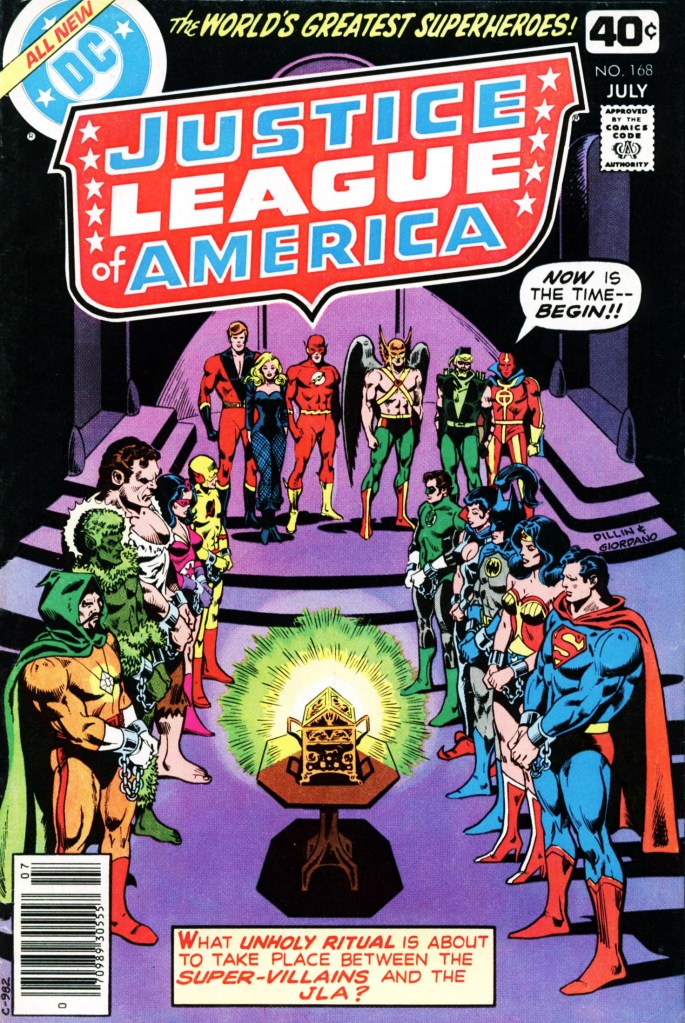
This week brought another issue of JUSTICE LEAGUE OF AMERICA, the third and concluding chapter to the League’s body-swapping adventure with the Secret Society of Super-Villains, a group whose short-lived series I was a big fan of. This story was also influential on novelist and future DC writer Brad Meltzer, who made it a key plot point in his IDENTITY CRISIS series a few decades later. This was also the first storyline to be put together under an editor other than Julie Schwartz in the history of the series–Ross Andru had taken editorial control of the book at the beginning of it. But that transition was lost upon me at the time. I wasn’t scrutinizing the credits to that degree yet.
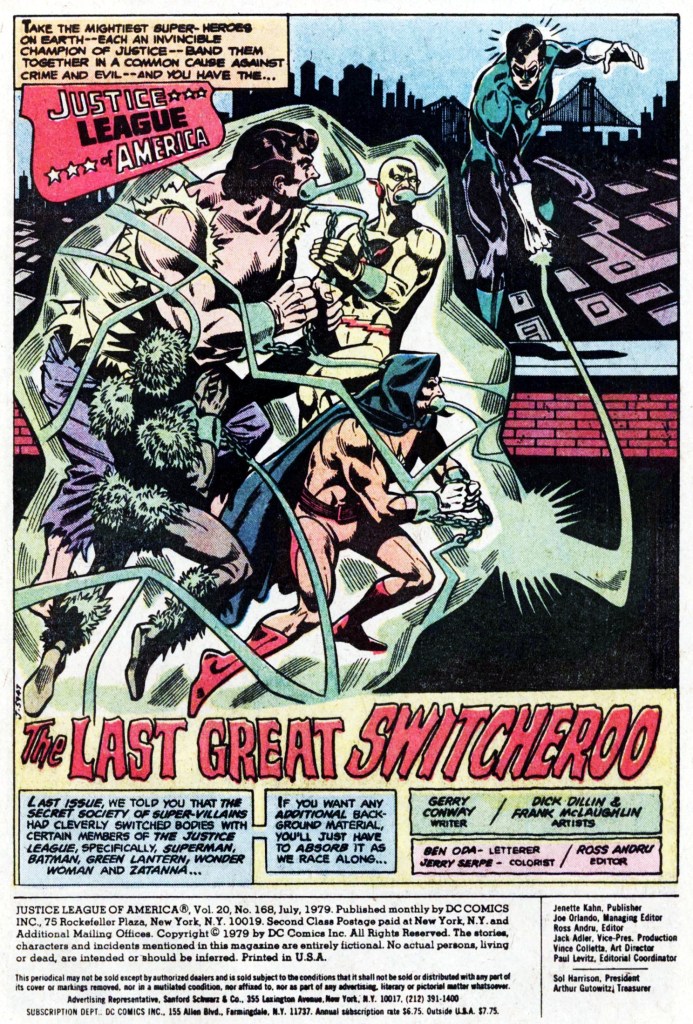
So the plot here is that the members of the Secret Society of Super Villains have switched bodies with five members of the Justice League: Superman, Batman, Wonder Woman, Green Lantern and Zatanna. And now disguised as their foes, they’ve captured the displaced Leaguers with the help of the untransformed League members. Only Zatanna remains at large, trapped in the form of Star Sapphire. Now, this raises a few pretty basic questions about this story. Given that a number of the villains such as Star Sapphire, use devices and gimmicks for their powers, why do the villains not take those away from the displaced Leaguers before they can be used against them? And for that matter, occupying the forms of Batman and Green Lantern in particular, who are masked, did nobody think to take a look to see who those heroes actually were? Writer Gerry Conway mostly tries to keep events barreling along so that nobody has time to think about such matters–but they’re pretty obvious.
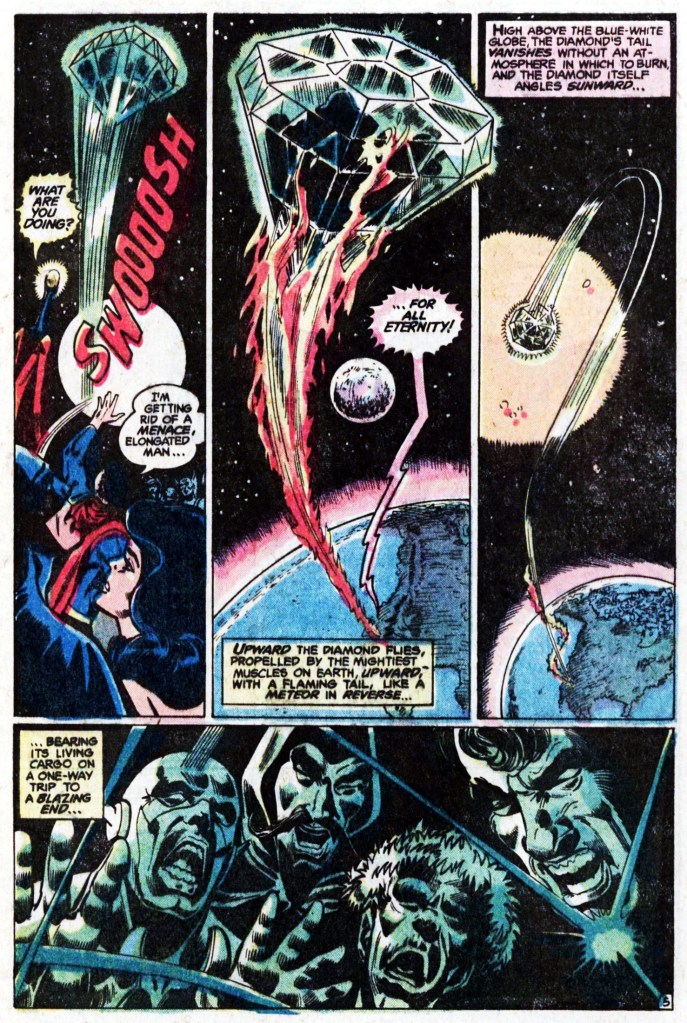
Anyway, at this point the disguised Society members have captured four of the displaced League members and are preparing to dispose of them. “Green Lantern” seals them inside a diamond-hard prison and then “Superman” picks up said prison and hurls it towards the sun. The non-transformed League members are shocked by this turn of events, but the fake Superman reassures them that he’s simply tossed the chamber into orbit until such time as a way to rehabilitate the prisoners is found. This explanation pacifies the heroes somewhat, but Green Arrow in particular is certain that this guy isn’t Superman–he smells a rat.
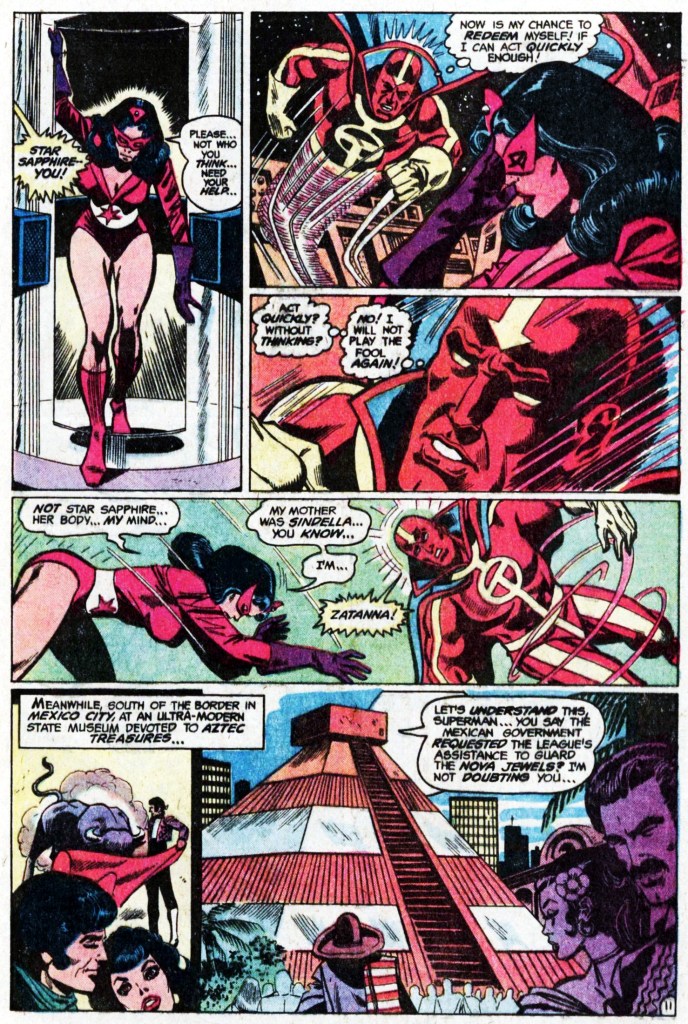
Meanwhile, up on the JLA’s satellite headquarters, the Red Tornado, who had been frozen by the villains at the beginning of this adventure, revives and breaks free of his icy entombment. He’s self-critical about the fact that once again he’s proven to be the League’s weak link, and he knows he needs to redeem himself. A moment later, he has the opportunity, as the Satellite’s teleporter flashes to life, materializing Star Sapphire within the headquarters. Red Tornado leaps to the attack, but stops, not wanting to make another foolish impulsive error. And it’s a good thing he does, because this isn’t really Star Sapphire at all, but rather Zatanna inhabiting Star Sapphire’s body.
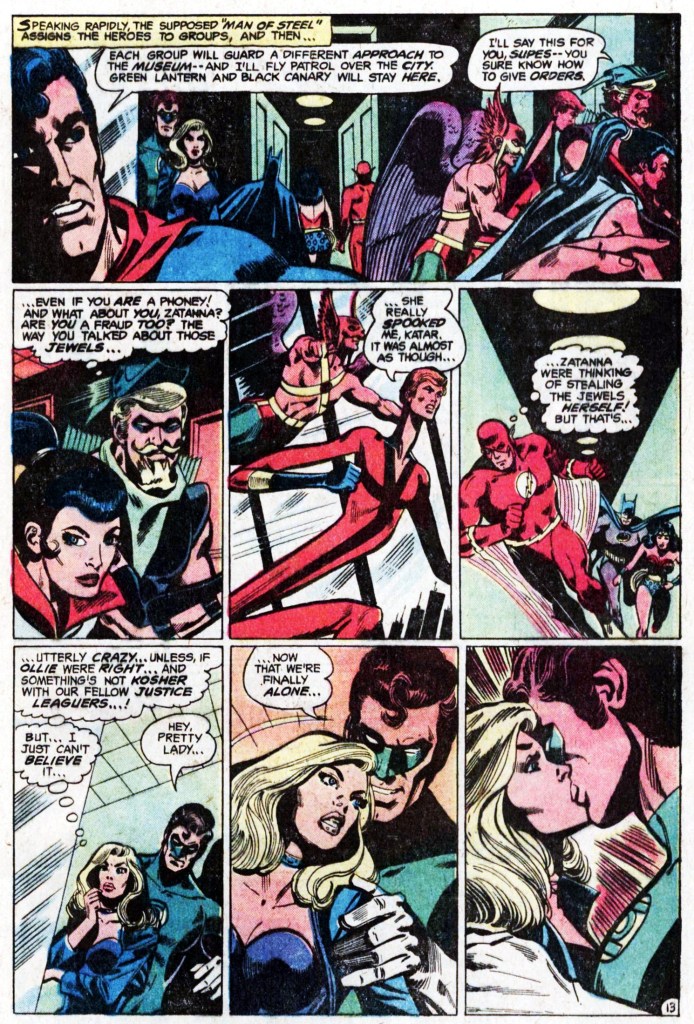
In the meantime, the Secret Society has put its ultimate plan into action–and it turns out to be about the most pedestrian and uninspired thing you could possibly imagine. Having gained the powers and the forms of five of the most powerful League members, what do these clowns decide to do with them? Why, rip off a bunch of Aztec-era jewels from a museum in Mexico City. The fake Leaguers indicate to their comrades that the Mexican Government has asked for the League’s help in guarding the jewels, and so the entire League is present–which also seems like bad planning on the villains’ part. The team splits up to cover more ground, with each secret Society member accompanied by another Leaguer.
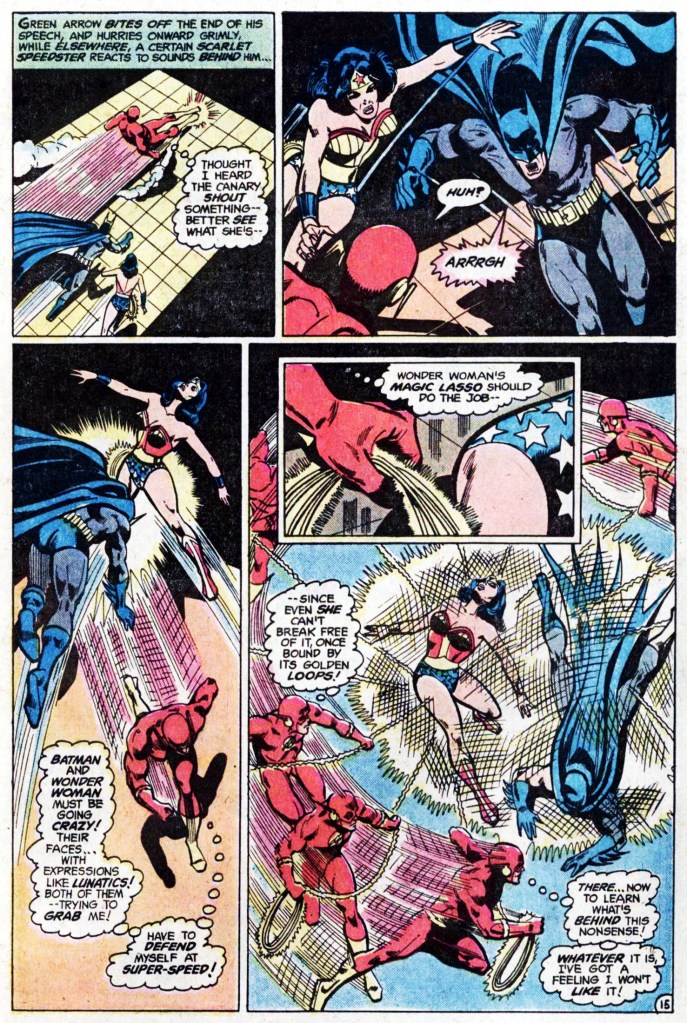
But the jig is up when the horny Professor Zoom, who inhabits the body of Green Lantern, attempts to molest Black Canary. Canary promptly clobbers him and sounds the alarm to her teammates. The bad guys immediately leap to the attack, but Green Arrow and the genuine Leaguers have been ready for this possibility and are prepared to take on their former friends. Their knowledge of the weaknesses and limitations of the forms the villains are inhabiting give them an immediate edge, and so they’re able to quickly mop up on the Secret Society in what can only be described as a huge anticlimax after three issues of plotting. The Wizard in Superman’s body attempts to escape, but he’s struck down by Superman in his old form–the trapped heroes were rescued by Red Tornado and Zatanna/Star Sapphire off-camera. So the day is saved, but the story is a bit of a wash.
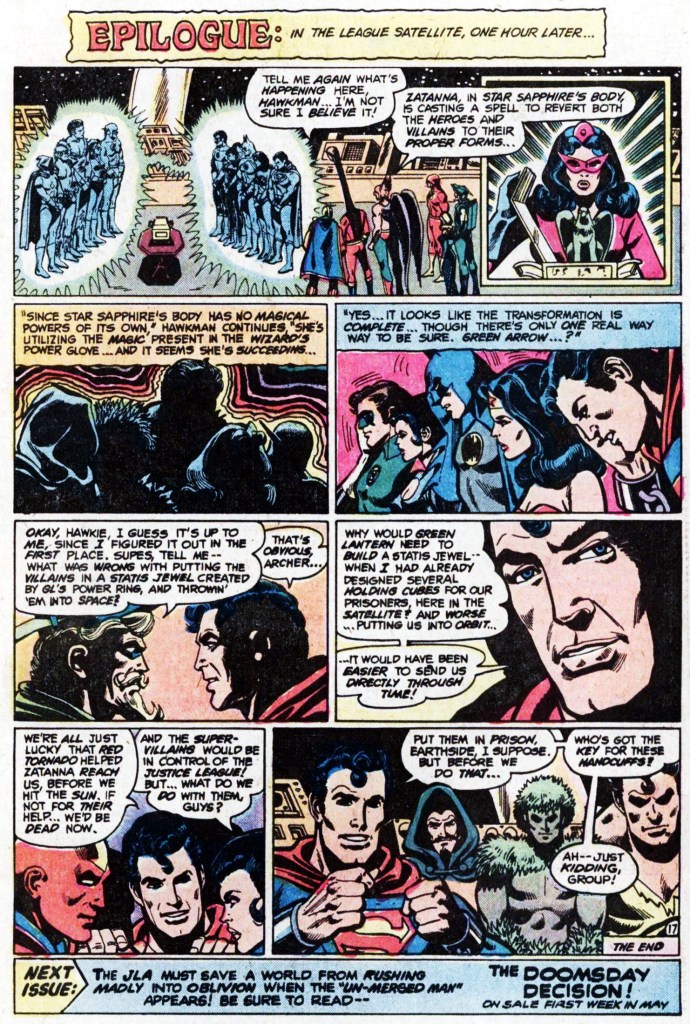
In a final page wrap-up, Zatanna utilizes the magic of the Wizards objects of power to cast a spell that puts everybody back where they belong–so the heroes are the heroes and the villains are the villains again. And that’s the end, pretty much. It is relatively apparent that editor Andru added in the final balloon on this page late in the game, worried, apparently, that fans would object to Superman needing a key to get out of the handcuffs that he’s held in. So this one is a stinker, and befouls the entire three-parter with a clunker of a conclusion. But it’s easy to see why Meltzer might have remembered this story and how using it as the catalyst moment in his later IDENTITY CRISIS series helps restore a bit of drama to this finale–as in its wake, there were things going on here that the readers of 1979, such as myself, weren’t made privy to.
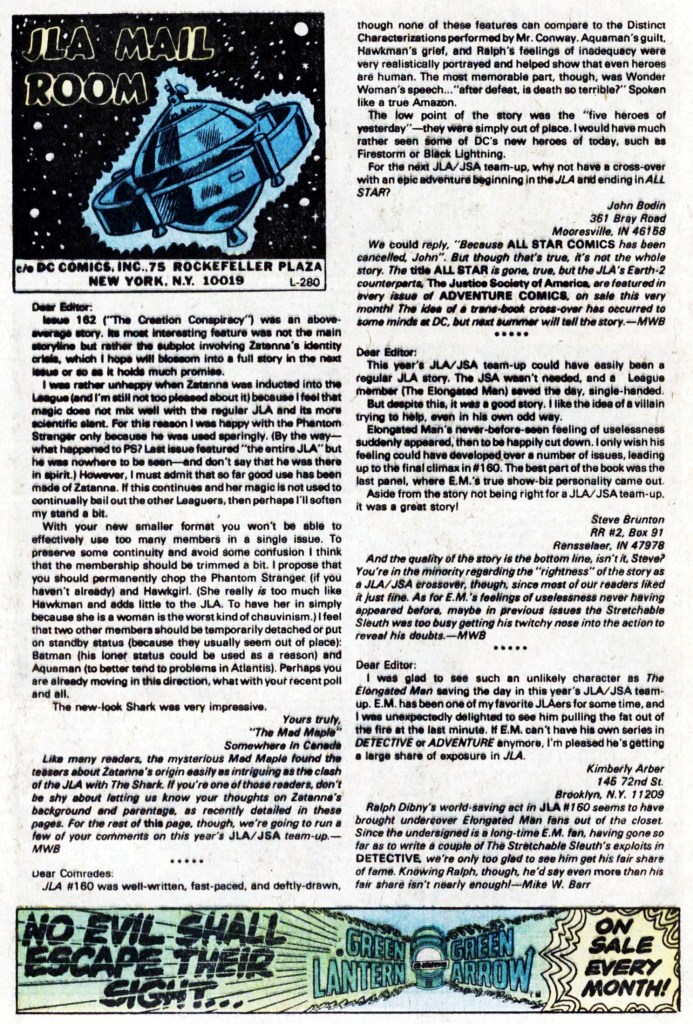
The JLA Mail Room letters page this issue features a letter sent in by a Canadian correspondent who signed his missives “The Mad Maple.” This would get shortened in the years to come by editor Tom DeFalco to T.M. Maple. Over the years, T.M. Maple would become a frequent presence on the letters pages of titles throughout the industry–it was a rare month indeed when at least one of his many erudite letters weren’t featured in one series or another. Eventually, years later, T.M. Maple revealed his true name and identity as Jim Burke. Burke passed away several years ago now, but he’s remembered for his extensive commentary by readers of this period.

And we got another installment of the weekly Daily Planet promotional page. This one contained a Fred Hembeck cartoon strip that explained briefly just who this fan cartoonist actually was, which was nice information to have. As was the always-welcome Answer Man question in which Bob Rozakis answered assorted questions posed by the firm’s readership. At the time, this page was one of the few ways for readers such as myself to know what comic books would be coming out the following week, so I studied it avidly.
 The Tom Brevoort Experience
The flaws in Conway’s JLA run are many and varied. That he was allowed to run rampant for so long remains one of the more shocking comic tales. But JLA in those days wasn’t treated as a top tier book and wouldn’t be so until after Crisis.
LikeLiked by 1 person
I think George Perez might’ve affected its tier status, even temporarily. Are we talking strictly sales?
LikeLiked by 1 person
I wasn’t into Gerry’s writing after I reached 12. Towards the end of his impressively long tenure on JLA. And his Bat-stories from the early 80’s haven’t aged well (or maybe I haven’t. 😉
His last JLA arc, the return of Despero, was aided by Luke McDonnell’s art. And I think it was finished up by incoming (and a personal fave) writer JM DeMatteis, so I stuck around for those final issues.
LikeLike
Bringing Perez on board certainly helped, even if it occurred in such a tragic way. DC knew that JLA had problems, which they tried to solved by bringing in Engelhart for a year before Conway, so I’m sure sales were a consideration but I think that the book itself was never treated as top tier despite featuring all of DC’s star players. It was just an afterthought.
LikeLike
And editors did not shar well back then and even past Crisis that remained true.
LikeLiked by 1 person
@Tim Prendergast what are basing that on? That JLA wasnt a priority. The implosion might’ve been a line wide wake up call. The SSoSV was also cancelled. Detective & Batman Family were combined. Would DC really be that cavalier with the rest of the line?
LikeLike
I think Mark Waid also revisited this story in the mid or late 1990’s. Maybe in a themed annual, or some other one-off issue. Terry Dodson on art? My memory’s hazy.
LikeLiked by 1 person
Right, “The Silver Age” — a mini-event that played out across several one-shots, bookended by two specials. My favorite bit is that Robby Reed ends up saving the day, loaning his H-Dial out to the heroes so they can transform into completely new forms and catch the bad guys off-guard. Very fun stuff:
https://dc.fandom.com/wiki/The_Silver_Age
LikeLiked by 3 people
Well, JLA was certainly consistent. Avengers had epic highs and embarrassing lows but JLA stayed in its niche, forgettable and usually improbable stories with a mostly A level team. The consistent use of Batman, Flash, Green Lantern, and Superman gave it some cachet but phoned in scripts worked against that. Conway’s long tenure makes sense what with the editorial fiefdoms and pre-Jenette and Paul DC not taking chances for the most part. It’s a title that these days I pick up for the writer since the title never inspired great like or dislike ever in me besides the Bwah Hah Hah League.
LikeLiked by 4 people
i liked the “Bwahaha” league. But my fave arc from it was the arc with the Hulk-sized Despero m, beautifully drawn by Adam Hughes. Some light moments, but mostly deadly serious.
Morrison’s “JLA” remains my favorite iteration.
LikeLike
I spoke briefly to the late George Perez many years ago at some convention. I asked him if he contributed any story-ideas to the JLA scripts which were credited solely to Conway, but he demurred, letting Conway have all the credit. But I still think the JLA stories with Perez– particularly the revised origin of the Red Tornado– read like nothing Conway did with anyone else, so I tend to think Perez was either (1) being modest, or (2) didn’t want to make waves. The world may never know.
LikeLiked by 1 person
I think the difference was Len Wein, not George.
Looking at those Conway/Pérez issues. they read to me like full-script, not plot-style, so I doubt George knew what was going to be in them before the script arrived — he was involved in plotting TITANS, but I don’t think he was with JLA. If you look at issue 195, which George did co-plot, it looks like it was done plot-style, with George breaking out into the kind of many-paneled pages he did in TITANS, but the issues around them that he’s just credited as an artist are mostly 6-7 panels, as was standard at the time.
But Len, who took over as editor some months before Dillin died, was likely involved in the plotting and direction of the series. You don’t see it immediately, as he gets used to working with the team and figuring out what he wants, but by the time I wrote an issue for him, he was clear on what he wanted. I’d pitched him a bunch of Gardner Fox-influenced ideas, and he told me they were very good Fox-type stories, but he didn’t want that. He wanted stories that felt like Roy Thomas AVENGERS stories.
And as his editorial tenure progresses, you start to see that, though I think he and Gerry are drawing more from the Englehart AVENGERS than Roy’s, with stories like the JLA going back in time to meet the DC Western heroes in a story involving a time-traveling conqueror.
But the Red Tornado origin, it seems to me, could very well be a shot at doing a story that feels like the Avengers story about the Vision being revealed to be the original Human Torch, there’s a story introducing the Major Arcana (who feel at least passingly like Marvel’s Zodiac), there’s a Despero story that feels a bit like a Grandmaster story…
It’s not overwhelming, and there are a few stories before that that feel like they’re modernizing the Fox approach, but it looks to me like Gerry and Len are figuring out how to make JLA bolder and more surprising, more like a Marvel comic. Once you hit 200, the stories feel Marvelesque without feeling specifically Marvel-inspired (though the Atom’s journey to the Micro-World felt like a definite nod to Marvel’s Sub-Atomica/Microverse), so it feels like they’ve been through their shakedown cruise and are comfortable with the new direction. And by then, I know the issues were being done plot-style, so they switched somewhere along the way. But the Pérez issues feel to me like it’s Gerry and Len figuring out what’ll work, and George happened to be there for it, enjoying drawing the League but not involved in the stories.
LikeLiked by 1 person
Okay, I’d buy that scenario more readily than the one I proposed, since it jibes with what Perez said to me. I just knew something had changed, and also (though I didn’t mention it earlier) that Conway’s scripting habits on JLA seemed to change back to what I considered his dominant plotting tendencies once Perez was gone. But now it seems more possible that the absence of Wein and his “make it like the Avengers” priority was what made the difference. I didn’t look up when Wein left but I see that editing on the first “Justice League Detroit” opus– which is more or less the “back to the old tendencies” period I’m talking about–is credited to Alan Gold.
LikeLike
Len’s last issue was the first I wrote — 224 — though I wouldn’t be surprised if the fill-ins that followed had at least been started by him.
As I understand it, Gerry had achieved a goal of his — he’d been regular writer of JLA longer than Fox had — and was ready to leave, with 223 as his last issue, but they couldn’t find a big enough name to take over, so he was talked back onboard. The only writer I know who’d been approached was Alan Moore, who chose to write SWAMP THING instead, but I assume Len, Marv, Paul, Doug and others had turned it down.
The idea of retooling JLA into a more modern book was part of what got him back aboard, and that direction began with his first issue back, as he got the League involved with the Martian story that’d set up the need for a new approach. And while I’ve never seen anyone actually say the Detroit League was inspired by the success of New Teen Titans and X-Men, it’s hard to imagine that they weren’t at least aware of the similarities while they were working it out. Though it’s fair to note that Gerry had already retooled a super-team by introducing the youthful Super-Squad into the JSA years earlier, back when the new X-Men were barely launched and hardly a success to emulate yet.
LikeLike
I loved the Daily Planet feature — if you’d asked me at the time, I’d have said I liked the Marvel Bullpen Bulletins better, but I paid more attention to the Daily Planet, reading and thinking about the articles promoting even books I had no interest in.
But I never liked the Answer Man feature. I thought Bob’s answers were so flat and disengaged — he seemed bored, and like he wanted to give the questioner the most minimal answers possible. This was probably an artifact of having so little room, since Bob isn’t like that at all. But as a reader, I felt like the Answer Man would rather not be bothered by these kids asking him stupid questions, and it put me off.
I suppose the real thing going on was that I liked the fake-Stan voice of the Bullpen Bulletins — it was engaged, excited about everything, where DC’s editorial voice was more matter-of-fact and unexcited.
But the content of those Daily Planet pages was something I really focused on — and I liked the Hembeck strips — and I think DC lost a helpful promo tool when they dropped them.
LikeLiked by 1 person
“I suppose the real thing going on was that I liked the fake-Stan voice of the Bullpen Bulletins — it was engaged, excited about everything, where DC’s editorial voice was more matter-of-fact and unexcited.”
This is purely a matter of personal preference, but I never warmed to Stan Lee’s prose style. I know I’m in the minority, but that “everyone’s invited to the clubhouse” approach always felt off-putting to me. The more straightforward approach at DC appealed to me more. The Daily Planet features were fine, but what I really liked were Dick Giordano’s Meanwhile… columns in the ’80s. Less a “welcome to the clubhouse” approach, and more a “pulling back the curtains” approach which I found to be more insightful as a teenager.
LikeLike
I liked Dick’s columns, too, and by then I’d pretty much outgrown the Bullpen Bulletins.
But DC’s editorial voice, pre-1980 or so, was very dry. At least, when they weren’t pretending to be a fictional character, which rarely went well either.
LikeLike
In the WB’s Justice League Unlimited series episode “The Great Brain Robbery” when the Flash and Luthor switched bodies, Luthor unmasked the Flash and didn’t recognize Wally West. So while Bruce Wayne might be famous enough to be recognized, Hal Jordan would be as much a nobody as Wally West was in that WB JLU episode. Plus this JLA body swapping 3-parter isn’t the only time villains could have unmasked heroes but didn’t: How many times has a masked hero been knocked out and or tied up or put in a deathtrap?
LikeLiked by 1 person
I believe it was the same week that Tom did Justice League of America#167 that I started re-watching Star Trek: Strange New Worlds season 1 On Demand and eventually re-watched episode 5 – “Spock Amok” which was in the same spirit as the Turnabout 1931 novel by Thorne Smith and 1940’s film of the same name that was based on it: Spock and T’Pring swap bodies when his attempt at a Vulcan soul sharing goes wrong. Like the Turnabout couple they had to do each other’s jobs. Then the Monday after I watched Spock Amok, I just happened to see Stargate SG-1 season 2 episode 17- “Holiday” ( Machello a dying old man ( scientist -warrior enemy of the Goa’uld ) uses his soul-swapping machine to take over Daniel Jackson’s body and gets a taste of life on Earth ) — I couldn’t believe I forgot those 2 episodes, but one hell of a coincidence that the Stargate SG-1 episode was on not to long after I watched the Star Trek: Strange New Worlds on demand.
LikeLike
Xavier Simon ( former friend of Thomas Wayne ) [ Detective Comics#481-482 ( January-March 1979 ) ] had a scientist build a machine to transfer his mind into other bodies ( He killed the scientist then transferred his mind into an albino gorilla and then Bruce Wayne’s. Spying on Bruce for years he learned he was Batman. Baron Tyrano ( The Man in the Iron Lung ) used technology to separate Green Lantern from Hal Jordan ( whose identity is unknown to him & his people ) into 2 separate people in a plot to swap bodies with Green Lantern [ Green Lantern #54 ( July 1967 ) ] — Batman & Green Lantern are the only Pre-Crisis ones in this Body-Swapping storyline that I know of that had near misses to losing their bodies. Kronin Krask ( Billionaire ) [ Thor#172 ( January 1970 ) ] kidnapped Jane Foster to force her then employer Dr. Jim North to transfer his mind into a new body ( Thor’s ).
LikeLike
Beat me to it! “I have no idea who this is.”
LikeLike
Based on this… Conway had a better touch on the Avengers even if he didn’t write that many issues.
The basic plot feels very much like something Fox and Sekowsky would have done in the 60’s, but they likely would have added some sort of out-of-the-box hook or resolution that would have added at least a hokey surprise. In 79 this could have worked if there was a body swap that was more of a slow burn with a member who didn’t have their own title. Superman has to be put back to normal pretty quickly… and who swaps body with Superman to just steal jewels?
LikeLike
The “plotting tendencies” I mentioned in my last post were my interpretation of Conway’s penchant for emulating Fox-style plots, or his view of what they were like. I thought those sort of plots still informed Justice League Detroit even when he seemed to be shooting for something more like an X-vibe in terms of the characters. At least Conway seemed to follow certain Fox-tropes a lot more than did two of his JLA predecessors, Denny O’Neil and Mike Friedrich…
LikeLike
Indeed, one of my favorite Fox/Sekowsky issues has a similar gimmick: JLA #61, “Operation: Jail the Justice League!” Although in this case, it’s not a literal body-swap, just an illusion.
(There’s also a very funny sequence where the other JLAers disguise themselves as Green Arrow, in order to throw a bad guy off his trail…all except for Wonder Woman, who takes one look in the mirror and says, “Nope, I’m never going to get away with this.”)
LikeLike
Wasting the Body-Swapping on stealing Aztec-era jewels was lacking in imagination. If it had to be jewels at least make it the equivalent of the 2 Rubies of Life [ Justice League of America#98 ( May 1972 ) — counterparts to Sargon’s Ruby of Life ] or powerful technology. The Philosopher’s Stone [ All-Star Comics#42 ( August 1948 ) JSA vs. Alchemist ][ Showcase#14 ( June 1958 ) Flash story – Doctor Alchemy ] which they could use to make themselves wealthy. For the Aztec-era jewels they leave the JLA out of their planning, hit the museum at night ( keep Blockbuster away from the capper ), Star Sapphire uses her gem to phase them through the walls ( if her gem works the same was as GL’s Power Ring ) and either use her gem to neutralize the alarm system or the Wizard uses magic to take care of the alarm system and teleport them in an out of the museum or Reverse-Flash could get in an out before the alarms go off by himself.
LikeLike
One interesting sidenote to the idea of Len Wein promoting a “JLA as Avengers” is that when Wein wrote JLA for fourteen issues, there’s nothing “Avengers-like” I could see. I thought Wein did better than Conway in emulating Fox-type plots, too. In the 70s liked Wein’s JLA better than that of anyone else in the decade except Englehart’s.
LikeLike
I agree on Wein and Englehart and have to point out that had Schwartz as an editor. If he’d even thought of JLA as Avengers then, it’s doubtful it would have been accepted.
LikeLiked by 1 person
Valid point. Schwartz edited most if not all of the Wein and Englehart issues and I guess (without checking) the early Conways up to a point. All three have in common a pretty heavy use of “gosh-wow” SF visual gimmicks of the sort Schwartz was known to favor, so it’s quite possible the common element was not emulating Gardner Fox but pleasing the editor. I don’t think during Englehart’s Avengers run he emphasized visual elements as wild as (say) Amos Fortune using Wonder Woman’s body as a prism for some reason I forget. No, not even in the Avengers story ending in a woman marrying a dead man who’s also the reincarnation of a tree.
LikeLike