


My brother Ken was still indulging in his momentary interest in Conan the Barbarian, and so he wound up buying this issue of SAVAGE SWORD OF CONAN when it came out. Looking back, I find that I’m a bit surprised that my mother went along with this, given the degree of nudity on display both in the issue and on this cover. For the most part, though, my parents weren’t especially restrictive about what we kids could read or watch, and my Mom did take me to the occasional R-rated movie during my younger days, notably the HEAVY METAL animated film. So I suppose this is consistent with that behavior.
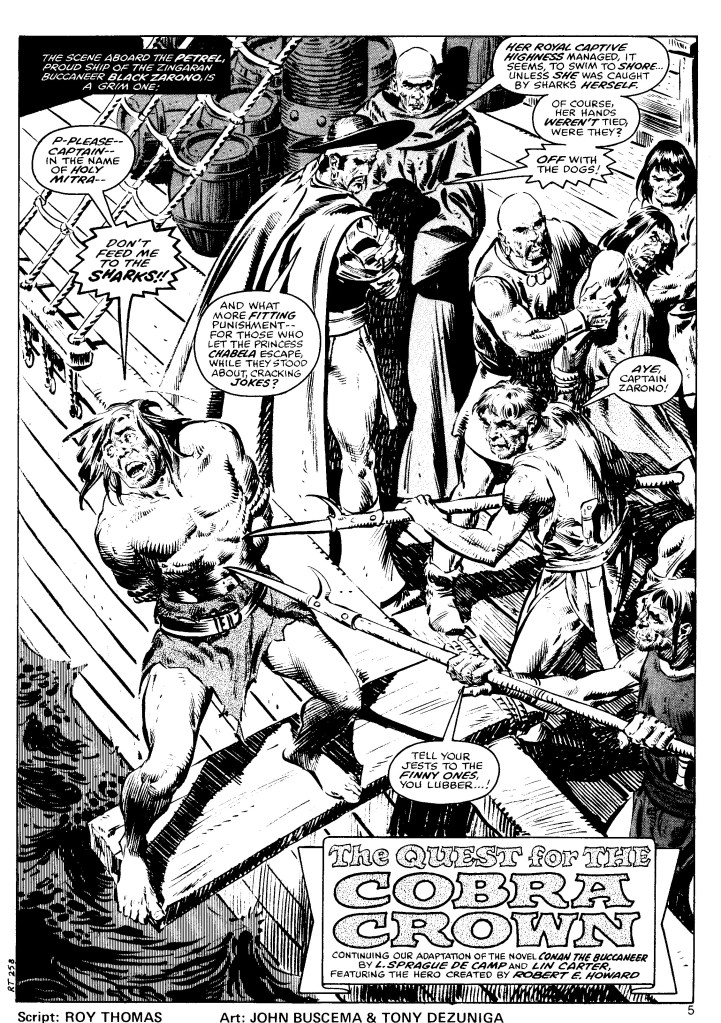
We’ve gone over all of this before, but I was then and still am now only vaguely interested in the Sword and Sorcery genre, so my engagement with this material was pretty tepid at best. There was unquestionably some really good work done in these books, work that I can appreciate a lot better at my more advanced age. But still, I never really feel the draw to read a big chunk of this material. That said, SAVAGE SWORD OF CONAN was a real mainstream success story for Marvel, the only one of the many black and white magazines that the company launched to go the distance and amass a run that encompassed years. Seems it appealed to a certain impulse buying audience that might have felt childish picking up a regular four-color comic book. And Conan’s adventures didn’t carry the silliness of men in tights battling one another.

This issue featured the second part of writer/editor Roy Thomas’s adaptation of L. Sprague de Camp’s novel CONAN THE BUCCANEER. For the most part, at least in the early days, Roy avoided referencing Conan material produced by authors other than creator Robert E. Howard. And in fact, contractually he had no access to those other stories. By by 1979, the relationship between all parties had apparently warmed up enough to permit Thomas to include such tales among the material he was adapting to comics. Roy makes full use of SAVAGE SWORD’s expansive page length to tackle this adaptation over the course of three issues, allowing him to give it greater incident and nuance than it would have had otherwise.
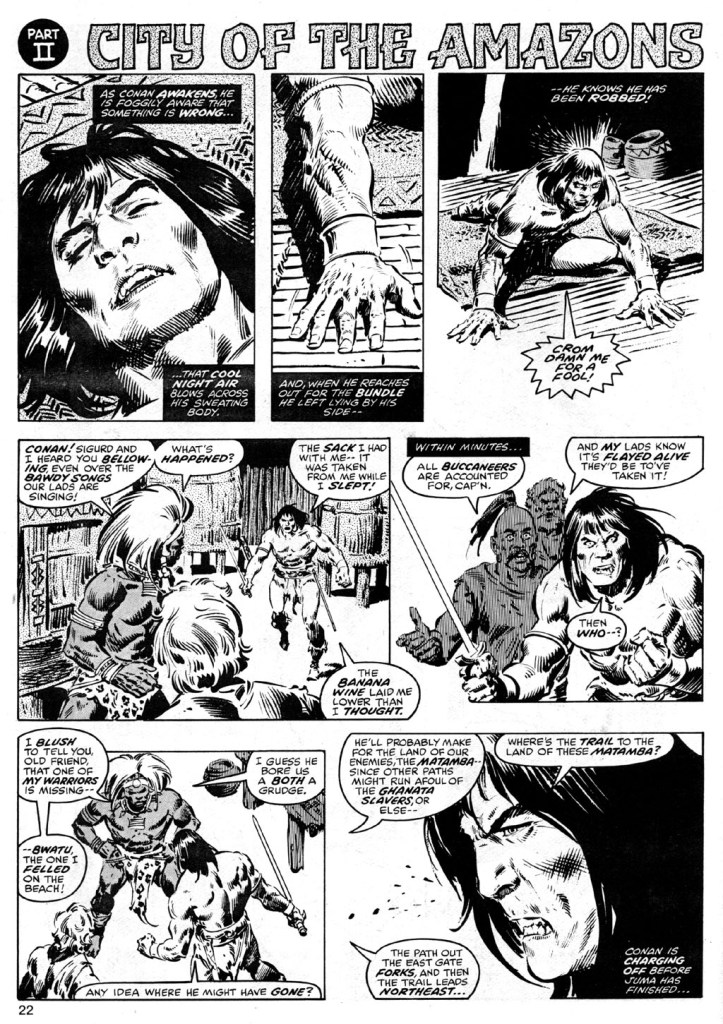
Regular penciler/breakdown artist John Buscema here has his work finished by Filipino artist Tony DeZuniga. This was a good call, in that DeZuniga added a lot of texture and depth to Buscema’s rock-solid storytelling. In a medium where color couldn’t be depended upon to make the pages feel fully realized, it was down to DeZuniga and others like him to provide that completeness through their use of the ink line. That all said, I’ve never been a huge fan of DeZuniga’s work. He tended to be what I sometimes call a “thick sauce”, meaning that he had a tendency to subsume the style of those he was working over underneath his own approach. In particular DeZuniga’s faces always stood out, and often didn’t resemble what Buscema must have done. It wasn’t a look that I was enamored of.
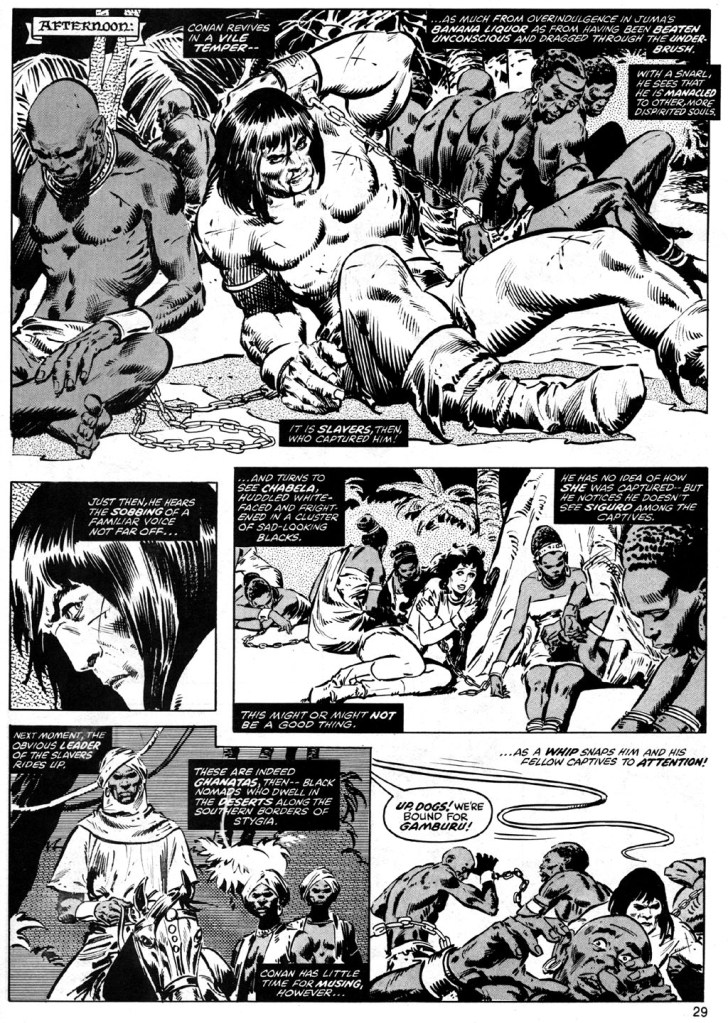
As for the story, it moved from incident to incident without connecting all that greatly with me. As I had no working knowledge of the topography of the Hyborean Age nor any of the assorted peoples who made up its world, the journeys and encounters were somewhat meaningless to me. I also didn’t find Conan to be especially heroic for all that he was the strongest warrior and the greatest fighter and so forth. So it was hard to whip up any genuine enthusiasm for his triumphs, nor concern for his reversals. I must assume that my brother felt more of a connection to what was going on, given that he continued to buy such comics for a little while longer. But me, I never really felt it.

The big feature of this second chapter of the adaptation is that it brings Conan once more into conflict with his great enemy, the Stygian sorcerer Thoth-Amon. As i understand things, while Howard created Thoth-Amon and used him in two Conan stories, the two characters never even met face-to-face in those stories. It was later writers, including Roy Thomas, who developed their relationship over time to make it a more personal conflict. And here, he’s mostly a figure who is involved at a distance, coveting the mystic Cobra Crown that Conan has inadvertently wound up in possession of. Otherwise, much of this installment is dedicated to the Cimmerian and Princess Chabela being captured by slavers and sold to a group of Amazons led by Queen Nzinga. Nzinga has eyes for Conan, and consequently a growing hatred for Chabela, whom he constantly saves from the worst abuse of slavery.
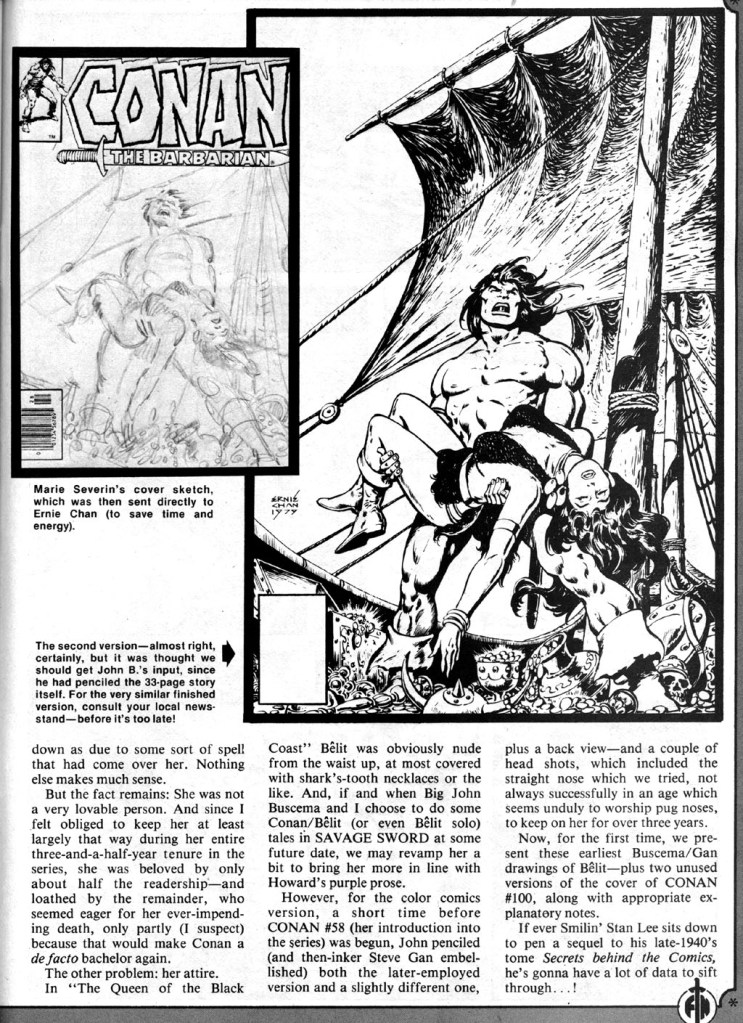
After the main story concludes, Roy provides a feature for the next couple of pages detailing the creation of the comic book incarnation of Belit and the making of the cover to CONAN #100. This piece fascinated me, as i was always interested in behind-the-scenes information on the making of the comics that I loved. Amazingly, Thomas runs two other rejected covers for the issue–the piece was executed three times in all, with only relatively minor differences between the images. This sems very much in keeping with the period, where some covers would wind up executed again and again in search of some mythical perfection. I don’t know that any more comics were sold using the final cover to CONAN #100 than would have been with the version above, for example.

As a back-up feature, there’s a Solomon Kane story freely adapted from a poem written by Robert E. Howard and illustrated by Dave Wenzel. It’s nice, but not terribly engaging, at least to me. Reading the poem’s prose felt to me like doing homework, and I had no real knowledge of who Solomon Kane was or what his deal was all about, so I was pretty clueless as a reader.
 The Tom Brevoort Experience
IMHO many of us of a certain age gave a look in at Conan and sword & sorcery in general back then because there was so damn much of it about. The genre has heavily mined in the late 70s & early 80s to the point of unavoidability. Aside: I was only ever vaguely interested in Conan but was completely turned off when I discovered one of Howard’s supposed Conan novels was actually written about a different character and was rewritten ala Mad Libs into a Conan story by a modern writer. I ran and have never looked back.
LikeLiked by 1 person
Lin Carter, who wrote a number of those, argued that all REH characters were pretty much interchangeable so it was no big. It was; Howard’s non-supernatural historical adventures were tedious and they stayed tedious when they became Conan stories. The heavily non-REH Lancer Conan paperbacks of the 1960s put me off him for years. I did enjoy Moorcock and Fritz Leiber’s sword and sorcery, however.
Likewise, the comics were way better when Roy stuck to his own stuff than when he adapted the Carter novels (deCamp was a better writer than Carter but he didn’t do great Conan either).
LikeLiked by 1 person
Not sure of the attraction of an author who wrote interchangeable characters to another author who wanted to write those characters. I didn’t really discover Moorcock until the First comic adaptions and have remained a fan ever since.
LikeLike
Disagree. For instance, I like the comics adaptation of “Shadow of the Vulture” just fine, but the original story is just as good if not better. You wouldn’t catch “Red Sonya” teasing a bunch of soldiers by dancing atop a table, after all– though I don’t doubt that a fair number of readers bought the issue if they happened to see the splash first.
LikeLike
No argument, Sonya steals the show in that story. And I agree, REH’s characters aren’t interchangeable with Conan or Solomon Kane (who aren’t interchangeable with each other).
A lot of his B-list stories, though, are indeed kind of interchangeable. In several historical adventures have Faction A and Faction B, Leader A and Leader B, Treacherous Lover of One Leader and there’s nobody with the Conan charisma (or Red Sonya) to make it catch fire. Turning those stories into Conan stories never worked for me.
And yes, while Carter did some amazing editing at Ballantine Books’ Adult Fantasy line he was, as someone put it, specfic methadone in his own writing (i.e., if you couldn’t live with the fact there was no more new Conan, Thongor wouldn’t give you the same high but it might take the edge off).
LikeLiked by 1 person
I could see your mom being lenient about these mags. She let Joe’s early band rehearse in the basement. She was always very nice to me, and seemed to like her boys pursing their creative interests. She has a great, if not quirky sense of humor. And a great big, warm mom smile. And an honest, giggling laugh. I haven’t seen her in a several years now, since Joe moved out of Delaware County, PA.
I’ve seen DeZuniga save lesser artists’ work. And add a more naturalistic edge to otherwise very popular artists (yes, John Byrne in MTU, Spidey & Thor vs. the Living Monolith, which you’ve covered before). I’ve also seen him smother some artists’ work. And as great as he is inking his own fabulous drawings, Tony can make or break others’. Like Klaus Janson’s. Only Klaus should ink Klaus’s own drawings.
In the case of a master like John Buscema, there wasn’t anything to improve on with his finished pencil drawings. I’ve come to realize J. Buscema was his own best inker. Though I did seeing what other top-tir inkers like Al Williamson & Klaus added. There was more of an influence on J. Buscema’s breakdowns or layouts than on his full drawings. You can see his style easily in most of the faces & figures, with a few exception on the faces where they look more like DeZuniga’s style.
Fortunately both Tony and Ernie Chan (Chua) were both good choices for Conan and his world. But I liked seeing Buscema’s unique look come through on his characters’ faces & figures. Their expressions & body language. Overall, this issue was a god collaboration..
LikeLiked by 1 person
Ooops. “Overall, this was a good (not “god”) collaboration”.
LikeLike
Pulp heroes seemed to be a lot less worried about having a recurring arch-nemesis than comic books. And Conan didn’t need one.
If nothing else, Tony DeZuniga drew the original three Black Orchid stories, which I loved (and still do).
LikeLike
My dad was a longtime fan of both the monthly Conan and Savage Sword, though both tended to be more impulse purchases for him, since even as an occasional comics shop denizen, he bought most of his comics at newsstands and corner stores, as God intended. Conan was a series that didn’t require much backstory and so it was ideally suited for occasional readers who liked the character but didn’t want to get too bogged down in continuity. I would usually have a look at them myself, though like you I never really connected with the series. I liked fantasy well enough, but for whatever reason I tended to prefer the “elves and wizards” school (which of course Marvel also attempted with Weirdworld and its dazzling Buscema/Nebres/Ledger art team) over “barbarians and sorcerers” stuff.
That said, this particular issue of Savage Sword (and the larger series it was part of) was a favorite and one that I returned to over the years. The cover by Marvel mag stalwart Earl Norem is particularly great, really capturing the pulpy essence of the story and the series in general. Yes, some of the elements of the cover (and the story within) might be seen as problematic by today’s standards but it’s so unapologetically lurid that I’m still utterly sold on it.
I agree that Tony DeZuniga wasn’t quite the best fit for John Buscema, but one thing I always liked about Conan was that it kept things fresh by changing up inkers while keeping the Buscema baseline in terms of pacing, staging, figures, storytelling, etc. (Although personally, I preferred Alfredo Alcala or Rudy Nebres!)
LikeLike
I’ve read a fair amount of Lin Carter’s fiction over the years, and if anyone had no room to talk about “interchangeable characters,” that would be him.
LikeLike
No question that Lin Carter distinguished himself by editing the Ballantine fantasy imprint, I still reread a lot of those whenever I find time, and am working on a reread of VATHEK now, complete with three additional Beckford short stories making their first paperback appearance. Carter did fandom a great service with his editing, I just wish he’d put as much work into his writing. I’d agree that REH, like most prolific writers, tended to write a lot of routine types, one being his standard musclehead brawler. But like I said, I haven’t come across any Carter heroes who don’t seem like Conan or John Carter knockoffs– though there was one story from an abortive series, where he had a magician-hero who learned the arts because his hands had been crushed by the same enemies who slew his parents, blah blah blah, and so the guy couldn’t handle a sword. That was the only change of pace known to me– whereas sometimes even some one-shot Howard characters have a little extra somethin’.
LikeLike