

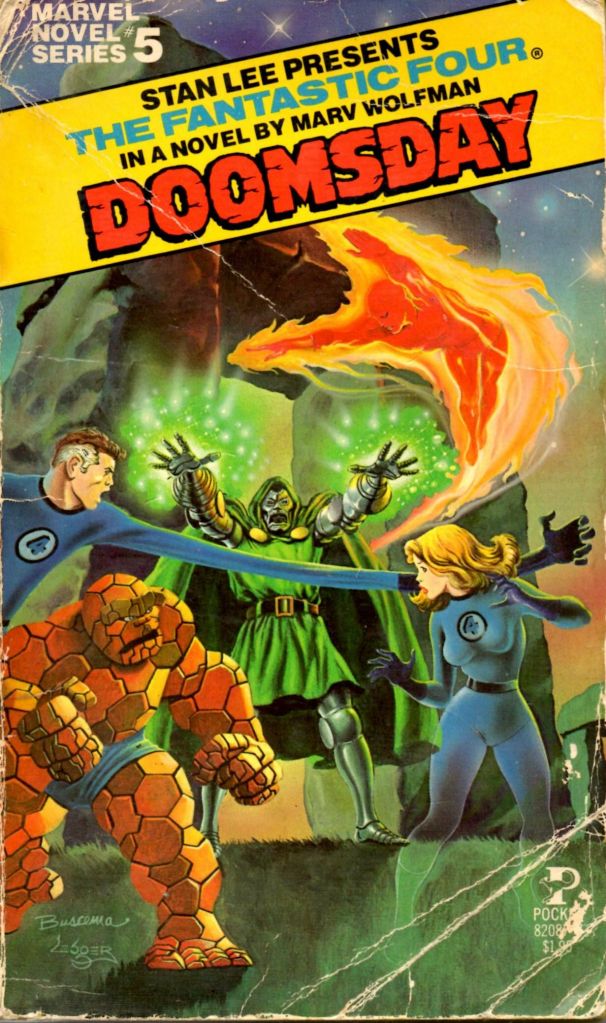
It was at about this point that my family went to see the film BUCK ROGERS IN THE 25th CENTURY at the local movie theater. We didn’t realize it at the time–well, I didn’t, at least–but this film was actually the pilot movie for a new television series that would debut in a couple of months. But the absolute frenzy surrounding science fiction that cropped up in the wake of STAR WARS made it a profitable decision to release the film in cinemas before it made it’s TV debut. I remember liking it well enough but not really being knocked out by it. That said, my family watched the eventual television series regularly throughout its two seasons. I can remember being especially excited about the episode in which Buster Crabbe guest-starred, having seen him as Flash Gordon in the serials and being aware that he’d also played Buck Rogers back in the day.
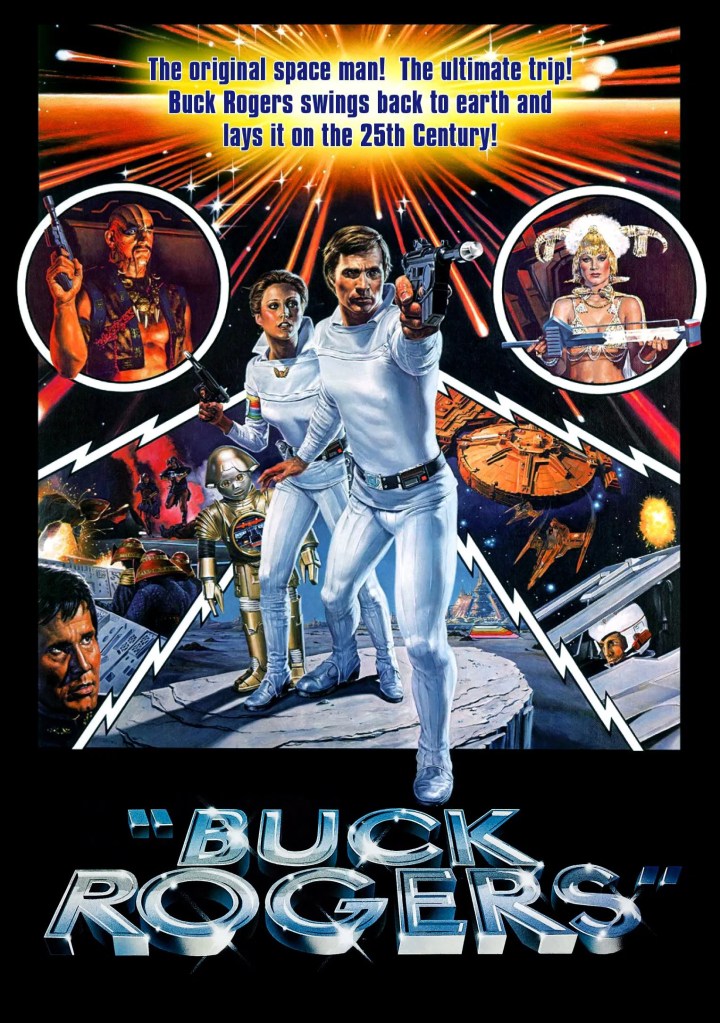
It may even have been on the drive back home from the movie theater that we stopped in to one of the local bookstores. And that’s when I found it: MARVEL NOVEL SERIES #5, spotlighting my absolute favorite series, the Fantastic Four. In addition to releasing paperback-sized reprint collections of early comic book stories, Pocket Books had also begun to roll out a series of Marvel-themed novels, in which the colorful characters from the comic book page were translated into prose form. My own copy of this edition is a bit worse for wear; at a certain point, I lent it to my similarly-FF-obsessed friend David Steckel, who wound up putting it into his pocket and cracking the spine in half as he proceeded to run and roughhouse.
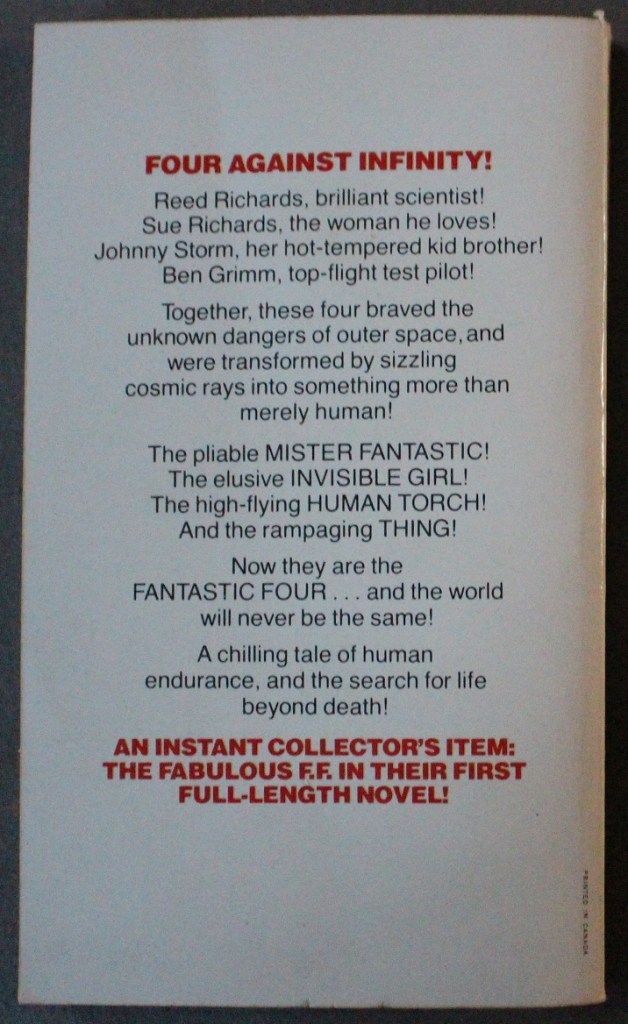
This novel was a completely new story written by Marv Wolfman, who was at the time also writing the ongoing FANTASTIC FOUR comic book series. These novels were apparently written very quickly, and for not a whole lot of money, so in later years Marv has talked about pretty much jamming this out. Still, as a young reader, I enjoyed it. It felt just a bit more serious and legitimate than the average comic book story. And I especially liked the painted cover by John Buscema and Peter Ledger, which felt a lot closer to a legitimate comic book image than a number of the previous Novel covers while still being appropriately slick. I could tell that it was Buscema’s work, but I couldn’t quite work out how he made it so polished and photographic, having no great knowledge of the airbrush as a tool or painting as a medium. Today, particularly with the work of Alex Ross having become so prevalent, it’s no big deal to see a realistic representation of a super hero that takes its subject matter seriously. But in 1979 when this volume first came out, that was a much rarer thing.
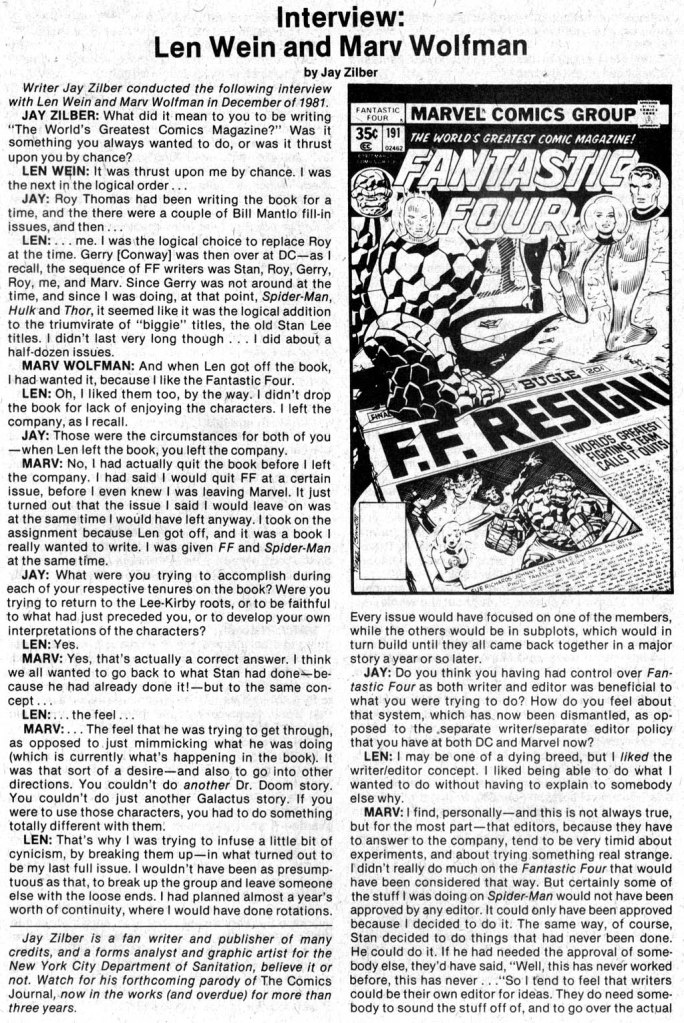
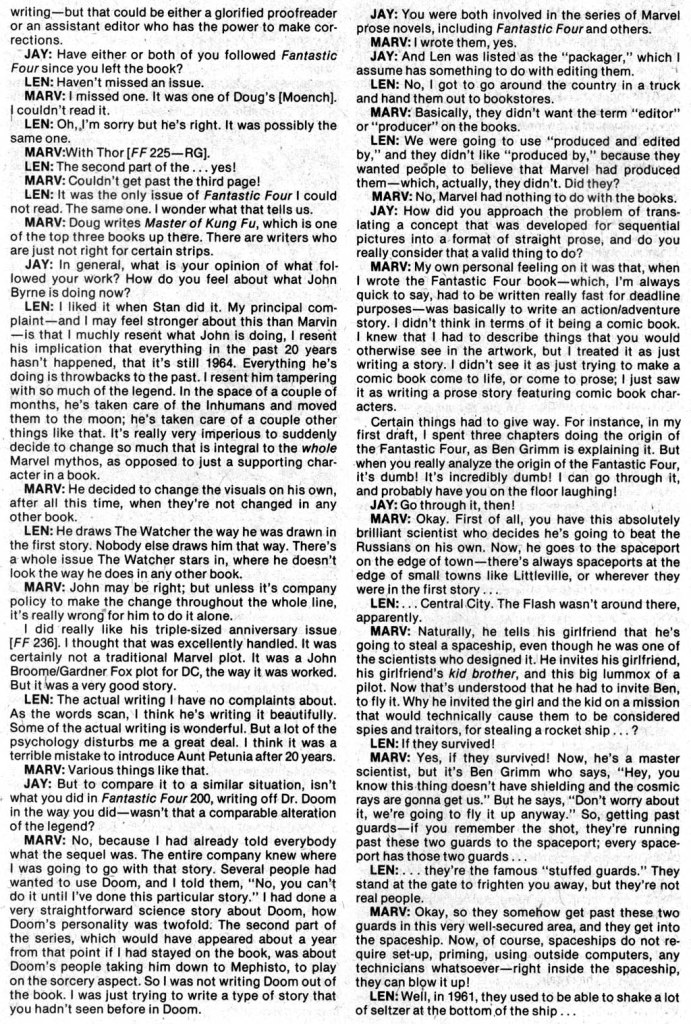
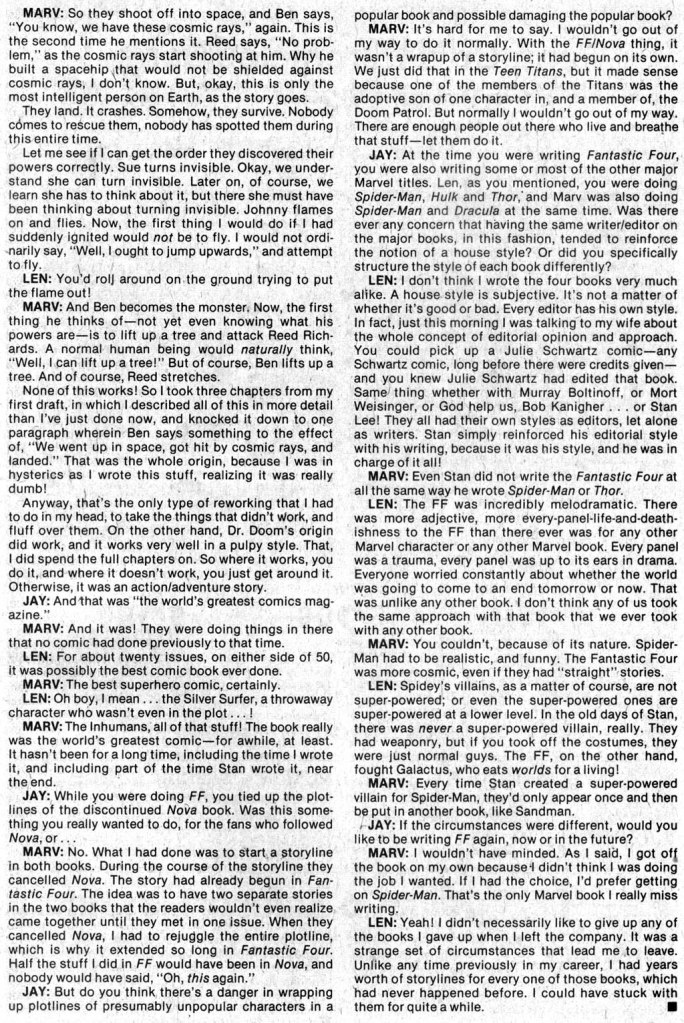
Marv speaks about the process of writing this novel at some length in this interview with him and fellow writer/editor Len Wein from FANTACO CHRONICLES #2 in 1981.
 The Tom Brevoort Experience
I’ve never read any novel featuring comic characters or novelizations of a comic. To me, comics are comics and books are books. Age never came with changing that. I agree with the two writers in their criticism of Byrne but to be honest, I didn’t like what they did either. I do think Wein did a much, much better job than Wolfman though.
LikeLike
I’d recommend Elliot S! Maggin’s Superman novel “Last Son of Krypton”. It’s quite good, with perhaps the best pre-Crisis portrayal of Lex Luthor. Maggin uses the strength of the book format for an extensive amount of character thoughts and dialogue exploring the Superman/Luthor relationship. He really made Luthor come alive as a full-fledged character with his own understandable motivations, rather than just a plot antagonist.
His other novel, “Miracle Monday” is said to be good too, though I haven’t read it.
Ah, his “Starwinds Howl” (The Epic Story Of Krypto The Superdog) is online. Highly recommended!
https://www.supermanthroughtheages.com/starwinds-howl/welcome.php
LikeLike
I read LAST SON OF KRYPTON when it was first published. I didn’t know how to take it. I don’t know the impetus for Maggin! writing it, but it was marketed as a tie-in to the first Christopher Reeve movie, complete with a signature of movie stills. The problem was that it was based on the continuity of the Schwartz-edited comics–complete with Steve Lombard and the Oa Guardians as supporting characters–and not the narrative world of the movie. I eventually chalked it up to DC’s failure to recognize that for most readers, the contemporary film and TV treatments of their characters were the characters to the general public. People who came to the comics from the film/TV stuff were bound to find the comics very strange and off-putting. The film/TV treatments of course did nothing for the comics sales.
LikeLike
RSMartin: You’re absolutely right, it’s steeped in the 70’s comics continuity, yet was marketed as a movie tie-in. I couldn’t say how well it sold as movie-related merchandise. While I can’t come up with another example, I suspect it was hardly the only project not based on a movie to be pushed in the wake of a big movie publicity campaign. But for a fan of those comics, it’s a novel which is notably successful on its own story-telling terms at exploring those comics characters. I’d already read many Maggin Superman comics when I read the novel, thus I took it as expanding in text some ideas he had written about in the comics stories. I wasn’t expecting a novelization of the Superman movie or anything like present-day Marvel Cinematic Universe. To me, any connection was obviously just publisher trend-following.
LikeLiked by 1 person
Last Son of Krypton is a delight. Maggin anticipates the idea of Lex as a corporate tycoon, except in his version he does it through a dozen or so pseudonyms and front companies. Miracle Monday is good too.
While I prefer my comics as comics rather than text, Adam Troy Castro’s Return of the Sinister Six trilogy from the 1990s is very entertaining.
IIRC Doomsday was enjoyable, and I did like Wolfman’s take on Reed meeting Sue. Not canon, but Jack and Stan weren’t consistent on the details of their meeting either.
LikeLike
I always thought Maggin’s Lex Luthor stories are about a man’s struggle between his arrogance and his decency, both of which are intrinsic to him.
He was a solid writer, who wrote subtle characters.
LikeLike
Well I don’t agree with what Len and Marv said about John Byrne’s run on the Fantastic Four. He clearly did not write the series as if the last 20 years never happened: Not from FF#232 ( July 1981 — with Diablo ) or FF#233 ( August 1981 — with Hammerhead with his cool exoskeleton ) or Ego the Living Planet to FF#236 ( FF in Syth-Clone bodies ) or FF#242-244( May- July1982 — Terrax the Tamer never came to Earth bring Galactus to eat it but to escape from Galactus ) or FF249-250 ( December-January 1982-1983 — Gladiator vs. Skrulls ( sure that was a nod and a wink to the Skrulls first appearance ) and a number of stories that say different. Sure he did stories inspired or different version of 1960s stories ( Infant Terrible & Spinnerette – FF#237 ) or ( Rama-Tut and Gaius Tiberius Augustus Aggrippa — FF#241 ) or ( Tomazooma & Terminus ). I had already mentioned elsewhere that Byrne made the FF look like the early Kirby tears ( I like what he did with the Watcher and so did later artists ( Quasar series had them morph into the second form ) and Gorgon in his more muscular form ).
LikeLike
Sure, I wasn’t a fan of exiling the Inhuman to the Moon ( Cause to me that made then as vulnerable as exiling them to the bottom of the ocean ). Nor did I like the depowering of Terrax the Tamer who should have had is mind wiped like the Surfer did in Darkseid vs. Galactus: The Hunger. But he did show the stupidity of getting rid of Franklin Richard’s super-powered protector ( Agatha Harkness ) in FF#256 ( July 1983 ).
LikeLike
John Byrne wasn’t the only artist in 1981[ FF#232 ( July 1981 ) ] to restore a Marvel hero to his 1960’s look, so did Marshall Rogers in Doctor Strange#48 ( August 1981 ) — his Strange Tales#110 mustache for the most part ( longer down the sides of his mouth but not curved upward on the sides of upper lip and black legs/tights instead of the blue in later years. No original cape but Steve Ditko’s Doctor Strange body type ). Loved Paul Smith’s Doctor Strange too.
LikeLiked by 1 person
John Byrne must have inspired others cause a year after Doctor Strange started looking more like his 1960s self, Spider-Man got his 1960s web-pits back [ The Amazing Spider-Man#231 ( August 1982 ) ].
LikeLike
It’s interesting how Len Wein and Marv Wolfman perpetuate the “Stan Lee created everything” storyline of Origins of Marvel Comics instead of acknowledging the more collaborative approach of the Marvel method where Jack Kirby and Steve Ditko played a prominent role in creating stories and characters.
LikeLike
They may not have known, at that point, quite how collaborative the writing on those books was. A lot of what we know about those days has come out in the years since.
They’d visited Kirby and seen him drawing comics during the 60s, and they’d even seen him scrap pages that he felt Stan would have rejected. But they may not have been aware how much of the plot Kirby was coming up with on his own.
Stan was hardly likely to have shared that with them.
LikeLiked by 1 person
For that matter, when Marv says that the FF wasn’t the world’s greatest comic even when Stan was writing it, toward the end, he’s referring to the issues after Kirby left, I’d think — and wasn’t aware that those issues were being ghost-plotted by others.
LikeLiked by 1 person
Marv says FF#236 ( November 1981 ) wasn’t a traditional Marvel plot, it was a John Broome/Gardner Fox plot for DC. Which part did he think was a DC plot, cause being made to forget they were the Fantastic Four is no different than when he ( Marv ) had the Sphinx make Richard Rider forget he was Nova [ Nova#11 ( July 1977 ) ] or Mesmero making the X-Men forget they were the X-Men [ X-Men#111 ( June 1978 ) script Chris Claremont ].
LikeLike
I haven’t looked at any of those Marvel novels in decades, but my recollection is that they were mostly not very good. If they were all done on short deadlines and crummy pay, that explains a lot.
LikeLike
Loved Paul Kupperberg’s “Murdermoon” as a child. Still re-read it every few years. Great Cover by Larkin.
LikeLike
“Buck Rogers swings back to Earth and lays it on the 25th century!”
‘That’s modern, with-it language, right, Pete?’
‘Oh, it’s hep, Dave. Real hep!”
LikeLike
I was just thinking of them ( Erin Gray & Gil Gerard ) this week. I was so disappointed Erin never did any other Sci-Fi or anything action oriented until decades later in the Pandora tv series ( 2019-2020 – 2 seasons ). If they did the series now, Colonel Wilma Deering would be far more kick-ass.
LikeLike
Given how Erin Gray and Wilma Deering were treated on the series, I don’t fault her for not wanting to do something in the sf-fantasy vein again. The first season was one thing. Yeah, she was cheesecake, but most of the scripts made her an ass-kicking partner in Buck’s adventures. The second season was something different. She was cheesecake and demeaned on top of it. The low point was the episode with the dwarf troupe, where the dwarves used telekinetic powers to strip her clothes off until they were interrupted–Hi, FCC!–and she was able to get away.
LikeLike
Erin Grey did a Star Trek fan production a few years ago, where she played a Star Fleet Command JAG Admiral, who is determined to frock Spock as a Captain and give him command of a capital ship of his own, due to the loss or damage of a few Constitution-class ships in ToS .
It was a nice job, she did not play the character as an “evil bureaucrat” (nor was it written that way).
Although, Erin Gray has always had the physicality to play tough, action heroines, I thought she was better as more careful, thoughtful characters; more a reasonable authority figure than a swaggering adventurer,
Just knowing how modern militaries work, I might have written the character as a retired JAG Admiral who was a Star Fleet “Special Executive Service” civilian who is the senior Fleet personnel civilian authority.
Kirk and Spock’s argument is that the regs are written in order to keep “Command Groups” together during 5 Year Missions, which you would assume would be persuasive to a senior JAG.
LikeLike
Erin Grey also read for Janeway in Voyager. (It woukl have let her trade universes in Grade. Although with a change in service . . . .)
Hell, she got promoted to Flag Rank for a Star Trek fan production . . . .)
LikeLike
A friend of mine lent me a novel with a collection of short stories about Batman to read ( Can only remember one was about the mechanic that built the Batmobile ) and those she wasn’t originally a comic book character another friend lent me a novel about Buffy the Vampire Slayer that took place after the series finale. It had The Borgias in it but she had never heard of them because I had to correct her on how to pronounce their name ( I think TV — either a TV show before the 2011 The Borgias tv series or History Channel is how I first heard of them ).
LikeLike
That might be “The Further Adventures of Batman”, a short story collection published in 1989. There were a bunch of those sorts of short story collections published around then. I recall a few of the stories were reasonably entertaining, but too many struck me as the writer just typing up some hackwork.
LikeLike
I read all of these novels, over and over again. Here, watch me recite from memory the spell Doom uses at Stonehenge:
“Astoroth and Mogoleth, Shintath and Beelzebub, demons of light and darkness, reality and fantasy, shadow and substance, truth and lies. I humble myself before your greatness. I am nothing and you are all.”
(The sentiments expressed in the spell always did seem at odds with Doom’s character, though. Humbling himself before their greatness?)
Most of the novels (and short stories) in the series were quite enjoyable, especially the Avengers ones. The Dr. Strange one (“Nightmare”) got repetitive, though, with Strange opening one door after another to see what universe was behind them–I think there were over 50. The movie people could do a lot worse than adapt the Spider-Man / Hulk one, I think that was “Crime Campaign”.
I saw Buck Rogers in the theater too–the version with a Draco cameo in it, I was disappointed that he was dropped for the series. Even as a kid, though, I thought Buck was a Philistine. I mean, there he is in the 25th century, and does he show the least curiosity about their cultural or musical forms? Noooo, he makes the keyboardist play disco (after first trying out some baroque fugue). (I guess we got the same sort of thing from the recent Star Trek movies, where they play Beastie Boys in the 23rd century and call it “classical music.”)
Somebody ought to do a straight-up movie adaptation of “Armageddon 2419,” complete with Han Airlords. The second novella establishes that they’re not really Han people, but a monstrous hybrids of aliens and Tibetans–yes, I know, this doesn’t exactly fix the problem, but it does raise the enticing possibility that the planetoid that impacted Central Asia was, in fact, Flash Gordon’s Mongo. Maybe somebody ought to do something with that.
I finally read some of the old Buck Rogers comics about ten years ago, and boy, were they awful. Maybe they get better later on? I can’t believe what I saw got kids of the era all excited over space stuff. Flash Gordon was vastly superior IMHO, but now nobody can reboot *that* without people starting to sing *that song* that is, no doubt, coursing through your brain right now as an earworm (sorry).
LikeLike
In a more recent Marvel novel, Razorback was a supporting character. I read and enjoyed it, but only for the bits he was in.
LikeLike
Re Kb’s comment about the ghost-writing of Stan Lee’s post-Kirby FFs– did someone come out and confess to having done the deed?
LikeLike