


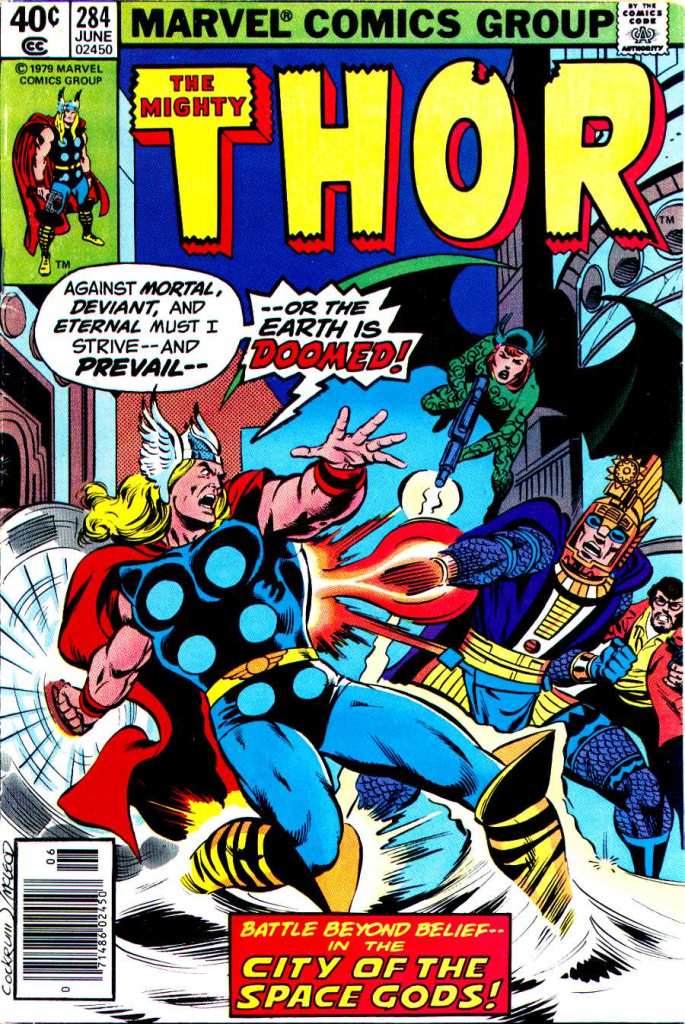
These next couple of years’ worth of THOR stories were truly a mixed bag, and as a reader, I had a difficult time remaining engaged–to the point where I dropped the title more than once, only to come back shortly thereafter on a week when I had spare cash and multiple issues were still available on the stands. This largely comes down to the major goal of this entire sequence: an attempt to integrate the characters Jack Kirby had created in his recently-cancelled ETERNALS series into the continuity of the larger Marvel Universe. This was always going to be a tough build because Kirby’s series was never intended to be happening within the MU, despite some editorial references to SHIELD that had been stripped into it by editorial. But given that it’s central premise was that the mythological figured that early man thought of as gods were actually the byproduct of alien meddling, that’s a tough circle to square against a cosmology in which Thor is one of the central characters.

Still, this sort of challenge was writer/editor Roy Thomas’ meat. Even more so that Stan Lee, Roy had devoted a lot of efforts in his prior stories to sorting out the growing mythology of the Marvel Universe and to making it all make sense. I expect, too, that Roy realized how much potential still resided within the bevy of new characters that Kirby had introduced and so wanted to structure an easy was in which that potential might be actualized in other series. At the time, though, I hadn’t quite yet fallen under the spell of Kirby, and so while I’d read an issue or two of ETERNALS, I was neither invested in it nor entirely familiar with every aspect of it. So the driving appeal of this long sequence was largely lost on me.
By this issue, Thor had become aware of the Celestials and the threat of their Fifty-Year Judgment of humanity, and desired to know more. This quest carried him to the Andes Mountains, wherein lies a secret city of the Eternals. Thor took action to save a passenger jet that had become imperiled by Gammenon the Gatherer, one of the celestials. But as this issue opens, the Thunder God finds his great powers no match for the Celestial, who swats him from the sky before conveying the plane and its contents back into the hidden city for study and appraisal. Reckoning that stealth may be the best approach here, Thor returns to his mortal identity of Donald Blake and mixes in with the passengers on the jet.

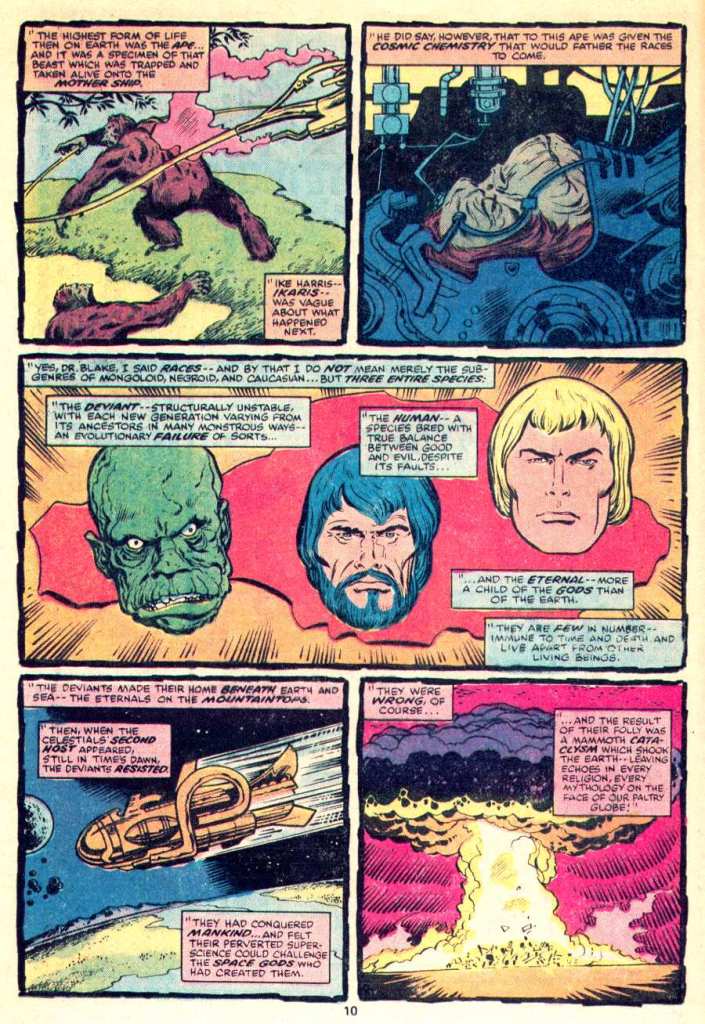
Within the city, Blake meets Dr. Daniel Damian, a supporting character from the ETERNALS series, as well as the Eternal Ajak as well. Dr. Damian gives Don and by extension the readership a crash course summary on the premise of the Eternals: the fact that, eons ago, the otherworldly Celestials had come to Earth and conducted genetic experiments upon burgeoning mankind, resulting in two offshoot species; the monstrous Deviants, whose unstable cellular structure marks them as the source for all of humanity’s myths about demons and monsters, and the godlike Eternals, immortal, unchanging beings of great power and beauty, the source of humankind’s myths about gods.
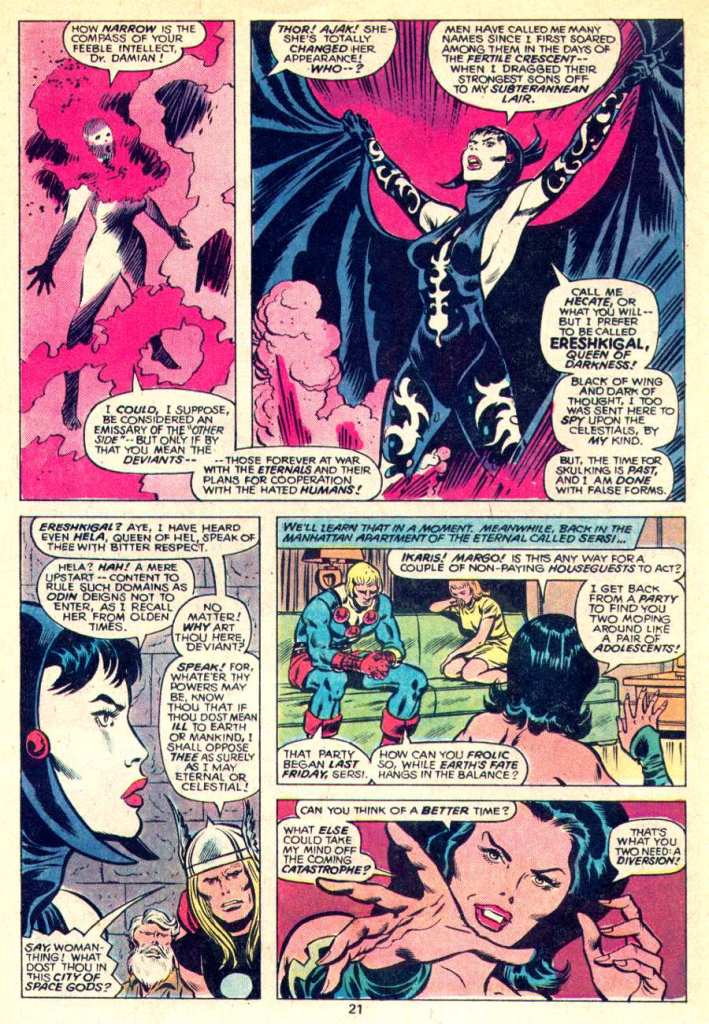
At this point, having gotten up to speed, Blake stamps his walking stick and resumes his true identity as Thor. But he isn’t the only passenger on board the jet with a dual identity. Another woman initiates a transformation of her own, revealing herself to be Ereshkigal of the deviants–I couldn’t even begin to work out how to pronounce her name, much less spell it, and I think that kept me from bonding with her as a character. Eresh reveals that she’s been sent here to spy on the Celestials as well.

At this point, a battle sequence is called for, and so one materializes on the flimsiest of pretexts, as Ereshkigal demands that nobody should leave, leading to Thor, Ajak and a SHIELD agent who also snuck in aboard the same plane–hell of a passenger manifest on that flight–all pretty much proclaiming, “You can’t tell me what to do!” and riotously throwing down with one another. This whole tussle is really pretty stupid, and while it goes on for a couple of pages to fulfill the action requisite for this story, it also doesn’t really amount to much of anything.

Once that nonsense is over, Thor decides that he needs to bring the stranded passengers to safety. Working with Dr. Damian, he’s able to momentarily open up an aperture in the dome concealing the hidden city, and he creates a storm to blind towering Arishem so that he can make a dash for the outer world, towing the remains of the jet in his wake. And that’s the issue. As a reader, I had the sense that this two-parter was a complete story and that next issue would be concerned with something else. But how wrong I was. But we’ll get into that in a few weeks.


“Titans From Space” — if Hercules had said it but being a Norse God one would think Thor would have in his head called them — Jotnar From Space — ( Jotnar ( plural) or Jotunn ( singular) for Giant(s) in Norse Mythology — don’t know how to do the 2 dots over the letter O ). Plus you would think that Celestial’s eyes ( assuming they have them ) would work different that Human & Asgardian ( not Heimdall’s ) eyes and that storm clouds wouldn’t affect their ability to see Thor taking the plane. More likely they let Thor take it.
LikeLiked by 1 person
Excellent art, but IMHO Thor’s 283-300 often was unintelligible to me as a child. I kept purchasing it as Thor was my Favorite Marvel Hero but man it was a “slog”.
LikeLiked by 1 person
I certainly agree that trying to integrate the Eternals into the Marvel Universe made no sense from a story logic perspective. But I found this sudden influx of characters into THOR more intriguing than off-putting, and it led me to seek out their previous appearances. So I suppose it “worked” on that level, at least.
(Come to think of it, a similar thing had happened at DC a few years prior. The late-70s revival of the New Gods, mixed bag though it was, was enough to put those characters on my radar.)
LikeLike
Fitting the New Gods into the DCU, where some of the Old Gods were clearly not dead and still fairly active in WONDER WOMAN struck me as a problem, too, though since it happened before I started reading the books it didn’t bother me as much as with the Eternals.
Still, DC had to pivot to the idea that the Old Gods were some new-to-us heretofore-unseen pantheon of gods, which never made any sense to me. It was clear to me that it was supposed to be _all_ the existing gods that died, Norse, Greco-Roman, Japanese, everyone (with the possible exception of Yahweh).
Sometimes I wonder how the Fourth World launch would have gone if we saw the Old Gods die in WONDER WOMAN, as the New Gods were debuting. Still wouldn’t really match Kirby’s cosmology, and neither he nor the other DC editors were interested in coordinating like that. But in a more modern comics industry, it’d have been a line-wide crossover, and the New Gods would have spun out of it. It’d have been a different kind of mess, I’m sure, but a very loud one.
LikeLike
Your idea for the Old/New Gods kind of ties in to my favorite “What If?” scenario: Jack Kirby and Mike Sekowsky trade assignments, with Sekowsky turning Jimmy Olsen into a globe-trotting adventurer, and Kirby taking over Wonder Woman.
LikeLike
I’d have loved to see a Kirby WONDER WOMAN, particularly right around then. I was playing around with the idea of what would have happened if Kirby took over WW in 1968, and I mentioned them to Alex Ross, who drew up a “Kirby WW” piece.
After posting it on social media, I wound up talking about it with a DC editor. Nothing came of it, at least not yet.
Kirby wouldn’t have wanted to do WW any more than he wanted to do JIMMY, and DC wouldn’t have thought of him for it. But I’d love to have seen it. Especially the villains he’d have cooked up, and the new outfits he’d have given the gods and the Amazons.
LikeLiked by 1 person
I hated the whole idea of bringing the Eternals into the Marvel Universe. Still do. Machine Man, too.
So this story wasn’t for me from the moment it started, and when it started trying to mix in Wagner’s Ring Cycle on top of this mess, it just spiraled out of control. And then it had to be wrapped up by two relatively inexperienced writers who didn’t know what Roy had in mind, resulting in storytelling disaster.
What a mess.
LikeLike
I think the mid-70’s Marvel Kirby-verse would have merged better with the Charlton Action heroes than what either property eventually got.
Kirby was still writing Captain America in 76 as if he had never encountered extraterrestrials. There was no way that Marvel wasn’t going to fold the Eternals and MM in… which I suppose they were itching to do while Kirby was still working on them.
LikeLike
Kirby had had Cap meet extraterrestrials himself, back in the day, even.
I’d have loved to have seen the Eternals (and Machine Man and a few others) established as part of tan alternate universe Thor could have traveled to, much as Roy had established Earth-A and others in FANTASTIC FOUR. But yeah, no way was Marvel going to do that.
LikeLike
Roy Thomas had an obsession with Wagner’s Ring Cycle: The Invaders#1-2 ( August-October 1975 — inspired characters ) and The Ring of the Nibelung#1-4 ( January-April 1989-1990 ) Gil Kane art ].
LikeLike
I don’t know if three projects, one of them initiated by someone else, constitutes an obsession. But certainly, an interest.
[I mean, I got known for doing historical flashback projects from LEGEND OF WONDER WOMAN (set in the past by Trina’s choice), MARVELS (set in the past because Alex wanted to use the original Human Torch and Gwen) and UNTOLD TALES OF SPIDER-MAN (set in the past by Marvel’s choice).]
LikeLike
Maybe fan [ Letter Page for The Invaders#1 ( August 1975 ) Ring Cycle was inspiration and he saw the opera with his wife Jeanie and Marvel reprint editor Irene Vartanoff at New York’s City’s famous Metropolitan Opera ] should have been the word I should have used. He wrote the first 2 The Invaders and did The Ring of the Nibelung for DC, so are you talking about the Thor series using the Ring Cycle?
LikeLike
“…so are you talking about the Thor series using the Ring Cycle?”
I’m not sure what you’re asking. If you mean which of those three projects was initiated by someone else, it’s the Gil Kane adaptation of the operas, which Gil initiated, and then the editor, Mike Gold, brought Roy in on.
In fact, Gil wanted to do a bigger project — he wanted to combine the operas with the Nibelungenlied and the Volsung Saga, and create a new take on it all, drawing on all of the legend. Roy said no, let’s just adapt the operas straight-up. Which was easier for him, since it meant he didn’t have to do any research or come up with newly-structured story to fit it all. So Gil adapted the operas and Roy dialogued the result. And then got credited as “adapter,” even though the guy figuring out how to turn the operas into comics was Gil.
I’d have much rather seen Gil’s initial ideas for it.
LikeLike
Yeah, Gil Kane’s idea does sound interesting. I did pick up The Ring of the Nibelung.
LikeLike
I did, too, and it looked great. But I thought it had a basic problem — the operas, of necessity, involve the singers declaiming at length about great events and battles and such that happen off stage, because the opera doesn’t have the ability to dramatize them, and can’t introduce characters naturally, so they come onstage with a declamatory song about what they are and what their history is.
Comics actually have the ability — and Gil had the skill — to dramatize the events instead of having long speeches describing them, but since Roy wanted to adapt the operas straight up, there are an awful lot of big expository speeches that could have been dramatic sequences. We got terrific Gil Kane art (and great Woodring coloring), but too often we got a spoken aria without the benefit of music.
LikeLike
I was a completist still back then (a fact not helped by my OCD that was decades from being diagnosed and my anal retentiveness) so I kept buying issue after issue of this series though I loathed it. In this issue however I absolutely loved Stone’s inking on Buscema more than any other inker before or after and the character of Ereshkigal. Her look and manner had me hoping for more which sadly didn’t happen as I wanted.
LikeLike
I tend to agree with how RT justified his retcon: that sooner or later, in a universe where every franchise owned by the company can meet every other franchise, sooner or later someone would have imported the Eternals into “616” (as it was later termed). If you think it’s going to happen anyway, why not make it into a big, splashy epic, warts and all, instead of some piddly MARVEL TEAM-UP between the Eternals and You Know Who?
LikeLike
At the time I thought it was awesome. Rereading Eternals, I realize what a bad game changer going from “These beings are the truth behind our myths, our nightmares, our gods!” to “these characters look a lot like our myths but it’s just a freaky coincidence, the myths are completely real” was.
The ring cycle stuff was … gratuitous and self-indulgent. Gruenwald’s finish was terrible. As some readers pointed out in the original series letter column, the Celestials are cosmic genocides. Gruenwald’s solution was “yes, but they know what they’re doing so it’s all cool.”
LikeLiked by 1 person