

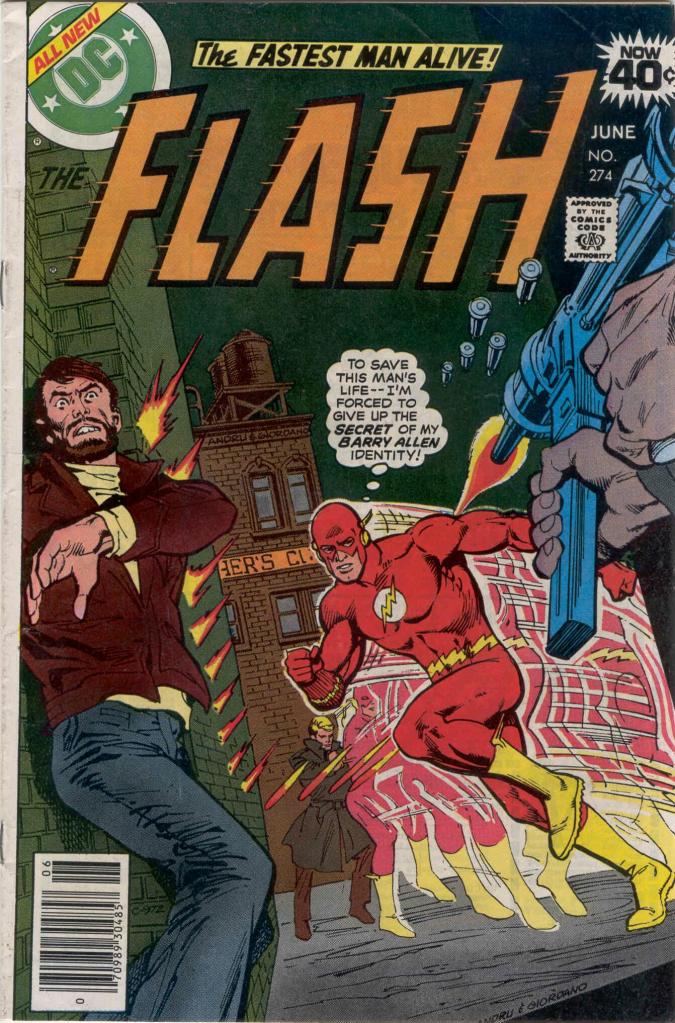
I picked up the latest issue of what had once been my favorite comic book series of all on my weekly excursion to the 7-11 on Thursday. My interest in THE FLASH had started to waver a bit of late, as I’d become more enamored of the Marvel books that were then occupying a lot of my attention. On top of which, the changes to the series weren’t working for me. I don’t know that I could have pointed to anything concrete with the exception of longtime regular artist Irv Novick being benched, but the change in emphasis in the storytelling away from colorful super-villains and puzzle-construction, integrating more “serious” elements such as drug use, corrupt cops, marital strife and psychological prison experiments weren’t really what I was looking for from the series. Still, I dutifully picked the book up each time a new issue came out, at least up to this point. I would miss the following two issues as the 7-11 stopped carrying THE FLASH for a few months, and when I was able to drop back in, I had missed a seismic moment, the death of the Flash’s wife Iris Allen. But we’ll get to all of that in due time.
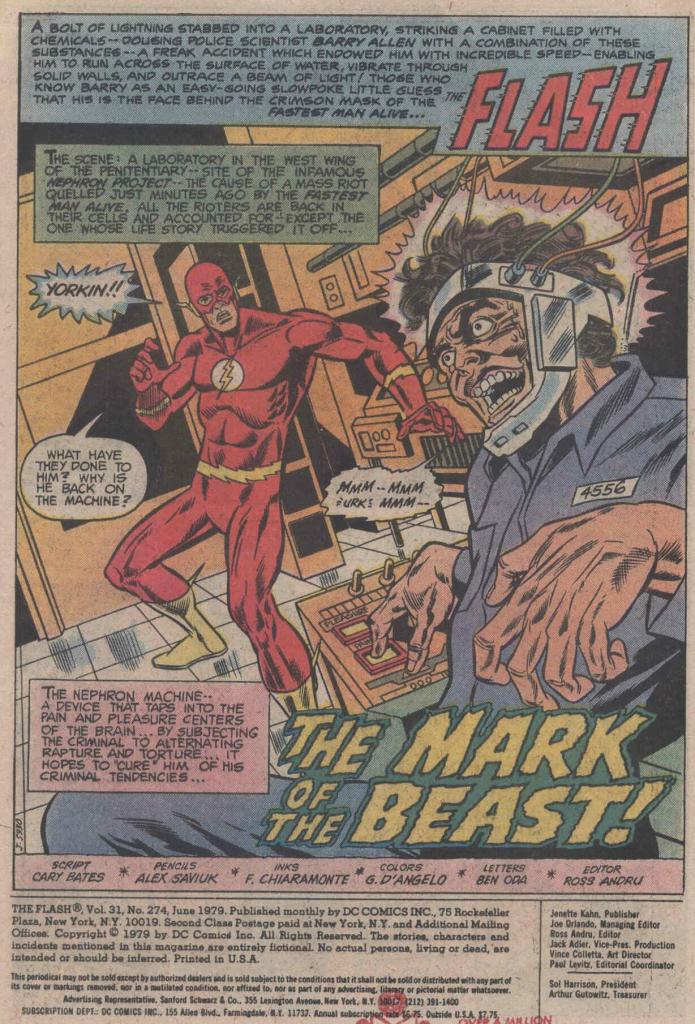
The thing that was actually responsible for these changes was a new editor, Ross Andru, once the artist on the series almost a decade earlier. He clearly wanted to push events in a new direction, and writer Cary Bates gamely attempted to oblige. This run was kind of a mess of conflicting tones and ideas, the more seemingly dark material made silly by its presentation, and the more fanciful ideas behind the character an ill-fit in a more realistically-depicted ecosystem. I can intuit the sort of thing that Ross was trying for, but this run didn’t manage to find the correct balance of its elements, and so it’s all a bit ill at ease with itself. This did make it easier to be sanguine about missing issues, though.
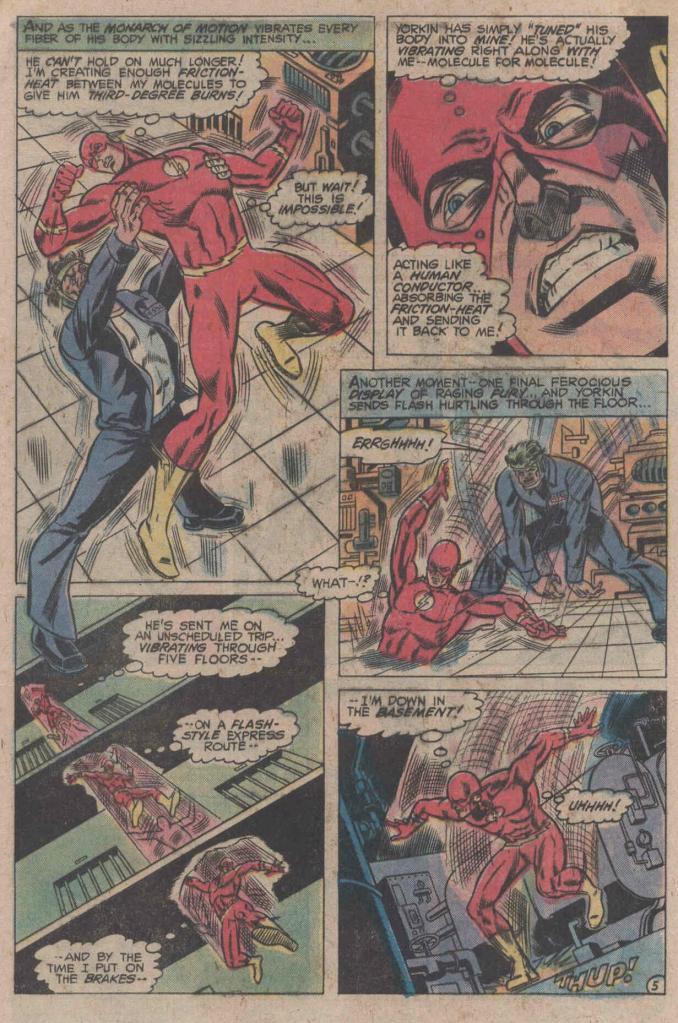
This issue picks up on the conclusion of the previous one, with the Flash having discovered inmate Clive Yorkin, who had been the subject of of a revolutionary process designed to eliminate evil impulses in the brains of hardened criminals, having plugged himself back into the Nephron device and giving himself a full orgasmic ride on it. Yorkin has clearly become addicted to the process, and it’s also unleashed startling physiological changes upon his body as well. For one thing, he’s now inhumanly strong. So much so that when the Flash moves to try to unplug him from the device, thinking him in distress, the now-monstrous Yorkin lashes out, ultimately hurling the Flash through five floors into the prison basement.
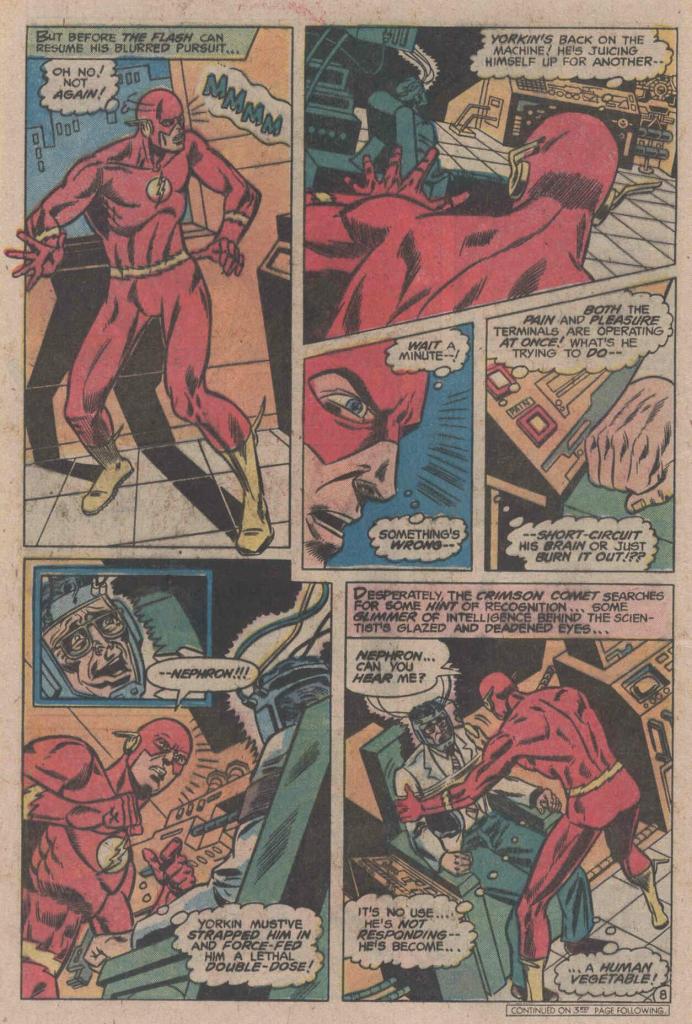
It has to be said that newcomer penciler Alex Saviuk tries his best, but his open style isn’t really the best for conveying what is meant to be the horror of these scenes. His depiction of Yorkin verges more on the comical than the horrific, which undercuts what is meant to be the drama of this entire sequence. Anyway, by the time that Flash can get back up to the fifth floor, Yorkin has fled the building. But before he went, he strapped Doctor Nephron himself into his own machine and turned up the juice stimulating both the man’s pain and pleasure centers. By the time Flash returns, Nephron has been reduced to a human vegetable. As detestable as he was in the previous issues, this is a tragic fate for anyone–but again, the artwork doesn’t really sell the moment effectively. The material wasn’t in tune with Saviuk’s strengths as an artist.
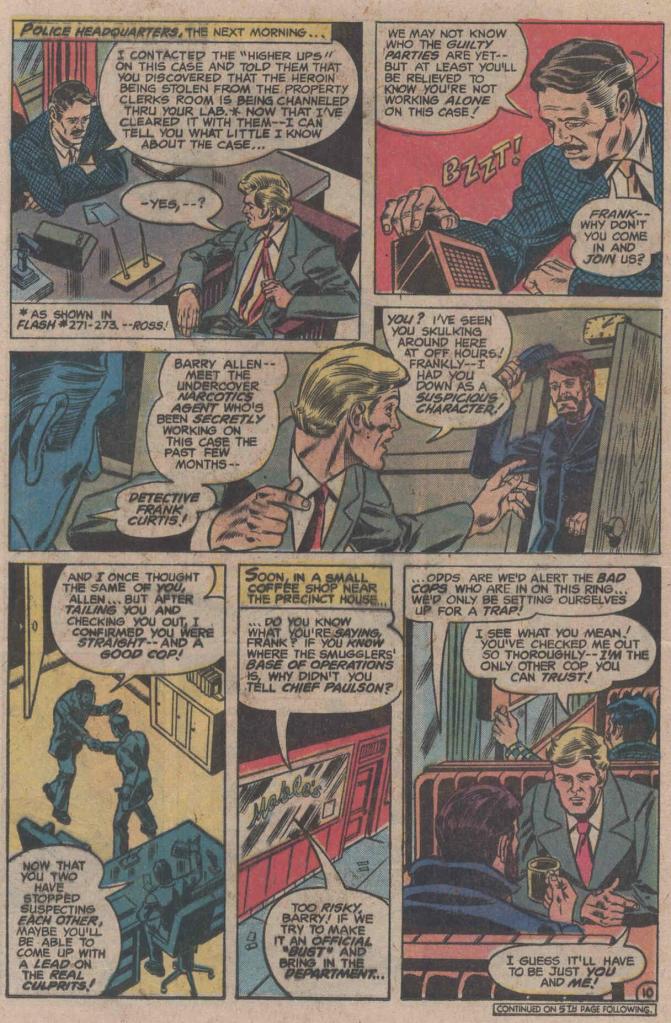
Later, back at Central City Police Headquarters, Barry Allen has a meeting with his superior Police Chief Paulson. Previously, Barry had discovered that Heroin that was being stolen from teh evidence room was being funneled out of the building through his laboratory, and he alerted Paulson to what was going on, as it indicated that there were some bad apple cops within the squad. Here, Paulson introduces Barry to a new supporting character, undercover narcotics officer Detective Frank Curtis. he and Barry go off to a diner to compare notes on the case, and Frank tells Barry that he’s already got intel on where the smugglers’ operation is headquartered. But not knowing who else on the force can be trusted, Frank and Barry decide that they need to bust the ring on their own. And Barry, of course, figures that if there’s trouble, he can use his super-speed to get them out of any jam.
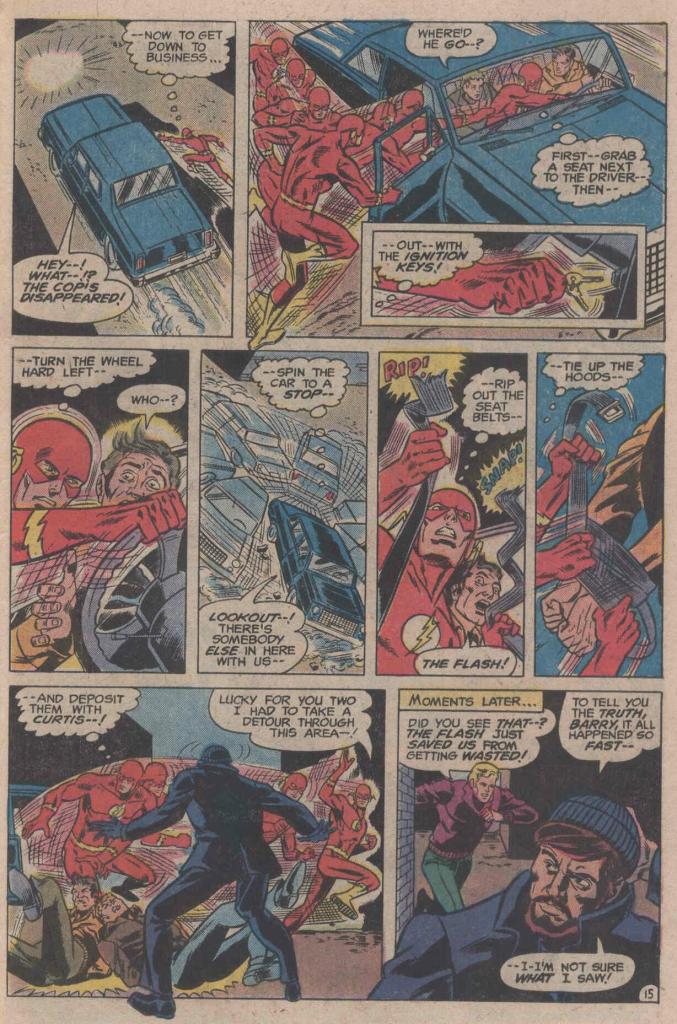
Unknown to the two cops, the man seated at the next booth has overheard them talking about the case, and he’s in the employ of the smugglers. so the bad guys are warned about the impending raid. When Frank and Barry burst into the drug warehouse, they find themselves on the bullseye of a crossfire designed to take them both out. Only Barry vibrating himself into intangibility allows him to survive teh hail of gunfire as he and Frank flee the room. But they still need to get back to their car and get out of there. So there’s a running gunfight that tries to be gritty and realistic, but that isn’t really artist Saviuk’s gear, so it falls a bit flat. As expected, at a key moment, Barry becomes the Flash, mops up on the smugglers and saves Frank’s life, and even easily maintains his secret identity despite what the cover seemed to have been promising. So the bust is made.
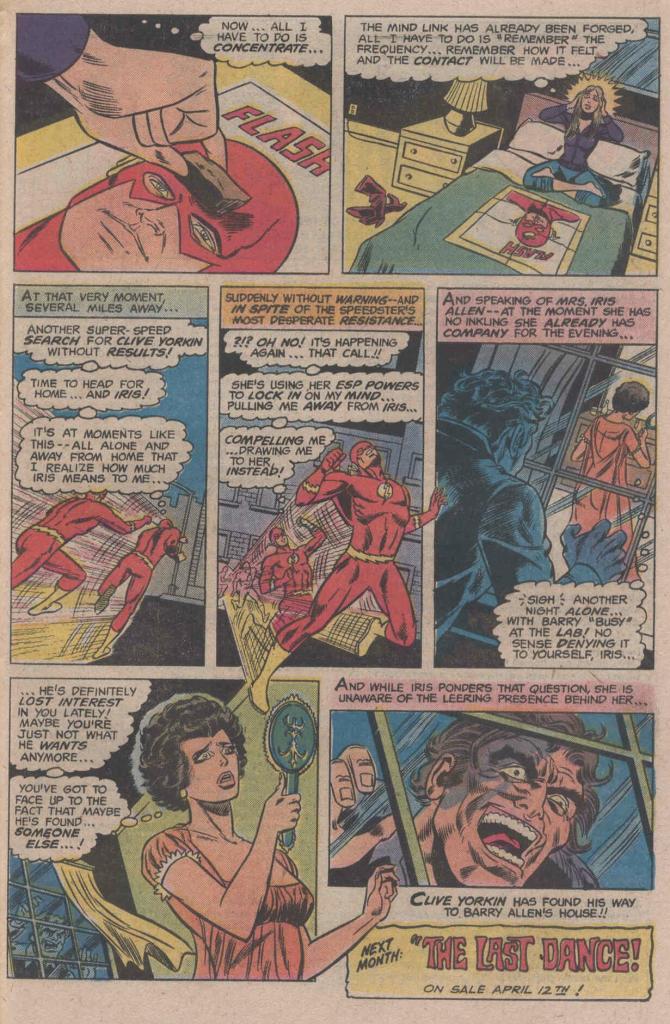
Elsewhere, Melanie, the girl with ESP powers who is obsessed with the Flash checks into a motel room. She’s intent on using a fragment from a wall that the Flash vibrated through as a psychic talisman to draw him to her. And as she exerts her powers, sure enough, the flash finds himself compelled to change course and race to her location. The timing here is really bad, too, because as we cut to the Allen household where Iris is waiting for Barry to return home, we see that Yorkin has somehow been drawn to this location. And so Iris is on the firing line and Flash cannot come to the rescue. To Be Continued!
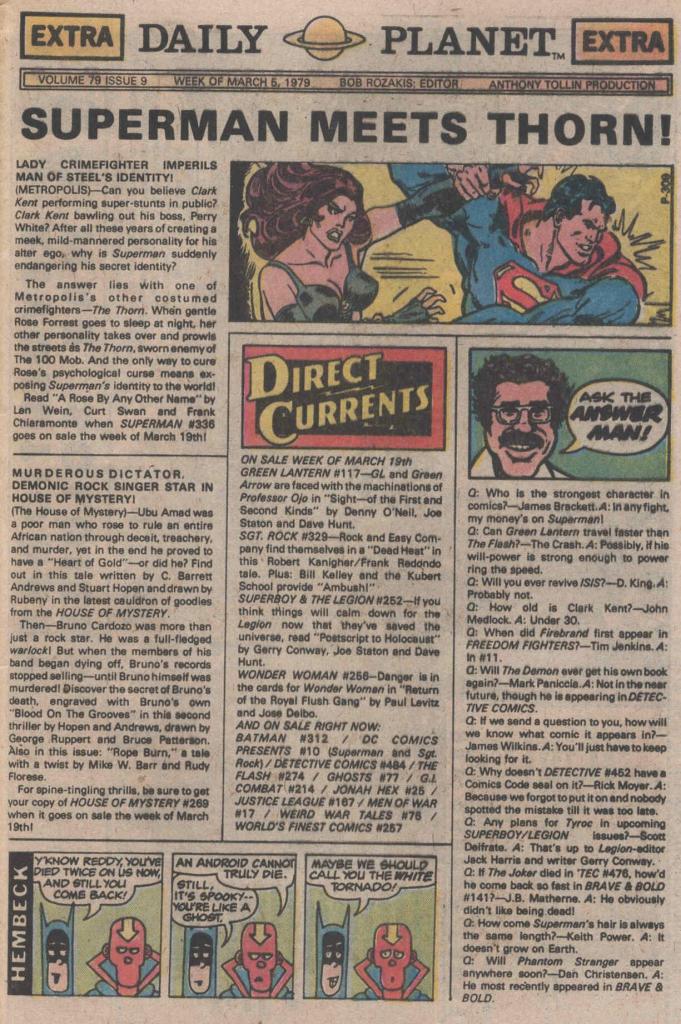
In addition to the Flash-Grams letters page, this issue also included the latest edition of the weekly Daily Planet promotional page which plugged the titles that would be released in a week’s time. Of greater interest to me was fan cartoonist Fred Hembeck’s comic strip, which was again goofy and fun. I also regularly enjoyed Bob Rozakis’ fondly-remembered Ask The Answer Man column where he’d answer questions posed by the readership.
 The Tom Brevoort Experience
The friction between Barry and Iris came from nowhere and seemed “unearned.”
It would have been more interesting to use that relationship to explore who Barry Allen was.
The Flash book featuring Wally West looked back at Barry Allen as a decent guy who lived up to the circumstances presented but would have happily lead a quiet life if those were the circumstance’s presented. The Secret Origen issues on the two Flashes and Mark Waid’s Graphic novel, The Life Story of the Flash are good examples.
(A lot of that came from how John Broome wrote the character from early on.)
Ross Andru was a talented guy, but he never seemed to have any luck working on The Flash. Despite being Infantino’s hand picked successor on the book, it never gelled and this also seemed to alienate people,
LikeLike
I for one am a Huge Fan of Andru’s 1979-1980 Flash covers. I know I’m not alone as in the Comic Art Community on the rare occasion one pops up at auction the bidding is fierce.
LikeLiked by 1 person
As a reader who was entering high school, I should have been the perfect audience for these attempts to add more realism and depth to the series, but I just bounced off it. Flash was my “comfort food” reading…it was supposed to look and read a certain way, and this deviated too much from the familiar formula.
Never mind the fact that there was absolutely nothing compelling about the Clive Yorkin character. Flash is well-known for having some of the most clever and appealing bad guys in comics, but this goofball was not worth the amount of real estate he took up. I rolled my eyes every time this literal drooling idiot managed to escape The Fastest Man Alive yet again.
It’s probable that I would’ve gotten bored with Flash anyway, even if they’d stuck to tradition (as I did with Superman around this same time). But the “bold new direction” certainly didn’t help. I hung around for a year or so, hoping it would “get good” again. But when Don Heck came on board (an artist I didn’t care for at the time, though I appreciate him more now), I took it as a sign it was time to go. And that was pretty much it for me and Flash.
LikeLiked by 1 person
Do you think this Z-grade Frankenstein, Clive (middle name Colin?) Yorkin would have been improved by a different artist, or was he just as a zero from the word “go?”
LikeLike
I don’t think he was salvageable. There’s just no “hook” there to hang a story on. He makes Colonel Computron look like Professor Moriarty.
LikeLike
You would have thought that if Clive Yorkin was going to gain any powers they would be psychic in nature and not physical strength.
LikeLiked by 1 person
Like his son, Glenn. 😉
LikeLike
I’m still annoyed that they killed off Iris, even though her death was ultimately retconned.
LikeLiked by 2 people
Reading through this era, there’s a lot to like about what they’re trying to do, but it’s not realized all that well. Along the course of the story, they forget where the prison is, and make a number of other mistakes that make me want them to draw a map of Central City so they know where the various events are happening, and then stick to it, rather than just presenting it as generic “city” with no landmarks or neighborhoods or character.
And while Alex Saviuk became a much stronger artist over time, he’s both inexperienced and inappropriate to the story here — and it even looks like Andru is doing a lot of storytelling sketches to show him what to do, though I’ve never seen that confirmed or debunked.
LikeLiked by 2 people
That opening splash of Yorkin sure looks like an Andru drawn mug.
LikeLiked by 1 person
As does the Flash’s body language.
A lot of these issues have points where it looks like Andru went over the layouts and said, “No, do it like this,” and sketched it out. Which is a perfectly valid kind of editorial input, and would have been an educational experience for the penciler.
I just don’t know whether it actually happened, and why you’d give someone a regular book if they needed the input as extensively as those issues made me suspect it happened.
LikeLiked by 1 person
You very much know the industry particulars better than I do… but I don’t think it would be the first time that a new comer got thrust onto a title before being ripe enough. It’s possible that Andru’s fixes appear heavy-handed since he’s doing them himself… or he was being collegiate and mentoring the new guy? Saviuk was green at this point and learning the ropes, but Jack Kirby also had his art redrawn and he was certainly experienced. Hiring the new guy that doesn’t meet expectations and hiring the seasoned professional that doesn’t meet expectations sounds like there was an editorial problem though. I’m possibly at risk of conflating different epochs, but in either case… Saviuk and Kirby’s art seem to be treated more or less the same editorially at DC…with parts getting redrawn by someone else. In either one it becomes a case of “why did they hire this guy?”
LikeLike
It doesn’t look to me like Andru is redrawing Saviuk. It looks like Andru is doing layout sketches here and there, and Saviuk is following them. I’ve seen other editors who are artists do that — I’ve seen Carl Potts sketches like that for example — and I’ve occasionally done crappy layout sketches of my own to show an artist what I’m going for.
In Kirby’s case, they knew they wanted Kirby for his plotting, his penciling and his creativity. They just didn’t think his Superman or Jimmy were on model. I think there were better ways of handling that, but they didn’t hire the wrong guy. They knew what they wanted. Weisinger would have various Superman artists do corrections on other Superman artists’ work here and there, and Stan and others would have Romita and others do corrections, too — this isn’t that kind of surface correction, though, it’s layout, storytelling.
And yeah, artists have gotten assignments before they were ready, but generally because the person who hired them thought they were up to the job, or there wasn’t anyone else. In this case, the editor doing the corrections (if he was) was the editor of the book, so he presumably did the hiring. And it was 1979, in the wake of the DC Implosion. There were a lot of artists looking for work, and Saviuk was already doing GREEN LANTERN regularly. Just off the top of my head, Trevor von Eeden had just recently lost a regular gig, Larry Hama had lost his editorial job, and Don Heck was already doing very nice-looking Flash stories in WORLD’S FINEST, and any of them would have suited the book better, at this point.
I don’t begrudge him the break — he developed into a very solid artist. I’m just a bit perplexed by why Andru, who knew what kind of book he wanted to turn FLASH into, would hire someone he (a) thought needed all this correction, and (b) wasn’t in tune with the new tone of the book. I’d think maybe he had a contract DC had to fill, but I don’t know why they’d give a relative newcomer a two-book-a-month contract, either.
Just one of those bits of comics history that makes me scratch my head.
LikeLiked by 2 people
@Kurt Busiek and anyone else, I get why Chicago would work as Central City . It’s “close” to the center of the continental US. Though maybe St. Louis is more centrally located?
Wasn’t Midway City analogous with Chicago? It’s almost “midway”, and there’s that airport of the same name. Though in a 1990’s Hawkman letters column, someone suggested the airport was named for Midway Island in the Pacific, to commemorate the WW2 battle there.
Central City & Midway City are geographically supposed to be separate & distant from each other. But I suppose both could reference Chicago. The way Gotham City & Metropolis used to both be inspired by NYC; Metropolis in the day, Gotham at night (I think I read that in one of Denny O’Neil’s columns).
LikeLike
Because when they invented Midway City, Central City was already Chicago.
And because the first Midway City story has the Bi-State Tunnel in it, which was a reference to the Detroit-Windsor Tunnel.
And because people up at DC at the time have told us what the models of the cities were.
[There were actually two faux-Detroits, Midway City and Motor City, which I think only showed up once.]
LikeLiked by 1 person
@Kurt Busiek, RE: Trevor Von Eeden drawing the Flash. Hell, yeah. He’d know how to convey kinetic energy, and emotional expressions.
LikeLike
“It doesn’t look to me like Andru is redrawing Saviuk. It looks like…”
Credit where it’s due, Mr. Busiek. That’s a spot-on comment. All of it.
LikeLike
Part of why Andru provided the layouts might have been more down to the fact that he had not been an editor for a long time . He and Esposito had published comics from 1951-’54 which was about 15 years previous to his becoming an editor for DC.
He may have wanted to put his best foot forward and as an artist he might have felt that was an effective way to set a standard. I would also assume he felt a need to do this . . . without becoming Kanigher or Weisinger, both editors he had done a lot of work for.
Further, I suspect Irv Novick was expected to stay on the strip and Rich Buckler was not a permanent substitute.
LikeLike
I think the reason Andru did correction layouts (if he did) was simply that he didn’t think the submitted art did the job well enough, and he was showing the young Alex Saviuk how to do it. I think the lessons stuck, too, since Saviuk had an Andru influence for the rest of his career. Comes in handy when drawing Spider-Man, too!
I’d assumed that taking Novick off the book was part of the move to modernize it, although it’s certainly possible that Julie Schwartz pulled Novick over to BATMAN to help that book (and because Novick had been a dependable artist for him for years) and Andru had to scramble. I just think, given the time and the direction Andru wanted to take the book in, he could have gotten other, more appropriate artists. But maybe it wasn’t his call.
I think Buckler could have worked fine (if Andru agreed; he’d have been adaptable to the material), but for whatever reason, Buckler never seemed to do steady runs on much. Even his FANTASTIC FOUR run has a fair number of issues drawn by someone else. And on FLASH, his two issues had help from John Calnan…
LikeLike
You really made Astro City itself a major character in Astro City. I would assume this (and things like it) might be why?
Bates once said, a few years before this that he had a specific place in mind as a model for Central City, the city in OH where he went to college. It is odd that did not come through more . . . .
Given how careful Andru was of cityscapes when he drew Spider-Man, I am surprised he didn’t emphasize that,
Maybe get photos of that city through interlibrary loan (back then) or have Bates bring in photos from when he was there or even go to the library and look at photo books about Midwestern cities..
LikeLiked by 1 person
Cary went to Ohio University in Athens, OH.
Central City is waaaaaay bigger than Athens, and doesn’t look like it at all. So if Cary was thinking that, he wasn’t putting it into the scripts.
Traditionally, Central City was Chicago, and I think it’d have much more presence if that had been brought into the stories.
LikeLiked by 1 person
I tended to think Midway City was more the analogue, and thought of a medium sized city in the Midwest as the Central City model.
Having the City be a character was a good idea; really added something.
LikeLike
I don’t think Central City needed to be a character; I think it needed to be a better-thought-out setting.
LikeLike
Fair enough.
LikeLike
Andru did like the M-3 SMG. He used them in his war stories and he used one on this cover.
LikeLiked by 1 person
@Kurt Busiek, thanks for that reference to the Bi-State Tunnel. I wasn’t a regular Flash reader. My access to comics was really limited until about 1983/84. So there’s tons of details I missed.
When John Ostrander took over the monthly Hawkworld/Hawkman series, he made his own home city of Chicago the Hawks’ base, too. And there was discussion in the letters column about Midway City having possibly meant as Chicago.
But I dont remember what was said now. I dont recall if John weighed in, one way or the other.
LikeLike
Completism I hadn’t defeated yet was why I stuck around but with my current mindset this arc would have had me dropping the book by now. Saviuk suited classic Flash but the direction didn’t. The sudden swerve was not the way to keep or entice readers. More logical groundwork over a few more issues and an artist who could have done gritty and speed was necessary too. Captain Atom and True Believers years later proved Bates could do what Andru wanted but with more time to breathe and art more appropriate to the goal.
LikeLike
I couldn’t quit Flash — my favorite hero — and in those days I always told myself “some day it’ll get good again and you won’t want a big gap in your collection, will you?” Sigh.
As John Minehan says above, the Iris/Barry conflict was terrible, completely forced and artificial. The whole thing reminds me of one of Tom’s old posts about editors who chart a Bold New Direction because they don’t get or don’t want the book’s appeal.
The Flash story where Cary Bates visits Earth-One, does indeed establish it’s in the same place as Athens, Ohio (IIRC, it acknowledges it’s way bigger).
LikeLike