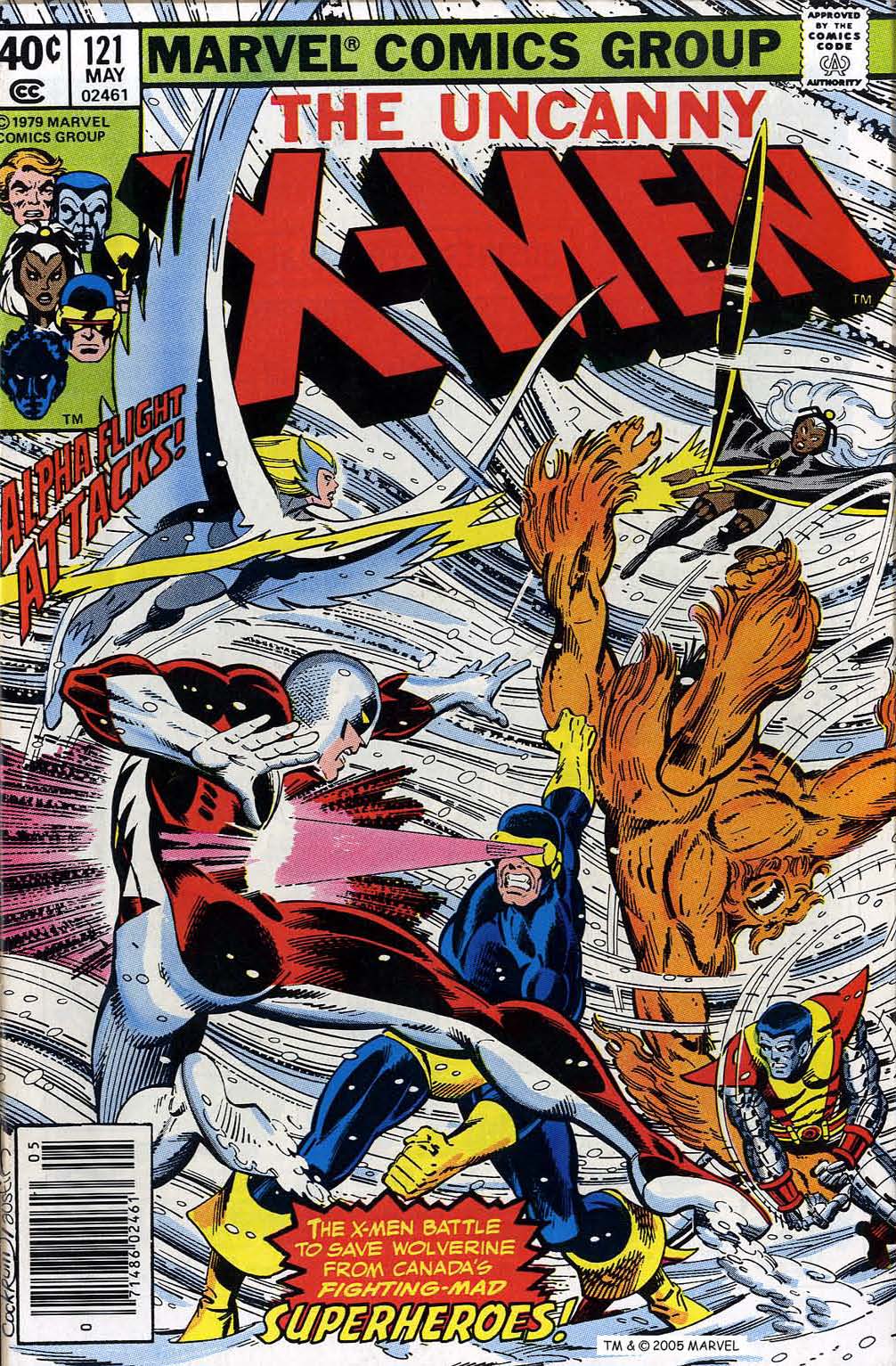


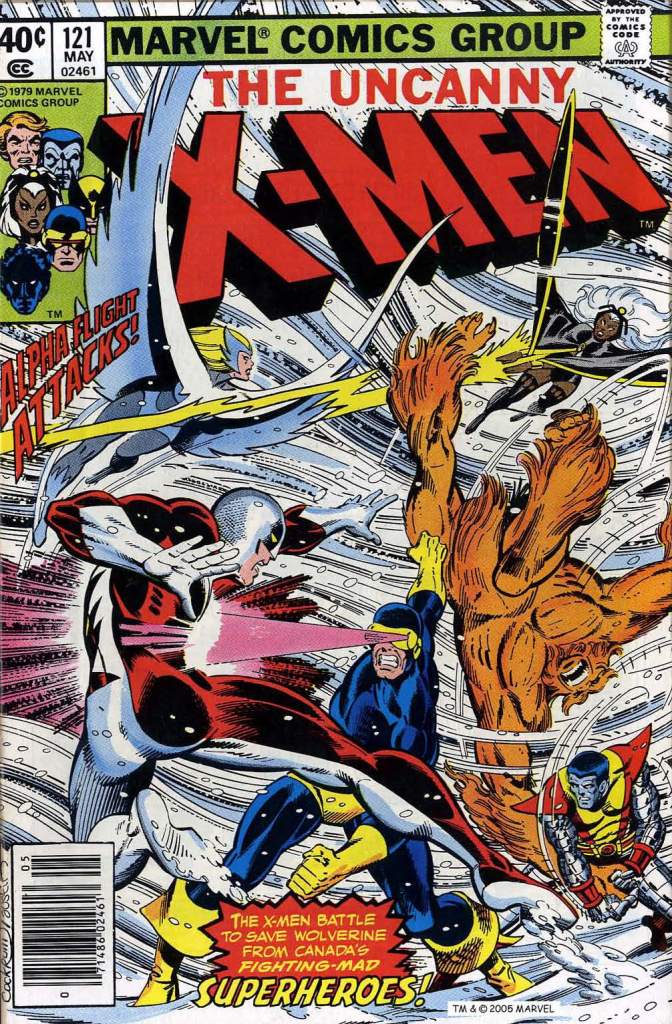
I didn’t really realize just how good of a comic book UNCANNY X-MEN was during this time period. I mean, I bought it regularly and enjoyed it every single issue. But it didn’t stand out for me particularly. I loved it, but i also loved FANTASTIC FOUR and AVENGERS and AMAZING SPIDER-MAN and a hold of other things. It wasn’t really until the Death of Phoenix that the series separated itself from the pack and became an acknowledged classic and I began to think of it differently. Though it has to be said, even at this point, X-MEN back issues featuring the new team were always priced way higher than anything else of its time period. So there was definitely demand for them, especially the hard-to-find early issues. I wouldn’t get to read most of those for another ten years or so myself.
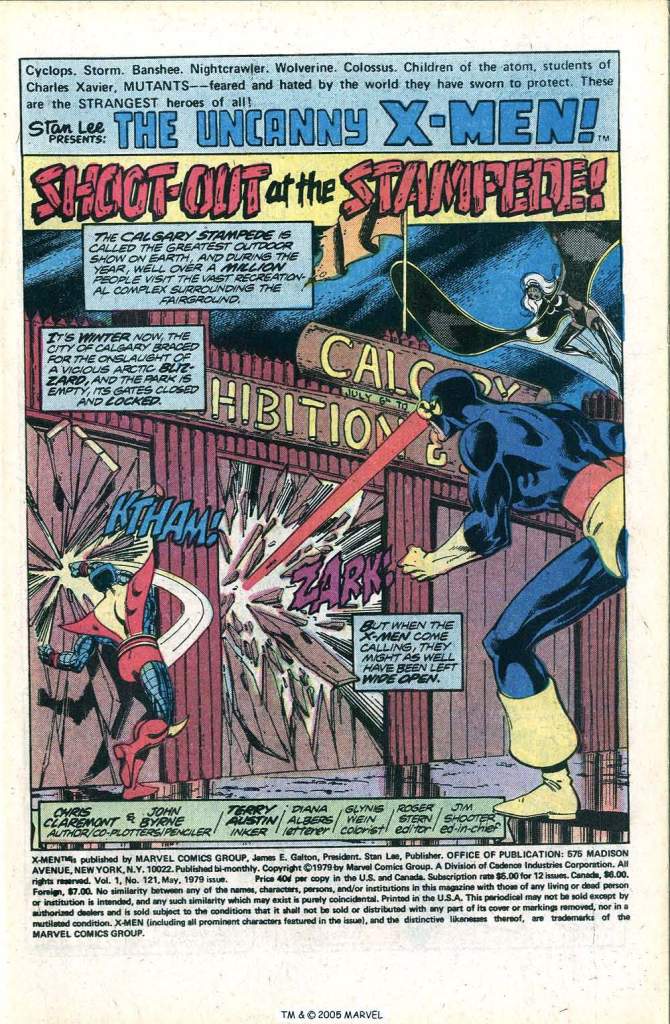
The series had a remarkably consistent creative team for a very long time. It was being written by Chris Claremont, co-plotted and penciled by John Byrne, inked by Terry Austin, lettered by Tom Orzechowski and colored by Glynis Wein. This issue is a slight deviation from that, as the story was lettered by Diana Albers. And the lettering is fine, but it isn’t quite as compact and compressed as what Orz would do, so in a few places you really started to notice the density of copy. But none of this put me off–I don’t think that I even noticed the switch at the time, it only became apparent to me looking back.
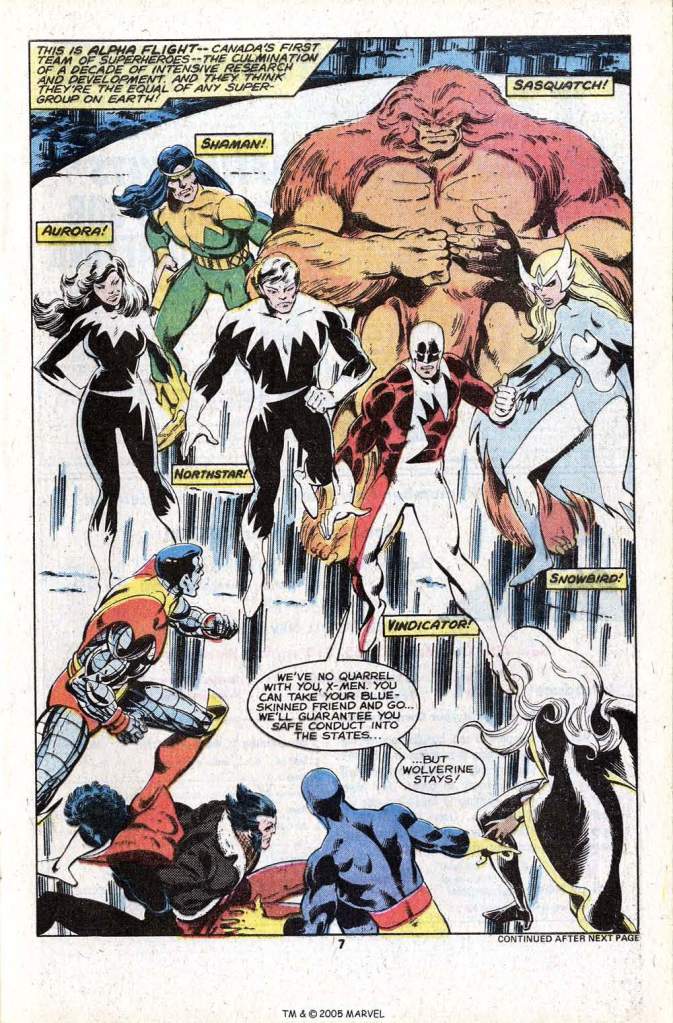
This particular issue was a bit of a minor milestone, as it’s the story that introduced Alpha Flight, Canada’s central super hero team, that had strong ties to the X-Men’s Wolverine. They had appeared in the previous issue as well, but only in shadow. So the debate over which issue constituted their first genuine appearance was hot in back issue circles. But this here is when we see them for the first time. The characters were created by John Byrne, but there wasn’t yet a whole lot to them. To hear John tell it, he simply came up with some Canadian “types” to fight the X-Men, not really expecting them to catch on. When they became a big hit and Marvel wanted John to launch a book with them, he had to put in effort to find a way to connect with his creations, and was never entirely comfortable with the series. Alpha Flight was never more intriguing, though, than in these early appearances when they were still fairly mysterious and there was only an intimation of larger backstories for each one of them.
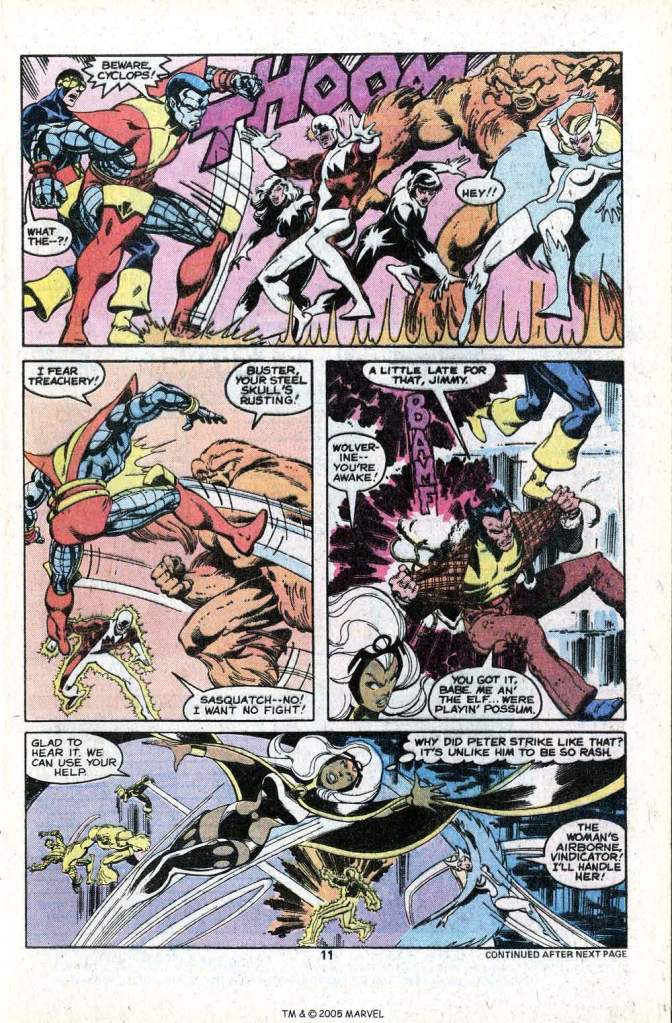
The plot of this issue is relatively basic, and it’s mostly there to set up the big fight between the two groups that occupies most of the run time. Traveling back home after having survived a confrontation with Magneto, the X-Men land in Canada. But Wolverine is wanted by the Canadian authorities–they had spent millions of dollars on him and his training and they want their investment back. So Logan’s old friend Vindicator and his Alpha Flight team are sent to bring in their rogue asset. The X-Men split up in an attempt to sneak to the border, but both Nightcrawler and Wolverine are captured by the Alphans. With no intention of leaving without their missing members, the X-Men stage an attack on the fairgrounds where Alpha is holding Logan and Kurt.
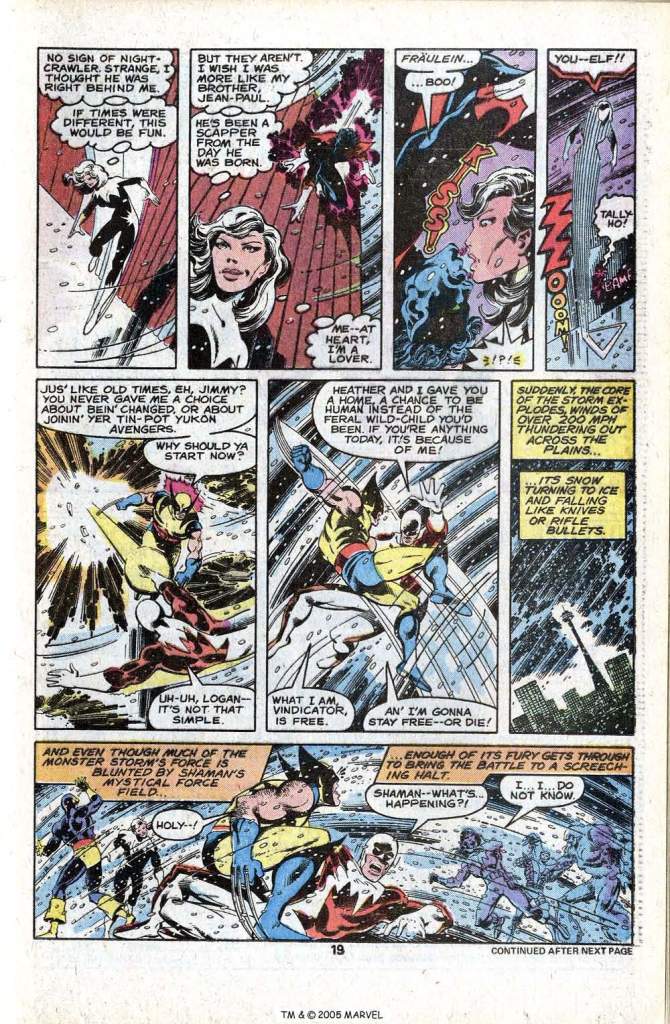
The X-Men confront Alpha Flight and Cyclops and Vindicator attempt to talk out their contradictory positions. But there’s a lack of trust between the two teams, and so when he sees Northstar circling around behind the X-Men’s leader, Colossus attacks impulsively, setting off a major brawl. That brawl is the heart of the issue, giving the creators a chance to show off the powers of both the new Alpha Flight heroes as well as the skills of the X-Men. It’s a serious battle, but one without a whole lot of stakes, so it allows for more lighthearted sequences such as this one where Nightcrawler taunts Aurora by impulsively stealing a kiss from her.
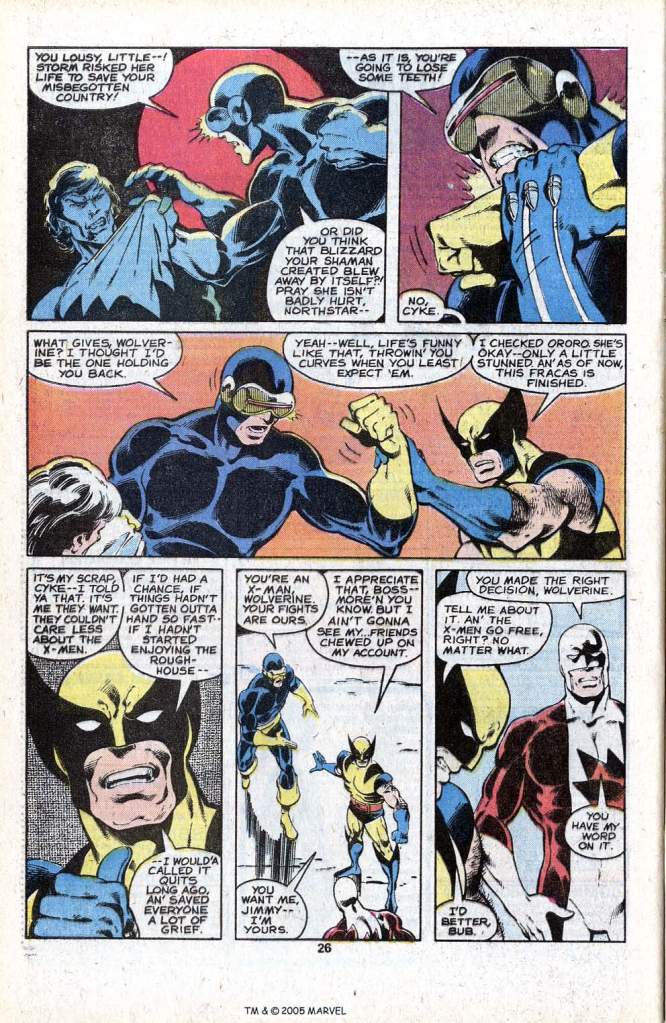
Meanwhile, a major weather system set into motion by the Alpha Flight mystic Shaman is running out of control, growing in size and severity throughout the story. Once the heroes become aware of it, Storm breaks off from the brawl in order to attempt to quell it. Which she does–but upon alighting, she’s sucker punched by Northstar for her efforts. This moment provides a turning point in hostilities, as Wolverine steps forward to put an end to the fight by surrendering himself to Alpha Flight. The X-Men aren’t really happy with this outcome, but they realize this is Wolverine’s choice and they need to respect it. So they end up exiting Canada.
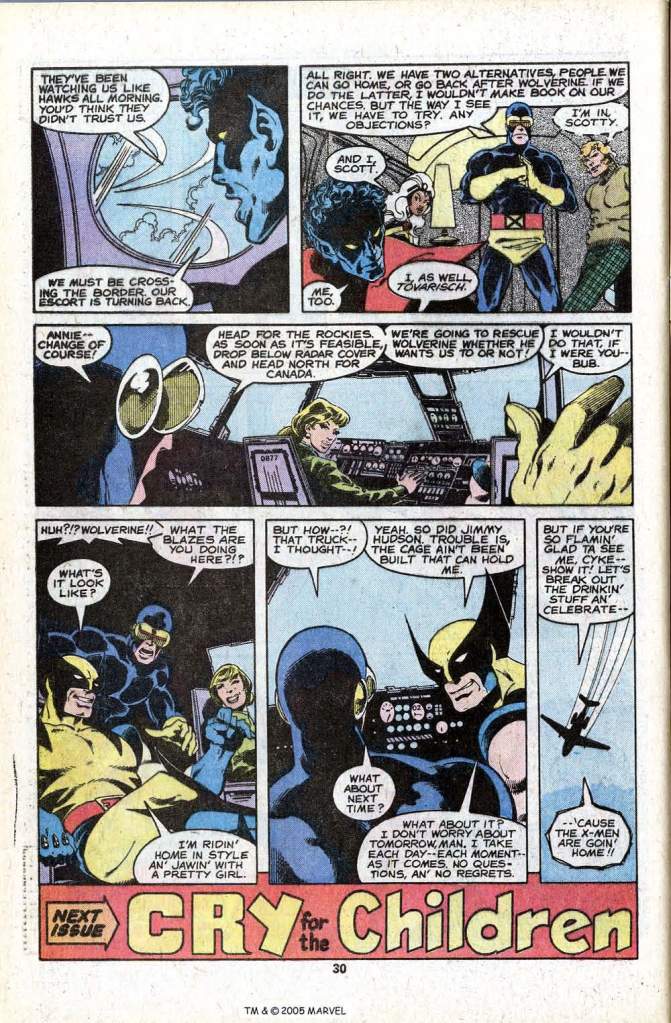
But Cyclops can’t let it go, and he orders the pilot to change course and head back into Canada. But twist: Wolverine is there in the plane’s cabin already! He escaped from the transport that Alpha Flight put him in almost instantly and was on board even before his comrades. And now that the team is back on United States soil, the chances of Alpha Flight pursuing them are slim. So the issue ends on an upbeat note, with the X-Men having almost returned home after literally eight issues on the road.


As a massive Alpha Flight fan, obviously this is an all-time favourite. But really, it’s so impressive how they introduce a whole team like this – yes, the characterisation is sketchy, but they’re all distinct in appearance and personality. It’s no wonder they caught on like they did – awesome costumes, and a sense of being something different from anything that had been seen in comics before! Give them their own series! 😉
LikeLiked by 3 people
I was still 7 in 1979. First time I saw Cyclops, he reminded me of Racer X, with the visir & that letter on his belt.
Byrne & Austin were definitely towards the head of the class of the new school back then.
LikeLiked by 1 person
True Claremont/Byrne magic here. A whole new team of rival super-heroes introduced. Plus: Canada!
LikeLiked by 3 people
“This issue is a slight deviation from that, as the story was lettered by Diana Albers.”
With Judicious John Costanza ghost-lettering that splash page.
kdb
LikeLiked by 3 people
I noticed that the splash page was a different letterer from the interior. I wondered if it was Gaspar Saladino, who did a lot of Marvel splash pages around then. On his blog, Todd Klein credits Saladino with the cover lettering, but not the splash page.
LikeLiked by 1 person
On the debates on which is the first appearance of Alpha Flight, The X-Men#120 ( April 1979 ) where only Vindicator is seen in costume and the rest ( Shaman ( Dr. Michael Twoyoungmen ), Sasquatch ( Dr. Walter Langkowski ), Snowbird ( Anne McKenzie ), Northstar ( Jean-Paul Beaubier ) & Aurora ( Jeanne-Marie Beaubier ) seen in their civilian identities & code names given or The X-Men#121 ( May 1979 ) seen here plain as day in costumes and in one case furry 10 foot tall body. Well Fantastic Four#1-2 ( November – January 1961-1962 ) answers that question, cause they had code names and no costumes in those 2 issues ( Costumes in FF## ( March 1962 ) — plus there is at DC Comics the Golden Age Atom.
LikeLiked by 2 people
IIRC in the 80s,90s, and most of the 00’s #121 was the Key. Then it became #120.
My opinion is they both are equals but we live in and era where every is obsessed with singular things being “best” “best” “best” or “The Best Jerry THE BEST”
LikeLiked by 1 person
One element from this period of X-Men that’s rarely acknowledged but was hugely influential as the glue that really held everything together during the Claremont/Byrne run: my old pal, editor Roger Stern. I personally witnessed quite a bit of it, &, man, Roger was elbows deep in it all. I can’t point to any specifics – such is the nature of comics editing – but let’s give Roger his props. Would’ve been a very, very different book w/o him…
LikeLiked by 5 people
Steven Grant, please write a book about Roger Stern. He had the midas touch (or insert some similar metaphor indicating how cool he was).
LikeLiked by 1 person
I’ll think about it.
LikeLiked by 1 person
Roger was glad to go freelance when he did, but all of the books he edited were better for his involvement. AVENGERS (during a tumultuous period, schedule-wise), IRON MAN in the Michelinie/JRJr/Layton run, MASTER OF KUNG FU for much of the Zeck period, the Duffy/Gammill POWER/FIST…the books he put together were really solid.
LikeLiked by 4 people
Kurt, as a writer, can you detect anything about the books he edited that reveal something like “the Stern stamp”? Did he try to have plots or dialogue work or flow in certain ways? In terms of editorial direction, I always think of Shooter’s dictum that the first page has to review/prepare the book for any new (“first”) reader so they feel like they can jump on the book. … I wonder if Stern is different from that. Stern’s books seem to allow for things to be packed in to really be enjoyed by the constant reader who wants to get as much story as he can get in his purchase? I’m just thinking out loud here. Any thoughts on what Stern did really well for his creators?
LikeLike
I never got to work with Roger as an editor, so I can’t really say how he approached it all. But Roger’s books were solidly done, even when it was a series that wasn’t to my taste. They were professionally-crafted — a new reader would understand what was going on, the pages weren’t overloaded, either with lettering crowding the art or art that made it hard to follow the story. There was “enough” story, and it was paced well. The books tended to improve if Roger took them over. He was kind of in the position of a TV/movie producer, and was producing well.
LikeLiked by 2 people
Other editors I’d noticed similar results from were Paul Levitz and (when he was at DC) Len Wein. Series they edited tended to get better when they came aboard.
LikeLiked by 2 people
In my experience – I worked with Roger a few times – he had no requirements like that, & was usually glad to go with whatever he felt worked. Whatever Jim’s dictums may have been, they really weren’t emphasized by either Roger or Al Milgrom, Marvel’s line editors at that point in time. (Or I may have already been aware enough of what was wanted it was invisible to me…)
LikeLiked by 2 people
Or maybe it’s a case of a a good editor = get out of the way of the creative team. ?
LikeLike
“Or maybe it’s a case of a a good editor = get out of the way of the creative team. ?”
No, if that’s all a good editor did, then publishers would scrap editors and just have traffic managers and proofreaders.
Editors serve as sounding boards, first-feedback and the guardian of the book’s tone and company concerns — all of which can be unnecessary if the creative team doesn’t need it, but almost any creative team needs some of that. And if the creators need more, then a good editor responds as needed.
LikeLiked by 2 people
Yeah, I seem to remember Avengers…
Al was on a lot of Jo’s PowerFist run, too…
But, yeah, Roger had a much better sense of what made a good Marvel story in that era than I did…
LikeLiked by 2 people
Going by the credits — which do not, of course, tell the whole story — Al only edited three issues of PM/IF, but he hired Jo (who was his assistant at the time), Roger hired Kerry, Denny inherited (and lost) both.
LikeLiked by 2 people
I was involved in at least 3 issues of PowerFist at the time, & Al was my editor on all of them…
LikeLiked by 2 people
By the time each of them came out, someone else was in the editor credits.
I assume in the case of 69, it was because Alan Weiss him draw slow.
With 61-62, those were the fourth and fifth issues Roger was listed as editor on, so Al was close to a year ahead on plots, on a bi-monthly book…
LikeLiked by 1 person
Either that or they were all unscheduled when you were plotting them (which might make more sense), and Roger and Denny slotted them in as needed.
LikeLike
I hadn’t realized Stern was an editor, though I enjoy his writing.
LikeLike
I’ve heard that Roger Stern and John Byrne have been close friends for decades. In terms of Stern’s role as editor on X-Men during this time, I wonder if part of it may have involved giving a certain amount of preference to Byrne’s ideas over Chris Claremont’s, or working to restrain some of Claremont’s creative tics. That may have resulted in more of a balance between Byrne and Claremont. I’ve also heard that after Stern left, subsequent editors fell more into Claremont’s camp, which fed into Byrne’s growing disenchantment. Just some supposition on my part, though.
LikeLike
Mid-’70s, ’73 or ’74, somewhere in there. Matter of fact, I was connected with John by a mutual friend around that time too – we were cooking up some stuff for amateur comics that never got done because reasons – & it was John who told me I should go meet Roger & Bob Layton at this monthly one day comic show held every 3rd Sunday back then at the downtown YMCA in Chicago. That’s how I connected with Roger, so Roger & John’s friendship is at least a few months older than that…
LikeLiked by 1 person
Us old timers all appreciate what the man did.
LikeLiked by 2 people
In Marvel Super Hero Contest of Champions#1-3 ( June -August 1982 ) at the back of there was an alphabetical listing of Marvel Super Heroes as of 1982 ( Issue#2 gives Sasquatch a different origin for his mutation, the creation of a serum — which would have made The Brute that Walks [ Journey into Mystery#65 ( February 1961 ) 1st story ] a close prototype ). When John Byrne did Alpha Flight my observations were that he amalgamated the members with 1960s era Marvel Heroes: Northstar & Aurora with Quicksilver ( his attitude, reluctant team member & over protective brother ) & the Scarlet Witch & with Yellowjacket & the Wasp ( her flirting ) — Yellowjacket & the Wasp as a team. Sasquatch ( with Hulk ( Bruce Banner ) & Goliath ( Hank Pym — especially with his Contest of Champions origin ) ), Shaman ( Doctor Strange & Dr. Donald Blake ( since he was still practicing medicine ), his Grandfather was his Ancient One and Talisman ( was Clea if she was Strange’s daughter and not his love interest )), Snowbird ( Thor & the Hulk ( she was given counterparts to the Hulk’s supporting cast — General Ross & Glenn Talbot/Betty Ross ( as one person ) in the RCMP ) and Guardian ( was Iron Man & Captain America ). I wondered if the original Box ( Roger Bochs ) missing his legs was John Byrne way of saying that Tony Stark should have lost his legs when he stepped on that landmine ( Unless I missed it I can’t remember how Roger Bochs lost his legs ).
LikeLiked by 2 people
We never got an explanation for Roger’s legs in the classic stories – Byrne and Mantlo both include passing mentions that confirm he’s an amputee, but that’s as far as we ever knew. Mark Gruenwald in the Official Handbook just notes that “for unrevealed reasons” he’s missing both his legs, maybe hinting that someone might want to explain it one day, but nobody did.
In recent years, the (annoying) introduction of Roger Bochs Jr told us that father and son were both born with a hereditary condition that required their legs to be removed…
LikeLike
Wow, that is a terrible explanation (retcon?). Who was the writer who barfed up that stupid idea?
LikeLike
John, that is a very insightful post. Wow. I love it.
LikeLike
Originally I would do Quicksilver/Ant-Man & Scarlet Witch/Wasp but I got it in my head that since Northstar & Aurora have the same powers that I should use Yellowjacket ( fly by artificial shoulder wings and fire energy from gloves ) & the Wasp ( fly with her real wings and fire energy from her hands ), plus when Aurora had a tantrum at her brother she asked Walter to alter her powers and he used a machine that was similar looking to the one Hank Pym used to give the Wasp her powers ( if my memory is correct ). Plus I forgot about red headed secretary Heather Hudson who worked for a corporation and red head secretary Pepper Potts who worked for Tony Stark’s corporation, except Heather Hudson was married to her Iron Man ( Weapon Alpha, Vindicator, Guardian ).
LikeLike
I’d never considered that Quicksilver & the Scarlet Witch were direct inspirations for Northstar & Aurora, but that makes a lot of sense, remixed with other characters or not.
Byrne and Claremont seemed to share an interest in brother/sister twins generally. Claremont went on to create Karma and her brother, as well as Fenris. I’m not sure if Quicksilver & the Scarlet Witch acted as an inspiration for them, too, or if he was just interested in the male/female dynamic of characters with the same/shared powers.
LikeLike
“But Wolverine is wanted by the Canadian authorities–they had spent millions of dollars on him and his training and they want their investment back. “
You won’t see any mention of this in the credits, but that was Dave Cockrum’s idea from back when he was the artist on the book. Dave was a former Navy man himself, and he grew up in a military family. Chris Claremont mentioned the idea to John Byrne when he took over, and Byrne ran with it, being Canadian himself. Ironically, it was Dave Cockrum who drew the cover of Alpha Flight’s first appearance, as well as the issue that introduced Vindicator as Weapon Alpha (X-Men # 109), where retrieving Wolverine first comes up.
LikeLiked by 2 people
Uncanny X-Men#121 was my first issue of X-Men ever. Thanks to the fine folks who owned DC Comics in 1978 and the DC Implosion. At my young age, I was a loyal and fairly content DC reader but with more spare change than comics to actually buy. I started sampling various Marvel titles includinfg this issue of X-Men and I decided to stick around awhile.
LikeLiked by 1 person