

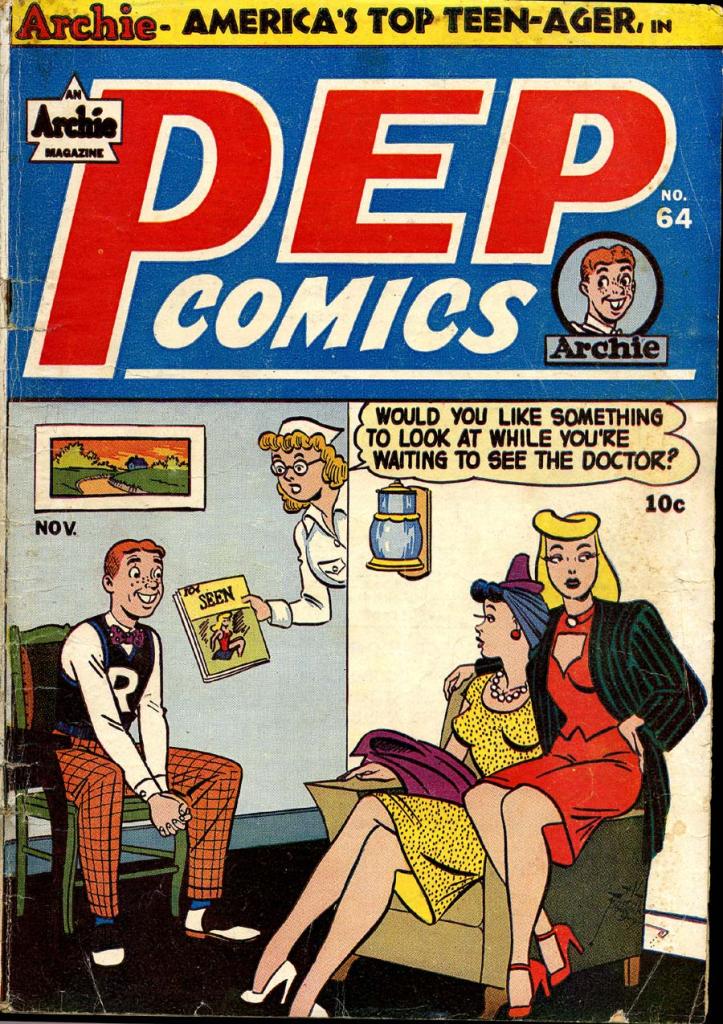
Predating Captain America and a horde of other lesser lights, The Shield was the first patriotic-themed super hero of the Golden Age of Comics, debuting in PEP COMICS #1 in 1939. He was billed as a “G-Man Extraordinary”, and over the next eight years, he’d carry on the fight against evil, losing his Superman-inspired super-powers along the way but gaining a kid sidekick in the person of Dusty, billed as the Boy Detective. Eventually, though, after the end of World war II, reader tastes began to shift away from costumed crime-fighters towards other genres. Before he knew it, the Shield found himself surrounded in the pages of PEP COMICS by Archie and Katy Keene and other humorous features. The writing was on the wall.
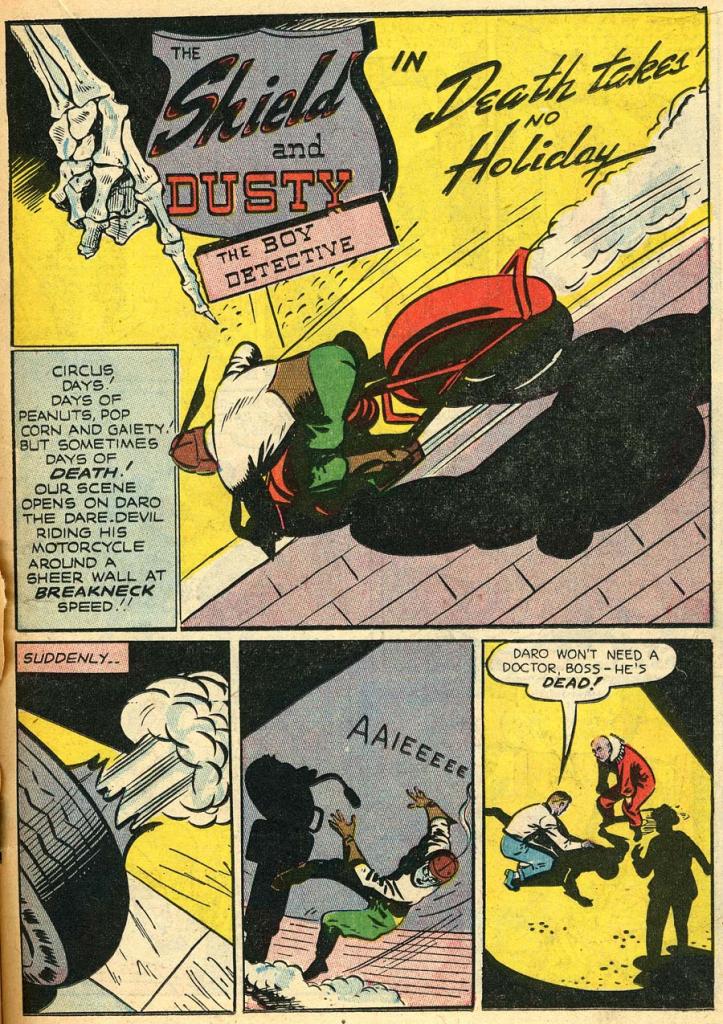
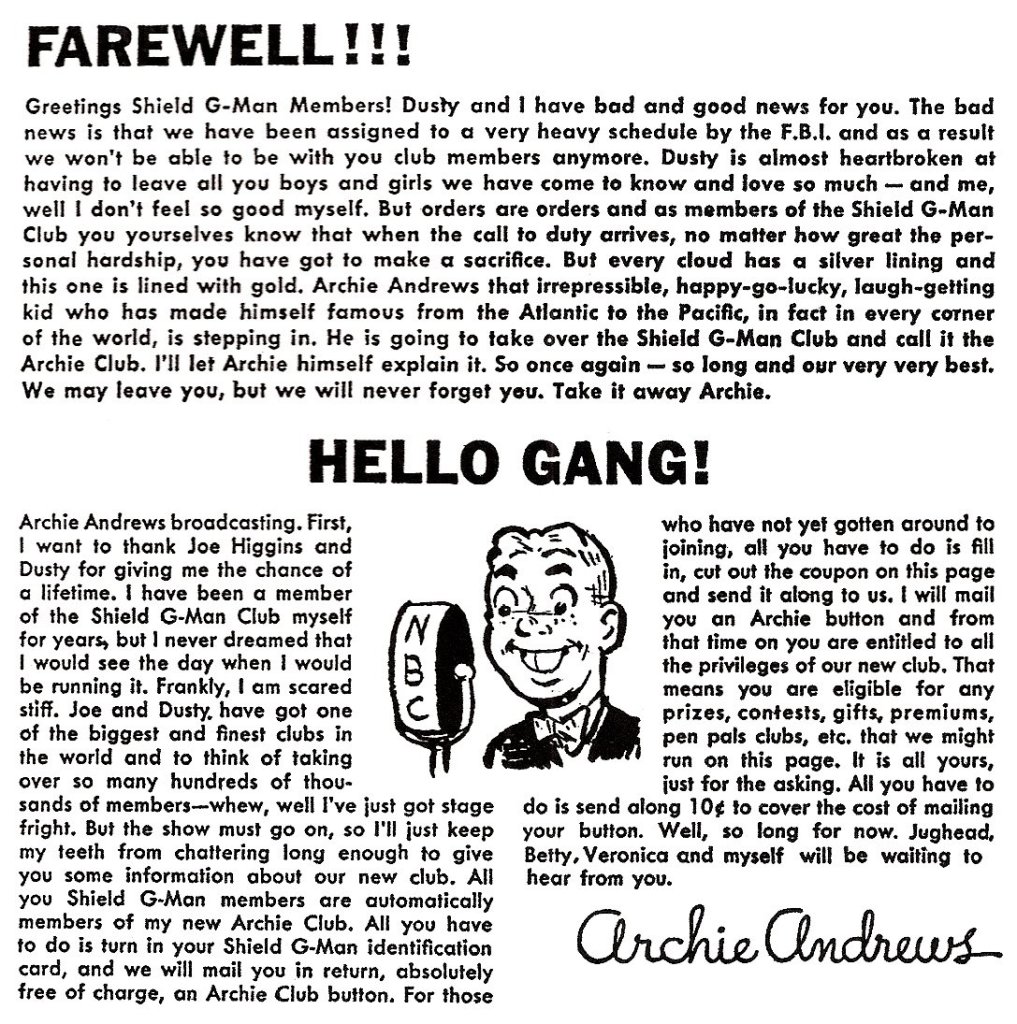
The very last original Shield story saw print in PEP COMICS #64 in 1947. I say last original because the following issue reprinted an earlier story before letting the feature die off. Additionally, the popular Shield Junior G-Man Club transitioned its entire membership over to the almost-identical Archie Club an issue after that.
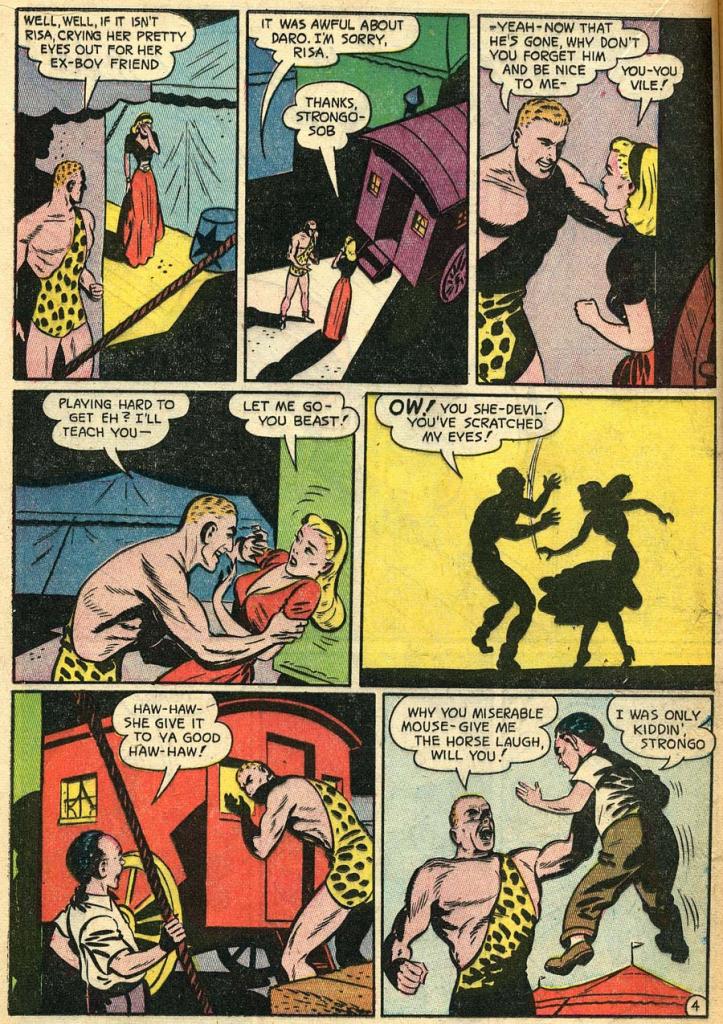
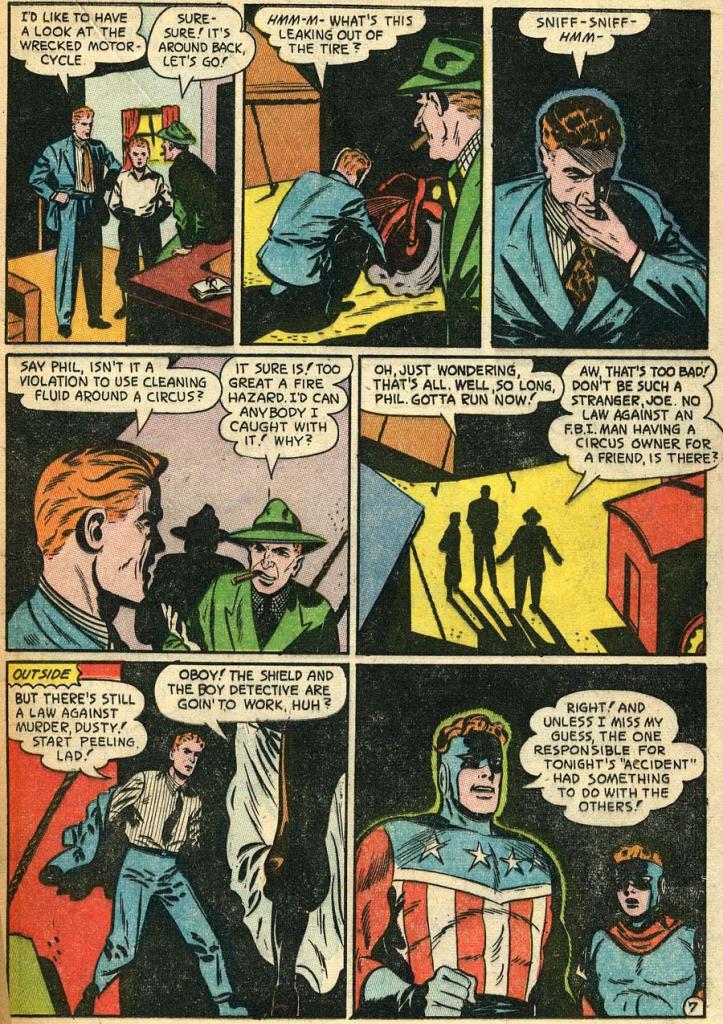
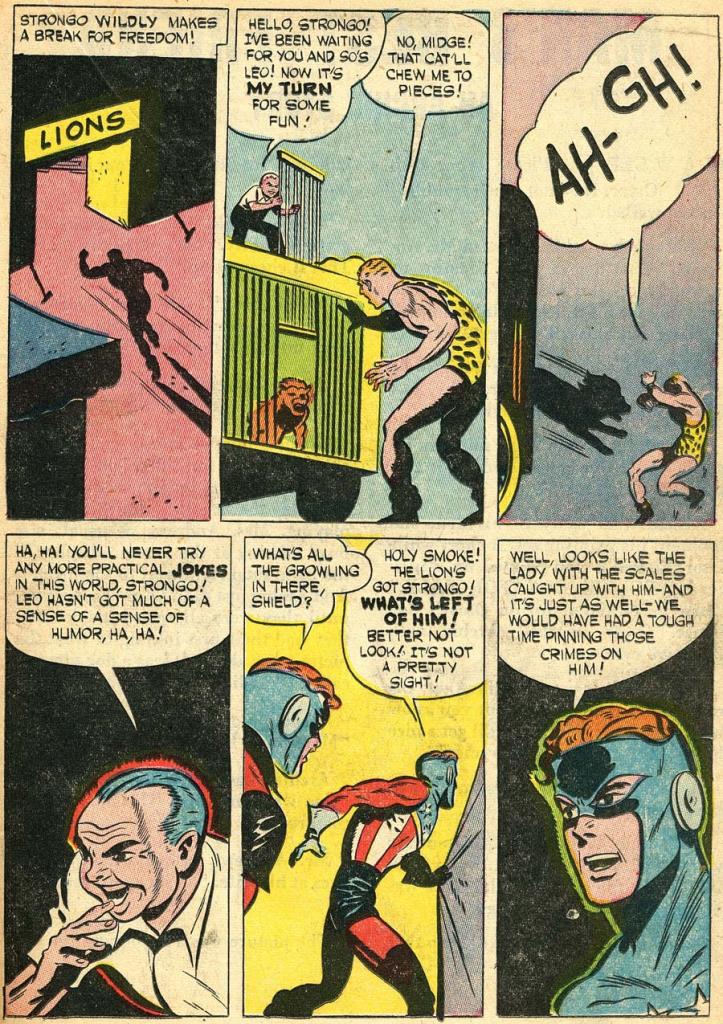
Like the first Shield story eight years earlier, this final story was illustrated by Irv Novick, who would later go on to work on DC’s war comics for several years before switching over to Batman and Flash stories in the 1970s. The author of this story is unknown.

It was also apparently cut down in length at the last minute–so much so that most of the pages still have their original page numbers in the corners. At least two pages from the start of this adventure were discarded before publication, but those numbers remained unchanged. Possibly this was to make room for the Katy Keene pin-up pages or similar filler material that was more of interest to the readers of the period.



 The Tom Brevoort Experience
Shield and Dusty didn’t remember us until 1984, which does seem suspicious when I think about it too much.
LikeLiked by 1 person
The Shield’s “farewell letter” to his fan club is actually a bit poignant.
LikeLiked by 2 people
It is. He goes out with a harmless lie that keeps his dignity intact and doesn’t blame the readership for moving on…. or Mr. Goldwater for obviously sacking and replacing him with a goofy teen-ager. He let’s the fans he has left know that the worst part is that he will miss them and graciously passes them onto his replacement. Any kid reading this in ’47 probably knew there wasn’t a heavy FBI assignment pulling him away…if there was it would just mean more comic stories… it’s not like this was a separate gig for the Shield and Dusty.
To his credit he doesn’t plead for anyone to write in and ask for him back, although maybe J. Edgar Hoover received a perplexing letter or two asking him to cut the Shield’s workload.
I imagine the Shield in later years seeing kids at newsstands looking at Pep starring Archie and just aching and showing up for a while in MLJ’s parking lot. The decades roll on and still Archie endures… more durable than the guy who was actually bullet proof.
LikeLiked by 3 people
Well said.
LikeLike
It feels strange to have to mark Like for a post that I do love, but feel saddened for the blatantly obvious loss of the Golden Age. Not as sad as the loss of the JSA (over and over) but the end of something that I didn’t experience myself, but the end of the comics that my mother told and retold me about until the characters felt like childhood friends to me.
LikeLiked by 2 people
I actually much prefer Irv’s work here over his “modern” style decades later. Styled faces & figures aided by dramatic lighting. Everything’s tighter & more simplified.
LikeLiked by 1 person
I prefer the style he used on Batman and Flash but this was impressive too. I have to add him to my list of Golden age artists whose work was better than the norm for the time. He, Joe Kubert, and Bob Kane really shined back then.
LikeLiked by 2 people
I agree on Kubert.
Mac Raboy might be my favorite Golden Ager. Graceful figures and fluid ink lines; masterful lighting, Beautiful drawings.
Fred Ray. Likely my favorite GA Superman artist. His images delivered on what Shuster’s drawings suggested. I like Shuster’s, for sure. Ray just refined Superman for me. Quintessential. Iconic.
Lou Fine. Raw, but still fluid & graceful. Powerful images.
Frank Frazetta. I mean, come on. But maybe he’s more Silver Age?
Jack Burnley. More simplified than Fred Ray, but the compacted power in the figures is still appealing.
Alex Toth. He was working then. But again, he got so much better, later.
LikeLiked by 1 person
Yep!… there’s an economy to the art that is very appealing overall, and a number of panels that are just outright cool… Page 9 panel 2 for instance. The heavy use of silhouettes work pretty well too. Silhouettes get called out a lot as a “cheat” but there’s a consistency in their use here that seems cinematic and intentional… even if it is ultimately a timesaver for the artist. The use of the shadow when the guy is being hung over the lion pit by a pitchfork is particularly good.
LikeLiked by 2 people
I’m just lucky I guess. Never saw a Novick story I didn’t love, even with the consistent maturing of his storytelling and art style/directing.
LikeLiked by 1 person
Well that was a gruesome end for Strongo, his Timely Comics strongman counterpart Strongo faired better against the Blonde Phantom ( granted she scared him so much that after he served his time in prison for theft, he refused to perform at the circus if women were present ) [ Marvel Mystery Comics#91 ( April 1949 ) “Alone with a Killer” ]. Dusty the Boy Detective, was he an amalgamation of Bucky & Robin the Boy Wonder? He has short sleeves and cape like Robin.
LikeLiked by 2 people