


I come from a family of readers, and so every time we’d go out to the mall or to another shopping center on the weekends, as typically happened most Saturdays, we almost always stopped into any bookstores that happened to be around. Our main destination, the Smith Haven Mall, had three if you can believe it. We wouldn’t necessarily go into all of them, but we’d certainly go into at least one. And so I became very familiar with the HUMOR section in each one–because that’s where any book on comic books or classic comic strips was inevitably racked, regardless of whether it was humorous in nature or not. In any event, it was at around this time that I came across this, the second Pocket Books paperback release of INCREDIBLE HULK stories. In a time before digital or even collected editions, these little paperbacks were an invaluable lifeline towards reading and collecting the stories of the past.

These little books typically collected about six issues’ worth of material in a volume. But this edition of INCREDIBLE HULK was set up slightly differently. That’s because the stories it contained came from the split anthology TALES TO ASTONISH that the Green Goliath shared with the Sub-Mariner. Accordingly, it collected all of the Hulk stories from TALES TO ASTONISH #85-99. There was a slight trade-off in that there weren’t any cover reproductions, but half of those covers would have been Sub-Mariner pieces anyway. Either way, it was a big block of Hulky goodness from the heart of Marvel’s most fertile period in the 1960s.
The choice of a second Hulk volume was a bit of a no-brainer. With the success of his weekly television series–the only Marvel character to successfully carry such a show in live action–the Hulk was at the height of his popularity, and so another INCREDIBLE HULK collection was virtually guaranteed to be a strong seller. What’s more, the time that these stories were culled from was pretty good in reflecting the status quo of the TV series, at least at the start. At the beginning of this volume, the world doesn’t know that Bruce Banner and the Hulk are one-and-the-same. for example. That event happens a portion of the way through the volume. The Hulk is also often on the move in these stories, traveling from place to place and getting drawn into dangerous situations not of his own making, either by people who fear him, people who want to take advantage of him, or people who want to destroy him. After having continually experimented with the strip almost from the moment of its conception, by this point Stan Lee and his collaborators had its essence down to a repeatable formula.

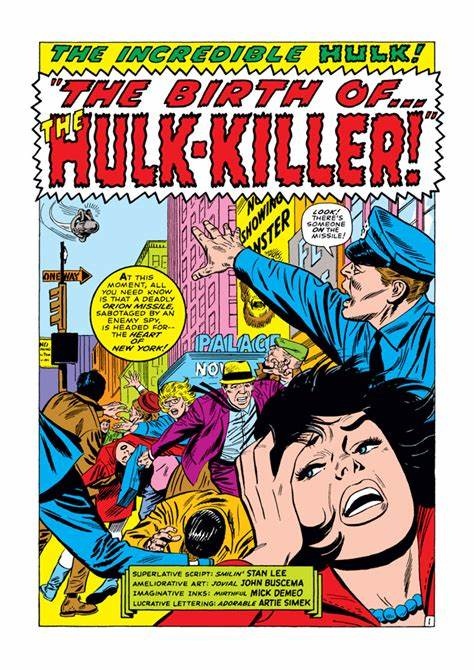
This volume also reflected the fact that the Hulk was a somewhat unsteady strip during this period. Marvel would often make fun of the fact that more artists had drawn the Hulk series than any other character, in an attempt to turn a deficit into something of an asset. So this book opens with a trio of tales illustrated by the great John Buscema, his first regular work for Marvel since returning to comics from advertising. In later years, John would speak about how bad his work on these stories was, and you can see his point–they’re lacking in dramatics and punch, even if everything is beautifully illustrated. (It also didn’t help that he was working with unsympathetic inkers who couldn’t seem to figure out how to capture his work well.) But John was still absorbing the lessons of Jack Kirby, and as soon as he cracked the code, he wound up being pulled off of Hulk for more important series such as AVENGERS.
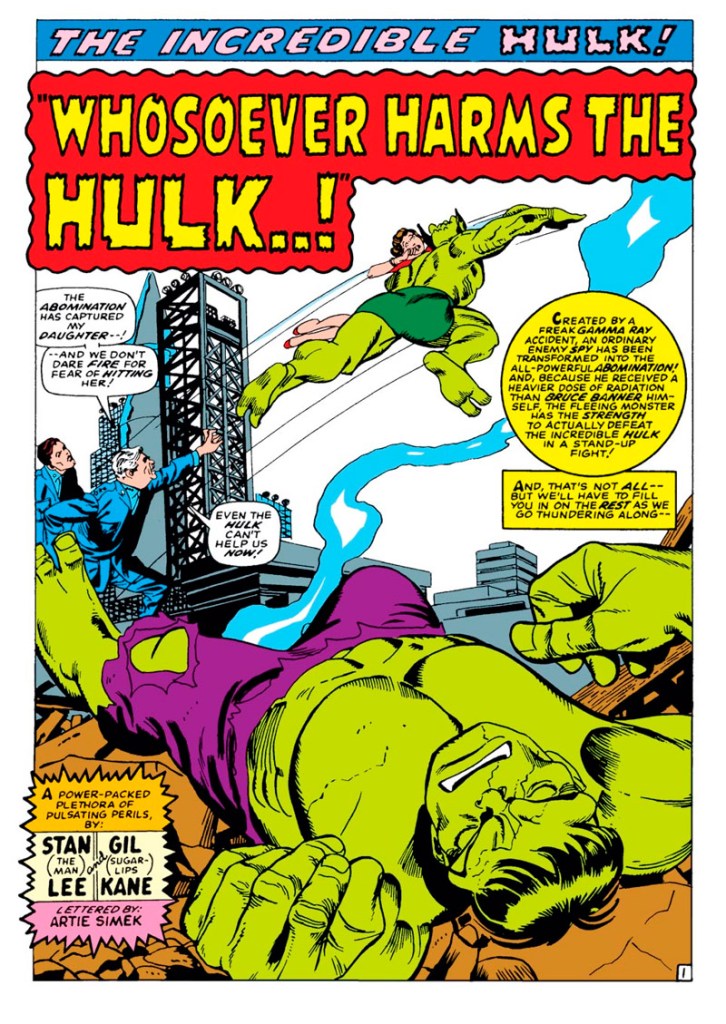
Then there’s a bit of a whiplash shift as the next four installments are illustrated by Gil Kane. Kane had come over to Marvel looking for more graphic freedom–he’d been a mainstay at DC for years, where he was drawing the popular GREEN LANTERN and THE ATOM series, among others. But having seen what Jack Kirby was doing in the Marvel books, Kane wanted to cut loose and add more dynamism and vitality to his pages. Unfortunately, his DC editors were quite happy with their clean, sedate approach to artwork, at that moment at least. So Kane began to pick up work elsewhere. Having to plot the stories as well as draw them was a new thing, and it took Gil a second to become comfortable with the approach. And he straight-up swipes Kirby shots repeatedly in these Hulk adventures. But regardless, these stories zipped along with energy and verve. Kane’s design for recurring Hulk foe the Abomination made that character memorable, even if his appearance has been codified down into something less outlandish over the years.

Succeeding Kane on the strip, the last eight stories or so were illustrated by Marie Severin, who had been toiling in the small Marvel Bullpen as a colorist and a corrections artist. Sexism had largely been responsible for keeping her out of the pages of actual super hero stories, but according to legend, Stan used her to illustrate an article that was promoting the Marvel renaissance, and publisher Martin Goodman saw her work for it and asked why she wasn’t drawing any strips for the firm. Even on her straight work, Marie’s pages always contained a dollop of humor in their presentation, like she knew just how outlandish this stuff was that she was being asked to illustrate and couldn’t help but smirk about it slightly in her images. But she could channel Kirby dynamism as well as anybody, and her work had a certain fluidity to it that made it lively.

I still wasn’t the hugest Hulk fan in the world, but this volume did help me to bridge the gap in my knowledge a little bit. And I was still the most attracted to the style of comics that had been done in the 1960s, so it was about as good a Hulk volume as I might have asked for. In the course of it, the mighty Green behemoth battles the Hulk-Killer (a special humanoid left over from an earlier adventure with his nemesis, the Leader), the alien Stranger, the Abomination, the Silver Surfer in that character’s first non-Jack Kirby appearance, the High Evolutionary and the Legions of the Living Lightning. So I got a lot of content for my $1.95. These Marvel Pocket Comics were essential reading for me, and I would buy them just about any time I came across a new volume.
 The Tom Brevoort Experience
I got the first PocketBook Hulk collection, which included the full run of the Hulk’s initial 6 issue series. I missed the 2nd PB collection but got most of those stories in the Marvel Super-Hero reprints. Several years ago, btw, I came across a site that included artwork Gil Kane had done for a short story Kane had done for one of DC’s anthology horror/suspense mags shortly before going to Marvel and which included a giant sea-creature that very closely resembled his rendition of the Abomination, aside from being much larger. Can’t really blame Kane for plagiarizing himself to take a conception for a one-shot character an re-use it for a character who would get a lot more use as a Hulk baddie, and Stan did select Abomination for inclusion in his Bring on the Bad Guys Fireside collection. I’d have thought the Leader may have made a more obvious choice as he had been Hulk’s most prominent baddie, but then the two-part Abomination story made a better fit than any of the stories featuring the Leader that Lee had written (and mostly drawn by Ditko) and which were part of a sprawling multi-chapter epic ending with the Leader’s apparent death. All reprinted in the later Fireside Hulk collection. It wasn’t until well after Tales to Astonish was re-titled for the Hulk and into Roy Thomas’ run that the Leader showed up again. I didn’t start collecting Hulk on a regular basis until issue 160, although I’d gotten quite a few earlier issues over the years, most of which got tossed out during my family’s move from California to Utah in 1971.
LikeLike
Fond memories of this one. Do you think the cover line of “all in full color“ was meant to distinguish it from the DC paperback reprints that were in black-and-white and cut up the pages? Or from comic strip collections a la Peanuts, Doonesbury, etc. at the time?
LikeLike
I think these Pocket Book paperbacks were overseen by Linda Sunshine, who also edited the Fireside reprints. She respected the aesthetics of the comics page.
LikeLike
I’ve grown to appreciate Marie Severin’s a lot more over the years. Given the artist participated in the plotting, I’ll note it’s during her time that Hulk gets the “Why must men hunt me?” loneliness that would be one of his trademark traits during the Bronze Age.
This era worked better for me than Lee/Trimpe which became a formularized Hulk Smash every issue.
LikeLiked by 1 person
The Severins were amazing. Each had such a wonderful style and the dynamism when needed that fueled early Marvel. They even managed to enhance and improve every artist I’ve seen them inking and very few artists have reached their level of greatness as both artists and inkers.
LikeLike
I have a number of these MMPBs – the FF, Dr. Strange, the first Hulk and maybe one or two more. Didn’t have this one, though. I wasn’t so interested in the Hulk that I could overlook the extreme reduction, and a friend of mine had a hefty collection of TALES TO ASTONISH I could read through.
Plus, I had a good source for back issues, so I think I mostly got the MMPBs of the material that was too expensive to hard to find.
LikeLike
“And he straight-up swipes Kirby shots repeatedly in these Hulk adventures.”
If so he did a good job making it look like straight up Gil Kane action. Never heard this charge before.
LikeLike
Yes! Was about to say that!
LikeLike
I picked up Hulk Vols 1 & 2 and Spidey Vol. 1 at a bookshop in Adelaide when he was 10-11. They were a revelation at the time, especially the Hulk stuff.
We got B&W reprints of Marvel stuff through the shortlived (and dodgy) Newton imprint in 1975-76, so I’d seen Ditko’s Spidey. But the published Hulk stories were randomly selected and didn’t include the earliest stuff.
So this book was great to have in my collection and fill in some of my knowledge gaps.
LikeLike
I still have this book from when I was a kid. It is awesome.
LikeLike
Unfortunately, I don’t think the early Hulk stories by Ditko in Tales to Astonish have ever been successfully reprinted? I remember being about to buy an Essentials B&W reprint volume, but noticing how poor the art reproduction was – in some cases with panels poorly re-drawn. The original art or stats must have been lost 😦
LikeLike
There was one of those Fireside books from the ’70s that included the Ditko stories:
https://marvel.fandom.com/wiki/Fireside_Book_Series_Vol_1_10
LikeLike
thanks. But wonder if it had the same art issues I noted?
LikeLiked by 1 person
Were these are issues resolved by the recent Epic collections?
LikeLike
Were these are issues resolved by the recent Epic collections?
LikeLike
I got “He Who Strikes the Silver Surfer” [ Tales to Astonish#93 ( July 1967 ) ] in Marvel Treasury Edition#13 ( 1976 ) which also reprinted Marvel Team-Up#6 ( January 1973 – Spider-Man & Thing vs. Puppet Master & Thinker ), The Avengers#58 ( November 1968 – “Even an Android Can Cry” ) & daredevil#86 ( April 1972 – “Once upon a Time — the Ox! ).
LikeLike