


Wildcat was one of the great second banana super heroes of the Golden Age of Comics–one who has become ostensibly more popular in more recent years than he was when his series was running in the back pages of SENSATION COMICS. Wildcat was champion prize-fighter Ted Grant who was inspired by the example of Green Lantern to adopt a costumed identity after he was framed for murder. Even after his own situation had been cleared up, he continued to operate as the fighting feline, eventually becoming a momentary member of the Justice Society of America in ALL-STAR COMICS for all of a pair of adventures.

But sadly, as tastes changed in the postwar period and costumed super heroes fell out of favor with the reading public, Wildcat was sent to the showers like so many of his contemporaries. His final solo outing was published in SENSATION COMICS #90–and by this point, he wasn’t active as a member of the Justice Society, so this was teh end of the road for him.

The writer of this final Wildcat adventure is unknown, as is its artist. The Grand Comic Database conjectures that it might be Gil Kane, but looking at it, I’m skeptical. Robert Kanigher served as the anthology’s editor, though Whitney Ellsworth was given that credit in the indicia.
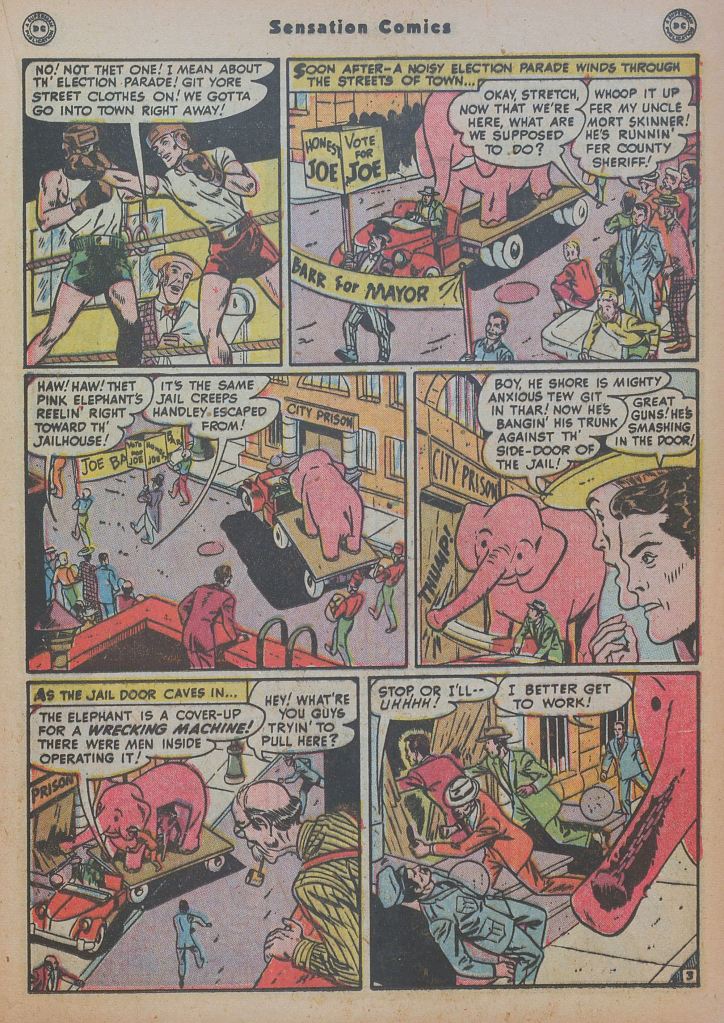


It’s another of the formulaic super hero stories that the DC titles of this period are full of: a criminal situation, the hero being overcome and placed into a deadly situation, an escape and then a hasty resolution. Very predictable on every level, it’s really no wonder why stories like this wore out their welcome so thoroughly.
 The Tom Brevoort Experience
Wildcat is replaced in the next issue of Sensation by Streak the Wonder Dog, who’d already usurped his master the Green Lantern! That mutt might just have been the Justice Society’s most successful foe! 🙂
LikeLiked by 2 people
Isn’t this a Pulp Hero thing: ( Comics.org ) Oddity- Wildcat leaves behind THE PAWPRINT OF A WILDCAT on the forehead of criminals as his calling card to the police [ Sensation Comics#3 ( March 1942 ) ]? Plus imitating Batman with his Cat-O-Cycle [ Sensation Comics#4 ( April 1942 ), Catocycle in Sensation Comics#20 ( August 1943 ),25 ( January 1944 ) ].
LikeLike
Cat-O-Cycle [ Sensation Comics#4 ( April 1942 ) page 5 panel 4 ” No roar from the motor, only a soft purr like that of a cat!” – I wonder if it was electric or hydrogen fuel cell powered ] & Catocycle [ Sensation Comics#71 ( November 1947 ) page 4 panel 1 “A switch of the lever and the versatile catocycle becomes an aquaplane” — riding the catocycle on the water ] — don’t what other abilities it has.
LikeLike
The art does not look like Gil Kane. His work on Wildcar (done under his “Gil Stack” pseudonym) apparently had a Kirby influence.
It looks more like the Quality or Fawcett (non-Beck/Costanza0 house look
The other thing I am reminded of is a .Bernard Krigstein Wildcat story from the late’40 reprinted in the1970s that had none of his later story telling brilliance, but had similar solid draftsmanship to this story (Bernard Krigstein (as B.B. Krig) Sensation Comics #84 Story Page 1 | Lot #92063 | Heritage Auctions) or Diversions of the Groovy Kind: Groovy Age Gold: “The Monkey’s Circle!” by Kanigher and Krigstein
.
LikeLike
Odd as it seems is this a Bernie Krigstein ( bernie krigstein wildcat sensation comics – Search Images) Wildcat story?
Given Bernie Krigstein’s later work, I might not have thought so, but it looks more like this Diversions of the Groovy Kind: Groovy Age Gold: “The Monkey’s Circle!” by Kanigher and Krigstein than Gil Kane’s work of the period.
It’s not great work, but the art and the story telling has a certain something. It looks more like art you would see in the Quality or Fawcett books, say Dollman or Spy Smasher.
Too bad this was not enough to turn things around for the feature (who clearly had a certain unrealized potential), but it gave Krigstein a chance on more appropriate material.
LikeLike
I checked that Kane credit and… uhh… GCD says it’s Kane and… about the only thing that looks like Kane is, if one tries hard enough, the Wildcat figure in the splash panel.
My very feeble recollection is of reading a reprint of a Wildcat story long, long ago — a tory obviously older than this one, one signed by Kane as Gil Stack. There were enough traces of Kane that I thought I recognize him as the artist, name notwithstanding. Which is to say that even at that point, again an earlier story than this one, the Kane we knew since the pre-Silver Age, was recognizable. Which, again, can’t be said about this story.
The GCD claims the credit came from Jerry Bails but it’s vague on whether it’s a credit for Kane on this story or just that generally he worked on some Wildcat stories:
“Credits from Jerry Bails. End of series. Next appearance in The Brave and the Bold #62.
Keith Chandler : The art was previously credited to Arthur Peddy ?, but none of his style is evident. This looks more to be the work of Gil Kane (whom Bails credits with working on this feature during this period).”
And to make things possibly murkier: IIRC, Kane may have been sharing a studio at this time with Carmine Infantino. I’d daresay I see more Infantino than Kane here but, like, it’s counting crumbs. There’s also a panel or three where the artist looks familiar but it’s tip of the tongue stuff.
Meanwhile, my understanding of editorial credits at DC for anthology books: Ellsworth was the credited editor on everything but there were story editors like Kanigher and Julie (B.O.) Schwartz and others. In the case of anthologies like Action, Adventure, and some others, they’d edit characters, not stories. So Weisinger edited Superman in Action but the back ups were edited by others. Not all anthologies were like this and I’m not sure when the change happened.
Or so I understand it…
LikeLike