

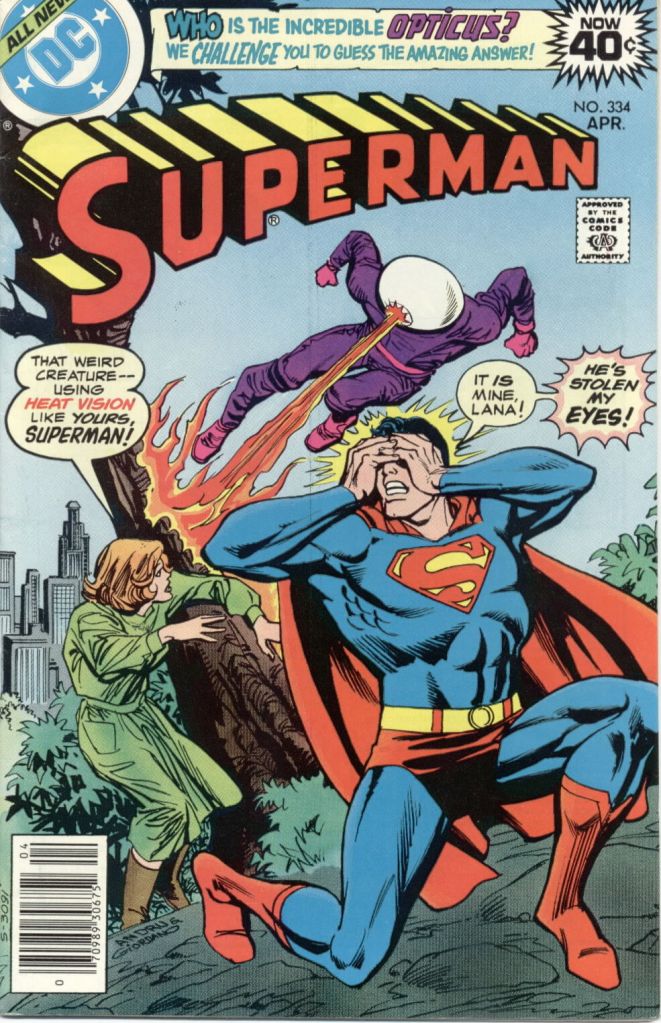
As much as you might have thought that it would, the public debut of SUPERMAN THE MOVIE didn’t really do much of anything to change the contents or direction of the SUPERMAN comics. Oh, sure, Clark Kent was brought back into the Daily Planet as a reporter (in addition to his job as a WGBS news broadcaster) but other than that cosmetic touch, the kinds of stories and the kind of artwork that had been the backbone of the strip for the rest of the 1970s remained essentially unchanged. This represents a bit of a missed opportunity, I think, to capture an audience who might have been lured into checking out the Man of Steel’s adventures by the wildly-popular film. But while it was slowly beginning to change, the editorial staff at DC didn’t yet see any great need to update and modernize their product, despite a changing marketplace and audience. That would come, though, in just a few years.
And this lack to change wasn’t any hardship for me. If anything, it was the opposite. The utter security of knowing exactly what one was going to get whenever one picked up an issue of SUPERMAN or ACTION COMICS was one of those series great benefits from where I stood. But the, I liked the Julie Schwartz-helmed era for the most part, had done practically since I read my very first comic book. And even though it wasn’t as exciting to me as the more bombastic Marvel books that had started to occupy my attention, there was absolutely something comforting about how unchanging the Man of Tomorrow’s adventures really were. It was like eating at McDonalds–no matter which franchise you shopped at, the food was prepared in exactly the same fashion.

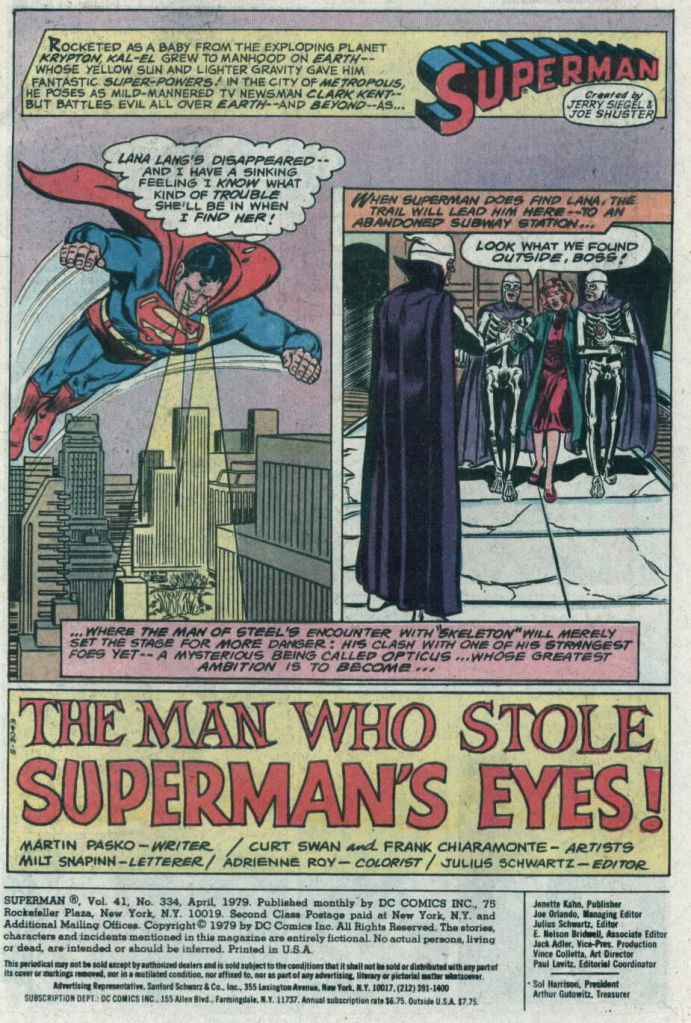
This issue opens with reporter Lana Lang having been captured by agents of Skeleton, a criminal organization made up of the remnants of the earlier defeated Skull. Superman has been aware of skeleton and waiting for its members to make their first move so that he can step in and apprehend them. But now, Lana’s actions force his hand, and he’s compelled to come to her rescue, even though it means losing track of the Skeleton leader. But this is just a little bit of action to open up the issue on, before getting to the meat of the story.
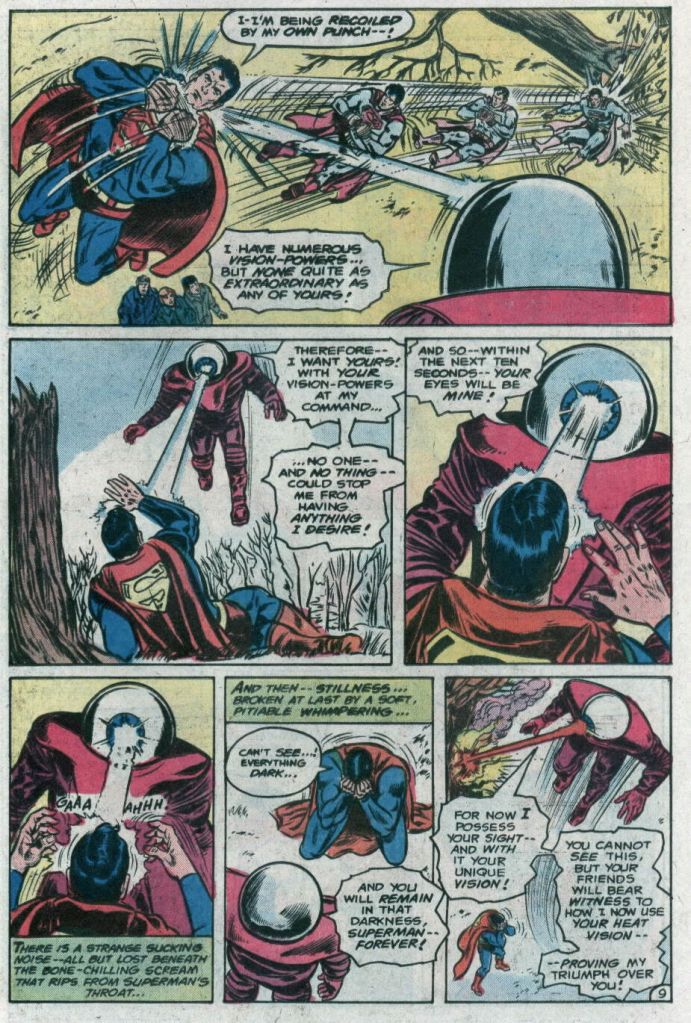
In order to protect a museum’s display of the mummy of an ancient Pharaoh and his valuable items, Superman has crafted a burglar-proof alarm system, one that he offers to demonstrate for the WGBS reporters. It involves a temperature-regulated alarm that will go off to alert the Man of Steel to a break-in if the temperature of it varies too greatly. But while teh demonstration is going on, the alarm is destroyed by a flying saucer piloted by a malevolent entity calling himself Opticus. Opticus swiftly overcomes the Man of Tomorrow and uses his strange helmet to remove Superman’s eyes, adding them to his own power. He can now use all of Superman’s vision powers while the Metropolis Marvel is struck blind.

What’s more, Superman now can’t use his heat vision to activate the theft-proof alarm system. But nobody else is going to know that, so he resolves to simply fake it and let the idea of the alarm be a deterrent. Unfortunately for Superman, the Skeleton crew planted a bug on Lana Lang while she was their prisoner, and so they’re all too aware that the valued relics are now effectively unprotected. So a day later, Skeleton’s men break into the museum with the intention of making off with their bounty. And for good measure, they simultaneously abduct Lana once again–because, hey. it’s a Tuesday. Lana thinks she’s sunk until a perfectly fine Superman shows up to rescue her from the escaped Skeleton leader.
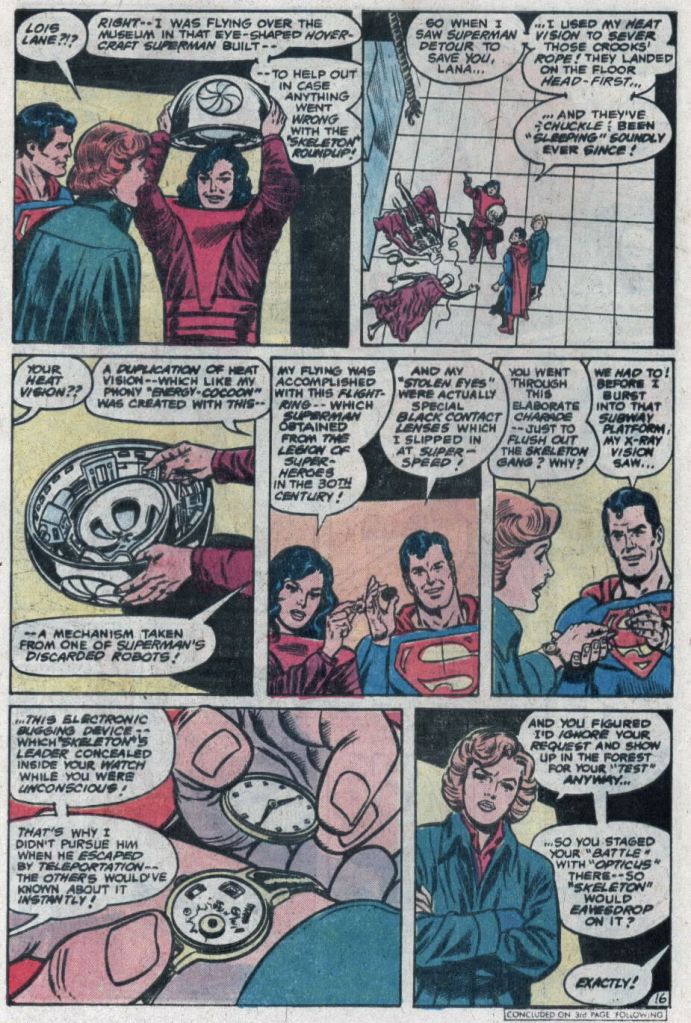
Returning with Lana to the museum, the pair see that the Skeleton theft crew have all been rounded up by Opticus–who removes his helmet, revealing himself to be Lois Lane in disguise. This entire thing has been a ruse–Superman detected the gang’s bug on Lana and contrived this situation to lure the group’s leader out into the open where he can be captured and taken off the board. And as Lana proved herself to be untrustworthy at the start of the issue by attempting to seek out the Skeleton crew that she knew Superman had under secret observation, the Man of Steel used her as a stalking horse the whole time. As you’d imagine, this doesn’t go over well with Lana, whose life was endangered twice in the last two days.

The whole thing is a deliberate bit of Superdickery, designed to showcase for Lana that the Man of Steel trusts Lois Lane in a way that he could never trust his childhood crush. It’s pretty needlessly cruel, but hey, a bunch of criminals were captured as a result, so that makes it all right, yes? In the end, a jilted and upset Lana stalks away, promising not to annoy Superman any longer, even if she has to leave Metropolis to make good on her promise. It’s the end to the Superman/Lois/Lana triangle that writer Marty Pasko had been playing with for several months, but I can’t really say that it’s a worthwhile conclusion. Nobody really comes across well in this story, not Superman, not Lana and not Lois (who went along with this whole ruse.) For all that the comics of editor Mort Weisinger could be casually misogynistic, the same was definitely true for the later Bronze Age books of his successor Schwartz.
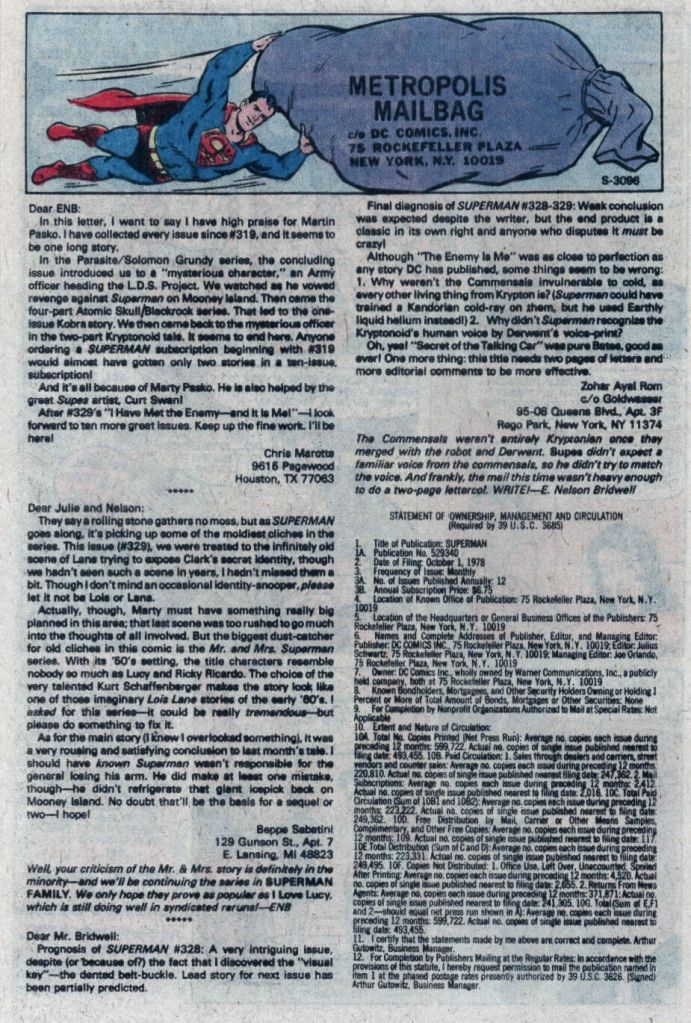
This issue’s installment of the Metropolis Mailbag letters page includes the yearly Statement of Ownership, which gives us a look at how well the title had been performing the 12-18 months prior to this. According to the figures, SUPERMAN had been selling 249,495 copies on a print run of 493,455, giving the book an efficiency rating of just under 51%. I have to assume that this percentage went up somewhat during the hype and release of the film, even if it didn’t remain there.
 The Tom Brevoort Experience
This plot is a variation of similar Superman plots used to lure out criminals:[ Superman#103 ( February 1956 ) Them Man Who Could Read Superman’s Mind! –Cosmo the Great ( Tom McLain ) who “knew” Superman’s secret identity — this plot used twice ]. [ Superman#124 ( September 1958 ) “The Super-Sword” — The Black Knight ( Perry White ) whose “magic sword” can harm Superman — lure out “Bull” Mathews ].
LikeLike
This story is at least 2 stories that Superman’s Legion of Super-Heroes Flight Ring is used by someone other than Superman: Superman actor Gregory Reed used it to impersonate Superman and fool the alien brain-thief Intellex [ Superman#396 ( June 1984 ) “The Battle for Superman’s Brain!” – Intellex is a prototype to alien brain-thief Hfuhruhurr the Word-Bringer – Adventures of Superman Annual#1 ( September 1987 ) “The Union” -Jim Starlin script ] while Superman was disguised as the Mystery Masquerader.
LikeLike
Superman#103 ( February 1956 ) The Man Who Could Read Superman’s Mind! – Cosmo the Great ( Tom McLain – a police officer ) – this plot used twice, but with a twist in Superman#114 ( July 1957 ) 2nd Superman story “The Man Who Discovered Superman’s Identity” — the great Mento ( a “mind-reader” con man ) who claimed to know Superman’s secret identity and set up Clark Kent as part of his con to rip-off a mobster.
LikeLike
Hey Tom, you got Clark Kent working for J. Jonah Jameson cause I think you meant the Daily Planet and not the Daily Bugle ( I’ve been there, thinking about 1 think and writing down another ). Granted the Daily Bugle has appeared in golden age DC Comics ( Like a Wildcat & golden age Huntress story to name one — I think that was printed long after the 1940s )
LikeLiked by 1 person
Tom! Instead of changing “Daly Bugle” to “Daily Planet”, maybe, please, just note the correction in paratheses? That’s a cognitive slip to be treasured and celebrated by all of us who love comics as much as we do.
Great catch, John!
LikeLike
The older comic in which the Daily Bugle appears that I can remember is a Mickey Mouse strip from the early ’30s (can’t exactly say the story arc, but I will check).
Kinda foreshadowing.
LikeLike
”This represents a bit of a missed opportunity, I think, to capture an audience who might have been lured into checking out the Man of Steel’s adventures by the wildly-popular film.”
Huuuuuuge missed opportunity.
LikeLike
I agree it’s a missed opportunity… but weren’t the DC offices generally a bit sour about the movie? It was a big payday for Mario Puzo to adapt a screenplay that had to be reworked… at the very least Denny O’Neil wasn’t that chill about it in interviews back in the day.
I’m sure I’m not the only one who’s wondered why comics in some form aren’t offered at the concessions during a movie. Once comics only became available in comic stores I doubt most folks who go to superhero movies these days are even aware comics are still being printed.
LikeLike
“… but weren’t the DC offices generally a bit sour about the movie?”
If they were, they should suck it up. If they can’t do that, they should be fired. Big, blockbuster movie featuring one of your two biggest characters, and you’re not going to capitalize on it because they hired a big name to write the story?
I doubt there was any real expectation that DC office staff were going to write the movie.
In any case, I haven’t heard that the DC office staff in general were sour about the movie. I’ve seen lots of them talk about how it was fun visiting the set or meeting Reeve when he came by the office. I think mostly they were pleased that there was going to be a big Superman movie.
“… at the very least Denny O’Neil wasn’t that chill about it in interviews back in the day.”
And in later years, some people working for DC weren’t that chill that somehow Denny always assigned the top-selling and gonna-pay-big-royalties Batman movie adaptations to himself. So it goes.
“I’m sure I’m not the only one who’s wondered why comics in some form aren’t offered at the concessions during a movie.”
Because popcorn and soda are much, much, much more profitable, and movie theater owners don’t want their staff selling concessions that don’t make that kind of money.
Not to mention that comic books are prone to damage, because they’re on cheap paper, and as such are more of a hassle to handle than candy bars. Even when comics have been given away free at movie theaters, they never went over that well, because theater owners didn’t want to deal with them, and theater-goers didn’t much care, so dozens of discarded free comics were one more thing theater employees had to pick up after the shows.
When they’ve been tried, they haven’t caught on.
LikeLiked by 1 person
One of many for Bronze Age DC.
LikeLike
There’s an almost-admirable intransigence about DC sticking with the staid team of Schwartz, Pasko, Swan & Chiaramonte in the era of the movie.
Pasko wrote precisely one good Superman story, and that’s the issue after this when Supes turns into Super-Crocodile (kinda).
LikeLike
I would guess Schwartz throttled Pasko’s full creativity considering the work he produced elsewhere. You can see the difference in Bates’ Superman work and plotting elsewhere as well. Dude was an old school editor who exerted a homogeneity based on his visions for a series unlike what we’re used to in editors today. It was common in the editorial fiefdoms of DC back then.
LikeLike
I remember not liking this much back in the day. Comparable Weisinger stories at least had a wackiness about them that mitigated the arguable misogyny, at least for some. But this one is just kind of blah. imo Schwartz hardly ever managed to duplicate the charm of his Silver Age superheroes when doing the Bronze Age SUPERMAN.
LikeLike
I can’t help but wonder is this first time someone called Superman a “jackass”?
LikeLiked by 1 person
I’m curious as to what kind of changes you think the Superman books should have made, since the movie stuck pretty closely to what was in the comics anyway.
LikeLike
More or less the kind of changes the post-crisis Byrne Superman went through, perhaps in a less sudden and milder way. Byrne was greatly inspired by the movies and Chris Reeve in designing the new universe.
“My” Superman was the Bronze-age one, with WGBS, Steve Lombard, Morgan Edge, Superboy, Kandor and the kryptonian lore. Movie’s Superman was basically the Golden-age one set in the seventies, close to the TV series. As a kid I was struck by the many differences, but I was able to appreciate the more “grounded” approach.
LikeLiked by 1 person
That’s interesting, because to my mind, Byrne’s reboot specifically repudiated a lot of the traditions and tropes that the movie embraced. Certainly, Byrne having Clark be a high school football star seems like a direct thumbing-of-the-nose at the movie’s classic “You were sent here for a reason, and it wasn’t to score touchdowns” scene. And Byrne famously threw out the notion of Clark acting like a clumsy nebbish to conceal his identity, an idea that Chris Reeve went all-in with. Byrne’s Luthor, the respectable CEO in a penthouse suite, seems like a far cry from Gene Hackman’s mad scientist in a secret underground lair. About the only thing from the movie I see in Byrne’s version is the sterile, crystalline look of Krypton (which I thought was one of the weaker bits of visual design in the movie, so go figure).
LikeLike
The biggest change for me would’ve been the art. It surprises me to hear Tom & Kurt & others suggest replacing Swan, a half dozen years before he eventually would be. I’ve gotten shouted down more than I can count for saying I wished Swan had been replaced, at least on the regular monthlies, before 1978, as if I were saying kids shouldn’t have access to lavatories in schools. People were & still get outraged as if I’m mercilessly disrespecting Swan’s work. He’s still considered the “GOAT” by many Superman fans. I respect the guy. He’s a legend. I just wasn’t excited by his work after I turned 12.
I’m fuzzy on who was around in 1978. But by the early 80’s, you could’ve brought in Don Newton (loved his Superman in DCCP, an issue with Green Arrow). Given Rich Buckler more Superman work , but with younger inkers, like Rubinstein, Richard Howell, Ordway (maybe instead of “All-Star Squadron” and a few years before he joined joined Byrne). I’d’ve poached Bob Hall, Kerry Gammill (sooner than he was), more from Keith Pollard (he drew an annual, I think), Mike Zeck (before 1984 when he was too hot to be wrangled from Marvel). And trend setters like Art Adams (who did draw Superman later in the ’80’s), Rick Leonardi, Denys Cowan, Jerome Moore.
Cary Bates was still writing good stories. I’d’ve kept him on a Super-series. I look at many of his stories now and they hold up. One of faves was one of his later jobs, in “DC Comics Presents” in 1985, with Adam Strange, drawn & colored by Klaus Janson. And Bates’ mid-80’s “Silverblade” was enjoyable. His first year on “Captain Atom” was, too; that first issue was one of the best first issues I read in the 1980’s.
Marv Wolfman was also writing good Superman stuff before Byrne came over. Maybe have Marv start even earlier than he did. It’s all hindsight, & still I’m blind to whatever obligations any of these pro’s had going on that likely would’ve prevented them from taking the gigs. But the point is that fresh new work should’ve started long before “Crisis”.
LikeLike
Curt Swan’s later career brings to my mind the last few films of Hawks & Hitchcock — master directors, but it’s clear that, at their age, they couldn’t fully meet the challenge posed by the heightened pace and realism of ‘New Hollywood’ film-making. (Hitchcock’s ‘Torn Curtain’, a supposedly sophisticated spy thriller deflated by its overreliance on sets, matte paintings and back projection, exemplifies this.)
If you compare the Pasko/Swan issues to the Wolfman/Kane run on Action Comics just a few years later (but still pre-Crisis), there’s no contest whatsoever.
LikeLiked by 1 person
@Oliver. Once I’d seen J.Buscema’s art (for me it was in the 1970s) Swan’s seemed obsolete. Then by the 80s we had so many more dynamic artists. Superman’s look couldn’t compare or even compete.
LikeLike
They could have reduced Swan’s workload, allowing him to fully express his potential, keeping him, e. g., on Action only and put Garcia Lòpez as a regular on Superman, possibly finding some proper inkers. Problem was, Swan was still very good at releasing more than 30 pages a month, so why give up on this? Garcia Lòpez was slower and clogged with editorial jobs, and proper inkers, well… (There is a Clark Kent short by JLGL inked by Colletta that still screams for vengeance).
They actually put in place this approach shortly before the movie’s release, as most of Superman’s issues from 301 on are by him, but then he was moved to DC Presents and soon used for ads, covers, merchandise and stuff. Too good for just comics.
LikeLike
Very true and the JGL issues were in 1976.
I thought a lot of the issue was Swan’s inkers after Anderson (except for dan Adkins and especially, Al. McWilliams).
LikeLike
Agreed. I was one of the ones thinking that Swan’s best days were behind him, and then suddenly Al Williamson comes in and I’m like, “Dang, he’s just as good as he ever was! Hunt and Chiaramonte were doing him dirty.”
LikeLike
There was a LOT there they were not doing justice to. Swan’s favorite inker was McWilliam’s from what I have read. (Some other guys who should have been used more were Scharffenberger; Austin; and Wiacek (who inked backgrounds for Oksner when he inked Swan . . . .
LikeLike
I really didn’t enjoy that issue. The whole business with Superman having his eyes stolen out of his head was a little too unpleasant for my younger self, even if it did eventually turn out to be a ruse. And the way Supes humiliated Lana at the end of the story was quite unforgivable. Maybe the Man of Steel justified deceiving Lana to himself as being cruel to be kind, but to me it just came across as cruel. Tearing her down in front of long-time rival Lois was adding salt to the wound.
LikeLike