

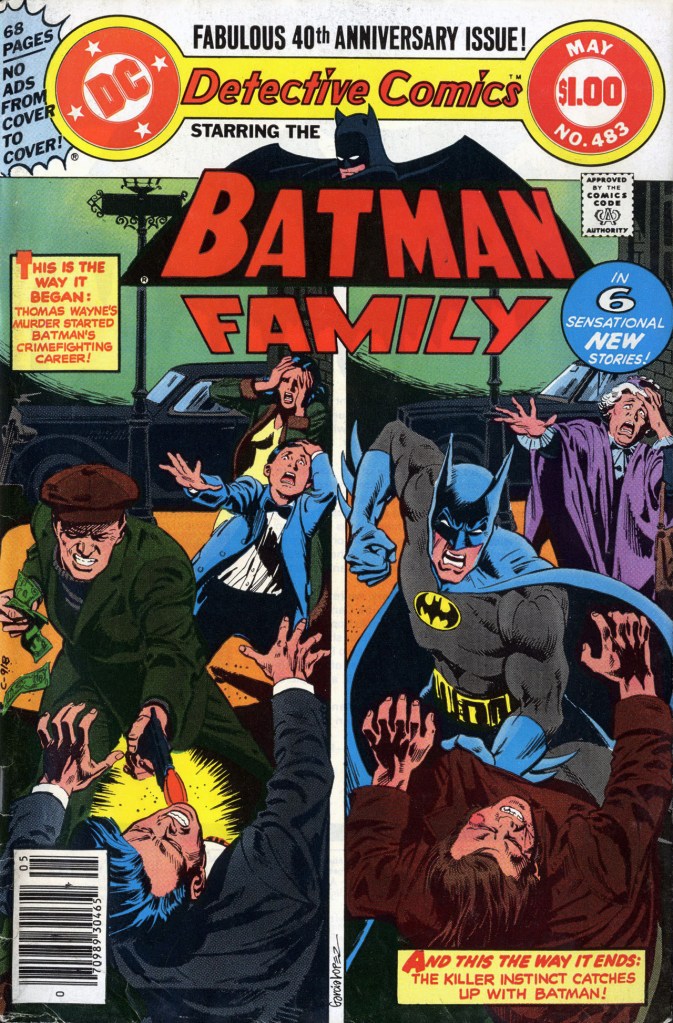
For almost the entirety of its run, I had been a regular reader of BATMAN FAMILY. But during the famous DC Implosion, in which DC’s publishing line was significantly pruned back, BATMAN FAMILY had been merged with DETECTIVE COMICS in an effort to keep the series that the company had been named after alive. Clearly, it worked, as DETECTIVE COMICS continues to be published to this day. But this meant that I stopped following BATMAN FAMILY. Why? Because my regular hook-up for new comics, my local 7-11, didn’t carry oversized books, which meant that DETECTIVE COMICS had stopped showing up there. I did end up with this special 40th Anniversary Issue of DETECTIVE, though, which indicates that I must have bought it at some other venue that my family happened to frequent that week. The fact that it was an Anniversary issue no doubt influenced my decision to pick it up, especially as the Huntress and Man-Bat features were no longer a part of the BATMAN FAMILY package.
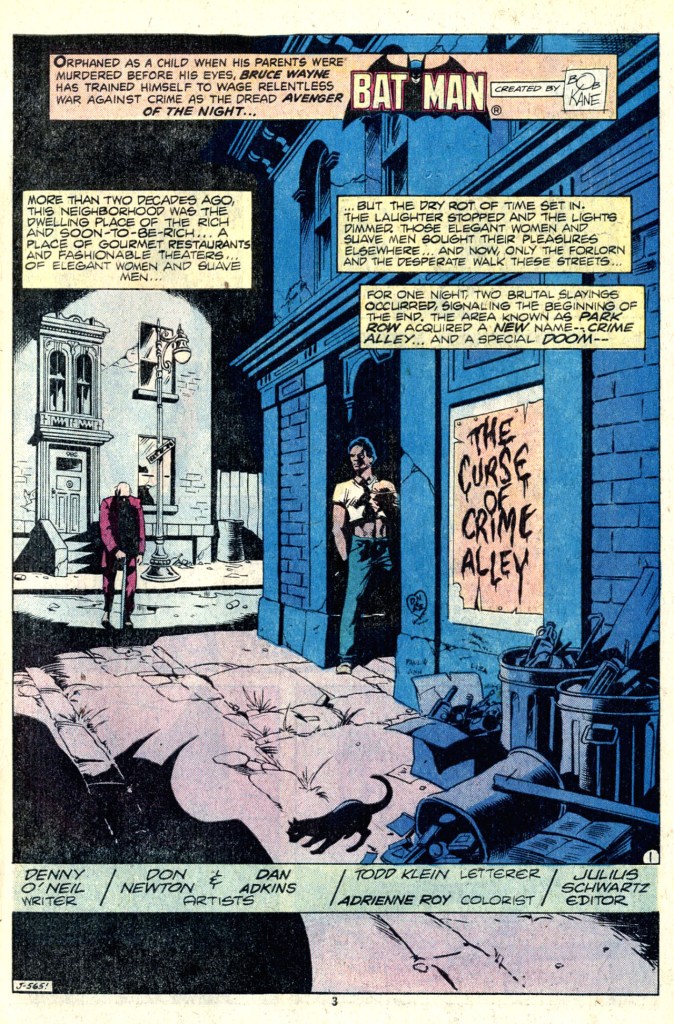
After an inside front cover editorial by editor Paul Levitz remarking on the 40-year history of the Batman, whose 40th Anniversary this issue marked, the first story in the issue was this one by Denny O’Neil and Don Newton. It referenced back to Denny’s earlier story that established “Crime Alley” as the place where Bruce Wayne’s parents had been murdered, so this was likely my first time encountering that fact. The story involves the gunmen of crazy crime-lord Maxie Zeus trying to smoke out an informant holed up in a tenement nearby to Crime Alley. They intend to flood the place with poison gas, heedless of the residents, in an attempt to flush their target out into the open. But the real struggle for Batman in this story is to not give into his worst, most violent impulses and kill any of these heartless men. With the aid of Leslie Thompkins, he does just that. Nice artwork on this job by Newton.
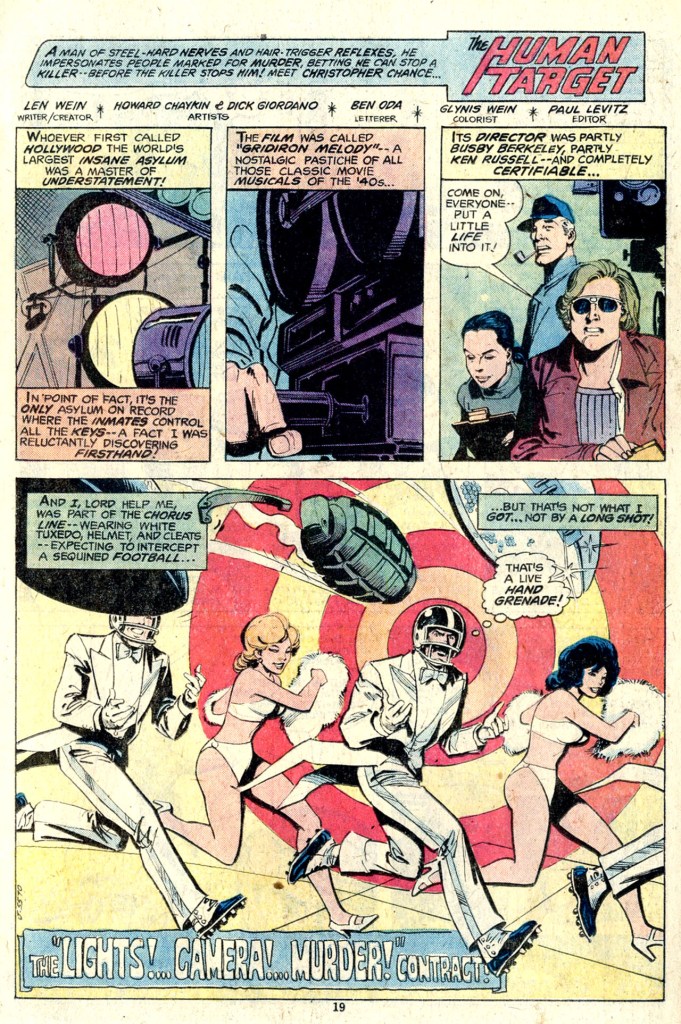
Next up is a story featuring Christopher Change, the Human Target, a master of impersonation who hires himself out to those targeted for death, taking their places and undoing their murders before they can happen. In this story, crafted by the character’s originator Len Wein and artist Howard Chaykin, Chance poses as a Hollywood stuntman on the set of a new musical. This is very appropriate subject matter for Chaykin, who does a fine job with it, though his particular finish is a bit buried under Dick Giordano’s strong inking hand. It’s the sort of 8-page story that filled the back pages of DETECTIVE COMICS pretty much since its inception, so its inclusion here is fitting.
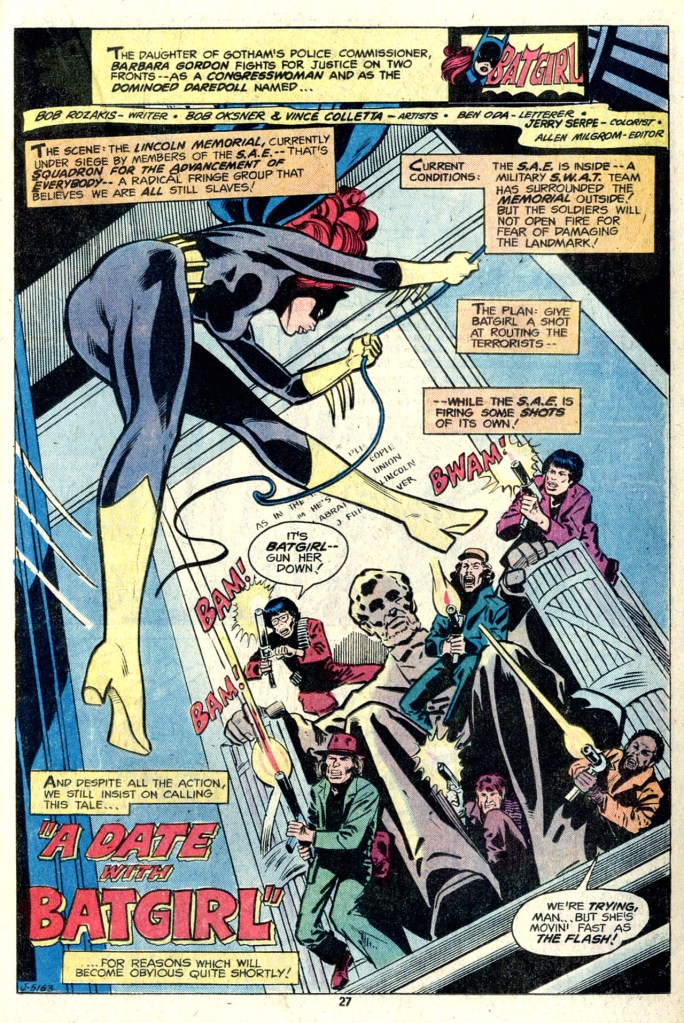
Next up is a Batgirl story written by Bob Rozakis whose pencils by the talented Bob Oksner are done absolutely no favors by the time-conscious inkwork of Vince Colletta. This is the third story in the issue, and each one so far has listed a different editor, a good clue that the book was being used to burn off inventory that had been accrued intended for assorted titles for some time. It’s a fun but silly little tale in which Batgirl is asked on a date by a soldier that she’s encountered twice now. She agrees, and their evening becomes a series of nutty occurrences, given that she’s in full Batgirl regalia for the entirety of the evening. But along the way, she and the Soldier wind up saving the Washington Monument from an attack by terrorists, so that isn’t nothing.
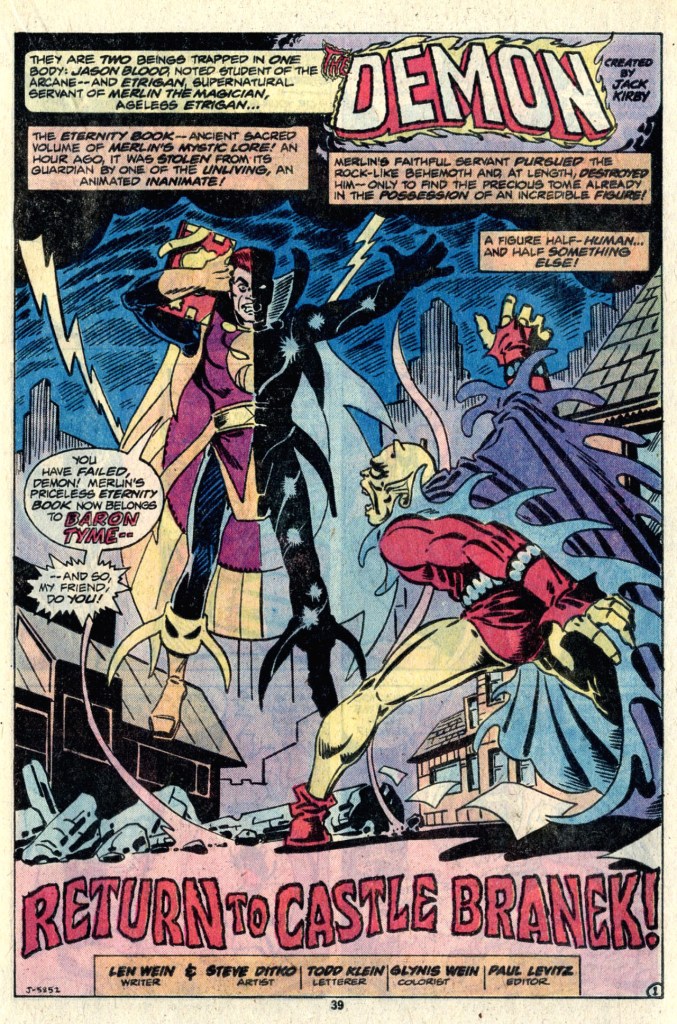
Next up was a story featuring Jack Kirby’s creation the Demon, produced by Len Wein and Steve Ditko. I really enjoyed this story, no doubt because Ditko makes it feel like a classic Doctor Strange tale, with all of his stylistic interpretations of sorcery throughout it. In particular, the artwork here is very strong–it feels like Ditko was really putting forward some effort on this one, rather than it just being the latest in a number of commercial jobs that he took on to pay the rent. In it, the Demon contends with the rogue sorcerer Baron Tyme, who has stolen Merlin’s mystic Eternity Book. Tyme intends to use the book to penetrate Merlin’s Tomb for nefarious purposes, and he’s able to revert the Demon back into Jason Blood forcibly by the end of the story. But when Tyme opens the Tomb, it’s empty. Cliffhanger! But I wouldn’t find out how why, as it would be a while before another issue of DETECTIVE COMICS came into my hands.
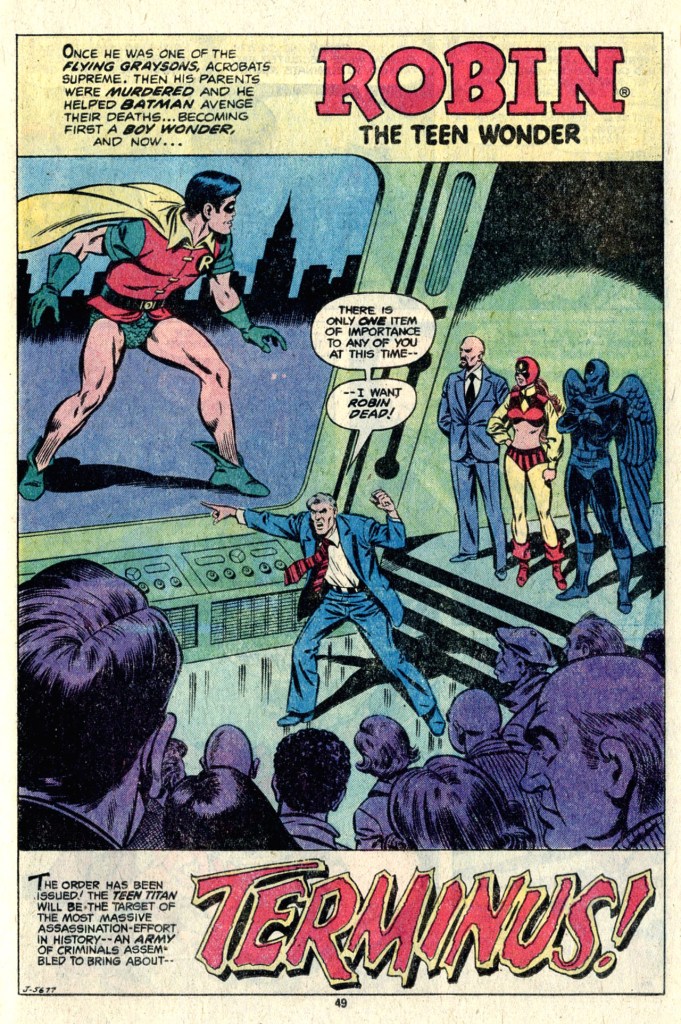
The next feature was a Robin tale also written by Bob Rozakis and illustrated by the charming Kurt Schaffenberger. Schaffenberger’s open, playful artwork wasn’t really all that good a mix with the darkness of Batman’s world, but I always found it appealing no matter what feature he was working on. In this one, Robin works to take down the criminal cartel Maze, contending with a pair of costumed agents for that organization, the Raven and Card Queen. It turns out, though, that Card Queen is a plant–she’s really Duela Dent, the Harlequin, Robin’s Teen Titans ally undercover, and so that helps to turn the tide. It also turns out that the Raven is secretly Dave Corby, Dick Grayson’s rival for the affections of longtime girlfriend Lori–and so he delights in revealing Dave’s true identity in his Dick Grayson guise, and humiliating him in front of Lori. This is framed as a big heroic moment, but it somehow seems a bit petty and cruel, too, even if Corby is a mob hitman.
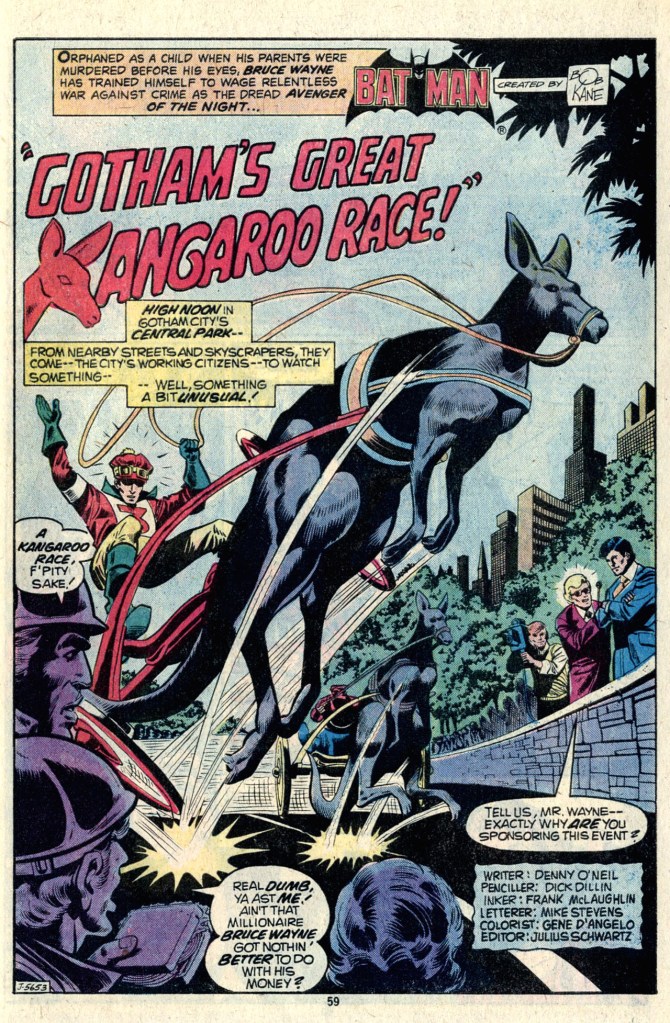
And the final story in the issue is another short Batman tale by Denny O’Neil, this one illustrated by Dick Dillin and edited by Julie Schwartz. it was probably intended as a back-up for BATMAN in its DC Explosion 50 cent incarnation. In it, Bruce Wayne sponsors a Kangaroo Race of all things for charity as a means to smoke out “Swagman” McGinty, a local terrorist who is also a specialist with Kangaroos, and who will doubtless compete in the race and win it since he needs a stake to pay for a weapons shipment that’s headed into Gotham. Which he does–taking Batman’s bugged prize money with him for his efforts. through it, Batman is able to crash the exchange and capture not only McGinty but also the arms merchant who is furnishing him with weapons. Batman actually accepts the reward out on the gun runner, anonymously gifting it to a local charity in need (and matching it with Bruce Wayne’s own money in the bargain.)
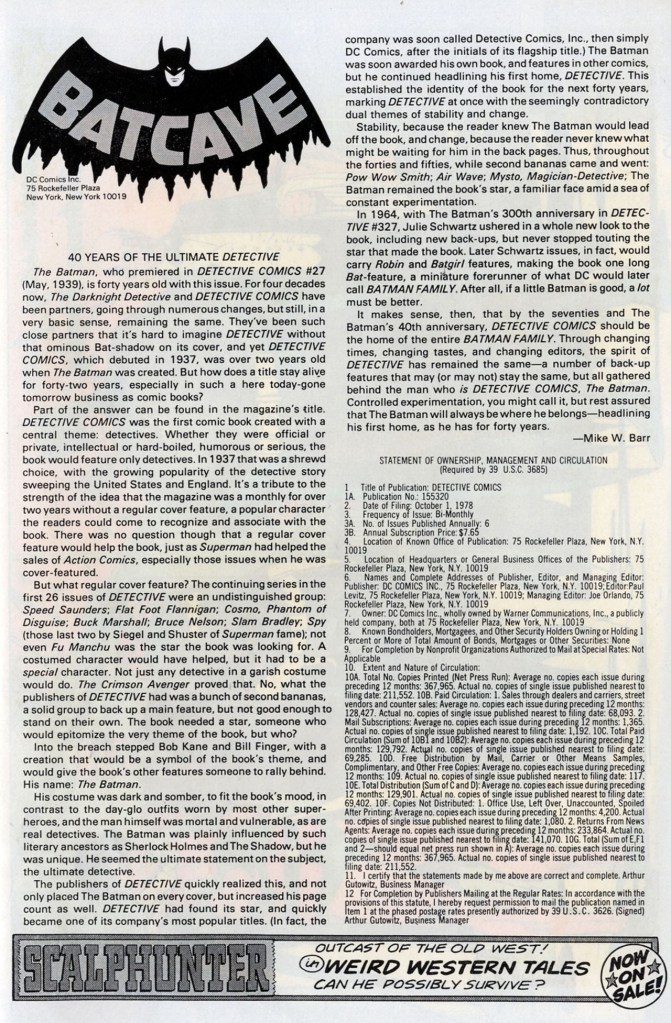
The inside back cover of the issue is mostly taken up by an essay by Mike W. Barr talking about the creation and history of the Caped Crusader and his place in DETECTIVE COMICS’ history. But it also carried this year’s Statement of Ownership, which tells us that DETECTIVE COMICS had been selling 69,285 copies on a print run of 211,552, giving it a miserable efficiency rating of just under 33%. You can see why the book was on the chopping block and why extraordinary measures needed to be taken in order to save it.
 The Tom Brevoort Experience
Just curious, but why was Detective such a low seller during this time? Seems like it read it as much as I did Batman during this period. The stories were as good, as was the art, and the back up stories were always compelling, at least to me.
LikeLike
The urban-gothic approach to Batman wasn’t popular with comics readers until Frank Miller worked on the feature in the mid-1980s. From a marketing standpoint, the editorial decision to shift to it in the late 1960s was a blunder, at least at the time. The Batman people knew was from the Adam West TV series–very popular in syndication in the 1970s–and animated treatments such as SUPER FRIENDS. The comics Batman in the ’70s had a very different tone from those, and it undoubtedly alienated potential readers. The sales of the Batbooks were more or less in perennial freefall for over 15 years.
LikeLike
it’s beyond dispute that the urban-gothic approach didn’t sell that well, but some fans (whose names I forget) have argued that in the waning days of the TV show the camp approach in the comics hadn’t done any better. Frank Robbins was still doing a few campy scripts when he took over, around the same time the show was cancelled. If any of those had sold phenomenally well, wouldn’t DC have stayed in that vein for several more issues? Instead they shifted to more crime stories and cut out Robin to de-emphasize associations with the teleseries.
LikeLiked by 1 person
To d9dunn:
The people you’re talking about were generally hostile to the TV series.
The most prominent propagators of the alleged need to shift away from the tone of the TV series were probably Maggie Thompson and her late husband Don Thompson, best known as editors of the Comics Buyer’s Guide in the 1980s and early 1990s. My gut tells me to include Mark Evanier in this, but I can’t say for sure about him. The argument the Thompsons made was that the decline in interest in Batman from the latter episodes of the TV series injured DC because at that point there were inflated print runs of the comics that led to substandard sell-throughs. But it’s a hypothesis the data doesn’t bear out.
After the TV series hit in 1966, DC was seeing per-issue-average sales of the main BATMAN series at close to 900k. These were fad sales, but the DC managers weren’t idiots. They obviously monitored the sales and were careful to adjust the print runs for declining interest. The main BATMAN book did not fall below 50% sell-through during the time the TV show was in first-run.
Explaining why 50% is optimal sell-through for returnable-market periodical comics is a more complicated subject than I want to get into here, but I gather it would have been the goal percentage of DC’s sales managers at this time.
Yes, the per-issue-average sales of the main BATMAN book fell from nearly 900k in 1966 to 533,540 during the 1967-1968 sales year that coincided with the final season of the TV series. But the title was still one of the industry’s top three color-comics sellers with ARCHIE and SUPERMAN.
And yes, sales fell again the following year (before the urban-gothic shift began) with BATMAN per-issue-average sales at 355,782. But it still outsold every DC title apart from the Superman books, as well as the Marvel books except for AMAZING SPIDER-MAN. And the sales were only slightly below those of the Spider-Man book.
Then the urban-gothic approach takes over and the sales really collapse. Sales of the main BATMAN book are close to halved over the next three years to 185,283. This far exceeds the declines other DC titles saw during the same time-frame.
My conclusion from this is that the O’Neil/Adams urban-gothic version of the character alienated readers, especially new readers. New readers would invariably come from the TV viewership, and they found a Batman they barely recognized. The Batman they knew wasn’t scarily imposing, the violence was more slapstick than disturbing, and the tone was lighthearted rather than dramatic and intense. They can’t be faulted for rejecting what they found in these comics. I gather Carmine Infantino and Julius Schwartz hated the TV series, so they persisted in this uncommercial treatment of the character. Their successors, worried about looking uncool to fandom, persisted further. But it was an incredible commercial mistake that continued until Frank Miller made the urban-gothic approach work. BATMAN sales had declined to about 75k an issue before Miller revived the character in the mid-1980s, and this was a time when multiple ongoing Marvel titles were selling over 200k an issue, with the top-sellers doing over 400k per.
LikeLiked by 1 person
Your stats are persuasive and your arguments well-reasoned. However, the only way to test whether or not the sales would have stayed stable would have been for DC to have stayed with the Camp Approach for something like a good two years more, and obviously we can’t judge that without the use of a reality-altering time machine.
(Note: I say “Camp Approach” advisedly. DC never quite did the same irony-thing that the TV writers were doing, but the comics came pretty close with what might be called “Cornball Batman,” at which both Robert Kanigher and Frank Robbins were old practiced hands.)
Is it possible that casual readers would have continued to support BATMAN despite the defection of hardcore fans (and yes, there were a lot of them complaining about Camp Batman in the letters)? Sure, it’s possible. BATMAN was pretty popular even before the New Look, and that seems to be why ABC pursued the franchise, no matter what DC had told Bob Kane about low sales.
It’s certainly possible that creative people who didn’t want to continue aping the TV show charted a course that cost DC sales. But I can also envision a timeline in which DC keeps the status quo and sales go down anyway, because the public is fickle. In a late interview– for the JOURNAL, I think– Infantino guided fusty old DC toward a more Gothic look for a lot of the titles– not just the horror books, but BATMAN and even THE FLASH a few times– because he Infantino thought that the new superhero boom might collapse like it did in the late forties. Was he wrong, at least about BATMAN? I don’t know.
But I think we as fans got much better Bat-stories because of that decision than if DC had soldiered on with Cornball Batman.
(And I say that as one who still likes Kanigher’s “Death Knocks Three Times;” no mean Gothic in its own right.)
LikeLiked by 1 person
The general analysis is that DETECTIVE and ACTION COMICS traditionally sold worse than BATMAN and SUPERMAN because the logos weren’t as blatant in bannering the star, which led casual buyers to pick up the more obvious choice in greater numbers. This is why, at various points over the years, DC has made the big words in the trade dress BATMAN or SUPERMAN and diminished the actual series title.
If so, then part of why the merger saved DETECTIVE may have been that the BATMAN FAMILY logo had BATMAN as the big word, not DETECTIVE.
DETECTIVE went bimonthly with the Jan-Feb 1977 issue, and I didn’t think the material immediately before that was all that compelling. A lot of John Calnan and Ernie Chan, if I remember correctly. But I agree with you that BATMAN was of roughly the same quality.
‘Both series’TEC had recently gotten a quality bump — Englehart and Rogers doing classic work. It may be that those issues weren’t fully reflected in the sales numbers when the decisions were being made, or it may be that while dedicated fans loved them, casual buyers didn’t. Or it might be that the bimonthly book was hit harder by the blizzards that messed up distribution, since a three-week distribution snafu could mess up one of three monthly issues in a three-month span, but mess up all of the issues of a bimonthly book for that period. Someone like Paul Levitz would probably have a better idea than I would, since he was there and part of those meetings.
LikeLiked by 1 person
Ernie Chan covered 95% of Batman AND ‘Tec for about 18 months (with some occasional help from the fabulous Garcia López), Calnan then replaced him on Batman (alternating to more notable artists) and Rogers on Detective.
Most of Batman stories were penned by David Vernon Reed, whose zanyish scripts (Underworld Olympics, anyone?) were pretty much saved by the minimalist, dynamic and gritty art of Chan. When Calnan came with his stiffy style, the magic mostly ended. Neverthelss Batman held and Detective, with way better scripts and art, sank…
LikeLiked by 1 person
Man, I hated David Vern’s scripts. I didn’t like Ernie Chan’s art, and liked Calnan’s less. But the scripts were just dullsville.
The shift from writers like Denny, Len, Frank Robbins and so forth to so much Vern may have made Julie Schwartz’s scheduling simpler, but it was a complete disappointment to me, at least.
BATMAN seemed to have more promo attempts, like the Who Killed Batman multi-parter and having Mike Grell come in as a very short-lived regular artist. That might have helped, along with that logo. But it still wasn’t good comics.
LikeLiked by 1 person
I’ll note that DETECTIVE actually outsold BATMAN during the 1977-1978 sales year. Not by a lot, but the per-issue average was higher. My guess is that it was due to the presence of Marshall Rogers on the book.
LikeLike
I’ll add that the 69,285 sales number for the Issue Closest to the Filing Date was most likely an outlier. The ICFDs for DC in the 1977-1978 sales year were all but certainly the ones with a June 1978 cover date. The June 1978 issue of Detective Comics was #477, which featured a Deadline Doom reprint from 1971. Deadline Doom reprint issues invariably had terrible sales.
LikeLike
The multiple editors thing wasn’t exactly a case of burning off inventory. Here’s how it worked:
Before ‘TEC and BATFAM were combined, the editor of ‘TEC was Julie, the editor of BATFAM was Al Milgrom. After the Implosion, DC reworked their editorial assignments, and Paul wound up with the Batman titles.
So some of that’s material that Julie had in process for ‘TEC, some is what Al had in process for BATFAM, and the rest is stuff Paul commissioned when he was handed the book. The one exception might be the Great Kangaroo Race story, which was commissioned as. a “Public Life of Bruce Wayne” story, but since the first PLoBW story had only appeared six months earlier, if it was inventory it wasn’t very old.
And you’d have started missing BATFAM even if it hadn’t been folded into ‘TEC — BATFAM went Dollar-sized four issues before the combination.
LikeLiked by 2 people
Also…
“This is very appropriate subject matter for Chaykin, who does a fine job with it, though his particular finish is a bit buried under Dick Giordano’s strong inking hand.”
…I think that was the intent. The regular creative team on this series was Len and Dick, and even in its previous run there were only two stories penciled by someone else. So I expect Dick was backed up, schedule-wise, and they got Howard to do breakdowns or layouts for Dick to finish, making the art look more like Giordano than Chaykin.
Dick would end up drawing the rest of this run, though there was one he didn’t ink.
It’d be very nice if DC would collect all of the Len/Dick HUMAN TARGET into a TPB, though I’m not going to hold my breath…
LikeLike
I recall being a bit disappointed to see Ditko drawing the Demon strip, if only because the previous installment had been by Michael Golden, who was fast becoming a favorite of mine. But looking back, Tom is correct — Ditko did a fantastic job.
LikeLike
Len Wein told me that he had some difficulty adjusting to the artist switch — he scripted the first Ditko chapter, and it didn’t feel right to him, so he compared it to the Golden chapter. He discovered he’d used lots of narrative captions on that first installment, but almost none in the Ditko chapter, because the storytelling was so clear that none were necessary.
So he went back and found places to add in captions to the Ditko pages, for atmosphere and consistency.
LikeLiked by 1 person
Ah, so Len was working “Marvel-style” (plot > art > script)? That might explain Tom’s observation that this story looks a little better than some of the other things Ditko drew in that era…working from a plot might have given him more leeway to do things his way, as opposed to following a full script.
LikeLike
I wish there was more space for additional Don Newton pages. 😦 I’ve been trying to dig up his runs on both “Detective” & “Batman”. Most of it, with good inking, ranks somewhere in my top 10 Bat-art. He and Gene Colan (also in my top Bat-10) seemed to have drawn the majority of Bat-stories in the early 80’s. I thought Don’s last stretch inked by Alfredo Alcala was a mis-match, & obscured the elegantly clean, smooth finish to his work.
I wasn’t sure if Denny coined the name “Crime Alley”, so thanks for saying he did. “No Hope in Crime Alley” years later has gained a lot of traction, & been referenced. Christopher Chance popped up after the “Dollar Comics” period ended, in a regular monthly issue of “Detective”, hired by Bruce to pose as Wayne. Except for the white hair by his ears, Chance pretty much already looked almost identical to Bruce. I’ve come across a few Rozakis-written Bat-stories, & was surprised how much I liked them. Pretty inventive. And I gotta say, despite understanding why it was used, the Demon still feels weird to me to be appearing in “Detective Comics”. Kirby’s king, but my fave Demon was by Matt Wagner.
I dislike how most “solo” books these days include the lead character’s “family”. Almost every character’s series is a team book. It feels redundant, since they’re based off the lead. And it takes panel time away from the character I want to see most. Relegating them to back-up features would be better to me than always folding them into the lead feature.
After Levitz, then Giordano, & then Wein successively (& successfully to me, creatively, anyway) took over as Bat-editors, the quality improved consistently. Denny & Don. Then Conway & Don (& several others), with Colan coming on. And then Doug Moench writing both monthly Bat-books. I still look back on those years, & most of those issues, with respect & admiration. And though Denny would arguably eclipse all of their tenures as Bat-editors, certainly holding the job much longer, the best work from their runs doesn’t suffer too badly by comparison. Newton & Colan, especially, still rank among the best for me.
Story-wise, “Batman: Year One” beats everything else. And the market changed to where it supported more Batman material. Writers like Starlin, Grant & Wagner, Collins, even Dixon, & then numerous others all got to contribute to one of the best & most dominate mythologies in comic books. “Shadow of the Bat”. “Batman Chronicles”. Too many “special projects” to count. Those opportunities weren’t there before. Movies & animated TV cartoons may have helped. Denny was likely the right Bat-guy at the right Bat-time to be Bat-editor. Oh, and the great Andy Helfer, and his “LotDK”. Chiarello’s “Batman: Black & White”.
LikeLike
I was eighteen when this came out. I preferred Batman Family to Detective Comics and didn’t give a hoot about numbering and would have been fine with ‘Tec being canceled. I also didn’t like O’Neil’s stories that much or grim dark Batman. In fact, I haven’t bought anything starring Batman since Dark Knight Returns and O’Neil’s editorship led to Bat-Dick being the prevalent characterization. Crisis pretty much was when I stopped following Batman faithfully.
Oksner was great and did an awesome job especially with female characters. The sexy part was well done though at first I thought the picture looked like Delbo’s art. Jose Delbo is unfortunately like Oksner in that his awesome body of work is generally forgotten.
The Demon was the weakest part of this issue despite Schaffenberger being a tonal mismatch. It’s funny that his Superboy work seemed right to me but that was always a lighthearted throwback series. I might not prefer grim dark Bat-Characters but Robin shouldn’t be THAT lighthearted. Back to Demon, it was the Ditko art I disliked. I’ve never been a fan. I started reading comics in 1973-ish so the Ditko heydey was rare reprints. Those I can could see the appeal to others (though I still wasn’t a Big Fan) but then modern Ditko was a big turn off to me. This at least was better than the few Legion stories he was a mismatch for and were just generally bad. I’ve always wondered if readers who went apeshit over them were being carried by nostalgia to better days than seeing objectively what was on the page.
LikeLike
I loved this oversized run of Detective Comics. I was about twelve years old when it started and Don Newton was one of the first artists whose work I could recognize on sight. There was something different about his Batman – he seemed a little bigger and more of a brawler. The villains were different as well. In this run Detective Comics focused on bad guys I wasn’t familiar with such as Maxie Zeus, the Sensei and his League of Assassins and the Crime Doctor. The other stories were pretty good as well – especially the Robin stories.
LikeLike
This was soon after I had gotten into comics, with Batman being my favorite. I was buying all the Batman titles I could get my hands onto, and this was right around the time they put out the Batman Spectacular and the Dynamic Classics reprint title, a real feast for a Batman fan. I really wish they had kept Batman Family as a separate title–merging it into Detective Comics really seemed to diminish the “Family” aspect of it, although I understand why they did it. And Bob Rozakis had less of a hand in it, too, although I really loved Batmite’s New York Adventure in another issue close to this one. I liked Don Newton’s artwork, except on Batman. Charlton’s Phantom, his Aquaman, and especially his work on the Shazam! series in World’s Finest I liked, but I just didn’t care for his style on Batman.
And I loved Michael Golden’s artwork on the first chapter of the Demon story, but I also already liked Steve Ditko at this point, so while it was a bit of a shock, I still enjoyed the Ditko chapters. I’m sure other people were a lot less pleased by it.
And the Human Target stories were always fun, largely because of Dick Giordano’s artwork I think. Giordano isn’t Neal Adams, but as Adam’s inker on the Batman stories, he still has a lot of that polish. I really enjoyed the times when Giordano would pencil AND ink his own pencils. Chaykin’s style is definitely buried under Giordano’s inks, but for the Human Target, that was fine.
LikeLike