

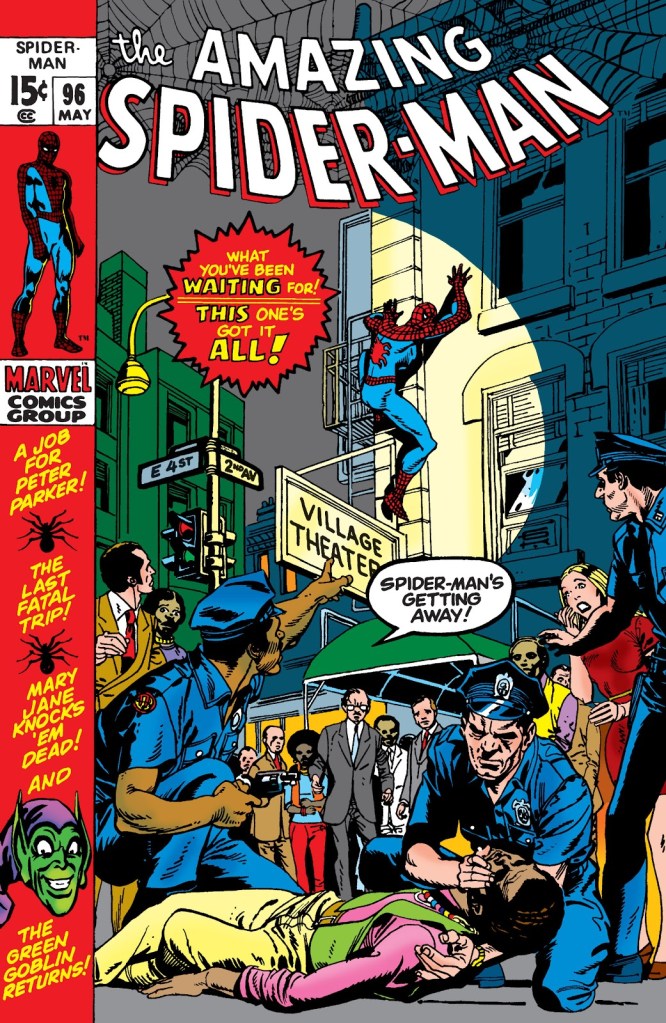
By 1971, Stan Lee’s career scripting comic books was winding down. While he’d remain in place as Marvel’s Publisher for the remainder of the decade, he ceased scripting pretty much everything he had been working on, except for an occasional and far-between assignment. AMAZING SPIDER-MAN #96 is the first part of the last truly great multi-part story that Stan dialogued for the magazine, and one that made headlines due to its content. Requested by the Department of Health, Education and Welfare to do a story that exposed the dangers of drug use to the book’s young readers, Lee complied–only to run afoul of the Comics Code, which prohibited any mention of drug use. Undaunted, Lee and publisher Martin Goodman decided to print the book anyway, without the Comics Code approval stamp. This led to the restrictive Code being revised and updated for the era, making such stories permissible under its strictures. It’s also a crackling Spider-Man adventure in which, under the pencil of artist Gil Kane, who brought a fluidity of motion back to the wall-crawler not seen since his co-creator Steve Ditko left the strip, the web-slinger was once again confronted by his most dangerous enemy, the Green Goblin.

It was just another issue of one of DC’s regular mystery/suspense anthology titles, but HOUSE OF SECRETS #92 would have an oversized impact on the future of comic books. Behind an absolutely stunning cover by artist Bernie Wrightson (for which future Marvel editor Louise Simonson posed as reference) the world was introduced to a muck-encrusted mockery of a man in a stand-alone story also evocatively illustrated by Wrightson and written by Len Wein. Intended only as a one-off, Wein and Wrightson were convinced to return to the idea a short year later by editor Joe Orlando–the issue had sold surprisingly well, and Orlando hoped to find a way to make a series out of it. And so, SWAMP THING became a new title in the DC line and Wein and Wrightson began a collaboration that would remain a high water mark in both creators’ careers.

The rejuvenation of BATMAN as a character was in full swing when issue #232 carried those strides forward. Working to cast off the image of the camp-driven television series of only a few years before, writer Denny O’Neil and artist Neal Adams brought the Darknight Detective back to his roots as a creature of the night. Here, Robin returns to the series for the first time in several months — he had been sent off to college, allowing Batman to operate on his own. But he’s a pawn in a deadly game between the Caped Crusader and his newest adversary, Ra’s Al Ghul, the Demon’s Head, master of the League of Assassins and a criminal on a scale that Batman had rarely encountered. It’s a globe-trotting adventure in the mold of a James Bond film, and Ra’s is definitely cast in a Bond villain mold. Batman is at once thoroughly capable in this story while also being totally overmatched by his opponent.

Having set the table across the first few issues of his Fourth World lynchpin series NEW GODS, creator Jack Kirby hit the gas in a big way, producing a string of masterpieces that stand with the best that the era had to offer. In issue #6, he presented “The Glory Boat”, a contemporary tale that centered around a family caught up in the epic conflict between grim Orion of the New Gods and his Apokoliptian enemies, the Deep Six. The son is a conscientious objector to the war going on in Vietnam, a position that earns him scorn from his veteran father. But when the chips are down, teh sone proves his worth, while his sire is petrified and unable to take action. But the story isn’t quite as simple as that, as Kirby allows each character to contain their own reality, and showcases the long-term effect that warfare can have on those who fight it.

An issue later, Kirby did it again in NEW GODS #7, with a story that is widely considered the pinnacle of his career; “The Pact”. In it, Kirby revealed the backstory of the ongoing conflict between New Genesis and Apokolips and the origins of both Darkseid, his main villain, and Highfather. It’s an epic tale told in only 24 pages, one that evokes myth and legend and history and folklore and combines them all into something elemental. It’s a departure in that it’s entirely set in the distant past, and the central character of the series, Orion, only appears in the final few panels of the story. But it’s essential reading for understanding what Kirby was building here, and its imagery is memorable and haunting.
 The Tom Brevoort Experience
As soon as I saw the cover of The Amazing Spider-Man#96 here I knew it was the one on drug use and no comics code, but I couldn’t remember at first how I knew this ( It must have been in one of the documentaries on comic books I saw on TV over the years ).
LikeLike
A very strong list.
I might also consider SAVAGE TALES 1 (for “The Frost-Giant’s Daughter”), INCREDIBLE HULK 140 (for Jarella), ALL-STAR WESTERN 10 (Jonah Hex!), AVENGERS 93 and SINISTER HOUSE OF SECRET LOVE 3, for a triple-threat masterpiece by Frank Robbins, Alex Toth and Frank Giacoia.
But I think the only two of those that might knock ASM 96 off the list would be ALL-STAR WESTERN and SAVAGE TALES.
But we shouldn’t overlook, of course, the immortal “The Ghost That Haunted Clark Kent,” from ACTION COMICS 406!
kdb
LikeLiked by 1 person
“The Glory Boat” is one of my all time favorites. I’d also include the Forever People story “I’ll Find You in Yesterday”.
LikeLike
New God’s #3 is often underestimated.
We, perhaps, underestimate how controversial this “Vietnam War” was if we did not live through that time.
A bit before this was published, I recall my father (a WWII) veteran) talking to a friend of the family (a recent high school graduate who was about to go to Canada to evade the Draft).
My father listened to the kid and had a lot of respect for the kid, since at the time the consequences were fairly dire about 5 1/2 years before Carter’s Amnesty.. Until about 1977, it was not certain that people who did that would be able to return to the US without serving time.
My father had made a different choice when he was young but respected that the kid,, at an early age. made a tough moral choice with real consequences.
That’s the story Kirby told (and I suspect Kirby and my father probably had a similar take).
LikeLiked by 2 people
Sorry, New Gods #6 (Glory Boat). . . .
LikeLiked by 1 person
A lot of people hated the story — I remember the letter columns. Although the book’s quite clear the son is opting out of the Vietnam War, people insisted he was a pacifist and therefore dying fighting proved Kirby had no idea what he was doing.
I was quite surprised when I read it years later and found it works great.
LikeLiked by 3 people
I agree.
That reaction sort of missed the point of the story.
LikeLiked by 1 person
The two titles I’d add are R. Crumb’s HOME-GROWN FUNNIES #1 and Gilbert Shelton’s THE FABULOUS FURRY FREAK BROTHERS #1.
LikeLiked by 1 person
The odd thing about House of Secrets # 92 was that it just sat in the spinner rack when I was a kid, back in 1971.
I read mostly war comics and Classics Illustrated then, but the cover was distinctive and it was there a long time.
Back then, in the days of newsstand comics, sometimes something would get stuck behind other books or something from 1972 would show up on the stand in 1974, but I honestly don’t remember anything that sat there as long.
LikeLiked by 2 people
I bought all five of these books when they came out, and enjoyed all of them.
LikeLiked by 2 people
I bought all five of these books when they came out and enjoyed them all!
LikeLiked by 2 people