

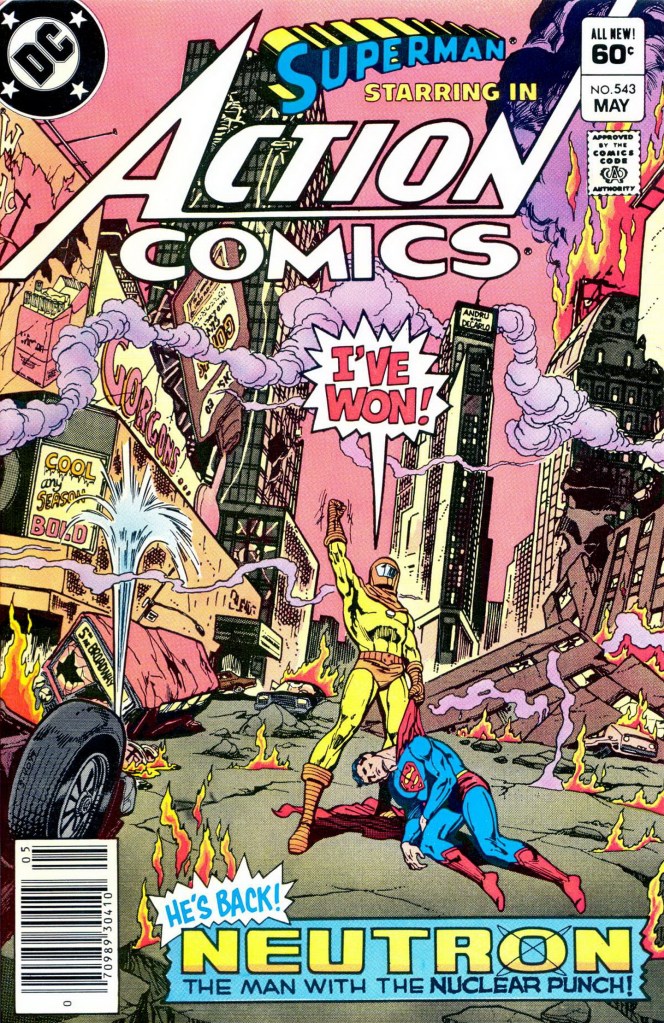
I really liked Marv Wolfman’s run writing ACTION COMICS. He was able to find a way to operate within the strictures of editor Julie Schwartz’s likes while still bringing the sort of serialized storytelling and characterization that he’d learned over at Marvel to the stories. It probably didn’t hurt that Marv and George Perez’s NEW TEEN TITANS was a monster hit, and so even Julie may have given him more latitude in the face of his success than he might have given most others. But as much as I liked what was going on here, I still cut ACTION COMICS from my buying list during my big purge of 1983. And this issue was the last that I purchased for the time being.
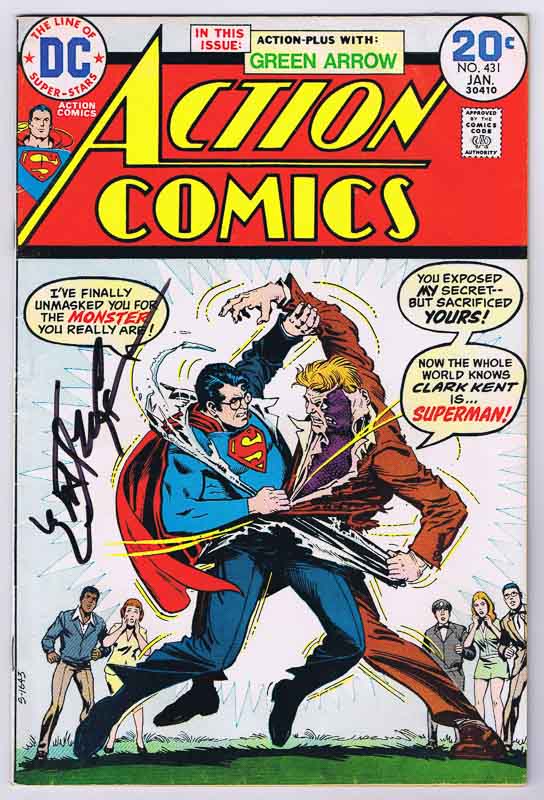
My very first issue of ACTION COMICS was this one, #431, the second part to a daffy two-part adventure. It was one of the very earliest comic books that I got, and at the age of six, I remember that I needed my Mom’s help to read it, even though I was already a pretty good reader on my own. But comic books included lots of big words like indestructible and impervious and annihilation and the like. My vocabulary definitely expanded the more that I read comics. Anyway, ACTION COMICS was a reliable favorite, and while I didn’t read every issue, I followed the series with some spotty regularity. After all, at that age, I had no control over when or even if I was ever going to get another comic book.
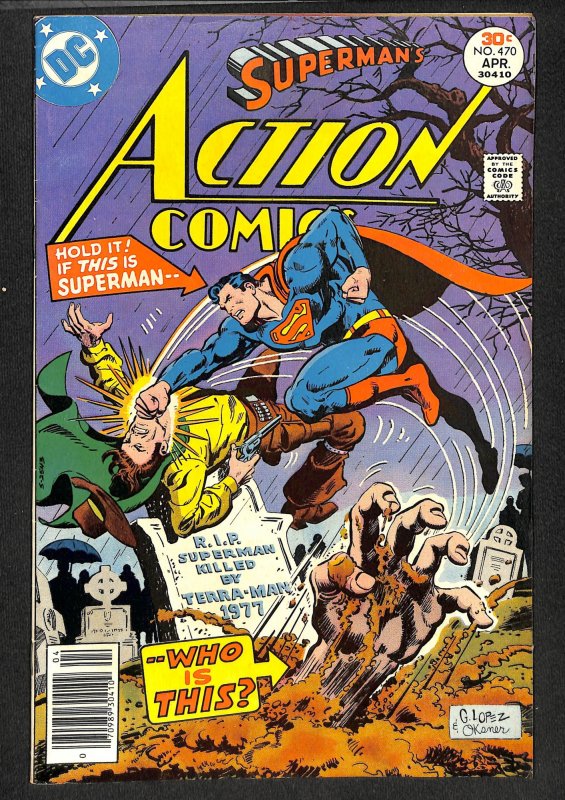
It was with issue #470 that I became a regular every-month reader. I was finally bringing in enough money (I was saving my school lunch money, skipping lunch and using it to buy comics. Wouldn’t you?) where I could follow more titles more regularly. And for no particular reason, this was the issue where I hopped on board. I did have one short period of three months where I stopped reading the book, but I resumed after that, and so I look at that as a momentary lapse rather than a break in service. ACTION COMICS under Julie Schwartz was, like Julies other books, utterly reliable, almost like any product that you would find at a supermarket. Every issue, you knew exactly what kind of a story you were going to be getting, and more often than not, who would be producing it. Consistency was a big factor in the appeal of the Schwartz books. There wasn’t ever any risk of getting something weird. This was comfort food for kids.
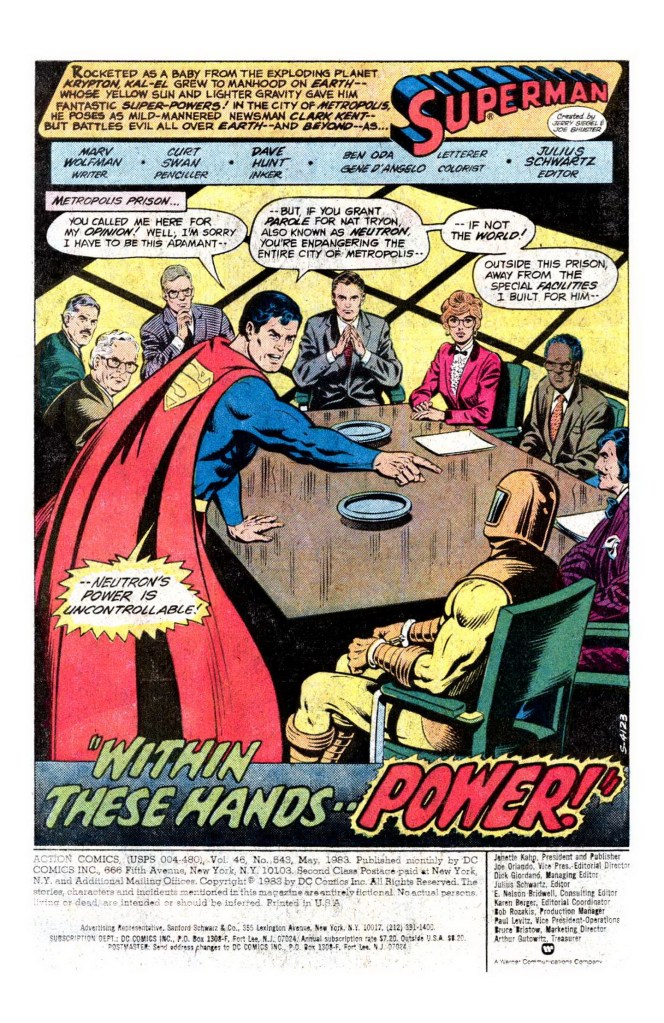
And even with Marv in the writer’s chair, that consistency still reigned supreme. While Gil Kane did drop in to do a couple of really sparking issues, the artwork was still more often than not in the hands of Superman mainstay Curt Swan. Swan was an artist of another era, a fine draftsman with a sensitive touch when it came to depicting emotions who never entirely adapted to doing Jack Kirby-style bombastic action. Swan was more like the Norman Rockwell of comic books, his pages steeped in a comfortable Americana flavor. This wasn’t what many readers were looking for in the 1970s and 1980s, though, where more sparkling illustrators such as George Perez and John Byrne rose to prominence. Swan got a rap for being too quiet, too dated, too dull. But that entirely overlooks his many strengths as an artist.
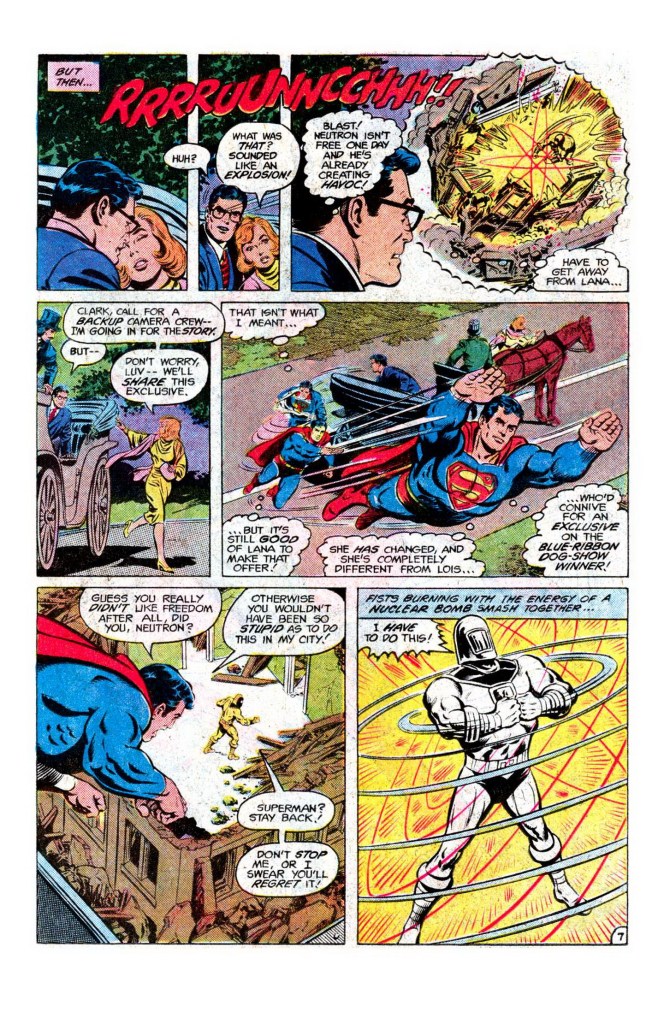
Marv, on the other hand, wrote a Superman that was progressive for the era, for all that it looked very much the same as it had for a decade previously on the surface. His stories were as much about soap opera as anything else: Lana Lang legitimately falls for Clark Kent, Superman’s relationship with Lois Lane heats up and grows more complex, and Lois is depicted as an intelligent and forthright reporter. At the same time, coming from the Marvel school, Wolfman also pitted the Man of Steel against opponents who could give him a physical challenge, like this issue’s antagonist, Neutron, a man turned into destructive energy. At the top of the story, Neutron and his manager have convinced the authorities that his earlier rampage was all a misunderstanding, and so he’s given his freedom despite Superman’s misgivings. A short while later, Superman runs across Neutron demolishing a building and swoops down to stop him.
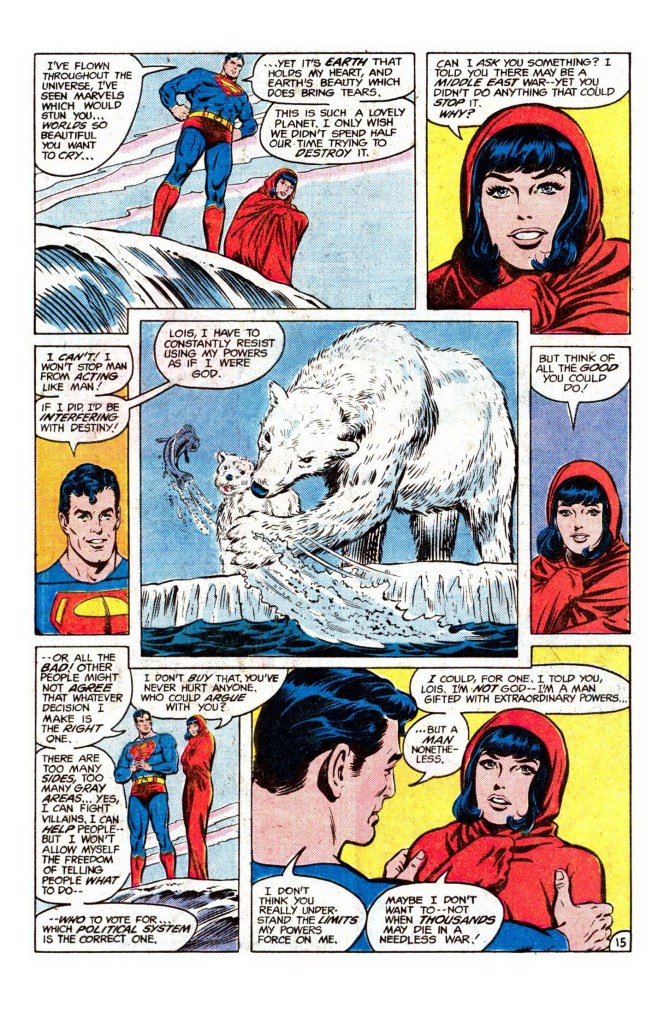
You can see teh payoff coming, can’t you? But before we get to that, this issue also includes this rather great sequence where, having just attempted to get an interview with a pair of vising dignitaries whose Middle Eastern countries are on the verge of open war, Lois asks Superman why he doesn’t act to prevent such bloodshed, and they have an exchange concerning what the responsible thing to do here is, and whether or not Superman is failing to use his great power to its ultimate potential–and even whether Superman himself is ultimately responsible for all the deaths that war will bring because he doesn’t take action to stop it. This sort of thinking is today very de rigueur for super hero stories, but in 1983 these sorts of ideas were somewhat powerful and new. And this difference of opinion drives a wedge between Superman and Lois, as she can’t believe that he is willing to stand by and let people choose to slaughter one another.
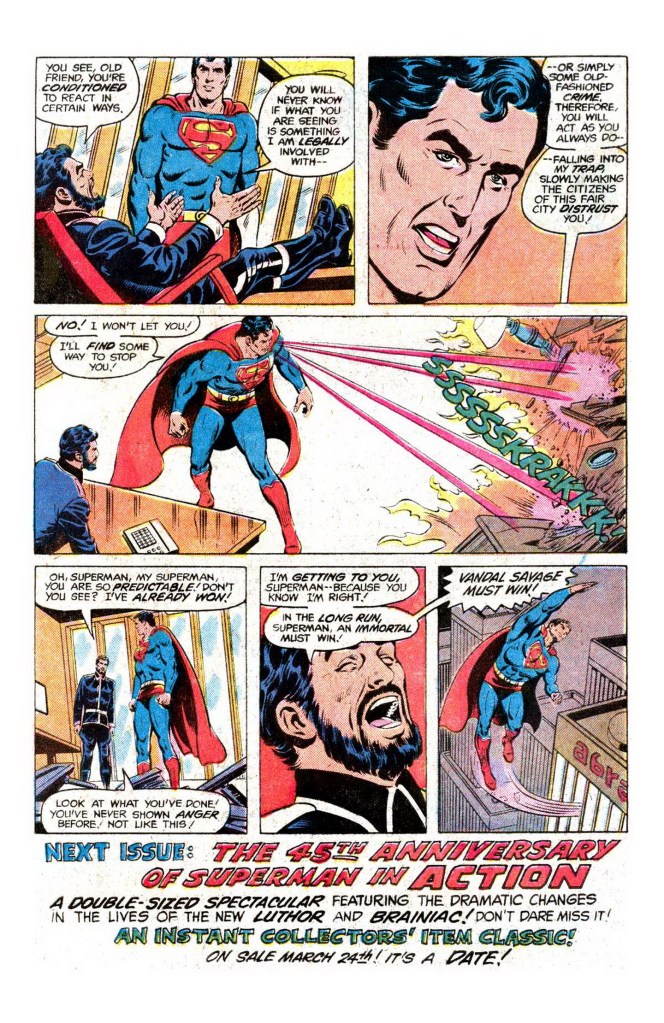
As for Neutron? As you’ve already no doubt worked out, he was hired to demolish that building legally by Vandal Savage–who here Marv had set up as a powerful businessman in Metropolis, sort of like a dry run for how he and John Byrne would later approach Lex Luthor. By deceiving Superman into attacking the innocent Neutron, Savage intends to erode Metropolis’ trust in the Man of Steel. And even faced with this fact, there isn’t much Superman can do about it.
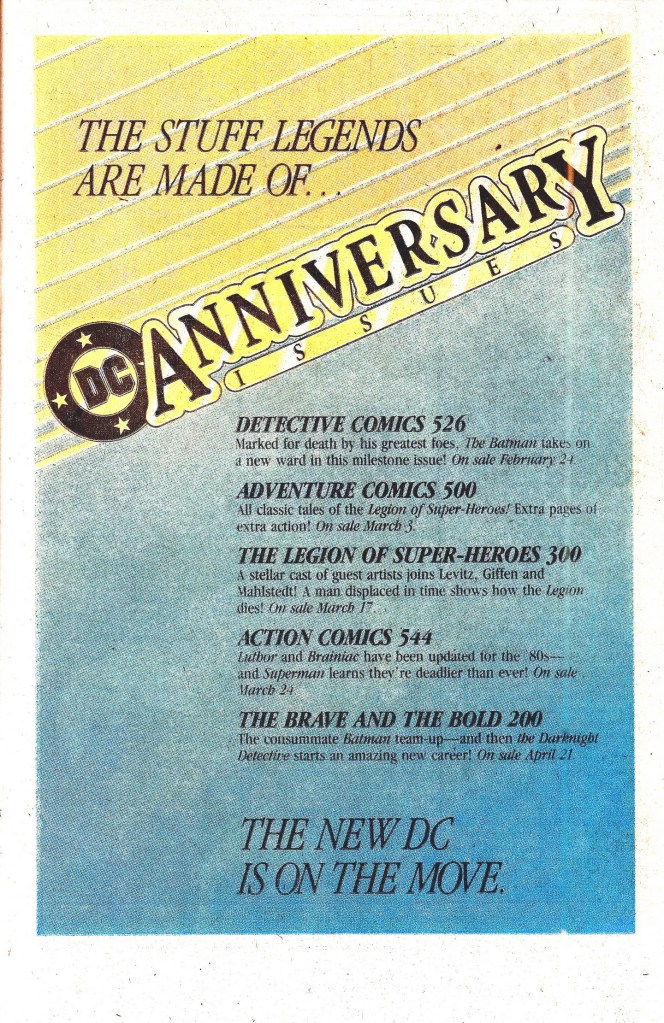
This issue also includes this house ad for a number of upcoming DC anniversary releases. And I have to say, DC had gotten wonderfully adept at making an oversized anniversary issue into something special, a real event. Just about everything that’s listed here was wonderful.
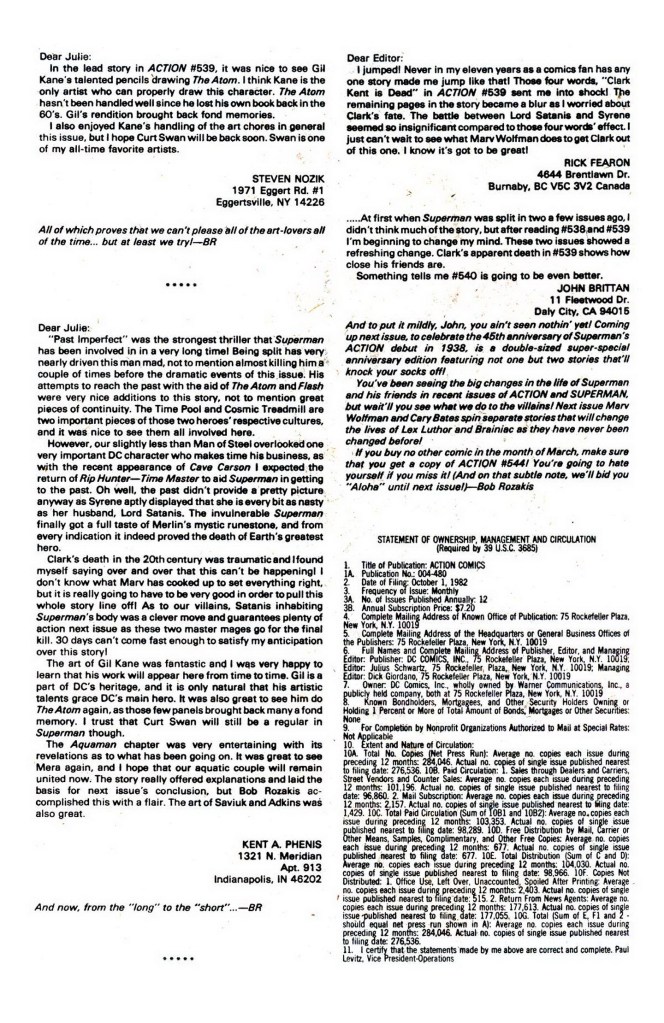
And look! It’s our old friend the Statement of Ownership, which gives us the data to analyze just how well or how poorly ACTION COMICS was performing at this moment in time. According to teh numbers, the book was shifting 98,289 copies on a print run of 276,536, giving it an efficiency rating of just under 36%, not a good number at all. Fortunately for DC and everybody else, this was the point where the non-returnable Direct Market was beginning to grow into the force it would shortly become and make publishing comic books continually viable. The returnable Newsstand market was simply disintegrating at this point, especially for low cover price/low return items such as comic books.
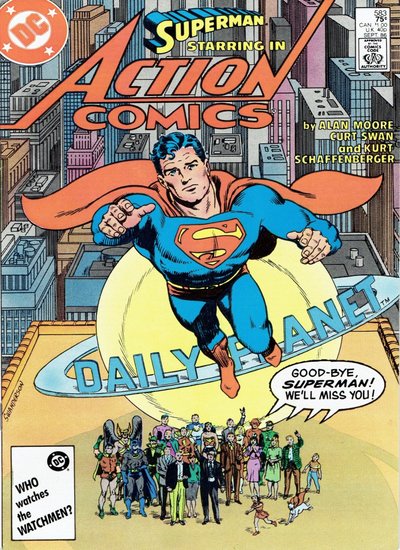
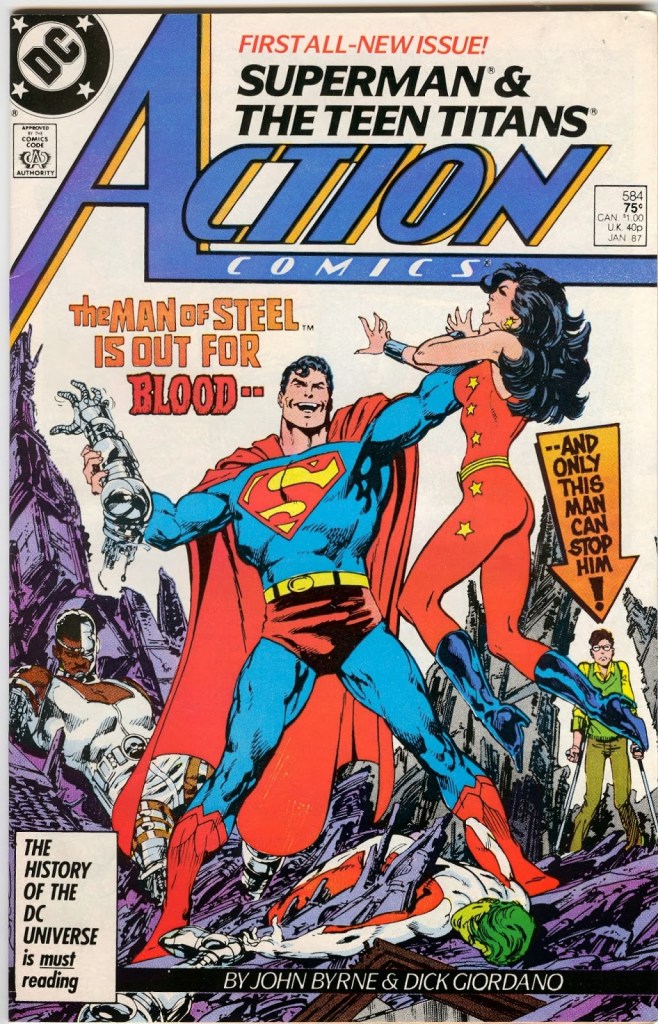
I came back to ACTION COMICS for Julie’s editorial swan song, as he saw out the era of the Bronze-age Superman in a miraculous story written by Alan Moore, in which Moore was able to bring all of the running story threads in teh series to a satisfying conclusion and to wring genuine pathos and emotion out of what was sometimes considered a silly mythology. He was joined by Curt Swan for the final time in ACTION COMICS as a regular artist. Three months later, I stuck around for John Byrne’s reinvention of the Man of Steel, in which ACTION COMICS became a team-up title that paired off the Superman with other figures from around the reconfigured and more streamlined DC Universe. I never entirely warmed to Byrne’s version of Superman, though–his stories often felt thin and under-developed to me. But there’s no denying that graphically they brought the character into the 1980s in a big way.
 The Tom Brevoort Experience
Terra Man is so ridiculous, his creation literally makes me mad.
LikeLiked by 1 person
I love Terra-Man. A space cowboy riding a pegasus with technology that’s indistinguishable from magic? One of my favorite super-foes.
LikeLiked by 1 person
Superman#299 ( May 1976 ) is my only book ( not counting his Who’s Who appearance or Crisis on Infinite Earths ) with the pre-Crisis Terra-Man { He was brought together with Lex Luthor, Mr. Mxyzptlk, Prankster, Brainiac, Toyman II, Kryptonite Man, Amalak & Parasite by the alien Xviar ( a.k.a. Mister Xavier/Mr.X ). But he seem more an Adam Strange or Hawkman class foe. Now, the Thing from 40,000 A.D. [ Superman#87 ( February 1954 ) shape-changer who mimics Superman’s form & powers ], Clayface II ( Matt Hagen ) [ World’s Finest Comics#140 ( March 1964 ) mimics Superman’s powers & form — didn’t do it again in WFC#144 ( September 1964 ) when he teamed up with Brainiac for some reason ], Byth ( Thanagarian shape-shifting thief ) [ Hawkman#9 ( April 1987 ) impersonates Superman & mimics his powers ], Metalo ( scientist-inventor with super strength & metal suit ) [ World’s Finest Comics#6 ( Summer 1942 ) Superman story — I would turn him into Wonder Woman’s fake WW2 foe Baron Blitzkrieg ], Radion [ Superman#308 ( February 1977 ) ] and as a team ( Brainiac, Grax, Marauder & Lex Luthor ) [ Action Comics#417 ( October 1972 ) ] I find interesting. NOT A BAD GUY: Gollo ( alien shape-shifter ) [ Action Comics#234 ( November 1957 ) ] is DC Comics answer to the Impossible Man.
LikeLike
like the Impossible Man, Gollo would make a re-appearance decades later [ Action Comics#572 ( October 1985 ) he comes to Earth for Superman’s help when his entire race of shape-changing aliens has decided to take Superman’s shape — comics.org ]
LikeLike
I’m not sure what it was but Marv Wolfman — whom I enjoyed on TOD, Nova, Green Lantern and of course Titans — did not work for me at all on Superman. I was too completist to stop buying but I didn’t enjoy his run at all.
Wolfman definitely wanted to have a DC villain functioning like the Kingpin, seemingly within the law and untouchable. Goldface in Green Lantern, Vandal Savage here. That also didn’t work for me except with Luthor.
LikeLiked by 1 person
Until John Byrne created the Master of the World, Marvel didn’t have a cro-magnon villain as old as Vandal Savage — Maha Yogi was to young. George Tuska drawn newspaper comic strip was the first time I ever saw Vandal Savage [ But many year later in the back issue section I did get his appearances in these Gil Kane drawn issues – Action Comics#552-553 ( February-March 1984 )].
LikeLiked by 1 person
I really liked Marc Wolfman’s run on Action, especially the issues drawn by Gil Kane. They heightened the stakes in Superman’s universe without throwing out his past, as John Byrne would do. I never really warmed to Byrne’s Superman either. The art was sharp, though.
LikeLike
Vandal Savage as an immortal Kingpin-figure seems like it ought to work. It’s certainly logical for a long lived villain to simply insert himself into the halls of power, instead of seeking to become an ostentatious overlord. And maybe the idea has worked, somewhere else. But something about Vandal Savage doesn’t work. Maybe it’s because he’s such a flat character that all his blah-blah about the innumerable foes he’s conquered comes to sound like hot air. Luthor and Kingpin have one thing commonly in their favor: they were born in specific time periods and rose to power by mastering the exigencies of those time frames. The guy who’s wormed his way into power in this time period because he’s done it so often– seems by comparison a little boring.
LikeLiked by 1 person
I once tried to pitch an elseworlds that I originally wrote as an RPG where Vandal Savage was the head of an Illuminati-like group of bad guys and the heroes were plucky rebels trying to topple them.
One of the villains I’ve always thought should have been bigger.
LikeLiked by 3 people
You mean like his Young Justice cartoon counterpart is?
LikeLiked by 1 person
Yes, Vandal Savage doesn’t seem to have anything distinctive about him. And it’s just sitting there to lean into his backstory, that he’s a literal caveman who grew up doing actual caveman stuff. Accumulate tribal status, be a powerful hunter, otherwise you starve or are a meal for predators. He could even have people who admire him in a twisted way, similar to the Joker.
But immortal villains should really be behind-the-scenes types, who play a very, very long game. After all, they have plenty of experience waiting out opponents. They also should have plenty of alternate identities, since they need to create those periodically, and why not a few more for spares? (hopefully better than something like “Andlav Esagva” or similar).
Note even if someone has a power where they can’t be killed, that doesn’t stop them from being made extremely miserable. An obvious problem is simply ending up dropped in the bottom of a deep pit somewhere, as then immortality is no help in getting out.
LikeLiked by 3 people
“Swan was more like the Norman Rockwell of comic books.” True, so true.
LikeLiked by 1 person
“While Gil Kane did drop in to do a couple of really sparking issues, the artwork was still more often than not in the hands of Superman mainstay Curt Swan.”
Kane actually did ten issues. Swan did more, if you count Marv’s four-issue stretch that was followed by 8-9 issues of other writers (mostly Gerry) before his regular run began. And Joe Staton did five.
But there were constant interruptions, as fill-ins broke up the run — understandable, when Marv was writing TITANS and setting up for CRISIS, but it still made it hard for the run to build up momentum.
LikeLiked by 2 people
j definitely noticed Marv’s credits & Gil’s credits screen art in the late 1980’s Saturday morning Superman animated TV cartoon. It was cool to see names I’d only knew from comicbooks on the small screen.
Makes sense that they worked on the character together in the comics. Not to mention all of their other collaborations before then.
LikeLiked by 1 person
My first subscription was to Action Comics, for Swan’s swan song–it literally ended because the book went on hiatus for the Man of Steel miniseries. You make an excellent point that the evolution of Superman was constant through the 80s. I certainly felt that the final year pre-Crisis (technically, during Crisis) was thoughtful and elegiac, and Swan delivered that masterfully. Ironically, it happened while Superman on the big screen was becoming very silly.
LikeLiked by 1 person
Well sa
LikeLike
I know I’ve read some of those Wolfman issues, but it was back at a time that I wouldn’t have recognized Wolfman as the writer. I even read most of the New Teen Titans without knowing who he was, though I did love Perez’s pencils!
I really enjoyed Byrne’s Action Comics run. It was an interesting time as he was ‘reinventing’ Superman and I wasn’t always sure what was going to come next. The team-ups in Action Comics gave us a chance to see more of Byrne’s takes on the rest of the DC Universe characters too. Many of the pairings I had never seen before, so it was a fun ride.
LikeLike
I was excited by Byrne’s coming onto “Action Comics”, too. I think I was 14. I’d followed his “Man of Steel” set-up mini-series, and his subsequent “Superman” relaunch. And Marv & Jerry’s “Adventures of Superman” (which kept the original numbering of “Superman”, Volume 1).
I wished they’d kept “DC Comics Presents” around, though. I get why they didn’t. Byrne’s team-up format in “Action” made “DCCP” (not CCCP, or USSR!) redundant. And a new # 1 issue was far more rare than one is today, almost 40 years later. A good sales bump.
But the title, “DC Comics Presents”, still appeals to me. So does “Marvel Comics Presents”. I’d use the titles for an anthology (which is what “Action” turned into briefly, some time after Byrne left the Superman books). Or even better, similar to DC’s “Solo” series, let premier professionals take some underused characters for a spin. A feature of 8-10 pages a month with the Silver Surfer by Walt Simonson should’ve been done a long time ago. Come on.
I was ultimately disappointed with Byrne’s “Action” run. Comics were changing more rapidly. The standard of quality was getting steeper. And churning out several books at “deadline style” was suffering by comparison, along side the cream of the new crop. I was slowly gettin’ older, and had been interested in drawing, life drawing, in art classes, for years by then. I started only noticing flaws in some comicbook drawings, including Byrne’s. I realized much later some of that was just financial, economical, trying to cram in as many pages a month, because it’s how they paid the bills.
I lost interest in Bryne’s team-ups in “Action”, the story & art for which seemed to be looking backwards, as I was looking for something new I hadn’t seen before. Maybe my first signs of “aging out”. Or at least, aging up.
LikeLiked by 1 person
Wow, it’s been so long that I had to look up DC Presents again! I guess it was the Superman team-up. I know I had a few issues, but I wasn’t much of a Superman fan.
I think people tend to hold Byrne to a higher standard. I guess that’s what happens when you get into the spotlight and it seems he wasn’t too shy about avoiding it either. No one is a perfect artist, but I think for the time his style (as well as Perez’s) were about the best there was. Completely personal opinion of course. I was trying to think of who you were thinking of as the “cream of the new crop”. Some of the Image artists maybe? I guess this was around the time when most of them were starting to get noticed.
LikeLiked by 1 person
I was never a fan of the pre-Crisis Superman. But I was 13 when Byrne began his run in 1986 and I absolutely loved it. He brought a swagger back to the character that it had largely been lacking since the Siegel and Shuster era. Having re-read it for the first time in probably 30 years in the recent hardcovers editions, I think it still mostly holds up. It’s not at the same level as the other DC reboots of the 1980s (Miller and Mazzucchelli’s Batman; Perez’s Wonder Woman; Grell’s Green Arrow; Chaykin’s Blackhawk; Truman’s Hawkworld; Gaiman and McKean’s Black Orchid; Chaykin and JLGL’s Twilight), but it’s still quite good.
LikeLike
@Daniel Klos, We’re about a year apart. The pre-CoIE was the only comicbook Superman I had for my 1st 14 to ears. It was enough, along w/ other media, to make be a fan. But I got tired of Swan s status quo version all those years (& long before me). Especially compared to newer artists emerging towards the end of his long, illustrious career.
I still liked the idea & history of Superman. And I looked for visual interpretations that matched the ideal. Shuster’s & Fleischer’s models were the benchmark. And the.great late 70’s, early ’80’s covers by Jose Luis Garcia-Lopez, Rich Buckler, & Ross Andru (all 3 often best inked by Dick Giordano), That’s where Superman looked best in those years. Still holds up. I prefer their versions to Byrne’s.
There’s a DC Comics Presents issue written by Cary Bates, & fully drawn, inked, & colored by Klaus Janson that ranks among my fave Superman stories.
Then there the Annual by Alan Moore & Dave Gibbons that was never bettered by the immediate post-CoIE era. I’d have to go to Morrison & Quitely’s All-Star run for anything better.
I also enjoyed the “original” Superman ‘s appearances in All-Star Squadron.
LikeLiked by 1 person