


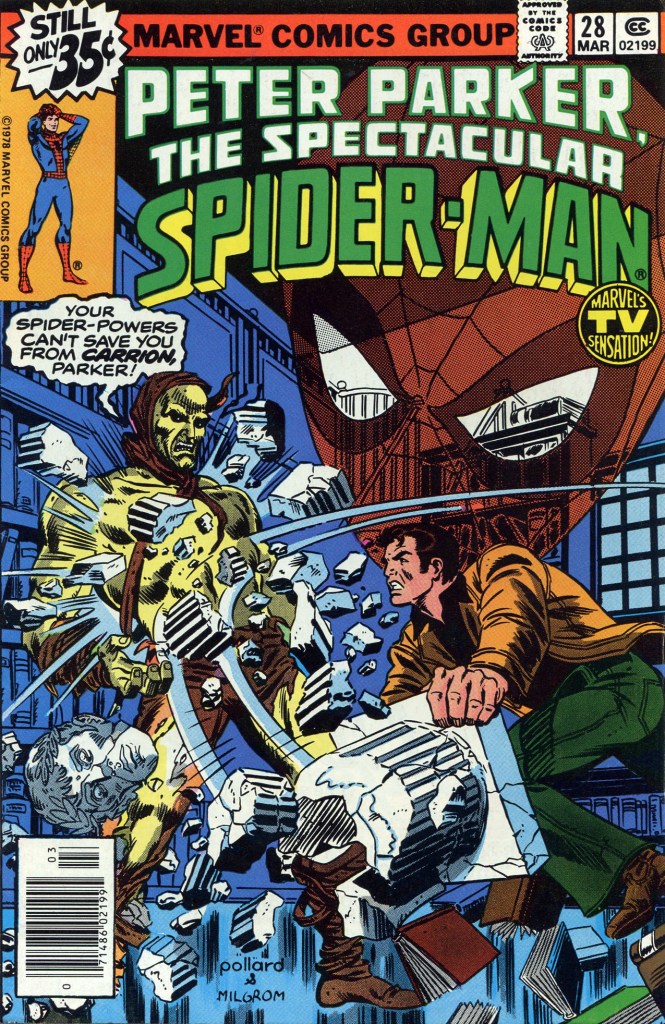
This was the second of two issues of PETER PARKER, THE SPECTACULAR SPIDER-MAN that were illustrated by a young Frank Miller, before that name really meant anything. Even more meaningfully, Daredevil, the character he would go on to reinvent, was a guest star in these two issues as well. It almost feels like fate. At the time this book came out, though, I gave the art no particular notice. It did feel a bit more sophisticated in its storytelling than had been the norm for PPSSSM, but not to such a degree that I noticed it. After the fact, as Frank’s DAREDEVIL heated up, these two issues of PETER PARKER jumped in price on the back issue market.
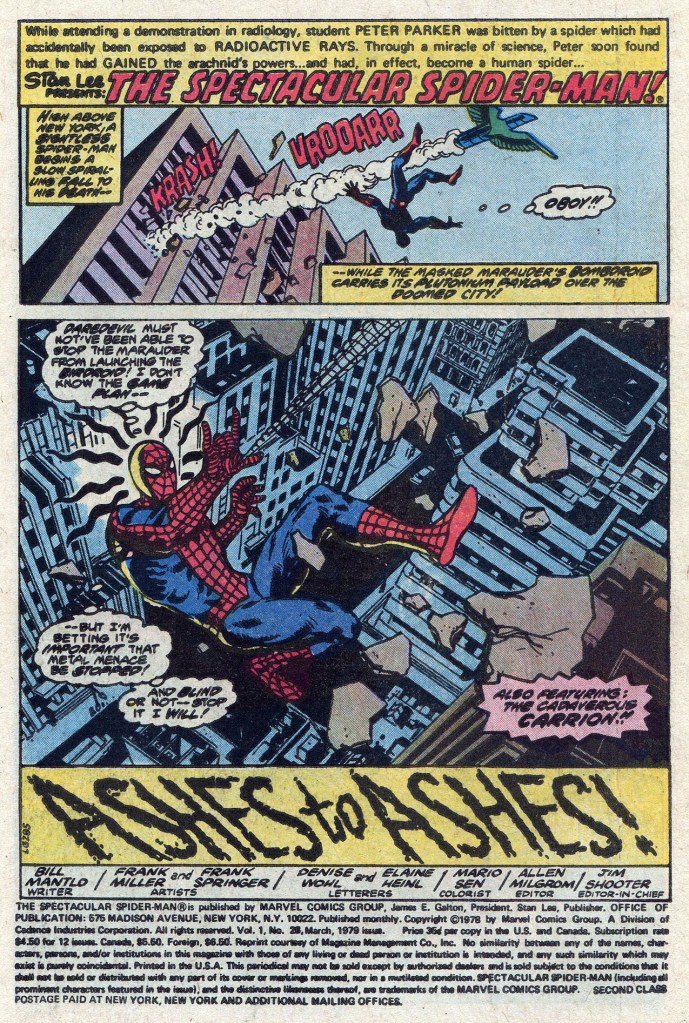
This was a bit of a transition issue, wrapping up the in-progress adventure in which Spider-Man had been blinded by the Masked Marauder and then segueing into pushing the running Carrion subplot to the fore. I can remember as a reader at this time being very excited and invested in the mystery of Carrion’s true identity, even though I didn’t have enough knowledge of Spidey’s history yet to puzzle it out. And that effort would have been wasted anyway, as Carrion’s true identity was changed at the eleventh hour after a protest from the writer of AMAZING SPIDER-MAN, who felt bringing the character writer Bill Mantlo had in mind back was a bad idea. In any event, Carrion was the first Spidey mystery foe that I’d encountered, and I was sucked into the story as a result, in the way a few years later readers went wild for the mystery of the Hobgoblin.
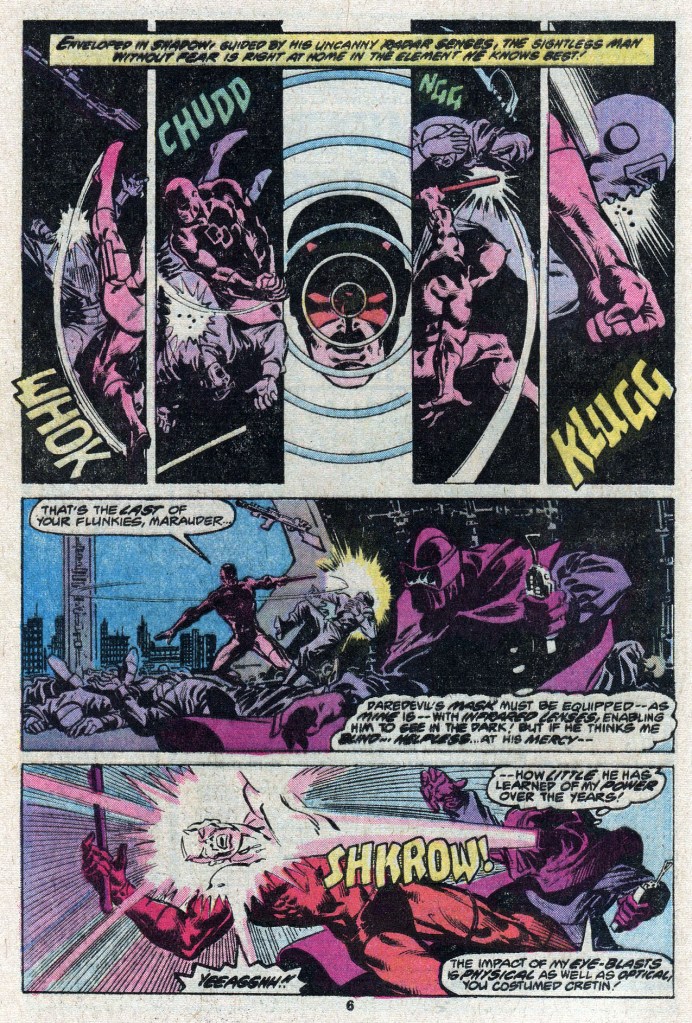
As can be seen in the storytelling on this page, Miller impressed even at this early stage of his career. Anyway, at the end of last issue, Daredevil had faced down the Masked Marauder and his goons solo, while the blinded Spider-Man clung to the wall outside, unable to help. But the Marauder got the upper hand and launched his Tri-Man android in its bird-bomb form towards New York City, intending to annihilate it completely. Spidey is almost knocked off his perch by the unexpected launch of the flying device, but he’s able to snag it with a web-line and prevent himself from falling to the ground below. What’s more, by climbing up his web-line, he’s able to reach the bird-bomb itself. Even blinded, he’s guided by his spider-sense as he attempts to disarm the flying bomb.

As Daredevil works to clock the Marauder and force him to disarm his doomsday weapon, Spidey takes matters right to the source, and despite not being able to see, he’s able to use his technical skill and his awesome strength to pull the plug on the bird-bomb. Of course, this means that he’s now riding a dead craft as it plummets towards the ground below, but by focusing on his other senses and in particular his spider-sense in a Daredevil-like manner, Spidey is able to glide the doomed ‘bot to Central Park where he and it lands safely and unharmed. But there isn’t a moment’s reprieve for the wall-crawler, as he’s immediately swarmed by cops who have heard that he was acing like a lunatic the previous evening–which is true, it was Spidey’s anguished reaction to his newfound blindness. But the web-slinger is in the soup once again.
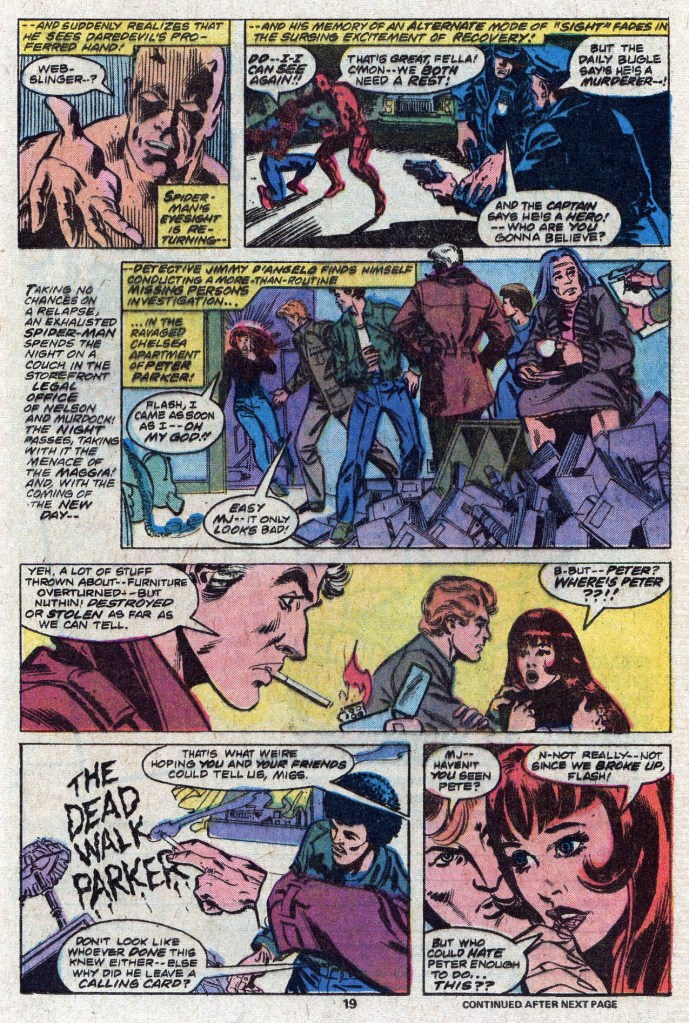
But Daredevil arrives in the nick of time to order the police to pull back. He sends them to wrap up the Marauder and his Maggia goons, then turns to help Spidey up. And wouldn’t you know it, it’s at this moment that the web-slinger realizes that he’s beginning to be able to see Daredevil again, and that means that his sight is returning, his optic nerve wasn’t permanently damaged as he feared. It’s still going to take him some recovery time to be fully back to normal, but the damage isn’t permanent. The next day, Spidey is feeling recovered enough to head back to his apartment, and is shocked to discover the place trashed. We saw Carrion do this last issue, but it’s news to Peter, and he’s not certain whether the target of the message scrawled on one wall–The Dead Walk, Parker–was meant for Peter or for Spider-Man. And with detectives examining the room, Peter’s disappearance for two days having convinced them that he may have been a victim of foul play, Spidey ditches his costume in a nearby alley before heading back into the building in street clothes.

Peter’s friends are overjoyed to see him alive and well, and he tells them that he injured his eyes doing a chemical experiment and that’s why he didn’t come home the past two nights. With his place trashed, Hector Ayala, also the White Tiger, offers Peter a crash-pad at his place. The next day, Peter heads to the E.S.U. library to meet up with Hector to take him up on the offer. But as he enters the building, he finds a security guard unconscious and after racing up the stairway, Hector knocked out as well, with another message scrawled in red dust across his body: Ashes To Ashes, Parker! And even before his spider-sense can warn him, suddenly Carrion appears behind him and knocks both Peter and the unconscious Hector off the mezzanine balcony.
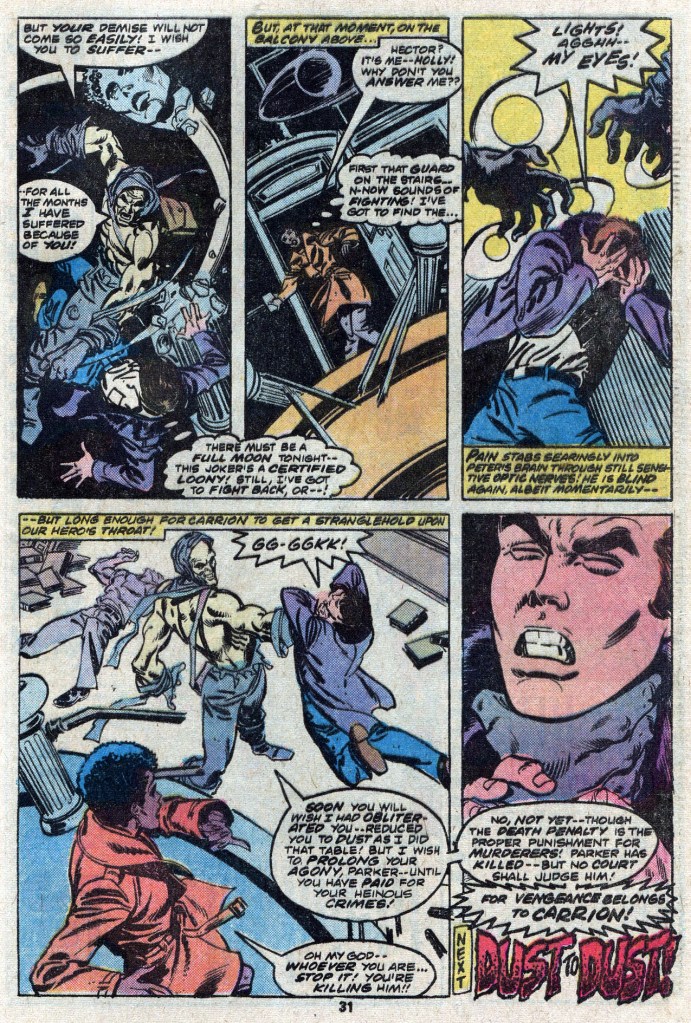
Carrion reveals almost instantly that he knows that Peter is really Spider-Man, which is a mixed blessing, as it means that Peter can use his powers openly to break his fall. But the sinister creature has the upper hand as the pair brawl with one another, Peter is unable to catch his breath and get his bearings. Even worse, Hector’s estranged girlfriend Holly Gillis has come to the library to try to patch things up with Hector, and hearing the battle, she instinctively turns the lights on. This is shockingly painful to Pete’s still-recovering eyes, and it gives Carrion the opportunity to grab a hold of him. We’ve already seen the menace’s ability to disintegrate matter with a touch, but he tells Parker that killing him in that manner would be too easy, too merciful. And as the issue wraps up, Pete finds himself in a choke-hold, unable to escape. To Be Continued!


t this point, Miller’s Spider-Man wore both its Ditko and its Romita influences like badges of honor,
He’d outgrow it very soon and become someone others imitated.
LikeLiked by 2 people
I liked Frank Springer’s work on this. It gave the book visual Consistency.
Given Vince Coletta’s work on the book, I wish he had continued to Ink Trevor Von Eeden’s work on Black Lightning.
LikeLike
I thought Vince’s inks really ground down Trevor’s work. There were few artists who’s drawing could withstand the sandblasted effect those inks had. Big, open shapes.
LikeLiked by 1 person
I was definitely noticing Miller’s art around this time. I don’t recall if the Peter Parker issues came before or after his issue of Marvel Two-In-One with the Thing and the Avengers, but both of them impressed me…clearly a talent to watch.
LikeLiked by 1 person
The MTIO was a couple of months later — and while you wouldn’t ordinarily think of Bob McLeod as a simpatico inker for Frank, he preserved all of Miller’s sharp page design and storytelling while giving the art a slick, commercial finish.
Sadly, I think Springer buried Miller here, so that you can see some of his strengths come through, but a lot of what was there must have been homogenized into standard-looking stuff. It did make it fit in with the general run of the series, but I’m not sure that was all that much of a plus.
LikeLiked by 3 people
Miller and Springer are both credited as artists so I presume that Frank didn’t do full pencils and Springer added detail with his brush. His inking is particularly heavy here compared to his work over Heck and Robbins.
Springer is generally a pretty good inker
LikeLiked by 1 person
I think Springer’s a very capable inker, but he’s best over pencilers with whom he’s stylistically aligned. He was one of Robbins’s best inkers, because they’re both working in strongly Caniff-influenced styles. When Springer was working over someone who didn’t have that stylistic connection, the result could be very Springer-looking at the cost of the penciler’s style.
In this case, yeah, Miller was probably just doing breakdowns. But I’d still rather have seen someone more simpatico do the finishes — as we’d get with Janson.
LikeLiked by 2 people
When he did a John Carter issue, I remember it being reported that Miller actually took the time to figure out how a four armed swordsman would use his weapons. The Dark Knight Returns was the beginning of when I’d stop following his work faithfully but when he exploded on the scene it was like a A-bomb!
LikeLiked by 1 person
Who was Carrion originally planned to be? I’d never realised that the reveal wasn’t the original intent.
LikeLike
So was Carrion originally meant to be Norman Osborne? Based on the ragged costume and his dialogue, that appears much more likely than Professor Warren.
LikeLike
Carrion was created to be the Peter Parker clone. Had this stood, The Clone Saga, had it even happened, would have been very different.
LikeLiked by 1 person
Ah, that possibility – that Carrion was the resurrected Peter Parker clone – didn’t even occur to me when reading those mags way back when.
LikeLike
I remember trying to track this one down. Wish I still had it, the art is nice. Maybe someday the Epic collections will also pick up PPtSSM.
LikeLiked by 1 person
Who was Carrion supposed to be originally? I don’t think I knew there was last-minute switch!
LikeLike
I re-read that MTIO issue JK mentioned recently. As with SPEC, one could hardly tell that Miller was anything beyond another guy doing his version of the Marvel house style– though the MTIO sported a nice big spread saluting Steranko’s NICK FURY series.
LikeLiked by 1 person
Technical term question: we all know that a two-page spread takes up two full pages.
But the spread I mentioned takes up the upper halves of two pages, while the bottom halves are regular panels.
So is there an industry term for that?
LikeLiked by 1 person