


ROM, SPACEKNIGHT is one of the better-remembered series of the early 1980s, this despite the fact that it was a toy tie-in comic. The toy was a bust, but the comic wound up running for 75 issues, a respectable run by any metric. Along with MICRONAUTS, it was writer Bill Manto’s greatest success in this period, as he invested these series with the same amount of imagination and energy that he would have for a typical Marvel book, and used the backdrop of the Marvel Universe aggressively to convince readers that the events taking place in the pages of ROM were a legitimate part of the overall tapestry. In only a few more years, the approach to licensed comics would become very different, as people realized how entangled the later reprint rights became.

The first issue or ROM that I read wasn’t purchased by me. Rather, it was bought by my younger brother Ken. I don’t know what attracted him to this issue–he may have seen the TV commercials for the ROM action figure. But I also read it, of course, but I wasn’t sucked into the story enough to continue buying it. I did pick up the next issue, #5, as it featured the House of Shadows from a very old Doctor Strange story that I had read, and so I felt a connection with the material. But that was it for the moment.

The issue that made me a regular ROM reader was the same one that did this for so many other fans of the day; #17, the first half of a two-part crossover with the X-Men. X-Men was the hottest title in teh land right at that moment, and so an appearance by those miraculous mutants made the issue a must-buy–if for no other reason that that, if you passed it up, its back issue price would inevitably soar higher than the issues around it. So it was an investment, you see, making sure to pick up appearances of the X-Men outside of their home series. And once I’d devoured these two issues, as had happened multiple times before, I simply carried on following the book almost out of habit. It was always an entertaining read, never the best book of the month, but never the worst, either.
ROM was blessed with a very simple story engine that was infinitely flexible and allowed for a broad span of stories, especially ones that intersected with the odd corners of the Marvel Universe that writer Mantlo was keen to play in. ROM was a Spaceknight, a cyborg soldier from the planet Galador who had given up his humanity in order to do battle with the shape-changing Dire Wraiths. As the Wraith menace spread throughout the galaxy, including Earth, the Spaceknights went forth to meet the challenge, and ROM arrived on our planet intent on rooting out the alien menace that was living among us. He carried among his arsenal an Analyzer that could detect the Wraiths even while hidden, and a Neutralizer that would exile them to limbo (since the Comics Code still frowned on killing one’s enemies, even if they were shape-changing blobs.) But because he’s seen gunning down seemingly ordinary people, ROM is branded an alien menace and is often at odds with the conventional authorities and other super heroes, who think he’s the bad guy.

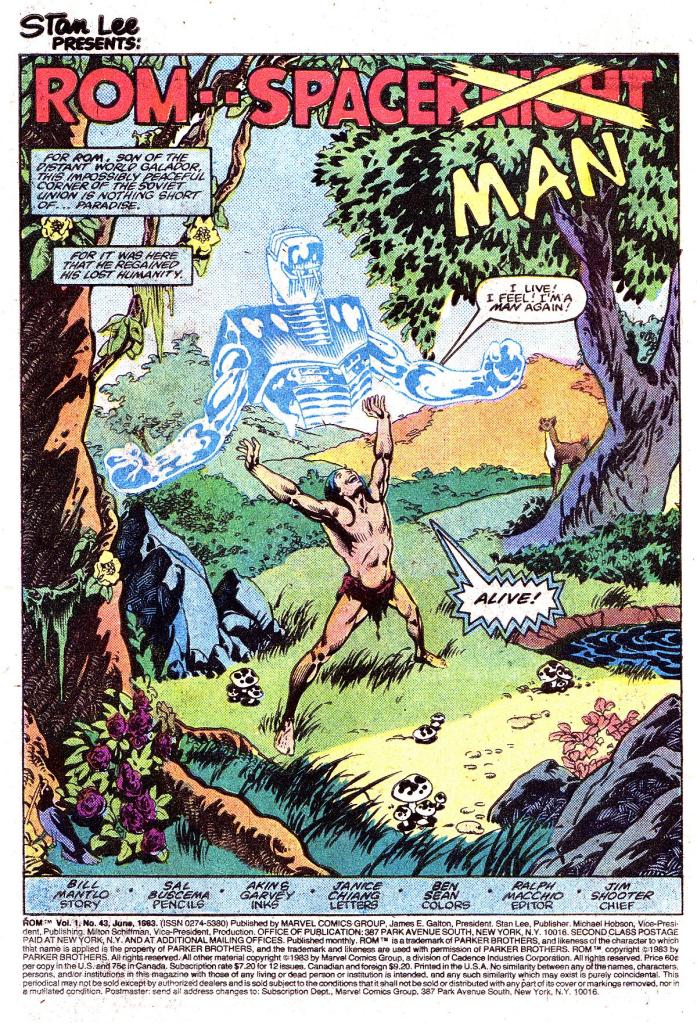
Another of the real strengths of ROM was the consistent presence of artist Sal Buscema. Sal had his ups and downs in terms of his overall popularity in the fan community, but he always delivered a rock solid story in the accepted Marvel house style. And a Sal book always felt like a Marvel book, which was something that benefitted ROM greatly. By the time of issue #43, he was being inked/finished by the team of Ian Akin and Brian Garvey, who gave the book’s finish a lush flavor similar to that of the Marvel black and white magazines of the 1970s. It was an attractive pairing, one that made Sal’s work look fresh after so many years (Sal didn’t always get the best inkers over his stuff, and guys like Mike Esposito spent a decade absolutely massacring his work.)

By this issue, ROM’s quest to defeat the Dire Wraiths had been going on for a while and not really getting anywhere. He’s root out some nest of Wraiths, then move on to a new location, rinse and repeat. What kept the series from becoming totally repetitive is the other Marvel heroes and villains who would show up along the way. So in this issue, ROM has had his humanity restored to him by Quasimodo, the android foe of the Fantastic Four who desires ROM’s armor for himself. So everybody is happy, right? Wrong! Because Quasimodo’s cure is only temporary, and that means that ROM’s new human body is going to decay itself to death in a stone cold hurry. But Quasi has his own problems, as he’s mistaken for the genuine article by the Wraith wizard calling himself Doctor Dredd, who has implanted the essence of ROM’s girlfriend Brandy Clarke inside the cyborg armor of his old love Starshine and now intends to have Starshine battle ROM to the death.

Quasimodo wants no part of this fight, but if he’s going to have to do battle, he’s going to approach it lethally–anything to protect his newfound liberation and mobility. So he and starshine fight a battle that ranges to teh edge of space and back, eventually continuing within the valley where the human ROM is located. While that’s going on, despite the fact that his body is decomposing swiftly (in a relatively horrific manner that it’s surprising the Comics Code of this period allowed), ROM has managed to find Doctor Dredd and he’s attempting to kill the Wraith with his bare hands for what he’s done to Brandy. Starshine, meanwhile, is able to defeat Quasimodo, destroying his essence completely. She thinks it’s ROM that she’s killed, and experiences immediate regret. But the truth comes out a moment later.

Starshine heads back for a reckoning with Dredd, only to find that the half-dead ROM has already killed him. What’s more, she recognizes ROM–but it may be too little, too late, as the Spaceknight passes out, his body having decayed perhaps to the point of no return. It was a good story, but at the point when I was forced to make cutbacks in my purchasing, I had no hesitation about putting ROM on the chopping block. And unlike the other titles that I dropped at this point, I was never able to pick it up again, as teh series wrapped up with #75 as I said earlier. And being a licensed book, there was never a Marvel revival (though other companies have fielded their own versions of ROM over the years. I have read none of them.)
 The Tom Brevoort Experience
This was after I’d stopped reading ROM. I had a very negative reaction to the Akin/Garvey inks — I’d really enjoyed the book when Sal was inking himself and when Joe Sinnott was inking the book, and I understood that the editor had switched inkers because they were trying to make the art look flashy and modern (as we’d see later with Danny Bulanadi inking Paul Ryan on FF), but I thought the effect came off as trying to make Sal look like something he was not, and it didn’t do anything for me but blunt the appeal of what Sal was good at.
The storytelling was still clear and energetic, but the drawing was so buried under an alien style that I thought it hurt the art, while Sal inked by a stylist like Janson enhanced Sal’s strengths rather than burying them. So I didn’t last very long into the Akin/Garvey era. I did think they were a decent choice over various other artists, particularly newcomers who needed a little help with the drawing, though.
As a result, I’ve never read most of the back half of ROM. If Marvel does shorter, paperback volumes of what they’re printing as omnibuses now, I’ll probably pick them up because I’d like to read where it all goes. But back then I just wanted Sal to be inked by someone who wasn’t burying him.
LikeLike
Too many inkers made Sal’s drawings look flat. And it was a very familiar style. I just read Kurt’s comment that he preferred Sal’s work unburied. For me, it was an exciting new take on old favorite. Sometimes inkers can add something to the other artist’s drawings that creates something new & unique. Janson’s one of those. I might like Sinnott’s inks one one artist, but not another. I thought Akin & Garvey’s slick sheen was perfect for a space knight. The lighting & shadows that delineated musculature & reflective metallic surfaces grabbed my attention. I liked their craft over Luke McDonnell’s Iron-Man very much, too.
LikeLike
Tom, you were surprised by the Comics Code letting Rom decomposing body slide but not what happened after the Dire Wraiths new look came with a new methods of impersonating people ( remember their tongues boring into people’s skulls and didn’t their bodies shrivel too? ). I enjoyed this series, but missed issues here and there.
LikeLike
On October 6, 2020 I sent the pages ( in an email ) to Marvel of an Atlas Age story [ Astonishing#8 ( January 1952 ) second story “The Man-Eater” ] about shape-changing people eating aliens that invaded Earth, as a possible replacement for the Dire Wraith ( cause I assumed Marvel didn’t own the rights to them either ).
LikeLike
I stuck with ROM through its entire run and I enjoyed Sal’s art but preferred Sinnott as inker. I do remember being pretty interested in Akin and Garvey’s slick technique even if the finished look over Sal could be overpowering. As mentioned in comments above…. A&K did a good job inking metal and they were an inking upgrade on McDonnell’s Ironman pencils.
LikeLiked by 1 person
We only found a Rom comic or two. They seemed pretty decent. I recently picked up the X-Men issues (17 and 18), thinking they might never get reprinted. Probably for way less than what they went for back in the X-men craze. I’m glad the omnibus for Rom (and Micronauts!) are coming out, as it will give me a chance to read the whole series from the start.
LikeLiked by 1 person
The violence in ROM was often graphic for a Code approved comic.
LikeLike
Tom, do you know if there are any plans to put ROM and Micronauts series on the Marvel Unlimited App after the Omnibuses are released?
LikeLike
One of my favorite comic series ever, next to Mantlo’s Micronauts. I, too, did not care for Akin & Garvey’s inking style at first, but it grew on me. I felt that Mantlo’s characters in this series (and Micronauts) were very realistic, and I came to care for them a great deal.
The reissues of Rom and Micronauts by IDW are nowhere near as good as Mantlo’s imaginative run.
LikeLike
Adding my voice in support of Akin & Garvey’s slick, dramatic inks. They give Sal an edge which (IMHO) I don’t think he ever had on his own — until the 90s, when his late-period style deliberately became sharper and punchier.
LikeLiked by 1 person
I bought it on a Monday, it was wrote by Bill.
De-Do-Rom-Rom-Rom De-Do-Rom-Rom.
With Sal on the pencils they could do no ill.
De-Do-Rom-Rom-Rom De-Do-Rom-Rom.
Goodnight everybody!
LikeLiked by 2 people
While I was a fan of both Mantlo and Buscema, Rom was a character I could never warm up to. He had some of the same problems as the Silver Surfer, in that he was both completely alien (and thus hard to relate to) and insufferably whiny. Characters like Spider-Man whine a lot too, but they leaven it with humor. Rom was just dreary.
LikeLiked by 1 person
I always felt that Rom and the Micronauts were the two licensed properties that fit most seamlessly into the Marvel Universe.
LikeLiked by 1 person