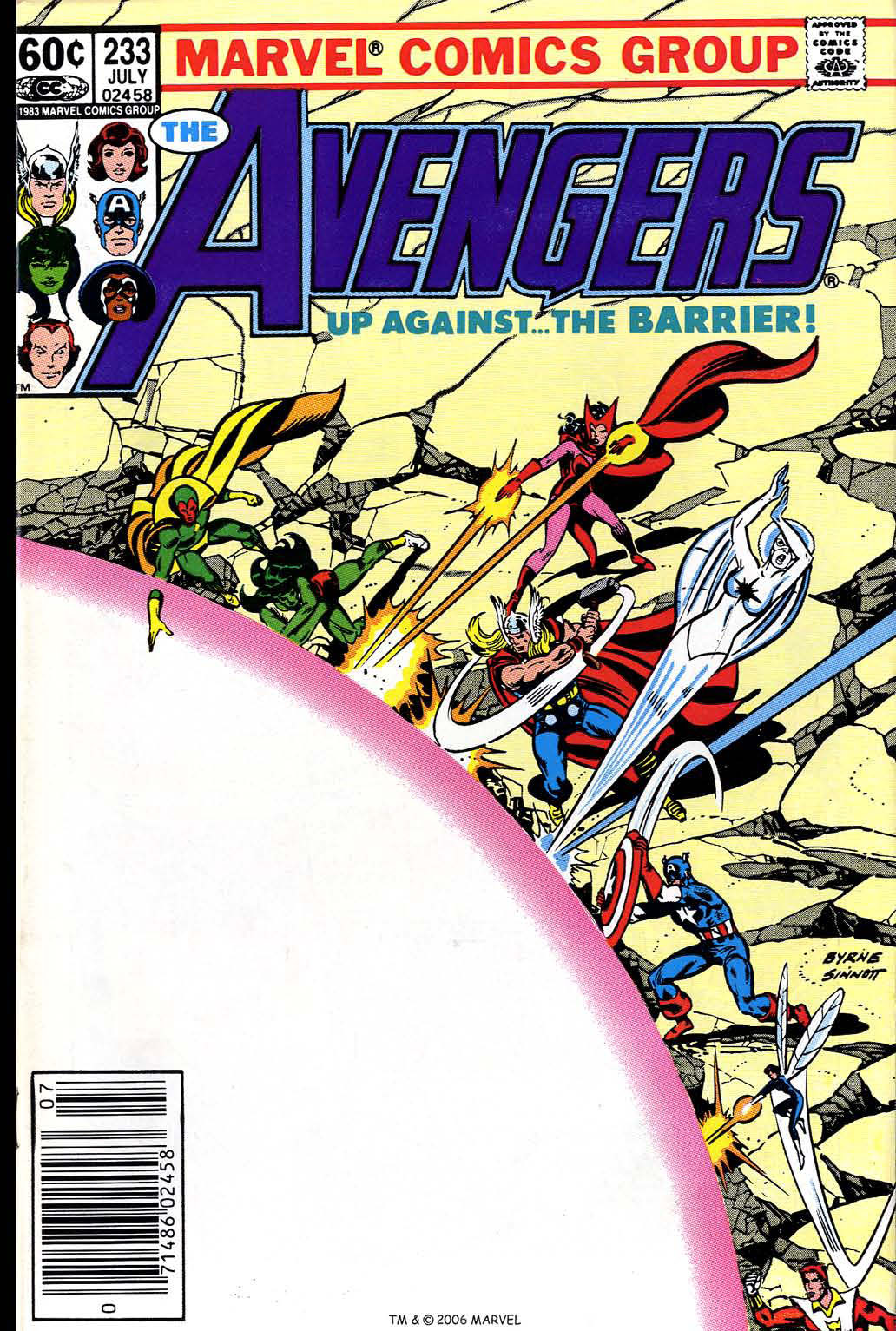


I had really enjoyed AVENGERS up to and just past issue #200. Likely a lot of that had to do with the artwork of George Perez and John Byrne. But once Perez left to go to DC, this was a book that took a hard left turn at a certain point, and I just didn’t like it at all, for all that I kept on reading it every month. That was the point where editor in chief Jim Shooter decided that the Avengers needed to return to being more akin to what the team was in its first year, and he unceremoniously dumped the existing cast in his first issue in favor of the “founding five” of Thor, Iron Man, Captain America, Yellowjacket and the Wasp, plus Tigra as new blood. On paper, this should have worked out fine. But for some reason, in this second go-around on the series, all of Jim’s Avengers behaved like assholes, and so this alienated me from the book. When it came time to chop titles, it wasn’t difficult to pull the plug on AVENGERS.
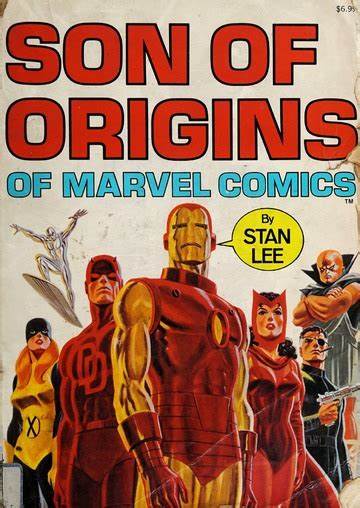
As recounted above, my very first encounter with the Avengers in print (I had seen them in episodes of the Captain America portions of the 1966 Marvel Super Heroes cartoon prior to this) was in the pages of SON OF ORIGINS OF MARVEL COMICS, which I borrowed from my local library as a consolation prize when ORIGINS OF MARVEL COMICS was checked out and unavailable. I very quickly began to check out the most current issues featuring most of these characters, widening my entry into the Marvel Universe.
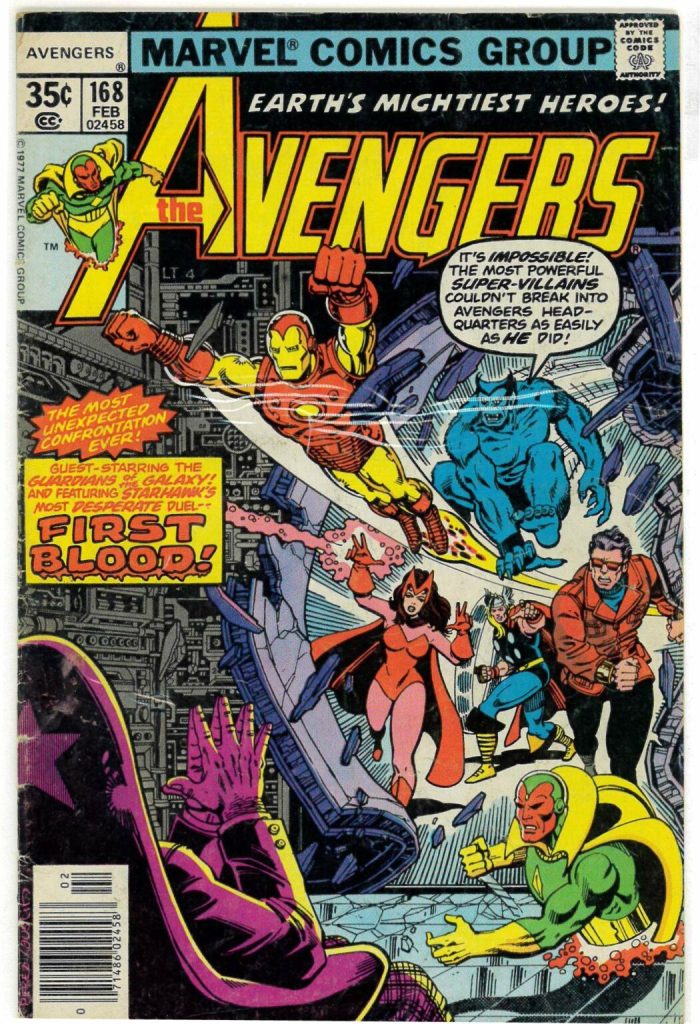
The first issue I bought new was this one, #168, the second part of the well-regarded Korvac Saga. And…I didn’t like it. I found it confusing, despite the fact that it was written by Jim Shooter, for whom clarity was a necessity. But this particular issue guest-starred the Guardians of the Galaxy from the future as well as, for no good reason, Nighthawk of the Defenders, so I couldn’t even quite figure out who the Avengers were. In context, it was a great issue, with the team first being approached by their recurring nemesis, government liaison Henry Peter Gyrich. But it put me off, and I didn’t buy another issue for three months.
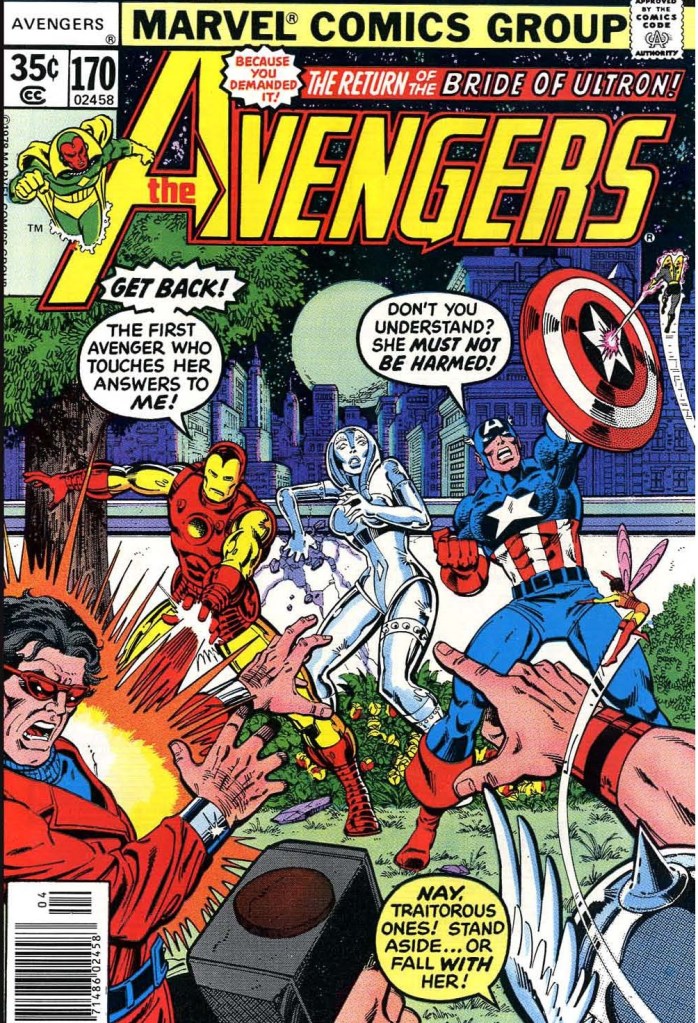
What brought me back was this issue, #170 and its follow-up, #171, both of which I bought at the same time. it turned out that I hadn’t even missed any story, as the issue in-between, #169, had been an emergency fill-in. Like so many Marvel titles of this period, AVENGERS was suffering from production problems. Anyway, this two-part battle against Ultron sealed the deal, and I became a regular AVENGERS reader moving forward.
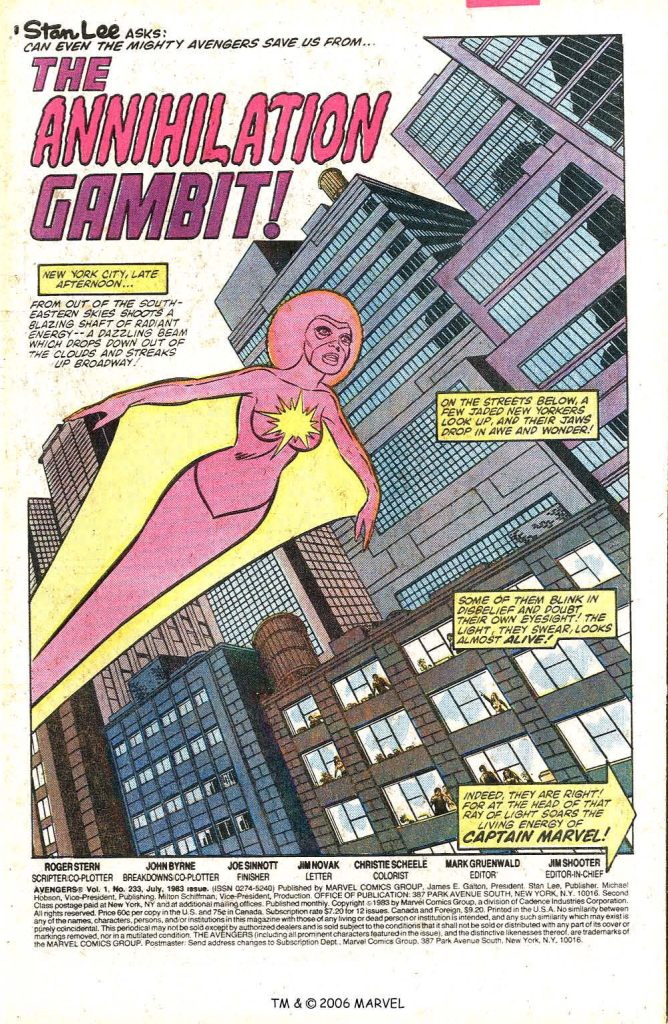
But as I mentioned at the top, the bloom was definitely off the rose by the time issue #233 came out. and a lot of it had to do with the manner in which returning writer Jim Shooter was characterizing the members of the team. In fairness to Jim, he was attempting to give them each the foibles and feet of clay that the early Stan Lee characters possessed, but he was a bit ham-fisted in his approach to this matter, and so instead the Avengers universally came across as egomaniacal jerks who couldn’t be bothered to help their teammates or to provide understanding in combat situations. I recently reread this run in MARVEL MASTERWORKS form, and my opinion remains largely unchanged. These were not good issues of the series.
Much of this run up to this point concerned the corruption of Yellowjacket. Having just lived through the Death of Phoenix and the way in which that story went awry in his opinion, Shooter set out to show his writers how it was done. His target was Hank Pym, a founding Avenger who hadn’t been able to hold his own series in years, and who had experienced a couple of mental breakdowns in the past. Shooter’s objective was to apply pressure to Yellowjacket and then permanently turn him into a villain. But again here, this played itself out in the most ham-handed way–including the moment that Jim has spent four decades running from in which Yellowjacket backhands his wife, the Wasp.
Part of the problem, too, was that Shooter was increasingly busy in his editor in chief duties–so much so that AVENGERS became later and later and later. Other writers were called in to script over Shooter’s plots, then to do fill-in stories of their own devising to help catch up the schedule. But eventually, it became apparent that Jim simply couldn’t handle the book on top of his existing workload. Enter Roger Stern, whom Shooter picked as his successor on the title. Roger came in intent on restoring Hank Pym’s honor, and he largely managed that over the course of three issues before writing Yellowjacket out of the series completely. I liked Stern’s first foray into the book a great deal, as it put right what had been going wrong–Roger’s Avengers were heroic and had empathy and got along well despite any differences. Roger also brought in the new Captain Marvel that he’d created in an AMAZING SPIDER-MAN Annual as new blood for the team.
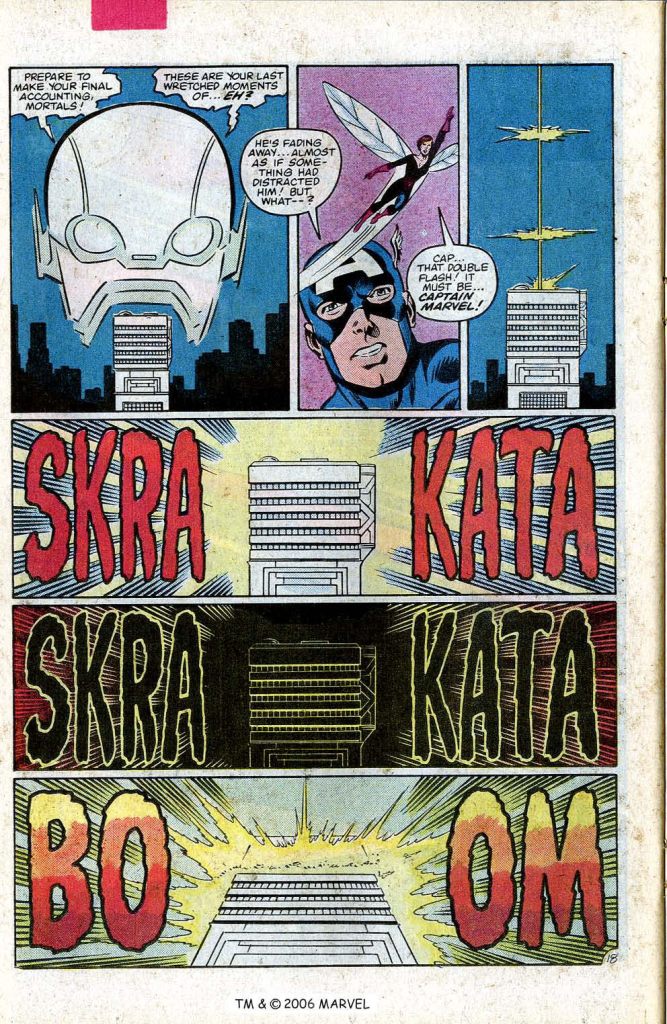
But very quickly, things began to slide again. AVENGERS had been saddled with not great artwork for a while by that time, apart from a couple of rare exceptions. This was when Shooter was in the midst of his insistence on medium, full-figure shots and diagram-like storytelling, which robbed a lot of sequences of their power. Joe Sinnott, displaced from FANTASTIC FOUR when John Byrne took over that title, was brought on to give everything a slick finish, but even he could only do so much with what was there. The book didn’t look bad, but it did feel tired and plastic and lifeless. I found that I simply wasn’t digging it any longer.
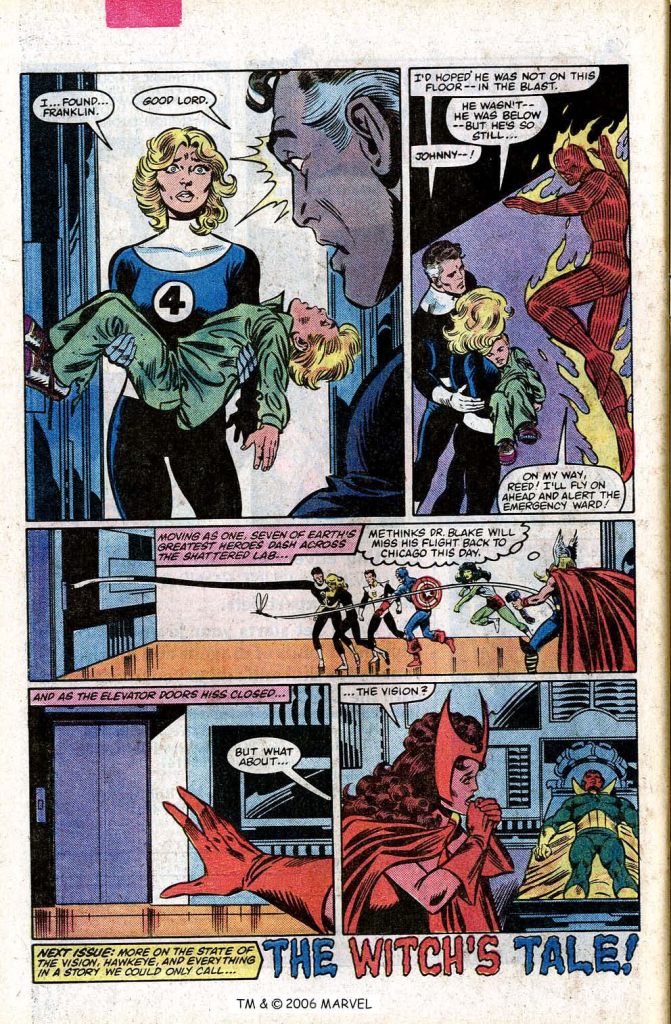
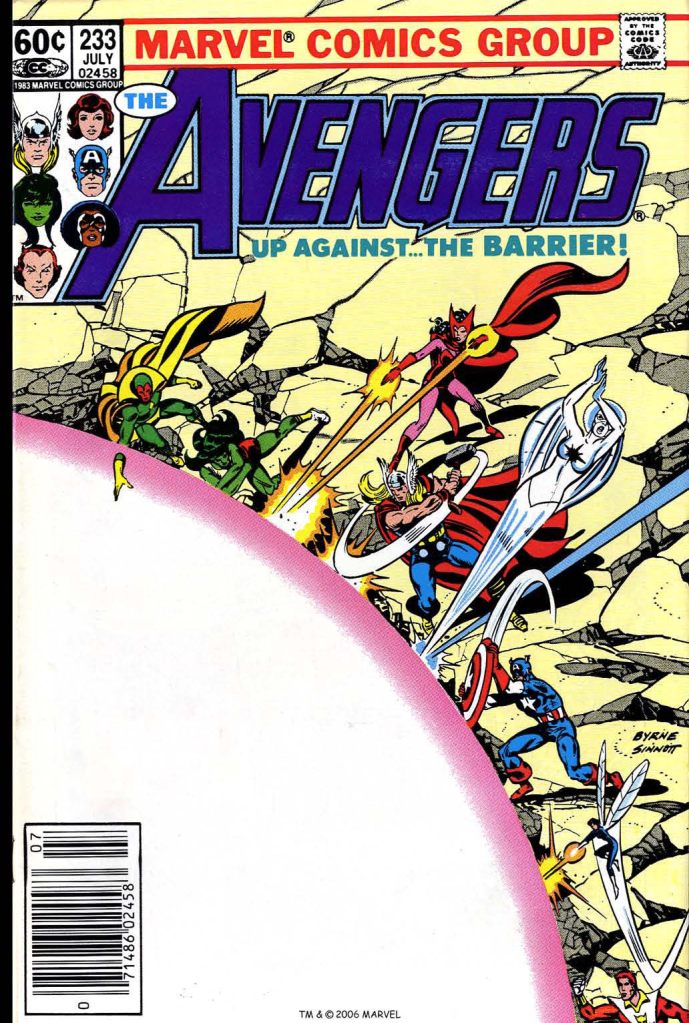
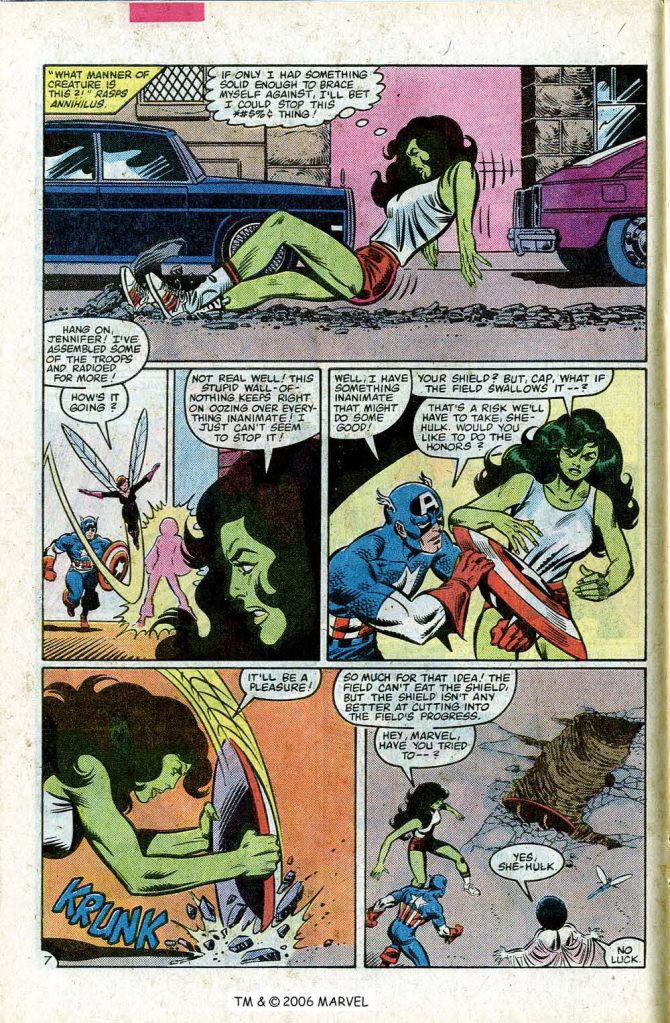
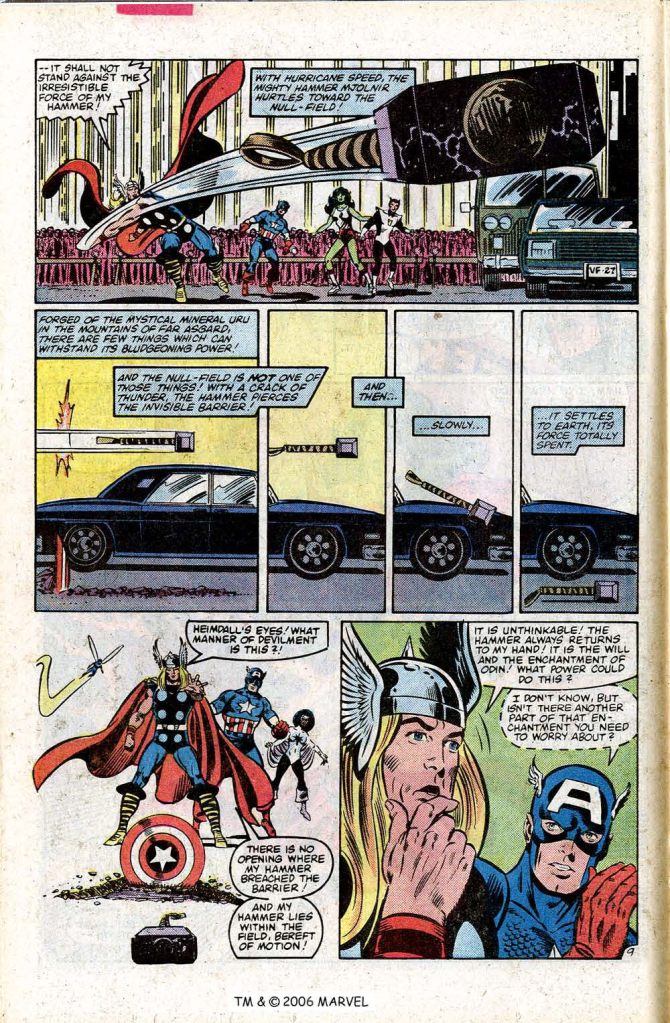
This final issue, #233, was the final straw. it was a part of a small crossover with FANTASTIC FOUR, in which John Byrne had been building up a storyline in which Annihilus had taken over the Baxter Building while the FF were stuck in the Negative Zone. This issue tells a Rashomon-like version of the same events as FANTASTIC FOUR #256, but from the point of view of the Avengers, who are on Earth. It’s a fun trick–but as all of the plot was being carried by FANTASTIC FOUR, the Avengers spend most of this issue trying to penetrate an invisible null-field that is expanding outward from the Baxter Building. A cool idea, but hardly breathless stuff. When Captain Marvel is eventually able to pierce the barrier by transforming herself into hard radiation and hurling herself at it from space, this coincides with the moment when the FF solve the problem from within the Negative Zone, so the whole involvement f the Avengers seems superfluous. This felt like empty calories to me, for all that it was fun (and for all that Byrne himself turned up to do breakdowns on this issue, repurposing a couple of pages from the contemporaneous FF issue.
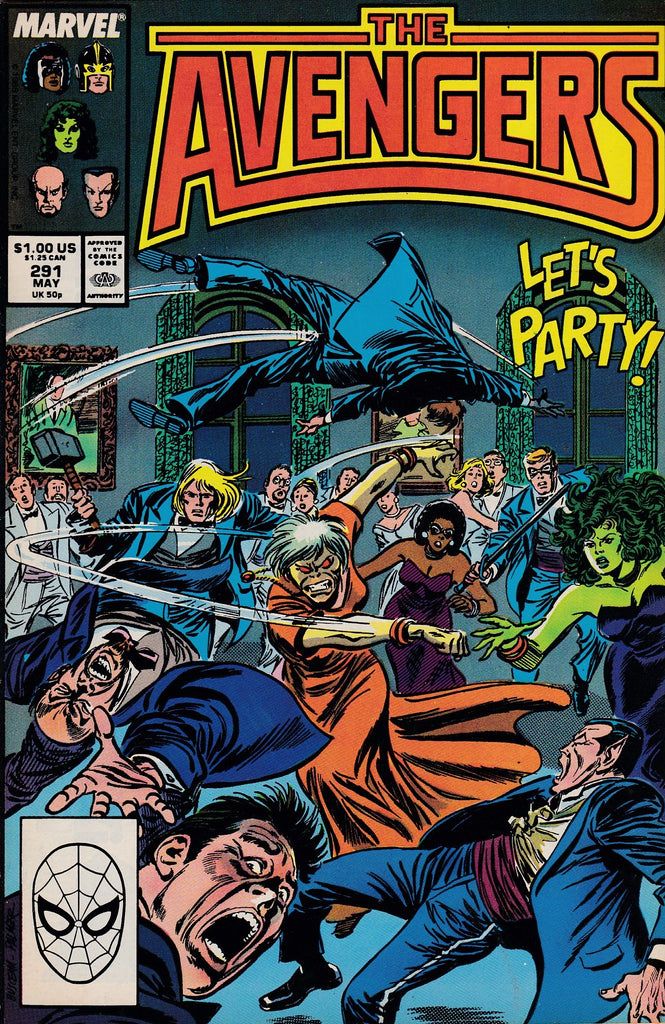
I did check in once or twice after this, though. I came back for #236-237 in which Spider-Man attempted to join the team, a situation that made me curious. And a few years later, I also dropped in for #267-269, the first reappearance of the Avengers’ ultimate foe Kang the Conqueror since he’d been obliterated by Steve Englehart towards the end of his run some 100 issues earlier. those stories were solid, but they still evidenced the clinical feeling that pushed me away. No, what brought me back as a reader was #291, and specifically the new series writer; Walt Simonson. I had come to Walter’s THOR extremely late, with his second-to-last issue, but I had hungrily hunted down all of the back issues and was a huge devotee of his work. So him doing AVENGERS seemed like a smart play. But again here, something wasn’t quite right still. I enjoyed the book well enough, but it never quite hit the same heights as Walt’s THOR series. perhaps that was because he didn’t draw AVENGERS himself. But just slightly more than a year from this point, I came onto staff as Marvel as an intern, and began to receive a bundle of Marvel books as comps every week, so I was back as a regular reader regardless of how much I did or didn’t like what was going on.
And of course, I had no idea during any of this time that Avengers Mansion would prove to be my home for 26 years in the days to come.


It should be noted that Avengers was one of Marvel’s top five sellers among ongoing titles throughout the early-1980s Shooter period so reviled here. Better than any ongoing series from DC with the possible exception of New Teen Titans, and I suspect it outsold NTT. Average monthly sales for Avengers throughout this period was over 220,000 copies per issue.
LikeLike
*This message brought to you by the Concerned Citizens for Jim Shooter. 😉
LikeLiked by 2 people
I came into the Avengers about this same time, with #238 after having read some excellent Thomas/Buscema issues in the #60s. Needless to say it was quite the letdown but I stuck with it, eventually collection the entire run save for #1.
LikeLiked by 2 people
I came into the Avengers about this same time, with #238 after having read some excellent Thomas/Buscema issues in the #60s. Needless to say it was quite the letdown but I stuck with it, eventually collected the entire run save for #1.
LikeLike
Shooter’s run soured me on the book. I did come back for a lot of Stern’s. He probably gave Hank’s insanity the best summing up: “It takes a strong man to shrink to ant size and not crack up … I was never that strong.”
Shooter did better with a story from his first run where Ultron wipes Pym’s memory of much of his career and Jan explains at one point how Hank had already been snapping from various pressures. Way more plausible than the later run.
Having dropped the book, I came back when Simonson was on it. It disappointed me too.
LikeLiked by 1 person
I couldn’t understand why the Avengers had become jerks either. Especially Captain America. Shooter had some good plot ideas overall though. The art was also very spotty, and it’s too bad because that period of Avengers has some of the my favorite stories. But at the same time, some of my least favorite. I think the new Captain Marvel might’ve taken me a minute to warm up to, probably because I had no idea who she was. But I think she was an amazing addition to the team. Much better than others like Black Knight, Dr. Druid, and Starfox!
LikeLiked by 1 person
CM (Monica), Cap (Steve), and then Avengers leader Wasp (Jan) all had a strong, stable rapport with each other, a solid foundation for the team with which to build on with other members. I really liked how Stern wrote Cap. He still led by example, but always deferred to Jan’s elected position of leader, even when directly asked questions by others in and outside the team. Cap was also the only member then that had his own solo title, so I understand the other characters were given more room for drama.
Stern also wrote Jan really well, at her most capable and decisive. She might be my fave Avengers’ team leader. But her frictions with both Herc and Dane (Black Knight) after #255 caused serious tensions that were later exploited by Baron Zemo during the “Siege” arc. Herc resented her being leader and giving him orders, and right or wrong, she became impatient and resentful of his behavior towards her. Dane’s crush on Jan impaired his performance on the team. He was distracted, and often unprofessional with her. She was also a bit ambiguous with him until it was too late, after his inability to deal with his frustrations already manifested.
It all added up to an explosive chemistry that helped give us some compelling characterizations and interactions. Seems like Tom missed out on the stretch of 30+ issues of Avengers that I really liked.
LikeLike
Avengers#233 is the second time an expanding energy field originated from the Baxter Building, the first was in Fantastic Four Annual#14 ( 1979 ) do to Nicolas Scratch. Well looking at the covers ( just checked comics.org ) apparently I stuck around, but I know I didn’t enjoy the art after Perez left nor a number of the plots.
LikeLiked by 1 person
I lasted longer than you but when I left, it was more final. It took you and Bendis to get me back for a time but since I’ve been spotty in what I return for. The Jed McCay stuff has been phenomenal though and I’m hoping he works on some X-Projects in the future. Black Cat by him surprised me when I realized it was one of my top five books of he year it debuted.
LikeLiked by 1 person
What Bendis achieved,l, w/ some of those amazing artists, still stands as my fave Avengers period.
I disliked some characterizations in the “Disassembled” arc. I didn’t like everything & everyone in his stories throughout. But there were several great moments that enhanced Avengers history.
I also really liked the text pages of interviews with the individual members.
LikeLiked by 1 person
Tom, I don’t remember the Defenders’ Nighthawk in Avengers # 168. We got a glimpse of Dr. Strange. And Captain Mar-Vell. Even what seems an oddball cameo by the 2-Gun Kid. I guess he’d been guesting in the series around that. Famous cover, I think I’d seen it in ads. When will we see Henry Cavill wearing Wonder Man’s red safari/leisure jacket? ;-) Some of George’s faces & figures look pretty much like in his 1980’s heydays. Others don’t resemble his later peak work as much. The facial profiles look similar to Starlin’s work. And the Beast in particular looks as if George was channeling Jim. The elongated arms & torso, the extra space between the nose & mouth. The team’s hair-trigger infighting was a bit much.
I had reprints of some of Roy Thomas & J.Buscema’s run, & I liked it, but this was in the 1970’s, & I was under 10 yrs old. Loved J.Buscema’s work then, & ever since. I didn’t like the look of the book in the early 80’s, when I could start to buy comics on my own. Was it Milgrom & Sinnott? It just looked stale. I have a better appreciation for Joe Sinnott since, especially over certain artists’ work more than others’. I’d stumbled on Stern, Hall, Breeding’s “West Coast Avengers” 4-issue mini, & was hooked. Hall quickly became a new fave for me. I’d also been following O’Neil & McDonnell’s Iron-Man for a couple of years. And Bob Harras & Luke’s Iron-Man # 7 really impressed me.
That kept me checking on the Avengers main book to see if the visuals improved enough to jump on. I did get a Annual around that time, by Stern, Ditko, & w/ finishes by Byrne. I liked it. And then I saw Bob Hall was on Avengers # 254, so I bought it, & liked it. “Ultimate Vision”, 16 years before Jemas & Quesada’s Ultimate line. And then, w/ # 255, J.Buscema made a triumphant return to the book, along w/ Tom Palmer. I do wish John had done full drawing each issue, rather than breakdowns or layouts on most of them. At times some figures & finishes looked sloppy. But overall, I was just glad he was on the book, & gave the characters some strong inherent qualities. Then when “West Coast” went monthly, I think they brought in the same clucky art that kept me off the “main” Avengers book. Fell far short of Hall & Breeding.
Roger Stern did a great job of balancing the Avengers’ personalities during that time. Tom skipped out on what was to be my fave team book run, until Morrisson’s JLA. I disliked Starfox, & mostly for his costume, & hair style, & was glad to see him go. Getting Namor on the team was a real bonus. He’d been an early Marvel fave of mine for the 8 or 9 years I’d been reading comics by then. But the core for me was Jan’s Wasp, Steve Rogers’ Cap (have to clarify these days. due to redundancies), & CM Monica Rambeau. They were the triangular base the team rested on.
Roger made me like Janet Van Dyne. I’d never really considered her much. He made her a smart, decisive leader. Kurt Busiek echoed that over a decade later. I thought both Janet & Monica suffered in those long years in between Roger & Kurt’s separate runs. Roger also wrote one of the best Caps. He wasn’t hair triggered like other writers made him act. He wasn’t stale & talked liked an outdated old man. Roger kept Steve’s “Greatest Generation” experience, but his Cap was open minded & forward thinking. He believed in the best that American Values could promise. And I loved how he reinforced Wasp’s leadership, when an outsider or even a teammate would ask Cap for his opinion or decision, he’d be quick to remind everyone that the Wasp had final say.
Monica was also supportive, & likely the most powerful member then. She was also smart, brave, & had been a police lieutenant. And representation matters. We didn’t give it its due back then. I liked how Roger portrayed her, & I HATED what happened to her after Roger left. Oh man, Mark & Ralph are likely very fortunate there wasn’t the immediacy of the internet then. I imagine they were mostly insulated from most fans’ feedback. I personally ever wrote a handful of letter to comics editors, but none to Marvel. Too busy being a kid. But Monica was a gave. I think I liked her much later Spectrum name the best, out of all the names Marvel gave her. Her most ecent soolo series was a letdown. I hardly recognized her characterization. If the 1980’s Avengers were more reflective of NYC back then, we’d have had Luke Cage join much earlier than he wound up signing on (thanks Brian Michael Bendis!). And Dr. (then Brother) Voodoo.
So on top of the stability that the mutual respect, competency, & friendship of Jan, Steve, & Monica brought to the team, were the time bombs of Hercules & the Black Knight. Dane Whitman wouldn’t have been my 1st choice to (re)join. But he supplied the necessary, & useful scientist role the team really, & historically, benefits from. But his crush on Jan really hindered some of his choices. It was interesting. I felt for the guy, but, it was what it was. Herc, oh, man. Comedic relief, yes. High level power, sure. I disliked him played as a buffoon, a caricature. This is 1 of the greatest fantasy heroes of all time. Or at least based on it. His growing frustration w/ the Wasp, & honestly, her sometimes baiting him, just to prove a point; & then his frenemy status w/ Namor made for many compelling interactions. Herc & Namor would’ve fit right in as World Tag-Team Champions in the 1980’s WWF pro-wrestling, where the 2 would fight each other almost as often as their opponents.
The issue Tom returned as a reader, # 291, was during a real low point for me. The series was hurting w/ Roger’s departure. Neither Ralph Macchio, or Mark Gruenwald, or even recent assistant Howard Mackie could save it for me. It kept getting worse. I had been a big Walt Simonson fan by then, because of his Thor Run, & his famous Dr. Fate special for DC. I knew he was great. But man, his Avengers run was a dud for me. I bailed after # 301. Half the FF on the team, still wearing their FF uniforms. It might’ve sparked some interested to see Reed & Sue in independent suits, more personally expressive, even different colors from each others’. I don’t know if it was due to editorial input. His later FF run was a blast. But Avengers just had dark clouds hovering over it after Roger left. And what they did to Marina was also really a bummer. Why’d they engineer Namor leaving? Of course he’d follow Marina. But why did it even have to happen, devolving into a monster? Ugh.
It wouldn’t get sunny enough for me to return to the Avengers until Kurt came on in 1998. I’d check in, periodically. Gilgamesh w/ his dopey bull helmet. Quasar’s mullet. Rage, in his dated biker garb & luchador mask. But the Tom Palmer look didn’t work as well w/ Hugh Haynes or Paul Ryan. It was better over Steve Epting (some very nice looking issues by Steve). But the writing was DISMAL. Byrne, Harras, others. And the friggin’ team jackets. The Black Knight wearing chain mail, (probably over something else, to protect his bare skin), then a tunic, and then a friggin’ leather jacket. Please. At least the vision didn’t wear one. Jeez.
LikeLiked by 2 people
“And what they did to Marina was also really a bummer. Why’d they engineer Namor leaving? Of course he’d follow Marina. But why did it even have to happen, devolving into a monster? Ugh.”
The REALLY annoying thing about Marrina’s stupid turns-into-a-monster death is that Roger Stern had started to set up a story to write her out with a happy ending – a two-panel interlude with Dan Smallwood, the guy who she clearly was meant to be with all along, in #287. Which was then completely ignored in favour of just killing her off. It still infuriates me whenever I see it mentioned…
LikeLiked by 2 people
Wow. I didn’t know. That stinks. Was Smallwood a character from her Alpha Flight days?
Her Dialog in those Avengers issues was a bit stiff. Different from what I remember from Alpha Flight, though I only read a few issues.
It just seemed like Stern had put in a highpoint run, & then it was just dismantled with little respect for its fans.
LikeLiked by 1 person
Dan Smallwood is part of Marrina’s origin story, from John Byrne’s Alpha Flight. Marrina was raised by Dan’s grandparents and they grew up together. Dan was in love with her, she was oblivious. When she went off with Namor, poor Dan was heartbroken.
It was clearly a back door to remove Marrina when Namor next got his own series, but it didn’t get used!
LikeLiked by 2 people
@zoomy Thanks! I was totally unaware of Dan & Marina’s history. Stern’s idea of their meeting again would’ve been better than what was done to her.
LikeLike
LikeLike
I caught the last issue of the Korvac saga after having left the title late in Steve Englehart’s run. My impression of Jim Shooter at the time was that he had a lot of big concepts as a plotter but a tin ear for dialogue.
LikeLiked by 1 person
IMO Shooter could do decent dialogue as long as he didn’t have to worry about characterization. His dialogue for his LEGION stories were snappy and often leavened with humor, but nearly all of the characters were interchangeable in terms of what one had to know about backstories, attitudes, etc. The tinniness of the ear is never worse than SECRET WARS, where he was completely unable to adjust himself to the demands of the spoken tone of individuals’ dialogue. At least in AVENGERS one can see him struggling to cope with individual characterization, though with what Tom correctly calls “ham-fisted” results.
LikeLiked by 1 person
speaking if tinny, I still love the Hulk’s angry thought reaction to one of Cap’s succinct orders in “Secret Wars”. Something like, “Don’t tell at me, you star-spangled tin tyrant! I’ll rip you in half!”. I liked the alliteration, but yikes…
LikeLiked by 1 person
I may as well add that if Shooter didn’t like a character– Yellowjacket, Ms Marvel– he often took the most expeditious route to get rid of that character, perhaps convinced that such action would help the book’s sales. What often happened– and this applied to anyone, not just Shooter– is that a “surgical strike” alienates those readers who had built a contrary liking for that character. I still think of Gwen Stacy’s death as such a strike, and after it happened I never again bought a brand-new issue of Spider-Man in silent protest. There are better ways to sideline a character who’s going nowhere– which I think you could argue re: Gwen– than just knocking them off or disgracing them in some way. (Which is not to say that those things should NEVER happen..)
LikeLiked by 1 person
“Civil War 2” sabotaged Carol Danvers for me. “Civil War” did the same for Tony Stark, too. Though Bendis still did good stuff with him in his Avengers.
LikeLike
Sales arguments against Jim Shooter, particularly during his EiC period at Marvel, are fatuous. It’s like arguing Patrick Mahomes isn’t a good quarterback, or that Andy Reid isn’t a good football coach. Sales at Marvel increased steadily during his tenure, and his last year was the best one. Did Shooter always call it right? No. But he had a better record–a much better record–for calling it right, at least in terms of sales, than anyone else in a similar position in comics over the last 50 years. These comics were meant for middle-school-aged boys. If you’re older than that, and the new superhero comics don’t appeal to you, it’s most likely not about the comics. It’s that your tastes have moved on. Go with it, and quit getting mad at comics that aren’t meant for you not appealing to you anymore.
LikeLike
Agree with RS that as long as sales stay good, a given editor/raconteur must be doing something right that keeps a majority of buyers on board.
But it’s hard to quantify what the something is. Shooter might have kept the same sales level on Avengers even if he had not railroaded Yellowjacket and Ms Marvel out of the group. His focus on an unexciting, basic level of storytelling might be exactly what the readers at a certain time wanted.
So we can only be absolutely sure that bad decisions have consequences when they reach some critical mass, and it’s largely testified that a lot of readers jumped ship because of those bad decisions– the Spider-Clone business, going purely on what other critics have said about its failure.
LikeLiked by 2 people
The Spider-Clone storyline reflected a very different sales situation. The sales-year before the storyline, average per-issue sales of Amazing Spider-Man were 353,025. The first year of it, api sales of ASM were 234,290. The second year of it, api sales of ASM were 216,779.
SALES WENT DOWN.
That’s not what happened with the early-1980s Avengers, where sales not only held steady, but they actually went up.
LikeLike
I love Perez’s work in general but the cover to Avengers #170 has always bothered my eye due to the awkward juxtaposition of Ironman, Jocasta, and Cap’s legs. Her left leg is in the flower garden but it looks like it just disappears behind Ironman’s. A very small chunk of her right foot can be seen, but it so closely follows the line of Cap’s boot cuff that it reads like a coloring mistake. At a glance it looks like her lower legs were simply forgotten.
I suspect that her right leg was originally fully drawn and this was a fix since there’s a lot of stuff going on in the foreground. The rock on the ground looks like it could almost be where her right foot was supposed to go. It’s even the right size.
Cover complaints aside… this was a great issue.
LikeLiked by 1 person
Tom, you’re a better man than I am (or was). I stopped reading The Avengers shortly after issue #200 for the very same reasons you mentioned. When I began reading the book at issue #126, there were so many great writers and artists (with the exception of the all too frequent reprint or fill in issue!).
I was still buying comics so I’d still check out and flip through each new issue and just sadly shake my head, longing for the days of superior art and stories.
Also agree about the lifeless, stiff art. I love Sinnott’s work on a talented artist like Kirby or Perez, but on a lesser artist, there wasn’t much he could do to improve the work. I stopped buying The Defenders for the very same reason. His inking over Don Perlin’s art was, unfortunately, lifeless.
LikeLiked by 1 person
RS, I wasn’t saying the Spider-Clone disaster was the same as the Shooter Avengers. I was saying that was an example where everyone could see that a particular drastic change definitely DID affect sales. In the case of Avengers, since the sales remained good, we don’t know if the drastic changes re Yellowjacket and Ms. Marvel made any difference or not. Either event might have lost some readers, but clearly not enough to change the overall level of sales. I still think a writer who wants to be rid of a character can come up with better ways to do so than Shooter did in those two cases, but that’s a subjective opinion only.
LikeLiked by 1 person
The first issue I read was no. 139 (Yellowjacket vs. Whirlwind), but the first issue I bought (from 7-11) was no. 171. I liked what we now call the “Korvac saga,” for reasons I can’t always identify, and of course Avengers annual no. 7. I also read the Fireside and Pocket Books reprints, Marvel Triple / super Action, etc. For me the glory days ended with Byrne. There were some good eras after that, of course, but they were *different* eras. My tastes can be wildly out-lying—e.g. I liked Timeslide, Heroes Reborn, Deathcry, and Wonder Man’s second costume. Working on a book about all this, oddly enough (on the *meaning* of the Avengers).
Question: I dimly recall that some writer wanted to do a story explaining the Scarlet Witch’s probability- altering powers in terms of parallel universes, but this got nixed by editors. Anybody remember who this was? This is impossible to Google!
LikeLike
Ah, never mind–it was Byrne.
LikeLike
Just today I finished reread Avengers 1-254 via Masterworks and while the first 150 issues was a pleasure cruise, the next 100 or so was some very rough sledding! There were some highs but the lows were so very low! Ending with 2 years of Milgrom/Sinnott art didn’t make the landing any easier. However, it did serve to reinforce my decision not to order Avengers West Coast Masterworks V1. 😉
LikeLiked by 1 person
Milgrom/Sinnott kept me off the Avengers. # 254 drawn by Bob Hall was my first issue back. J.Buscema & Tom Palmer returned w/ # 255. I stayed until a handful of issues after writer Roger Stern left.
Milgrom/Sinnott kept me off the West Coast book, too. I loved the 4-issue miniseries by Stern, Hall, & Breeding. Seeing the same art on the WCA ongoing monthly that kept me of the Avengers was areal disappointment.
LikeLike
I have no real excuse for why I stuck through it or why I also followed them onto WCA. Both Stern and Engelhart wrote some good stuff but that art dragged it all down and even rereading now with a jaundiced eye the words still fail to rise above the art.
LikeLiked by 1 person
I was never turned off by Milgrom (though Sinnott did no one any favors in later years) but I never bought anything because of him. Him, Hannigan, and Pollard were my mid-range artists. There are more but those are just off the top of my head.
LikeLiked by 1 person
@Steve, I’d put Pollard in my top 1/3 of artists, all-time. Above Trimpe, Perlin, Milgrom, Ron Wilson, Greg LaRoque, even above capable & distinguished Sal Buscema. Above a bigger name like Starlin. Even above competent & dynamic Kerry Gammill. With a good inker, Pollard’s work was often really satisfying.
LikeLiked by 1 person
Joe Sinnott, displaced from FANTASTIC FOUR when John Byrne took over that title, was brought on to give everything a slick finish, but even he could only do so much with what was there.
When Captain Marvel is eventually able to pierce the barrier by transforming herself into hard radiation and hurling herself at it from space, this coincides with the moment when the FF solve the problem from within the Negative Zone, so the whole involvement f the Avengers seems superfluous.
This is the first anti-Stern Avengers blog I’ve read. You left as it got good and Buscema returned. Al Milgrom gets a lot of flack, but he does a great Spider-Man and great cosmic stuff. And too much defense for Shooter’s bad run. Shooter was trying to do the Dark Phoenix right, but making Hank Pym go evil which wentagainst the stories a year earlier where Hank was well adjusted to being a reserve Avenger and madly in love with Jan.
LikeLike
And does anyone buy that the artist is to blame for The Slap and the editor in chief couldn’t hav eit fixed?
LikeLike