

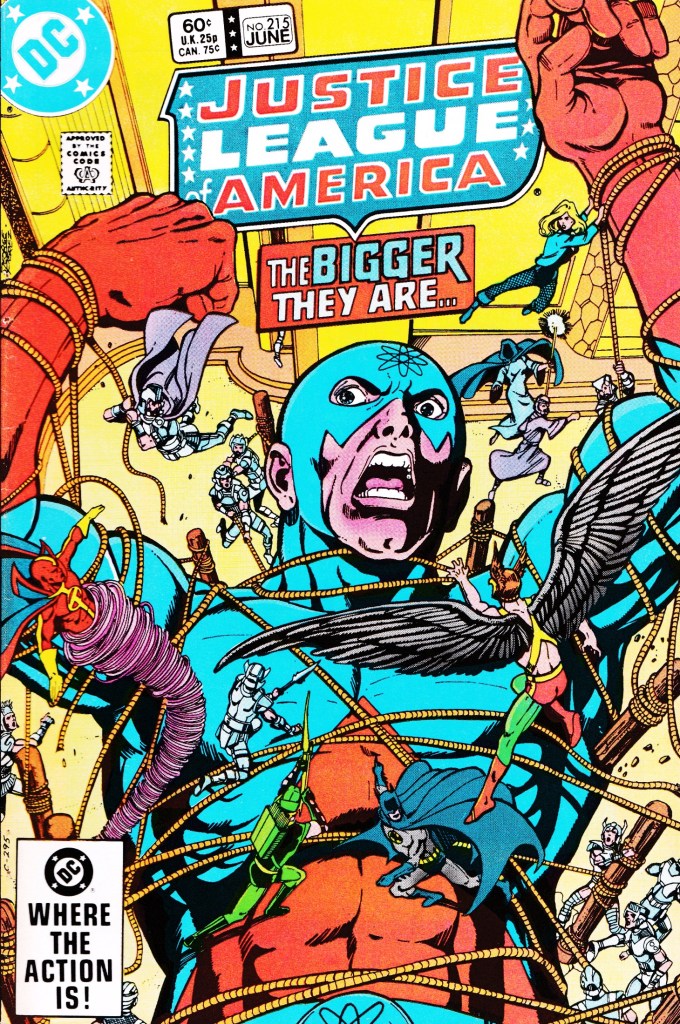
JUSTICE LEAGUE OF AMERICA had been one of my favorite comic books when I was younger. It was one of only three series to which I ever maintained a subscription to insure that I didn’t miss an issue. But by 1982, the book was feeling tired and a bit stale. Writer Gerry Conway had been in place for more than sixty issues, and one got the feeling that his heart wasn’t in the assignment to the same degree it had once been. But the real drag, from my standpoint, was the art. There had been a brief moment there where George Perez had been illustrating the book, and he continued to provide covers such as the one above for a long time. But the interior work was being done by Don Heck. Heck was a solid craftsman whose best work wasn’t in the super hero genre, but that’s where the business was and so that’s what he did a lot of. His JLA isn’t terrible, but it does feel a bit like a throwback to an earlier era. Especially as compared to the best Marvel books of this period, JUSTICE LEAGUE OF AMERICA was lagging.
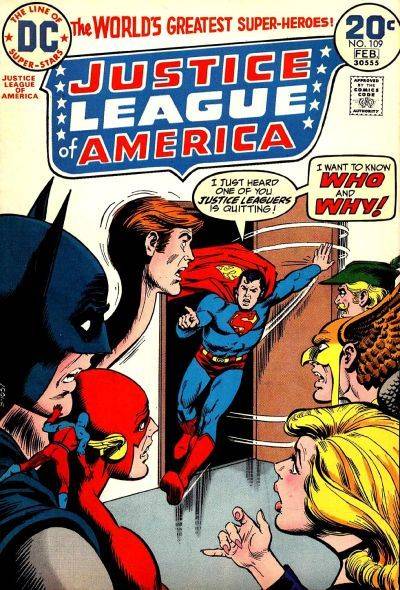
The first issue of JUSTICE LEAGUE OF AMERICA that I had read was this one, #109, and it completely knocked my socks off. It was in the midst of a very good, overlooked run by writer Len Wein. Unflappable artist Dick Dillin was in place, as he had been and would be for many years, but here he was often being inked by Dick Giordano, who raised his work up. While I had some difficulty in being able to get every issue as my access to comic book racks was limited at six years old, this was a comic I bought whenever a new issue was available to me. By #121, I had a subscription, which I maintained for many years, through #153 I think, But I continued to follow it month after month even beyond that, for another fifty-plus issues.
DC at this time was at the very beginnings of a cultural shift, one that would find fruition in CRISIS ON INFINITE EARTHS and its aftermath. Basically, it had begun to tailor its output to the burgeoning Direct Sales market of comic book specialty stores rather than mainstream candy store racks. This shift was gradual, it didn’t happen all at once. But it did mean that there were suddenly a lot of exciting new and refurbished DC titles, many of them produced by expat Marvel talent: NEW TEEN TITANS, ALL-STAR SQUADRON, ARAK, Marv Wolfman’s GREEN LANTERN and OMEGA MEN which grew out of it, LEGION OF SUPER HEROES under Levitz and Giffen, CAMELOT 3000, even weird things like SWORD OF THE ATOM (which came out shortly after this issue of JLA) and so forth. But this had the side effect of making the DC books that carried along in their traditional way feel less engaging by contrast. So SUPERMAN and ACTION COMICS and, yes, JUSTICE LEAGUE OF AMERICA suffered by contrast.
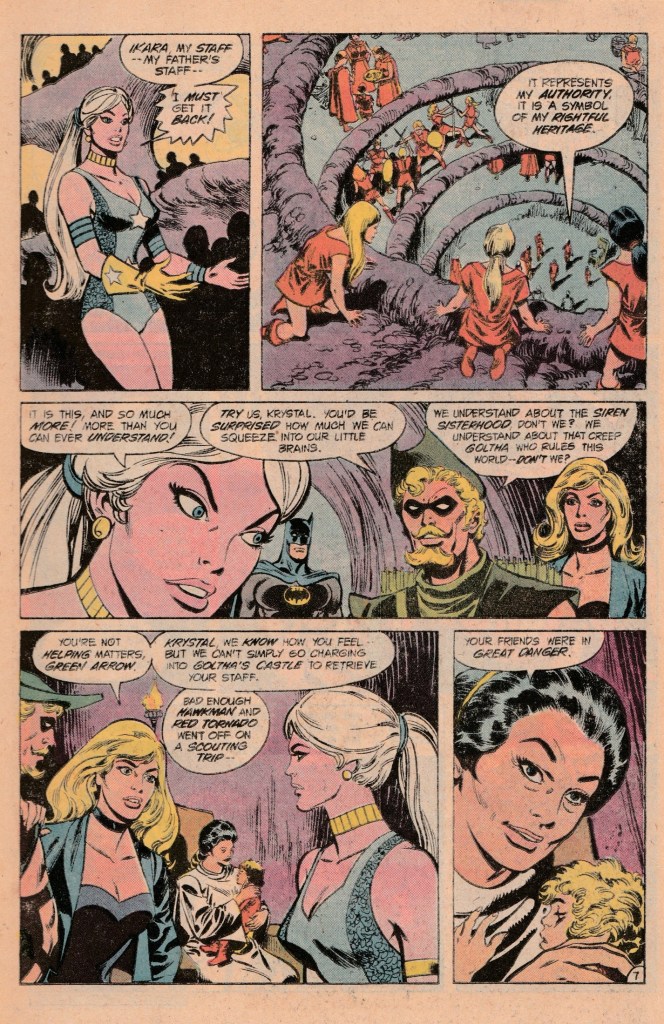
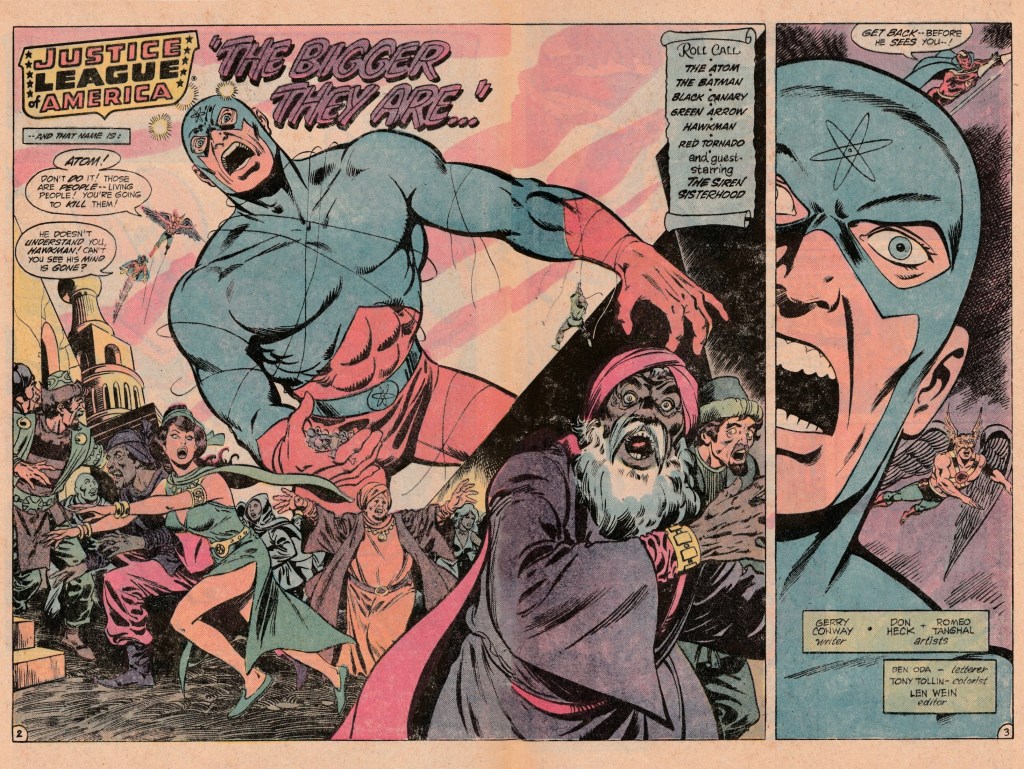
It became a bit of a thing to tear down the work of Don Heck past a certain point–fandom can be mercurial and certainly cruel. But he had some definite chops, some of which he wasn’t often in a position to show off to best effect. But I can only tell you what I thought of his work at DC at this time. And the truth is, I didn’t like it. Don shifted to JUSTICE LEAGUE from FLASH when Carmine Infantino returned to that series. I hadn’t really liked Don’s FLASH, though I suspect he was more comfortable on that series than he was on JLA. I can see why putting him on the League made sense, given his years penciling early AVENGERS stories. But time and the tastes of the audience had moved on since then, and fans wanted a more modern, more detailed and more kinetic approach to their super-team titles by the early 1980s, myself included.
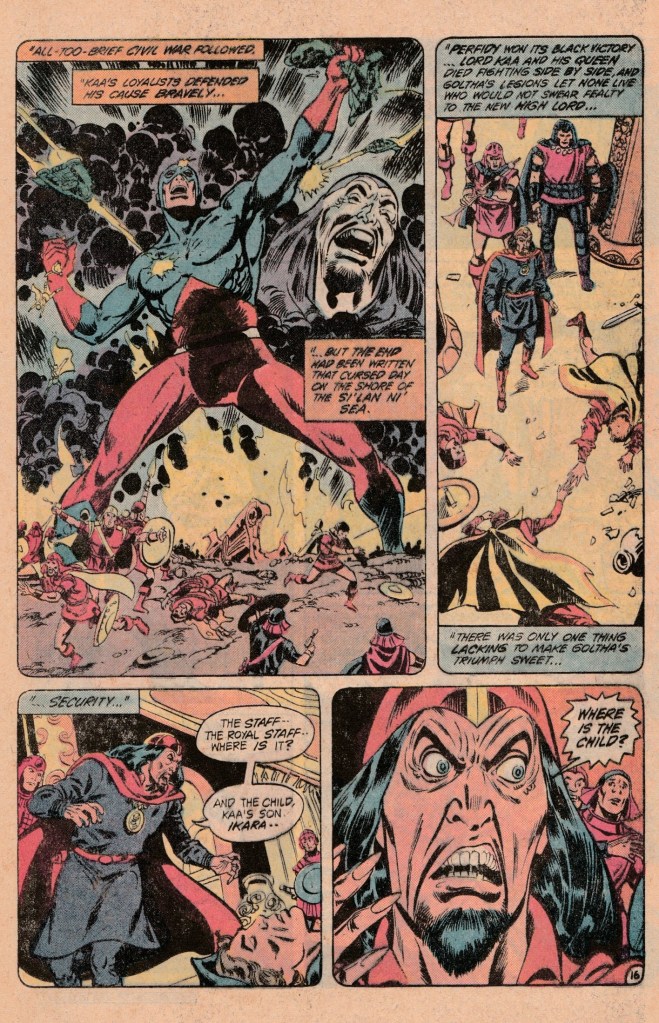
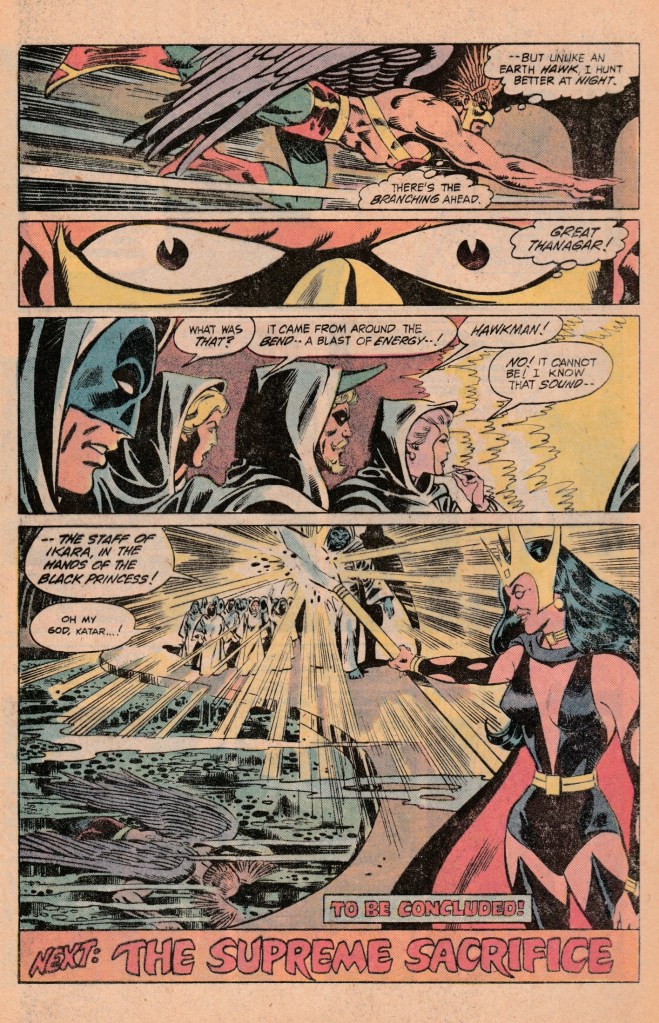
Still, a love for the Justice League had been ingrained in my from almost the beginning of my comic book buying life, and so I kept on picking up issues, hoping that the material would improve. And there were enough solid outings along the way to keep me going, to keep me hanging on. But once it became apparent that I needed to curtail my buying habits and that I could no longer afford all of the titles I was picking up every month, leaving JUSTICE LEAGUE OF AMERICA behind wasn’t a difficult decision. #215, seen here, was my last issue purchased. It felt very much like casting aside a thing from my youth that I had outgrown.
I did have a bit of an Indian Summer with the book, though, as a year or two later, I was compelled to check out JUSTICE LEAGUE OF AMERICA ANNUAL #2 and the formation of what had become known over the years as Justice League Detroit. This was a well-intentioned attempt to rework a concept that was seen by many as slowly dying into something more akin to both Marvel’s AVENGERS and DC’s NEW TEEN TITANS. All of the big characters were out, and under the leadership of Aquaman, Zatanna, the Elongated Man and the Martian Manhunter, a bizarre crew of second-stringers if ever there was one, were joined by a quartet of newcomers: Vixen (who had been meant to be a headliner with her own series before the DC Implosion killed those plans), Steel (based on an earlier short-lived hero similarly squashed by the DC Implosion), and the unfortunate Gypsy and Vibe, neither of whom have aged terribly well.
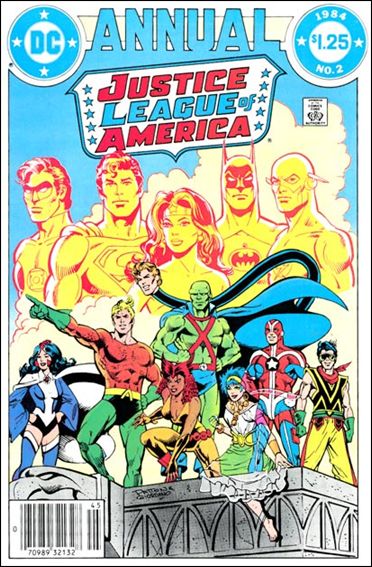
I have to confess, maybe it was the excitement of the era in terms of DC’s advancement, but I was immediately enthralled by this new concept, and I started following the series again. In large part, i think, this was driven by the fact that I quite liked the artwork of Chuck Patton, who was the title’s regular artist. But that didn’t last for very long, and the concept of the series began to rattle, especially once both Conway and Patton left the book. I did the same around then, right after the crossover with INFINITY INC. that comprised the final Earth-One/Earth-Two crossover. But knowing that change was in the offing, I did come back for the book’s final four issues, in which the newcomer characters were mostly brutally killed off in order to wipe the slate clean for what promised to be a more classic iteration of the team that would launch out of the LEGENDS crossover.
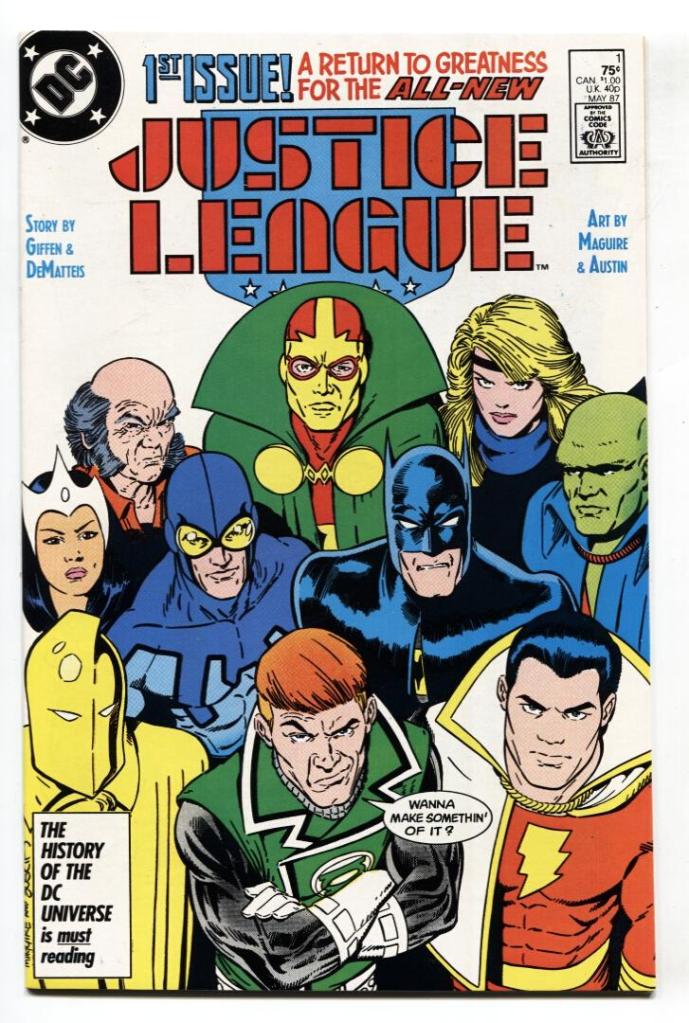
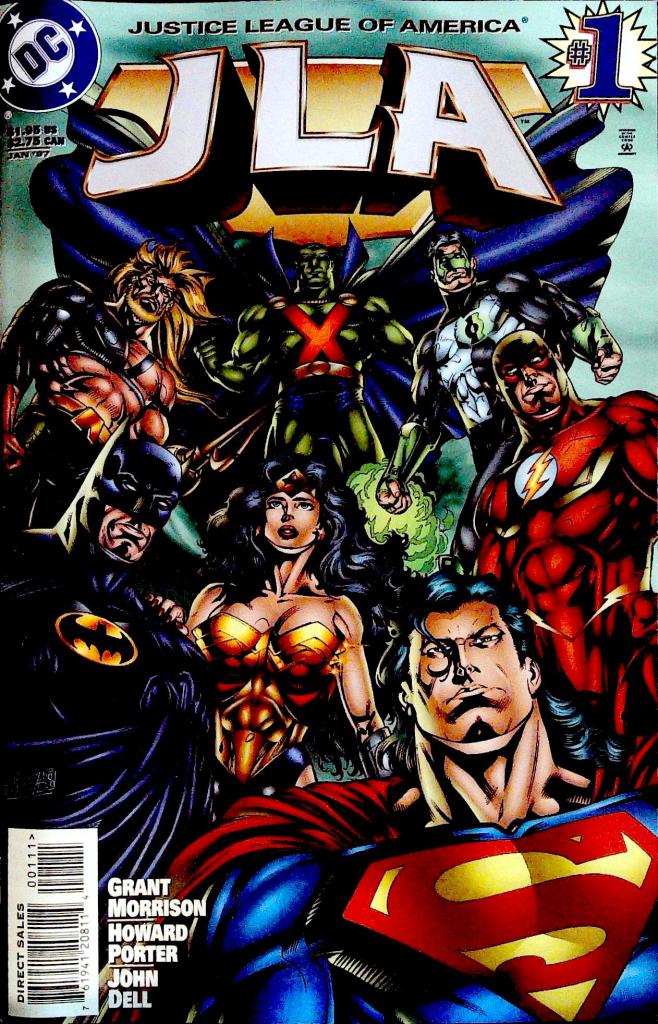
But the point at which I came back for real was with the launch of JUSTICE LEAGUE, soon thereafter JUSTICE LEAGUE INTERNATIONAL. And to be honest, I had mixed feelings about it, even as I bought and read it every month. The artwork by Kevin Maguire was top flight, and the stories by Keith Giffen and J.M. DeMatteis were wild and unpredictable. But across the first couple of issues, the comedy aspect of the series kept growing in volume, to the point where the series became almost a parody of itself. It was laughing at the assorted Leaguers, not with them, and that made me uncomfortable. I’ve mentioned on a few occasions that I likely would have enjoyed the book far more if it simply hadn’t been called JUSTICE LEAGUE, since I came to that property with a certain expectation. But you can’t argue with success, and what’s become known as the BWA-HA-HA incarnation of the League was a mammoth hit for many years. I’d have to wait another decade or so before Grant Morrison and Howard Porter would finally give me a Justice League that was on the money for what I was looking for.
 The Tom Brevoort Experience
Was Wein’s run that overlooked? Most fans I knew at the time — a small sample, admittedly — loved it.
I agree Conway had run out of steam by this point. That whole subatomic arc felt like he was more interested in Sub-Atomica than the heroes.
I could never get into the Sitcom League of America though as you say, no arguing with success.
I don’t care for Don Heck’s work though I just read the X-Men where Professor X supposedly dies and there’s real pathos in the final panel. Is his romance stuff available anywhere? I wouldn’t mind seeing what he did in that genre, just out of curiosity.
LikeLike
For my part, the Heck JLA is one of my favorite periods. I was never a fan of Dick Dillin, though I too like the Wein/Dillin/Giordano run a lot. And I liked the brief Pérez run, too — but I think the Heck run was all written plot-style, which meant Don gave it his usual “everyone gets a moment” storytelling and the dialogue was convivial and flowed well.
LikeLiked by 2 people
[Breaking up my comment because WordPress is being difficult…]
I also thought Don’s run was a part of the Marvelizing of DC. Len hired him because he’d liked Don’s AVENGERS (and working with him on FLASH), and we got at least two multi-part stories in his run that seemed directly Marvel-inspired — the team-up with the Western heroes, echoing Englehart doing it in AVENGERS, and this sojourn in the “Microcosmos,” which felt like it was intended as DC’s Sub-Atomica/Microverse.
LikeLiked by 2 people
Then there was an excellent Royal Flush gang story that felt paced to be an Avengers story, and it all read to me like Len wanted JLA to be like AVENGERS (which he did, specifically Roy’s AVENGERS, as he told me when I wrote my first JLA fill-in). So it was at least an interim step toward what DC was becoming.
LikeLiked by 2 people
Though, unlike you, I clung doggedly to every DC series I’d ever started (still do, I think), I bought the post-Englehart issues grudgingly* and nothing–nothing–tested my resolve like the post-Dillin JLA. I’d never cared for Don’s superhero work, either, in large part because I first came across it way past its peak. I couldn’t tell you what this particular story was about if you waterboarded me. Kurt popping up around this time was a treat, and I actually did enjoy #206, which was a one-off drawn by Carmine and centering around Zatanna and (most of) the heroes who’d helped her find her father in the 1960s. (It also gave us a totally forgotten tidbit of DC lore: that the leads of the Space Museum feature, Tommy and Gardner Parker, were direct descendants of one of them, though which one was never disclosed.) I do remember that #210-212 were originally planned as one 72-page tabloid edition, so you’ve inspired me to go back and look at those to see if they feel special in any way. So much for my afternoon.
LikeLiked by 1 person
*Post-Englehart, Marty Pasko was given the choice between Justice League and the World’s Greatest Superheroes newspaper strip, and I gave him shit about his decision until the day he died.
LikeLike
I think the Schwartz/Conway JLA was not strong (nor the Andru/Conway JLA), so I tend to agree that Schwartz/Pasko would have been better. Wein/Conway I liked a lot.
kdb
LikeLike
That’s a shame, I’m sure I would have liked that. I certainly followed WGSH religiously from the jump.
LikeLike
Pasko had done some good work on JLA with Schwartz in 1975-’76, prior to Engelhart taking the book.
Pasko probably would have been a good replacement. The Doctor Light story, and the story about the alien who makes the JLA’s computer stsyem work were clever and evoked an interesting period in DC’s history.
I also wonder if Pasko getting Superman and having a long stint on a group comic (Metal Men) had not cooled his ardour to write JLA regularly.
LikeLike
Conway was probably better suited to not being the only writer on te book. He did good stories (the revamp of Dr. Destiny or the dusting off of Red Tornado) but might not have been the best choice for a regular writer.
LikeLike
“I also wonder if Pasko getting Superman and having a long stint on a group comic (Metal Men) had not cooled his ardour to write JLA regularly.”
I doubt it. His run on METAL MEN was only about 5 issues long (only 3 of them as solo writer). And WORLD’S GREATEST SUPER-HEROES started out as something very like a JLA series.
LikeLike
Agreed, that Space Museum story in #206 was one of the stand-outs that I passingly make mention of. And I do remember the flow of #210-212 being uneven, as the break points in the story weren’t ideal.
LikeLike
The post-Dillin JLA included some great work from George Perez and some of the better stories (imo) of Conway’s career. Did you truly not care for these, or were you just talking about the Heck (and possibly the Buckler) issues?
LikeLike
You’re correct. (And, of course, I love issue #200.) I was speaking generally and could have been more specific. And I hate Buckler’s work with a passion. It was karaoke.
LikeLiked by 1 person
But at least karaoke can be made fun by alcohol.
LikeLike
@MarkWaid I liked much of Buckler’s stuff. Especially anything of his inked by Dick Giordano, including the covers they did in the late 1970’s & early 1980’s. His “All-Star Squadron” #36 (? GA Superman vs. Captain Marvel), inked by Richard Howell, is my favorite of the whole series.
I tried Buckler’s Archie/Red Circle books, but despite liking the art, the out-dates costumes & stories couldn’t keep me interested.
I see similarities to his work in stuff by artists that may have broke big after he started ( not referring to the swipes he’s infamous & maybe vilified for). Artists like Hall, Hanigan, Pollard, Patton, Jurgens, & early Trevor Von Eden (before TVE re-invented his style & to be, revolutionized comics)
I didn’t like Buckler’s FF run. But at least he kept Reed looking athletic as Kirby intended, & as J.Buscena maintained.
Is your dismissal of Buckler’s work based on the swipes?
I still find the fundamentals of his work superior to most of his contemporaries, & even many others who came after.
LikeLiked by 1 person
I generally enjoy Buckler’s work, though I can understand why some—particularly other comic pros—can’t get past the swiping.
LikeLiked by 1 person
I had dropped the series a bit before this…I held a grudge against Conway for replacing Englehart (don’t ask me why I blamed him specifically, it’s not like he mugged Englehart in an alley and took the assignment from him at gunpoint). Looking at those scans, the art actually looks pretty good to me, Heck and Tanghal made a good team.
Like Tom, I was intrigued enough to check out the debut of the “Detroit League”, but almost immediately bailed out. In principle, I wasn’t opposed to a “Cap’s Kooky Quartet” version of the JLA, but these specific characters ranged from uninteresting to downright embarrassing. Vibe, the Super-Breakdancer? What were they thinking?
Giffen and DeMatteis’ rebooted League started out with great promise (and some spectacular art by the likes of Maguire and Hughes), but for me the novelty wore off pretty quickly. Some cute gags and character bits, but I was always left wishing for meatier plots.
Morrison’s epic, over-the-top approach to JLA was right up my alley. Porter’s art, less so, but overall I thought that was a spectacular run.
LikeLiked by 2 people
Maybe it’s the Romeo Tanghal inks, but Heck’s art on this is much better than I remember. Good Lord, am I about to have a Tuska Awakening with Heck?
LikeLiked by 2 people
You’ll enjoy it if you do…
LikeLiked by 1 person
His DC superhero work always left pre-teen me cold – I was absolutely crestfallen when he came on board “Dial H.” But not even ten years later, his Atlas output would knock my socks off (Thank you, Marvel monster reprints in quarter bins!).
LikeLike
Dean Robert Willetts on X/Twitter posted some fantastic B&W pages by Don Heck of men in suits & hats, & women in dresses. Could’ve been from the 1950’s, I don’t know. I was far more impressed with them than his superhero stuff, though his old Avengers pages have some hidden gems. I wish he’d have gotten the chance to draw some Slam Bradley for DC set back in the day. More recently, Dean shared pages of a Black Widow story, characters again mostly in “civilian plain clothes”, inked by Sal Buscema, and they also looked terrific. Sal really strengthened Don’s lines. The women looked extra glamourous.
My earliest impression on “new” work by Don Heck as it was published was his “Steel” with Conway, and a Halo back-up story in BatO, written of course by Mike W. Barr. I was underwhelmed. I was really young, and honestly many times more ignorant of what went into drawing a comic than I am now.
Makes sense why Conway would repurpose his Vixen and Steel concepts into his new JLA line-up. I was pretty open to new superheroes then (still am). But after several issues of almost everyone in “JLD” complaining how inadequate they felt they were, I started to believe it myself, & lost interest. I did go back for the Despero story & I had followed Luke McDonnell on “Iron-Man” (he got to draw villain Vibro and new hero Vibe at around the same time, w/ the same “wave” effect to illustrate both of their powers’ use).
Barr’s Outsiders, even my fave X-Men Line-up (drawn by Paul Smith and then JRJr), never seemed so self-defeating as Conway’s “JLD” (and I disliked his characterization of Aquaman, a real prick to his teammates). Kurt’s Liberty Project, although gathered/rounded up under different circumstances, seemed to have enough defiance (or spite) to still try and beat the odds. If the characters believe, it makes it easier for the readers to, too.
I was 15 or 16 when Giffen & DeMatteis’ JLBwaHaha came out. I did enjoy it. Bats’ “one punch” KO of Guy Gardner is still discussed on-line, a seminal moment in superhero comicbooks for a generation. I also liked some of the heavier themes, though humor was still sprinkled throughout, as in Despero’s next return (“Blood & Thunder!”). Maguire’s art was interesting. But I was floored & fascinated by Adam Hughes’ work. It was downhill for me when Adam left. Looking back, I’m impressed w/ Andy Helfer’s editorial output then. Byrne’s Super-books, “JL”, his own Shadow adaptation, then “Justice, Inc”. Paradox Press, “Road to Perdition”, “History of Violence”, all the way through to my favorite incarnation of the Doom Patrol, by John Arcudi & Tang Eng Huat.
Morrisson’s “JLA” remains my fave incarnation, and fave superhero team book. Except for Mark Waid’s Flash and Peter David’s Aquaman, which were pretty much equal w/ Grant’s, I liked how each character was written in Grant’s JLA more than I did in the characters’ own books.
LikeLike
Heck’s best strength (imo) as a comic book artist is shown in the expressions of the mob running on the intro splash. It’s solid and distinctive work though I can completely understand why the work could be considered dated looking. He was good with character bits and telling a straightforward story but he wasn’t the guy to deliver impact and fighting action on a page. His work never soured a book for me though and he drew a lot of comics I love. He looks well inked here.
LikeLiked by 2 people
Don was very good at intrigue and suspense, which can all work really well in a superhero story. But if the writer asks for Kirbyesque spectacle, Don just isn’t going to nail that. That’s why I thought his FLASH worked really well — Cary Bates wrote plot and gimmick and incident much more than he wrote “Wow lookit the Big Cool Thing!”
LikeLiked by 2 people
I think this Microcosmos story, which is mostly about character issues and “palace intrigue,” would have worked much better if the Microcosmosians looked like an interesting otherdimensional culture, rather than “Californians in Greco-Roman casualwear.” But that kind of design isn’t Heck’s wheelhouse either.
LikeLiked by 2 people
His work on Flash did work well… also mostly enjoyed his stint on Wonder woman. Agreed that he was good at intrigue and suspense.
He could draw pretty women and handsome guys, but really excelled at drawing ugly mugs like Happy Hogan. Having to make all the leads conventionally good-looking in a super hero story played against that I think… probably why he was better suited for westerns and horror.
A stand out Don book to me is Giant-size Defenders #4. Written by Gerber, it just flows so nicely with the tragic subplot packing more oomph than the main battle between two super-teams.
LikeLiked by 1 person
My favorite stuff by Heck is the handful of “Rose and the Thorn” backups he drew in LOIS LANE. It was right in his wheelhouse — noir-ish crime and suspense, plus a sexy femme fatale.
LikeLiked by 2 people
This “Microcosmos” storyline was actually supposed to be Conway’s exit from JLA. The last issue has an announcement from Conway that he’s moving on: “Thank you all for your support these past five years” etc, etc. Then there are a few fill-in issues, and then Conway just… kind of comes back. No explanation, not even a mention of his return.
I’ve always wondered what went on there. Because of the run of fill-ins, I always sort of guessed that nobody else was available to take over (or willing to tackle the logistics of a team book like JLA), and Conway just sort of sighed and said, “OK, fine, I’ll do it.” But that is just wild guesswork on my part.
The book may have seemed tired at this point, but, well, he WAS leaving. Maybe the revamp to the Detroit League was Conway trying to reinvigorate his own interest (also wild supposition on my part.)
LikeLiked by 1 person
You’re more or less right, Chris.
Gerry was going to leave, and DC was going to find a new writer. They thought new artist Chuck Patton would help sales, and a new writer to go with him would be promotable. But they couldn’t find anyone they wanted to go with.
LikeLiked by 2 people
This was when Len offered Alan Moore his choice of SWAMP THING or JLA, and Moore chose SWAMP THING. After the fill-in I wrote, Chuck tells me he asked Len, “What about this guy, this was real good,” and Len told him I wasn’t a big enough name. [I wasn’t!]
LikeLiked by 1 person
So they couldn’t find a name, Gerry stuck around for the animal-people arc, and then they came up with the JLDetroit direction as a way to make the team younger, hopefully cooler, open to more character drama — more like X-Men or Titans, which were selling well.
LikeLiked by 1 person
That’s always bugged me about comics. More so with writing. “Not a big enough name”, like it was the movies. Where in music, and even comic book art, gatekeepers are or should be looking for good new talent, the next hot/big thing. How do you get to be a big name? By doing good work. It’d be faster on a higher profile title. But they’d rather a writer toil away on lesser known books., like promotion was only based on seniority. But if you’re good, you’re good. If you’ve “passed the audition” w/ that fill-in, that should’ve been it.
Is it the same for lettering or coloring? If someone knocked an editor’s socks off w/ their craft, would they be stuck on only fill-ins & back-ups? A good editor should have an eye for good talent, and then employee it. Because that sells books. Once Laura Martin, Dave Baron, or Dave Stewart, Matt Hollingworth, were wowing people with their amazing color art, it seems like they rightfully they got offers from everyone.
How long was Kevin Maguire working in comics before Andy Helfer gave him “JL”? I mean, I’d think you’d WANT someone who can do good stuff on your flagship books. Adam Hughes had done a few things in comics before getting JL:A. I have his guest spots on “Nexus”, “The Elementals”, & his “Maze Agency” series. But his amazing work spoke for itself. And once Maguire & Hughes started their runs for Andy on JL/A, their names blew up. Recognition from their work.
Carlin bugged me, too, but by doing the opposite. Denying Waid & Morrison (maybe others, like Kurt?) runs with Superman’s titles because their names were “too big”. Maybe because he’d have had less leverage over them, I don’t know. But he could’ve treated the readers to better stories, AND increased sales. What a wacked strategy he chose, instead.
Another oddball scenario was DiDio giving those 2 younger writers a shot with a wild, line-wide alien storyline. I’d been reading comics for decades by then, & had never heard of those guys, had no idea why their idea was being given such deference as to affect the whole DCU. The idea didn’t work. & it was scrapped as if it never happened. But because the idea didn’t work, not because their bylines were new.
Most current superhero comics writing seems interchangeable to me. No one’s really impressing me anymore. A few bright spots. “Black Hammer” was good for a while (it’s spin-offs, too). The better writing seems to be in non-superhero books. Maybe I’ve aged out. Or I’ve just previously read some great stuff that hasn’t been topped since. I realize anyone has to show they can do the work well, before they get to do the marquee characters. I just don’t see why it seems to take longer to convince editors with writers more than for artists or other disciplines.
Meanwhile, and maybe the business has changed so much since then (right- for a while you needed to have been a produced screenwriter or published novelist to write comics) that titles are now revolving doors for a succession of writers who can’t get sales high enough. The industry is understandably desperate to increase sales. But it seemed like several writers “back in the day” stayed on books too long, after their work had gone stale. And the “house style” of writing expected by editors then, could limit writing, similarly to how Vince Colletta’s inks “equalized” different artists’ drawing.
Conway on JLA was an example. I guess that was a luxury of Marvel & DC back then. The business could afford to carry people longer. And the Big 2’s losses were then opportunities for smaller publishers, so we’d get books like “Nexus”, “Airboy”, “Mage”, “Grendel”, and Kurt’s “Liberty Project”. And then there were some really gifted writers, like Kelley Puckett, that I don’t think ever got a shot at extended runs on the premier titles, despite having more than proved their talent with some of the biggest characters on “alternate takes”, or anthology books, or back-up features.
LikeLike
I too never enjoyed Don Heck’s superhero work, but I was surprised to see I enjoyed his Cliff Mason [ Jann of the Jungle series ] work when I was collecting Atlas Comics era stories on to a USB. I grew up on Marvel Comics so have very few DC books during the same time period. Picked up most of the Perez JLA when they came out and the others later. Wasn’t a Dillin fan but I had to get my hands on the DC version of Thor, Quicksilver, Scarlet With & Yellowjacket. Awhile back I did wonder why DC never put Gil Kane or Neal Adams or other more talented than Dick Dillin artist on the Justice League.
LikeLike
“I did wonder why DC never put Gil Kane or Neal Adams or other more talented than Dick Dillin artist on the Justice League.”Drawing a book with that many characters in it is a lot of work, and Gil Kane didn’t want to do books that took too long; it cut into his earnings. Neal was a fan, but he wasn’t a steady deadline guy. Dillin, like Sekowsky, would fit all the characters in and deliver on-time, year after year.
LikeLiked by 1 person
I take it that George Tuska who drew the Justice League for the newspapers wasn’t a fan of doing monthly team book either?
LikeLike
I don’t think George was much of a superhero fan at all.
But before the days that hot team books paid high royalties, a lot of artists preferred to avoid them. Paul Levitz has often said that they had to get talented newcomers to draw LEGION pre-royalties, because nobody experienced wanted such a grueling job.
LikeLiked by 1 person
I wonder if the fact that Dillin had handled Blackhawks, a team book with severn main characters at DC and Quality for about 16 0R 18 years and that was coming to an end, was not part of why Dillin got JLA in 1968.
Sid Greene inked the first year, so their wasn’t much of a stylistic change until Joe Gella became the inker.
I always thought Dillin was a fairly good draftsman if he was not doing long shots with a lot of characters. He did very dynamic panels,
LikeLiked by 2 people
“I wonder if the fact that Dillin had handled Blackhawks, a team book with seven main characters at DC and Quality for about 16 0R 18 years and that was coming to an end, was not part of why Dillin got JLA in 1968.”I would figure it had to be.
LikeLiked by 1 person
Whew, lots to digest there covering so many eras of the Justice League! I think we bought most all of the Detroit League issues. I’m not sure why, I’m guessing we found a dependable source for the comics and so we kept buying them. I didn’t really care for the run though. Justice League/Justice League International I did though. I think it was that it hit at the right time, bringing back some of the real Justice League members. Maguires art was something new and slick. Giffens humor was something new to me too (having not read Lobo. Erm, well i did read Ambush Bug, but this was different. I especially liked the Annual that Willingham pencilled. The “Gray Man”? It was pretty creepy. On the other hand, I was not a fan of Morrision’s JLA. I didn’t read it till years later, and I find a lot of people loved it because they returned the JLA to the original characters. I mainly didn’t like the ultra-paranoid “Bat-God” that came from that run. There are certainly good parts about it though.
LikeLiked by 1 person