

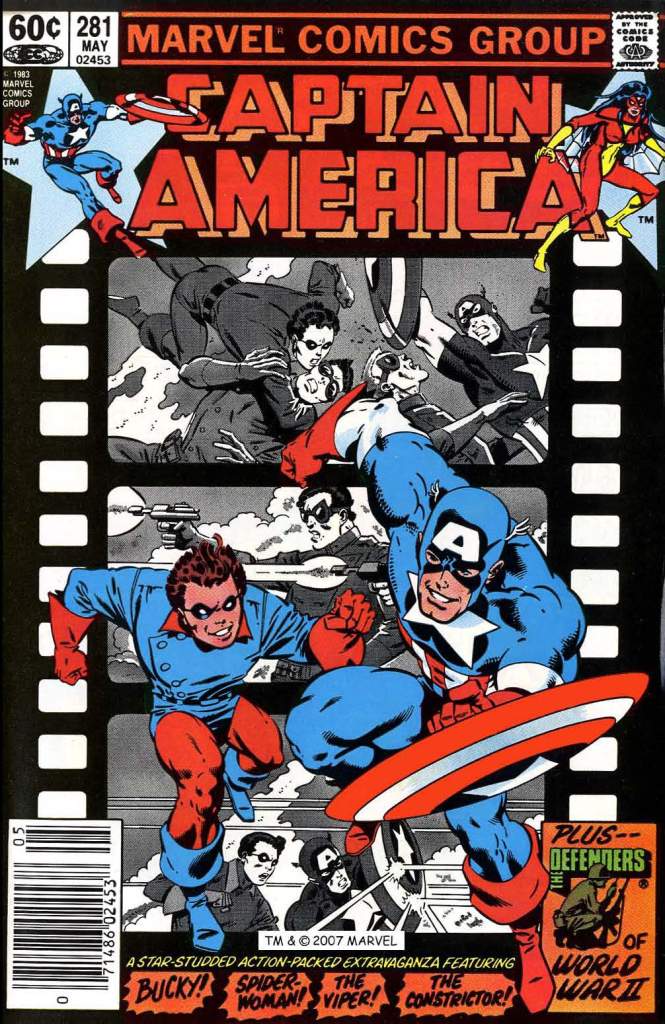
The last regular issue of CAPTAIN AMERICA that I bought was #281, almost a hundred issues on from when I’d first sampled the book. The series was on a bit of an upswing at this point, having just concluded a multi-part adventure that established the contemporary Baron Zemo (who had previously appeared as the one-off villain, the Phoenix.) So like AMAZING SPIDER-MAN, it was in the midst of a strong, solid run by writer J.M. DeMatteis and artist Mike Zeck. So why did it get the cut?
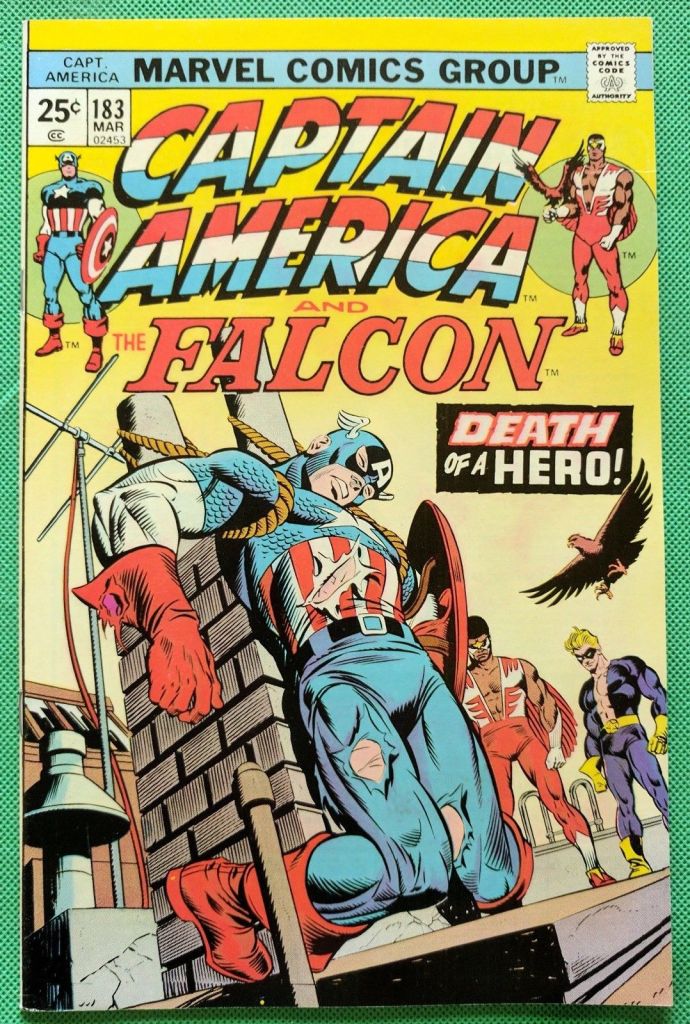
The first issue of CAPTAIN AMERICA I ever got was this one, #183, at the tail end of the Nomad storyline. It’s a great issue, but as a six-year-old, I couldn’t really make heads or tails of it, and it played to me as though Captain America had been killed and crucified on a rooftop. Frank Robbins’ stylized artwork was alien to my young eyes as well. For years, this issue and a contemporaneous issue of THOR put me off of Marvel titles entirely.
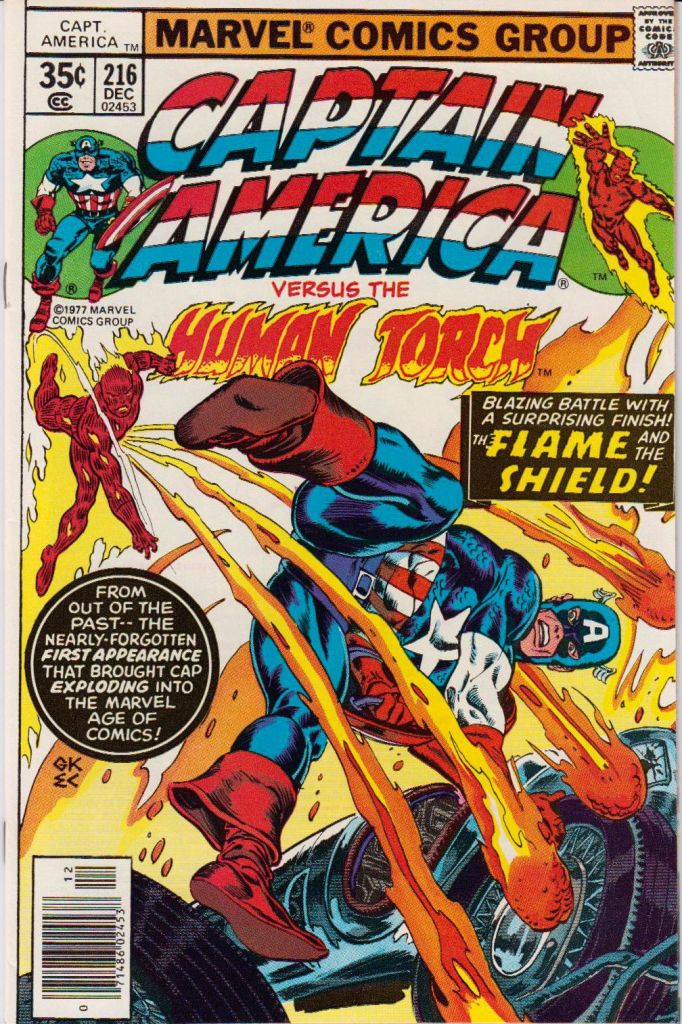
When I eventually branched back out into Marvel comics, the subject of my initial focus was the Fantastic Four, particularly the Human Torch. And so I picked up this issue when I saw it, not realizing that it was a reprint of a much earlier story by Stan Lee and Jack Kirby, a sort of dry run at resurrecting the company’s most successful golden age character. I liked the book, but as it was the Torch who brung me, I didn’t stick around for the next issue.
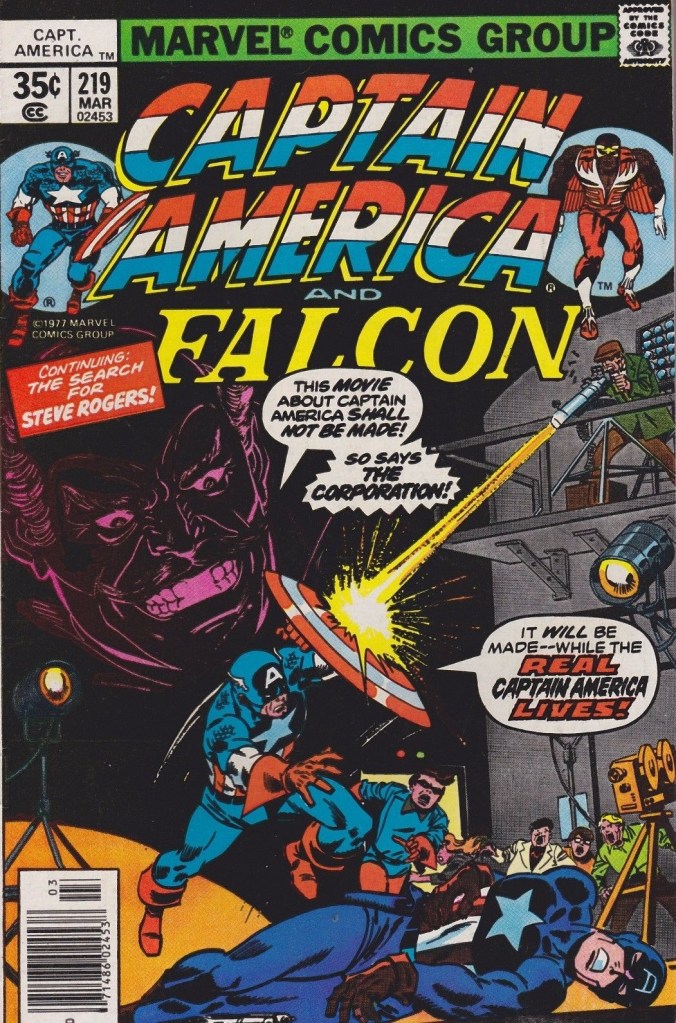
That only lasted for three months, until the setting of this story–during the making of the 1944 Captain America movie serial–got me to take the plunge. This is where I began reading the book on a regular basis–which is sort of funny, as it was right at a point where it was experiencing creative tumult, with fill-ins abounding. But somehow, I was able to get onto the CAP train at this point, and I stayed there all the way through #281.
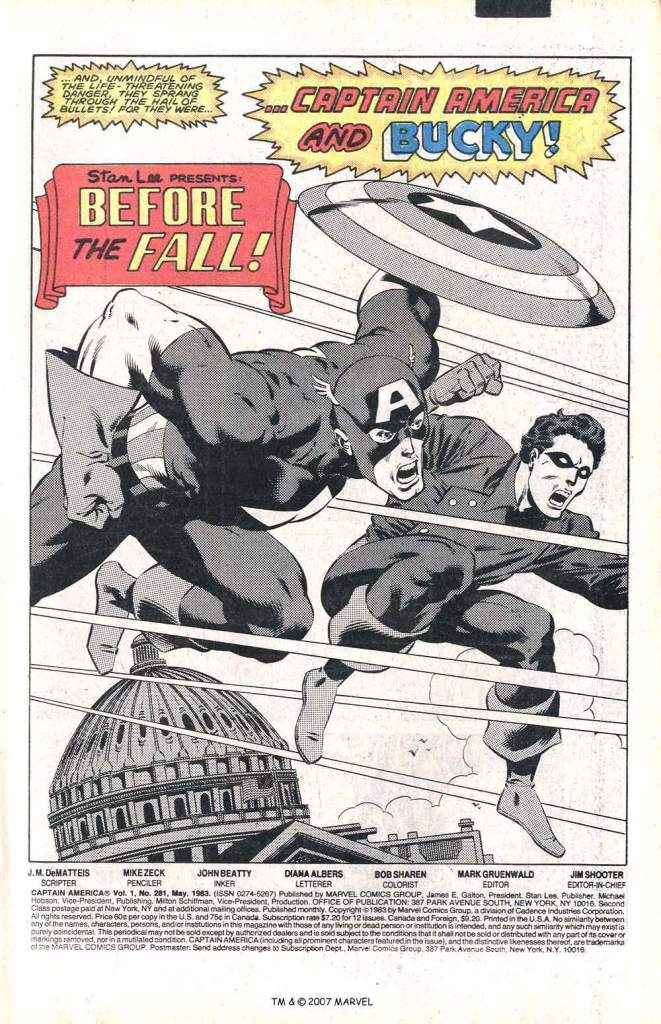
Looking back at it, you would think I would have been enthralled by this issue of CAPTAIN AMERICA, as much of it revolves around the return of Jack Monroe, who had been the replacement Bucky of the 1950s. That whole backstory was needlessly complicated, but I was a sucker for all of that history, and so Jack’s return (he even gets his name in this issue) should have really captured my attention. But it didn’t somehow.
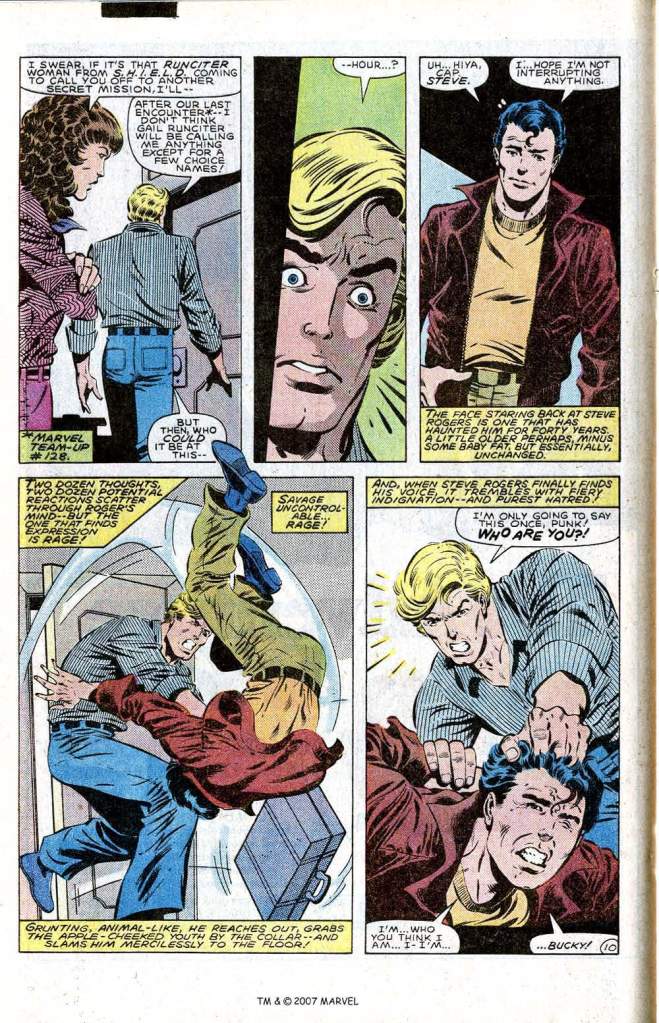
For one thing–and it’s maybe stupid thing to get hung up on, but that’s how many comic book readers are–it bugged me all throughout this issue that Bucky/Monroe’s hair was colored black rather than its proper brown. And the storytelling is heavy, filled with dense captions that carry a lot of the narrative thrust of the issue. The artwork, meanwhile, felt constrained. EIC Jim Shooter had begun advocating for pages to be more in a typical grid format, six panels per page. In them, he wanted to see full figures, which meant a lot of reliance on middle shots. While Zeck was still a strong illustrator, this approach dialed down a lot of the energy of his work, making it seem lethargic and quiet.
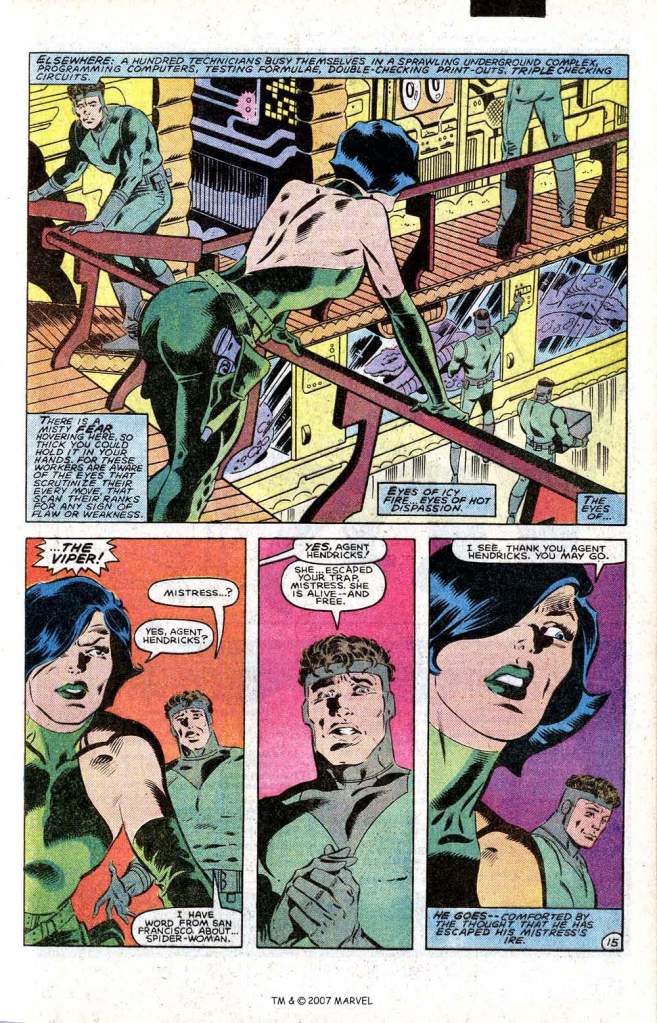
This issue also contained a long subplot about Viper, the former Madame Hydra, attempting to kill Spider-Woman in San Francisco. Jessica Drew even gets a multi-page action sequence in an attempt to get some movement into the first half of this issue. But even though Viper was clearly who Cap was going to be contending with next, I found it difficult to connect with any of this material. I hadn’t come to CAPTAIN AMERICA for the clean-up of SPIDER-WOMAN subplots (Viper had recently been revealed to be Jessica Drew’s mother, a revelation that played havoc with her established history and one that CAPTAIN AMERICA Mark Gruenwald wanted to reverse, hence her presence in this story.)
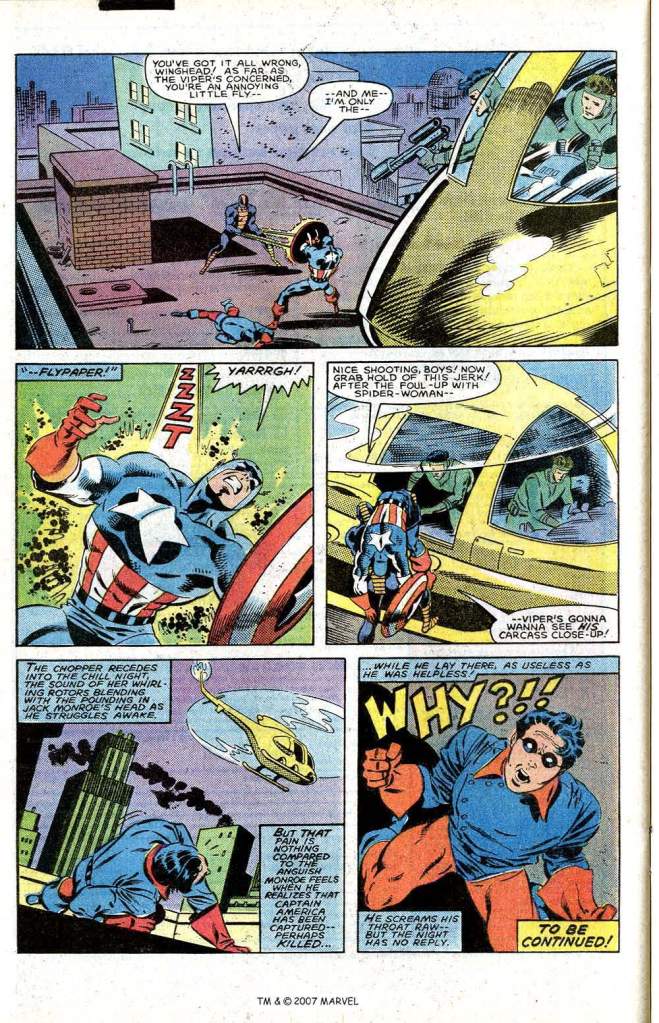
Anyway, the issue wraps up with Cap and the 1950s Bucky roaming across the rooftops, where they’re attacked by the Viper’s men including the Constrictor. It’s a perfunctory action sequence, in which they clobber Bucky quickly, then subdue Cap and carry him off–leaving Bucky pissed off about his failure in the field. To Be Continued. The whole thing is well-crafted, but it all felt a bit plastic to me, a bit calculated. It didn’t feel like it had a lot of true heart. Possibly, this is because that Viper plotline was something that writer DeMatteis was asked to tackle rather than something he came up with on his own, I don’t know. None of it was bad. But it just wasn’t good enough to keep the book on my buy list in the face of my dwindling funds.
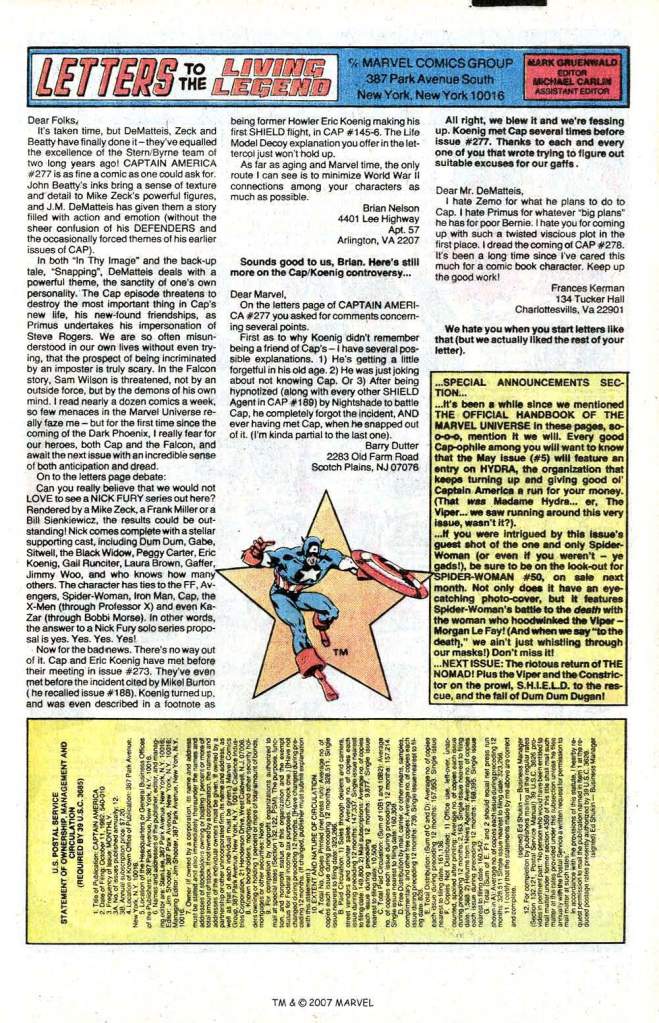
This issue’s LETTERS TO A LIVING LEGEND letters page included a note from Barry Dutter, who would go on to be an Assistant Editor at Marvel in the early 1990s. It also included that year’s Statement of Ownership, which allows us to see that at the time I dropped the title, it was selling an average of 160,308 copies on a print run of 323,266, giving it an efficiency of 49 and 1/2%, which is a step up from the previous times we had looked at it. So what Shooter was doing here was working, at least in the broadest sense for the greatest number of readers.
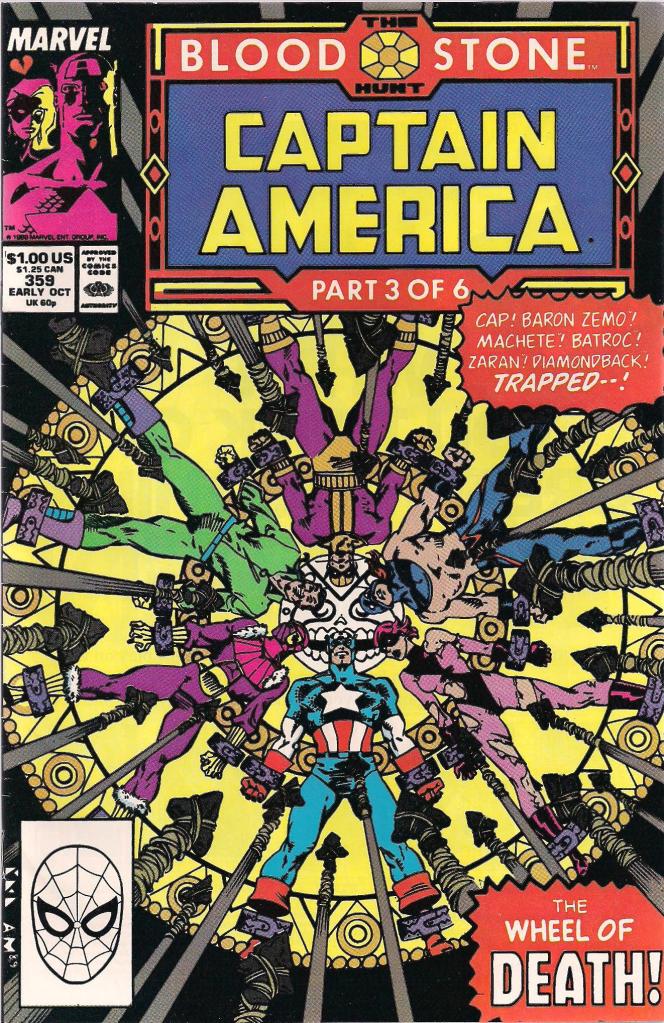
I had a harder time letting go of CAPTAIN AMERICA than it may seem at first blush, as I came back twice in the course of the next year. First for #285 and the death of the Patriot, another of the substitute Captain Americas of the postwar period. And then I was around for #286-288, which resurrected Luther Manning, Deathlok, and set him up for a new futuristic series that never happened. I had liked Deathlok, and Zeck’s version of the character looked great, so I dropped in for those three issues. But again, I didn’t stay. The next issue I sampled years later was #350, the climax of the John Walker becomes Captain America cycle of stories. I had flipped through a few of them and knew what was going on broadly, but it was the oversized anniversary nature of #350 that got me to take the plunge. Again, it was good enough, but not so good that it got me back on the wagon regularly. So in the end, it wasn’t until I started my internship at Marvel and began to get weekly bundles of all of the Marvel books that I began following CAPTAIN AMERICA regularly again. The first issue was #359, shown above, which was written by Mark Gruenwald (who was still in the first half of his 100+ issue tenure as Cap’s writer) and artist Kieron Dwyer.
 The Tom Brevoort Experience
I can’t tell you when I dropped Cap but it was somewhere in the mess that was Gruenwald’s run after he finished all the ideas he had when he started writing the book (Not that we realized that at the time but I recall reading an article about it later and pegged the general area of where I jumped off). I gotta say in general that while I loved the Two In One stories with Macchio, Squadron Supreme, and Quasar, I was very underwhelmed by his Cap and the rules he adhered to when writing. I also don’t think I ever read another run featuring Captain America after that. Thor I at least sampled one run and I’ve tried to get into a few with Iron man but Capis pretty much a dead property to me.
Oh, and DP7. God, I loved DP7.
LikeLike
I was in and out of the Captain America series. Was there for the Roger Stern/John Byrne stories, Red Skull-Ameridroid-second Nomad stories, Deathlok stories and others ( I do have CA#183 & 281 seen here ). I did most times love the way the late Mark Gruenwald thought but like Mark Waid wrote Captain America like he had super-strength ( at least twice Gruenwald had Cap face a small army of super-villains ( a number of whom based on their powers could have easily defeated him ) and Waid had Cap break the Rhino’s nose ( That fight should have gone the way of Buggs Bunny vs. the Wrestler ) ).
LikeLike
I mean the scene where Buggs is climbing all over the wrestler trying to budge him, that is what we should see in a Cap vs. Rhino fight, not breaking his nose ( Cause even using his shield he doesn’t have the strength needed to do that ).
LikeLike
Having been reading a lot of Silver Age Marvel recently, I’m confident Cap could clobber the Rhino by using judo, which turns an attacker’s strength against him! Seriously, in the SIlver Age judo is like the ultimate super-power.
LikeLike
I probably should have used Roger Stern & John Byrne’s Captain America & Batroc vs. Mister Hyde fight where they were using hit-and-run tactics to fight him. In the end Mister Hyde defeated himself, like he did in his next appearance fighting Spider-Man ( who also uses hit-and-run tactics against more powerful foes — like the Rhino ( strength & speed ) or I don’t know how much time after that but he defeated himself in a subway tunnel ( electrocuted himself ) during Daredevil’s hit-and-run fight with him. THE EXAMPLE I ALWAYS USE: I don’t care how good a fighter Cap or the Steel Serpent are Cap doesn’t have the strength or speed to defeat the Scorpion ( lift 15 tons, speed and agility ) either nor did Steel Serpent in Marvel Team-Up have the strength or speed to do what he did just using his martial arts or the Kingpin against Spider-Man ( lift 10 tons, speed & agility ), cause the fact that Spider-Man and the Scorpion didn’t kill or cripple each other in their FIRST BATTLE is proof that Non-Super-Strong characters can’t defeat the much stronger Hero or Villain ( They could both just stand there like Khan in Star Trek Into Darkness and Cap, Kingpin ( no laser cane or weapons ), Steel Serpent ( no iron-fist use ) or the Batman couldn’t hurt them either ).
LikeLiked by 1 person
Fair enough. Brian Cronin has a whole list of “fight shouild have gone the other way” stories on his blog.
Regarding the Kingpin, he’s been used as an argument that even non-super humans in the MU are physically more powerful than we are (I discuss that here: https://atomicjunkshop.com/does-this-mean-aunt-may-could-beat-me-up-ordinary-people-in-comic-books/)
LikeLiked by 1 person
I loved the DeMatteis/Zeck run, but I dropped the Gruenwald run like a hot rock ASAP. I’m not sure if I even last 6 issues and that was at the point where I was buying virtually everything. I didn’t buy another issue, beyond crossovers, until Waid took over.
LikeLike
I bought a few of Mark’s run. Keiron Dwyer’s art was hard for me to resist.
LikeLiked by 1 person
Not a selling point for me. Too blocky and generic for me.
LikeLike
Maybe it was the inks by other people. When he left Cap, he did some Bat-books. He inked his own drawing for a “Year One” themed annual. Pretty great. Back to Cap, I wasn’t into Pail Neary’s oblong faces & figures, so I left towards the end of DeMatteis’s run. Only popping back in after Mark was on it, for that Nighthawk appearance, overlapping “Squadron Supreme”. Not into Ron Lim’s art, either, or really anyone else’s who worked on Mark’s marathon stint, except Keiron, & he was in his early 20’s. His Daredevil issues around that time looked even better. Of course inked by Al Williamson helped, but even under Fred Fredericks, Dwyer’s stuff looked strong.
LikeLiked by 1 person
Sadly, Dwyer began the trend of drawing Cap like a house. As for Neary, Zeck being pulled off the book to waste his talent on the excretable Secret Wars is a true crime. What I wouldn’t give to have seen him do the run up to #300!
LikeLike
I’m not sure if it was availability or interest, but our Captain America collection was pretty sporadic. We had a few of the Zeck run, including the first part of the Deathlok story. Zeck did a great job on him. I saw the original cover that Zeck drew of Cap vs Wolverine and that is also amazing.
We had most of the Gruenwald run. A few issues of the great Stern/Byrne run. There’s some nice gems in there.
LikeLiked by 1 person
I wrote a long blog post in 2021 about “My History as a Capfan” at https://robimes.blogspot.com/2021/04/my-history-as-capfan.html
In short, I had started reading the series around #229 (Jan. 1979), when I was 8 years old, and considered Cap to be the one series that I would collect every issue of. By #260 (Aug. 1981) I had a mail subscription so that I would be sure not to miss an issue. But I finally let the sub lapse with #300 (Dec. 1984) and stayed away for a year. The loss of Mike Zeck to Secret Wars was a real blow, since the creative team was at a real high during the period around (and including) #281. But my tastes as a reader were changing, too, and I ignored Secret Wars entirely, drifting away from a lot of the Marvel titles that I had followed religiously as a pre-teen, only a couple years before.
Fortunately I never really had the problem as a kid of having to budget my comics-buying to the extent that I had to drop titles that I still enjoyed reading.
LikeLiked by 2 people
I bowed out at #300 also. I missed Mike Zeck too, and with DeMatteis heading out the door, there didn’t seem to be much reason to stick around. I remember picking up a couple of Gruenwald’s issues, and later a few of Waid’s, but they didn’t really “click” with me. As you say, our tastes change as we get older.
The last time I really vibed with a run of Cap issues was when Robert Morales took over around 2002. I’d really enjoyed his handling of Steve Rogers in the TRUTH mini-series, so when I heard he was taking over the regular book, I jumped on it. And I ended up liking it a lot! But alas, it got cut short (as good things always seem to be), and I haven’t paid much attention to Cap since.
LikeLiked by 1 person