

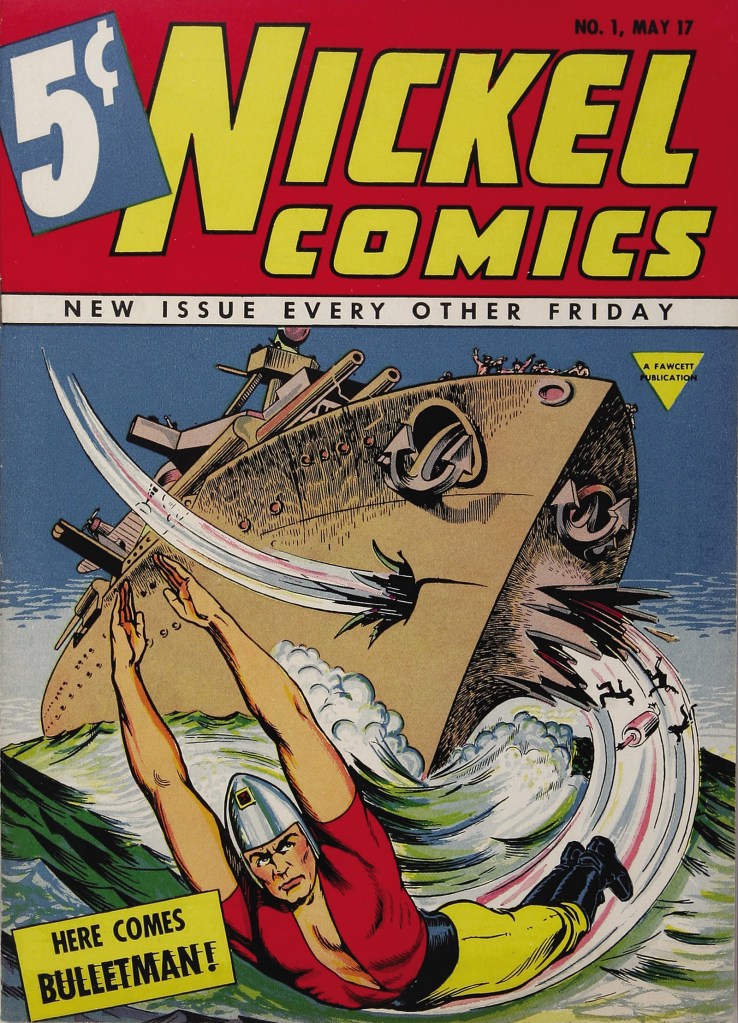
After Superman had opened the floodgates and showed publishers that there was money to be made in comic books by putting out the adventures of costumed heroes, Fawcett jumped into the field with both feet. They were an established publisher already, and so had staff and connections in place to produce and distribute their new books immediately–and a guaranteed placement on seller’s racks due to their existing track record. While Fawcett leapt into the filed with a traditional comic book, WHIZ COICS #2 (the #1 was an ashcan edition used to capture the trademark to the title), they also experimented a bit with the basic package at the start, to see if they could hit on something that would work better. So MASTER COMICS started out as a much larger tabloid comic, for example. But we’re here to talk about NICKEL COMICS and its long-running cover feature, Bulletman.
NICKEL COMICS was another experiment on the part of Fawcett. It was half as long as a regular comic book of the period, containing only 32 page rather than the standard 64. But, as the title implied, it also cost half as much–only a nickel as opposed to a dime. In an economy still recovering from a major depression, Fawcett must have figured that this would be a big sales draw. To offset the size and the fact that the book would only generate half as much profit for all concerned, Fawcett decided to release it twice-a-month.

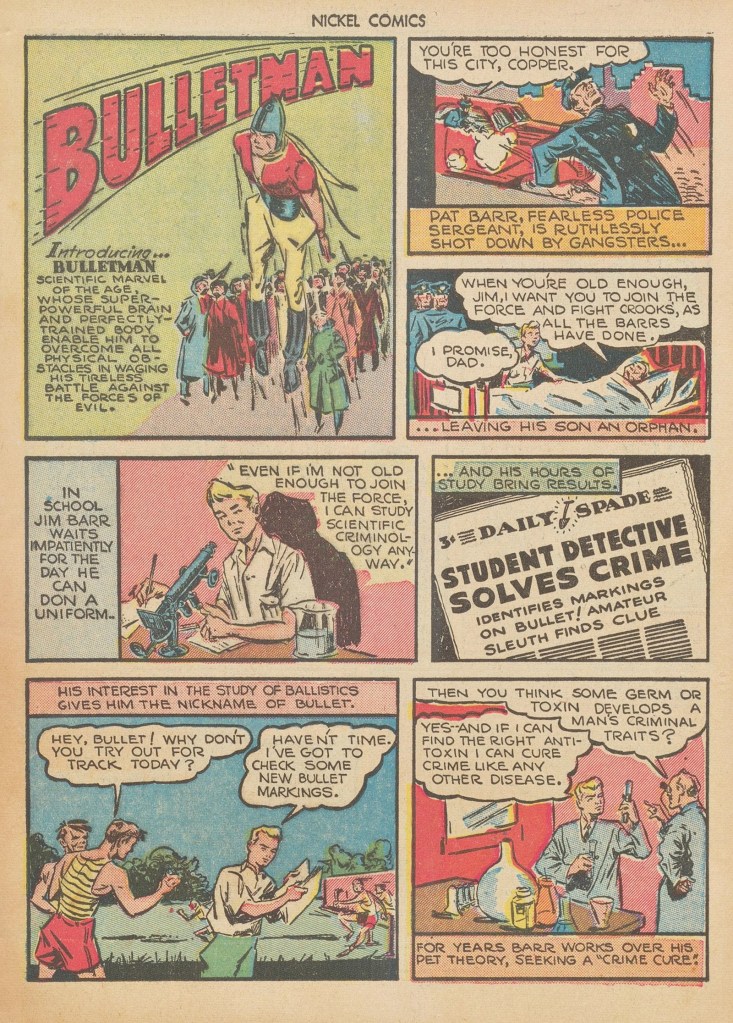
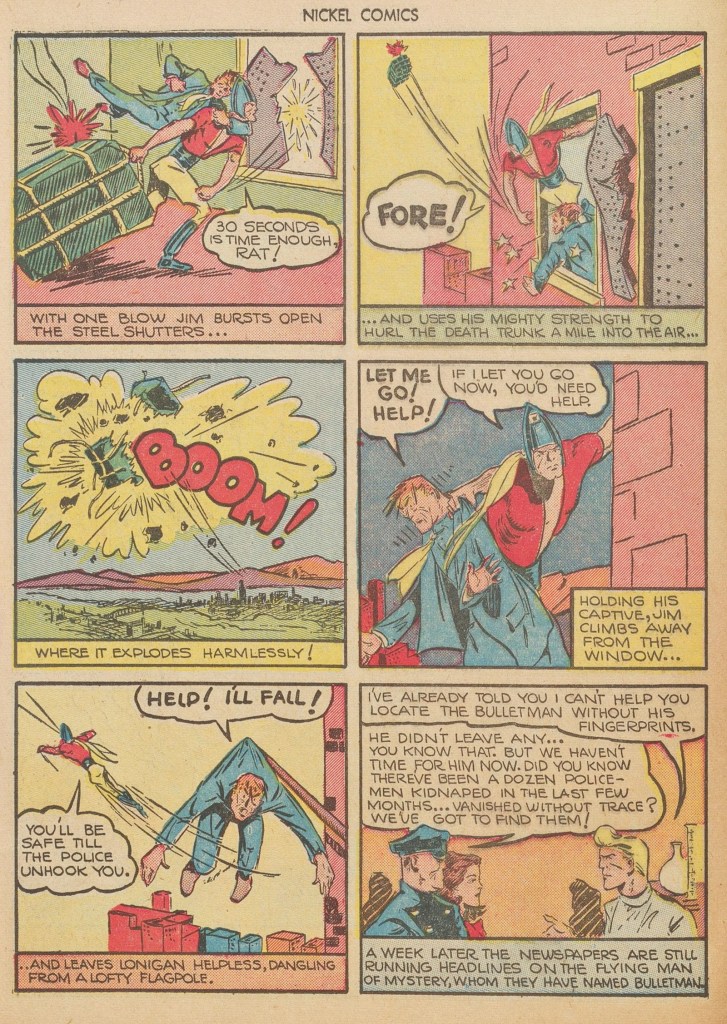
The lead feature in NICKEL COMICS was Bulletman, and he would prove to have real staying power, becoming Fawcett’s second most popular series after the Marvel Family. The strip was the creation of writer Bill Parker and artist Jon Smalle, who worked on the feature initially, Bulletman was one of the first of the “specialist” super heroes, costumed crime-fighters who possessed only a single special power, as opposed to the multitude embraced by Superman. In Bulletman’s case, it was the ability to fy and deflect bullets thanks to his gravity-regulator helmet. Early on in the strip, Bulletman also possessed superhuman strength and durability, but those traits faded away over time as the series got rolling.
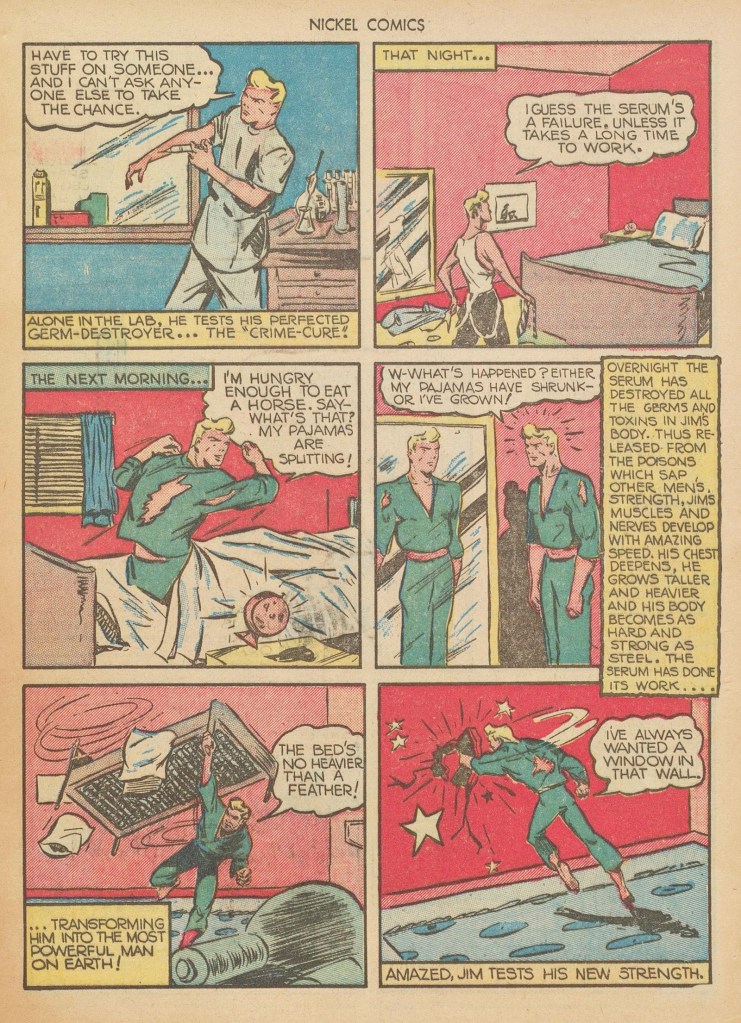
Given enhanced vitality by a “crime cure” serum of his own design which has eliminated all of the harmful germs and toxins from his body, Jim “Bullet” Barr, finds himself, like captain America later would, as a perfect specimen of manhood. Similar to the later Barry Allen Flash, he worked by day as a Police scientist, having lacked the physicality to pass the Police Academy entrance exam. Having come from a long lineage of cops and crime-fighters, Barr created both his serum and the gravity-helmet that allows him to fly in order to follow in his forefathers’ footsteps and battle on the side of law and order.
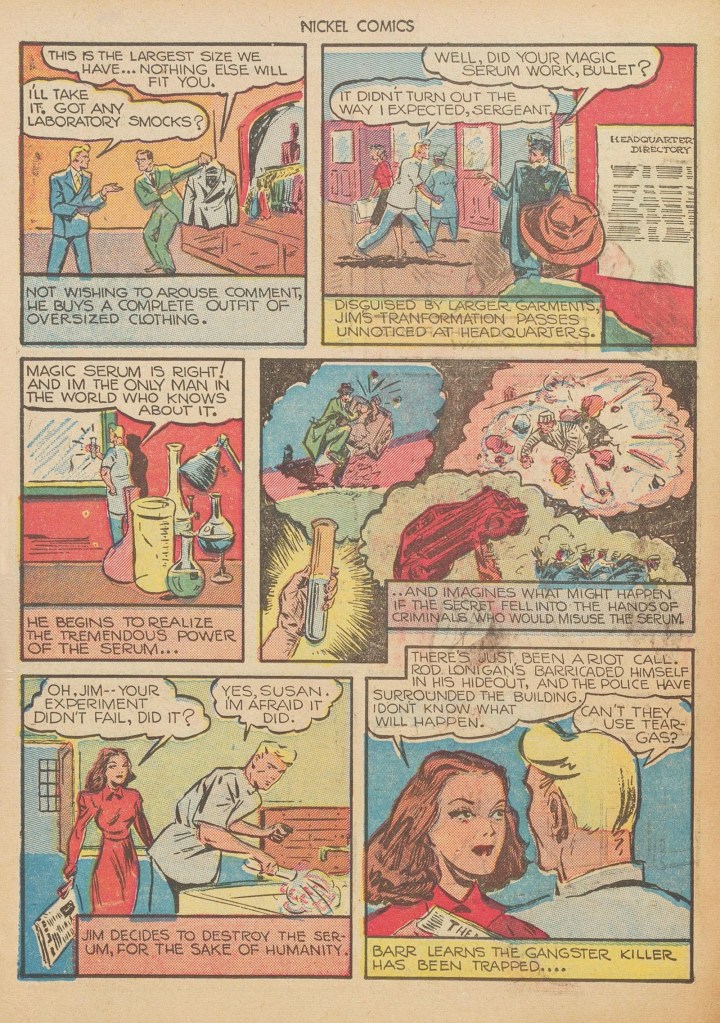
The first story also introduces Susan Kent, the daughter of the Police commissioner and Barr’s love interest. Within a year or so, Barr would give her a gravity helmet of her own, which she’d use as his partner Bulletgirl. And typically, Bulletgirl was treated as an equal partner in the endeavor of fighting crime, rather than as a sidekick or junior partner. The pair were dubbed the Flying Detectives, and eventually headlined in their own comic book title as well as appearing in anthology series. It was a rare instance of a male-and-female super hero partnership in the comics of the day, and that difference was a part of it’s appeal, I expect.

One of the other appeals is that the series developed a rogue’s gallery of colorful villains for the duo, in the manner of Batman or Dick Tracy. There were the Weeper, Doctor Riddle, the Dude, the Man without a Face, the Son of Dracula, the Black Spider and more. This trend began with this very first story, which introduced a recurring for for the human bullet, Blackmask, who is described as a super-criminal.

Unfortunately, despite the appeal of its lead character, NICKEL COMICS was a bust. The fact that it brought in half as much profit with the same amount of handling meant that it was pushed aside on shelves in favor of more regular comic releases. It’s final issue was #8 four months after its launch. But realizing that they had a good thing in Bulletman, the editors at Fawcett moved the strip over to MASTER COMICS, which they had reduced in size to typical comic book proportions and which they were in the process of combining with SLAM-BANG COMICS, another early anthology attempt. All of the best and most popular strips from the three series were merged into MASTER COMICS, with the result that it sold well enough to survive and thrive. Of course, the book really took off when Captain Marvel Jr. displaced Bulletman as the cover feature with issue #23.

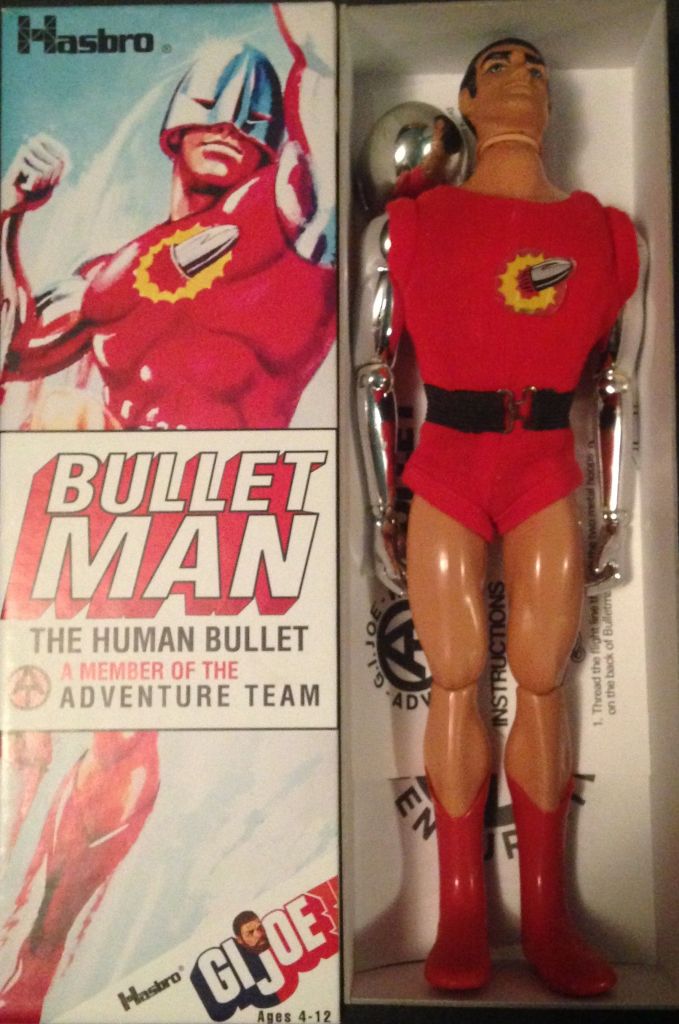
Since Fawcett got out of the comic book business in 1953, Bulletman and Bulletgirl have fallen into obscurity. Like the rest of Fawcett’s back-catalogue, DC acquired the rights to the characters, and they’ve made sporadic appearances from the 1970s to today, usually in concert with Captain Marvel. And also in the 1970s, Hasbro released an unrelated Bulletman action figure as a part of their G.I.Joe Adventure Team line, pushing that property more towards the super-heroic and away from military adventurism, which was out of fashion at that moment.


 The Tom Brevoort Experience
Those ads for the G.I.Joe Bulletman, the Human Bullet, really flooded comics for a while. DC should have given him a series to tie in with it… 🙂
LikeLike
Hey, I had a Bulletman doll! Or action figure, or whatever.
LikeLiked by 1 person
Love the concept that you can have a massive increase in body size but still con people into thinking you’re puny if you can just buy clothes big enough…
And y’know what? It IS funny how easy it was to design a gravity-regulator helmet!
LikeLiked by 1 person
Really swell
LikeLike
So THIS is what it’s like when WordPress wants us to login to WordPress before you type your missive. It sends the first two words and you look like an idiot.
LikeLiked by 1 person
Many of us have had similar goofs.
LikeLike
Bulletman didn’t really hit his stride until Bulletgirl was introduced to the strip. Their partnership really did stand out…
LikeLike