

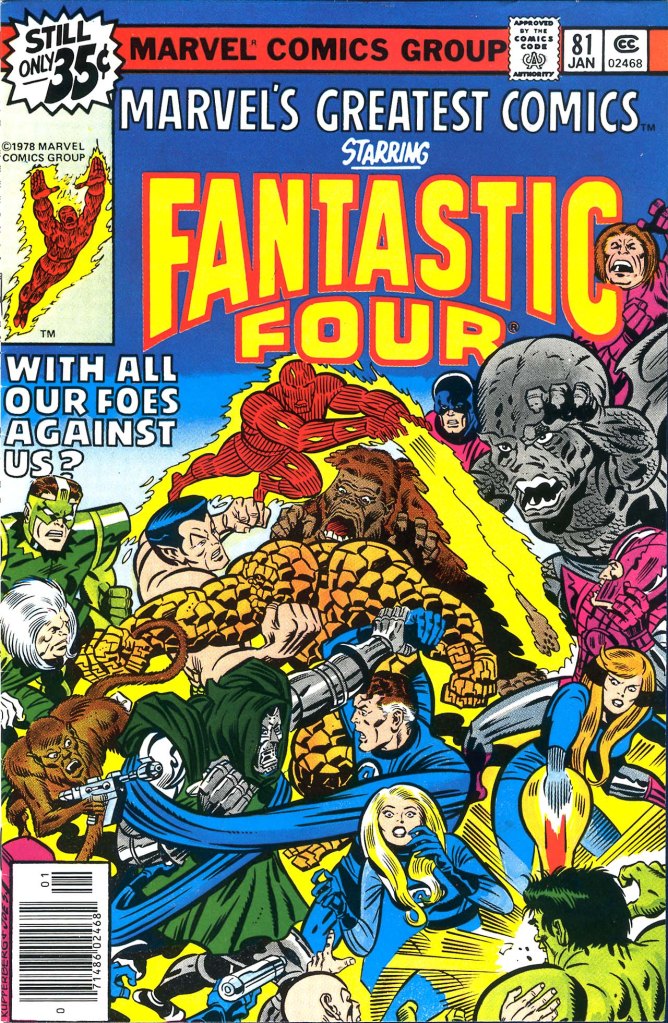
I had been waiting for this issue of MARVEL’S GREATEST COMICS for a good long while. Having the Olshevsky OFFICIAL MARVEL INDEX TO THE FANTASTIC FOUR, I knew that this next book would be reprinting FANTASTIC FOUR #100. And that was of special interest to me for one reason: due to nothing more than it being the centennial issue, the back issue price of the original comic had experienced a mark-up. While a typical issue from this period could be easily had for $1.25 or thereabouts, FANTASTIC FOUR #100 was typically priced closer to $6.00. I had drawn an arbitrary line in the sand that I would never pay more than $4.99 for any single issue of a comic book (a threshold that I eventually passed for a copy of UNCANNY X-MEN #115, which I paid five bucks for. These days, my maximum expenditure for a single book is $1400.00) So without this reprint, I might never get a change to read the story inside.
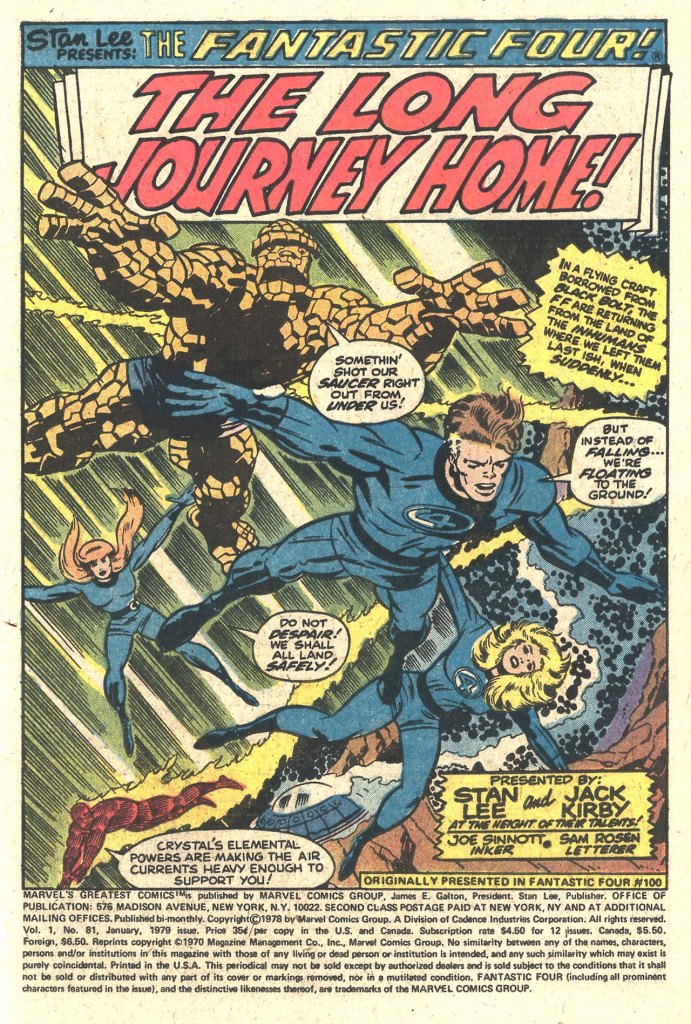
And that story was entertaining enough, though it was far from Stan Lee and Jack Kirby’s best. This was right at the tail end of their partnership, and Kirby was eyebaling the door, waiting for the particulars of his new deal with DC/National’s publisher Carmine Infantino to crystalize. Consequently, while he continued to give his all to the artwork, Kirby was holding back on creating any new characters and concepts, and he’d begun to insist that Lee do more of the plotting if he was going to be credited equally. Supposedly this story started out as something that was going to be featured in FANTASTIC FOUR ANNUAL #7 before it was decided to switch the Annuals to an all-reprint format. Consequently, there was a lot of incident to cram into this issue, even if the plot was relatively thin, and so Kirby had to pack more panels onto most of his pages than he’d typically do to get it all in.
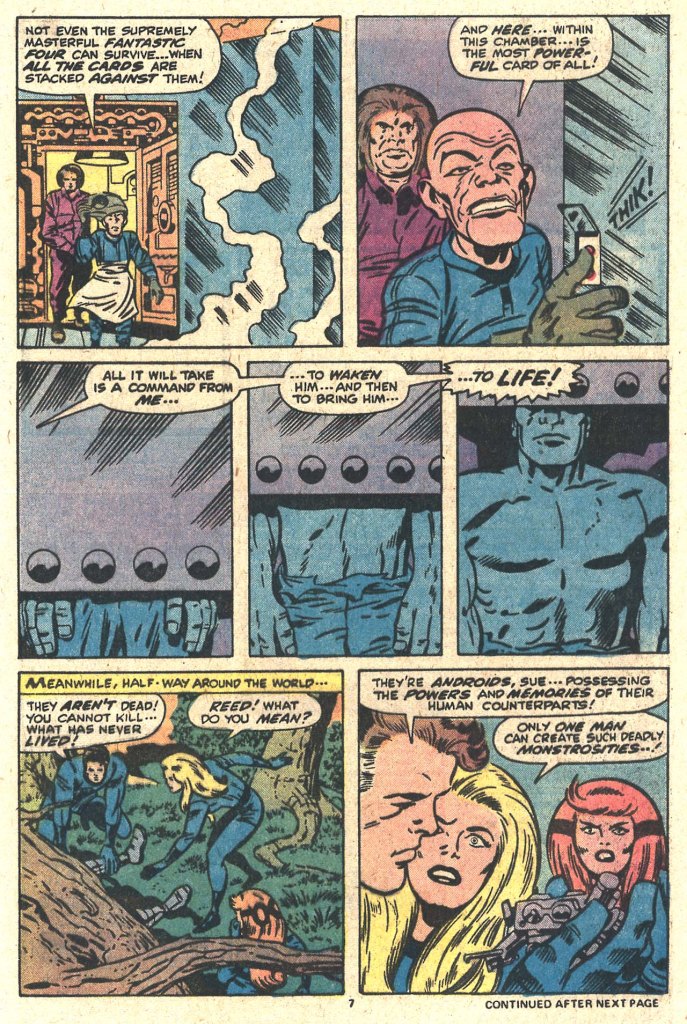
The conceit of the story is that while traveling back to their Baxter Building Headquarters from the Inhumans’ Great Refuge, the Fantastic Four are attacked by all of their old former foes at once. This is the work of the Mad Thinker and the Puppet Master, who have crafted lifelike robots of all of the required villains–leaving in reserve only an android of the Incredible Hulk, whom they worry is too dangerous to unleash. Either Kirby or Lee or both forget here that the Thinker is the android-maker while the Puppet Master’s specialty is controlling folks through his radioactive clay figures. Consequently, the story pushes the Puppet Master to the fore as the creators of these androids, even though that makes little sense for the character.
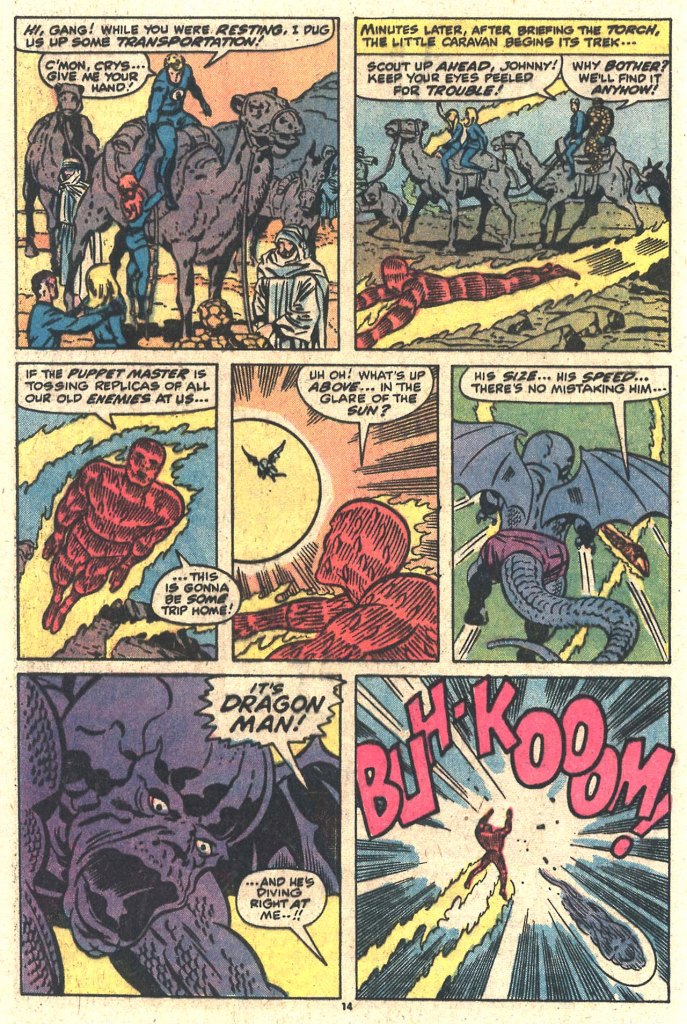
In any event, the story is structured like a Road picture, with the Fantastic Four (really five since Crystal is with them) journeying across the globe towards home while being jumped by androids of all of their old enemies in waves. It’s a story concept that sounds really exciting to a kid–who wouldn’t want to see the FF take on all of their old villains at one time? But as an actual story, it’s a bit thin and repetitive. The entire issue is simply the FF make a bit of forward progress, a couple more villain androids crop up, the FF fights the androids, trashing them in a relatively short time since there are so many more to get through. Rince and repeat. There’s also not a lot of characterization to the issue apart from a well-worn set of quips and broad character traits that have been honed over 100 releases.
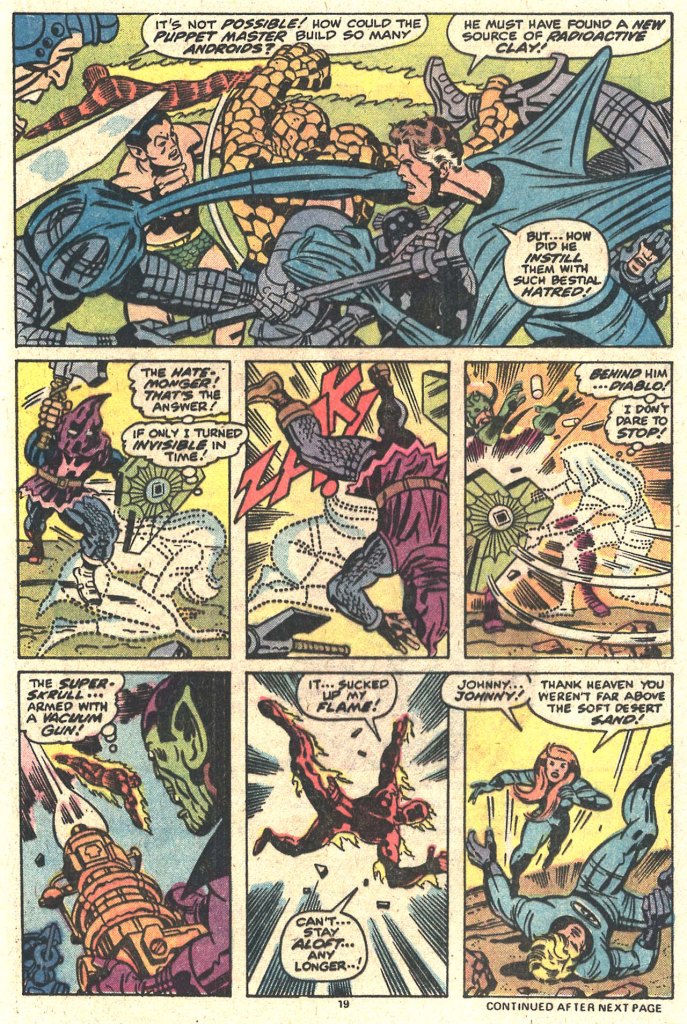
Those fight sequences are also not what they might have been had Kirby had more space to work with. The Annual-sized version of this story would have had at least a bunch more visual panache to it. But here, Jack is knocking out seven, eight and nine panel page after page, which means that any sense of spectacle and scale is lost amidst the carnage. Lee gamely tries to keep things energetic in the copy, but often he doesn’t have the room to do much more than to name the assorted villains who are at that moment attacking. (In the page above, I’m certain that Jack drew just a regular old Skrull, and Stan decided to call him the Super-Skrull, despite the fact that he uses a vacuum gun rather than any of the Super-Skrull’s mirror-FF powers.)
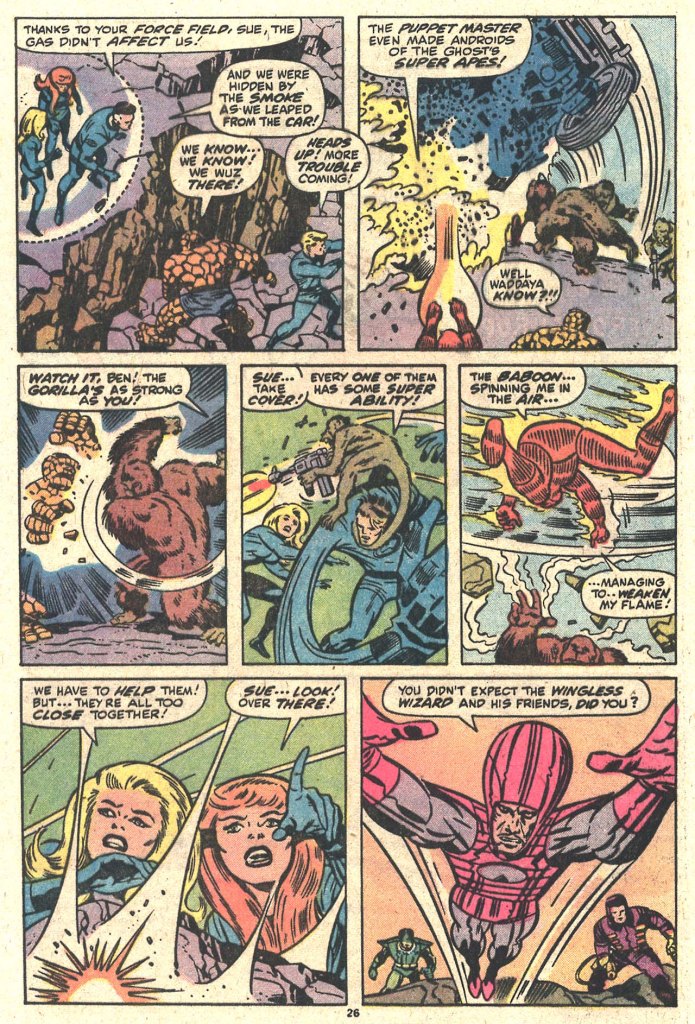
Still, this is Kirby and Lee, so there’s excitement and fun to be had, even if it’s all not quite as magnificent as the version you imagined in your mind. I know that, as a simple reader, I was totally engaged by this gauntlet of villains, and was interested in particular by ones such as the Hate-Monger, whose earlier stories I hadn’t yet read. The big superstar player in the adventure, though, is Crystal, whose ill-defined elemental powers and bravery save the team on more than one occasion. It’s as though Kirby and Lee are making an argument for keeping her around as a part of the main cast–the letters pages of this era debated hotly for a while about whether the series should now be retitled FANTASTIC FIVE. I’m guessing that the emphasis on Crystal was Kirby’s doing, since Lee writes her out again almost immediately once Jack has left the building. But it was stories like this one that made me like her as a character, and I still sort of regret that she wound up married to Quicksilver.
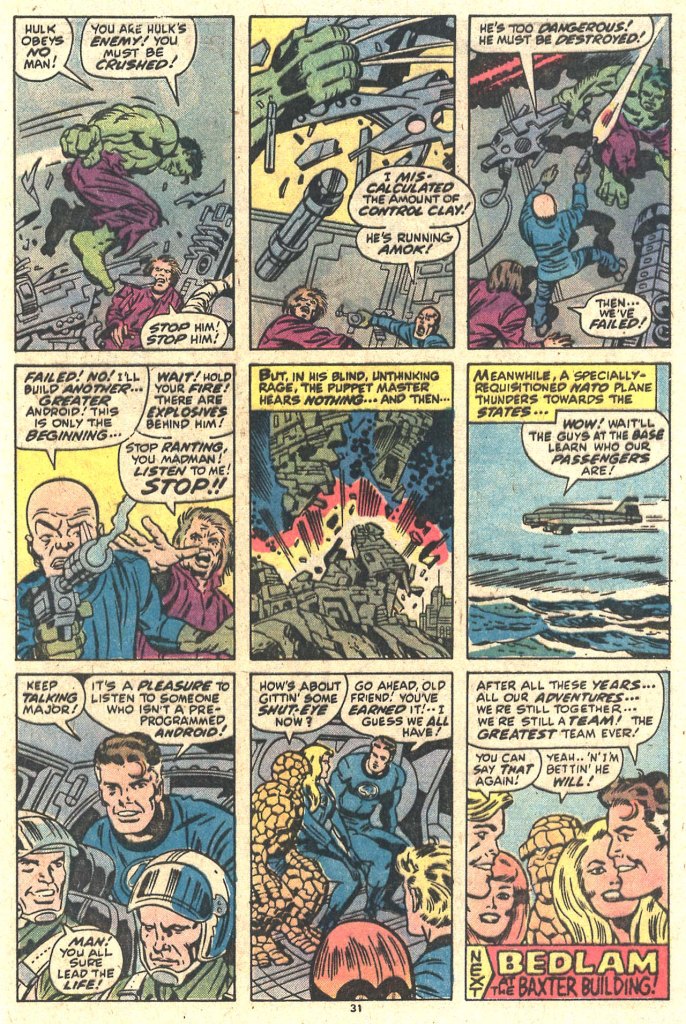
As the issue winds down towards its finale, with their army of androids steadily being depleted, the Thinker and the Puppet Master have little choice but to activate their Hulk-bot and send it off to kill the FF. But as they feared, the bestial Hulk, even in android form, proves too powerful to adequately control, and as the Puppet Master tries to halt the android’s deadly rampage, his shots wind up striking some nearby explosives and the entire base goes up in a ball of flame, ending the danger to the unknowing Fantastic four. Of course, there’s no chance that either the Thinker nor the Puppet Master is dead and gone for good–this has “temporary super-villain death” written all over it. In any event, the only outright acknowledgement of this having been the centennial issue comes from Reed right at the end, where he comments about how long the group has been together and how many adventures they’ve shared. As a centennial issue, it’s perfectly fine but nothing special. By that same token, the idea that a centennial issue was something to be commemorated was kind of a new idea in the first place, so on that level the story did have a certain specialness to it.
 The Tom Brevoort Experience
I bought a copy of this for my brother, back when Silver Age stuff was still affordable to a teenager. Hid it in a section of my own comics where I knew he’d never look … and promptly forgot where it was. I think it was more than a year before I came across it.
I have the same problem with TO Morrow you point out with the Puppet Master. Because he created Red Tornado a number of 21st century stories treat him primarily as an android master rather than a man using futuristic technology of all kinds.
LikeLike
This issue was where I first read this story too. It’s always felt off to me as well. story and art wise. The story pacing is frenetic and it’s hard to believe those are Joe Sinnott inks.
LikeLike
It’s been a while since I looked at FF 100, but I’m sure some of the art shown here has been retouched from the original printing. Maybe they didn’t have good stats.
LikeLike
On the cover, regarding Sue, there is a patch of blue on her right side. Is that supposed to be Reed or am I just looking at it wrong?
LikeLike
That’ll be Reed’s leg. It’s a bit more obvious on the original cover, where those force-blasts aren’t blanking out quite so much of Sue’s figure.
LikeLiked by 1 person
Looking at the original art, I think that might be SUE’S leg. Maybe?

LikeLiked by 1 person
The argument that FF 100 was originally slated to be an extra-long story that was shoehorned into the usual 20-page format at the last minute has circulated for a while. For comparison, here’s a hasty panel count of FF 100 and the surrounding issues:
FF 99: 93 panels (and a nice full-page splash on page 11)
FF 100: 135 panels
FF 101: 112 panels
Hence, the argument seems to be supported by the evidence.
FF 100 was also the first issue of the run where pages 12 and 13 were half story, half ads, so Jack, after the initial splash page, fit the remaining 134 panels into essentially 18 pages of space.
By the way, the title lettering on page 1 looks more like Joe Rosen’s work than Sam’s, to my eyes. I know the Rosen brothers had split the workload on stories before (Avengers Annual #2, for instance), and (according to the Distinguished Competition’s letterer supreme, Todd Klein) had shared living quarters for a number of years.
LikeLike
Tom, first time I read what you had written here I should have don’t have done a better job of checking to see if this issue ( the original printing ) was the only time the Puppet Master ever created robots cause I must have on a subconscious level remembered seeing this issue when I was checking out comics.org/strange tales [ Strange Tales#133 ( June 1965 ) Human Torch & The Thing – “The Terrible Toys!” — The Puppet Master BUILDS ROBOTIC “statutes” he can control, and undergoes plastic surgery so no one will recognize him. Ice Queen ( robot — seen on the cover ) — by Stan Lee ( Plot, Dialogue ), Bob Powell ( Plot-Pencils ) & Mike Esposito ( inks )] — Maybe the Puppet Master learned how to make robots from the Thinker?
LikeLike
Hey Tom, looks like in his first appearance [ Fantastic Four#8 ( November 1962 ) ] the Puppet Master created 2 Robots ( A 8 to 10 foot tall robot looking robot on pages 15-16 and a winged horse on page 16 that he flew away on — both he called Puppets and said he mentally controlled ( without any head gear like Professor Zog with Electro or Professor Mendel Stromm and his 2 robots [ The Amazing Spider-Man#37 ( June 1966 ) ] or Dr. Marla Madison’s psycho-cybernetic helmet used to control her Spider-Slayer Mark V [ The Amazing Spider-Man#167 ( January 1977 ) worn by J. Jonah Jameson ] ) ).
LikeLike